Overview
The reaction quotient (Q) is a fundamental concept in General Chemistry that serves as a predictive tool for understanding chemical equilibrium. While the equilibrium constant (K) describes a system at equilibrium, the reaction quotient describes a system at any point in time, whether at equilibrium or not. This distinction makes Q an invaluable diagnostic parameter that allows chemists and students to determine the direction a reaction will proceed to reach equilibrium. For the MCAT, mastery of the reaction quotient is essential because it bridges thermodynamics, kinetics and equilibrium, and provides the foundation for understanding Le Châtelier's principle, electrochemistry, and biological buffer systems.
The reaction quotient MCAT questions frequently appear in both standalone questions and passage-based scenarios, particularly in contexts involving biological systems, acid-base chemistry, and electrochemical cells. Understanding Q enables students to predict whether a reaction will proceed forward (toward products), reverse (toward reactants), or remain at equilibrium. This predictive capability is crucial for analyzing experimental data, interpreting graphs showing concentration changes over time, and solving complex multi-step problems that integrate thermodynamics with equilibrium concepts.
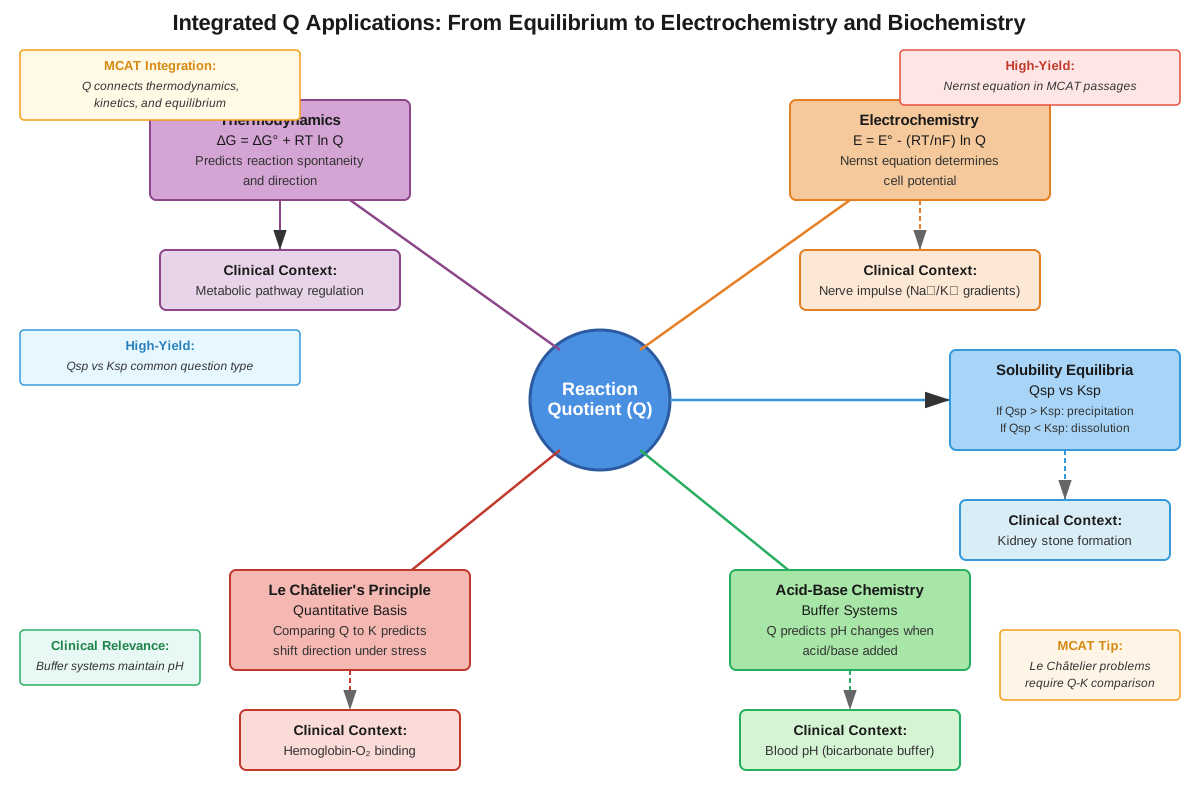
The relationship between the reaction quotient and other General Chemistry concepts is extensive. Q directly connects to Gibbs free energy (ΔG = ΔG° + RT ln Q), equilibrium constants (comparing Q to K), Le Châtelier's principle (understanding shifts in equilibrium), and electrochemistry (the Nernst equation). Additionally, the reaction quotient provides insight into solubility equilibria, acid-base equilibria, and complex ion formation—all high-yield topics for the MCAT. By mastering the reaction quotient, students develop a comprehensive framework for analyzing any reversible chemical process, making this topic a cornerstone of MCAT General Chemistry preparation.
Learning Objectives
- [ ] Define Reaction quotient using accurate General Chemistry terminology
- [ ] Explain why Reaction quotient matters for the MCAT
- [ ] Apply Reaction quotient to exam-style questions
- [ ] Identify common mistakes related to Reaction quotient
- [ ] Connect Reaction quotient to related General Chemistry concepts
- [ ] Calculate Q for homogeneous and heterogeneous equilibria given concentration or pressure data
- [ ] Predict the direction of reaction spontaneity by comparing Q to K under various conditions
- [ ] Integrate the reaction quotient with thermodynamic equations to solve multi-step problems
Prerequisites
- Equilibrium constant (K): Understanding K is essential because Q uses the same mathematical form but applies to non-equilibrium conditions
- Molarity and concentration units: Q calculations require accurate concentration values and unit conversions
- Stoichiometry and balanced chemical equations: The exponents in the Q expression come directly from stoichiometric coefficients
- Basic thermodynamics (ΔG, ΔG°): The relationship between Q and Gibbs free energy is frequently tested on the MCAT
- Le Châtelier's principle: Q provides the quantitative basis for predicting equilibrium shifts
- Gas laws and partial pressures: For gas-phase reactions, Q can be expressed using partial pressures
Why This Topic Matters
The reaction quotient appears regularly on the MCAT, with approximately 2-4 questions per exam directly or indirectly testing this concept. Questions may appear as standalone items in the Chemical and Physical Foundations of Biological Systems section or embedded within passages describing experimental procedures, biological systems, or industrial processes. The MCAT frequently tests the reaction quotient in contexts involving buffer systems, solubility equilibria, electrochemical cells, and metabolic pathways where reversible reactions are crucial.
Clinically and in real-world applications, the reaction quotient concept underlies numerous physiological processes. The oxygen-hemoglobin dissociation curve, for instance, represents an equilibrium system where Q changes with varying oxygen partial pressures in different tissues. Drug delivery systems, enzyme kinetics, and acid-base homeostasis all involve reversible reactions where understanding Q helps predict system behavior. In industrial chemistry, the Haber process for ammonia synthesis and the contact process for sulfuric acid production both rely on manipulating Q to maximize product yield.
Common MCAT passage scenarios include: experimental data showing concentration changes over time with questions asking whether the system has reached equilibrium; electrochemistry passages requiring use of the Nernst equation (which incorporates Q); solubility problems asking whether a precipitate will form; and biological passages describing metabolic pathways where students must predict reaction direction based on cellular concentrations. Recognizing these contexts and quickly identifying when to apply Q versus K is a critical exam skill that distinguishes high-scoring students.
Core Concepts
Definition and Mathematical Expression
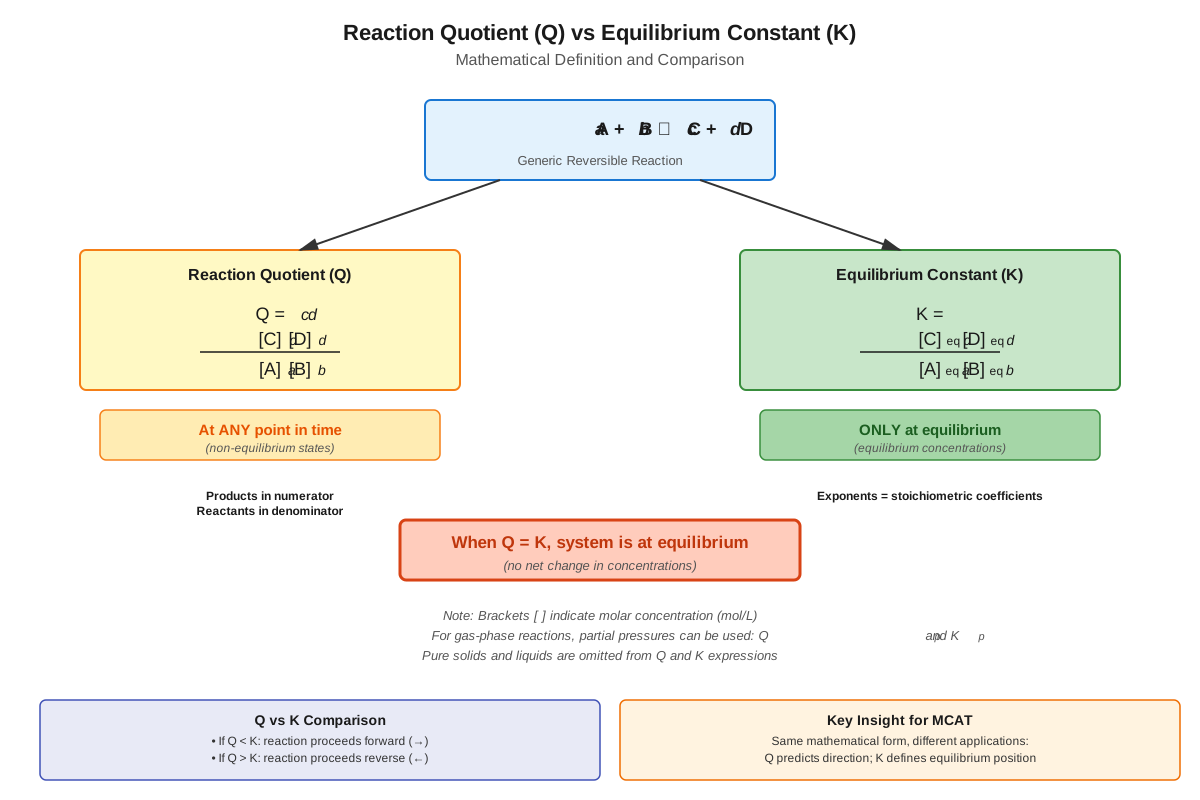
The reaction quotient (Q) is a dimensionless value calculated using the same mathematical form as the equilibrium constant but using the actual concentrations or partial pressures of reactants and products at any given moment, not necessarily at equilibrium. For a general reversible reaction:
aA + bB ⇌ cC + dDThe reaction quotient is expressed as:
Q = [C]^c[D]^d / [A]^a[B]^bWhere the brackets [ ] denote molar concentrations (mol/L), and the lowercase letters represent stoichiometric coefficients. For gas-phase reactions, Q can also be expressed using partial pressures (Qp):
Qp = (P_C)^c(P_D)^d / (P_A)^a(P_B)^bThe critical distinction between Q and K is temporal: K is calculated using equilibrium concentrations (constant at a given temperature), while Q is calculated using instantaneous concentrations that may change as the reaction proceeds toward equilibrium.
Comparing Q to K: Predicting Reaction Direction
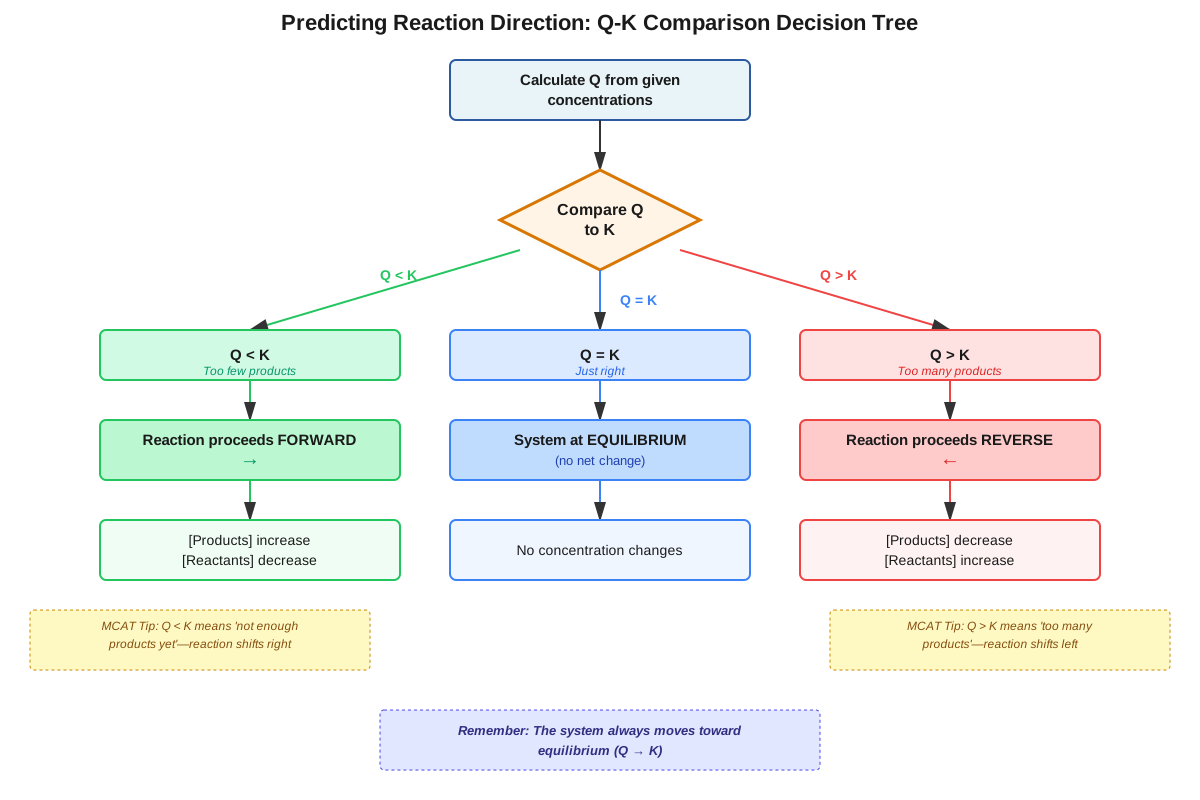
The power of the reaction quotient lies in its comparison to the equilibrium constant. This comparison reveals the direction a reaction must proceed to reach equilibrium:
| Relationship | Meaning | Reaction Direction |
|---|---|---|
| Q < K | Too few products relative to equilibrium | Forward (→) toward products |
| Q = K | System is at equilibrium | No net change |
| Q > K | Too many products relative to equilibrium | Reverse (←) toward reactants |
This relationship is fundamental to MCAT problem-solving. When Q < K, the numerator (products) is too small or the denominator (reactants) is too large compared to equilibrium values, so the reaction proceeds forward to increase products and decrease reactants. Conversely, when Q > K, the system has excess products and will shift in reverse to restore equilibrium proportions.
Heterogeneous Equilibria and Q
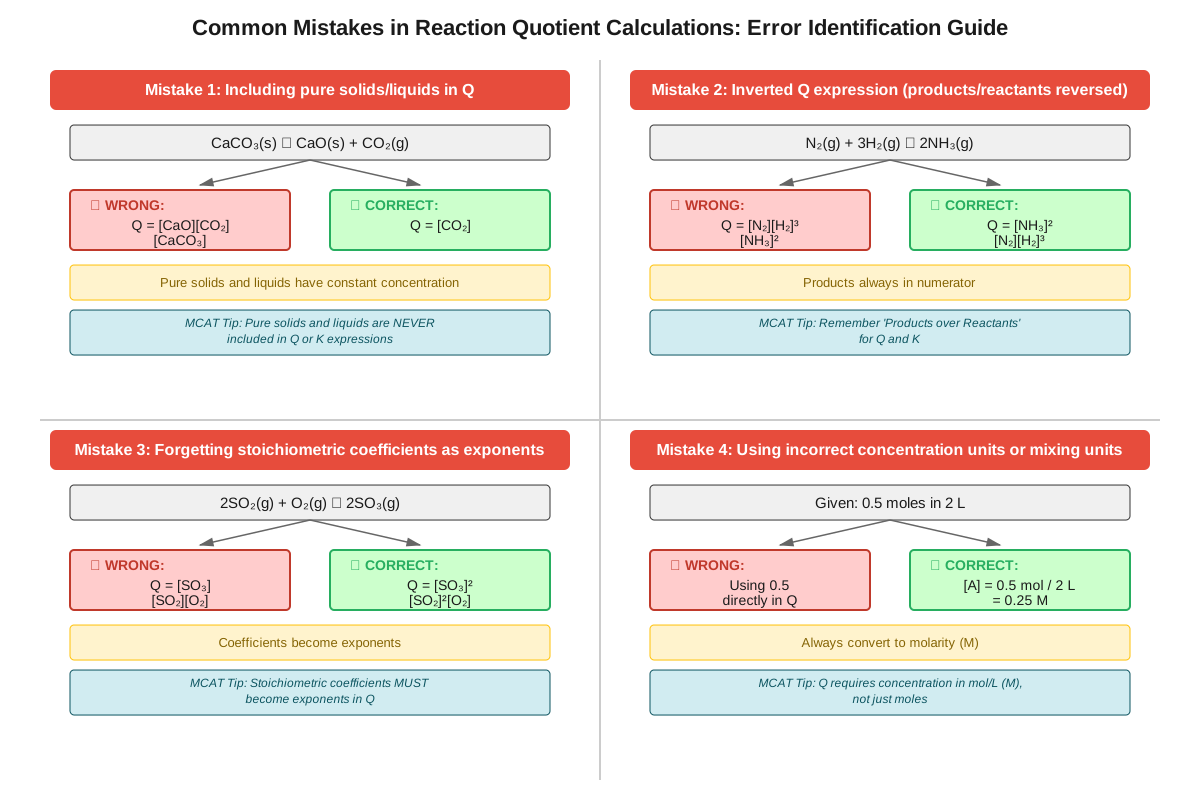
For heterogeneous equilibria involving pure solids or pure liquids, these substances are omitted from the Q expression because their activities are defined as 1 (their concentrations don't change appreciably during the reaction). For example:
CaCO₃(s) ⇌ CaO(s) + CO₂(g)The reaction quotient is:
Q = [CO₂]Only the gaseous CO₂ appears in the expression. This principle extends to solubility equilibria, where the solid salt is excluded. For example, for silver chloride dissolving:
AgCl(s) ⇌ Ag⁺(aq) + Cl⁻(aq)The reaction quotient (often called the ion product, Qsp, in this context) is:
Qsp = [Ag⁺][Cl⁻]Comparing Qsp to Ksp (the solubility product constant) predicts whether precipitation will occur (Qsp > Ksp), dissolution will continue (Qsp < Ksp), or the solution is saturated (Qsp = Ksp).
Relationship to Gibbs Free Energy
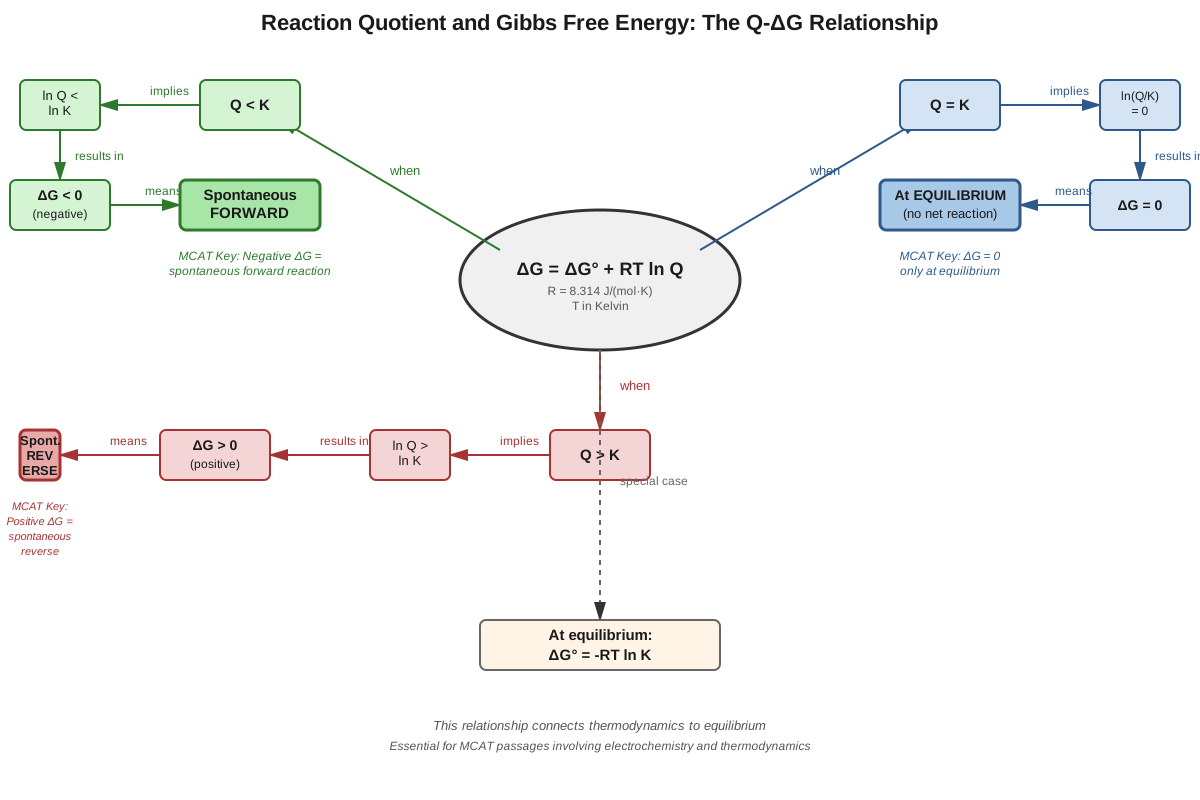
The reaction quotient directly connects to thermodynamics through the Gibbs free energy equation:
ΔG = ΔG° + RT ln QWhere:
- ΔG = Gibbs free energy change under non-standard conditions
- ΔG° = standard Gibbs free energy change
- R = universal gas constant (8.314 J/mol·K)
- T = temperature in Kelvin
- Q = reaction quotient
At equilibrium, ΔG = 0 and Q = K, which yields the important relationship:
ΔG° = -RT ln KThis connection allows students to predict reaction spontaneity: when Q < K, ΔG < 0 (spontaneous forward); when Q > K, ΔG > 0 (non-spontaneous forward, spontaneous reverse); when Q = K, ΔG = 0 (equilibrium). This thermodynamic perspective is frequently tested on the MCAT, particularly in passages integrating multiple chemistry concepts.
Application to Electrochemistry
In electrochemistry, the reaction quotient appears in the Nernst equation, which relates cell potential to concentration:
E = E° - (RT/nF) ln QOr at 25°C (298 K):
E = E° - (0.0592/n) log QWhere:
- E = cell potential under non-standard conditions
- E° = standard cell potential
- n = number of electrons transferred
- F = Faraday's constant
- Q = reaction quotient for the cell reaction
This application demonstrates how Q predicts the voltage of electrochemical cells under varying concentration conditions, a common MCAT scenario involving batteries, concentration cells, or biological electron transport chains.
Dynamic Nature and Time Evolution
Unlike K, which remains constant at a given temperature, Q changes continuously as a reaction proceeds toward equilibrium. Initially, when only reactants are present, Q = 0 (no products in the numerator). As the reaction proceeds forward, Q increases. If Q overshoots K (perhaps due to adding excess products), Q > K and the reaction reverses. Eventually, Q approaches K asymptotically, and when Q = K, the system reaches dynamic equilibrium where forward and reverse reaction rates are equal.
This dynamic perspective helps students understand concentration-time graphs commonly shown in MCAT passages. Recognizing that Q is changing while K remains fixed provides insight into why reactions shift and how external perturbations (adding reactants/products, changing volume, changing temperature) affect system behavior.
Concept Relationships
The reaction quotient serves as a central hub connecting multiple General Chemistry concepts. Q directly derives from the equilibrium constant K, using identical mathematical form but different concentration values. Understanding this relationship is foundational: K represents the target ratio that Q approaches as a reaction proceeds toward equilibrium.
Q connects to Le Châtelier's principle by providing quantitative predictions for qualitative shifts. When a stress is applied (adding reactants, removing products, changing pressure), Q changes instantaneously, creating a Q ≠ K situation that drives the system to re-establish equilibrium. For example, adding reactants decreases Q (larger denominator), making Q < K and driving the forward reaction—exactly what Le Châtelier's principle predicts qualitatively.
Thermodynamically, Q links to Gibbs free energy through ΔG = ΔG° + RT ln Q. This relationship bridges kinetics and equilibrium with thermodynamics, allowing students to predict spontaneity based on concentration conditions. When Q < K, ln Q < ln K, making ΔG negative and the forward reaction spontaneous.
In electrochemistry, Q appears in the Nernst equation, connecting equilibrium concepts to redox reactions and cell potentials. The Nernst equation essentially translates the ΔG equation into electrical terms, showing how concentration changes affect voltage.
For solubility equilibria, Q becomes Qsp (ion product), which compares to Ksp to predict precipitation. This specialized application demonstrates how the general Q concept adapts to specific equilibrium types.
Relationship map: Balanced equation → Stoichiometric coefficients → Q expression → Compare Q to K → Predict reaction direction → Apply to ΔG equation → Determine spontaneity → Connect to Nernst equation (for redox) → Predict cell potential
High-Yield Facts
⭐ Q uses the same mathematical form as K but with instantaneous (non-equilibrium) concentrations
⭐ When Q < K, the reaction proceeds forward toward products; when Q > K, the reaction proceeds reverse toward reactants
⭐ When Q = K, the system is at equilibrium and no net reaction occurs
⭐ Pure solids and pure liquids are omitted from Q expressions (their activity = 1)
⭐ The relationship ΔG = ΔG° + RT ln Q connects Q to thermodynamic spontaneity
- For gas-phase reactions, Q can be expressed using partial pressures (Qp) instead of concentrations
- At equilibrium, Q = K and ΔG = 0, leading to ΔG° = -RT ln K
- The Nernst equation (E = E° - (RT/nF) ln Q) incorporates Q to predict cell potentials under non-standard conditions
- For solubility equilibria, Q is called the ion product (Qsp) and compares to Ksp to predict precipitation
- Q = 0 when only reactants are present initially (no products yet formed)
- Temperature changes affect K but not the form of the Q expression; however, changing T changes K, which affects the Q vs. K comparison
- In biological systems, Q is rarely equal to K; metabolic reactions are typically driven far from equilibrium by coupling to ATP hydrolysis
Quick check — test yourself on Reaction quotient so far.
Try Flashcards →Common Misconceptions
Misconception: Q and K are the same thing and can be used interchangeably.
Correction: Q and K have the same mathematical form but fundamentally different meanings. K uses equilibrium concentrations and is constant at a given temperature. Q uses instantaneous concentrations and changes as the reaction proceeds. Q = K only at equilibrium.
Misconception: When Q > K, the reaction is "more favorable" or "has a larger equilibrium constant."
Correction: When Q > K, the system has too many products relative to equilibrium, so the reaction proceeds in reverse (toward reactants) to decrease Q until Q = K. The equilibrium constant K doesn't change; only Q changes as the reaction shifts.
Misconception: Pure solids and liquids should be included in Q calculations using their molar masses or densities.
Correction: Pure solids and pure liquids are omitted entirely from Q expressions because their activities are defined as 1. Their concentrations don't change appreciably during the reaction, so they don't affect the equilibrium position.
Misconception: If Q < K, the reaction will go to completion (100% products).
Correction: Q < K means the reaction proceeds forward, but it will stop when Q = K, not when all reactants are consumed. Most reactions reach equilibrium with both reactants and products present. Only reactions with very large K values (K >> 1) approach completion.
Misconception: Changing the volume of a reaction container changes K.
Correction: Changing volume changes the concentrations of gases, which changes Q, but K remains constant at constant temperature. The Q ≠ K situation created by the volume change drives the system to re-establish equilibrium, but the target K value hasn't changed.
Misconception: The reaction quotient only applies to chemical reactions, not to physical processes.
Correction: Q applies to any reversible process at equilibrium, including phase changes (vapor pressure equilibria), dissolution (solubility equilibria), and binding equilibria (like oxygen binding to hemoglobin). The concept is universal for reversible processes.
Misconception: In the Nernst equation, a larger Q always means a larger cell potential E.
Correction: In the Nernst equation E = E° - (RT/nF) ln Q, a larger Q decreases E (note the negative sign). This makes sense: as products accumulate (increasing Q), the driving force for the forward reaction decreases, reducing the cell potential.
Worked Examples
Example 1: Predicting Reaction Direction
Problem: Consider the reaction at 500 K:
N₂(g) + 3H₂(g) ⇌ 2NH₃(g) K = 0.50A reaction vessel contains 0.20 M N₂, 0.30 M H₂, and 0.10 M NH₃. Determine the direction the reaction will proceed.
Solution:
Step 1: Write the expression for Q using the given concentrations.
Q = [NH₃]² / ([N₂][H₂]³)Step 2: Substitute the given concentrations.
Q = (0.10)² / ((0.20)(0.30)³)
Q = 0.010 / ((0.20)(0.027))
Q = 0.010 / 0.0054
Q = 1.85
Step 3: Compare Q to K.
Q = 1.85 and K = 0.50, so Q > K
Step 4: Interpret the result.
Since Q > K, the system has too many products (NH₃) relative to equilibrium. The reaction will proceed in the reverse direction (toward reactants), consuming NH₃ and producing N₂ and H₂ until Q decreases to equal K.
Connection to learning objectives: This problem demonstrates how to calculate Q, compare it to K, and predict reaction direction—core skills for MCAT questions on kinetics and equilibrium.
Example 2: Solubility and Precipitation
Problem: A solution contains 1.0 × 10⁻⁴ M Ag⁺ and 2.0 × 10⁻⁴ M Cl⁻. Will AgCl precipitate? (Ksp for AgCl = 1.8 × 10⁻¹⁰)
Solution:
Step 1: Write the dissolution equilibrium and the expression for Qsp.
AgCl(s) ⇌ Ag⁺(aq) + Cl⁻(aq)Qsp = [Ag⁺][Cl⁻]Note: The solid AgCl is omitted from the expression.
Step 2: Calculate Qsp using the given ion concentrations.
Qsp = (1.0 × 10⁻⁴)(2.0 × 10⁻⁴)
Qsp = 2.0 × 10⁻⁸
Step 3: Compare Qsp to Ksp.
Qsp = 2.0 × 10⁻⁸ and Ksp = 1.8 × 10⁻¹⁰
Qsp > Ksp (by more than 100-fold)
Step 4: Interpret the result.
Since Qsp > Ksp, the solution contains more dissolved ions than equilibrium allows. The system will shift in reverse (toward the solid), meaning AgCl will precipitate until the ion concentrations decrease enough that Qsp = Ksp.
Connection to learning objectives: This example shows how Q (as Qsp) applies to heterogeneous equilibria and connects to solubility, a common MCAT topic. Recognizing when to omit solids from the expression is a key skill.
Example 3: Thermodynamic Integration
Problem: For a reaction at 298 K with ΔG° = +15 kJ/mol and K = 0.0025, calculate ΔG when Q = 0.10. Is the reaction spontaneous under these conditions?
Solution:
Step 1: Use the Gibbs free energy equation.
ΔG = ΔG° + RT ln QStep 2: Convert ΔG° to J/mol and substitute values.
ΔG° = 15,000 J/mol
R = 8.314 J/(mol·K)
T = 298 K
Q = 0.10
ΔG = 15,000 + (8.314)(298) ln(0.10)
ΔG = 15,000 + (2478) ln(0.10)
ΔG = 15,000 + (2478)(-2.303)
ΔG = 15,000 - 5707
ΔG = +9,293 J/mol ≈ +9.3 kJ/mol
Step 3: Interpret the result.
Since ΔG is positive (+9.3 kJ/mol), the forward reaction is non-spontaneous under these conditions. The reverse reaction is spontaneous.
Step 4: Verify using Q vs. K comparison.
Q = 0.10 and K = 0.0025, so Q > K
This confirms the reaction should proceed in reverse, consistent with the positive ΔG.
Connection to learning objectives: This problem integrates Q with thermodynamics, demonstrating how multiple concepts connect. MCAT passages often require this type of multi-step reasoning across topics.
Exam Strategy
When approaching MCAT questions on the reaction quotient, first identify whether the system is at equilibrium or not. Trigger phrases include: "initially," "at time zero," "before equilibrium," "after adding," or "will the reaction proceed." These signal that Q ≠ K and you need to calculate or reason about Q.
Step-by-step approach:
- Write the balanced equation if not provided
- Identify what's given: concentrations, pressures, or qualitative information
- Write the Q expression using stoichiometric coefficients as exponents
- Calculate Q (or determine qualitatively if it increased/decreased)
- Compare Q to K (given or calculable from ΔG°)
- Predict direction: Q < K → forward; Q > K → reverse; Q = K → equilibrium
- Connect to the question: Does it ask about spontaneity, direction, ΔG, or cell potential?
Process of elimination tips:
- Eliminate answer choices that confuse Q with K (e.g., "Q is constant at constant temperature")
- Eliminate choices that reverse the Q < K and Q > K predictions
- Watch for answers that incorrectly include solids/liquids in Q expressions
- Be suspicious of choices claiming reactions "go to completion" unless K is extremely large
Time allocation: Most Q problems require 60-90 seconds. If a calculation seems excessively complex, look for a qualitative approach or check if the question asks for direction rather than an exact value. Many MCAT questions test conceptual understanding rather than computational skill.
Common question types:
- Predict direction: Given concentrations and K, which way will the reaction proceed?
- Precipitation: Will a solid form given ion concentrations and Ksp?
- Electrochemistry: How does changing concentration affect cell potential?
- Thermodynamics: Calculate ΔG given Q and ΔG° or K
- Graphical: Interpret concentration vs. time graphs to identify when Q = K
Exam Tip: If a passage describes adding a substance or changing conditions, immediately think "Q just changed." This triggers the Q vs. K comparison and predicts the system's response.
Memory Techniques
Mnemonic for Q vs. K comparison: "Less Favors Forward"
- When Q is Less than K, the reaction Favors moving Forward
- When Q is greater than K, think "Greater Goes Back" (reverse)
Visualization strategy: Picture Q and K as two targets on a number line. Q is a moving arrow that's trying to hit the K target. If Q is to the left of K (Q < K), the arrow moves right (forward reaction). If Q is to the right of K (Q > K), the arrow moves left (reverse reaction). When Q hits K, the arrow stops moving (equilibrium).
Acronym for Q expression construction: "Products Powered, Reactants Rooted"
- Products go on top (numerator), raised to their stoichiometric Powers
- Reactants go on bottom (denominator, the Root), also raised to powers
Thermodynamic connection mnemonic: "Q Less, G Negative, Go!"
- When Q is Less than K, G (ΔG) is Negative, so the reaction will Go forward
For solubility: "Solid Stays Out"
- The Solid always Stays Out of the Q (or K) expression
Nernst equation sign: Remember "Q Up, E Down"
- When Q goes Up (more products), E goes Down (less driving force)
- The negative sign in E = E° - (RT/nF) ln Q makes this relationship inverse
Summary
The reaction quotient (Q) is a critical tool in General Chemistry that predicts the direction a reversible reaction will proceed to reach equilibrium. Using the same mathematical form as the equilibrium constant K but with instantaneous concentrations, Q provides a snapshot of a system's current state. By comparing Q to K, students can determine whether a reaction will proceed forward (Q < K), reverse (Q > K), or is at equilibrium (Q = K). This concept extends beyond simple chemical reactions to solubility equilibria (Qsp vs. Ksp), electrochemistry (Nernst equation), and thermodynamics (ΔG = ΔG° + RT ln Q). For the MCAT, mastering Q means understanding not just the calculations but the conceptual framework that connects equilibrium, spontaneity, and reaction direction. The ability to quickly assess Q vs. K and predict system behavior is essential for success on kinetics and equilibrium questions, which frequently appear in both standalone items and complex passages integrating multiple chemistry concepts.
Key Takeaways
- The reaction quotient Q uses instantaneous concentrations while the equilibrium constant K uses equilibrium concentrations; they share the same mathematical form
- Comparing Q to K predicts reaction direction: Q < K means forward, Q > K means reverse, Q = K means equilibrium
- Pure solids and pure liquids are always omitted from Q expressions because their activities equal 1
- The thermodynamic relationship ΔG = ΔG° + RT ln Q connects Q to spontaneity and allows prediction of whether a reaction will proceed
- Q appears in the Nernst equation for electrochemistry, showing how concentration affects cell potential
- For solubility equilibria, Q becomes Qsp (ion product) and compares to Ksp to predict precipitation
- Q changes continuously as a reaction proceeds toward equilibrium, while K remains constant at constant temperature
Related Topics
Le Châtelier's Principle: Understanding Q provides the quantitative foundation for Le Châtelier's qualitative predictions about equilibrium shifts. When a stress is applied, Q changes, creating a Q ≠ K situation that drives the system to re-establish equilibrium.
Acid-Base Equilibria: The reaction quotient applies to weak acid and base dissociation, buffer systems, and titrations. Comparing Q to Ka or Kb helps predict proton transfer direction and buffer capacity.
Electrochemistry and the Nernst Equation: The Nernst equation incorporates Q to calculate cell potentials under non-standard conditions, connecting equilibrium concepts to redox reactions and biological electron transport.
Chemical Thermodynamics: The relationship between Q, K, ΔG, and ΔG° integrates equilibrium with energy considerations, enabling prediction of spontaneity and calculation of equilibrium constants from thermodynamic data.
Solubility Equilibria: Applying Q as the ion product (Qsp) and comparing to Ksp predicts precipitation and dissolution, essential for understanding kidney stone formation, drug solubility, and analytical chemistry.
Mastering the reaction quotient creates a strong foundation for these advanced topics and enables integration of multiple General Chemistry concepts—a key skill for MCAT success.
Practice CTA
Now that you've mastered the reaction quotient concept, it's time to solidify your understanding through active practice. Attempt the practice questions and flashcards designed specifically for this topic. Focus on problems that require you to calculate Q, compare it to K, and predict reaction direction—these skills appear repeatedly on the MCAT. Remember, understanding the concept is just the first step; applying it under timed conditions is what translates knowledge into points on test day. You've built a strong foundation in kinetics and equilibrium—now demonstrate your mastery through deliberate practice!
Sign up free to keep reading
Create a free AnvayaPrep account to finish this MCAT guide on Reaction quotient — plus flashcards and practice questions.