Overview
Entropy is a fundamental concept in Thermodynamics that quantifies the degree of disorder or randomness in a system. In General Chemistry, entropy serves as a critical bridge between microscopic molecular behavior and macroscopic thermodynamic properties, making it essential for understanding spontaneous processes, chemical equilibria, and energy transformations. The concept appears throughout the MCAT, particularly in questions involving reaction spontaneity, phase changes, and the Second Law of Thermodynamics.
For the MCAT, entropy represents more than just an abstract thermodynamic quantity—it provides the conceptual framework for predicting whether reactions will proceed spontaneously and understanding why certain processes occur naturally while others require energy input. Students must grasp both the qualitative aspects (recognizing when entropy increases or decreases) and quantitative applications (calculating entropy changes and using them to determine Gibbs free energy). The Entropy MCAT questions frequently appear in passage-based formats that integrate multiple thermodynamic concepts, requiring students to analyze experimental data, interpret graphs, and apply the relationship between entropy, enthalpy, and free energy.
Understanding entropy connects directly to other General Chemistry concepts including enthalpy, Gibbs free energy, equilibrium constants, and reaction kinetics. The interplay between entropy and enthalpy determines the spontaneity of reactions through the Gibbs free energy equation, while entropy considerations explain phenomena ranging from protein folding in biochemistry to the dissolution of salts in solution chemistry. Mastering entropy provides the foundation for understanding why biological systems maintain order, how heat engines operate, and why certain chemical transformations are thermodynamically favorable.
Learning Objectives
- [ ] Define Entropy using accurate General Chemistry terminology
- [ ] Explain why Entropy matters for the MCAT
- [ ] Apply Entropy to exam-style questions
- [ ] Identify common mistakes related to Entropy
- [ ] Connect Entropy to related General Chemistry concepts
- [ ] Calculate standard entropy changes for chemical reactions using tabulated values
- [ ] Predict the sign of entropy change for physical and chemical processes
- [ ] Integrate entropy with enthalpy to determine reaction spontaneity using Gibbs free energy
- [ ] Distinguish between system entropy, surroundings entropy, and universe entropy
Prerequisites
- First and Second Laws of Thermodynamics: Entropy is defined through the Second Law, which states that the entropy of the universe increases for spontaneous processes
- System vs. Surroundings: Understanding the distinction between system and surroundings is essential for calculating total entropy changes
- State Functions: Entropy is a state function, meaning its change depends only on initial and final states, not the path taken
- Heat and Temperature: Entropy changes are calculated using heat transfer and temperature, requiring comfort with these fundamental concepts
- Enthalpy: Entropy works alongside enthalpy in determining Gibbs free energy and reaction spontaneity
- Molecular Structure: Predicting entropy changes requires understanding molecular complexity, bonding, and phase states
Why This Topic Matters
Entropy appears in approximately 5-8% of MCAT Chemical and Physical Foundations questions, making it a medium-yield but essential topic. Questions typically appear in two formats: discrete questions testing conceptual understanding of entropy changes in specific processes, and passage-based questions requiring integration of entropy with other thermodynamic quantities to analyze experimental scenarios or biological systems.
In clinical and biological contexts, entropy explains crucial phenomena including protein folding (where hydrophobic effects are entropy-driven), membrane formation, drug binding, and metabolic pathway directionality. The human body constantly battles entropy by using energy from ATP hydrolysis to maintain cellular organization, making this concept fundamental to understanding biochemical energetics. Medical applications include understanding why certain drug formulations are stable, how cryopreservation works, and why some biochemical reactions require coupling to energetically favorable processes.
Common MCAT passage scenarios involving entropy include: analyzing phase diagrams and phase transitions, evaluating reaction spontaneity under different temperature conditions, interpreting calorimetry data to calculate thermodynamic quantities, and explaining the thermodynamic basis for biochemical processes like protein denaturation or micelle formation. The MCAT frequently tests whether students can predict entropy changes qualitatively (without calculation) and whether they understand the relationship between molecular-level disorder and macroscopic entropy values.
Core Concepts
Definition and Molecular Interpretation of Entropy
Entropy (S) is a thermodynamic state function that measures the number of possible microscopic arrangements (microstates) available to a system at a given macroscopic state. Mathematically, entropy relates to the number of microstates (W) through the Boltzmann equation:
S = k_B ln(W)where k_B is Boltzmann's constant. For practical MCAT purposes, entropy quantifies the degree of disorder, randomness, or dispersal of energy in a system. Higher entropy corresponds to greater disorder and more possible molecular arrangements.
At the molecular level, entropy increases when:
- Molecules have more freedom of movement
- Energy becomes more dispersed or spread out
- The number of particles increases
- Molecular complexity increases
- Temperature increases (molecules move faster with more possible energy states)
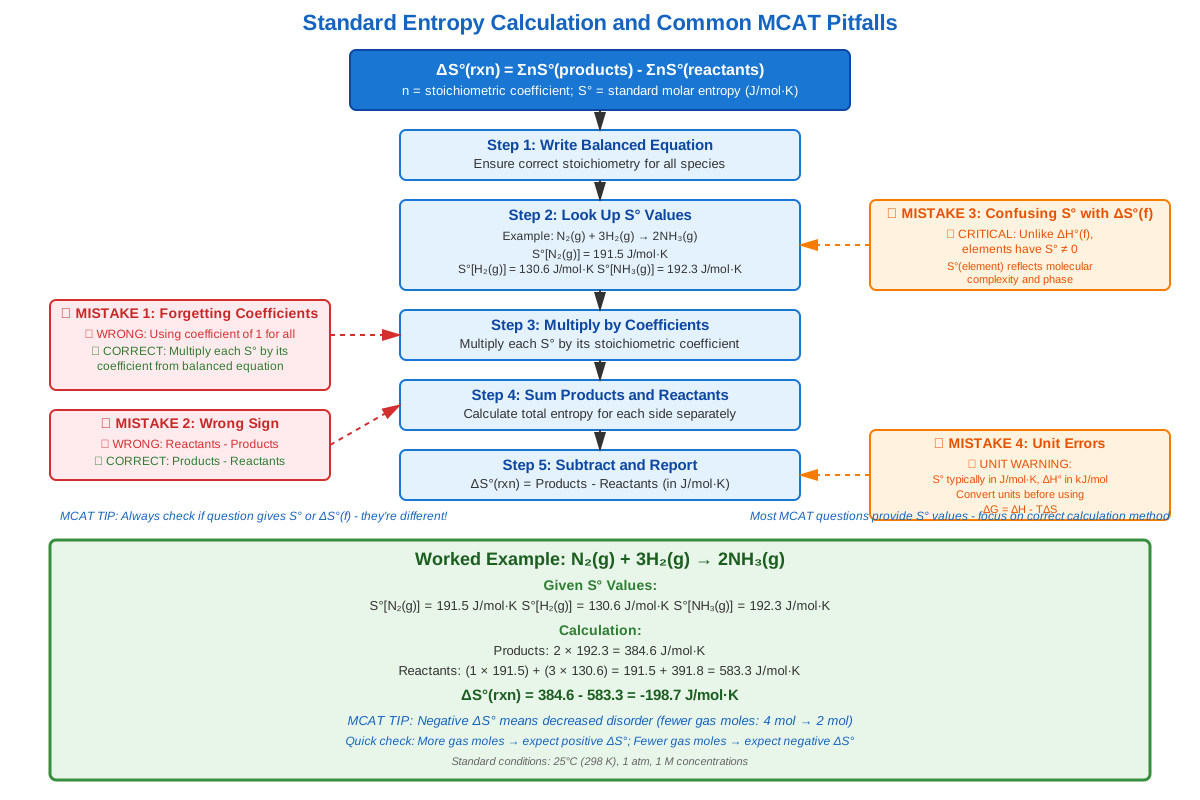
The standard molar entropy (S°) represents the entropy of one mole of a substance under standard conditions (298 K, 1 atm, 1 M concentration). Unlike standard enthalpy of formation, elements in their standard states have non-zero entropy values because molecular motion exists at temperatures above absolute zero.
The Second Law of Thermodynamics
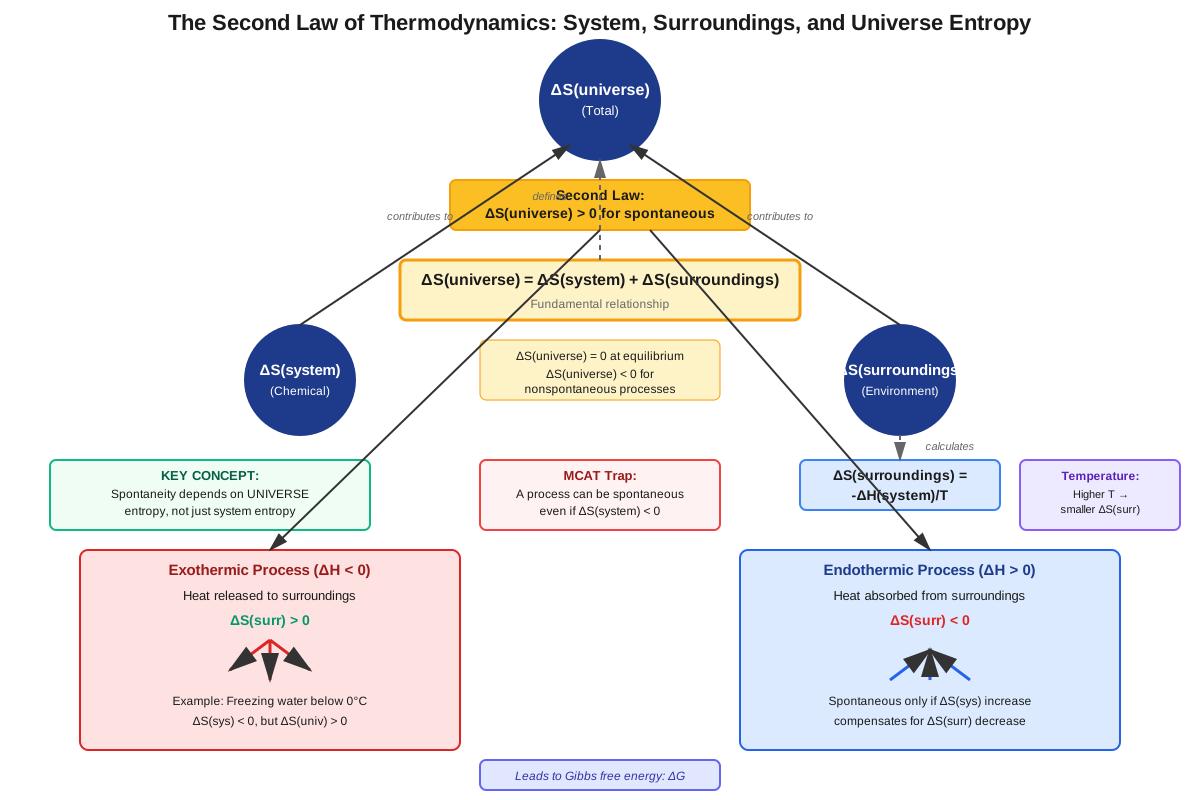
The Second Law of Thermodynamics states that the entropy of the universe increases for any spontaneous process:
ΔS_universe = ΔS_system + ΔS_surroundings > 0 (for spontaneous processes)This fundamental principle means that while a system's entropy can decrease (as in crystallization or protein folding), the total entropy change including the surroundings must be positive for the process to occur spontaneously. This law explains the directionality of natural processes and why certain transformations are irreversible.
For reversible processes (ideal, infinitely slow processes at equilibrium), ΔS_universe = 0. For irreversible processes (all real spontaneous processes), ΔS_universe > 0. This distinction is crucial for understanding why perpetual motion machines are impossible and why energy transformations always involve some energy dispersal as heat.
Calculating Entropy Changes
For chemical reactions, the standard entropy change (ΔS°_rxn) is calculated using:
ΔS°_rxn = Σ(n × S°_products) - Σ(n × S°_reactants)where n represents stoichiometric coefficients and S° values are tabulated standard molar entropies.
For phase transitions at constant temperature, entropy change is calculated as:
ΔS = q_rev / T = ΔH / Twhere q_rev is the heat transferred reversibly, T is the absolute temperature in Kelvin, and ΔH is the enthalpy change for the phase transition.
For temperature changes without phase transitions:
ΔS = n × C × ln(T_final / T_initial)where C is the heat capacity (C_p for constant pressure, C_v for constant volume).
Predicting Entropy Changes Qualitatively
The MCAT frequently tests the ability to predict whether ΔS is positive, negative, or approximately zero without calculation. Key principles include:
| Process | ΔS Sign | Explanation |
|---|---|---|
| Solid → Liquid → Gas | Positive (+) | Increasing molecular freedom and disorder |
| Gas → Liquid → Solid | Negative (−) | Decreasing molecular freedom and disorder |
| Dissolution of ionic solids | Usually Positive (+) | Ions dispersed in solution have more freedom than in crystal lattice |
| Increase in number of gas molecules | Positive (+) | More particles means more possible arrangements |
| Decrease in number of gas molecules | Negative (−) | Fewer particles means fewer possible arrangements |
| Mixing of substances | Positive (+) | Mixed state has more possible arrangements than separated |
| Temperature increase | Positive (+) | More kinetic energy means more accessible energy states |
For chemical reactions, focus on:
- Change in number of gas molecules: The most important factor for predicting ΔS_rxn
- Phase changes: Gas formation increases entropy significantly
- Molecular complexity: Breaking large molecules into smaller ones typically increases entropy
- Dissolution: Dissolving solids or liquids generally increases entropy
Entropy and Gibbs Free Energy
Entropy combines with enthalpy to determine reaction spontaneity through the Gibbs free energy equation:
ΔG = ΔH - TΔSwhere:
- ΔG < 0: spontaneous (thermodynamically favorable)
- ΔG = 0: at equilibrium
- ΔG > 0: non-spontaneous (thermodynamically unfavorable)
This relationship reveals that reactions can be spontaneous even if endothermic (ΔH > 0) if the entropy increase is sufficiently large, and reactions can be spontaneous even if entropy decreases (ΔS < 0) if the enthalpy decrease is sufficiently large. Temperature determines the relative importance of enthalpy versus entropy contributions.
The four possible combinations of ΔH and ΔS create different temperature dependencies:
| ΔH | ΔS | ΔG | Spontaneity |
|---|---|---|---|
| − | + | Always − | Spontaneous at all temperatures |
| + | − | Always + | Non-spontaneous at all temperatures |
| − | − | − at low T, + at high T | Spontaneous at low temperatures only |
| + | + | + at low T, − at high T | Spontaneous at high temperatures only |
Third Law of Thermodynamics
The Third Law of Thermodynamics states that the entropy of a perfect crystal at absolute zero (0 K) is zero. This provides an absolute reference point for entropy measurements, unlike enthalpy which is measured relative to formation from elements. Consequently, all substances have positive absolute entropy values at temperatures above 0 K.
This law explains why entropy values are tabulated as absolute values (S°) rather than relative values (like ΔH°_f), and why even elements in their standard states have non-zero entropy. The Third Law also implies that absolute zero is unattainable in practice, as reaching it would require removing all molecular motion and achieving perfect order.
Concept Relationships
Entropy serves as the central concept connecting multiple thermodynamic principles. The Second Law of Thermodynamics defines entropy's behavior in spontaneous processes, establishing that ΔS_universe > 0 for any real process. This connects directly to Gibbs free energy, where entropy combines with enthalpy to determine spontaneity through ΔG = ΔH - TΔS.
The relationship flows as: Molecular disorder (microscopic) → Entropy (macroscopic state function) → Gibbs free energy (spontaneity predictor) → Equilibrium position (K_eq relates to ΔG° through ΔG° = -RT ln K).
Entropy connects to phase transitions because melting, vaporization, and sublimation all involve entropy increases as molecular freedom increases. These phase changes link to intermolecular forces, as stronger forces create more ordered states with lower entropy. The relationship extends to solution chemistry, where dissolution typically increases entropy by dispersing solute particles throughout the solvent.
Temperature dependence creates another connection: kinetic molecular theory explains how higher temperatures increase molecular motion, which increases the number of accessible energy states and thus increases entropy. This temperature-entropy relationship becomes crucial in the Gibbs free energy equation, where the TΔS term determines whether entropy or enthalpy dominates spontaneity at different temperatures.
For chemical reactions, entropy changes connect to stoichiometry (particularly gas molecule changes), molecular structure (complexity and bonding), and reaction mechanisms (bond breaking and formation). These connections extend to biochemistry, where entropy drives hydrophobic effects, protein folding, and membrane assembly—all crucial for understanding biological systems on the MCAT.
High-Yield Facts
⭐ Entropy increases when solids melt, liquids vaporize, or solids dissolve in solution due to increased molecular freedom and disorder
⭐ For chemical reactions, the change in number of gas molecules is the most important factor for predicting the sign of ΔS_rxn
⭐ A reaction can be spontaneous (ΔG < 0) even if ΔS < 0, provided ΔH is sufficiently negative and temperature is low
⭐ The entropy of the universe always increases for spontaneous processes: ΔS_universe = ΔS_system + ΔS_surroundings > 0
⭐ Standard molar entropy values (S°) are always positive and non-zero for all substances at temperatures above 0 K, unlike standard enthalpies of formation
- Gases have much higher entropy than liquids, which have higher entropy than solids (S_gas >> S_liquid > S_solid)
- Entropy is a state function, so ΔS depends only on initial and final states, not the path taken
- More complex molecules generally have higher entropy than simpler molecules due to more possible arrangements
- Mixing substances always increases entropy because mixed states have more possible molecular arrangements
- At phase transitions, ΔS = ΔH_transition / T, where T is the transition temperature in Kelvin
- Entropy increases with temperature because molecules have access to more energy states at higher temperatures
- The relationship ΔG° = -RT ln K connects entropy (through ΔG) to equilibrium constants
- Hydrophobic effects in biochemistry are entropy-driven: nonpolar molecules cluster together to maximize water entropy
- Entropy of surroundings changes according to ΔS_surr = -ΔH_system / T (heat released to surroundings increases their entropy)
Quick check — test yourself on Entropy so far.
Try Flashcards →Common Misconceptions
Misconception: Entropy is the same as disorder or chaos in the everyday sense.
Correction: Entropy specifically measures the number of microscopic arrangements available to a system. While "disorder" is a useful analogy, entropy is precisely defined through statistical mechanics and relates to energy dispersal and the number of accessible microstates, not simply visual messiness.
Misconception: Spontaneous processes always increase the entropy of the system.
Correction: Spontaneous processes increase the entropy of the universe (system + surroundings), but the system's entropy can decrease if the surroundings' entropy increases by a larger amount. Examples include crystallization, protein folding, and freezing—all spontaneous under appropriate conditions despite decreasing system entropy.
Misconception: Elements in their standard states have zero entropy, similar to how they have zero enthalpy of formation.
Correction: Elements in their standard states have non-zero positive entropy values because molecular motion exists at temperatures above absolute zero. Only perfect crystals at 0 K have zero entropy (Third Law). Standard enthalpy of formation is defined as zero for elements by convention, but entropy is an absolute quantity.
Misconception: Entropy changes can be ignored if they're small compared to enthalpy changes.
Correction: The contribution of entropy to spontaneity depends on the TΔS term, not just ΔS alone. Even small entropy changes become significant at high temperatures because they're multiplied by T in the Gibbs free energy equation. Temperature determines whether enthalpy or entropy dominates.
Misconception: Increasing the number of molecules always increases entropy.
Correction: Increasing the number of gas molecules reliably increases entropy significantly, but changes in solid or liquid molecules have much smaller effects. The phase matters enormously: 2 moles of gas has much higher entropy than 3 moles of solid. Focus on gas molecule changes when predicting ΔS for reactions.
Misconception: Entropy and enthalpy have the same units.
Correction: Enthalpy has units of energy (J/mol or kJ/mol), while entropy has units of energy per temperature (J/mol·K or kJ/mol·K). This difference is crucial when using the Gibbs free energy equation—entropy must be multiplied by temperature to match enthalpy's units.
Misconception: A negative ΔG means a reaction will occur quickly.
Correction: ΔG determines thermodynamic favorability (whether a reaction can occur spontaneously), not kinetics (how fast it occurs). A reaction with very negative ΔG might still be extremely slow if the activation energy is high. Thermodynamics and kinetics are independent concepts.
Worked Examples
Example 1: Predicting Entropy Change and Determining Spontaneity
Question: Consider the reaction: CaCO₃(s) → CaO(s) + CO₂(g). Given the following data at 298 K:
- ΔH°_rxn = +178 kJ/mol
- S°[CaCO₃(s)] = 93 J/mol·K
- S°[CaO(s)] = 40 J/mol·K
- S°[CO₂(g)] = 214 J/mol·K
(a) Calculate ΔS°_rxn and explain the sign
(b) Calculate ΔG°_rxn at 298 K
(c) At what temperature does this reaction become spontaneous?
Solution:
(a) Calculate ΔS°_rxn:
ΔS°_rxn = Σ(n × S°_products) - Σ(n × S°_reactants)
ΔS°_rxn = [S°(CaO) + S°(CO₂)] - [S°(CaCO₃)]
ΔS°_rxn = [40 + 214] - [93]
ΔS°_rxn = 254 - 93 = +161 J/mol·K = +0.161 kJ/mol·K
The positive ΔS makes sense because:
- One mole of gas (CO₂) is produced from solid reactants
- Gas molecules have much higher entropy than solids
- The number of particles increases from 1 to 2
- Molecular freedom increases dramatically
(b) Calculate ΔG°_rxn at 298 K:
ΔG° = ΔH° - TΔS°
ΔG° = 178 kJ/mol - (298 K)(0.161 kJ/mol·K)
ΔG° = 178 - 48.0 = +130 kJ/mol
At 298 K, ΔG° is positive, so the reaction is non-spontaneous under standard conditions at room temperature. This makes sense: limestone (CaCO₃) is stable at room temperature and doesn't spontaneously decompose.
(c) Find temperature where reaction becomes spontaneous (ΔG = 0):
ΔG = ΔH - TΔS = 0
T = ΔH / ΔS
T = 178 kJ/mol / 0.161 kJ/mol·K
T = 1,106 K (approximately 833°C)
This reaction becomes spontaneous above 1,106 K. This is why limestone must be heated to high temperatures in kilns to produce lime (CaO) for cement production. This example demonstrates a +ΔH, +ΔS reaction that is spontaneous only at high temperatures.
Key Takeaway: This problem integrates entropy calculation, Gibbs free energy, and temperature dependence—all high-yield for the MCAT. Remember that endothermic reactions with positive entropy changes become spontaneous at high temperatures.
Example 2: Analyzing Entropy Changes in a Biological Context
Question: A biochemistry researcher studies protein folding. When a denatured protein folds into its native state in aqueous solution at 298 K, the following observations are made:
- The process is spontaneous (ΔG < 0)
- The process is exothermic (ΔH = -45 kJ/mol)
- The protein becomes more ordered (lower entropy)
The researcher measures ΔS_protein = -80 J/mol·K for the folding process. Explain how this process can be spontaneous despite the decrease in protein entropy, and calculate the entropy change of the surroundings.
Solution:
The key insight is distinguishing between system entropy (the protein) and universe entropy (protein + surroundings). For spontaneity, we need ΔS_universe > 0, even though ΔS_protein < 0.
First, verify the process is spontaneous using Gibbs free energy:
ΔG = ΔH - TΔS_protein
ΔG = -45 kJ/mol - (298 K)(-80 J/mol·K)
ΔG = -45 kJ/mol - (-23.84 kJ/mol)
ΔG = -45 + 23.84 = -21.2 kJ/mol
Since ΔG < 0, the process is indeed spontaneous, confirming the observation.
Calculate entropy change of surroundings:
ΔS_surroundings = -ΔH_system / T
ΔS_surroundings = -(-45 kJ/mol) / 298 K
ΔS_surroundings = +45,000 J/mol / 298 K
ΔS_surroundings = +151 J/mol·K
Calculate total entropy change:
ΔS_universe = ΔS_protein + ΔS_surroundings
ΔS_universe = -80 J/mol·K + 151 J/mol·K
ΔS_universe = +71 J/mol·KExplanation: Protein folding is spontaneous because the exothermic nature of the process (forming hydrogen bonds, van der Waals interactions, and hydrophobic interactions) releases heat to the surroundings. This heat increases the entropy of the water molecules in the surroundings by more than the protein's entropy decreases. The large positive ΔS_surroundings (+151 J/mol·K) overcomes the negative ΔS_protein (-80 J/mol·K), resulting in a net increase in universe entropy (+71 J/mol·K).
Additionally, the hydrophobic effect contributes: when hydrophobic amino acid residues cluster in the protein core, water molecules that were ordered around these residues become more disordered, further increasing the entropy of the surroundings.
Key Takeaway: This example illustrates a crucial MCAT concept—spontaneous processes can decrease system entropy if they sufficiently increase surroundings entropy. The Second Law applies to the universe, not just the system. This principle explains many biological processes including protein folding, membrane formation, and enzyme-substrate binding.
Exam Strategy
When approaching entropy questions on the MCAT, first identify whether the question asks for qualitative prediction (sign of ΔS) or quantitative calculation. Most MCAT entropy questions emphasize qualitative reasoning and conceptual understanding rather than complex calculations.
Trigger words and phrases to recognize:
- "Disorder," "randomness," "dispersal" → entropy concepts
- "Spontaneous," "favorable," "will this reaction proceed" → need to consider ΔG = ΔH - TΔS
- "Phase change," "melting," "vaporization," "dissolution" → entropy increases
- "Number of gas molecules," "moles of gas" → primary factor for predicting ΔS_rxn
- "Temperature dependence," "at what temperature" → analyze TΔS term in Gibbs equation
- "System vs. surroundings" → distinguish ΔS_system from ΔS_universe
Systematic approach for entropy questions:
- Identify what's being asked: Sign of ΔS, calculation of ΔS, or effect on spontaneity?
- For qualitative predictions: Look for these factors in order of importance:
- Change in number of gas molecules (most important)
- Phase changes (solid → liquid → gas increases entropy)
- Dissolution or mixing (usually increases entropy)
- Molecular complexity changes
- Temperature changes
- For spontaneity questions: Remember that ΔG determines spontaneity, not ΔS alone. Consider both ΔH and ΔS, and recognize that temperature determines which dominates.
- For calculation questions: Check units carefully (J vs. kJ, per mole vs. total) and ensure temperature is in Kelvin.
Process of elimination tips:
- Eliminate answer choices that violate the Second Law (ΔS_universe < 0 for spontaneous processes)
- Eliminate choices that confuse system entropy with universe entropy
- Eliminate choices that claim entropy determines reaction rate (confusing thermodynamics with kinetics)
- For "which process has the largest entropy increase" questions, prioritize gas formation over other changes
Time allocation: Discrete entropy questions typically require 60-90 seconds. Passage-based questions integrating entropy with other thermodynamic concepts may require 90-120 seconds. If a calculation seems excessively complex, look for a conceptual shortcut or qualitative reasoning path—the MCAT rarely requires lengthy calculations.
Exam Tip: When stuck between two answers, ask yourself: "Does this answer respect the Second Law?" Many incorrect options violate fundamental principles like ΔS_universe > 0 for spontaneous processes.
Memory Techniques
Mnemonic for entropy-increasing processes: "GAS MIXES HOT"
- Gas formation (phase change to gas)
- Atoms/molecules increase in number
- Solids dissolve (dissolution)
- Mixing of substances
- Increasing molecular complexity
- Xpanding volume (gas expansion)
- Elevating temperature
- Solid to liquid to gas transitions
- Heat dispersal
- Order decreasing
- Temperature rising
Mnemonic for Gibbs free energy and spontaneity: "HEAT FALLS"
- High temperature favors entropy (TΔS term dominates)
- Exothermic + entropy increase = Always spontaneous
- All temperatures: ΔH(−) and ΔS(+) always spontaneous
- Temperature determines which term dominates
- Favorable when ΔG negative
- Always non-spontaneous: ΔH(+) and ΔS(−)
- Low temperature favors enthalpy (ΔH term dominates)
- Less than zero ΔG means spontaneous
- Spontaneity depends on ΔG, not ΔS alone
Visualization for entropy: Picture a deck of cards. A perfectly ordered deck (all suits separated, cards in order) represents low entropy—only one arrangement. A shuffled deck represents high entropy—millions of possible arrangements. When you shuffle (add energy), entropy increases. This analogy helps remember that entropy relates to the number of possible arrangements.
Acronym for entropy units: "JoKe"
- Joules per mole per Kelvin (J/mol·K)
- Remember: entropy has temperature in the denominator, unlike enthalpy
Memory aid for Third Law: "Zero Kelvin = Zero Entropy" (for perfect crystals). The double zero helps remember this absolute reference point.
Summary
Entropy is a fundamental thermodynamic state function that quantifies molecular disorder and the number of possible microscopic arrangements in a system. The Second Law of Thermodynamics establishes that the entropy of the universe increases for all spontaneous processes, providing the directionality for natural transformations. For the MCAT, students must master both qualitative prediction of entropy changes (recognizing that gas formation, phase transitions, dissolution, and temperature increases all increase entropy) and quantitative applications through the Gibbs free energy equation (ΔG = ΔH - TΔS). The interplay between entropy and enthalpy determines reaction spontaneity, with temperature controlling which factor dominates. Critical concepts include distinguishing system entropy from universe entropy, understanding that spontaneous processes can decrease system entropy if surroundings entropy increases sufficiently, and recognizing that entropy changes in reactions depend primarily on changes in the number of gas molecules. Entropy connects to broader General Chemistry topics including thermodynamics, equilibrium, and solution chemistry, while extending to biochemical applications like protein folding and membrane assembly that frequently appear in MCAT passages.
Key Takeaways
- Entropy measures molecular disorder and the number of possible microscopic arrangements; it increases with gas formation, dissolution, mixing, and temperature increases
- The Second Law states that ΔS_universe = ΔS_system + ΔS_surroundings > 0 for all spontaneous processes, even if system entropy decreases
- Spontaneity is determined by Gibbs free energy (ΔG = ΔH - TΔS), not entropy alone; reactions can be spontaneous with negative ΔS if ΔH is sufficiently negative
- For chemical reactions, changes in the number of gas molecules are the most important factor for predicting the sign of ΔS_rxn
- Standard molar entropy values (S°) are always positive for all substances above 0 K, unlike standard enthalpies of formation which are zero for elements
- Temperature determines whether enthalpy or entropy dominates spontaneity: low temperatures favor enthalpy, high temperatures favor entropy
- Entropy is a state function with units of J/mol·K, and its change depends only on initial and final states, not the path taken
Related Topics
Gibbs Free Energy and Thermodynamic Favorability: Building directly on entropy, this topic explores how ΔG integrates entropy and enthalpy to predict equilibrium position and calculate equilibrium constants through ΔG° = -RT ln K. Mastering entropy is essential before tackling the full thermodynamic analysis of chemical systems.
Chemical Equilibrium and Le Chatelier's Principle: Entropy changes help explain why equilibria shift with temperature changes and why certain equilibrium positions are favored. The connection between ΔG° and K_eq links thermodynamic spontaneity to equilibrium concentrations.
Electrochemistry and Cell Potentials: The relationship ΔG = -nFE° connects entropy (through ΔG) to electrochemical cell potentials, explaining why certain redox reactions are spontaneous and how batteries generate electrical energy from chemical reactions.
Phase Diagrams and Phase Transitions: Entropy changes drive phase transitions, and understanding entropy helps interpret phase diagrams, predict phase behavior under different conditions, and explain phenomena like supercritical fluids.
Biochemical Thermodynamics: Entropy principles extend to protein folding, enzyme kinetics, membrane formation, and metabolic pathway analysis—all high-yield for the MCAT's Biological and Biochemical Foundations section.
Practice CTA
Now that you've mastered the core concepts of entropy, it's time to reinforce your understanding through active practice. Work through the practice questions to test your ability to predict entropy changes, calculate thermodynamic quantities, and apply the Second Law to diverse scenarios. Use the flashcards to drill high-yield facts and ensure rapid recall of key relationships during the exam. Remember: understanding entropy provides the foundation for mastering thermodynamics, one of the most integrated and frequently tested topics on the MCAT. Your investment in truly understanding these concepts—not just memorizing formulas—will pay dividends across multiple sections of the exam. You've got this!
Sign up free to keep reading
Create a free AnvayaPrep account to finish this MCAT guide on Entropy — plus flashcards and practice questions.