Overview
Phase diagrams are graphical representations that map the physical state of a substance (solid, liquid, or gas) as a function of temperature and pressure. These powerful tools in General Chemistry allow scientists and medical professionals to predict how substances will behave under varying environmental conditions. For the MCAT, phase diagrams represent a critical intersection of thermodynamics, intermolecular forces, and physical chemistry that frequently appears in both discrete questions and passage-based items within the Chemical and Physical Foundations of Biological Systems section.
Understanding phase diagrams requires synthesizing knowledge about intermolecular forces, energy changes during phase transitions, and the relationship between macroscopic properties and molecular behavior. The MCAT tests not only the ability to read and interpret these diagrams but also to apply them to real-world scenarios such as the behavior of anesthetic gases, the preservation of biological samples through freeze-drying, or the physiological effects of rapid decompression. Phase diagrams serve as a visual framework for understanding how matter responds to environmental changes—a concept fundamental to both laboratory techniques and clinical applications.
Within the broader context of Solutions and Phase Behavior, phase diagrams provide the foundation for understanding more complex phenomena such as colligative properties, vapor pressure depression, and the behavior of mixtures. Mastery of this topic enables students to tackle questions involving phase transitions, critical points, and the unique properties of substances under extreme conditions. The approximately 30 minutes invested in mastering this medium-difficulty topic yields substantial returns, as phase diagram questions often serve as gateways to higher-order reasoning about thermodynamic principles and molecular interactions.
Learning Objectives
- [ ] Define Phase diagrams using accurate General Chemistry terminology
- [ ] Explain why Phase diagrams matters for the MCAT
- [ ] Apply Phase diagrams to exam-style questions
- [ ] Identify common mistakes related to Phase diagrams
- [ ] Connect Phase diagrams to related General Chemistry concepts
- [ ] Interpret the triple point and critical point on a phase diagram and explain their physical significance
- [ ] Predict phase transitions that occur when following specific paths on a phase diagram
- [ ] Compare and contrast the phase diagrams of water and carbon dioxide to understand atypical behavior
Prerequisites
- Intermolecular forces (hydrogen bonding, dipole-dipole, London dispersion forces): These forces determine the relative stability of different phases and the energy required for phase transitions
- States of matter (solid, liquid, gas): Understanding the molecular arrangement and kinetic energy in each phase is essential for interpreting phase boundaries
- Basic thermodynamics (enthalpy, entropy): Phase transitions involve energy changes that can be understood through thermodynamic principles
- Pressure and temperature units: Phase diagrams use these variables as axes, requiring comfort with unit conversions and relationships
- Vapor pressure concepts: The liquid-gas boundary on a phase diagram represents equilibrium vapor pressure at different temperatures
Why This Topic Matters
Phase diagrams have significant clinical and practical applications that extend beyond the chemistry laboratory. In medicine, understanding phase behavior is crucial for anesthesiology (volatile anesthetics exist near their boiling points at body temperature), cryopreservation of tissues and cells, and the formulation of pharmaceuticals that must remain stable across temperature ranges. The process of lyophilization (freeze-drying) used to preserve vaccines and medications relies directly on phase diagram principles, particularly the sublimation pathway that bypasses the liquid phase.
On the MCAT, phase diagrams appear with moderate frequency, typically 1-2 questions per exam. These questions most commonly appear as discrete items testing diagram interpretation or within passages discussing experimental procedures involving temperature and pressure changes. The Chemical and Physical Foundations section may present phase diagrams in contexts ranging from industrial chemistry to atmospheric science. Approximately 60% of phase diagram questions require students to trace a path on the diagram and identify resulting phase changes, while 40% test understanding of special points (triple point, critical point) or atypical behavior.
Exam passages frequently embed phase diagrams within discussions of experimental techniques such as supercritical fluid extraction, distillation processes, or the behavior of substances in extreme environments (deep-sea diving, high-altitude physiology). The ability to quickly extract information from a phase diagram and connect it to the experimental context separates high-scoring students from those who struggle with integrated reasoning. Additionally, phase diagram questions often serve as "bridge" items that connect pure chemistry knowledge to biological or physical applications, making them valuable for demonstrating interdisciplinary thinking.
Core Concepts
Structure and Components of Phase Diagrams
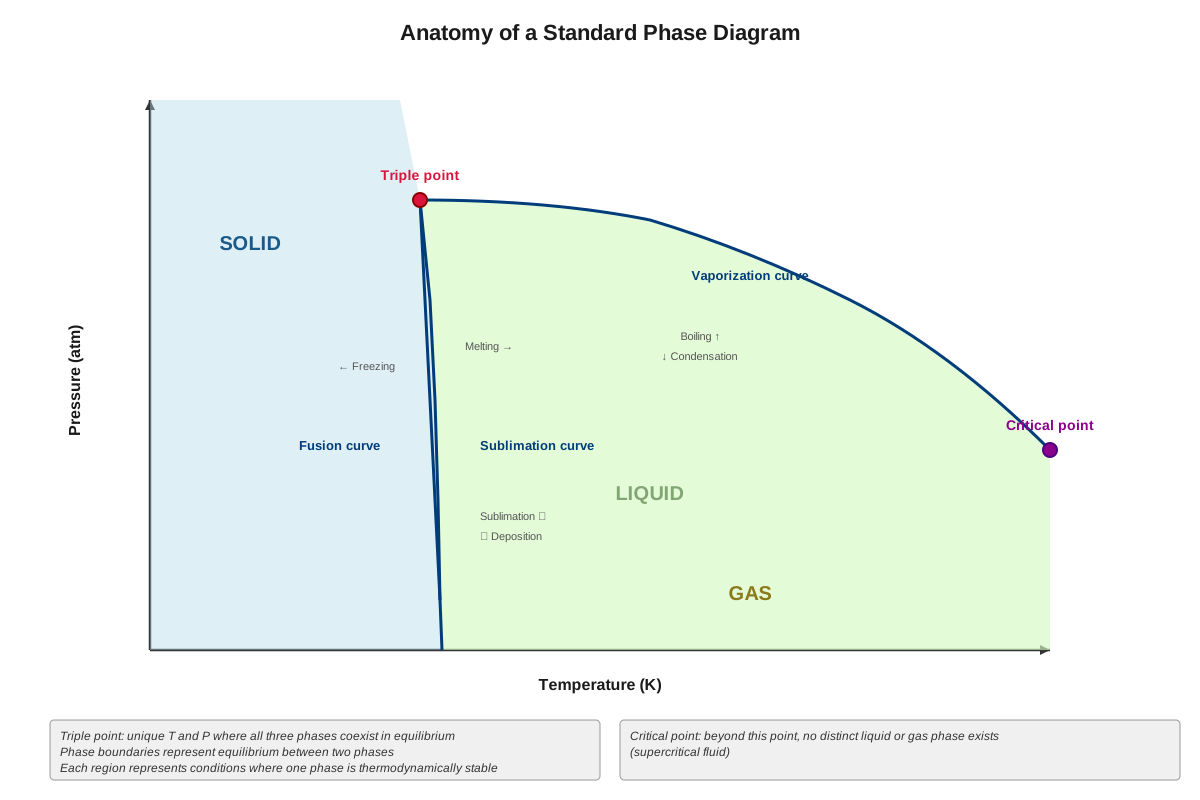
A phase diagram is a two-dimensional graph with pressure (typically in atmospheres or pascals) on the y-axis and temperature (in Kelvin or Celsius) on the x-axis. The diagram is divided into regions representing the three primary phases of matter: solid, liquid, and gas. The boundaries between these regions are called phase boundaries or phase equilibrium lines, and they represent conditions under which two phases coexist in equilibrium.
The three main phase boundaries are:
- Solid-liquid boundary (fusion/melting curve): Separates solid and liquid phases
- Liquid-gas boundary (vaporization curve): Separates liquid and gas phases
- Solid-gas boundary (sublimation curve): Separates solid and gas phases
Each point on a phase boundary represents a specific temperature-pressure combination where two phases exist in dynamic equilibrium. Moving across a phase boundary (by changing temperature, pressure, or both) results in a phase transition—the conversion of matter from one physical state to another.
The Triple Point
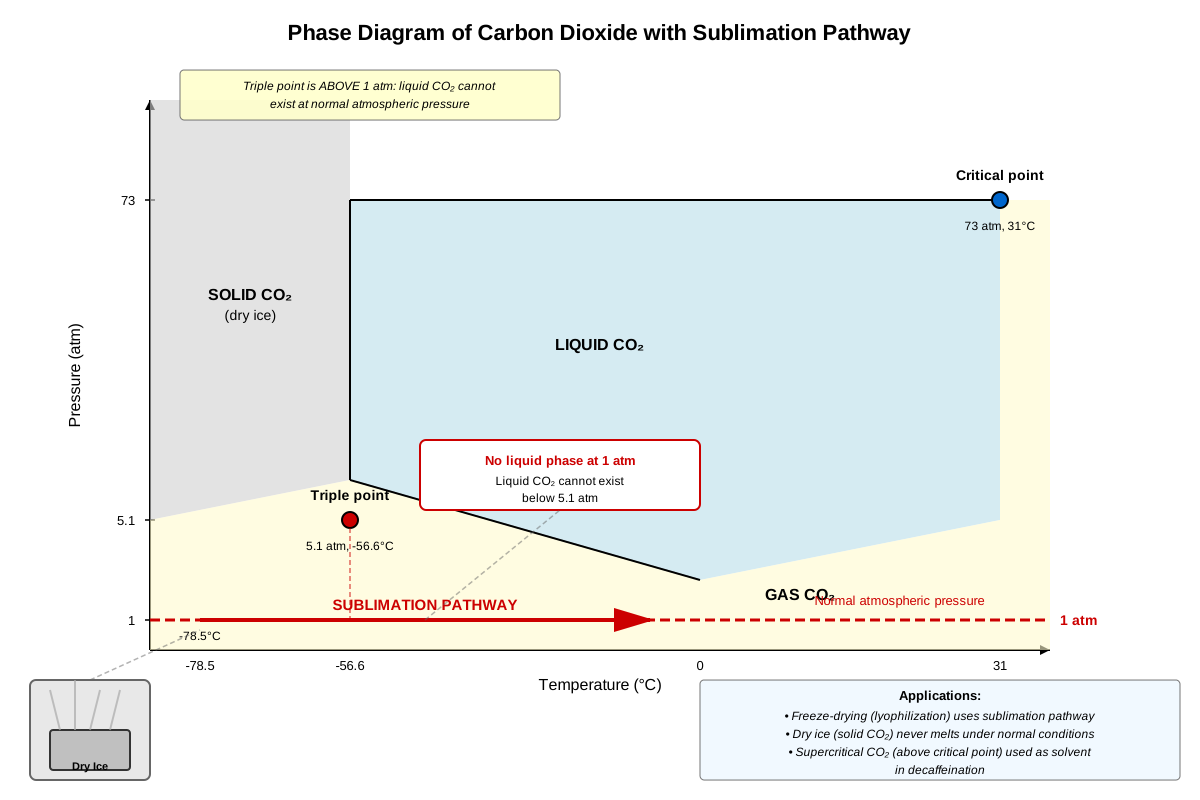
The triple point is the unique combination of temperature and pressure at which all three phases (solid, liquid, and gas) coexist in equilibrium. This point represents the intersection of all three phase boundaries and is an invariant property of each substance—meaning it occurs at one specific temperature and pressure combination that cannot be changed. For water, the triple point occurs at 0.01°C (273.16 K) and 0.006 atm (611.657 Pa). For carbon dioxide, the triple point is at -56.6°C and 5.11 atm.
The triple point has practical significance: it serves as a reference point for temperature scales and demonstrates that under certain conditions, all three phases can exist simultaneously. Below the triple point pressure, a substance cannot exist as a liquid regardless of temperature—it can only exist as solid or gas, transitioning directly between these phases through sublimation or deposition.
The Critical Point
The critical point represents the endpoint of the liquid-gas phase boundary and is defined by the critical temperature (Tc) and critical pressure (Pc). Above the critical temperature, no amount of pressure can condense a gas into a liquid. Above the critical point, the substance exists as a supercritical fluid—a state of matter that exhibits properties intermediate between liquids and gases, with liquid-like density but gas-like diffusivity.
For water, the critical point occurs at 374°C and 218 atm. For carbon dioxide, it occurs at 31°C and 73 atm. The relatively accessible critical point of CO₂ makes supercritical carbon dioxide useful for industrial applications such as caffeine extraction from coffee beans and pharmaceutical purification. Understanding the critical point is essential for MCAT questions involving extreme conditions or industrial processes.
Phase Transitions and Pathways
Phase transitions occur when a substance crosses a phase boundary. The six primary phase transitions are:
| Transition | Initial Phase | Final Phase | Energy Change |
|---|---|---|---|
| Melting/Fusion | Solid | Liquid | Endothermic (+ΔH) |
| Freezing/Solidification | Liquid | Solid | Exothermic (-ΔH) |
| Vaporization/Boiling | Liquid | Gas | Endothermic (+ΔH) |
| Condensation | Gas | Liquid | Exothermic (-ΔH) |
| Sublimation | Solid | Gas | Endothermic (+ΔH) |
| Deposition | Gas | Solid | Exothermic (-ΔH) |
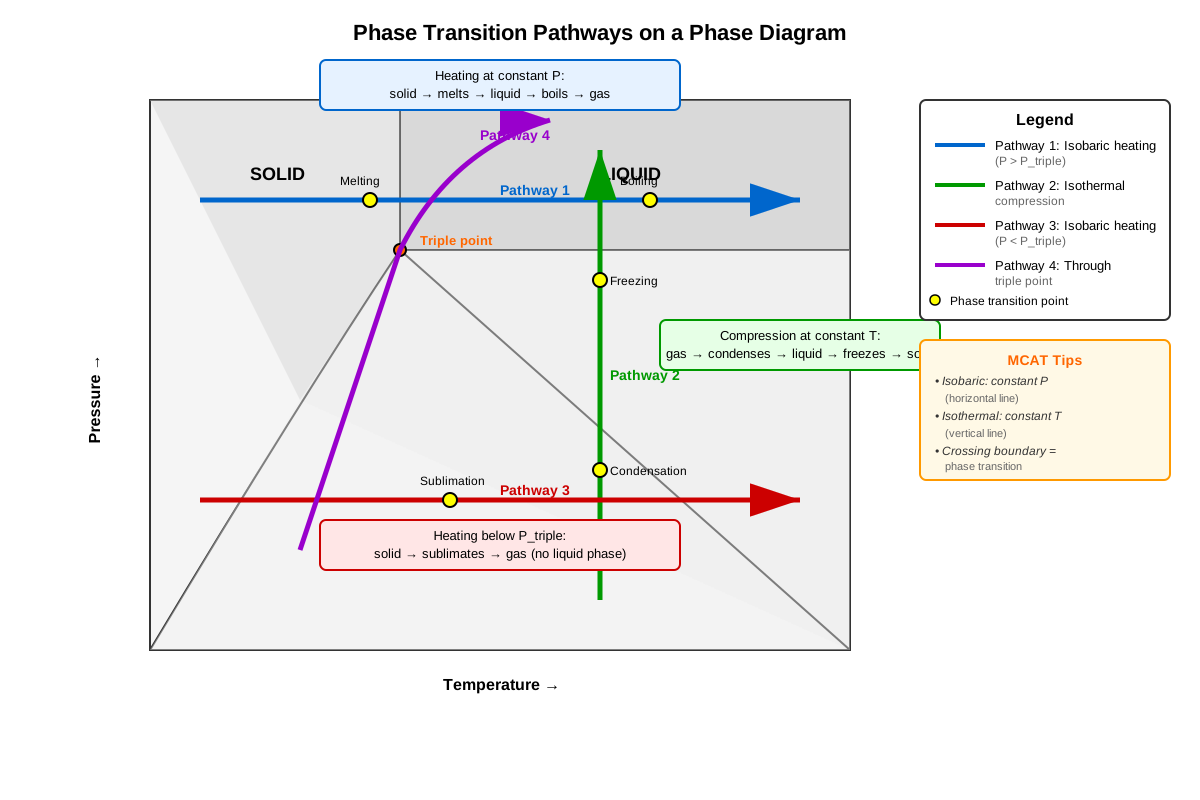
When analyzing a phase diagram, students must be able to trace paths representing changes in temperature and/or pressure and identify which phase transitions occur. A horizontal path (constant temperature, changing pressure) represents isothermal compression or expansion. A vertical path (constant pressure, changing temperature) represents isobaric heating or cooling—the most common scenario in laboratory settings.
The Slope of Phase Boundaries
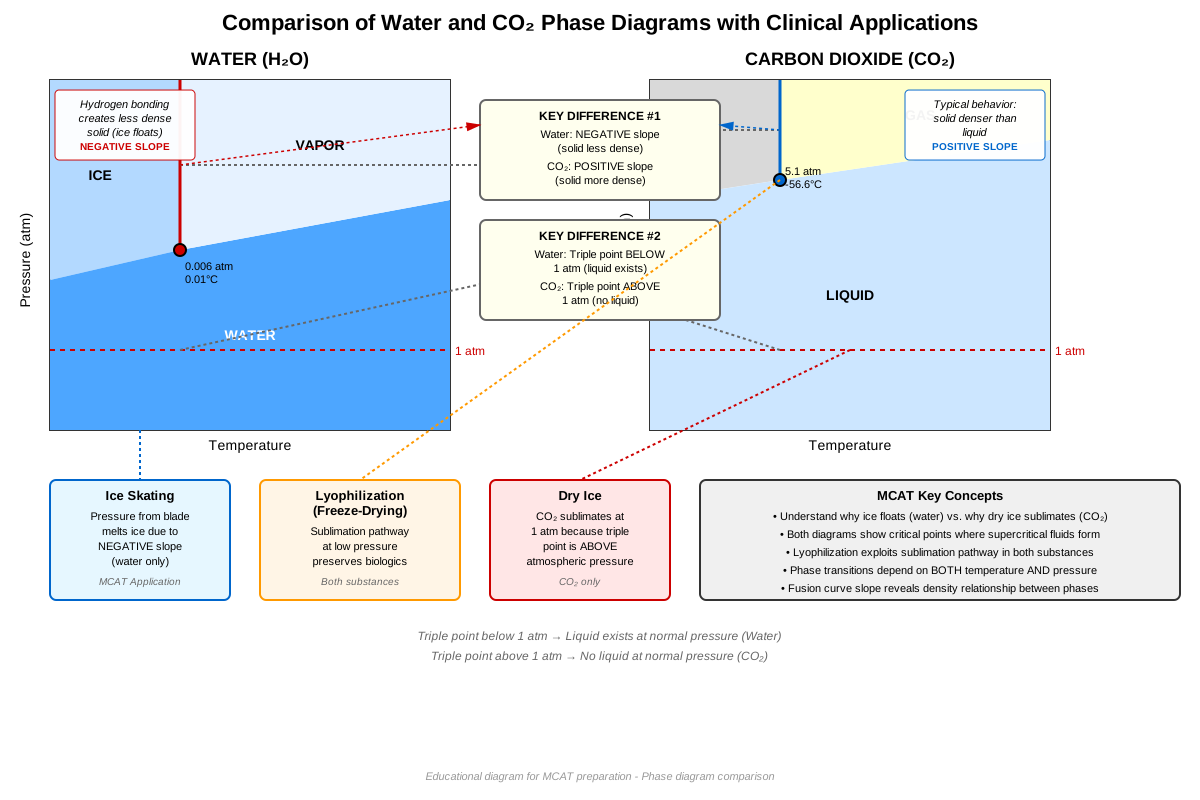
The slope of the solid-liquid boundary provides important information about a substance's behavior. For most substances, this boundary has a positive slope, meaning that increasing pressure favors the solid phase (the denser phase). This occurs because solids are typically more dense than their corresponding liquids, so applying pressure stabilizes the more compact solid structure.
Water exhibits atypical behavior with a negative slope for its solid-liquid boundary. This unusual characteristic results from ice being less dense than liquid water due to the open hexagonal crystal structure created by hydrogen bonding. The negative slope means that increasing pressure on ice can cause it to melt—a phenomenon responsible for ice skating (pressure from the blade creates a thin layer of liquid water) and glacier movement. This atypical behavior is frequently tested on the MCAT because it requires students to understand the molecular basis for macroscopic observations.
Normal Melting and Boiling Points
The normal melting point is the temperature at which a substance transitions from solid to liquid at 1 atm pressure (standard atmospheric pressure). Similarly, the normal boiling point is the temperature at which a substance transitions from liquid to gas at 1 atm. These points are found by drawing a horizontal line at P = 1 atm and identifying where it intersects the solid-liquid and liquid-gas boundaries, respectively.
The normal boiling point is particularly important because it represents the temperature at which the vapor pressure of the liquid equals atmospheric pressure. At higher elevations where atmospheric pressure is lower, the boiling point decreases—water boils at temperatures below 100°C on mountaintops. This relationship between pressure and boiling point has practical implications for cooking, sterilization procedures, and physiological processes.
Reading and Interpreting Phase Diagrams
To effectively use a phase diagram for MCAT questions:
- Identify the starting conditions: Locate the initial temperature and pressure on the diagram
- Determine the initial phase: Identify which region contains the starting point
- Trace the path: Follow the described changes in temperature and/or pressure
- Identify boundary crossings: Note each phase boundary crossed and the resulting transition
- Determine the final phase: Identify the region containing the endpoint
Exam Tip: Always check whether the question asks about the phase at a specific point or the transitions that occur along a path. These require different analytical approaches.
Concept Relationships
Phase diagrams integrate multiple fundamental concepts in General Chemistry and Solutions and Phase Behavior. The position of phase boundaries directly reflects the strength of intermolecular forces—substances with stronger intermolecular forces have higher melting and boiling points, shifting their phase boundaries toward higher temperatures. The energy required to cross phase boundaries (enthalpy of fusion, enthalpy of vaporization) determines the steepness and position of these boundaries.
The relationship flow can be mapped as: Intermolecular Forces → determine → Relative Phase Stability → manifests as → Phase Boundary Positions → which define → Conditions for Phase Transitions → which affect → Physical Properties and Behavior.
Phase diagrams connect to vapor pressure concepts through the liquid-gas boundary, which represents the equilibrium vapor pressure at each temperature. The Clausius-Clapeyron equation mathematically describes this boundary, linking phase diagrams to thermodynamics and kinetics. Understanding phase diagrams also enables comprehension of colligative properties—adding solutes to solvents shifts phase boundaries, causing boiling point elevation and freezing point depression.
The critical point concept connects to real gas behavior and deviations from ideal gas law predictions. Near the critical point, the distinction between liquid and gas phases disappears, and substances exhibit properties that cannot be explained by simple kinetic molecular theory. This connects phase diagrams to more advanced topics in physical chemistry and thermodynamics.
Quick check — test yourself on Phase diagrams so far.
Try Flashcards →High-Yield Facts
⭐ The triple point is the unique temperature and pressure where solid, liquid, and gas phases coexist in equilibrium
⭐ Above the critical temperature, a gas cannot be liquefied regardless of applied pressure
⭐ Water's solid-liquid boundary has a negative slope because ice is less dense than liquid water
⭐ The normal boiling point occurs where the liquid-gas boundary intersects P = 1 atm
⭐ Below the triple point pressure, a substance cannot exist as a liquid and will sublimate directly from solid to gas
- The solid-liquid boundary is nearly vertical for most substances because solids and liquids have similar densities
- The liquid-gas boundary always terminates at the critical point
- Increasing pressure generally favors the denser phase (solid > liquid > gas for most substances)
- The vapor pressure of a liquid increases exponentially with temperature, creating the curved liquid-gas boundary
- Supercritical fluids have liquid-like densities but gas-like viscosities and diffusion rates
- Carbon dioxide's triple point (5.11 atm) is above atmospheric pressure, so CO₂ sublimes at standard conditions
- The slope of phase boundaries can be predicted using the Clausius-Clapeyron equation
- Phase transitions at boundaries are reversible equilibrium processes
- The enthalpy of vaporization is always greater than the enthalpy of fusion for the same substance
- Crossing a phase boundary requires energy input (endothermic) or energy release (exothermic) but no temperature change during the transition
Common Misconceptions
Misconception: The triple point is a range of conditions rather than a single point.
Correction: The triple point is an invariant point—a single, specific combination of temperature and pressure unique to each substance. It cannot be changed and represents the only conditions where all three phases coexist.
Misconception: All substances have phase diagrams with the same general shape and features.
Correction: While most substances show similar patterns, important exceptions exist. Water's negative solid-liquid slope is atypical, and some substances (like helium) have phase diagrams with unusual features such as regions where the solid phase cannot exist at any temperature.
Misconception: Crossing a phase boundary always involves a temperature change.
Correction: Phase transitions occur at constant temperature when following a phase boundary or when pressure changes at constant temperature. During a phase transition at equilibrium, added energy goes into breaking intermolecular forces rather than increasing kinetic energy (temperature).
Misconception: The critical point and triple point are the same thing.
Correction: These are distinct features. The triple point is where all three phases coexist and occurs at the intersection of all phase boundaries. The critical point is the endpoint of the liquid-gas boundary, above which the liquid and gas phases become indistinguishable.
Misconception: Sublimation only occurs at very low pressures.
Correction: Sublimation occurs whenever a substance transitions directly from solid to gas, which happens at any pressure below the triple point pressure. For substances like CO₂ with high triple point pressures, sublimation occurs at normal atmospheric pressure (dry ice sublimes at 1 atm).
Misconception: The normal boiling point is the highest temperature at which a liquid can exist.
Correction: Liquids can exist at temperatures well above their normal boiling point if pressure is increased. The normal boiling point is simply the temperature at which vapor pressure equals 1 atm. In a pressure cooker, water remains liquid above 100°C due to elevated pressure.
Worked Examples
Example 1: Tracing a Path on a Phase Diagram
Question: A sample of water begins at -10°C and 0.5 atm. The sample is heated at constant pressure until it reaches 120°C. Describe all phase transitions that occur and identify the phases present at the beginning, middle, and end of this process.
Solution:
Step 1: Identify starting conditions and phase
- Temperature: -10°C, Pressure: 0.5 atm
- At these conditions, water exists as ice (solid) because we are below the freezing point and in the solid region of the phase diagram
Step 2: Trace the path
- The process occurs at constant pressure (0.5 atm), so we draw a horizontal line at P = 0.5 atm
- We move from T = -10°C to T = 120°C, moving left to right on the diagram
Step 3: Identify phase boundaries crossed
- First boundary: Solid-liquid boundary at approximately 0°C (slightly below due to pressure being less than 1 atm)
- Phase transition: Melting/fusion (solid → liquid)
- Ice converts to liquid water
- Second boundary: Liquid-gas boundary at approximately 98°C (below 100°C because pressure is less than 1 atm)
- Phase transition: Vaporization/boiling (liquid → gas)
- Liquid water converts to water vapor
Step 4: Identify phases at key points
- Beginning (-10°C, 0.5 atm): Solid (ice)
- Middle (50°C, 0.5 atm): Liquid (water)
- End (120°C, 0.5 atm): Gas (water vapor)
Key Insight: This problem demonstrates that boiling point depends on pressure. At 0.5 atm (approximately half of standard atmospheric pressure), water boils at a temperature below 100°C. This connects to the concept that vapor pressure must equal external pressure for boiling to occur.
Example 2: Analyzing Carbon Dioxide Behavior
Question: Explain why solid carbon dioxide (dry ice) sublimes at room temperature and atmospheric pressure, while solid water (ice) melts under the same conditions. Use phase diagram principles in your explanation.
Solution:
Step 1: Identify the relevant phase diagram features
- The key difference lies in the position of the triple point for each substance
- Water's triple point: 0.01°C and 0.006 atm
- Carbon dioxide's triple point: -56.6°C and 5.11 atm
Step 2: Analyze conditions relative to triple points
- Room temperature and atmospheric pressure: approximately 25°C and 1 atm
- For water: 1 atm is above the triple point pressure (0.006 atm)
- At pressures above the triple point, the liquid phase can exist
- At 1 atm, drawing a horizontal line shows that increasing temperature from below 0°C crosses the solid-liquid boundary first
- Therefore, ice melts to liquid water
- For carbon dioxide: 1 atm is below the triple point pressure (5.11 atm)
- At pressures below the triple point, the liquid phase cannot exist
- At 1 atm, drawing a horizontal line shows only solid and gas regions
- Therefore, dry ice sublimes directly to CO₂ gas
Step 3: Connect to molecular explanation
- CO₂ has a higher triple point pressure because its molecular structure and intermolecular forces create conditions where the liquid phase requires higher pressure to be stable
- The relatively weak London dispersion forces in CO₂ (compared to hydrogen bonding in water) mean that at low pressures, the gas phase is strongly favored
Key Insight: Whether a substance melts or sublimes at atmospheric pressure depends entirely on whether atmospheric pressure is above or below the substance's triple point pressure. This explains why dry ice is useful for creating fog effects (it sublimes without creating liquid) and why liquid CO₂ requires pressurized containers.
Exam Strategy
When approaching phase diagram questions on the MCAT, begin by quickly orienting yourself to the diagram's axes and identifying the three phase regions. Look for labeled special points (triple point, critical point) and note any unusual features such as negative slopes. Most MCAT phase diagram questions fall into three categories: (1) identifying phases at specific conditions, (2) tracing paths and identifying transitions, or (3) comparing substances or explaining atypical behavior.
Trigger words and phrases to watch for:
- "At standard pressure" or "at 1 atm" → Look for normal melting/boiling points
- "Increases pressure while maintaining temperature" → Horizontal path moving upward
- "Heated at constant pressure" → Vertical path moving right
- "Below the triple point" → Liquid phase cannot exist; expect sublimation
- "Supercritical conditions" → Above both critical temperature and pressure
- "Negative slope" → Likely referring to water's unusual solid-liquid boundary
Process-of-elimination strategies:
- Eliminate answer choices that place a substance in the liquid phase when conditions are below the triple point pressure
- Eliminate choices that suggest liquefaction is possible above the critical temperature
- For water-specific questions, eliminate answers that don't account for ice being less dense than liquid water
- When asked about phase transitions, eliminate answers that violate energy conservation (e.g., exothermic melting)
Time allocation: Phase diagram questions typically require 60-90 seconds. Spend 15-20 seconds orienting to the diagram, 30-40 seconds tracing the path or analyzing the conditions, and 15-20 seconds selecting and confirming your answer. If a question requires multiple steps or complex reasoning, flag it and return if time permits—these questions often appear more difficult than they are once you've completed easier items and built confidence.
Exam Tip: If you're unsure about a phase boundary's exact position, remember that increasing temperature always favors phases with higher kinetic energy (solid → liquid → gas), while increasing pressure always favors denser phases (gas → liquid → solid, except for water's solid-liquid transition).
Memory Techniques
Mnemonic for phase transitions and energy changes:
"Some Melting Requires Energy, Freezing Releases Energy"
- Sublimation, Melting, (Vapo)Rization = Endothermic (require energy input)
- Freezing, Condensation, Deposition = Release Energy (exothermic)
Acronym for special points: "TC"
- Triple point: Three phases coexist
- Critical point: Cannot liquefy above this temperature
Visualization strategy for water's unusual behavior:
Picture ice cubes floating in a glass of water. This visual immediately reminds you that ice is less dense than liquid water, which explains the negative slope of water's solid-liquid boundary. When pressure increases on ice, it "squeezes" it into the denser liquid phase.
Memory aid for triple point pressure and sublimation:
"Below the Triple, No Liquid Ripple"
- Below the triple point pressure, liquid cannot exist, so substances sublimate
Slope direction memory device:
"Most substances: Pressure Pushes to Solid" (positive slope)
"Water is Weird: Pressure Produces Water" (negative slope)
Summary
Phase diagrams are essential graphical tools in General Chemistry that map the physical state of substances as functions of temperature and pressure. These diagrams feature three main regions (solid, liquid, gas) separated by phase boundaries representing equilibrium conditions between phases. The triple point marks the unique conditions where all three phases coexist, while the critical point represents the temperature and pressure above which liquid and gas phases become indistinguishable. For the MCAT, students must be able to interpret phase diagrams, trace paths representing changes in conditions, identify resulting phase transitions, and understand special cases like water's negative solid-liquid slope. The ability to connect phase diagram features to molecular properties (intermolecular forces, density relationships) and practical applications (sublimation of dry ice, pressure cooking, supercritical fluid extraction) distinguishes high-performing students. Mastery requires understanding both the graphical representation and the underlying thermodynamic principles that determine phase stability and transitions.
Key Takeaways
- Phase diagrams plot pressure versus temperature and divide space into regions representing solid, liquid, and gas phases separated by equilibrium boundaries
- The triple point is the unique temperature-pressure combination where all three phases coexist; below this pressure, liquids cannot exist
- The critical point marks the end of the liquid-gas boundary; above the critical temperature, gases cannot be liquefied regardless of pressure
- Water exhibits atypical behavior with a negative solid-liquid slope because ice is less dense than liquid water due to hydrogen bonding structure
- Normal melting and boiling points occur where phase boundaries intersect the P = 1 atm line
- Tracing paths on phase diagrams requires identifying starting conditions, following temperature/pressure changes, noting boundary crossings, and determining final phases
- Phase transitions crossing boundaries are endothermic when moving toward higher energy phases (solid→liquid→gas) and exothermic in reverse
Related Topics
Colligative Properties: Understanding how solutes affect phase boundaries leads directly to explaining freezing point depression and boiling point elevation—key concepts for solution chemistry and biological systems.
Clausius-Clapeyron Equation: This mathematical relationship describes the liquid-gas phase boundary and connects phase diagrams to thermodynamics and kinetics, enabling quantitative predictions of vapor pressure.
Intermolecular Forces: The strength and type of intermolecular forces determine the position of phase boundaries, making this foundational knowledge essential for predicting and explaining phase behavior.
Thermodynamics of Phase Transitions: Enthalpy and entropy changes during phase transitions provide the energetic basis for phase diagram features and connect to broader thermodynamic principles.
Real Gases and Van der Waals Equation: Understanding deviations from ideal behavior near the critical point requires knowledge of real gas properties and intermolecular interactions.
Practice CTA
Now that you've mastered the core concepts of phase diagrams, it's time to solidify your understanding through active practice. Work through the practice questions to test your ability to interpret diagrams, trace paths, and apply these concepts to MCAT-style scenarios. Use the flashcards to reinforce high-yield facts and special points. Remember, phase diagrams integrate multiple areas of General Chemistry—each practice question you complete strengthens not only this topic but also your broader understanding of Solutions and Phase Behavior. Your investment in mastering this medium-yield topic will pay dividends when you encounter integrated passages that require quick, accurate phase diagram interpretation. You've got this!
Sign up free to keep reading
Create a free AnvayaPrep account to finish this MCAT guide on Phase diagrams — plus flashcards and practice questions.