Overview
The molecular formula is a fundamental concept in General Chemistry that represents the actual number of atoms of each element present in a single molecule of a compound. Unlike the empirical formula, which shows only the simplest whole-number ratio of atoms, the molecular formula provides the complete atomic composition. For example, glucose has the molecular formula C₆H₁₂O₆, indicating that each molecule contains exactly 6 carbon atoms, 12 hydrogen atoms, and 6 oxygen atoms. This distinction becomes critical when analyzing compounds with identical empirical formulas but different molecular structures and properties.
Understanding molecular formulas is essential for success on the MCAT because they form the foundation for stoichiometry and reactions, mass calculations, and structural analysis. The MCAT frequently tests the ability to determine molecular formulas from experimental data, convert between empirical and molecular formulas, and use molecular formulas to calculate molar masses and perform stoichiometric calculations. These skills appear across multiple sections of the exam, particularly in passages involving combustion analysis, mass spectrometry data, and biochemical pathway questions.
The molecular formula concept bridges several critical areas of General Chemistry MCAT content. It connects directly to atomic structure and the periodic table (understanding elemental composition), stoichiometry (quantitative relationships in reactions), and organic chemistry (structural isomers sharing the same molecular formula). Mastery of molecular formulas enables students to tackle complex problems involving percent composition, limiting reagents, theoretical yields, and the relationship between structure and function in biological molecules—all high-yield topics for exam success.
Learning Objectives
- [ ] Define molecular formula using accurate General Chemistry terminology
- [ ] Explain why molecular formula matters for the MCAT
- [ ] Apply molecular formula to exam-style questions
- [ ] Identify common mistakes related to molecular formula
- [ ] Connect molecular formula to related General Chemistry concepts
- [ ] Calculate molecular formula from empirical formula and molar mass data
- [ ] Determine molecular formula from percent composition and experimental data
- [ ] Distinguish between molecular formula, empirical formula, and structural formula in problem-solving contexts
Prerequisites
- Atomic structure and the periodic table: Understanding atomic mass units and how to read element symbols is essential for interpreting and writing molecular formulas
- Mole concept and Avogadro's number: The molecular formula represents the composition of one molecule, and mole calculations allow scaling to macroscopic quantities
- Empirical formula determination: Molecular formulas are often calculated as whole-number multiples of empirical formulas
- Basic stoichiometry: Converting between mass, moles, and number of particles is required for molecular formula calculations
- Percent composition: Many molecular formula problems begin with mass percent data that must be converted to atomic ratios
Why This Topic Matters
Clinical and Real-World Significance: Molecular formulas are indispensable in pharmaceutical development, where the exact composition of drug molecules determines their efficacy, safety, and metabolic pathways. For instance, the molecular formula of aspirin (C₉H₈O₄) reveals its complete atomic composition, which is critical for understanding its synthesis, dosing calculations, and interactions with biological systems. In clinical laboratory settings, molecular formulas enable precise quantification of metabolites, hormones, and toxins through techniques like mass spectrometry. Medical professionals use molecular formula information when calculating drug dosages, understanding metabolic pathways, and interpreting diagnostic tests.
Exam Statistics: Molecular formula questions appear in approximately 5-8% of General Chemistry passages on the MCAT, with additional indirect applications in organic chemistry and biochemistry sections. These questions typically appear as discrete items or as part of multi-step stoichiometry passages. The MCAT commonly presents molecular formula problems in the context of combustion analysis, mass spectrometry interpretation, or reaction stoichiometry calculations. Questions may ask students to determine an unknown molecular formula from experimental data, calculate molar mass from a given formula, or identify which compounds could be structural isomers based on shared molecular formulas.
Common Exam Presentations: The MCAT integrates molecular formula concepts into passages about analytical chemistry techniques (mass spectrometry, elemental analysis), biochemical pathways (where students must track atoms through metabolic transformations), and organic reaction mechanisms (where molecular formulas help verify product identity). Passages may present combustion data and ask students to determine the molecular formula of an unknown hydrocarbon, or provide mass spectrometry results showing molecular ion peaks that correspond to specific molecular formulas. Understanding molecular formulas is also essential for balancing complex biochemical equations and determining limiting reagents in multi-step synthesis problems.
Core Concepts
Definition and Notation
The molecular formula is a chemical notation that specifies the exact number of atoms of each element present in one molecule of a compound. It is written using element symbols from the periodic table followed by subscript numbers indicating the quantity of each atom type. When only one atom of an element is present, the subscript "1" is omitted by convention. For example, ethanol's molecular formula is C₂H₆O, indicating 2 carbon atoms, 6 hydrogen atoms, and 1 oxygen atom per molecule.
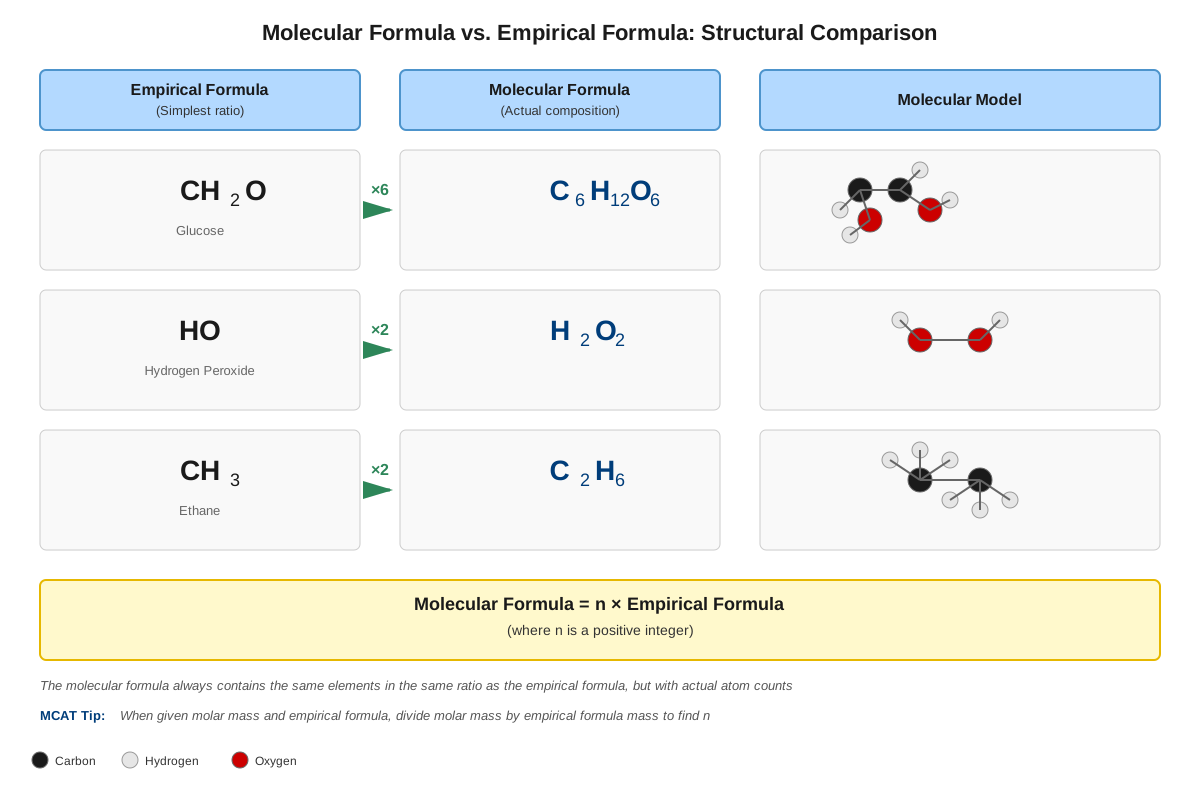
The molecular formula differs fundamentally from other chemical representations. While the empirical formula shows the simplest whole-number ratio of atoms, the molecular formula shows the actual number. For instance, both glucose (C₆H₁₂O₆) and formaldehyde (CH₂O) have the same empirical formula (CH₂O), but their molecular formulas reveal their true compositions. The structural formula goes further by showing how atoms are bonded together, but the molecular formula focuses solely on quantity and identity of atoms.
Relationship Between Empirical and Molecular Formulas
The molecular formula is always a whole-number multiple of the empirical formula. This relationship can be expressed mathematically:
Molecular Formula = (Empirical Formula) × nwhere n is a positive integer (1, 2, 3, etc.). To determine n, divide the molecular molar mass by the empirical formula mass:
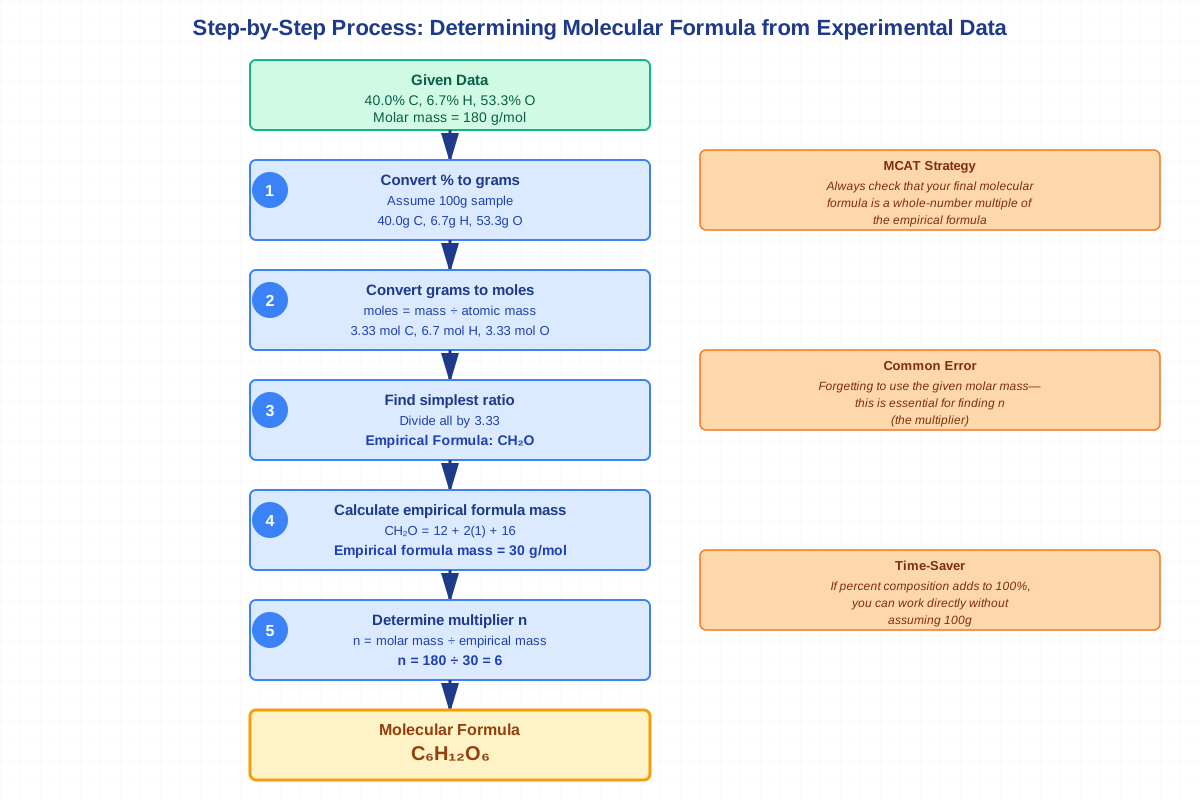
n = (Molecular Molar Mass) / (Empirical Formula Mass)For example, if a compound has an empirical formula of CH₂O (empirical mass = 30 g/mol) and a molecular molar mass of 180 g/mol, then n = 180/30 = 6, giving a molecular formula of C₆H₁₂O₆. This calculation is one of the most frequently tested applications on the MCAT.
Determining Molecular Formula from Percent Composition
A common MCAT problem type provides percent composition data and asks for the molecular formula. The systematic approach involves:
- Convert percentages to grams: Assume 100 g of compound, so percentages become grams directly
- Convert grams to moles: Divide each element's mass by its atomic mass
- Find the simplest ratio: Divide all mole values by the smallest number of moles
- Determine the empirical formula: Use the simplest whole-number ratio
- Calculate the molecular formula: Use the provided molar mass to find the multiplier n
This multi-step process requires careful attention to significant figures and rounding decisions, as MCAT questions often include answer choices that result from common calculation errors.
Molecular Formula and Molar Mass
The molar mass of a compound can be calculated directly from its molecular formula by summing the atomic masses of all constituent atoms. This relationship is bidirectional: given a molecular formula, you can calculate molar mass; given molar mass and empirical formula, you can determine the molecular formula.
For example, the molecular formula C₆H₁₂O₆ yields a molar mass of:
- Carbon: 6 × 12.01 g/mol = 72.06 g/mol
- Hydrogen: 12 × 1.008 g/mol = 12.096 g/mol
- Oxygen: 6 × 16.00 g/mol = 96.00 g/mol
- Total molar mass = 180.16 g/mol
This calculation is essential for stoichiometric conversions between mass and moles in reaction problems.
Combustion Analysis and Molecular Formula
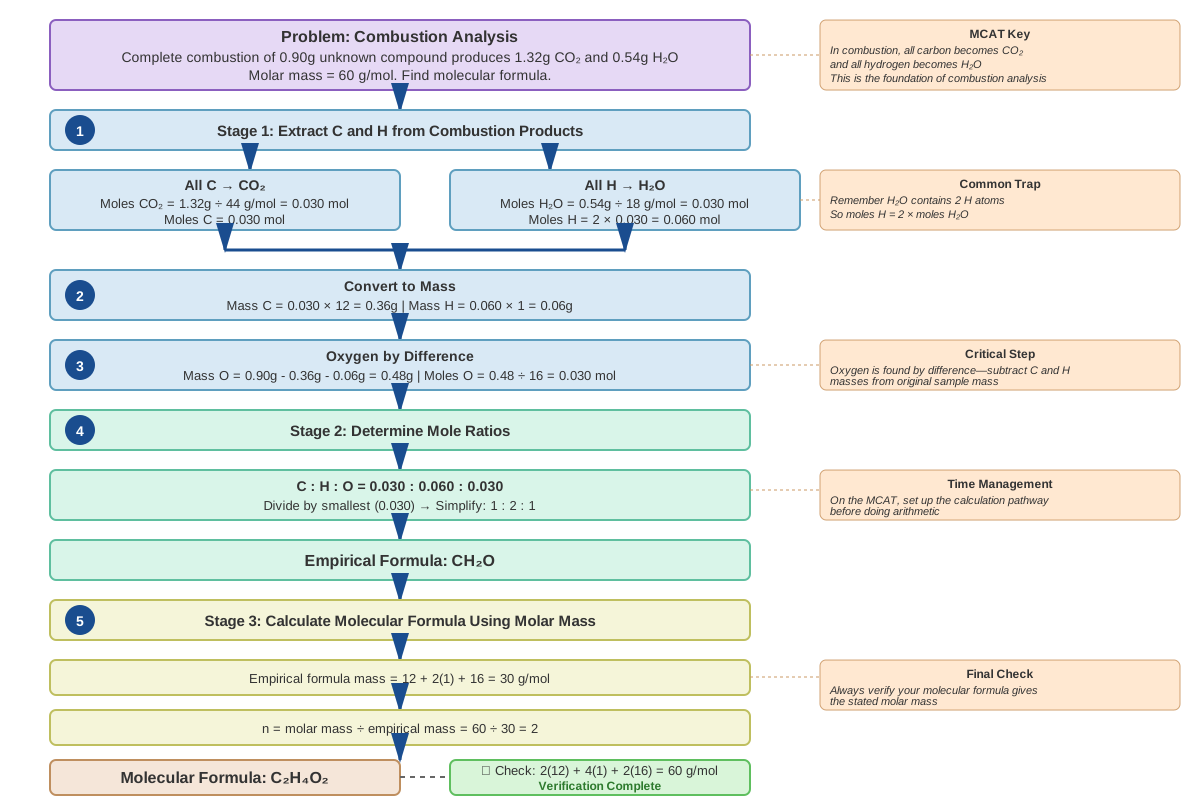
Combustion analysis is an experimental technique frequently featured in MCAT passages. When an organic compound containing C, H, and possibly O is burned completely in excess oxygen, it produces CO₂ and H₂O. By measuring the masses of these products, chemists can determine the molecular formula of the original compound.
The key relationships are:
- All carbon in the compound becomes CO₂
- All hydrogen in the compound becomes H₂O
- Oxygen in the compound (if present) must be calculated by difference
The systematic approach:
- Calculate moles of C from moles of CO₂ produced (1:1 ratio)
- Calculate moles of H from moles of H₂O produced (1:2 ratio)
- Calculate mass of C and H
- Subtract from total compound mass to find mass of O
- Convert to moles and find empirical formula
- Use molar mass to determine molecular formula
Molecular Formula in Isomer Analysis
Compounds with identical molecular formulas but different structural arrangements are called isomers. The molecular formula alone cannot distinguish between isomers, but it provides the constraint within which different structures can exist. For example, C₄H₁₀O represents the molecular formula for several different alcohols and ethers, including:
- 1-butanol (a primary alcohol)
- 2-butanol (a secondary alcohol)
- Diethyl ether (an ether)
Understanding that a single molecular formula can represent multiple distinct compounds is crucial for organic chemistry passages on the MCAT, where students must recognize that structural differences lead to different physical and chemical properties despite identical molecular formulas.
Molecular Formula and Stoichiometry
In stoichiometry and reactions, molecular formulas enable quantitative predictions about reactants and products. Balanced chemical equations use molecular formulas to show the exact number of molecules participating in reactions. For instance:
C₆H₁₂O₆ + 6O₂ → 6CO₂ + 6H₂OThis equation shows that one molecule of glucose (molecular formula C₆H₁₂O₆) reacts with six molecules of oxygen to produce six molecules each of carbon dioxide and water. The molecular formulas allow calculation of mass relationships, limiting reagents, and theoretical yields—all high-yield MCAT topics.
Comparison Table: Formula Types
| Formula Type | Information Provided | Example (Glucose) | Example (Acetic Acid) |
|---|---|---|---|
| Molecular Formula | Exact number of each atom | C₆H₁₂O₆ | C₂H₄O₂ |
| Empirical Formula | Simplest whole-number ratio | CH₂O | CH₂O |
| Structural Formula | Bonding arrangement | Shows ring structure | CH₃COOH |
| Condensed Formula | Bonding groups | Not typically used | CH₃COOH |
Concept Relationships
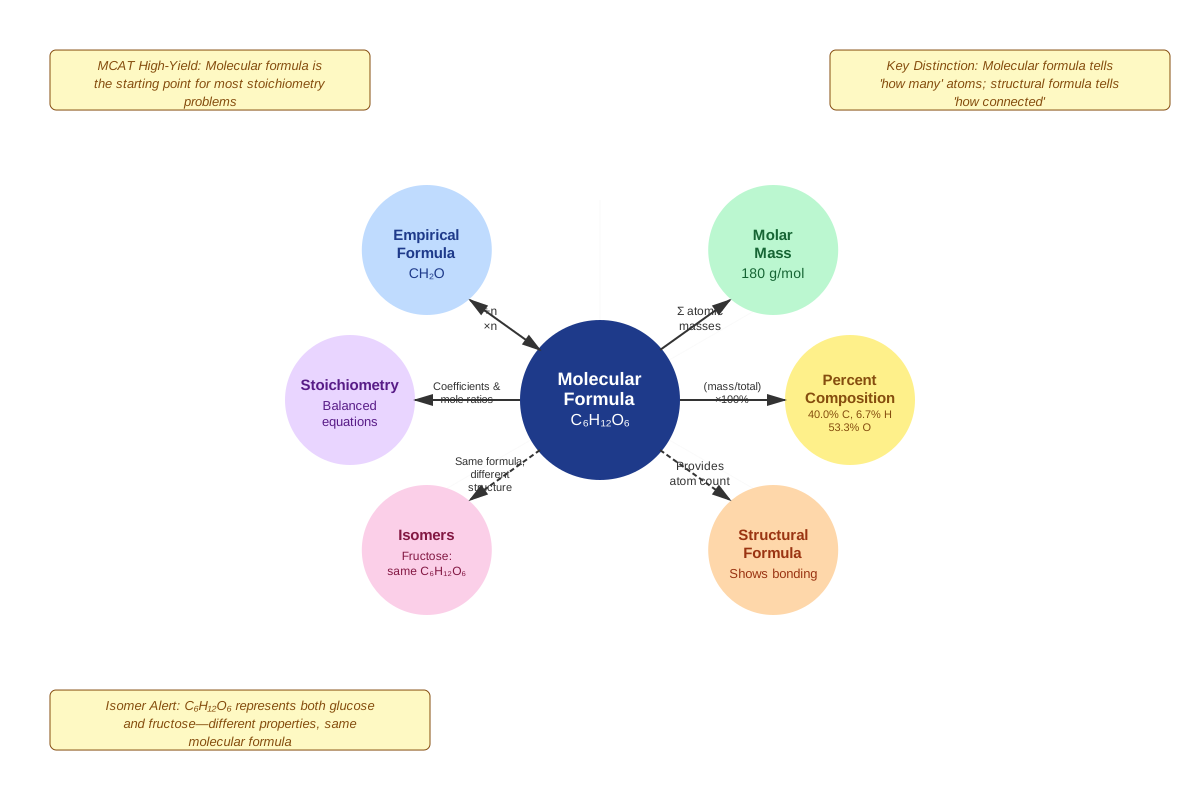
The molecular formula concept sits at the intersection of multiple fundamental chemistry principles. Atomic structure provides the foundation: understanding that elements have characteristic atomic masses enables calculation of molecular masses from formulas. The mole concept allows scaling from individual molecules (described by molecular formulas) to laboratory quantities, creating the bridge between microscopic and macroscopic chemistry.
The relationship flows as follows: Percent composition data → Empirical formula → Molecular formula → Stoichiometric calculations. Each step builds on the previous one. Percent composition analysis yields the simplest ratio of atoms (empirical formula), which combined with molar mass data produces the molecular formula, which then enables all quantitative reaction calculations.
Molecular formulas connect bidirectionally with molar mass: given a molecular formula, molar mass can be calculated; given molar mass and empirical formula, the molecular formula can be determined. This relationship is exploited in mass spectrometry problems, where the molecular ion peak provides molar mass information used to identify unknown compounds.
Within organic chemistry, molecular formulas relate to structural isomers and degrees of unsaturation. The same molecular formula can represent multiple structural arrangements, and the molecular formula's hydrogen deficiency reveals information about rings and multiple bonds. For example, the molecular formula C₄H₈ indicates one degree of unsaturation, meaning the compound contains either one double bond or one ring.
The concept also connects forward to reaction stoichiometry, where balanced equations using molecular formulas enable calculation of limiting reagents, theoretical yields, and percent yields. Additionally, molecular formulas are essential for understanding combustion reactions, synthesis pathways, and metabolic transformations that appear in biochemistry passages.
Quick check — test yourself on Molecular formula so far.
Try Flashcards →High-Yield Facts
⭐ The molecular formula is always a whole-number multiple (n ≥ 1) of the empirical formula
⭐ To find n: divide the molecular molar mass by the empirical formula mass
⭐ In combustion analysis, all carbon becomes CO₂ and all hydrogen becomes H₂O
⭐ Compounds with the same molecular formula but different structures are called isomers
⭐ The molecular formula alone provides enough information to calculate exact molar mass
- When given percent composition, assume 100 g total to convert percentages directly to grams
- The subscripts in a molecular formula must be whole numbers (or very close due to rounding)
- Oxygen content in combustion analysis is typically found by subtracting C and H masses from total mass
- Mass spectrometry's molecular ion peak (M⁺) corresponds to the molecular formula's molar mass
- The molecular formula provides the elemental composition but no information about bonding or structure
- For hydrocarbons, the general molecular formula CₙH₂ₙ₊₂ represents alkanes (saturated compounds)
- A molecular formula of C₆H₁₂O₆ could represent glucose, fructose, or galactose (structural isomers)
- The degree of unsaturation can be calculated from the molecular formula to predict rings and multiple bonds
- Molecular formulas are essential for balancing chemical equations and performing stoichiometric calculations
- When n = 1, the molecular formula equals the empirical formula (e.g., H₂O, CH₄, CO₂)
Common Misconceptions
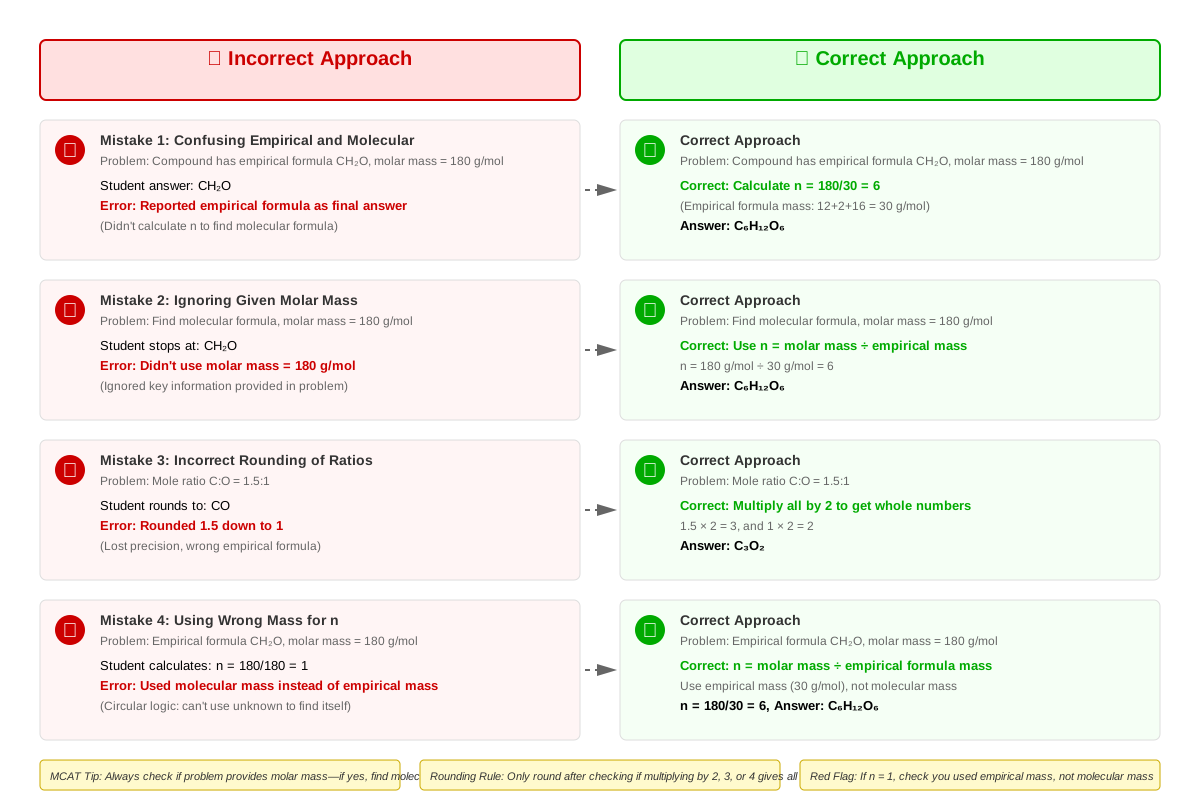
Misconception: The molecular formula and empirical formula are always the same.
Correction: The molecular formula equals the empirical formula only when n = 1. Many compounds have molecular formulas that are multiples of their empirical formulas. For example, benzene (C₆H₆) has an empirical formula of CH, and glucose (C₆H₁₂O₆) has an empirical formula of CH₂O.
Misconception: You can determine the structure of a molecule from its molecular formula alone.
Correction: The molecular formula provides only the quantity and identity of atoms, not their arrangement. Multiple structural isomers can share the same molecular formula. For example, C₂H₆O represents both ethanol (CH₃CH₂OH) and dimethyl ether (CH₃OCH₃), which have completely different properties and structures.
Misconception: In combustion analysis, the mass of oxygen in the original compound equals the mass of oxygen in the products.
Correction: Oxygen from the air (O₂) also contributes to the products. To find oxygen in the original compound, calculate the masses of carbon and hydrogen from the products, then subtract these from the original compound's total mass. Never try to calculate oxygen directly from product masses.
Misconception: When calculating n (the multiplier), any decimal value should be rounded to the nearest integer.
Correction: The value of n must be a whole number, but if your calculation yields something like 1.5 or 2.5, this indicates you should multiply by 2 to get whole numbers (3 or 5). Only round to the nearest integer when the decimal is very small (due to rounding error), typically less than 0.1 from a whole number.
Misconception: The molecular formula tells you whether a compound is ionic or covalent.
Correction: The molecular formula notation is used primarily for covalent compounds where discrete molecules exist. Ionic compounds are typically represented by empirical formulas showing the ratio of ions. For example, NaCl is the formula unit for sodium chloride, not a molecular formula, because ionic compounds don't exist as discrete molecules.
Misconception: If two compounds have different molecular formulas, they must have different molar masses.
Correction: While this is generally true, it's theoretically possible for two different molecular formulas to have nearly identical molar masses due to the specific combination of elements. However, for MCAT purposes, different molecular formulas will have distinguishably different molar masses.
Misconception: The subscripts in a molecular formula can be fractional.
Correction: Molecular formulas must have whole-number subscripts because they represent actual numbers of atoms in a molecule, and you cannot have a fraction of an atom. If calculations yield fractional values, they must be converted to whole numbers by finding the appropriate multiplier.
Worked Examples
Example 1: Determining Molecular Formula from Empirical Formula and Molar Mass
Problem: A compound has an empirical formula of CH₂O and a molar mass of 180 g/mol. What is its molecular formula?
Solution:
Step 1: Calculate the empirical formula mass
- C: 1 × 12.01 g/mol = 12.01 g/mol
- H: 2 × 1.008 g/mol = 2.016 g/mol
- O: 1 × 16.00 g/mol = 16.00 g/mol
- Empirical formula mass = 30.03 g/mol
Step 2: Calculate the multiplier n
n = (Molecular Molar Mass) / (Empirical Formula Mass)
n = 180 g/mol / 30.03 g/mol = 5.99 ≈ 6
Step 3: Multiply the empirical formula by n
- Molecular formula = (CH₂O) × 6 = C₆H₁₂O₆
Answer: The molecular formula is C₆H₁₂O₆ (glucose)
Key Insight: This problem demonstrates the direct relationship between empirical and molecular formulas. The slight deviation from exactly 6.00 (we got 5.99) is due to rounding in atomic masses and should be rounded to the nearest whole number. This is a classic MCAT problem type that tests whether students understand the n multiplier concept.
Example 2: Combustion Analysis to Determine Molecular Formula
Problem: Complete combustion of 0.500 g of an unknown hydrocarbon produces 1.617 g of CO₂ and 0.662 g of H₂O. The compound's molar mass is determined to be 86 g/mol by mass spectrometry. What is the molecular formula?
Solution:
Step 1: Calculate moles of carbon from CO₂
Moles of CO₂ = 1.617 g / 44.01 g/mol = 0.03674 mol
Moles of C = 0.03674 mol (1:1 ratio with CO₂)
Mass of C = 0.03674 mol × 12.01 g/mol = 0.441 g
Step 2: Calculate moles of hydrogen from H₂O
Moles of H₂O = 0.662 g / 18.02 g/mol = 0.03673 mol
Moles of H = 0.03673 mol × 2 = 0.07346 mol (2 H per H₂O)
Mass of H = 0.07346 mol × 1.008 g/mol = 0.0740 g
Step 3: Check if oxygen is present
Mass of C + Mass of H = 0.441 g + 0.0740 g = 0.515 gThis exceeds the original 0.500 g sample (due to rounding), confirming this is a hydrocarbon with no oxygen.
Step 4: Find the empirical formula
Mole ratio C:H = 0.03674 : 0.07346 = 1 : 2
Empirical formula = CH₂
Step 5: Calculate empirical formula mass and find n
Empirical formula mass = 12.01 + 2(1.008) = 14.03 g/mol
n = 86 g/mol / 14.03 g/mol = 6.13 ≈ 6
Step 6: Determine molecular formula
Molecular formula = (CH₂) × 6 = C₆H₁₂Answer: The molecular formula is C₆H₁₂
Key Insight: This problem integrates combustion analysis with molecular formula determination, a high-yield MCAT combination. Notice that we verified the compound contains only C and H by checking that their masses account for the total sample mass. The compound C₆H₁₂ could be cyclohexane or various hexene isomers—the molecular formula alone doesn't distinguish between these structural possibilities.
Exam Strategy
When approaching molecular formula MCAT questions, begin by identifying what information is provided and what is being asked. Questions typically fall into three categories: (1) calculating molecular formula from empirical formula and molar mass, (2) determining molecular formula from combustion or percent composition data, or (3) using molecular formula for stoichiometric calculations.
Trigger words and phrases to watch for include: "empirical formula," "molar mass," "combustion analysis," "percent composition," "mass spectrometry," "molecular ion peak," and "isomers." When you see "empirical formula" paired with "molar mass," immediately think about calculating the multiplier n. When you see "combustion" or "burned in excess oxygen," prepare to track carbon through CO₂ and hydrogen through H₂O.
Process-of-elimination strategies: If answer choices show different molecular formulas, quickly calculate their molar masses and eliminate any that don't match given data. If the question provides an empirical formula, eliminate any answer choices that aren't whole-number multiples of it. For combustion problems, eliminate answers that would require fractional atoms or that violate the law of conservation of mass.
Time allocation: Simple molecular formula calculations (empirical to molecular) should take 30-45 seconds. Combustion analysis problems require 90-120 seconds due to multiple calculation steps. Don't get bogged down in excessive significant figures—MCAT answer choices are typically distinct enough that rounding to 2-3 significant figures is sufficient. If you're spending more than 2 minutes on a molecular formula question, flag it and move on.
Exam Tip: Always verify that your final molecular formula makes chemical sense. Hydrocarbons should follow patterns like CₙH₂ₙ₊₂ (alkanes), CₙH₂ₙ (alkenes/cycloalkanes), or CₙH₂ₙ₋₂ (alkynes). If your answer doesn't fit expected patterns, recheck your calculations.
Common trap answers include: (1) the empirical formula itself (when n ≠ 1), (2) formulas with incorrect multipliers (using n = 2 when n = 3), (3) formulas that result from calculation errors in combustion analysis (forgetting to double hydrogen from H₂O), and (4) formulas that ignore oxygen content in the original compound.
Memory Techniques
Mnemonic for combustion analysis steps: "Can Harry Order Excellent Meals?"
- Calculate moles of carbon from CO₂
- Hydrogen moles from H₂O (remember to multiply by 2!)
- Oxygen by difference (subtract C and H masses from total)
- Empirical formula from mole ratios
- Molecular formula using molar mass
Visualization strategy: Picture the molecular formula as a "recipe" that tells you exactly how many of each "ingredient" (atom) you need to make one "dish" (molecule). Just as doubling a recipe doubles all ingredients proportionally, the molecular formula is the empirical formula "recipe" multiplied by n.
Acronym for formula relationships: "EMM" - Empirical leads to Molecular using Molar mass. This reminds you that you need all three pieces of information and their relationship.
Memory aid for the n calculation: Think "Big over Small" - the big molecular molar mass divided by the small empirical formula mass gives you n. This prevents the common error of dividing in the wrong direction.
Rhyme for combustion: "Carbon goes to CO₂, hydrogen to H₂O too, oxygen you find by subtraction, that's the combustion reaction!" This simple rhyme helps remember where each element ends up in combustion analysis.
Summary
The molecular formula represents the exact number and identity of atoms in a single molecule, distinguishing it from the empirical formula (simplest ratio) and structural formula (bonding arrangement). Mastery of molecular formulas requires understanding their relationship to empirical formulas through the whole-number multiplier n, calculated by dividing molecular molar mass by empirical formula mass. MCAT questions frequently test the ability to determine molecular formulas from combustion analysis data (tracking carbon through CO₂ and hydrogen through H₂O, with oxygen found by difference) or from percent composition combined with molar mass. The molecular formula enables calculation of exact molar mass and serves as the foundation for stoichiometric calculations in balanced equations. Understanding that multiple structural isomers can share the same molecular formula is crucial for organic chemistry applications. Success on molecular formula questions requires systematic problem-solving: convert given data to moles, find empirical formula, use molar mass to determine the multiplier, and verify the answer makes chemical sense.
Key Takeaways
- The molecular formula shows the actual number of each type of atom in one molecule, always as a whole-number multiple (n) of the empirical formula
- Calculate n by dividing the molecular molar mass by the empirical formula mass: n = MM / EFM
- In combustion analysis, all carbon becomes CO₂ (1:1 ratio) and all hydrogen becomes H₂O (1:2 ratio), with oxygen found by mass difference
- The same molecular formula can represent different structural isomers with distinct properties
- Molecular formulas enable direct calculation of molar mass and are essential for all stoichiometric calculations
- Common MCAT question types include empirical-to-molecular conversions, combustion analysis, and using molecular formulas in reaction stoichiometry
- Always verify that calculated molecular formulas have whole-number subscripts and make chemical sense for the compound type
Related Topics
Empirical Formula Determination: Understanding how to calculate the simplest whole-number ratio of atoms from percent composition or mass data is the prerequisite skill for molecular formula problems. Mastering empirical formulas enables progression to molecular formula calculations.
Stoichiometry and Limiting Reagents: Molecular formulas are essential for balancing equations and performing quantitative calculations about reactants and products. This topic builds directly on molecular formula knowledge.
Mass Spectrometry: This analytical technique provides molecular mass data (from the molecular ion peak) that, combined with other information, allows determination of molecular formulas. Understanding molecular formulas enhances interpretation of mass spectra.
Structural Isomers and Organic Chemistry: Multiple compounds can share the same molecular formula but have different structures and properties. Molecular formula mastery provides the foundation for understanding isomerism.
Degrees of Unsaturation: This concept uses the molecular formula to calculate the number of rings and/or multiple bonds in a molecule, connecting molecular formula to structural predictions.
Combustion Reactions and Thermochemistry: Complete combustion reactions use molecular formulas to calculate energy released and products formed, integrating molecular formula knowledge with thermodynamic concepts.
Practice CTA
Now that you've mastered the fundamentals of molecular formulas, it's time to solidify your understanding through active practice. Challenge yourself with the practice questions and flashcards designed specifically for this topic. Focus on problems involving combustion analysis and empirical-to-molecular conversions, as these are the highest-yield question types on the MCAT. Remember, the difference between knowing the concept and scoring points on test day is the ability to apply your knowledge quickly and accurately under pressure. Each practice problem you complete builds the pattern recognition and problem-solving speed essential for MCAT success. You've got this!
Sign up free to keep reading
Create a free AnvayaPrep account to finish this MCAT guide on Molecular formula — plus flashcards and practice questions.