Overview
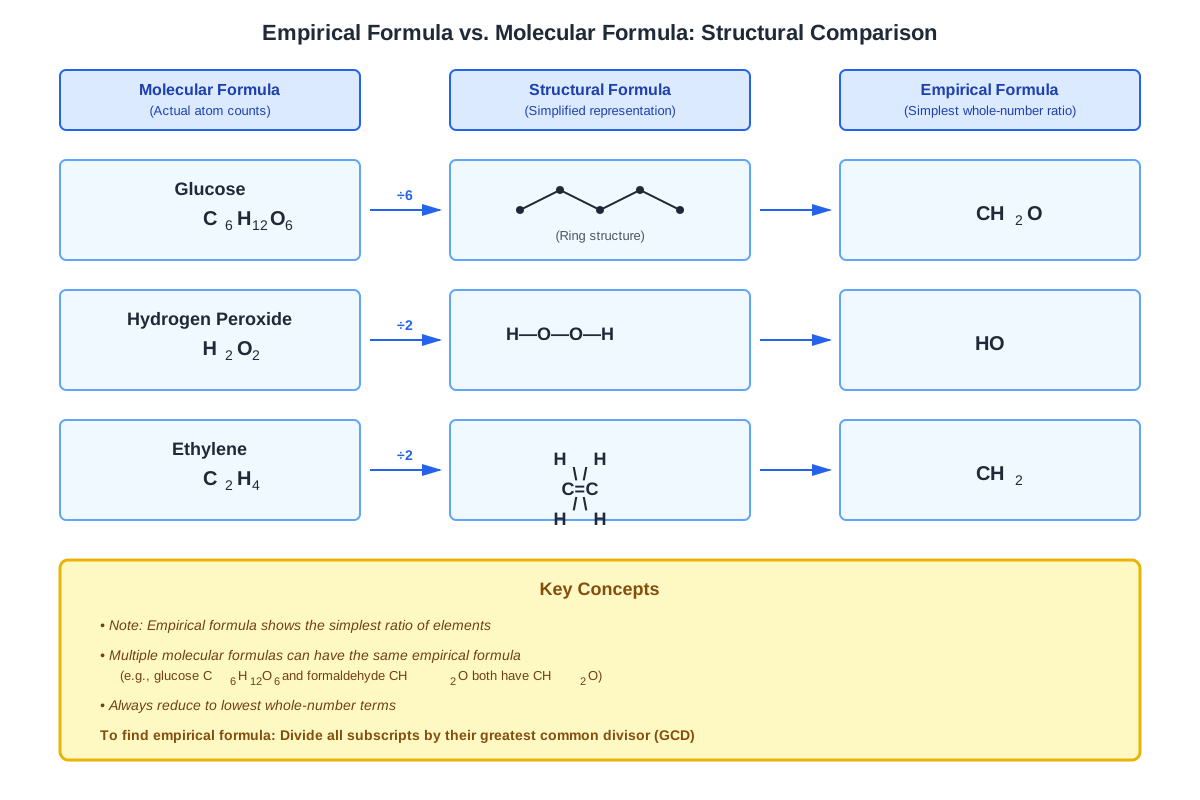
The empirical formula represents the simplest whole-number ratio of atoms of each element present in a compound. Unlike molecular formulas that show the actual number of atoms in a molecule, empirical formulas reduce these numbers to their lowest terms. For instance, glucose has a molecular formula of C₆H₁₂O₆, but its empirical formula is CH₂O—the simplest ratio that maintains the relative proportions of carbon, hydrogen, and oxygen atoms. This fundamental concept bridges composition analysis with molecular structure determination, serving as a critical tool in General Chemistry problem-solving.
Understanding empirical formula is essential for MCAT success because it appears frequently in Stoichiometry and Reactions questions, often integrated with combustion analysis, percent composition calculations, and molecular formula determinations. The MCAT tests not only the mechanical calculation of empirical formulas but also conceptual understanding of how composition data translates to chemical formulas. Questions may present experimental data from combustion reactions, mass spectrometry results, or percent composition tables, requiring students to work backward from analytical data to determine the simplest formula representation of an unknown compound.
The empirical formula MCAT questions connect to broader General Chemistry themes including molar mass calculations, limiting reagent problems, and reaction stoichiometry. Mastery of this topic enables students to tackle complex passages involving organic compound identification, pharmaceutical synthesis pathways, and biochemical molecule characterization. The empirical formula serves as the foundation for understanding molecular formulas, structural formulas, and ultimately the three-dimensional architecture of molecules—concepts that extend into organic chemistry and biochemistry sections of the exam.
Learning Objectives
- [ ] Define empirical formula using accurate General Chemistry terminology
- [ ] Explain why empirical formula matters for the MCAT
- [ ] Apply empirical formula to exam-style questions
- [ ] Identify common mistakes related to empirical formula
- [ ] Connect empirical formula to related General Chemistry concepts
- [ ] Calculate empirical formulas from percent composition data with 100% accuracy
- [ ] Distinguish between empirical formulas and molecular formulas in various contexts
- [ ] Determine molecular formulas from empirical formulas when given molar mass information
- [ ] Analyze combustion analysis data to derive empirical formulas of organic compounds
Prerequisites
- Mole concept and Avogadro's number: Essential for converting between mass, moles, and number of atoms when determining atomic ratios
- Atomic mass and molar mass: Required to convert mass data into moles, the fundamental unit for establishing atomic ratios
- Percent composition calculations: Provides the starting data from which empirical formulas are derived
- Basic stoichiometry: Understanding mole ratios forms the conceptual foundation for empirical formula determination
- Simplifying ratios and fractions: Mathematical skill necessary to reduce mole ratios to smallest whole numbers
Why This Topic Matters
Clinical and Real-World Significance: Empirical formulas play a crucial role in pharmaceutical development, where chemists must identify unknown compounds isolated from natural sources or synthesized in laboratories. When researchers discover a potentially therapeutic compound, determining its empirical formula represents the first step in structural elucidation. This information guides further analysis using spectroscopic techniques and helps predict chemical properties, reactivity patterns, and potential biological activity. In forensic science, empirical formula determination helps identify unknown substances found at crime scenes or in toxicology samples.
MCAT Exam Statistics: Empirical formula questions appear in approximately 3-5% of General Chemistry passages and discrete questions on the MCAT. These questions typically present as medium-difficulty problems worth 1-2 minutes of solving time. The topic most commonly appears in three formats: (1) combustion analysis passages requiring calculation of empirical formulas from product masses, (2) percent composition problems integrated with molecular formula determination, and (3) conceptual questions distinguishing between empirical and molecular formulas in the context of isomers or compound identification.
Common Exam Presentations: The MCAT frequently embeds empirical formula calculations within larger experimental passages describing analytical chemistry techniques. Students might encounter a passage about mass spectrometry or elemental analysis where they must determine an unknown compound's empirical formula from provided data. Other common scenarios include organic chemistry synthesis passages where reaction products must be identified, biochemistry passages involving carbohydrate or lipid analysis, and general chemistry passages about combustion reactions. The exam particularly favors questions that require multiple steps: converting mass to moles, establishing mole ratios, simplifying to whole numbers, and then using additional information to determine molecular formulas.
Core Concepts
Definition and Fundamental Principles
The empirical formula represents the simplest positive integer ratio of atoms of each element in a compound. This formula provides compositional information without revealing the actual number of atoms in a molecule. The term "empirical" derives from the Greek word for "experience," reflecting that these formulas can be determined experimentally through compositional analysis without knowing molecular structure.
Every compound has one unique empirical formula, but multiple compounds may share the same empirical formula. For example, acetylene (C₂H₂), benzene (C₆H₆), and styrene (C₈H₈) all have the empirical formula CH. This occurs because empirical formulas only convey relative proportions, not absolute quantities. The relationship between empirical and molecular formulas follows this principle: the molecular formula is always a whole-number multiple of the empirical formula.
Calculating Empirical Formulas from Percent Composition
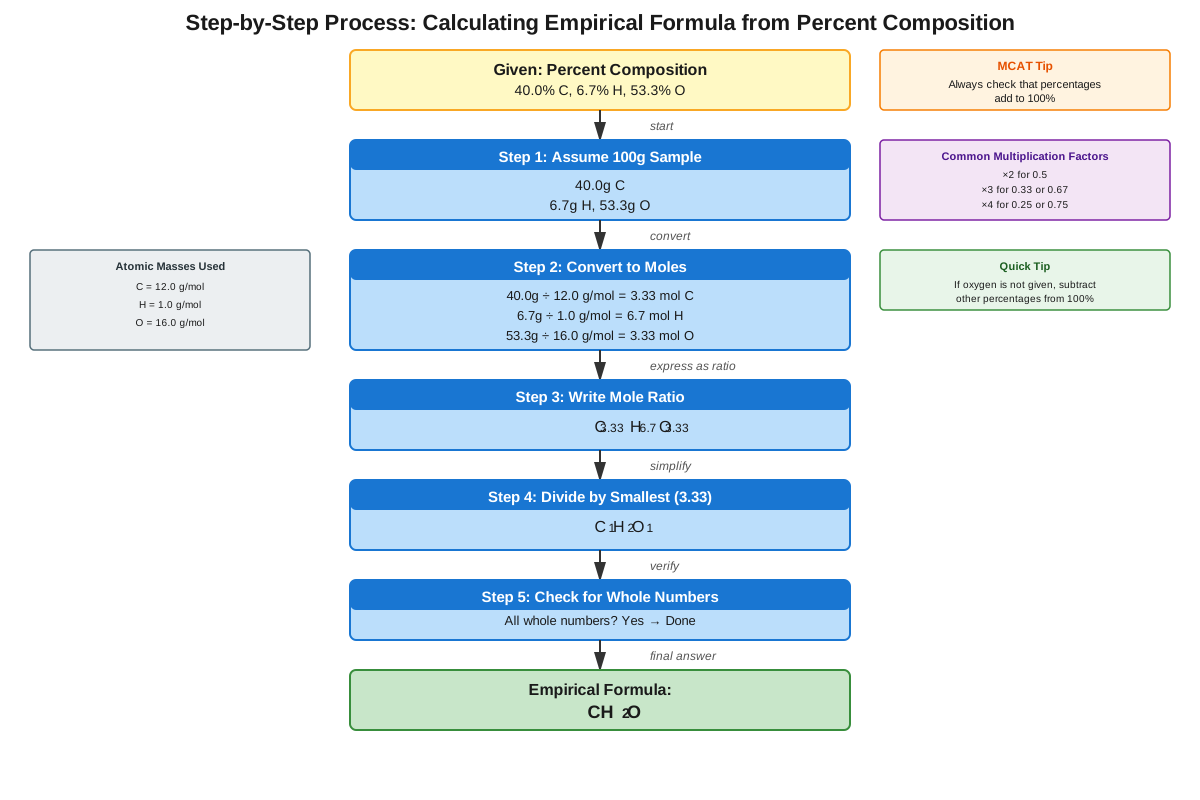
The standard procedure for determining empirical formulas from percent composition data follows a systematic five-step process:
- Assume a 100-gram sample: This converts percentages directly to grams, simplifying calculations
- Convert mass to moles: Divide each element's mass by its atomic mass
- Determine mole ratios: Divide all mole values by the smallest number of moles
- Convert to whole numbers: Multiply all ratios by the smallest integer that produces whole numbers
- Write the empirical formula: Use the whole-number ratios as subscripts
Example Calculation: A compound contains 40.0% carbon, 6.7% hydrogen, and 53.3% oxygen by mass.
Step 1: Assume 100 g sample
- Carbon: 40.0 g
- Hydrogen: 6.7 g
- Oxygen: 53.3 g

Step 2: Convert to moles
- C: 40.0 g ÷ 12.0 g/mol = 3.33 mol
- H: 6.7 g ÷ 1.0 g/mol = 6.7 mol
- O: 53.3 g ÷ 16.0 g/mol = 3.33 mol

Step 3: Divide by smallest (3.33)
- C: 3.33 ÷ 3.33 = 1
- H: 6.7 ÷ 3.33 = 2.01 ≈ 2
- O: 3.33 ÷ 3.33 = 1

Step 4: Already whole numbers

Step 5: Empirical formula = CH₂O
Combustion Analysis and Empirical Formula Determination
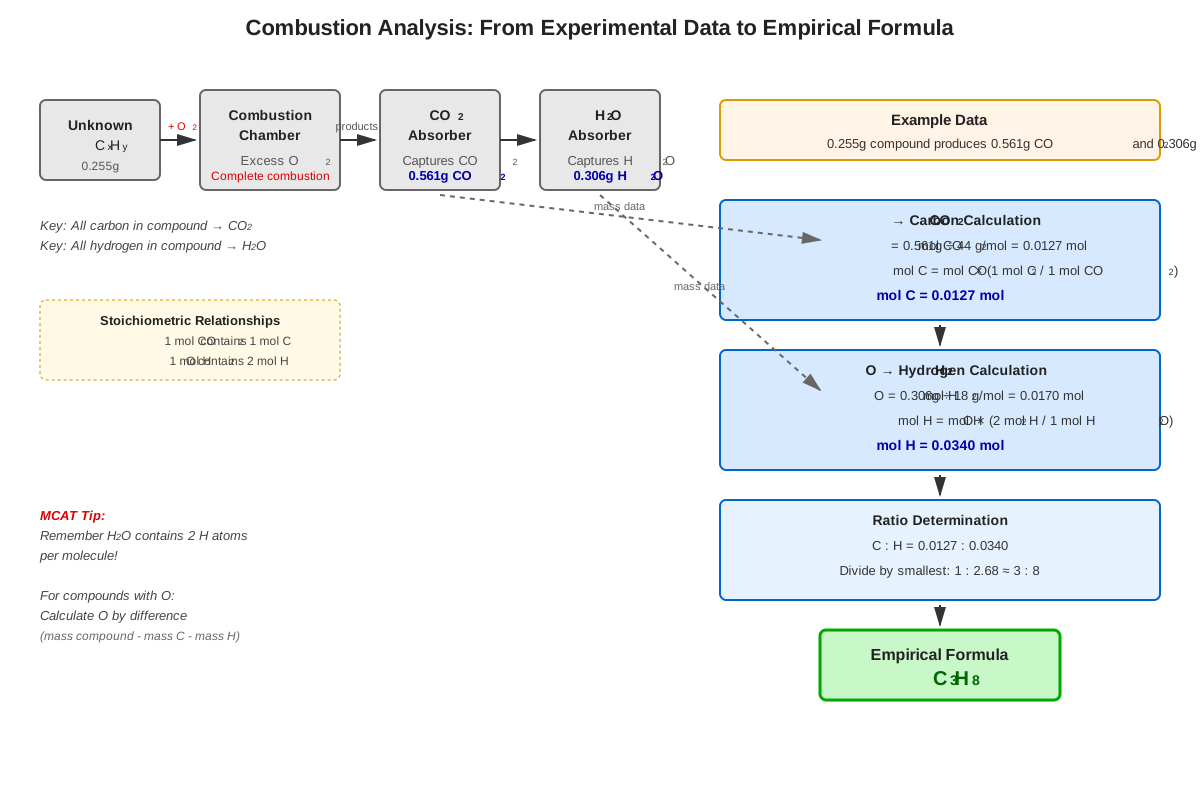
Combustion analysis represents the most common experimental method for determining empirical formulas of organic compounds. When an organic compound undergoes complete combustion in excess oxygen, carbon converts to CO₂ and hydrogen converts to H₂O. By measuring the masses of these products, chemists can calculate the original amounts of carbon and hydrogen. If oxygen is present in the original compound, its mass is determined by subtraction.
The combustion analysis process requires these key steps:
- Measure the mass of the unknown organic compound
- Combust the sample completely in excess O₂
- Collect and weigh CO₂ and H₂O products
- Calculate moles of C from moles of CO₂ (1:1 ratio)
- Calculate moles of H from moles of H₂O (1:2 ratio)
- Determine moles of O by subtracting C and H masses from original sample mass
- Establish mole ratios and derive empirical formula
MCAT Exam Tip: Combustion analysis problems always provide product masses, not reactant oxygen mass. The oxygen in CO₂ and H₂O comes from both the compound AND the excess O₂ used for combustion.
Empirical Formula vs. Molecular Formula
Understanding the distinction between empirical and molecular formulas is crucial for MCAT success:
| Feature | Empirical Formula | Molecular Formula |
|---|---|---|
| Definition | Simplest whole-number ratio | Actual number of atoms |
| Information provided | Relative proportions | Absolute quantities |
| Uniqueness | Multiple compounds may share | Unique to each compound |
| Determination | From composition data alone | Requires molar mass |
| Example | CH₂O | C₆H₁₂O₆ (glucose) |
The molecular formula equals the empirical formula multiplied by an integer (n):
Molecular formula = (Empirical formula)ₙ

where n = Molar mass of compound / Molar mass of empirical formula
This relationship means that determining a molecular formula requires two pieces of information: the empirical formula and the compound's molar mass. The MCAT frequently tests this two-step process, providing composition data to find the empirical formula, then giving molar mass to determine the molecular formula.
Handling Non-Whole Number Ratios
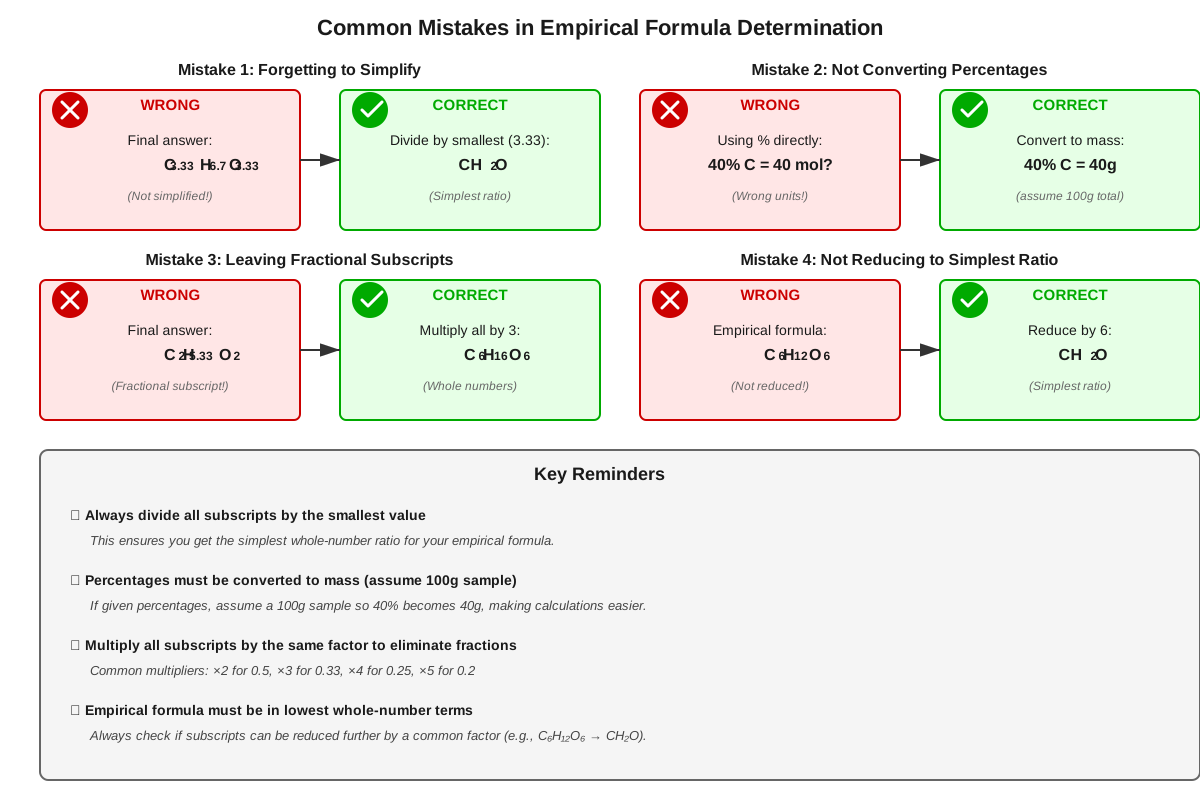
When mole ratios don't yield whole numbers after dividing by the smallest value, multiplication by specific factors converts them to integers:
- Ratio contains 0.5: Multiply all values by 2
- Ratio contains 0.33 or 0.67: Multiply all values by 3
- Ratio contains 0.25 or 0.75: Multiply all values by 4
- Ratio contains 0.2, 0.4, 0.6, or 0.8: Multiply all values by 5
Example: If mole ratios are C: 1, H: 1.5, O: 1, multiply all by 2 to get C₂H₃O₂.
The key principle: always multiply ALL ratios by the same factor to maintain correct proportions. A common error involves rounding prematurely instead of using the appropriate multiplication factor.
Special Cases and Considerations
Hydrated compounds present a unique application of empirical formula concepts. These ionic compounds contain water molecules in their crystal structure, written as compound·xH₂O. Determining the formula requires calculating the mole ratio between the anhydrous compound and water. For example, CuSO₄·5H₂O indicates five water molecules per formula unit of copper(II) sulfate.
Ionic compounds always have their formula written in simplest form, making their written formula equivalent to their empirical formula. NaCl, CaCl₂, and Al₂O₃ are all empirical formulas because ionic compounds exist as extended lattices, not discrete molecules.
Organic compound families often share empirical formulas. Alkenes (CₙH₂ₙ) all have the empirical formula CH₂, while alkynes (CₙH₂ₙ₋₂) have empirical formula CH. Recognizing these patterns helps predict properties and identify compound classes on the MCAT.
Concept Relationships
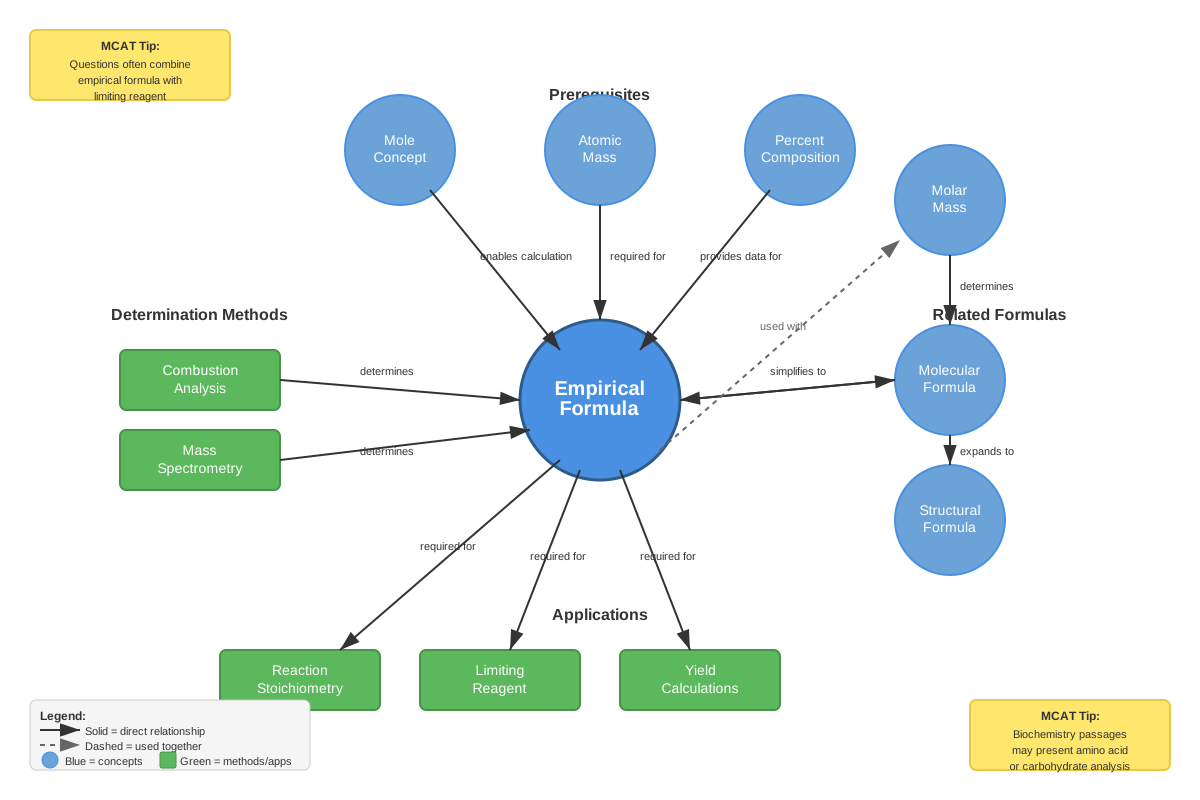
The empirical formula concept sits at the intersection of multiple General Chemistry principles, serving as a bridge between composition and structure. The foundational relationship flows: atomic mass → molar mass → mole calculations → mole ratios → empirical formula → molecular formula → structural formula. Each step builds upon the previous, with empirical formula representing the critical midpoint where quantitative composition data transforms into qualitative structural information.
Within Stoichiometry and Reactions, empirical formulas connect directly to balanced chemical equations. The subscripts in an empirical formula determine the stoichiometric coefficients needed to balance reactions involving that compound. This relationship extends to limiting reagent problems, where knowing the empirical formula allows calculation of theoretical yields and percent yields.
The empirical formula concept also links to percent composition through a bidirectional relationship: percent composition data enables empirical formula determination, while empirical formulas allow calculation of theoretical percent composition. This reciprocal connection appears frequently in MCAT questions that ask students to verify experimental results or identify unknown compounds.
Combustion analysis represents the experimental manifestation of empirical formula determination, connecting laboratory techniques to theoretical calculations. The products of combustion (CO₂ and H₂O) provide indirect measurement of the original compound's composition, demonstrating how stoichiometry principles apply to analytical chemistry.
Finally, empirical formulas connect forward to more advanced topics: molecular formulas require empirical formulas plus molar mass data, structural formulas build upon molecular formulas, and isomer identification depends on distinguishing compounds with identical molecular formulas but different structures. This progression from simplest ratio to three-dimensional structure represents a fundamental theme in chemistry education and MCAT testing.
Quick check — test yourself on Empirical formula so far.
Try Flashcards →High-Yield Facts
⭐ The empirical formula represents the simplest whole-number ratio of atoms in a compound, not the actual number of atoms
⭐ To find empirical formula from percent composition: assume 100g sample, convert to moles, divide by smallest, multiply to get whole numbers
⭐ Molecular formula = (Empirical formula)ₙ, where n = molar mass of compound ÷ molar mass of empirical formula
⭐ In combustion analysis, moles of C = moles of CO₂, and moles of H = 2 × moles of H₂O
⭐ When mole ratios contain 0.5, multiply all ratios by 2; for 0.33 or 0.67, multiply by 3; for 0.25 or 0.75, multiply by 4
- Multiple compounds can share the same empirical formula (e.g., CH for C₂H₂, C₆H₆, C₈H₈)
- Ionic compounds are always written in empirical formula form because they exist as extended lattices
- Oxygen content in organic compounds is typically determined by subtraction after finding C and H from combustion products
- The empirical formula mass is always a factor of the molecular formula mass
- All alkenes (CₙH₂ₙ) have the empirical formula CH₂ regardless of chain length
- Hydrated compounds like CuSO₄·5H₂O require determining the mole ratio between anhydrous compound and water
- Rounding mole ratios should only occur after multiplying to achieve whole numbers, not before
Common Misconceptions
Misconception: The empirical formula shows the actual number of atoms in a molecule.
Correction: The empirical formula shows only the simplest ratio of atoms. The molecular formula shows actual numbers. For example, hydrogen peroxide has molecular formula H₂O₂ but empirical formula HO.
Misconception: All compounds with the same molecular formula have the same empirical formula.
Correction: This is actually true—compounds with identical molecular formulas (isomers) do share the same empirical formula. However, compounds with the same empirical formula may have different molecular formulas (e.g., CH₂O could be CH₂O, C₂H₄O₂, or C₆H₁₂O₆).
Misconception: When calculating empirical formulas, mole ratios should be rounded to the nearest whole number immediately after dividing by the smallest value.
Correction: Premature rounding causes errors. If ratios are 1:1.5:1, rounding 1.5 to 2 is incorrect. Instead, multiply all ratios by 2 to get 2:3:2. Only round when values are within 0.1 of a whole number (e.g., 2.05 or 1.98).
Misconception: In combustion analysis, the mass of oxygen in CO₂ and H₂O comes from the original compound.
Correction: The oxygen in combustion products comes from BOTH the original compound AND the excess O₂ used for combustion. Only the carbon and hydrogen in products come exclusively from the original compound. Oxygen content must be determined by subtracting C and H masses from the original sample mass.
Misconception: The empirical formula can be determined from a balanced chemical equation alone.
Correction: Balanced equations show mole ratios between different compounds, not atom ratios within a single compound. Empirical formulas require composition data (percent composition, combustion analysis results, or direct mass measurements), not reaction stoichiometry.
Misconception: Molecular formulas are always different from empirical formulas.
Correction: For some compounds, the molecular formula equals the empirical formula (n=1). Examples include H₂O, CO₂, NH₃, and CH₄. These compounds are already in their simplest ratio form.
Worked Examples
Example 1: Empirical Formula from Percent Composition
Problem: A compound used as a food preservative contains 40.0% carbon, 6.7% hydrogen, and 53.3% oxygen by mass. Determine its empirical formula.
Solution:
Step 1: Assume a 100.0 g sample to convert percentages to grams
- Carbon: 40.0 g
- Hydrogen: 6.7 g
- Oxygen: 53.3 g
Step 2: Convert each element's mass to moles using atomic masses (C = 12.0 g/mol, H = 1.0 g/mol, O = 16.0 g/mol)
- Moles of C = 40.0 g ÷ 12.0 g/mol = 3.33 mol
- Moles of H = 6.7 g ÷ 1.0 g/mol = 6.7 mol
- Moles of O = 53.3 g ÷ 16.0 g/mol = 3.33 mol
Step 3: Divide all mole values by the smallest number of moles (3.33)
- C: 3.33 ÷ 3.33 = 1.00
- H: 6.7 ÷ 3.33 = 2.01 ≈ 2.0
- O: 3.33 ÷ 3.33 = 1.00
Step 4: The ratios are already whole numbers (within rounding error)
Step 5: Write the empirical formula using these ratios as subscripts
Answer: CH₂O
Connection to Learning Objectives: This problem demonstrates the standard procedure for empirical formula determination from percent composition, applying the systematic approach essential for MCAT success. The compound is formaldehyde (molecular formula CH₂O) or could be glucose (C₆H₁₂O₆) or acetic acid (C₂H₄O₂)—all share this empirical formula.
Example 2: Combustion Analysis with Molecular Formula Determination
Problem: A 0.500 g sample of an unknown hydrocarbon undergoes complete combustion, producing 1.650 g of CO₂ and 0.675 g of H₂O. The molar mass of the compound is determined to be 84.0 g/mol. Determine both the empirical formula and molecular formula.
Solution:
Step 1: Calculate moles of carbon from CO₂ produced
- Molar mass of CO₂ = 44.0 g/mol
- Moles of CO₂ = 1.650 g ÷ 44.0 g/mol = 0.0375 mol
- Moles of C = 0.0375 mol (1:1 ratio with CO₂)
Step 2: Calculate moles of hydrogen from H₂O produced
- Molar mass of H₂O = 18.0 g/mol
- Moles of H₂O = 0.675 g ÷ 18.0 g/mol = 0.0375 mol
- Moles of H = 2 × 0.0375 mol = 0.0750 mol (2 H per H₂O)
Step 3: Check if oxygen is present by calculating mass of C and H
- Mass of C = 0.0375 mol × 12.0 g/mol = 0.450 g
- Mass of H = 0.0750 mol × 1.0 g/mol = 0.075 g
- Total mass = 0.450 + 0.075 = 0.525 g
Since 0.525 g > 0.500 g (the original sample), there's a rounding issue, but the compound is a hydrocarbon (C and H only).
Step 4: Determine mole ratio
- C: 0.0375 mol ÷ 0.0375 = 1
- H: 0.0750 mol ÷ 0.0375 = 2
Empirical formula: CH₂
Step 5: Determine molecular formula using molar mass
- Empirical formula mass = 12.0 + 2(1.0) = 14.0 g/mol
- n = 84.0 g/mol ÷ 14.0 g/mol = 6
- Molecular formula = (CH₂)₆ = C₆H₁₂
Answer: Empirical formula = CH₂; Molecular formula = C₆H₁₂
Connection to Learning Objectives: This problem integrates combustion analysis with molecular formula determination, demonstrating how multiple pieces of information combine to fully characterize an unknown compound. The compound could be cyclohexane or any hexene isomer, all sharing the molecular formula C₆H₁₂.
Exam Strategy
Approaching MCAT Empirical Formula Questions: Begin by identifying what type of data the question provides. Percent composition problems require the "assume 100g" approach, while combustion analysis requires extracting carbon from CO₂ and hydrogen from H₂O. Always write down the systematic steps rather than attempting mental calculations—this reduces errors and allows partial credit recovery if time runs short.
Trigger Words and Phrases: Watch for these key phrases that signal empirical formula questions:
- "Simplest formula" or "simplest ratio" = empirical formula
- "Combustion produces X grams of CO₂ and Y grams of H₂O" = combustion analysis
- "Percent composition by mass" = percent composition to empirical formula
- "Molar mass is determined to be..." = proceed to molecular formula after finding empirical
- "Elemental analysis reveals..." = composition data provided
Process of Elimination Tips: When answer choices show different formulas, quickly eliminate options that:
- Don't reduce to simplest ratios (e.g., C₂H₄ cannot be an empirical formula because it reduces to CH₂)
- Have impossible mole ratios based on the given data (check if the ratios match your calculations)
- Show molecular formulas when the question asks for empirical formulas
- Have incorrect molar masses when molecular formula is requested
Time Allocation: Empirical formula calculations typically require 1.5-2 minutes for straightforward problems. If a question requires both empirical and molecular formula determination, allocate 2.5-3 minutes. If you find yourself spending more than 3 minutes, flag the question and return later—these are medium-difficulty questions that shouldn't consume excessive time.
Strategic Tip: On combustion analysis problems, immediately write the key relationships: moles C = moles CO₂, and moles H = 2 × moles H₂O. This prevents the common error of forgetting the 2:1 ratio for hydrogen.
Calculator Efficiency: The MCAT provides a basic calculator. For empirical formula problems, perform divisions in order: calculate all moles first, then divide all by the smallest value. Keep at least three significant figures during intermediate steps to avoid rounding errors, but recognize that final subscripts must be whole numbers.
Memory Techniques
MNEMONIC for Empirical Formula Steps - "ACDRW":
- Assume 100 grams
- Convert to moles
- Divide by smallest
- Ratio to whole numbers (multiply if needed)
- Write the formula
VISUALIZATION Strategy: Picture empirical formulas as "reduced fractions" for molecules. Just as 6/12 reduces to 1/2, C₆H₁₂O₆ reduces to CH₂O. This analogy helps remember that empirical formulas represent the simplest ratio.
ACRONYM for Combustion Analysis - "CHOPS":
- Carbon from CO₂ (1:1 ratio)
- Hydrogen from H₂O (1:2 ratio)
- Oxygen by subtraction
- Products give you C and H
- Subtract to find O
Multiplication Factors Memory Aid: Remember "Half-Double, Third-Triple, Quarter-Quadruple"
- 0.5 in ratio → multiply by 2
- 0.33 or 0.67 in ratio → multiply by 3
- 0.25 or 0.75 in ratio → multiply by 4
Pattern Recognition: Common empirical formulas to memorize:
- Alkenes: CH₂
- Alkynes: CH
- Carbohydrates: CH₂O
- Many organic acids: CH₂O (or variations)
Summary
The empirical formula represents the cornerstone of compositional analysis in General Chemistry, expressing the simplest whole-number ratio of atoms in a compound. Mastery requires understanding both the conceptual distinction between empirical and molecular formulas and the systematic procedures for calculating empirical formulas from experimental data. The standard approach—assuming 100g samples, converting to moles, establishing ratios, and converting to whole numbers—applies universally to percent composition problems. Combustion analysis extends this foundation by requiring extraction of elemental information from product masses, with the critical relationships that carbon moles equal CO₂ moles and hydrogen moles equal twice H₂O moles. For MCAT success, students must recognize that empirical formula determination often serves as the first step toward molecular formula identification, requiring integration with molar mass data. The ability to move fluidly between composition data, empirical formulas, and molecular formulas while avoiding common pitfalls like premature rounding or misinterpreting combustion product oxygen represents essential competency for test day.
Key Takeaways
- The empirical formula shows the simplest whole-number ratio of atoms, while the molecular formula shows actual numbers; multiple compounds can share the same empirical formula
- The systematic five-step process (assume 100g, convert to moles, divide by smallest, multiply to whole numbers, write formula) applies to all percent composition problems
- In combustion analysis, moles of C = moles of CO₂ and moles of H = 2 × moles of H₂O; oxygen is determined by subtraction from original sample mass
- Molecular formula = (Empirical formula)ₙ where n = compound molar mass ÷ empirical formula mass
- When mole ratios contain 0.5, multiply by 2; for 0.33/0.67, multiply by 3; for 0.25/0.75, multiply by 4—never round prematurely
- Empirical formula questions appear in 3-5% of MCAT General Chemistry content, typically as medium-difficulty problems requiring 1.5-3 minutes
- Common mistakes include confusing empirical with molecular formulas, premature rounding, and mishandling oxygen in combustion analysis
Related Topics
Molecular Formula Determination: Building directly on empirical formulas, this topic explores how molar mass data enables calculation of actual molecular formulas, essential for identifying specific compounds rather than just compositional ratios.
Percent Composition: The reciprocal relationship with empirical formulas—percent composition provides input data for empirical formula calculations, while empirical formulas enable theoretical percent composition predictions.
Combustion Reactions: Understanding complete combustion stoichiometry provides the theoretical foundation for combustion analysis, connecting reaction balancing to analytical chemistry applications.
Limiting Reagents and Theoretical Yield: Empirical and molecular formulas determine the stoichiometric relationships needed for these calculations, extending compositional knowledge to quantitative reaction predictions.
Structural Isomers: Compounds sharing molecular formulas but differing in structure demonstrate why empirical formulas alone provide insufficient information for complete compound identification, motivating the study of structural chemistry.
Practice CTA
Now that you've mastered the fundamental concepts of empirical formulas, it's time to solidify your understanding through active practice. Challenge yourself with the accompanying practice questions that mirror actual MCAT question styles, including combustion analysis passages and multi-step calculations. Use the flashcards to reinforce the systematic procedures and key relationships until they become automatic. Remember: empirical formula problems reward methodical approaches and careful attention to detail—skills that improve dramatically with deliberate practice. Your ability to confidently navigate these questions will not only boost your General Chemistry score but also strengthen the foundational skills needed for success across all MCAT science sections. Start practicing now to transform conceptual understanding into test-day mastery!
Sign up free to keep reading
Create a free AnvayaPrep account to finish this MCAT guide on Empirical formula — plus flashcards and practice questions.