Overview
The concept of the mole stands as one of the most fundamental pillars in General Chemistry and serves as the universal language chemists use to count and measure atoms, molecules, and ions. A mole is defined as exactly 6.02214076 × 10²³ elementary entities (atoms, molecules, ions, or other particles), a number known as Avogadro's number. This seemingly abstract concept bridges the microscopic world of individual atoms with the macroscopic world of laboratory measurements, allowing chemists to convert between the mass of a substance, the number of particles it contains, and the volume it occupies under specific conditions.
For the MCAT, understanding moles is absolutely essential because it forms the foundation for virtually all quantitative chemistry problems. Whether calculating reactant quantities in biochemical pathways, determining gas volumes in respiratory physiology, or analyzing solution concentrations in renal function, mole calculations appear throughout the Chemical and Physical Foundations of Biological Systems section. The mole concept integrates seamlessly with stoichiometry, limiting reagents, solution chemistry, gas laws, and thermodynamics—making it impossible to achieve a competitive MCAT score without mastery of this topic.
Within the broader context of Stoichiometry and Reactions, the mole serves as the conversion factor that transforms balanced chemical equations from symbolic representations into quantitative predictions. This topic connects directly to atomic structure (understanding what we're counting), chemical formulas (determining molar mass), solution chemistry (molarity calculations), gas laws (molar volume), and reaction yields (theoretical versus actual amounts). Mastering moles provides the mathematical framework necessary for understanding how chemical reactions proceed quantitatively in biological systems.
Learning Objectives
- [ ] Define moles using accurate General Chemistry terminology
- [ ] Explain why moles matters for the MCAT
- [ ] Apply moles to exam-style questions
- [ ] Identify common mistakes related to moles
- [ ] Connect moles to related General Chemistry concepts
- [ ] Calculate the number of moles from mass, number of particles, or gas volume under standard conditions
- [ ] Interconvert between moles, grams, molecules, atoms, and liters for various substances
- [ ] Apply mole concepts to determine empirical and molecular formulas from experimental data
- [ ] Use molar relationships to solve multi-step stoichiometry problems involving limiting reagents and percent yield
Prerequisites
- Atomic structure and the periodic table: Understanding atomic mass units and how to read atomic masses from the periodic table is essential for calculating molar mass
- Basic algebra and unit conversion: Mole calculations require dimensional analysis and the ability to manipulate ratios and proportions
- Chemical formulas and nomenclature: Interpreting subscripts in chemical formulas is necessary to determine the number of atoms of each element in a compound
- Scientific notation: Avogadro's number and particle counts require comfort with very large numbers expressed in exponential form
- Balancing chemical equations: Stoichiometric calculations depend on correctly balanced equations to establish mole ratios
Why This Topic Matters
The mole concept appears in approximately 15-20% of General Chemistry questions on the MCAT, making it one of the highest-yield topics in the entire chemistry curriculum. Beyond direct calculation questions, mole-based reasoning underlies nearly every quantitative chemistry problem, including those in biochemistry passages about enzyme kinetics, metabolism, and drug concentrations. Medical professionals use mole-based units daily: drug dosages are often expressed in millimoles, blood chemistry panels report electrolyte concentrations in millimoles per liter (mmol/L), and understanding acid-base balance requires mole calculations.
In clinical contexts, the mole concept enables physicians to understand drug pharmacokinetics, calculate appropriate medication doses based on molecular weight, interpret laboratory values, and understand the quantitative relationships in metabolic pathways. For example, understanding that one mole of glucose yields a specific number of moles of ATP through cellular respiration requires mole-based stoichiometric thinking. Similarly, calculating the number of oxygen molecules needed for complete combustion of fatty acids or determining the buffering capacity of blood both depend on mole relationships.
On the MCAT, mole questions typically appear in three formats: (1) standalone discrete questions testing direct conversions between mass, moles, and particles; (2) passage-based questions embedded in experimental chemistry contexts requiring multi-step stoichiometric calculations; and (3) integrated questions in biochemistry or physiology passages where mole concepts support understanding of biological processes. The exam frequently tests whether students can recognize when to apply mole conversions, select appropriate conversion factors, and execute calculations efficiently under time pressure.
Core Concepts
Definition and Fundamental Nature of the Mole
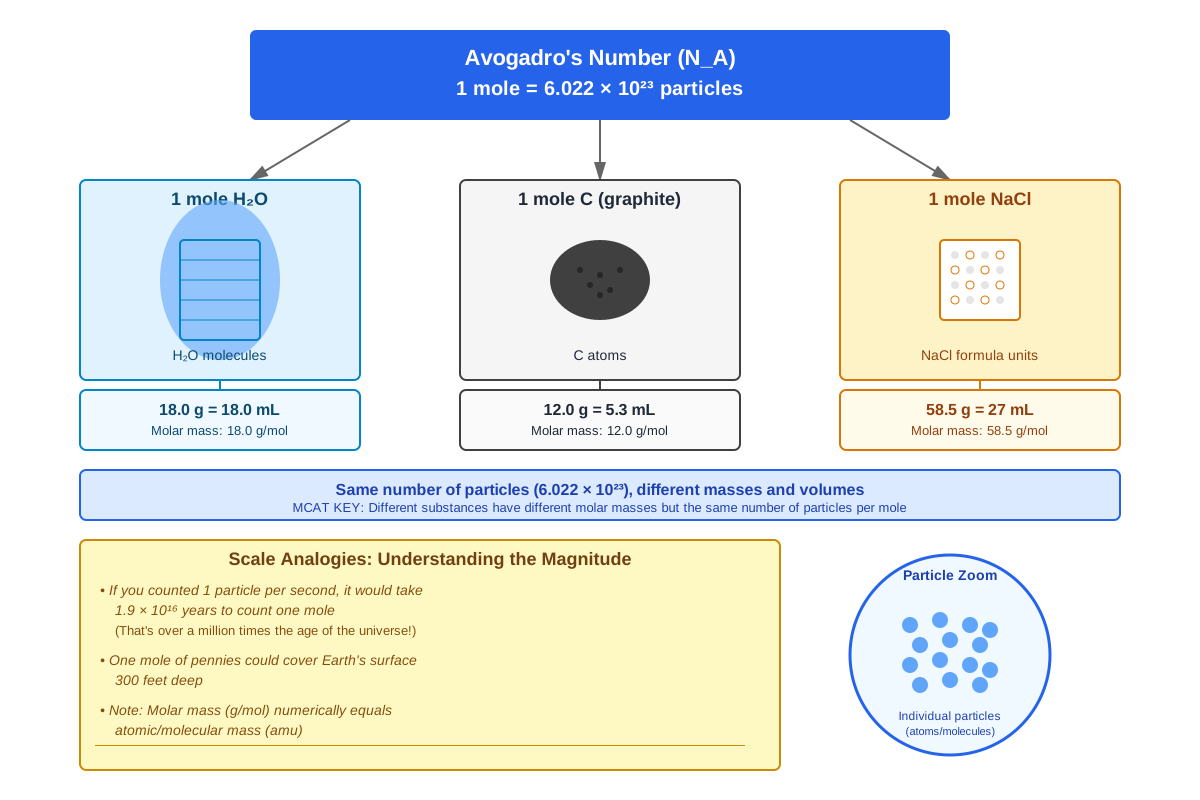
The mole (abbreviated mol) is the SI base unit for the amount of substance, defined as exactly 6.02214076 × 10²³ elementary entities. This number, called Avogadro's number (Nₐ), was chosen because it represents the number of carbon-12 atoms in exactly 12 grams of carbon-12. The mole serves as a "chemist's dozen"—just as a dozen always means 12 items regardless of what those items are, a mole always means 6.022 × 10²³ entities regardless of whether those entities are atoms, molecules, ions, electrons, or any other specified particle.
The power of the mole lies in its connection to measurable mass. One mole of any element has a mass in grams numerically equal to its atomic mass in atomic mass units (amu). For example, carbon has an atomic mass of 12.01 amu, so one mole of carbon atoms has a mass of 12.01 grams. This relationship extends to compounds: the molar mass of a compound (expressed in g/mol) equals the sum of the atomic masses of all atoms in its molecular formula.
Molar Mass Calculations
Molar mass represents the mass of one mole of a substance and serves as the critical conversion factor between mass and moles. To calculate molar mass:
- Write the molecular formula of the compound
- Identify the number of atoms of each element
- Multiply each element's atomic mass by the number of atoms present
- Sum all contributions to obtain the total molar mass
For example, glucose (C₆H₁₂O₆) has a molar mass calculated as:
- Carbon: 6 atoms × 12.01 g/mol = 72.06 g/mol
- Hydrogen: 12 atoms × 1.008 g/mol = 12.096 g/mol
- Oxygen: 6 atoms × 16.00 g/mol = 96.00 g/mol
- Total molar mass = 180.16 g/mol
For the MCAT, students should be able to quickly estimate molar masses using rounded atomic masses (C = 12, H = 1, O = 16, N = 14, etc.) to save time during calculations.
The Mole Conversion Triangle
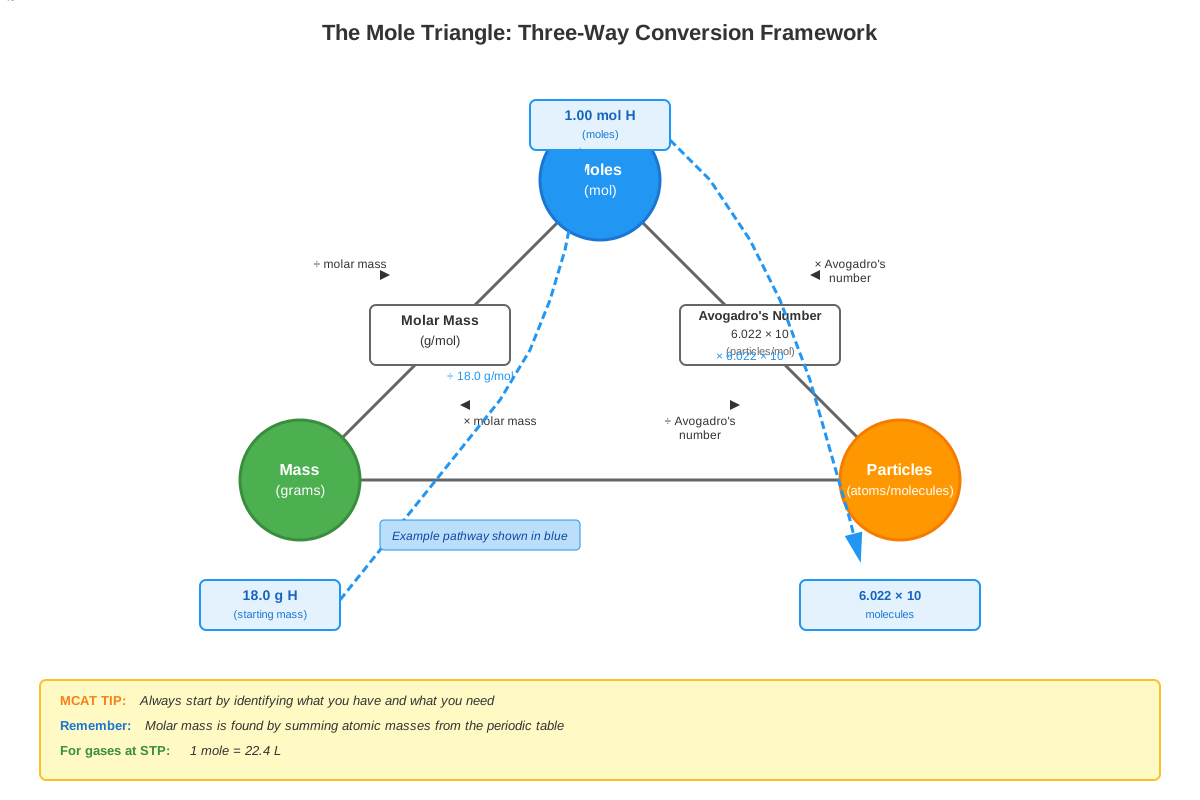
The fundamental mole conversions form a triangle connecting three quantities: mass (grams), amount (moles), and number of particles. These conversions use two key relationships:
Mass (g) ←→ Moles (mol) ←→ Number of particles
    ↓           ↑              ↓
Molar mass   Avogadro's number
  (g/mol)    (6.022 × 10²³/mol)
Converting mass to moles:
moles = mass (g) / molar mass (g/mol)Converting moles to particles:
number of particles = moles × Avogadro's numberConverting mass directly to particles (combining both steps):
number of particles = (mass / molar mass) × Avogadro's numberMoles in Chemical Formulas
Chemical formulas encode mole relationships at the molecular level. The subscripts in a formula indicate the mole ratio of elements within the compound. For water (H₂O), the subscripts tell us that:
- 1 molecule contains 2 atoms of H and 1 atom of O
- 1 mole of H₂O contains 2 moles of H atoms and 1 mole of O atoms
- 1 mole of H₂O molecules contains 3 moles of total atoms
This principle extends to more complex formulas. For calcium phosphate [Ca₃(PO₄)₂]:
- 1 mole of Ca₃(PO₄)₂ contains 3 moles of Ca, 2 moles of P, and 8 moles of O
- Total atoms per formula unit: 3 + 2 + 8 = 13 atoms
- 1 mole of Ca₃(PO₄)₂ contains 13 moles of atoms
Percent Composition and Empirical Formulas
Percent composition describes the mass percentage of each element in a compound and can be calculated from the molecular formula or determined experimentally. The percent composition of element X in a compound is:
% X = (mass of X in formula / molar mass of compound) × 100%The empirical formula represents the simplest whole-number ratio of atoms in a compound, while the molecular formula shows the actual number of atoms. To determine an empirical formula from percent composition:
- Assume 100 g of compound (converts percentages to grams)
- Convert mass of each element to moles
- Divide all mole values by the smallest number of moles
- Multiply by the smallest integer that produces whole numbers
The molecular formula is always a whole-number multiple of the empirical formula, determined by comparing the empirical formula mass to the actual molar mass.
Moles in Solutions
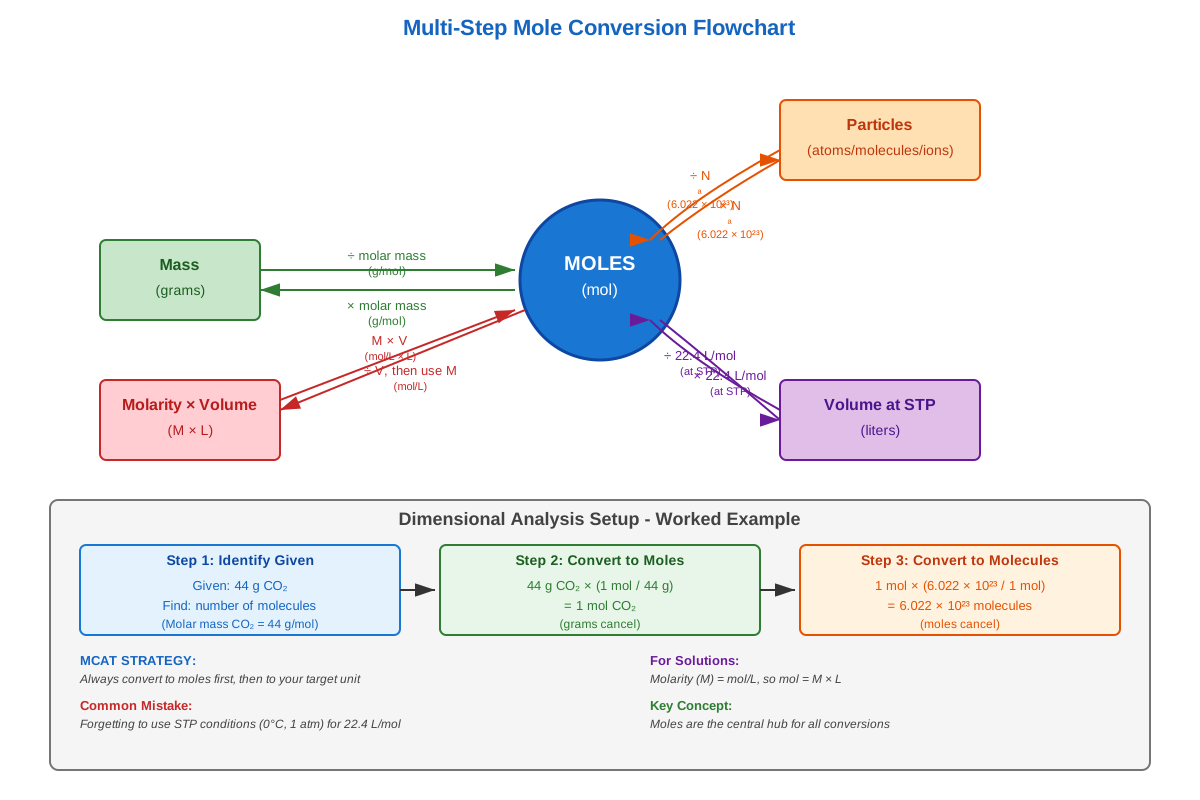
In solution chemistry, molarity (M) expresses concentration as moles of solute per liter of solution:
Molarity (M) = moles of solute / liters of solutionThis relationship allows conversion between solution volume and moles:
moles = Molarity × Volume (L)For dilution problems, the number of moles remains constant, leading to the dilution equation:
M₁V₁ = M₂V₂Understanding molarity is crucial for MCAT passages involving buffer systems, titrations, and biological fluid compositions.
Moles and Gas Laws
Under standard temperature and pressure (STP: 0°C and 1 atm), one mole of any ideal gas occupies 22.4 liters. This molar volume provides another conversion pathway:
moles of gas = volume (L) at STP / 22.4 L/molThe ideal gas law (PV = nRT) generalizes this relationship for any conditions, where n represents moles. This connection between moles and gas volume is essential for understanding respiratory physiology and gas exchange in biological systems.
Concept Relationships
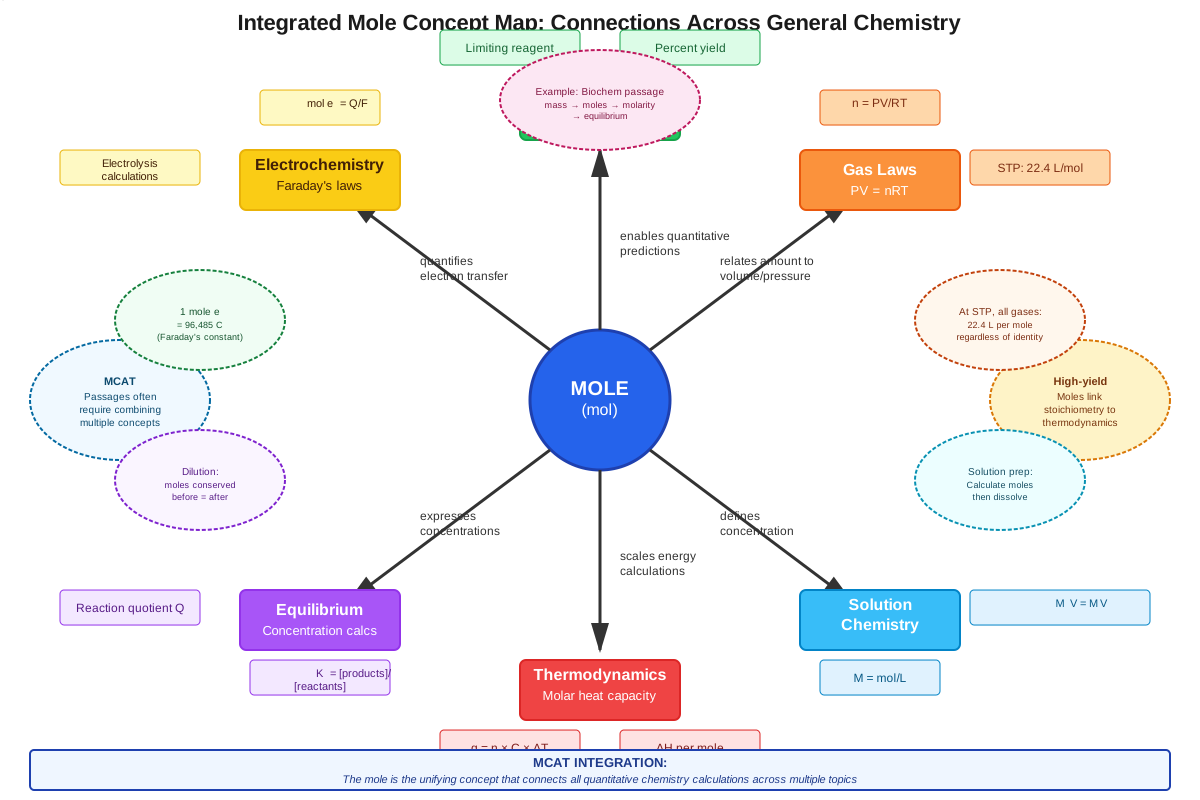
The mole concept serves as the central hub connecting multiple areas of General Chemistry. At the most fundamental level, atomic structure provides the basis for atomic mass, which determines molar mass. The periodic table organization reflects atomic mass trends, making it the primary reference tool for mole calculations.
Moving outward, moles connect directly to stoichiometry: balanced chemical equations provide mole ratios between reactants and products, enabling quantitative predictions about reaction outcomes. This relationship flows as: balanced equation → mole ratios → mass relationships → limiting reagent determination → theoretical yield calculations.
In solution chemistry, moles bridge to concentration units (molarity, molality) and colligative properties (which depend on the number of moles of solute particles). The pathway is: moles of solute → molarity → osmotic pressure, boiling point elevation, and freezing point depression.
For gases, moles connect to gas laws through the ideal gas equation, linking amount of substance to pressure, volume, and temperature. This relationship extends to partial pressures (each gas contributes pressure proportional to its mole fraction) and gas stoichiometry in reactions.
In thermodynamics, moles appear in calculations of enthalpy changes (ΔH is typically expressed per mole), entropy (S has units of J/mol·K), and Gibbs free energy. The relationship flows: moles → heat absorbed or released → energy changes in biological systems.
The concept map can be visualized as:
Atomic Mass → Molar Mass → Moles ↔ Mass (grams)
↓
Moles ↔ Particles (Avogadro's number)
↓
Moles ↔ Volume (for gases)
↓
Moles ↔ Concentration (for solutions)
↓
Stoichiometric Calculations → Limiting Reagents → Percent Yield
Quick check — test yourself on Moles so far.
Try Flashcards →High-Yield Facts
⭐ One mole of any substance contains exactly 6.022 × 10²³ elementary entities (Avogadro's number)
⭐ Molar mass (g/mol) numerically equals the sum of atomic masses from the periodic table
⭐ The conversion formula moles = mass (g) / molar mass (g/mol) is the most frequently used relationship on the MCAT
⭐ At STP (0°C, 1 atm), one mole of any ideal gas occupies 22.4 L
⭐ Molarity (M) = moles of solute / liters of solution is essential for all solution stoichiometry problems
- The subscripts in a chemical formula represent mole ratios of elements within the compound
- Percent composition can be calculated from molar mass: (mass of element / total molar mass) × 100%
- The empirical formula represents the simplest whole-number ratio of atoms, while the molecular formula may be a multiple of this ratio
- In stoichiometric calculations, coefficients in balanced equations represent mole ratios between substances
- One mole of a compound contains Avogadro's number of molecules, but the number of total atoms depends on the molecular formula
- For dilution problems, M₁V₁ = M₂V₂ applies because the number of moles remains constant
- Molar mass serves as the conversion factor between the microscopic (atomic) scale and macroscopic (laboratory) scale
Common Misconceptions
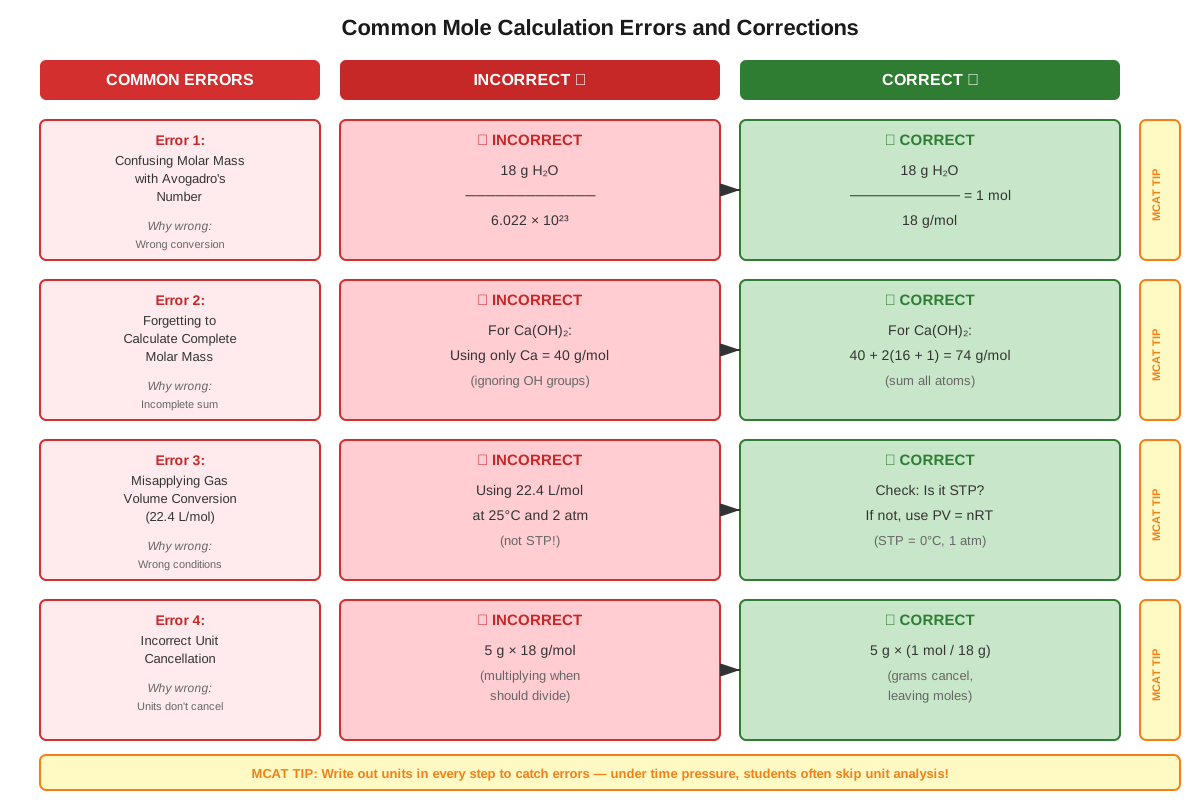
Misconception: A mole is a specific type of molecule or a unit of mass.
Correction: A mole is a counting unit (like "dozen") that represents 6.022 × 10²³ of any specified entity. It is not a unit of mass, though it relates to mass through molar mass. One mole of helium atoms has a different mass than one mole of uranium atoms, but both contain the same number of atoms.
Misconception: Avogadro's number applies only to atoms, not to molecules or ions.
Correction: Avogadro's number applies to any specified elementary entity. One mole of H₂O molecules contains 6.022 × 10²³ molecules, one mole of Na⁺ ions contains 6.022 × 10²³ ions, and one mole of electrons contains 6.022 × 10²³ electrons. The key is to specify what entity is being counted.
Misconception: The molar mass of a compound equals the sum of the molar masses of its elements without considering subscripts.
Correction: Molar mass must account for the number of atoms of each element. For H₂SO₄, the molar mass is not (1 + 32 + 16) g/mol, but rather [2(1) + 32 + 4(16)] = 98 g/mol. Each subscript multiplies the atomic mass of that element.
Misconception: One mole of any compound contains the same number of atoms.
Correction: One mole of any compound contains the same number of molecules (or formula units), but the number of atoms varies. One mole of H₂O contains 3 moles of atoms (2 H + 1 O), while one mole of C₆H₁₂O₆ contains 24 moles of atoms (6 + 12 + 6).
Misconception: In solution problems, molarity can be calculated as moles/mass of solvent.
Correction: Molarity is defined as moles of solute per liter of total solution, not per mass of solvent. This is different from molality (moles/kg of solvent). Confusing these definitions leads to incorrect concentration calculations.
Misconception: The 22.4 L/mol molar volume applies to all gases under any conditions.
Correction: The 22.4 L/mol value is specific to STP (0°C and 1 atm). At other temperatures and pressures, the molar volume differs and must be calculated using the ideal gas law (PV = nRT). At body temperature (37°C) and 1 atm, one mole of gas occupies approximately 25.4 L.
Misconception: When converting from mass to particles, you can skip the mole step and use a single conversion factor.
Correction: While mathematically you can combine conversion factors, conceptually you must recognize that mass → moles → particles requires two distinct steps: dividing by molar mass, then multiplying by Avogadro's number. Attempting shortcuts without understanding these steps leads to errors in unit cancellation.
Worked Examples
Example 1: Multi-Step Mole Conversion
Question: How many oxygen atoms are present in 45.0 g of glucose (C₆H₁₂O₆)?
Solution:
Step 1: Calculate the molar mass of glucose
- C: 6 × 12.01 g/mol = 72.06 g/mol
- H: 12 × 1.008 g/mol = 12.096 g/mol
- O: 6 × 16.00 g/mol = 96.00 g/mol
- Total molar mass = 180.16 g/mol (round to 180 g/mol for MCAT)
Step 2: Convert mass of glucose to moles of glucose
moles of glucose = 45.0 g / 180 g/mol = 0.25 mol glucoseStep 3: Determine moles of oxygen atoms
Each molecule of glucose contains 6 oxygen atoms, so each mole of glucose contains 6 moles of oxygen atoms:
moles of O atoms = 0.25 mol glucose × (6 mol O / 1 mol glucose) = 1.5 mol O atomsStep 4: Convert moles of oxygen atoms to number of atoms
number of O atoms = 1.5 mol × 6.022 × 10²³ atoms/mol = 9.03 × 10²³ atomsAnswer: 9.03 × 10²³ oxygen atoms
Key Concepts Applied: This problem demonstrates the complete conversion pathway from mass → moles of compound → moles of atoms → number of atoms. It requires understanding that subscripts in formulas represent mole ratios and that Avogadro's number converts moles to particles.
Example 2: Empirical and Molecular Formula Determination
Question: A compound is analyzed and found to contain 40.0% carbon, 6.7% hydrogen, and 53.3% oxygen by mass. If the molar mass of the compound is 180 g/mol, what are the empirical and molecular formulas?
Solution:
Step 1: Assume 100 g of compound (converts percentages to grams)
- 40.0 g C
- 6.7 g H
- 53.3 g O
Step 2: Convert mass of each element to moles
moles of C = 40.0 g / 12.01 g/mol = 3.33 mol
moles of H = 6.7 g / 1.008 g/mol = 6.65 mol
moles of O = 53.3 g / 16.00 g/mol = 3.33 mol
Step 3: Divide by the smallest number of moles (3.33)
C: 3.33 / 3.33 = 1
H: 6.65 / 3.33 = 2
O: 3.33 / 3.33 = 1
Step 4: Write the empirical formula
Empirical formula = CH₂O
Step 5: Calculate empirical formula mass
Empirical formula mass = 12 + 2(1) + 16 = 30 g/molStep 6: Determine the molecular formula
n = molar mass / empirical formula mass = 180 / 30 = 6Molecular formula = (CH₂O)₆ = C₆H₁₂O₆
Answer: Empirical formula is CH₂O; molecular formula is C₆H₁₂O₆ (glucose)
Key Concepts Applied: This problem integrates percent composition, mole conversions, empirical formula determination, and the relationship between empirical and molecular formulas. It demonstrates how experimental data (percent composition and molar mass) can be used to determine molecular structure.
Exam Strategy
When approaching MCAT questions involving moles, begin by identifying what quantity is given and what quantity is requested. Most problems require moving through the conversion triangle: mass ↔ moles ↔ particles (or volume for gases). Write down the conversion pathway before calculating to avoid skipping steps.
Trigger words and phrases to recognize:
- "How many molecules/atoms" → signals need for Avogadro's number
- "Mass of" or "grams of" → signals need for molar mass conversion
- "Concentration" or "molarity" → signals moles = M × V
- "At STP" → signals use of 22.4 L/mol for gases
- "Percent composition" → signals need to find mass contribution of each element
- "Empirical formula" → signals need to find simplest ratio
Process of elimination strategies:
- Check units in answer choices first—if the question asks for moles but an answer has units of grams or molecules, eliminate it immediately
- Estimate magnitude using powers of 10—if you're converting 1 gram of a substance with molar mass ~100 g/mol, expect ~0.01 moles, not 10 moles
- For stoichiometry problems, eliminate answers that violate conservation of mass or produce impossible ratios
- When multiple conversion steps are needed, eliminate answers that could only result from skipping a step
Time allocation advice:
- Simple one-step conversions (mass to moles or moles to particles): 30-45 seconds
- Multi-step stoichiometry problems: 60-90 seconds
- Empirical/molecular formula problems: 90-120 seconds
- If a calculation appears to require more than 2 minutes, look for a conceptual shortcut or estimation approach
Calculation efficiency tips:
- Round atomic masses to whole numbers for estimation (C = 12, O = 16, N = 14)
- Recognize common molar masses: H₂O = 18, CO₂ = 44, NaCl = 58.5, glucose = 180
- Use scientific notation throughout to avoid errors with very large or small numbers
- For Avogadro's number, 6 × 10²³ is sufficient for most MCAT calculations
Memory Techniques
Mnemonic for conversion pathway: "Mary Makes Awesome Pies"
- Mass (grams) → Molar mass → Amount (moles) → Avogadro's number → Particles
Mnemonic for molar volume at STP: "Two Twins For Lunch" = 22.4 L/mol
- Two Two = 22
- Four = .4
- Lunch = Liters
Visualization strategy for Avogadro's number:
Imagine a mole of pennies could cover the entire Earth's surface to a depth of several hundred meters. This helps conceptualize the enormous magnitude of 6.022 × 10²³. One mole of sand grains would cover the United States to a depth of several feet. This visualization reinforces that moles are used because individual atoms are incredibly tiny and numerous.
Acronym for solution concentration: "Moles Very Likely" = M = moles/L
This reminds you that molarity uses liters of solution (not volume of solvent or mass of solvent)
Memory aid for empirical formula determination: "Assume, Convert, Divide, Multiply"
- Assume 100 g sample
- Convert percentages to moles
- Divide by smallest
- Multiply to get whole numbers
Conceptual anchor: Remember that the mole is simply a counting unit, like "dozen." Just as 1 dozen eggs = 12 eggs and 1 dozen cars = 12 cars (different masses), 1 mole of H atoms and 1 mole of C atoms both contain the same number of atoms (6.022 × 10²³) but have different masses.
Summary
The mole is the fundamental counting unit in chemistry, representing 6.022 × 10²³ elementary entities and serving as the bridge between the atomic scale and laboratory measurements. Mastery of mole concepts requires understanding three core conversion relationships: mass to moles (using molar mass), moles to particles (using Avogadro's number), and moles to volume (for gases at STP or using the ideal gas law). These conversions form the foundation for all quantitative chemistry on the MCAT, including stoichiometry, solution chemistry, gas laws, and thermodynamics. Success with mole problems depends on recognizing the conversion pathway needed, applying dimensional analysis systematically, and understanding that subscripts in chemical formulas represent mole ratios. The ability to quickly calculate molar mass, interconvert between mass and moles, and apply mole ratios from balanced equations is essential for achieving a competitive MCAT score, as these skills appear in approximately 15-20% of chemistry questions and underlie quantitative reasoning in biochemistry and physiology passages.
Key Takeaways
- The mole is a counting unit equal to 6.022 × 10²³ entities, serving as the universal conversion factor between atomic-scale and laboratory-scale measurements
- Molar mass (g/mol) equals the sum of atomic masses from the periodic table and converts between mass and moles
- All mole conversions follow the pathway: mass ↔ moles ↔ particles, with molar mass and Avogadro's number as conversion factors
- Subscripts in chemical formulas represent mole ratios of elements, essential for stoichiometric calculations
- At STP, one mole of any ideal gas occupies 22.4 L; molarity (M) expresses solution concentration as moles per liter
- Empirical formulas show simplest whole-number ratios, while molecular formulas may be whole-number multiples of the empirical formula
- Systematic dimensional analysis and careful attention to units prevent the most common calculation errors on the MCAT
Related Topics
Stoichiometry and Limiting Reagents: Building directly on mole concepts, this topic applies mole ratios from balanced equations to determine which reactant limits product formation and calculate theoretical yields. Mastering moles is prerequisite to understanding reaction stoichiometry.
Solution Chemistry and Concentration Units: Molarity, molality, mole fraction, and other concentration expressions all depend on mole calculations. This topic extends mole concepts into the solution phase, essential for understanding biological fluids.
Gas Laws and Ideal Gas Behavior: The ideal gas law (PV = nRT) uses moles as the amount variable, connecting mole concepts to pressure, volume, and temperature relationships critical for respiratory physiology.
Thermochemistry and Enthalpy: Heat changes in reactions are typically expressed per mole (kJ/mol), requiring mole calculations to determine total energy changes in metabolic processes.
Acid-Base Chemistry and pH: Understanding buffer capacity, titration calculations, and pH changes all require mole-based reasoning about proton transfer and concentration changes.
Practice CTA
Now that you've mastered the foundational concepts of moles and their applications in General Chemistry, it's time to solidify your understanding through active practice. Challenge yourself with the practice questions and flashcards designed specifically for this topic—they'll help you identify any remaining gaps in your knowledge and build the speed and confidence you need for test day. Remember, the difference between understanding mole concepts and achieving a top MCAT score lies in deliberate practice with exam-style problems. You've built the foundation; now strengthen it through application. Your future patients are counting on the quantitative reasoning skills you're developing right now!
Sign up free to keep reading
Create a free AnvayaPrep account to finish this MCAT guide on Moles — plus flashcards and practice questions.