Overview
Enthalpy is a fundamental thermodynamic state function that quantifies the total heat content of a system at constant pressure. In General Chemistry, enthalpy serves as the cornerstone for understanding energy changes in chemical reactions, phase transitions, and physical processes. For the MCAT, enthalpy represents one of the most frequently tested concepts within thermodynamics, appearing in both discrete questions and passage-based scenarios across the Chemical and Physical Foundations of Biological Systems section. Mastery of enthalpy enables students to predict reaction spontaneity, calculate energy requirements for biological processes, and understand the energetics underlying metabolism, drug interactions, and physiological phenomena.
The significance of Enthalpy MCAT preparation extends beyond memorizing definitions and formulas. Students must develop an intuitive understanding of how enthalpy changes relate to bond breaking and formation, why certain reactions release heat while others absorb it, and how to manipulate thermochemical equations using Hess's Law. Enthalpy calculations frequently appear alongside other thermodynamic quantities such as entropy and Gibbs free energy, requiring integrated knowledge across multiple concepts. The MCAT tests not just computational ability but also conceptual understanding—distinguishing between system and surroundings, recognizing the sign conventions for exothermic versus endothermic processes, and applying standard enthalpy values to novel scenarios.
Within the broader landscape of General Chemistry, enthalpy connects intimately with chemical kinetics, equilibrium, electrochemistry, and acid-base chemistry. Understanding enthalpy changes helps predict whether reactions will proceed, how temperature affects equilibrium position, and why certain metabolic pathways require energy input while others release energy. The concept bridges physical chemistry principles with biological applications, making it essential for interpreting passages about cellular respiration, photosynthesis, protein folding, and pharmaceutical thermodynamics that commonly appear on the MCAT.
Learning Objectives
- [ ] Define Enthalpy using accurate General Chemistry terminology
- [ ] Explain why Enthalpy matters for the MCAT
- [ ] Apply Enthalpy to exam-style questions
- [ ] Identify common mistakes related to Enthalpy
- [ ] Connect Enthalpy to related General Chemistry concepts
- [ ] Calculate enthalpy changes using Hess's Law and standard formation enthalpies
- [ ] Distinguish between different types of enthalpy (formation, combustion, reaction, bond)
- [ ] Interpret enthalpy diagrams and reaction coordinate diagrams to determine energy changes
- [ ] Predict the sign and magnitude of enthalpy changes based on molecular structure and bonding
Prerequisites
- First Law of Thermodynamics: Understanding energy conservation is essential because enthalpy changes represent energy transfers between system and surroundings
- Basic stoichiometry and balanced equations: Enthalpy calculations require proper mole ratios and balanced chemical equations
- States of matter and phase transitions: Enthalpy changes accompany phase changes, requiring knowledge of solid, liquid, and gas properties
- Chemical bonding fundamentals: Bond breaking requires energy input while bond formation releases energy, forming the molecular basis of enthalpy changes
- Basic algebra and unit conversions: Enthalpy problems involve mathematical manipulation and converting between kilojoules and joules
Why This Topic Matters
Enthalpy appears in approximately 8-12% of MCAT Chemical and Physical Foundations questions, making it a medium-to-high yield topic that warrants thorough preparation. The concept appears in multiple question formats: discrete questions testing direct calculations, passage-based questions requiring interpretation of experimental thermodynamic data, and integrated questions connecting enthalpy to biological processes like ATP hydrolysis, metabolic pathways, or protein denaturation.
Clinically and biologically, enthalpy changes govern virtually every biochemical process in living organisms. Cellular respiration releases approximately 686 kcal/mol from glucose oxidation, providing the energy currency (ATP) that powers muscle contraction, nerve impulse transmission, and biosynthesis. Understanding enthalpy helps explain why fever increases metabolic rate, how brown adipose tissue generates heat through uncoupled respiration, and why certain drugs require energy input for absorption while others release energy upon binding to receptors. Pharmaceutical development relies heavily on enthalpy measurements to predict drug stability, solubility, and binding affinity to target proteins.
On the MCAT, enthalpy commonly appears in passages describing calorimetry experiments, metabolic studies, or thermochemical analyses of reaction mechanisms. Students encounter questions asking them to calculate reaction enthalpies from bond energies, determine heat released in combustion reactions, apply Hess's Law to multi-step pathways, or interpret enthalpy diagrams showing activation energy and overall energy change. The exam frequently tests the relationship between enthalpy and other thermodynamic functions, particularly in questions about spontaneity that require integrating enthalpy with entropy to calculate Gibbs free energy.
Core Concepts
Definition and Mathematical Representation
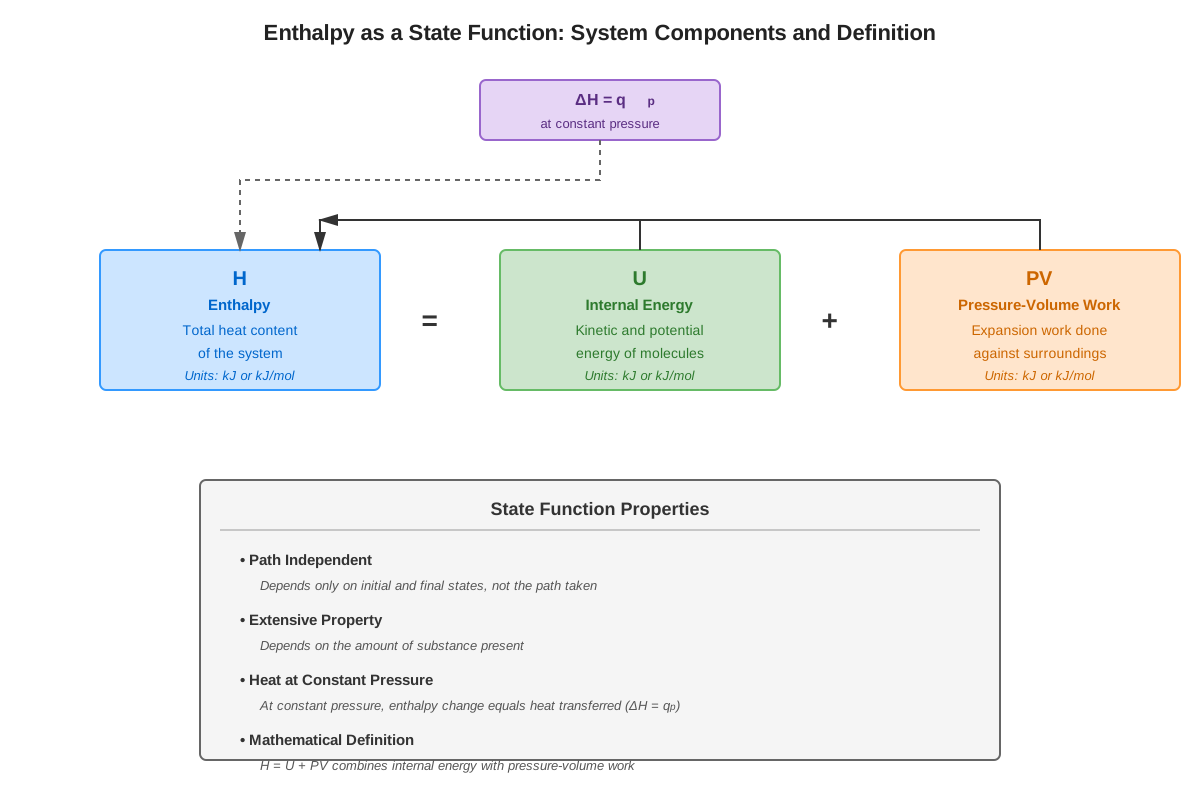
Enthalpy (H) is a state function defined as the sum of a system's internal energy (U) plus the product of pressure (P) and volume (V):
H = U + PVFor most chemical processes occurring at constant pressure (the typical laboratory and biological condition), the change in enthalpy (ΔH) equals the heat absorbed or released:
ΔH = q_pwhere q_p represents heat transfer at constant pressure. This relationship makes enthalpy particularly useful for studying reactions in open containers, biological systems, and atmospheric conditions where pressure remains essentially constant. The enthalpy change (ΔH) for a process is calculated as:
ΔH = H_final - H_initial = H_products - H_reactantsEnthalpy is an extensive property, meaning its value depends on the amount of substance present. Standard enthalpy values are typically reported per mole of reaction as written, with units of kJ/mol or kcal/mol.
Sign Conventions and Thermochemical Processes
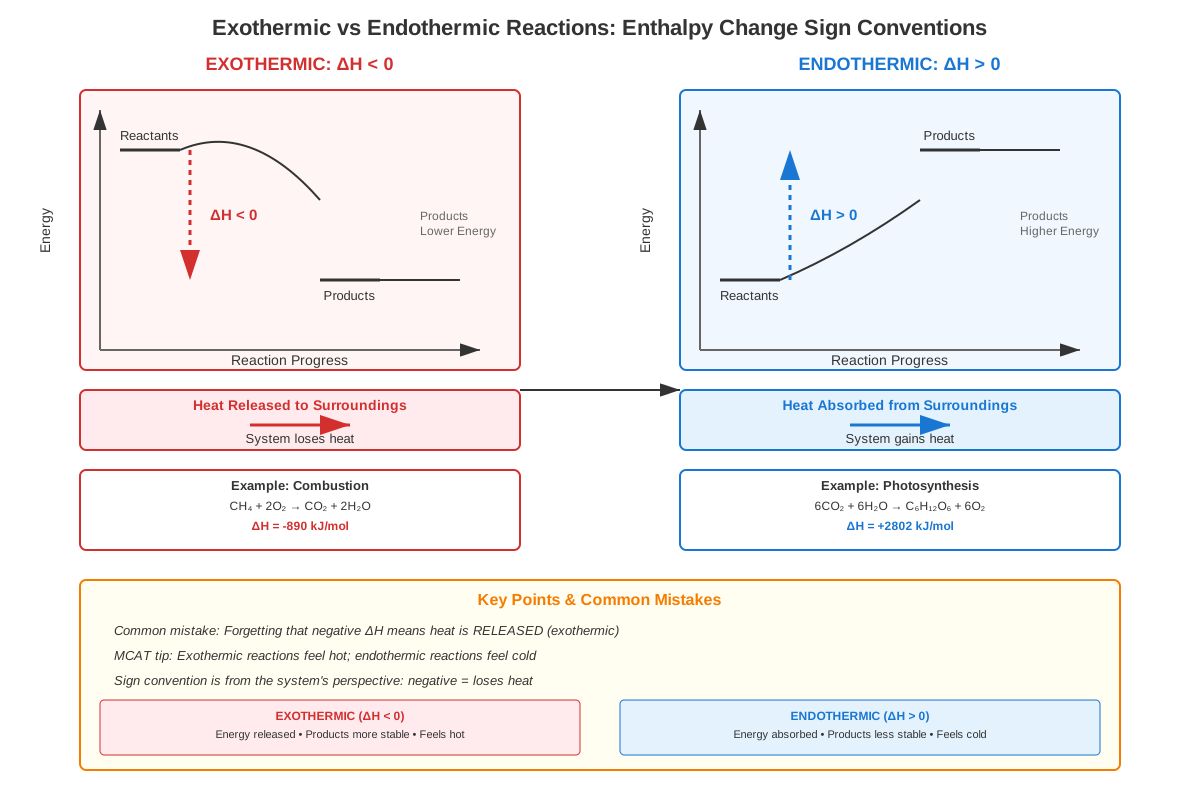
The sign of ΔH provides critical information about energy flow:
Exothermic processes (ΔH < 0, negative) release heat to the surroundings. The products have lower enthalpy than the reactants, and the system loses energy. Examples include:
- Combustion reactions (burning fuels)
- Neutralization reactions (acid + base)
- Condensation and freezing (gas → liquid → solid)
- Most bond formation processes
- Cellular respiration
Endothermic processes (ΔH > 0, positive) absorb heat from the surroundings. The products have higher enthalpy than the reactants, and the system gains energy. Examples include:
- Melting and vaporization (solid → liquid → gas)
- Photosynthesis
- Thermal decomposition reactions
- Most bond breaking processes
- Dissolving ammonium nitrate in water
MCAT Tip: The sign convention follows the system's perspective. If the system releases heat (exothermic), it loses energy, so ΔH is negative. If the system absorbs heat (endothermic), it gains energy, so ΔH is positive.
Standard Enthalpy of Formation
The standard enthalpy of formation (ΔH°f) represents the enthalpy change when one mole of a compound forms from its constituent elements in their standard states at 25°C (298 K) and 1 atm pressure. By definition, the standard enthalpy of formation for any element in its most stable form equals zero.
For example:
- ΔH°f [O₂(g)] = 0 kJ/mol (oxygen's standard state)
- ΔH°f [H₂O(l)] = -285.8 kJ/mol (formation from H₂ and O₂)
- ΔH°f [CO₂(g)] = -393.5 kJ/mol (formation from C and O₂)
The standard enthalpy of reaction (ΔH°rxn) can be calculated from formation enthalpies:
ΔH°rxn = Σ(n × ΔH°f,products) - Σ(n × ΔH°f,reactants)where n represents the stoichiometric coefficients. This method allows calculation of reaction enthalpies without performing calorimetry experiments, making it invaluable for predicting energetics of proposed reactions.
Hess's Law and Enthalpy Calculations
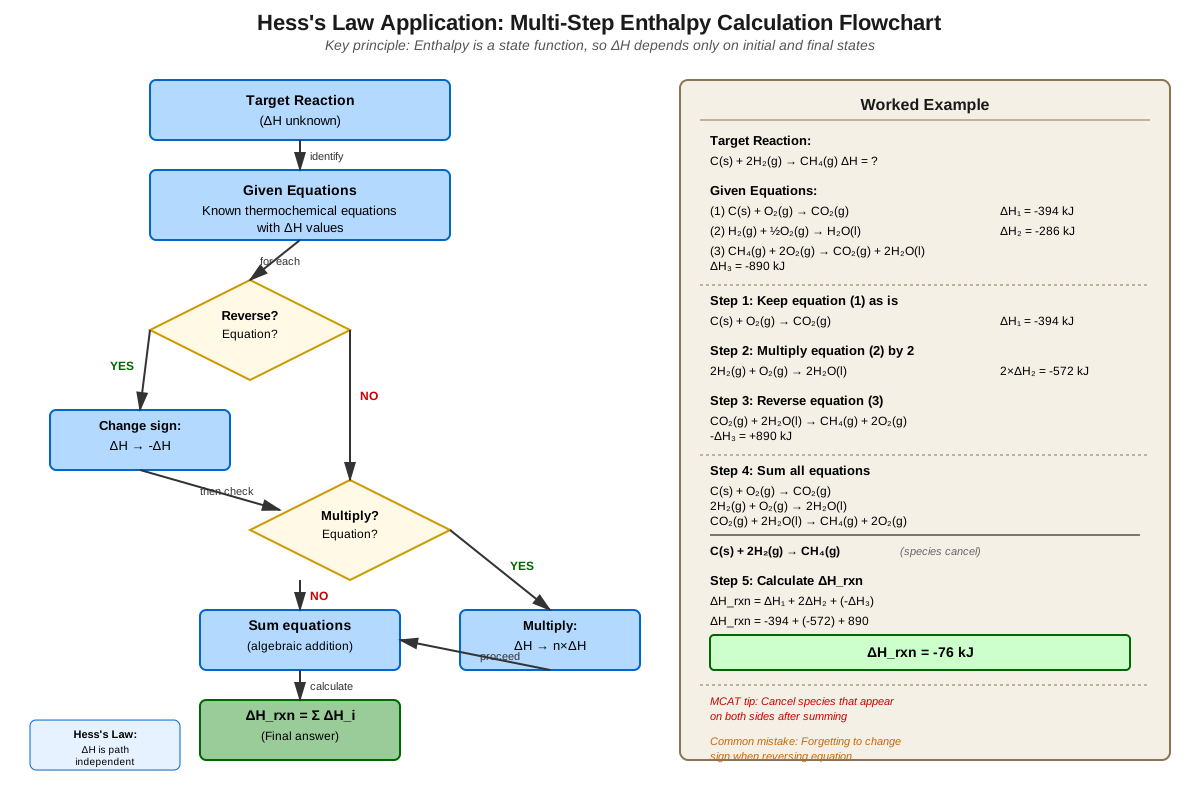
Hess's Law states that the total enthalpy change for a reaction is independent of the pathway taken—it depends only on the initial and final states. This principle reflects enthalpy's nature as a state function. Hess's Law enables calculation of difficult-to-measure enthalpy changes by combining known thermochemical equations.
When manipulating thermochemical equations:
- Reversing a reaction changes the sign of ΔH
- Multiplying coefficients by a factor multiplies ΔH by the same factor
- Adding equations adds their ΔH values
For example, to find ΔH for C(s) + ½O₂(g) → CO(g), combine:
- C(s) + O₂(g) → CO₂(g), ΔH₁ = -393.5 kJ
- CO(g) + ½O₂(g) → CO₂(g), ΔH₂ = -283.0 kJ
Reversing the second equation and adding:
- ΔH = ΔH₁ - ΔH₂ = -393.5 - (-283.0) = -110.5 kJ
Bond Enthalpy and Molecular Structure
Bond enthalpy (bond dissociation energy) represents the energy required to break one mole of a specific bond in the gas phase. Bond breaking is always endothermic (requires energy input), while bond formation is always exothermic (releases energy).
The enthalpy of reaction can be estimated from bond enthalpies:
ΔH°rxn ≈ Σ(bonds broken) - Σ(bonds formed)This approximation works best for gas-phase reactions and provides insight into why reactions occur. Reactions tend to be exothermic when stronger bonds form than those broken, and endothermic when weaker bonds form than those broken.
| Bond Type | Average Bond Enthalpy (kJ/mol) |
|---|---|
| C-C | 347 |
| C=C | 611 |
| C≡C | 837 |
| C-H | 413 |
| O-H | 463 |
| C=O | 745 |
| O=O | 498 |
Note that bond enthalpies are averages across different molecular environments and provide estimates rather than exact values.
Types of Enthalpy Changes
Several specialized enthalpy terms appear frequently on the MCAT:
Enthalpy of combustion (ΔH°comb): Heat released when one mole of substance burns completely in oxygen. Always negative (exothermic). Critical for understanding metabolism and fuel energy content.
Enthalpy of fusion (ΔH°fus): Energy required to melt one mole of solid to liquid at the melting point. Always positive (endothermic).
Enthalpy of vaporization (ΔH°vap): Energy required to convert one mole of liquid to gas at the boiling point. Always positive and larger than ΔH°fus for the same substance.
Enthalpy of solution (ΔH°soln): Heat change when one mole of solute dissolves in solvent. Can be positive or negative depending on the relative strengths of solute-solute, solvent-solvent, and solute-solvent interactions.
Enthalpy of neutralization: Heat released when acid and base react to form one mole of water. Approximately -57 kJ/mol for strong acid-strong base reactions.
Calorimetry and Experimental Determination
Enthalpy changes are measured experimentally using calorimetry. A calorimeter measures temperature changes resulting from chemical reactions or physical processes. The heat transferred is calculated using:
q = mcΔTwhere m is mass, c is specific heat capacity, and ΔT is temperature change. For constant-pressure calorimetry (coffee cup calorimeter), q equals ΔH directly.
The heat capacity (C) of a calorimeter represents the energy required to raise its temperature by 1°C:
q = CΔTMCAT problems often provide calorimeter data and ask students to calculate ΔH for reactions, requiring careful attention to sign conventions and whether the temperature change refers to the system or surroundings.
Concept Relationships
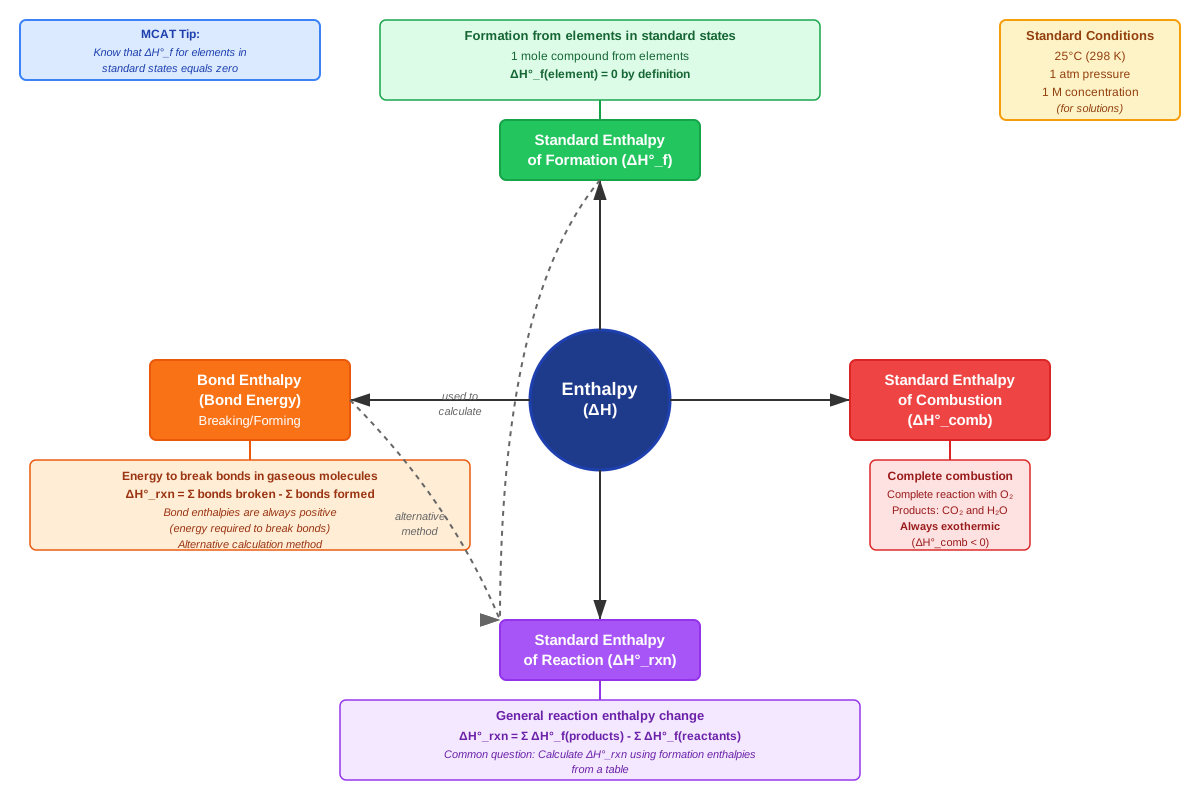
Enthalpy serves as a central hub connecting multiple thermodynamic and chemical concepts. The relationship begins with the First Law of Thermodynamics (conservation of energy), which establishes that enthalpy changes represent energy transfers between system and surroundings. This foundational principle leads directly to understanding exothermic and endothermic processes, which in turn connect to chemical kinetics through activation energy concepts.
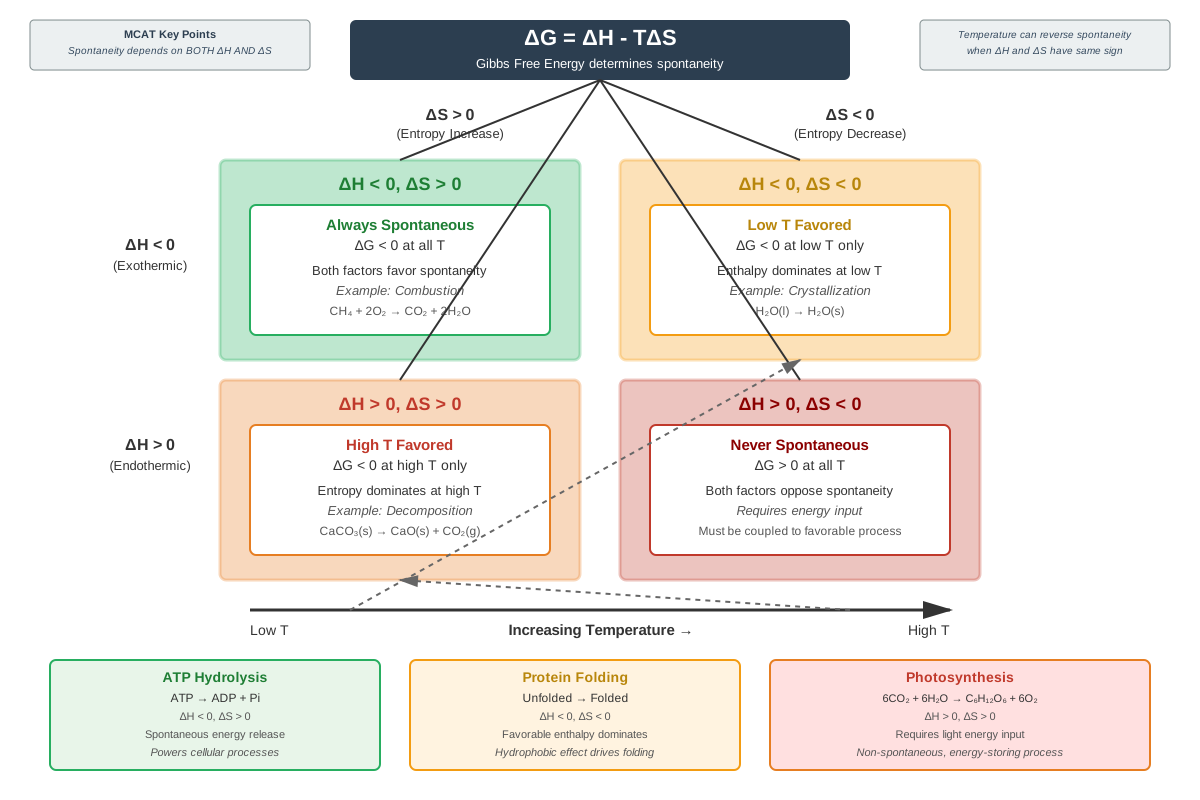
The pathway flows: Enthalpy → combines with Entropy → determines Gibbs Free Energy → predicts spontaneity and equilibrium. This relationship is quantified by the Gibbs equation (ΔG = ΔH - TΔS), making enthalpy one of two factors governing whether reactions proceed spontaneously. Temperature serves as the weighting factor determining whether enthalpy or entropy dominates spontaneity.
Hess's Law connects to stoichiometry and balanced equations, as proper coefficient manipulation is essential for combining thermochemical equations. This relationship extends to standard formation enthalpies, which provide a systematic method for calculating reaction enthalpies from tabulated data.
Bond enthalpy bridges enthalpy to molecular structure and chemical bonding, explaining why reactions occur at the molecular level. This connection extends to organic chemistry, where understanding bond strengths helps predict reaction energetics and mechanisms.
Calorimetry links enthalpy to experimental chemistry and laboratory techniques, while phase transitions connect enthalpy to intermolecular forces and states of matter. The strength of intermolecular forces directly determines the magnitude of fusion and vaporization enthalpies.
In biological contexts, enthalpy connects to metabolism (cellular respiration and photosynthesis), biochemistry (ATP hydrolysis, protein folding), and pharmacology (drug binding and stability). Understanding these relationships enables students to approach integrated MCAT passages that span multiple disciplines.
Quick check — test yourself on Enthalpy so far.
Try Flashcards →High-Yield Facts
⭐ Enthalpy is a state function: ΔH depends only on initial and final states, not the pathway taken—this is the foundation of Hess's Law
⭐ Sign convention: Exothermic reactions have negative ΔH (system loses heat); endothermic reactions have positive ΔH (system gains heat)
⭐ Standard formation enthalpy: ΔH°f for elements in their standard states equals zero by definition
⭐ Bond breaking requires energy (endothermic, positive ΔH); bond formation releases energy (exothermic, negative ΔH)
⭐ ΔH°rxn calculation: Sum of (products' formation enthalpies) minus sum of (reactants' formation enthalpies), weighted by stoichiometric coefficients
- Enthalpy of vaporization is always greater than enthalpy of fusion for the same substance because more intermolecular forces must be overcome
- At constant pressure, ΔH = q (heat transferred), making enthalpy particularly useful for biological and laboratory conditions
- Reversing a reaction changes the sign of ΔH but not its magnitude
- Multiplying a balanced equation by a factor multiplies ΔH by the same factor
- Standard conditions for thermodynamic data: 25°C (298 K), 1 atm pressure, 1 M concentration for solutions
- Combustion reactions are always exothermic (negative ΔH)
- The enthalpy of neutralization for strong acid-strong base reactions is approximately -57 kJ/mol
- Phase transitions from more ordered to less ordered states (solid → liquid → gas) are always endothermic
- Enthalpy alone does not determine spontaneity; both enthalpy and entropy must be considered via Gibbs free energy
Common Misconceptions
Misconception: Negative ΔH means the reaction absorbs heat.
Correction: Negative ΔH indicates an exothermic reaction that releases heat to the surroundings. The negative sign means the system loses energy. Think of it as the system's "bank account"—negative means money (energy) going out.
Misconception: Enthalpy and heat are always the same thing.
Correction: Enthalpy change equals heat only at constant pressure (ΔH = qp). At constant volume, heat equals the change in internal energy (qv = ΔU). Since most biological and laboratory processes occur at constant pressure, ΔH = q is usually valid, but the distinction matters for theoretical understanding.
Misconception: Exothermic reactions always occur spontaneously, while endothermic reactions never do.
Correction: Spontaneity depends on Gibbs free energy (ΔG = ΔH - TΔS), which includes both enthalpy and entropy contributions. Many endothermic processes occur spontaneously when the entropy increase is sufficiently large (e.g., ice melting above 0°C, ammonium nitrate dissolving in water).
Misconception: Bond enthalpies give exact values for reaction enthalpies.
Correction: Bond enthalpies are average values across different molecular environments and provide only estimates. Exact enthalpy calculations require standard formation enthalpies or calorimetry data. Bond enthalpy calculations work best for gas-phase reactions and provide conceptual understanding rather than precise values.
Misconception: The enthalpy of formation for any compound equals the enthalpy of its combustion.
Correction: Formation enthalpy refers to making a compound from elements in standard states; combustion enthalpy refers to burning it completely in oxygen. These are different processes with different ΔH values. For example, ΔH°f[glucose] = -1274 kJ/mol (forming it), while ΔH°comb[glucose] = -2803 kJ/mol (burning it).
Misconception: Temperature change in the surroundings has the opposite sign of ΔH.
Correction: Temperature change in the surroundings has the same sign as -ΔH. If ΔH is negative (exothermic), the system releases heat, so the surroundings warm up (positive temperature change). If ΔH is positive (endothermic), the system absorbs heat, so the surroundings cool down (negative temperature change).
Misconception: Catalysts change the enthalpy of reaction.
Correction: Catalysts lower activation energy and speed up reactions but do not change ΔH. Since enthalpy is a state function depending only on initial and final states, the pathway (catalyzed or uncatalyzed) doesn't affect the overall energy change.
Worked Examples
Example 1: Calculating Reaction Enthalpy Using Formation Enthalpies
Problem: Calculate the standard enthalpy change for the combustion of methane:
CH₄(g) + 2O₂(g) → CO₂(g) + 2H₂O(l)
Given standard formation enthalpies:
- ΔH°f[CH₄(g)] = -74.8 kJ/mol
- ΔH°f[CO₂(g)] = -393.5 kJ/mol
- ΔH°f[H₂O(l)] = -285.8 kJ/mol
- ΔH°f[O₂(g)] = 0 kJ/mol (element in standard state)
Solution:
Step 1: Write the formula for ΔH°rxn:
ΔH°rxn = Σ(n × ΔH°f,products) - Σ(n × ΔH°f,reactants)Step 2: Calculate the sum for products:
- Products: 1 mol CO₂ + 2 mol H₂O
- Sum = (1 × -393.5) + (2 × -285.8) = -393.5 + (-571.6) = -965.1 kJ
Step 3: Calculate the sum for reactants:
- Reactants: 1 mol CH₄ + 2 mol O₂
- Sum = (1 × -74.8) + (2 × 0) = -74.8 kJ
Step 4: Calculate ΔH°rxn:
- ΔH°rxn = -965.1 - (-74.8) = -965.1 + 74.8 = -890.3 kJ
Interpretation: The negative value confirms this combustion reaction is exothermic, releasing 890.3 kJ per mole of methane burned. This connects to the learning objective of applying enthalpy to exam-style calculations and demonstrates why methane serves as an excellent fuel—it releases substantial energy.
Example 2: Using Hess's Law to Determine an Unknown Enthalpy
Problem: Given the following thermochemical equations, calculate ΔH for the reaction:
2C(s) + H₂(g) → C₂H₂(g)
Known equations:
- C₂H₂(g) + (5/2)O₂(g) → 2CO₂(g) + H₂O(l), ΔH₁ = -1300 kJ
- C(s) + O₂(g) → CO₂(g), ΔH₂ = -394 kJ
- H₂(g) + (1/2)O₂(g) → H₂O(l), ΔH₃ = -286 kJ
Solution:
Step 1: Identify the target equation and what manipulations are needed.
- Target: 2C(s) + H₂(g) → C₂H₂(g)
- We need C₂H₂ as a product, so reverse equation 1
- We need 2C(s) as reactants, so multiply equation 2 by 2
- We need H₂(g) as a reactant, so keep equation 3 as is
Step 2: Manipulate the equations:
- Equation 1 reversed: 2CO₂(g) + H₂O(l) → C₂H₂(g) + (5/2)O₂(g), ΔH = +1300 kJ
- Equation 2 × 2: 2C(s) + 2O₂(g) → 2CO₂(g), ΔH = 2(-394) = -788 kJ
- Equation 3: H₂(g) + (1/2)O₂(g) → H₂O(l), ΔH = -286 kJ
Step 3: Add the manipulated equations:
2CO₂(g) + H₂O(l) → C₂H₂(g) + (5/2)O₂(g)     ΔH = +1300 kJ
2C(s) + 2O₂(g) → 2CO₂(g)                     ΔH = -788 kJ
H₂(g) + (1/2)O₂(g) → H₂O(l)                  ΔH = -286 kJ
_________________________________________________________
2C(s) + H₂(g) → C₂H₂(g)                      ΔH = +226 kJ
Step 4: Verify by canceling species that appear on both sides:
- 2CO₂ cancels, H₂O cancels, (5/2 - 2 - 1/2 = 0) O₂ cancels
- Final equation matches target
Answer: ΔH = +226 kJ
Interpretation: The positive enthalpy indicates that forming acetylene from carbon and hydrogen is endothermic, requiring energy input. This explains why acetylene is not formed spontaneously from its elements and why it stores considerable chemical energy, making it useful for welding torches. This example demonstrates Hess's Law application, a high-yield MCAT skill.
Exam Strategy
When approaching MCAT questions on enthalpy, begin by identifying the question type: calculation-based (requiring formulas and numerical manipulation) or concept-based (testing understanding of principles and relationships). For calculation questions, immediately write down the relevant formula—either ΔH°rxn = Σ(products) - Σ(reactants) for formation enthalpies or the Hess's Law approach for combining equations.
Trigger words and phrases that signal enthalpy questions include:
- "Heat released" or "heat absorbed" → indicates ΔH calculation
- "Exothermic" or "endothermic" → focus on sign of ΔH
- "Standard conditions" → use ΔH°f values
- "Bond energies" → apply bond enthalpy estimation method
- "Calorimeter" → use q = mcΔT or q = CΔT
- "Hess's Law" or "multiple steps" → combine thermochemical equations
For process-of-elimination strategies, remember:
- Eliminate answers with incorrect signs (exothermic must be negative, endothermic positive)
- Check magnitude reasonableness: combustion reactions typically release hundreds of kJ/mol, not single-digit values
- Verify units: enthalpy is typically kJ or kJ/mol, not kJ/g or other units
- For Hess's Law problems, eliminate answers that don't result from proper equation manipulation
Time allocation: Straightforward enthalpy calculations should take 60-90 seconds. Hess's Law problems requiring multiple equation manipulations may need 2-3 minutes. If a problem requires more than 3 minutes, flag it and return later—the MCAT rewards efficient time management.
Critical Exam Tip: Always check whether the question asks for ΔH per mole of a specific reactant or product versus the ΔH for the reaction as written. Stoichiometry errors are the most common mistake in enthalpy calculations.
When passages present experimental data, look for:
- Temperature changes → calculate q, then determine ΔH
- Multiple reaction pathways → apply Hess's Law
- Comparison of different reactions → analyze relative magnitudes and signs
- Phase transitions → recall that vaporization > fusion for enthalpy changes
Memory Techniques
Mnemonic for sign conventions: "EXO-exits, ENDO-enters"
- EXOthermic reactions have energy EXiting the system (negative ΔH)
- ENDOthermic reactions have energy ENtering the system (positive ΔH)
Acronym for standard formation enthalpy rules: "ZERO ELEMENTS"
- ΔH°f = ZERO for ELEMENTS in their standard states
Visualization for Hess's Law: Picture thermochemical equations as LEGO blocks that can be flipped (reversed), multiplied (duplicated), and stacked (added) to build the target equation. Each manipulation changes ΔH accordingly: flipping changes sign, duplicating multiplies ΔH, stacking adds ΔH values.
Mnemonic for bond enthalpy calculations: "Break Bonds, Buy Energy; Form Bonds, Free Energy"
- Breaking bonds requires purchasing (adding) energy (positive)
- Forming bonds provides free (releases) energy (negative)
- ΔH = Energy bought (bonds broken) - Energy freed (bonds formed)
Memory aid for phase transition enthalpies: "Vapor > Fusion" (alphabetically V comes after F, and ΔH°vap > ΔH°fus)
- Vaporization requires more energy than fusion because more intermolecular forces must be overcome
Acronym for enthalpy types: "FCVS-N" (pronounced "focus-N")
- Formation
- Combustion
- Vaporization
- Solution
- Neutralization
Conceptual anchor: Think of enthalpy as a "heat bank account" for the system. Deposits (positive ΔH) mean the system gains heat; withdrawals (negative ΔH) mean the system loses heat to surroundings.
Summary
Enthalpy represents the total heat content of a system and serves as a fundamental thermodynamic state function essential for understanding energy changes in chemical reactions and physical processes. Defined as H = U + PV, enthalpy changes at constant pressure equal the heat transferred, making it particularly relevant for biological and laboratory conditions. The sign of ΔH distinguishes exothermic processes (negative, heat released) from endothermic processes (positive, heat absorbed). Standard formation enthalpies provide a systematic method for calculating reaction enthalpies using the formula ΔH°rxn = Σ(products) - Σ(reactants), while Hess's Law enables determination of unknown enthalpies by combining thermochemical equations. Bond enthalpy concepts explain reaction energetics at the molecular level: bond breaking requires energy input while bond formation releases energy. For MCAT success, students must master enthalpy calculations, recognize sign conventions, apply Hess's Law, and connect enthalpy to spontaneity through its relationship with entropy and Gibbs free energy. Understanding enthalpy enables interpretation of metabolic pathways, calorimetry experiments, and thermochemical data that frequently appear in exam passages.
Key Takeaways
- Enthalpy (H) is a state function representing total heat content; ΔH depends only on initial and final states, not pathway (foundation of Hess's Law)
- Sign convention is critical: negative ΔH indicates exothermic (heat released), positive ΔH indicates endothermic (heat absorbed)
- Standard formation enthalpies (ΔH°f) enable calculation of reaction enthalpies; elements in standard states have ΔH°f = 0 by definition
- Bond breaking requires energy (endothermic), bond formation releases energy (exothermic); ΔH°rxn ≈ bonds broken - bonds formed
- Hess's Law applications: reversing reactions changes ΔH sign, multiplying coefficients multiplies ΔH, adding equations adds ΔH values
- Enthalpy alone does not determine spontaneity; both enthalpy and entropy contribute to Gibbs free energy (ΔG = ΔH - TΔS)
- At constant pressure, ΔH = q, making enthalpy measurements directly accessible through calorimetry in typical laboratory and biological conditions
Related Topics
Entropy and the Second Law of Thermodynamics: Understanding entropy (disorder) complements enthalpy knowledge and together they determine reaction spontaneity through Gibbs free energy. Mastering enthalpy provides the foundation for entropy concepts.
Gibbs Free Energy: Combines enthalpy and entropy (ΔG = ΔH - TΔS) to predict spontaneity and equilibrium position. Enthalpy mastery is prerequisite for understanding how temperature affects spontaneity.
Chemical Kinetics and Activation Energy: Enthalpy diagrams show both activation energy (kinetic barrier) and overall enthalpy change (thermodynamic favorability). Understanding enthalpy enables interpretation of reaction coordinate diagrams.
Electrochemistry: Cell potential relates to Gibbs free energy (ΔG = -nFE°), which depends on enthalpy. Enthalpy changes in redox reactions determine battery and fuel cell efficiency.
Acid-Base Chemistry: Neutralization reactions have characteristic enthalpy changes (~-57 kJ/mol for strong acid-strong base). Understanding enthalpy helps predict heat effects in buffer systems and titrations.
Biochemical Energetics: ATP hydrolysis, metabolic pathways, and enzyme-catalyzed reactions all involve enthalpy changes. Mastering thermodynamic principles enables understanding of cellular energy transformations.
Practice CTA
Now that you've mastered the core concepts of enthalpy, it's time to solidify your understanding through active practice. Work through the practice questions to test your ability to calculate enthalpy changes, apply Hess's Law, and interpret thermochemical data in MCAT-style scenarios. Use the flashcards to reinforce high-yield facts, sign conventions, and formulas until they become automatic. Remember: thermodynamics questions reward systematic problem-solving approaches and careful attention to signs and units. Each practice problem you complete builds the pattern recognition and confidence needed to excel on test day. You've built a strong foundation—now apply it!
Sign up free to keep reading
Create a free AnvayaPrep account to finish this MCAT guide on Enthalpy — plus flashcards and practice questions.