Overview
Solution concentration is a fundamental concept in General Chemistry that quantifies the amount of solute dissolved in a given quantity of solvent or solution. This topic sits at the intersection of stoichiometry, chemical reactions, and solution chemistry, making it indispensable for MCAT success. Understanding how to express, calculate, and interconvert various concentration units enables students to solve complex problems involving dilutions, reaction stoichiometry in solution, colligative properties, and acid-base chemistry.
For the MCAT, solution concentration appears across multiple contexts within the Chemical and Physical Foundations of Biological Systems section. Questions may involve calculating molarity for buffer preparation, determining the concentration of products after a reaction, or applying dilution principles to experimental scenarios. The MCAT frequently embeds concentration calculations within passage-based questions about laboratory techniques, pharmacokinetics, or biochemical assays, requiring rapid unit conversion and conceptual understanding rather than mere formula memorization.
Mastery of solution concentration in General Chemistry provides the foundation for understanding osmotic pressure, vapor pressure depression, and other colligative properties. It connects directly to stoichiometry and reactions by enabling quantitative predictions about reactants and products in aqueous systems. This topic also bridges to biochemistry (enzyme kinetics, Michaelis-Menten equations) and physiology (blood plasma concentrations, drug dosing), making it one of the highest-yield topics for integrated MCAT passages that span multiple disciplines.
Learning Objectives
- [ ] Define solution concentration using accurate General Chemistry terminology
- [ ] Explain why solution concentration matters for the MCAT
- [ ] Apply solution concentration to exam-style questions
- [ ] Identify common mistakes related to solution concentration
- [ ] Connect solution concentration to related General Chemistry concepts
- [ ] Calculate and interconvert between molarity, molality, mole fraction, mass percent, and parts per million
- [ ] Apply the dilution equation (M₁V₁ = M₂V₂) to multi-step dilution problems
- [ ] Determine solution concentrations from experimental data including titrations and spectrophotometry
Prerequisites
- Mole concept and molar mass calculations: Essential for converting between grams of solute and moles, which forms the basis of molarity calculations
- Stoichiometric relationships: Required to determine how concentrations change during chemical reactions in solution
- Unit conversions and dimensional analysis: Critical for interconverting concentration units and avoiding calculation errors
- Basic algebra: Necessary for manipulating concentration equations and solving for unknown variables
- Density relationships: Important for converting between volume-based and mass-based concentration expressions
Why This Topic Matters
Solution concentration calculations appear in approximately 8-12% of MCAT General Chemistry questions, making it a medium-to-high yield topic. Beyond standalone calculation questions, concentration concepts underpin passages about experimental design, analytical chemistry techniques, and biological systems. Real-world applications include pharmaceutical formulation (ensuring proper drug dosages), clinical laboratory testing (measuring blood glucose or electrolyte levels), and environmental monitoring (detecting pollutant concentrations in water supplies).
The MCAT tests solution concentration through multiple question formats: direct calculation problems, conceptual questions about dilution effects, passage-based questions requiring interpretation of experimental protocols, and integrated problems connecting concentration to equilibrium, kinetics, or thermodynamics. Common passage contexts include spectrophotometric analysis (Beer's Law), titration experiments, buffer preparation, and osmotic pressure measurements in biological membranes.
Understanding concentration is particularly critical for the MCAT because it appears in interdisciplinary contexts. A passage might describe enzyme activity as a function of substrate concentration (biochemistry), discuss how changing blood plasma concentration affects osmotic balance (physiology), or present data from a titration used to determine an unknown acid concentration (analytical chemistry). Students who can rapidly calculate and conceptualize concentrations gain significant time advantages on test day.
Core Concepts
Molarity (M)
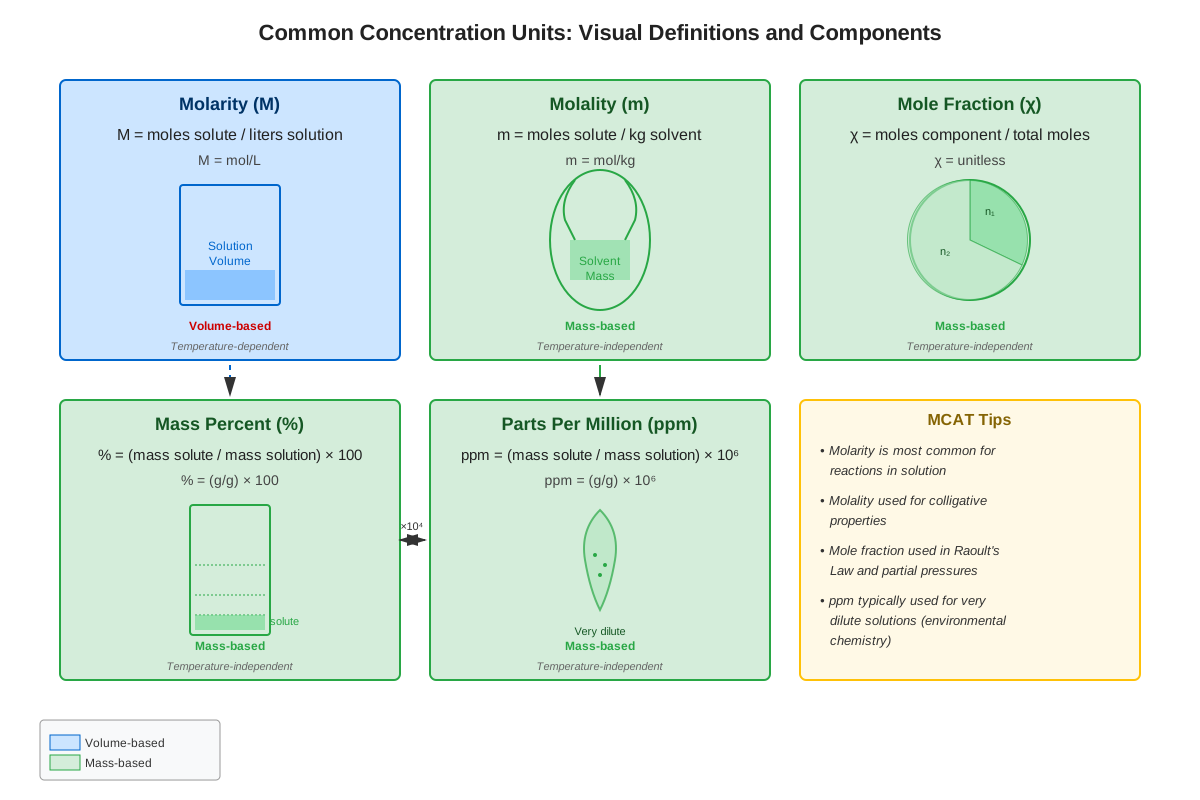
Molarity represents the most commonly used concentration unit in chemistry and on the MCAT. It is defined as moles of solute per liter of solution:
Molarity (M) = moles of solute / liters of solutionThe key distinction is that molarity uses the total volume of the solution (solute + solvent), not just the solvent volume. When preparing a 1.0 M NaCl solution, one would dissolve 1.0 mole of NaCl in water and then add enough water to bring the total volume to exactly 1.0 L.
Molarity is temperature-dependent because solution volume changes with temperature (liquids expand when heated). This makes molarity convenient for laboratory work at controlled temperatures but less ideal for precise thermodynamic calculations. For MCAT purposes, assume room temperature unless stated otherwise.
Example: To prepare 500 mL of 0.25 M glucose (C₆H₁₂O₆, MW = 180 g/mol):
- Moles needed = 0.25 mol/L × 0.500 L = 0.125 mol
- Mass needed = 0.125 mol × 180 g/mol = 22.5 g
- Dissolve 22.5 g glucose in water and dilute to exactly 500 mL total volume
Molality (m)
Molality is defined as moles of solute per kilogram of solvent:
Molality (m) = moles of solute / kilograms of solventUnlike molarity, molality uses the mass of the solvent only, making it temperature-independent (mass doesn't change with temperature). This property makes molality the preferred unit for colligative property calculations (boiling point elevation, freezing point depression, osmotic pressure) where temperature changes are involved.
For dilute aqueous solutions where the density is approximately 1.0 g/mL, molarity and molality values are nearly identical. However, they diverge significantly in concentrated solutions or when using non-aqueous solvents.
Example: A solution containing 0.50 mol NaCl dissolved in 250 g of water has:
- Molality = 0.50 mol / 0.250 kg = 2.0 m
Mole Fraction (χ)
Mole fraction represents the ratio of moles of one component to the total moles of all components:
χ_A = moles of A / (moles of A + moles of B + moles of C + ...)Mole fraction is dimensionless and always ranges from 0 to 1. The sum of all mole fractions in a solution equals 1. This unit is particularly useful in Raoult's Law calculations (vapor pressure) and in expressing gas compositions.
Example: A solution contains 2.0 mol ethanol and 8.0 mol water:
- χ_ethanol = 2.0 / (2.0 + 8.0) = 0.20
- χ_water = 8.0 / 10.0 = 0.80
Mass Percent (% m/m)
Mass percent expresses the mass of solute as a percentage of the total solution mass:
Mass percent = (mass of solute / mass of solution) × 100%This unit is common in commercial products (e.g., "70% isopropyl alcohol") and biological contexts (e.g., "0.9% saline solution"). Mass percent is temperature-independent and doesn't require molecular weight information.
Example: A 5.0% glucose solution contains 5.0 g glucose per 100 g total solution (5.0 g glucose + 95.0 g water).
Parts Per Million (ppm) and Parts Per Billion (ppb)
Parts per million and parts per billion express very dilute concentrations, commonly used for environmental pollutants or trace elements:
ppm = (mass of solute / mass of solution) × 10⁶
ppb = (mass of solute / mass of solution) × 10⁹
For dilute aqueous solutions, 1 ppm ≈ 1 mg/L (assuming solution density = 1.0 g/mL). These units appear on the MCAT in environmental chemistry or toxicology contexts.
Dilution Calculations
The dilution equation is one of the highest-yield formulas for the MCAT:
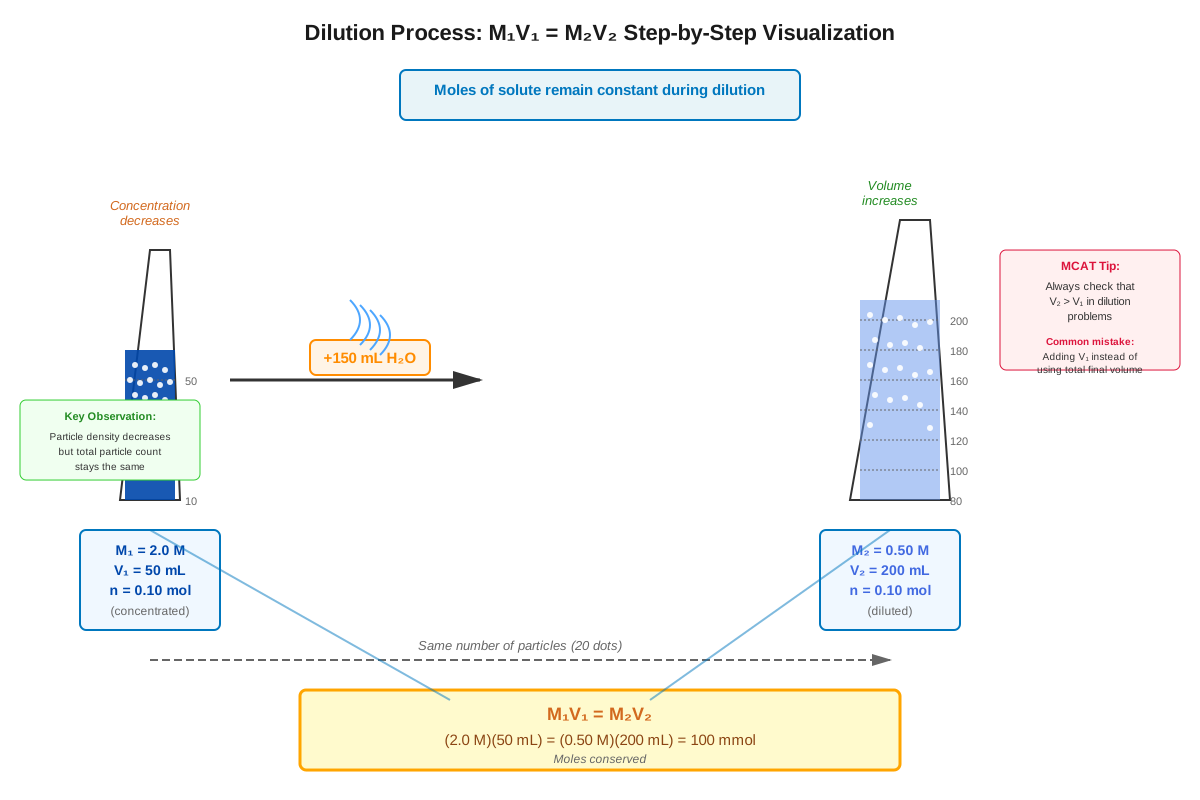
M₁V₁ = M₂V₂This equation states that the number of moles of solute remains constant during dilution (only solvent is added). M₁ and V₁ represent the initial molarity and volume, while M₂ and V₂ represent the final values.
Exam Tip: The dilution equation works with any concentration unit (M, m, ppm) as long as the same unit is used on both sides. It can also be extended to serial dilutions by applying it sequentially.
Example: Diluting 25 mL of 6.0 M HCl to 150 mL:
- (6.0 M)(25 mL) = M₂(150 mL)
- M₂ = 1.0 M
Concentration from Experimental Data
The MCAT frequently requires calculating concentration from experimental measurements:
From titration data: At the equivalence point, moles of acid = moles of base (for monoprotic acids and bases)
M_acid × V_acid = M_base × V_baseFrom Beer's Law (spectrophotometry):
A = εbcwhere A = absorbance, ε = molar absorptivity, b = path length, c = concentration
Concentration Unit Interconversions
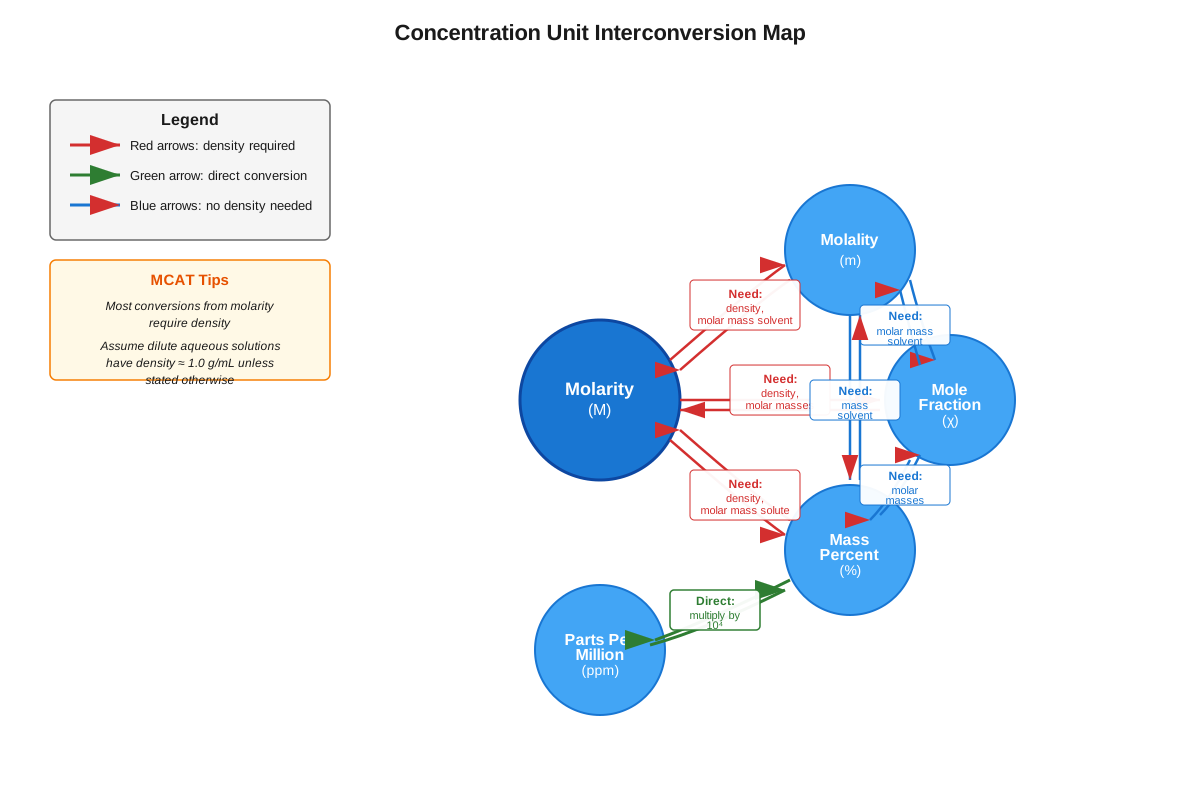
Converting between concentration units requires density information and molecular weights:
| From | To | Requires | Approach |
|---|---|---|---|
| Molarity | Molality | Density, MW | Calculate mass of solvent from solution volume and density |
| Molarity | Mass % | Density, MW | Calculate masses of solute and solution |
| Mass % | Molarity | Density, MW | Calculate moles from mass, volume from density |
| Molality | Mole fraction | MW of solvent | Convert solvent mass to moles |
Concept Relationships
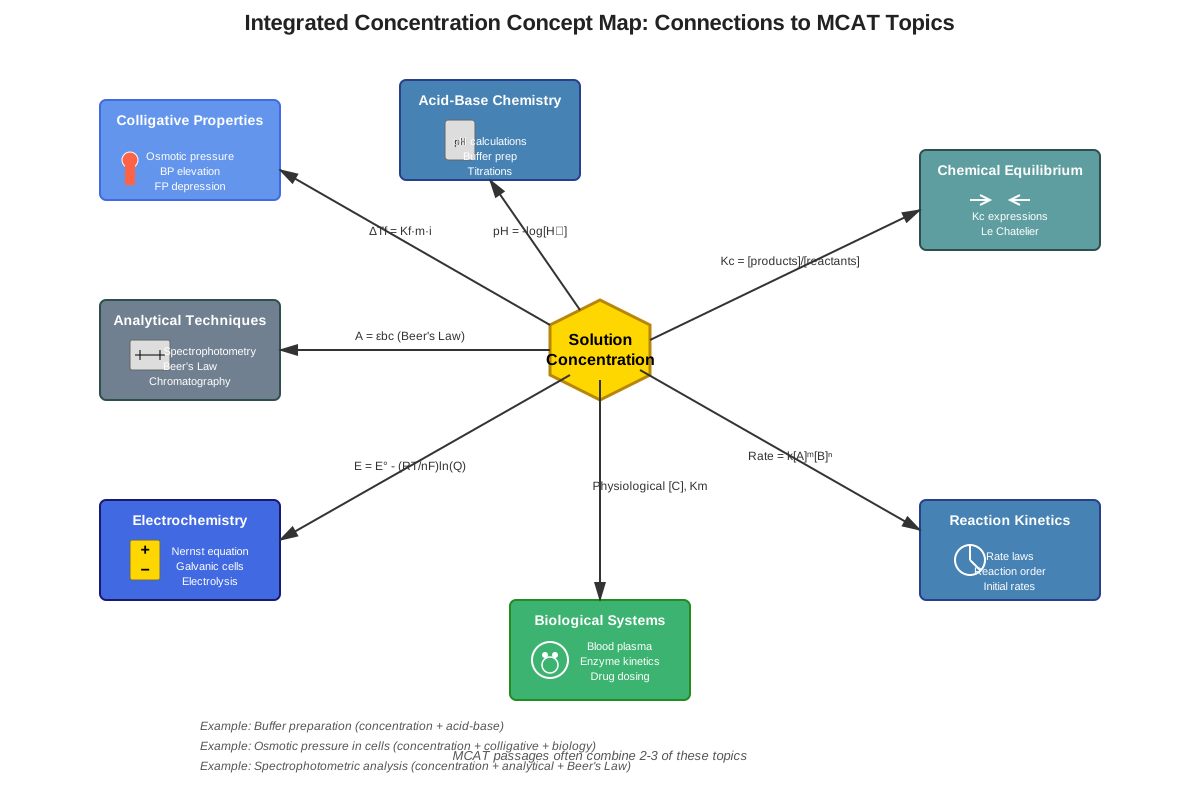
Solution concentration concepts form an interconnected network within stoichiometry and reactions. Molarity serves as the central hub, connecting to dilution calculations (M₁V₁ = M₂V₂), reaction stoichiometry (using molarity to find moles of reactants), and limiting reagent problems in solution.
The relationship flow: Moles of solute → calculated using MW and mass → Molarity → determined by dividing by solution volume → Dilution → applying M₁V₁ = M₂V₂ → Reaction stoichiometry → using molarity to predict product concentrations.
Molality branches from molarity through density conversions and connects directly to colligative properties (freezing point depression: ΔTf = Kf × m × i). Mole fraction connects to partial pressure calculations (Raoult's Law: P_A = χ_A × P°_A) and vapor pressure depression.
Mass-based units (mass percent, ppm, ppb) relate to molarity through density and molecular weight, forming a conversion triangle: mass percent ↔ molarity ↔ molality, with density and MW serving as conversion factors.
All concentration expressions ultimately derive from the fundamental relationship: amount of solute relative to amount of solution or solvent. The choice of unit depends on the application: molarity for reactions, molality for colligative properties, mole fraction for vapor pressure, and mass percent for commercial applications.
Quick check — test yourself on Solution concentration so far.
Try Flashcards →High-Yield Facts
⭐ Molarity (M) = moles solute / liters solution is the most common concentration unit on the MCAT and is temperature-dependent
⭐ The dilution equation M₁V₁ = M₂V₂ assumes moles of solute remain constant; it works with any concentration unit
⭐ Molality (m) = moles solute / kg solvent is temperature-independent and used for colligative property calculations
⭐ For dilute aqueous solutions, molarity ≈ molality because solution density ≈ 1.0 g/mL
⭐ Mole fraction is dimensionless and the sum of all mole fractions in a solution equals 1.0
- Mass percent = (mass solute / mass solution) × 100% and is commonly used for commercial solutions
- 1 ppm ≈ 1 mg/L for dilute aqueous solutions (assuming density = 1.0 g/mL)
- When preparing a molar solution, dissolve solute first, then dilute to the final volume mark
- Concentration decreases during dilution but the number of moles of solute stays constant
- Converting between concentration units requires density and molecular weight information
- At the titration equivalence point for monoprotic acids/bases: M_acid × V_acid = M_base × V_base
- Beer's Law (A = εbc) relates absorbance to concentration in spectrophotometry experiments
Common Misconceptions
Misconception: When preparing a 1.0 M solution in 1.0 L, add 1 mole of solute to exactly 1.0 L of water.
Correction: Add 1 mole of solute to water, then add water until the total solution volume reaches 1.0 L. The final volume includes both solute and solvent.
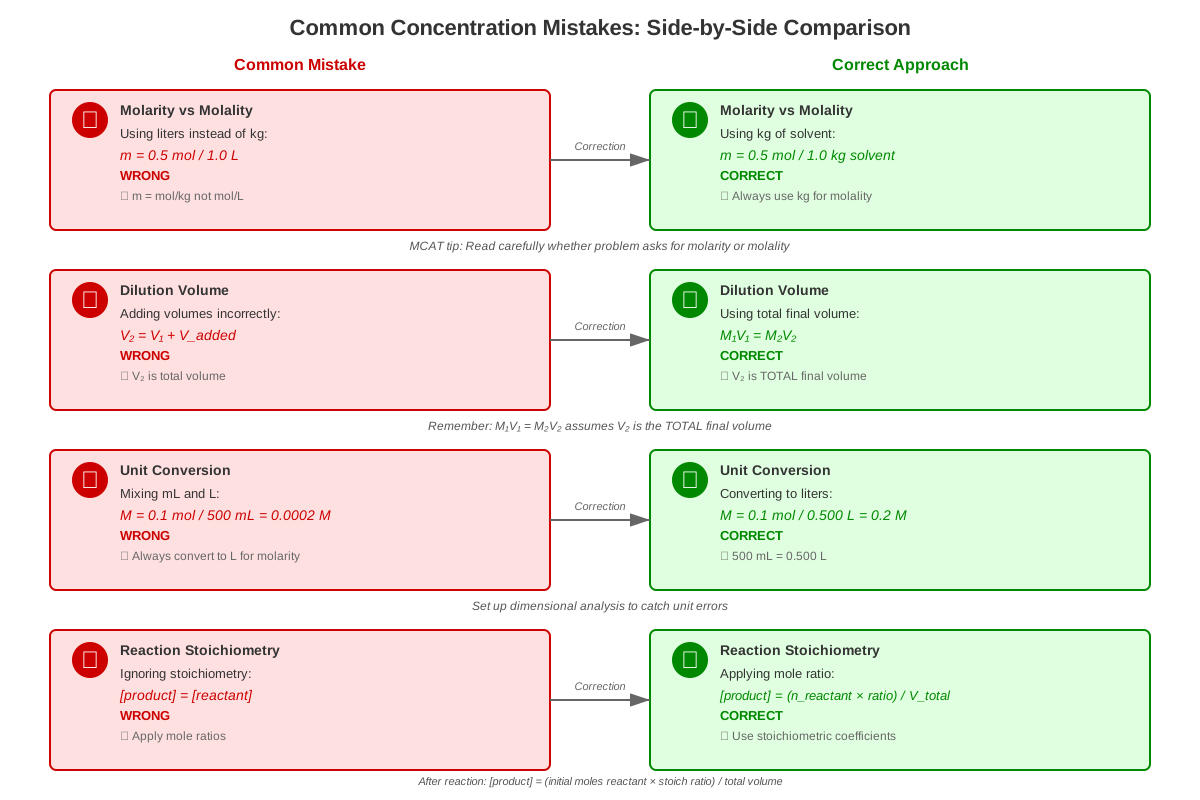
Misconception: Molarity and molality are interchangeable terms.
Correction: Molarity uses liters of solution (denominator), while molality uses kilograms of solvent. They are only approximately equal for dilute aqueous solutions.
Misconception: Doubling the volume of a solution doubles its concentration.
Correction: Doubling the volume (by adding solvent) halves the concentration. Concentration and volume are inversely related during dilution.
Misconception: In the dilution equation M₁V₁ = M₂V₂, V₂ represents the volume of solvent added.
Correction: V₂ represents the final total volume of the diluted solution, not the volume added. The volume added = V₂ - V₁.
Misconception: Mass percent and volume percent are the same thing.
Correction: Mass percent uses mass of solute/mass of solution, while volume percent uses volume of solute/volume of solution. They differ unless densities are identical.
Misconception: Mole fraction can exceed 1.0 for concentrated solutions.
Correction: Mole fraction is always between 0 and 1.0 by definition, as it represents a ratio of parts to whole.
Misconception: ppm and ppb are only used for solid solutions.
Correction: These units are most commonly used for very dilute aqueous solutions (environmental pollutants, trace minerals) and gases, not solids.
Worked Examples
Example 1: Multi-Step Dilution Problem
Question: A laboratory technician needs to prepare 250 mL of 0.15 M NaCl solution starting from a 3.0 M stock solution. Describe the preparation procedure and calculate the volume of stock solution needed.
Solution:
Step 1: Identify known values
- M₁ = 3.0 M (stock concentration)
- M₂ = 0.15 M (desired concentration)
- V₂ = 250 mL (final volume)
- V₁ = ? (volume of stock needed)
Step 2: Apply the dilution equation
M₁V₁ = M₂V₂
(3.0 M)(V₁) = (0.15 M)(250 mL)
V₁ = (0.15 × 250) / 3.0 = 12.5 mL
Step 3: Describe the procedure
- Measure 12.5 mL of the 3.0 M stock solution using a graduated cylinder or pipette
- Transfer to a 250 mL volumetric flask
- Add distilled water until the solution level reaches the 250 mL mark
- Mix thoroughly
Key concept: The volume of water added is 250 - 12.5 = 237.5 mL, but the critical value for the dilution equation is the final total volume (250 mL).
Example 2: Concentration Unit Conversion
Question: A solution is prepared by dissolving 25.0 g of glucose (C₆H₁₂O₆, MW = 180 g/mol) in 500 g of water. The final solution has a density of 1.04 g/mL. Calculate: (a) molality, (b) mole fraction of glucose, and (c) molarity.
Solution:
(a) Calculate molality
Step 1: Find moles of glucose
moles = 25.0 g / 180 g/mol = 0.139 molStep 2: Convert solvent mass to kg
500 g water = 0.500 kgStep 3: Calculate molality
molality = 0.139 mol / 0.500 kg = 0.278 m(b) Calculate mole fraction
Step 1: Find moles of water
moles water = 500 g / 18.0 g/mol = 27.8 molStep 2: Calculate mole fraction of glucose
χ_glucose = 0.139 / (0.139 + 27.8) = 0.139 / 27.9 = 0.00498(c) Calculate molarity
Step 1: Find total solution mass
mass solution = 25.0 g + 500 g = 525 gStep 2: Convert to volume using density
volume = 525 g / 1.04 g/mL = 505 mL = 0.505 LStep 3: Calculate molarity
Molarity = 0.139 mol / 0.505 L = 0.275 MKey observation: Notice that molarity (0.275 M) and molality (0.278 m) are very close for this dilute aqueous solution, confirming the high-yield fact that they are approximately equal when density ≈ 1.0 g/mL.
Exam Strategy
When approaching solution concentration questions on the MCAT, first identify which concentration unit is being used and what the question is asking for. Many students lose points by confusing molarity with molality or by using the wrong volume (solution vs. solvent) in calculations.
Trigger words to recognize:
- "Dilute" or "dilution" → think M₁V₁ = M₂V₂
- "Prepare a solution" → remember to dilute to final volume, not add that volume
- "Colligative properties," "freezing point," "boiling point" → use molality, not molarity
- "Vapor pressure" → use mole fraction
- "Titration" or "equivalence point" → M₁V₁ = M₂V₂ (for monoprotic acids/bases)
- "Absorbance" or "spectrophotometry" → Beer's Law (A = εbc)
Process of elimination strategies:
- If answer choices differ by powers of 10, check unit conversions (mL to L, g to kg)
- For dilution problems, the final concentration must be lower than the initial concentration
- Molarity values cannot be negative or exceed the theoretical maximum based on solute solubility
- When converting units, the answer should make physical sense (e.g., a "dilute" solution shouldn't have molarity > 1 M)
Time allocation: Straightforward concentration calculations should take 30-45 seconds. Multi-step problems involving unit conversions may require 60-90 seconds. If a problem requires more than 2 minutes, flag it and return later—there may be a conceptual shortcut you're missing.
Exam Tip: For dilution problems, quickly check if the answer makes sense by estimating. If diluting 10 mL of 6 M to 60 mL, the concentration should be approximately 1 M (6-fold dilution). This prevents calculation errors.
Memory Techniques
Molarity vs. Molality Mnemonic: "Molarity has an 'r' like 'solution' (both have r), molality has an 'l' like 'solvent' (both have l)." This helps remember that molarity uses solution volume while molality uses solvent mass.
Dilution Equation Visualization: Picture a concentrated solution as "dark" and diluted as "light." When you add water (dilute), the color gets lighter but the total number of colored molecules (moles) stays the same. This reinforces that M₁V₁ = M₂V₂ because moles are conserved.
MOLES Acronym for Concentration Units:
- Molarity = moles/Liter solution
- mOlality = moles/kg solvent
- Liters for molarity, kiLograms for molality
- Equal (approximately) for dilute aqueous solutions
- Solution vs. Solvent distinguishes them
Dilution Direction Memory Aid: "Add water, concentration goes down" → When V increases, M decreases (inverse relationship). Visualize spreading the same amount of solute over a larger volume.
Unit Conversion Triangle: Draw a triangle with molarity at top, molality at bottom left, mass percent at bottom right. Label the sides with what you need for conversion: density + MW. This visual helps remember that converting between any two requires specific information.
Summary
Solution concentration quantifies the amount of solute relative to solution or solvent, with multiple units serving different purposes in chemistry and on the MCAT. Molarity (moles/L solution) is the most common unit for reactions and laboratory work, while molality (moles/kg solvent) is essential for colligative properties due to its temperature independence. The dilution equation M₁V₁ = M₂V₂ is a high-yield formula that appears frequently on the exam, requiring students to recognize that moles of solute remain constant during dilution. Converting between concentration units demands careful attention to whether the denominator represents solution or solvent, and whether mass or volume is used. MCAT questions integrate concentration calculations with experimental techniques (titrations, spectrophotometry), reaction stoichiometry, and biological applications. Mastery requires not just memorizing formulas but understanding the conceptual differences between units and recognizing which unit is appropriate for each context. Success on concentration problems comes from systematic problem-solving: identify the given unit, determine what's being asked, apply the appropriate formula, and verify that the answer makes physical sense.
Key Takeaways
- Molarity (M) = moles solute / liters solution is the most frequently tested concentration unit on the MCAT
- The dilution equation M₁V₁ = M₂V₂ assumes constant moles of solute and works with any concentration unit
- Molality (m) = moles solute / kg solvent is temperature-independent and used for colligative property calculations
- For dilute aqueous solutions, molarity ≈ molality because solution density ≈ 1.0 g/mL
- When preparing solutions, always dilute to the final volume mark, not add that volume of solvent
- Converting between concentration units requires density and molecular weight information
- Mole fraction is dimensionless, ranges from 0 to 1, and all mole fractions sum to 1
Related Topics
Colligative Properties: Mastering solution concentration, particularly molality, enables understanding of freezing point depression, boiling point elevation, and osmotic pressure—all of which depend on solute particle concentration rather than identity.
Acid-Base Chemistry and Buffers: Concentration calculations are essential for pH calculations, buffer preparation, and understanding the Henderson-Hasselbalch equation, which requires knowing the concentrations of weak acids and their conjugate bases.
Chemical Kinetics: Reaction rates depend on reactant concentrations, and rate laws express this relationship mathematically. Understanding molarity is prerequisite to analyzing how concentration changes affect reaction speed.
Equilibrium: The equilibrium constant expression uses molar concentrations of reactants and products. Calculating equilibrium concentrations requires facility with molarity and concentration changes during reactions.
Electrochemistry: The Nernst equation relates cell potential to ion concentrations, requiring conversion between concentration units and understanding of how dilution affects electrochemical cell voltage.
Practice CTA
Now that you've mastered the core concepts of solution concentration, it's time to solidify your understanding through active practice. Work through the practice questions to test your ability to calculate concentrations, perform dilutions, and convert between units under timed conditions. Use the flashcards to reinforce high-yield facts and formulas until they become automatic. Remember, the MCAT rewards not just knowledge but speed and accuracy—practice transforms understanding into test-day performance. You've built a strong foundation; now apply it to achieve your target score!
Sign up free to keep reading
Create a free AnvayaPrep account to finish this MCAT guide on Solution concentration — plus flashcards and practice questions.