Overview
Spontaneity is a fundamental concept in thermodynamics that describes whether a process can occur without continuous external intervention. In General Chemistry, understanding spontaneity is crucial for predicting the direction of chemical reactions, phase transitions, and energy transformations. A spontaneous process is one that, once initiated, proceeds on its own without requiring constant energy input—though it may require an initial activation energy to begin. Importantly, spontaneity says nothing about the rate of a process; a spontaneous reaction may occur rapidly or take millennia to complete.
For the MCAT, spontaneity represents a high-yield topic that bridges multiple areas of chemistry and biology. Questions frequently test the relationship between Gibbs free energy, entropy, enthalpy, and temperature in determining whether processes are thermodynamically favorable. The exam often presents scenarios requiring students to predict reaction direction, interpret energy diagrams, or analyze coupled reactions in biological systems. Mastery of spontaneity enables students to understand cellular metabolism, protein folding, membrane transport, and countless other biochemical processes.
The concept of spontaneity connects intimately with other General Chemistry principles including thermodynamic laws, equilibrium, electrochemistry, and kinetics. While kinetics describes how fast a reaction proceeds, thermodynamics (specifically spontaneity) determines whether it can proceed at all. This distinction is frequently tested on the MCAT, making spontaneity an essential component of a comprehensive chemistry foundation. Understanding spontaneity also provides the framework for analyzing Le Chatelier's principle, calculating equilibrium constants, and predicting the behavior of galvanic and electrolytic cells.
Learning Objectives
- [ ] Define Spontaneity using accurate General Chemistry terminology
- [ ] Explain why Spontaneity matters for the MCAT
- [ ] Apply Spontaneity to exam-style questions
- [ ] Identify common mistakes related to Spontaneity
- [ ] Connect Spontaneity to related General Chemistry concepts
- [ ] Calculate Gibbs free energy changes and predict spontaneity under various conditions
- [ ] Distinguish between spontaneity and reaction rate in chemical processes
- [ ] Analyze the temperature dependence of spontaneous processes using thermodynamic parameters
Prerequisites
- First and Second Laws of Thermodynamics: Understanding that energy is conserved and that entropy of the universe increases provides the foundation for why spontaneous processes occur
- Enthalpy (ΔH): Knowledge of heat changes in reactions is necessary to evaluate one component of the spontaneity equation
- Entropy (ΔS): Familiarity with disorder and the statistical nature of molecular arrangements is essential for understanding the driving force behind many spontaneous processes
- Basic algebra and equation manipulation: Required for solving Gibbs free energy equations and rearranging thermodynamic relationships
- States of matter and phase transitions: Understanding molecular organization helps predict entropy changes in various processes
Why This Topic Matters
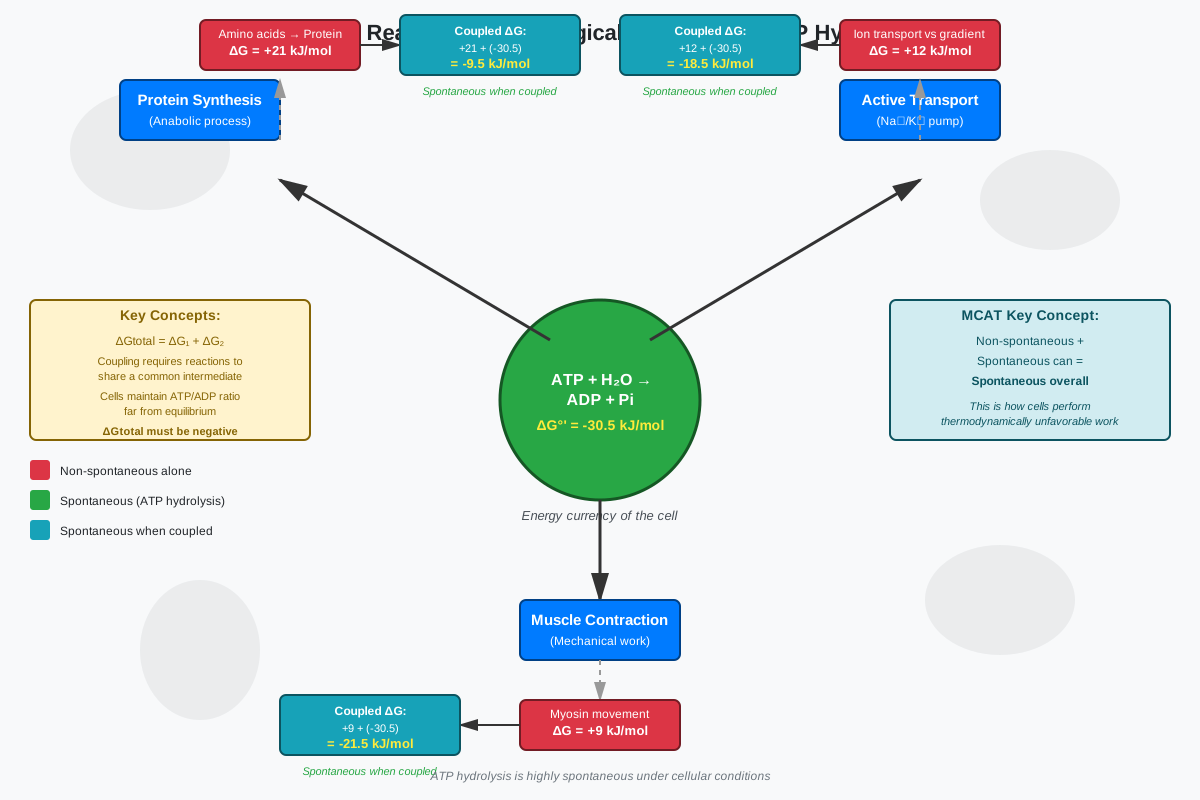
Spontaneity is not merely an abstract thermodynamic concept—it governs virtually every chemical and biological process. In living systems, spontaneous processes drive ATP hydrolysis, protein synthesis, membrane potential maintenance, and metabolic pathways. The human body couples non-spontaneous reactions (like building proteins) with spontaneous ones (like ATP breakdown) to accomplish essential functions. Understanding spontaneity allows medical professionals to comprehend drug delivery, enzyme catalysis, and disease mechanisms at the molecular level.
On the MCAT, spontaneity appears in approximately 3-5 questions per exam, distributed across the Chemical and Physical Foundations section and occasionally in Biological and Biochemical Foundations when discussing metabolism. Questions typically present in three formats: (1) direct calculation problems requiring Gibbs free energy determination, (2) conceptual questions about the relationship between thermodynamic parameters, and (3) passage-based questions analyzing experimental data or biological systems. The exam frequently tests the temperature-dependence of spontaneity, requiring students to determine at what temperature a process becomes spontaneous or non-spontaneous.
Common MCAT passages involving spontaneity include electrochemical cells (relating ΔG to cell potential), phase diagrams (analyzing spontaneous phase transitions), enzyme kinetics (distinguishing thermodynamic favorability from catalytic rate enhancement), and metabolic pathways (understanding coupled reactions). The exam particularly favors questions that require integrating multiple concepts, such as predicting how temperature changes affect both equilibrium position and spontaneity, or determining whether a reaction is spontaneous under non-standard conditions.
Core Concepts
Definition of Spontaneity
Spontaneity refers to the thermodynamic tendency of a process to occur without continuous external intervention once initiated. A spontaneous process is thermodynamically favorable and will proceed in the forward direction when left to itself. Crucially, spontaneity is determined solely by thermodynamic state functions and is independent of the pathway taken or the rate at which the process occurs. The universe naturally evolves toward states of maximum entropy, and spontaneous processes are those that increase the total entropy of the universe (system plus surroundings).
The mathematical criterion for spontaneity is expressed through Gibbs free energy (G), a state function that combines enthalpy and entropy effects:
ΔG = ΔH - TΔSWhere:
- ΔG = change in Gibbs free energy
- ΔH = change in enthalpy (heat content)
- T = absolute temperature (Kelvin)
- ΔS = change in entropy (disorder)
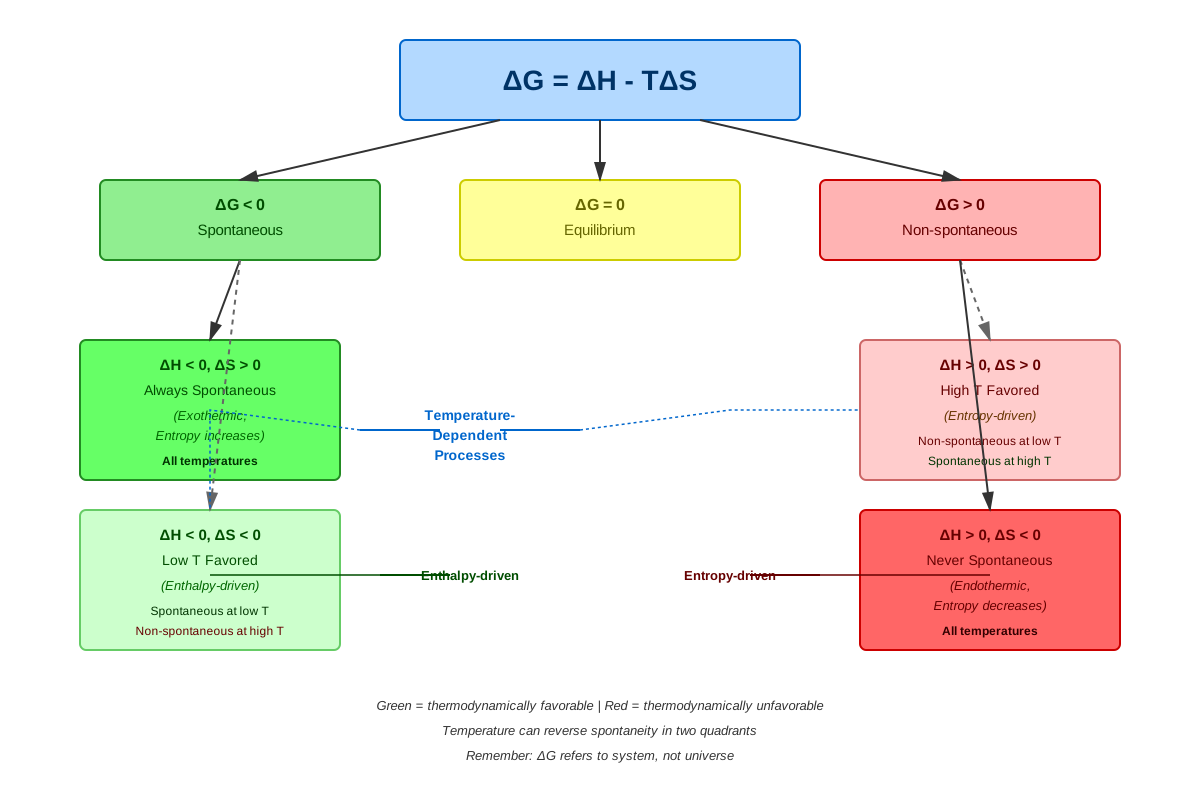
A process is spontaneous when ΔG < 0 (negative), at equilibrium when ΔG = 0, and non-spontaneous when ΔG > 0 (positive).
The Gibbs Free Energy Equation
The Gibbs free energy equation represents the balance between two competing factors: the enthalpy change (energy released or absorbed) and the entropy change (disorder created or destroyed), weighted by temperature. This equation reveals that spontaneity depends not only on the intrinsic properties of the system (ΔH and ΔS) but also on external conditions (temperature).
Enthalpy contribution (ΔH): Exothermic processes (ΔH < 0) release energy to the surroundings, favoring spontaneity. The system becomes more stable by achieving a lower energy state. Endothermic processes (ΔH > 0) require energy input and oppose spontaneity from an enthalpic perspective.
Entropy contribution (TΔS): Processes that increase disorder (ΔS > 0) are favored by the second law of thermodynamics. The temperature coefficient means that entropy effects become increasingly important at higher temperatures. At low temperatures, enthalpy dominates; at high temperatures, entropy dominates.
Four Scenarios of Spontaneity
The relationship between ΔH, ΔS, and temperature creates four distinct scenarios:
| ΔH | ΔS | ΔG | Spontaneity | Temperature Dependence | ||||
|---|---|---|---|---|---|---|---|---|
| Negative (−) | Positive (+) | Always negative | Always spontaneous | Spontaneous at all temperatures | ||||
| Positive (+) | Negative (−) | Always positive | Never spontaneous | Non-spontaneous at all temperatures | ||||
| Negative (−) | Negative (−) | Depends on T | Spontaneous at low T | Spontaneous when \ | ΔH\ | > \ | TΔS\ | |
| Positive (+) | Positive (+) | Depends on T | Spontaneous at high T | Spontaneous when TΔS > ΔH |
Scenario 1 (ΔH < 0, ΔS > 0): Both factors favor spontaneity. Examples include combustion reactions and the dissolution of many salts in water. These processes are thermodynamically favorable under all conditions.
Scenario 2 (ΔH > 0, ΔS < 0): Both factors oppose spontaneity. These processes require continuous energy input and will not occur spontaneously. An example is the synthesis of complex molecules from simpler ones without coupling to favorable reactions.
Scenario 3 (ΔH < 0, ΔS < 0): Enthalpy favors spontaneity while entropy opposes it. At low temperatures, the enthalpy term dominates, making ΔG negative. As temperature increases, the TΔS term grows larger, eventually making ΔG positive. Example: condensation of water vapor (exothermic but decreases disorder).
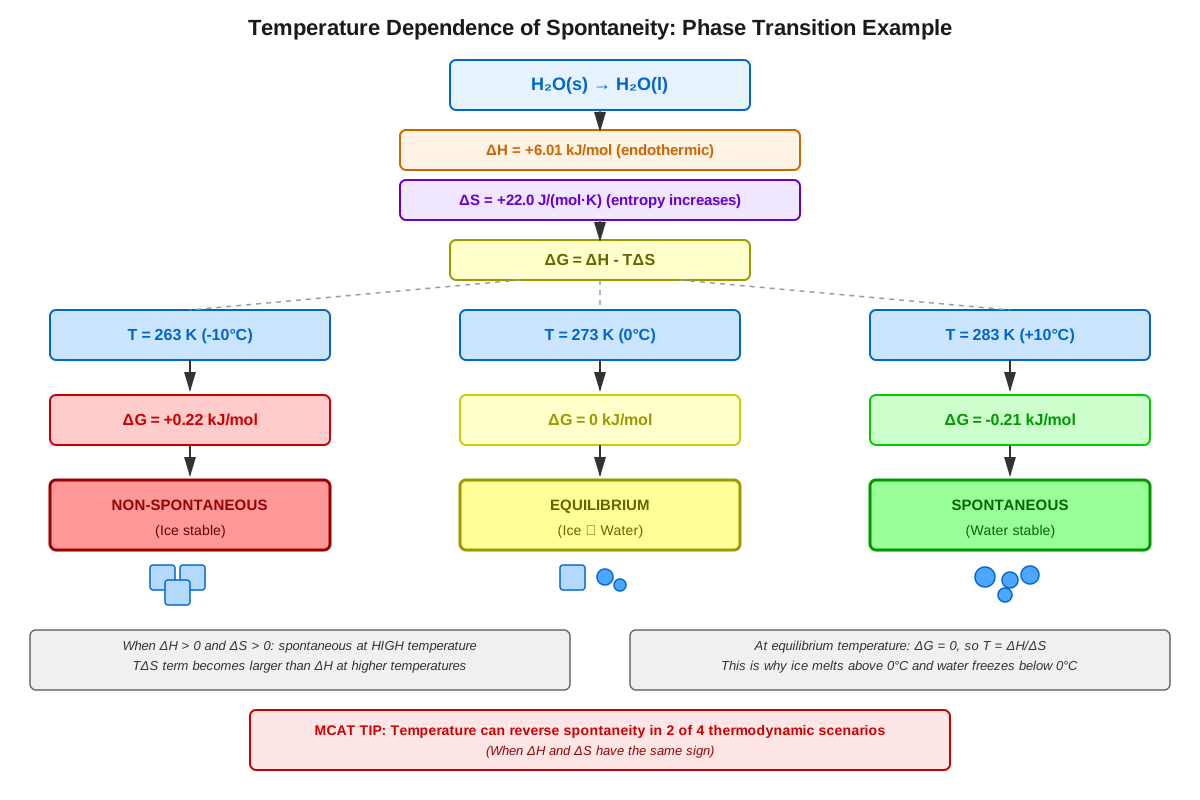
Scenario 4 (ΔH > 0, ΔS > 0): Entropy favors spontaneity while enthalpy opposes it. At low temperatures, the unfavorable enthalpy dominates. At high temperatures, the favorable entropy term (TΔS) becomes large enough to overcome the positive ΔH, making ΔG negative. Example: melting of ice or evaporation of water.
Standard Free Energy Change
The standard free energy change (ΔG°) refers to the free energy change when all reactants and products are in their standard states (1 M concentration for solutions, 1 atm pressure for gases, pure substances for solids and liquids, 25°C temperature). This standardization allows comparison between different reactions.
The relationship between standard free energy and the equilibrium constant (K) is:
ΔG° = -RT ln(K)Where:
- R = universal gas constant (8.314 J/mol·K)
- T = absolute temperature
- K = equilibrium constant
This equation reveals that:
- When K > 1: ΔG° < 0 (products favored at equilibrium)
- When K = 1: ΔG° = 0 (equal amounts of reactants and products)
- When K < 1: ΔG° > 0 (reactants favored at equilibrium)
Non-Standard Conditions and the Reaction Quotient
Under non-standard conditions, the actual free energy change (ΔG) differs from ΔG° and is calculated using the reaction quotient (Q):
ΔG = ΔG° + RT ln(Q)The reaction quotient Q has the same form as the equilibrium constant but uses actual concentrations rather than equilibrium concentrations. This equation allows prediction of spontaneity under any conditions:
- When Q < K: ΔG < 0, reaction proceeds forward (spontaneous)
- When Q = K: ΔG = 0, system at equilibrium
- When Q > K: ΔG > 0, reaction proceeds backward (reverse reaction spontaneous)
Spontaneity vs. Kinetics
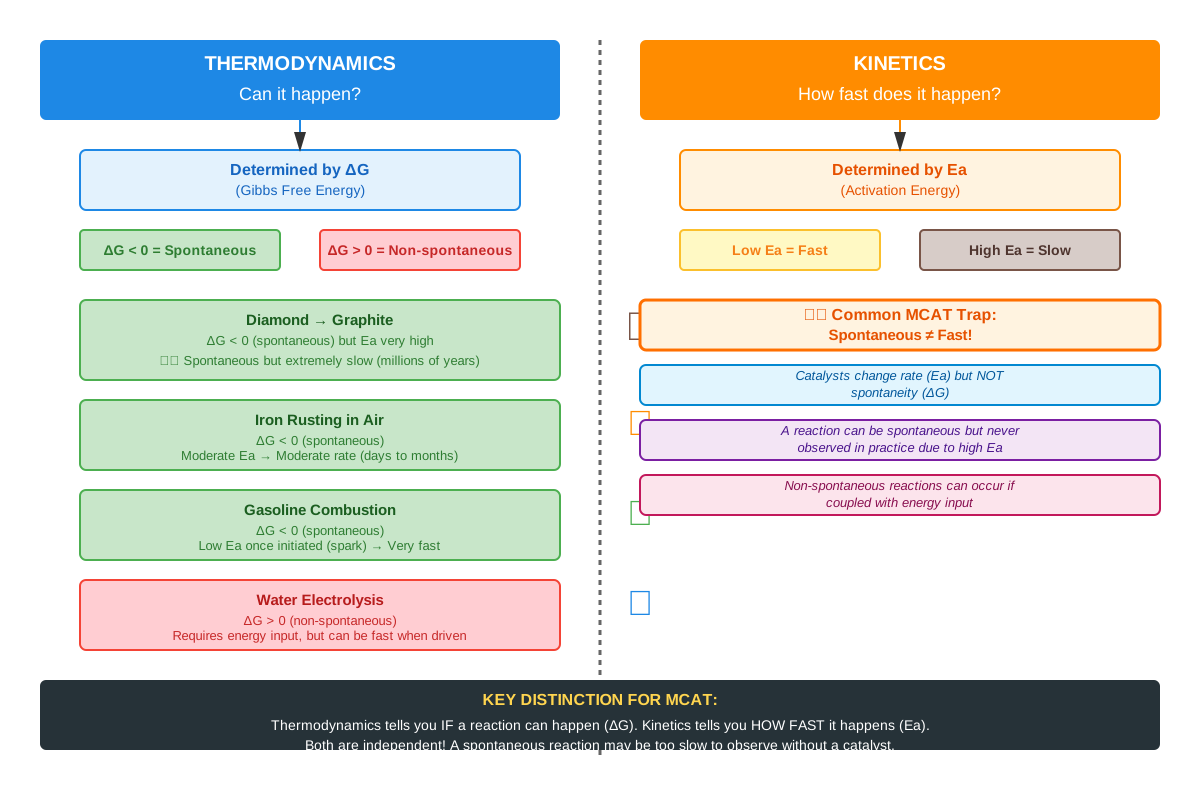
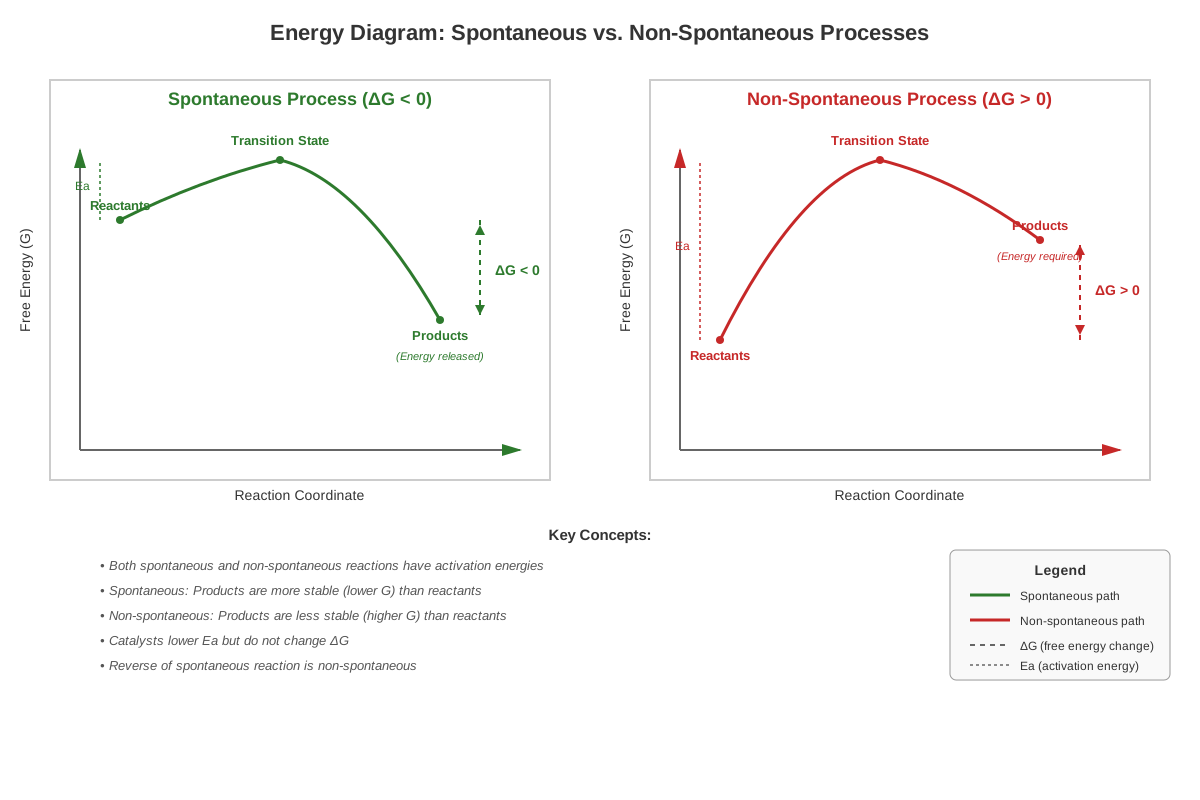
A critical distinction for the MCAT is that spontaneity does not determine reaction rate. A spontaneous reaction (ΔG < 0) is thermodynamically favorable but may proceed infinitesimally slowly. Diamond spontaneously converts to graphite at room temperature (ΔG < 0), yet diamonds persist indefinitely because the activation energy barrier is enormous.
Kinetics describes how fast a reaction proceeds and depends on activation energy, temperature, concentration, and catalysts. Thermodynamics (spontaneity) describes whether a reaction can proceed and depends only on the initial and final states. Catalysts, including enzymes, increase reaction rates by lowering activation energy but do not change ΔG or affect whether a reaction is spontaneous. This distinction appears frequently on the MCAT in questions asking whether adding a catalyst makes a non-spontaneous reaction spontaneous (it does not).
Coupled Reactions
In biological systems, non-spontaneous reactions (ΔG > 0) are driven by coupling them to spontaneous reactions (ΔG < 0). The overall free energy change is the sum of individual ΔG values:
ΔG_total = ΔG_1 + ΔG_2If ΔG_total < 0, the coupled process is spontaneous. The most common example is ATP hydrolysis (ΔG° ≈ -30.5 kJ/mol), which drives numerous non-spontaneous biosynthetic reactions. For instance, glucose phosphorylation (ΔG° = +13.8 kJ/mol) is coupled with ATP hydrolysis to produce glucose-6-phosphate, with an overall ΔG° of approximately -16.7 kJ/mol, making the process spontaneous.
Concept Relationships
The concept of spontaneity serves as the central organizing principle connecting multiple thermodynamic concepts. Entropy and enthalpy are the two fundamental state functions that determine spontaneity through their combination in the Gibbs free energy equation. The Second Law of Thermodynamics provides the theoretical foundation: spontaneous processes increase the total entropy of the universe, and Gibbs free energy conveniently packages this universal entropy change into a system-focused quantity.
Spontaneity directly connects to chemical equilibrium through the relationship ΔG° = -RT ln(K). At equilibrium, ΔG = 0, representing the state of maximum entropy and minimum free energy for the system. The position of equilibrium (whether products or reactants are favored) is determined by the sign and magnitude of ΔG°. Le Chatelier's principle can be understood through spontaneity: when a system at equilibrium is disturbed, it shifts in the direction that makes ΔG negative, restoring equilibrium.
In electrochemistry, spontaneity manifests as electrical potential. The relationship ΔG° = -nFE° connects free energy to cell potential, where spontaneous reactions (ΔG° < 0) produce positive cell potentials and occur in galvanic cells. Non-spontaneous reactions require external voltage and occur in electrolytic cells. This connection makes electrochemistry a powerful tool for measuring thermodynamic quantities.
The relationship map flows as follows: Second Law of Thermodynamics → establishes that entropy increases in spontaneous processes → combined with enthalpy changes through Gibbs free energy → determines spontaneity → predicts equilibrium position → connects to electrochemical potential → enables coupled reactions in biological systems.
Quick check — test yourself on Spontaneity so far.
Try Flashcards →High-Yield Facts
⭐ A negative ΔG indicates a spontaneous process; positive ΔG indicates non-spontaneous; ΔG = 0 indicates equilibrium
⭐ The equation ΔG = ΔH - TΔS shows that spontaneity depends on both enthalpy and entropy, weighted by temperature
⭐ Spontaneity is independent of reaction rate; spontaneous reactions may be extremely slow
⭐ ΔG° = -RT ln(K) relates standard free energy to the equilibrium constant
⭐ When ΔH < 0 and ΔS > 0, the process is spontaneous at all temperatures
- When ΔH > 0 and ΔS < 0, the process is non-spontaneous at all temperatures
- Catalysts and enzymes do not change ΔG or affect spontaneity; they only increase reaction rate
- At equilibrium, ΔG = 0 and Q = K, representing the state of minimum free energy
- Coupled reactions allow non-spontaneous processes to occur by pairing them with spontaneous ones
- The relationship ΔG = ΔG° + RT ln(Q) predicts spontaneity under non-standard conditions
- Increasing temperature favors processes with positive ΔS (entropy-driven reactions)
- Exergonic reactions release free energy (ΔG < 0); endergonic reactions require free energy input (ΔG > 0)
- Standard conditions are defined as 1 M concentration, 1 atm pressure, and 25°C (298 K)
- The sign of ΔG determines reaction direction, while the magnitude indicates how far from equilibrium the system is
Common Misconceptions
Misconception: Spontaneous reactions occur rapidly or instantaneously.
Correction: Spontaneity describes thermodynamic favorability, not kinetics. Diamond converting to graphite is spontaneous (ΔG < 0) but occurs immeasurably slowly at room temperature due to high activation energy. Spontaneity indicates whether a process can occur, not how fast it will occur.
Misconception: All exothermic reactions are spontaneous.
Correction: While exothermic reactions (ΔH < 0) have a favorable enthalpy contribution, spontaneity also depends on entropy. If ΔS is sufficiently negative and temperature is high enough, the -TΔS term can make ΔG positive despite negative ΔH. For example, 2O₃(g) → 3O₂(g) is exothermic but becomes non-spontaneous at very high temperatures due to the entropy decrease.
Misconception: Adding a catalyst makes a non-spontaneous reaction spontaneous.
Correction: Catalysts lower activation energy and increase reaction rate but do not change ΔG. A catalyst accelerates both forward and reverse reactions equally, affecting how quickly equilibrium is reached but not the equilibrium position or spontaneity. If ΔG > 0 without a catalyst, it remains positive with a catalyst.
Misconception: ΔG° and ΔG are interchangeable terms.
Correction: ΔG° is the standard free energy change under standard conditions (1 M, 1 atm, 25°C), while ΔG is the actual free energy change under any conditions. They are related by ΔG = ΔG° + RT ln(Q). A reaction with positive ΔG° can still be spontaneous (ΔG < 0) under certain non-standard conditions if Q is sufficiently small.
Misconception: At equilibrium, the forward and reverse reactions have stopped.
Correction: At equilibrium, ΔG = 0 and the forward and reverse reaction rates are equal, but both reactions continue to occur. This is dynamic equilibrium, not static. The concentrations remain constant because the rates of formation and consumption are balanced, not because reactions have ceased.
Misconception: Entropy always increases in spontaneous processes.
Correction: The entropy of the universe (system + surroundings) always increases in spontaneous processes, but the entropy of the system alone may decrease. For example, water freezing at -10°C is spontaneous despite decreasing system entropy because the heat released increases the entropy of the surroundings by a greater amount.
Misconception: If K > 1, the reaction goes to completion.
Correction: K > 1 means products are favored at equilibrium (ΔG° < 0), but significant amounts of reactants typically remain. Only when K is extremely large (>10¹⁰) does the reaction approach completion. The magnitude of K indicates the equilibrium position, not whether the reaction goes to completion.
Worked Examples
Example 1: Determining Temperature Dependence of Spontaneity
Problem: For the reaction N₂(g) + 3H₂(g) → 2NH₃(g), ΔH° = -92.4 kJ/mol and ΔS° = -198.7 J/mol·K. (a) Is this reaction spontaneous at 25°C? (b) At what temperature does the reaction cease to be spontaneous?
Solution:
(a) First, convert temperature to Kelvin and ensure consistent units:
- T = 25°C + 273 = 298 K
- ΔH° = -92.4 kJ/mol = -92,400 J/mol
- ΔS° = -198.7 J/mol·K
Apply the Gibbs free energy equation:
ΔG° = ΔH° - TΔS°
ΔG° = -92,400 J/mol - (298 K)(-198.7 J/mol·K)
ΔG° = -92,400 J/mol + 59,213 J/mol
ΔG° = -33,187 J/mol = -33.2 kJ/mol
Since ΔG° < 0, the reaction is spontaneous at 25°C.
Analysis: This is a Scenario 3 case (ΔH < 0, ΔS < 0). The exothermic nature favors spontaneity, while the entropy decrease (4 moles gas → 2 moles gas) opposes it. At 25°C, the enthalpy term dominates, making the reaction spontaneous.
(b) The reaction ceases to be spontaneous when ΔG° = 0:
0 = ΔH° - TΔS°
TΔS° = ΔH°
T = ΔH°/ΔS°
T = -92,400 J/mol / -198.7 J/mol·K
T = 465 K = 192°C
Above 465 K, the -TΔS term becomes larger in magnitude than ΔH°, making ΔG° positive and the reaction non-spontaneous. This explains why ammonia synthesis (Haber process) is performed at moderate temperatures despite being exothermic—higher temperatures decrease the thermodynamic favorability.
Example 2: Non-Standard Conditions and Reaction Quotient
Problem: Consider the reaction A(aq) + B(aq) ⇌ C(aq) with ΔG° = +15.0 kJ/mol at 25°C. If [A] = 0.10 M, [B] = 0.10 M, and [C] = 10.0 M, is the forward reaction spontaneous under these conditions?
Solution:
First, calculate the equilibrium constant from ΔG°:
ΔG° = -RT ln(K)
15,000 J/mol = -(8.314 J/mol·K)(298 K) ln(K)
15,000 = -2477.6 ln(K)
ln(K) = -6.06
K = e^(-6.06) = 2.35 × 10^(-3)
Next, calculate the reaction quotient Q:
Q = [C]/([A][B])
Q = 10.0/(0.10 × 0.10)
Q = 10.0/0.01 = 1000
Now calculate ΔG under these conditions:
ΔG = ΔG° + RT ln(Q)
ΔG = 15,000 J/mol + (8.314 J/mol·K)(298 K) ln(1000)
ΔG = 15,000 + (2477.6)(6.91)
ΔG = 15,000 + 17,120
ΔG = +32,120 J/mol = +32.1 kJ/mol
Since ΔG > 0, the forward reaction is non-spontaneous under these conditions.
Analysis: Although ΔG° is positive (products not favored at standard conditions), we must check actual conditions. Here, Q (1000) >> K (0.00235), meaning there is far too much product relative to equilibrium. The system will shift backward (reverse reaction is spontaneous) to reach equilibrium. This demonstrates that even reactions with unfavorable ΔG° can be spontaneous in the forward direction if Q < K, and reactions with favorable ΔG° can be non-spontaneous if Q > K.
Exam Strategy
When approaching MCAT questions on spontaneity, begin by identifying what the question is asking: spontaneity determination (sign of ΔG), temperature effects, equilibrium relationships, or kinetic vs. thermodynamic considerations. Read carefully to distinguish between standard (ΔG°) and non-standard (ΔG) conditions.
Trigger words and phrases to recognize:
- "Thermodynamically favorable" = spontaneous, ΔG < 0
- "At equilibrium" = ΔG = 0, Q = K
- "Under standard conditions" = use ΔG°, 1 M, 1 atm, 25°C
- "Exergonic" = releases free energy, ΔG < 0
- "Endergonic" = requires free energy input, ΔG > 0
- "Products favored" = K > 1, ΔG° < 0
- "Coupled reaction" = sum individual ΔG values
Process-of-elimination strategies:
- Immediately eliminate answers confusing spontaneity with kinetics (e.g., "adding a catalyst makes the reaction spontaneous")
- For temperature-dependence questions, identify the signs of ΔH and ΔS first, then eliminate answers inconsistent with the four scenarios
- If given K or ΔG°, eliminate answers that incorrectly relate these quantities (remember: K > 1 means ΔG° < 0)
- For coupled reactions, eliminate answers suggesting non-spontaneous reactions can occur without coupling to spontaneous ones
Time allocation: Straightforward ΔG calculations should take 30-45 seconds. Conceptual questions about spontaneity vs. kinetics or temperature dependence should take 20-30 seconds. Passage-based questions requiring integration of multiple concepts may take 60-90 seconds. If a calculation becomes complex, consider whether conceptual reasoning or answer elimination might be faster.
Common question formats:
- Given ΔH and ΔS, determine spontaneity at specified temperature
- Predict how temperature change affects spontaneity
- Distinguish between thermodynamic favorability and reaction rate
- Calculate ΔG under non-standard conditions using Q
- Analyze coupled reactions in metabolic pathways
- Relate ΔG° to equilibrium constant or cell potential
Memory Techniques
Mnemonic for spontaneity scenarios: "HENS" (Heat-Entropy-Never-Sometimes)
- Heat out (ΔH < 0), Entropy up (ΔS > 0) → Always spontaneous
- Heat in (ΔH > 0), Entropy down (ΔS < 0) → Never spontaneous
- Heat out (ΔH < 0), Entropy down (ΔS < 0) → Spontaneous at low T
- Heat in (ΔH > 0), Entropy up (ΔS > 0) → Spontaneous at high T
Visualization for ΔG = ΔH - TΔS: Picture a tug-of-war between enthalpy (pulling left) and entropy (pulling right), with temperature as the strength multiplier for entropy. At low temperatures, enthalpy wins; at high temperatures, entropy wins.
Acronym for remembering ΔG relationships: "GLEN"
- Gibbs free energy
- Less than zero = spontaneous
- Equals zero = equilibrium
- Not less than zero (positive) = non-spontaneous
Memory aid for standard conditions: "1-1-25" (like a date: January 1st, 25°C)
- 1 M concentration
- 1 atm pressure
- 25°C temperature
Conceptual anchor: Remember that spontaneity is about "Can it happen?" while kinetics is about "How fast does it happen?" Think of a boulder on a hill: rolling down is spontaneous (lower potential energy) but may be prevented by a barrier (activation energy).
Summary
Spontaneity in General Chemistry describes the thermodynamic tendency of processes to occur without continuous external intervention, determined by the sign of Gibbs free energy (ΔG). The fundamental equation ΔG = ΔH - TΔS reveals that spontaneity depends on the balance between enthalpy changes, entropy changes, and temperature. Negative ΔG indicates spontaneous processes, positive ΔG indicates non-spontaneous processes, and ΔG = 0 indicates equilibrium. Critically, spontaneity is independent of reaction rate—thermodynamically favorable reactions may proceed extremely slowly due to high activation energy barriers. The MCAT frequently tests the four scenarios arising from different combinations of ΔH and ΔS signs, the relationship between ΔG° and equilibrium constant (ΔG° = -RT ln K), and the distinction between standard and non-standard conditions (ΔG = ΔG° + RT ln Q). Understanding spontaneity enables prediction of reaction direction, analysis of coupled reactions in biological systems, and connection to electrochemical processes. Mastery requires recognizing that catalysts affect kinetics but not thermodynamics, that entropy of the universe (not just the system) determines spontaneity, and that temperature can reverse spontaneity for reactions where ΔH and ΔS have the same sign.
Key Takeaways
- Spontaneity is determined by ΔG: negative values indicate spontaneous processes, zero indicates equilibrium, and positive values indicate non-spontaneous processes
- The equation ΔG = ΔH - TΔS integrates enthalpy and entropy effects, with temperature determining which factor dominates
- Spontaneity is completely independent of reaction rate—thermodynamically favorable reactions may be kinetically slow
- Four scenarios exist based on ΔH and ΔS signs: always spontaneous (ΔH < 0, ΔS > 0), never spontaneous (ΔH > 0, ΔS < 0), and two temperature-dependent cases
- Standard free energy (ΔG°) relates to equilibrium constant through ΔG° = -RT ln K, while actual free energy (ΔG) depends on reaction quotient Q
- Catalysts and enzymes do not change spontaneity—they only affect the rate at which equilibrium is reached
- Coupled reactions enable non-spontaneous processes by pairing them with spontaneous ones, with the sum of ΔG values determining overall spontaneity
Related Topics
Chemical Equilibrium: Understanding spontaneity provides the foundation for equilibrium concepts, as equilibrium represents the state where ΔG = 0 and forward and reverse reaction rates are equal. Mastery of spontaneity enables prediction of equilibrium position and response to stress.
Electrochemistry: The relationship ΔG° = -nFE° directly connects spontaneity to cell potential, making electrochemistry a practical application of thermodynamic principles. Understanding spontaneity is essential for distinguishing galvanic (spontaneous) from electrolytic (non-spontaneous) cells.
Kinetics and Activation Energy: While spontaneity determines whether reactions can occur, kinetics describes how fast they proceed. The distinction between thermodynamic favorability and kinetic barriers is crucial for understanding catalysis and reaction mechanisms.
Biochemical Energetics: Metabolic pathways rely on coupled reactions where ATP hydrolysis drives non-spontaneous biosynthetic processes. Understanding spontaneity is essential for analyzing cellular metabolism, active transport, and signal transduction.
Phase Transitions and Colligative Properties: Spontaneity principles govern phase changes, with temperature determining which phase is thermodynamically stable. This connects to vapor pressure, boiling point elevation, and freezing point depression.
Practice CTA
Now that you have mastered the core concepts of spontaneity, it's time to solidify your understanding through active practice. Attempt the practice questions and flashcards to test your ability to apply these principles under exam conditions. Focus on distinguishing between spontaneity and kinetics, calculating ΔG under various conditions, and predicting temperature effects on reaction favorability. Remember that thermodynamics mastery comes through repeated application—each practice problem strengthens your intuition for predicting chemical behavior. The investment you make in understanding spontaneity will pay dividends across multiple MCAT sections, from General Chemistry calculations to biochemical pathway analysis. You've built a strong foundation; now reinforce it through deliberate practice!
Sign up free to keep reading
Create a free AnvayaPrep account to finish this MCAT guide on Spontaneity — plus flashcards and practice questions.