Overview
Phase transitions represent fundamental changes in the physical state of matter—solid, liquid, gas, and plasma—driven by alterations in temperature, pressure, or both. In General Chemistry, understanding phase transitions is essential for predicting how substances behave under varying conditions, interpreting phase diagrams, and calculating energy changes during state transformations. These transitions occur when the balance between intermolecular forces and kinetic energy shifts, causing molecules to reorganize into different structural arrangements with distinct physical properties.
For the MCAT, phase transitions appear frequently in both standalone questions and passage-based items within the Chemical and Physical Foundations of Biological Systems section. Test-makers commonly integrate phase transition concepts with thermodynamics, intermolecular forces, colligative properties, and equilibrium. Students must recognize the energetic requirements of different transitions, interpret heating and cooling curves, apply the Clausius-Clapeyron equation, and understand how phase behavior relates to biological systems such as protein denaturation, membrane fluidity, and cryopreservation.
Phase transitions General Chemistry connects intimately with broader topics in Solutions and Phase Behavior, including vapor pressure, Raoult's law, boiling point elevation, and freezing point depression. Mastery of phase transitions provides the foundation for understanding how solutes affect solvent properties, why certain substances sublime under specific conditions, and how phase diagrams map the stability regions of different states. This topic bridges thermochemistry (enthalpy changes), kinetics (rates of phase change), and intermolecular forces (the molecular basis for state stability), making it a high-yield area that integrates multiple General Chemistry domains.
Learning Objectives
- [ ] Define phase transitions using accurate General Chemistry terminology
- [ ] Explain why phase transitions matters for the MCAT
- [ ] Apply phase transitions to exam-style questions
- [ ] Identify common mistakes related to phase transitions
- [ ] Connect phase transitions to related General Chemistry concepts
- [ ] Calculate energy requirements for phase transitions using enthalpy of fusion and vaporization
- [ ] Interpret phase diagrams including triple points, critical points, and phase boundaries
- [ ] Predict the direction of phase transitions based on changes in temperature and pressure
- [ ] Distinguish between endothermic and exothermic phase transitions and their thermodynamic implications
Prerequisites
- Intermolecular forces (hydrogen bonding, dipole-dipole, London dispersion): Phase transitions fundamentally depend on the strength of attractive forces between molecules
- Thermodynamics basics (enthalpy, entropy, Gibbs free energy): Energy calculations and spontaneity predictions require thermodynamic principles
- States of matter (solid, liquid, gas properties): Understanding the characteristics of each phase is necessary before studying transitions between them
- Kinetic molecular theory: The relationship between temperature and molecular motion explains why heating drives phase transitions
- Energy and heat transfer: Phase transitions involve energy absorption or release without temperature change during the transition itself
Why This Topic Matters
Phase transitions MCAT questions appear in approximately 3-5% of Chemical and Physical Foundations passages, often integrated with thermodynamics, solutions chemistry, or biochemical applications. The MCAT tests phase transitions through heating curves, phase diagram interpretation, energy calculations, and conceptual questions about molecular behavior during state changes. Understanding phase transitions enables students to tackle questions about biological phenomena such as sweating (evaporative cooling), ice formation in cells (cryobiology), lipid bilayer phase transitions affecting membrane permeability, and protein stability under temperature stress.
Clinically, phase transitions have profound significance. Cryosurgery exploits freezing transitions to destroy abnormal tissue. Anesthesia involves volatile liquids that undergo vaporization at body temperature. Hypothermia and hyperthermia treatments depend on controlled phase behavior of water in tissues. Lyophilization (freeze-drying) preserves pharmaceuticals and vaccines by sublimation. Understanding phase transitions helps medical professionals predict drug stability, design delivery systems, and comprehend physiological responses to temperature extremes.
On the MCAT, phase transition questions typically appear as: (1) heating/cooling curve interpretation requiring identification of phase regions and plateau calculations, (2) phase diagram analysis asking students to predict states under specific conditions, (3) thermodynamic calculations involving enthalpy of fusion or vaporization, (4) passage-based questions connecting phase behavior to experimental procedures or biological systems, and (5) conceptual questions about molecular-level changes during transitions. Recognizing these patterns allows efficient question navigation and accurate answer selection.
Core Concepts
Types of Phase Transitions
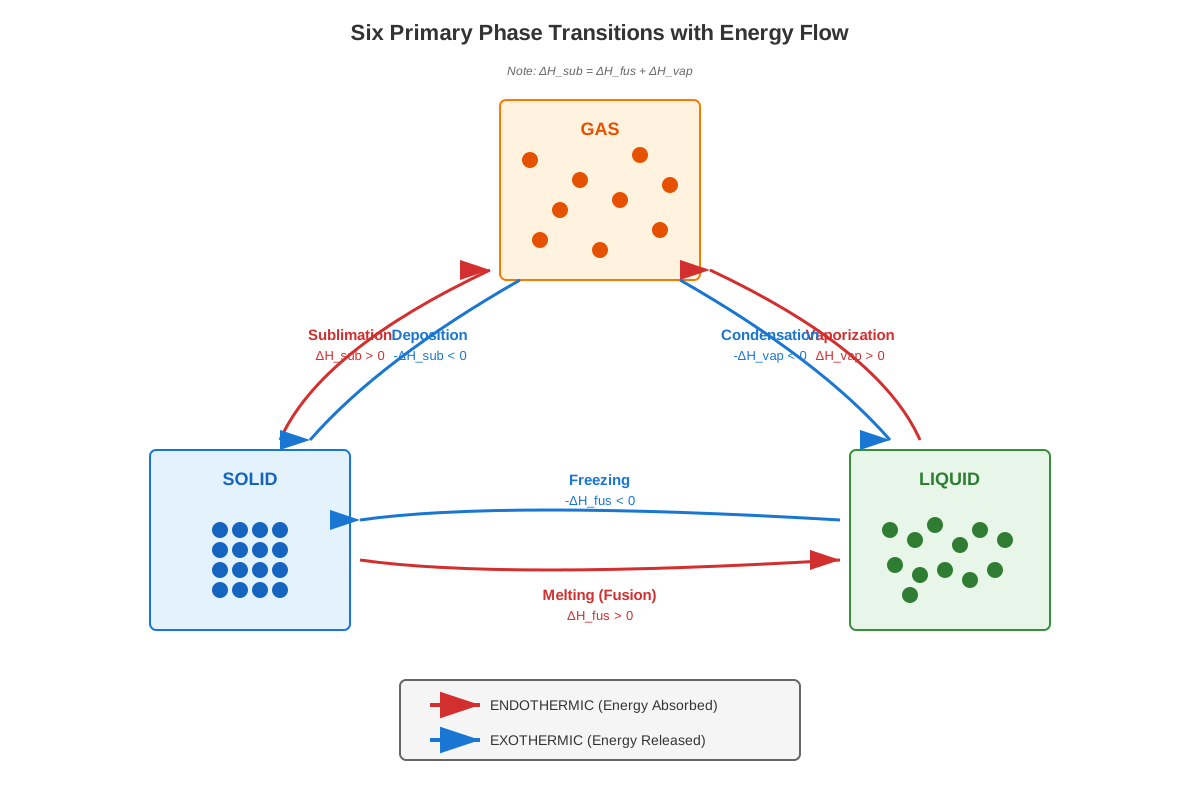
Phase transitions are transformations between different states of matter, each with a specific name and characteristic energy change. The six primary transitions form three pairs of reverse processes:
Melting (fusion) converts solid to liquid, requiring energy input to overcome the ordered crystalline structure. The enthalpy of fusion (ΔH_fus) quantifies this energy requirement, typically ranging from 5-30 kJ/mol for most substances. The reverse process, freezing (solidification), releases the same amount of energy as molecules organize into fixed positions.
Vaporization transforms liquid to gas, demanding substantial energy to completely overcome intermolecular forces. This occurs through evaporation (surface phenomenon at any temperature) or boiling (bulk phenomenon at a specific temperature where vapor pressure equals external pressure). The enthalpy of vaporization (ΔH_vap) is considerably larger than ΔH_fus, typically 40-50 kJ/mol for water. Condensation reverses vaporization, releasing energy as gas molecules slow and attract each other.
Sublimation directly converts solid to gas without passing through the liquid phase, occurring when vapor pressure of the solid exceeds atmospheric pressure before reaching the melting point. Dry ice (solid CO₂), iodine crystals, and naphthalene exhibit sublimation at room temperature. Deposition reverses sublimation, as seen in frost formation when water vapor converts directly to ice crystals.
| Transition | Initial State | Final State | Energy Change | ΔH Sign |
|---|---|---|---|---|
| Melting | Solid | Liquid | Endothermic | Positive |
| Freezing | Liquid | Solid | Exothermic | Negative |
| Vaporization | Liquid | Gas | Endothermic | Positive |
| Condensation | Gas | Liquid | Exothermic | Negative |
| Sublimation | Solid | Gas | Endothermic | Positive |
| Deposition | Gas | Solid | Exothermic | Negative |
Heating and Cooling Curves
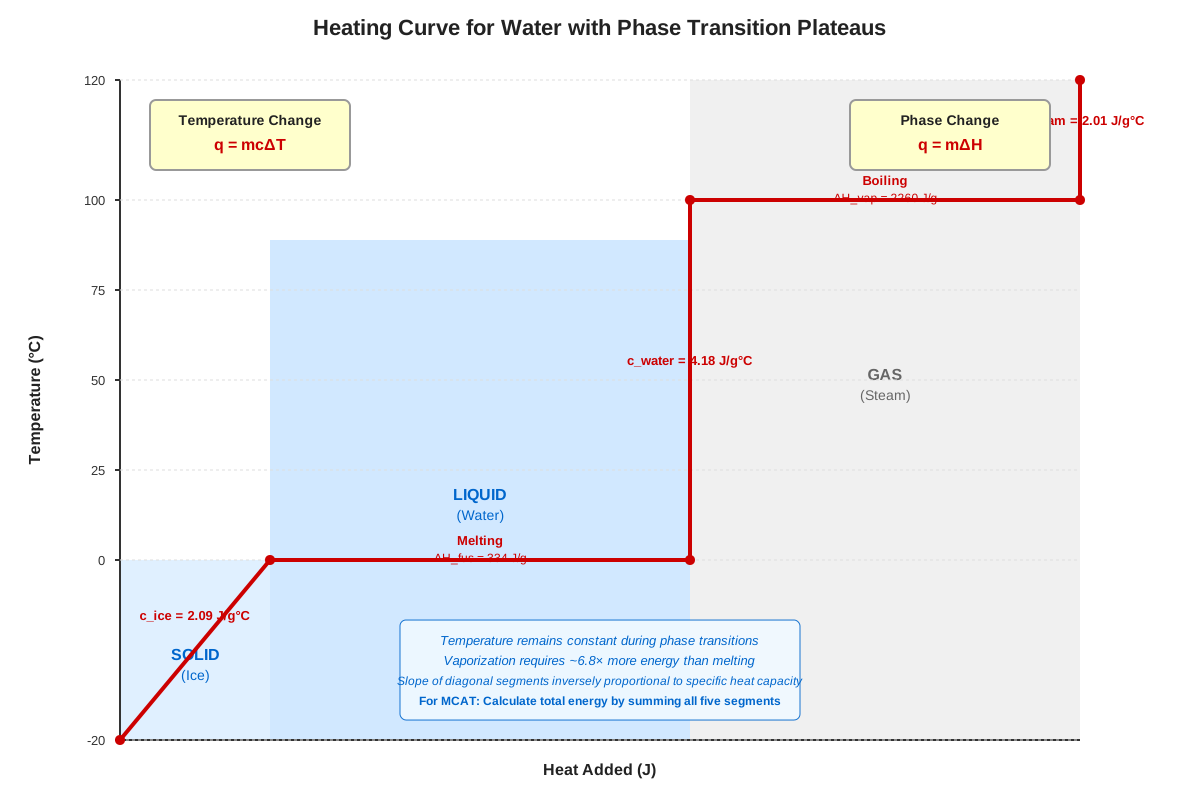
Heating curves graphically represent temperature changes as a substance absorbs heat at constant pressure. These curves contain five distinct regions:
- Solid heating: Temperature increases linearly as heat increases kinetic energy of vibrating molecules (slope = 1/[mass × specific heat of solid])
- Melting plateau: Temperature remains constant at the melting point while heat breaks intermolecular forces (length proportional to ΔH_fus)
- Liquid heating: Temperature increases with different slope than solid region (slope = 1/[mass × specific heat of liquid])
- Boiling plateau: Temperature remains constant at the boiling point while heat overcomes remaining intermolecular forces (length proportional to ΔH_vap)
- Gas heating: Temperature increases with steepest slope as heat increases translational kinetic energy (slope = 1/[mass × specific heat of gas])
MCAT Exam Tip: The horizontal plateaus represent phase transitions where added energy breaks intermolecular forces rather than increasing kinetic energy. Temperature remains constant because kinetic energy (which determines temperature) doesn't change during the transition—only potential energy changes.
The total heat required for a complete phase transition calculation follows:
q_total = m·c_solid·ΔT₁ + n·ΔH_fus + m·c_liquid·ΔT₂ + n·ΔH_vap + m·c_gas·ΔT₃Where m = mass, c = specific heat capacity, n = moles, and ΔT = temperature change in each region.
Phase Diagrams
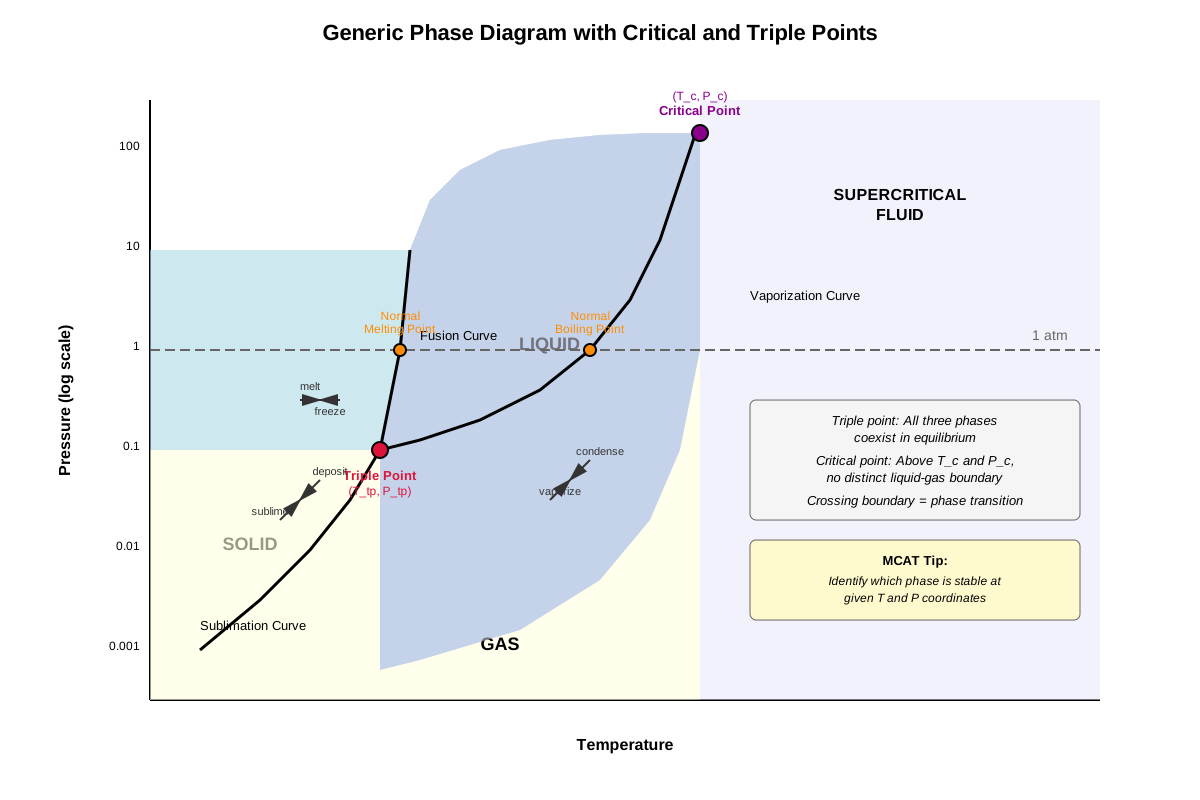
Phase diagrams map the stable state of a substance as a function of temperature (x-axis) and pressure (y-axis). These diagrams contain three regions (solid, liquid, gas), three boundary lines, and two special points:
Phase boundaries represent conditions where two phases coexist in equilibrium:
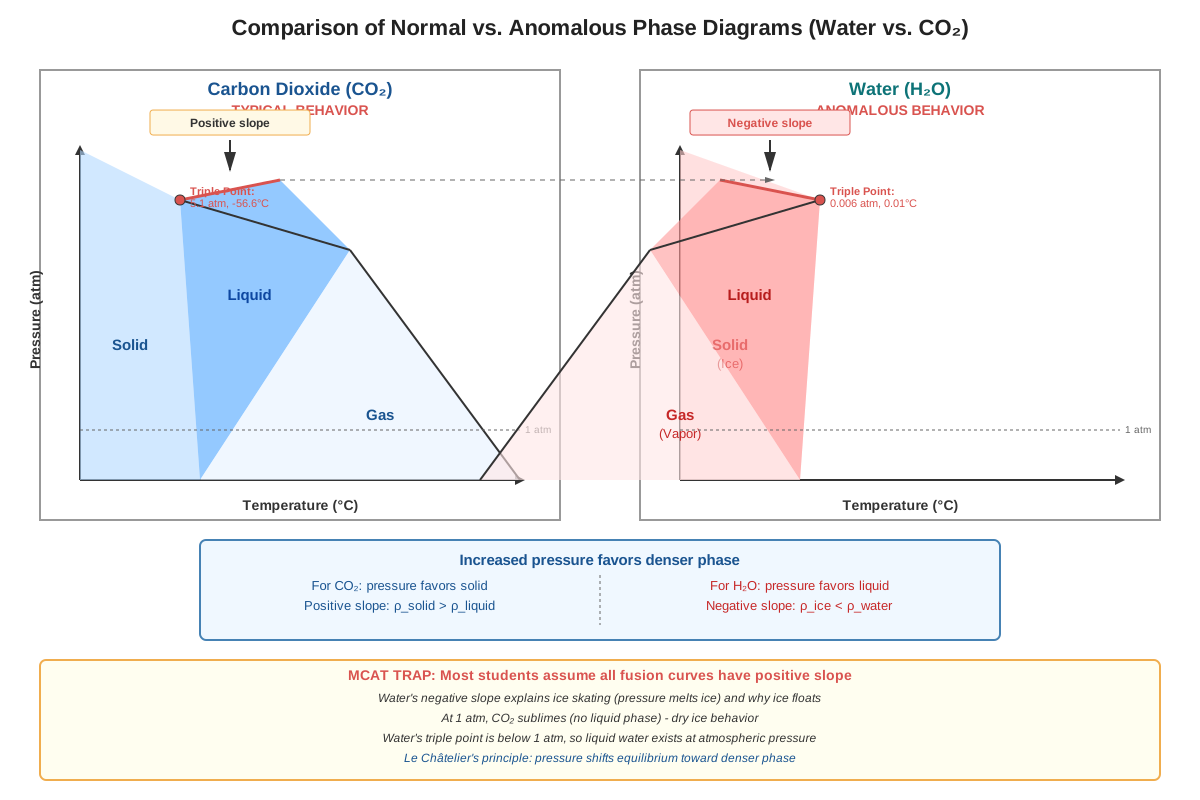
- Solid-liquid boundary (fusion curve): Nearly vertical line showing melting point variation with pressure; positive slope for most substances, negative slope for water due to ice's lower density
- Liquid-gas boundary (vaporization curve): Shows boiling point increasing with pressure; terminates at the critical point
- Solid-gas boundary (sublimation curve): Represents conditions for direct solid-gas transition
The triple point marks the unique temperature and pressure where all three phases coexist in equilibrium. For water, this occurs at 0.01°C and 611.657 Pa (0.006 atm). Below the triple point pressure, substances cannot exist as liquids—they transition directly between solid and gas.
The critical point defines the temperature and pressure above which distinct liquid and gas phases cannot exist. Beyond this point, the substance becomes a supercritical fluid with properties intermediate between liquid and gas. For water, T_c = 374°C and P_c = 218 atm. Supercritical CO₂ is used in pharmaceutical extraction and chromatography.
Molecular Basis of Phase Transitions
At the molecular level, phase transitions reflect the competition between intermolecular forces (which favor ordered, condensed states) and thermal kinetic energy (which favors disorder and separation). Temperature serves as a proxy for average kinetic energy, while pressure affects the volume available to molecules.
In solids, molecules occupy fixed positions in a crystalline or amorphous structure, vibrating about equilibrium positions. Strong intermolecular forces maintain this order. As temperature increases, vibrational amplitude grows until molecules gain sufficient energy to overcome positional constraints—this is melting. The melting point depends on intermolecular force strength: ionic solids (NaCl, mp = 801°C) > hydrogen-bonded networks (H₂O, mp = 0°C) > dipolar molecules (HCl, mp = -114°C) > nonpolar molecules (CH₄, mp = -182°C).
In liquids, molecules maintain close proximity but move freely past one another. Intermolecular forces still significantly influence behavior, but molecules possess sufficient kinetic energy to overcome positional order. As temperature increases, more molecules achieve escape velocity from the liquid surface (evaporation). When vapor pressure equals external pressure, bubbles form throughout the liquid—this is boiling.
In gases, molecules move independently with negligible intermolecular interactions except during brief collisions. Kinetic energy dominates, and molecules occupy all available volume. Cooling reduces kinetic energy until intermolecular forces can capture molecules into the liquid phase (condensation).
Vapor Pressure and Phase Equilibrium
Vapor pressure represents the pressure exerted by a vapor in equilibrium with its liquid or solid phase in a closed system. At any temperature below the boiling point, some molecules possess sufficient kinetic energy to escape the liquid surface. In a closed container, these molecules accumulate until the rate of evaporation equals the rate of condensation—establishing dynamic equilibrium.
Vapor pressure increases exponentially with temperature, described by the Clausius-Clapeyron equation:
ln(P₂/P₁) = -(ΔH_vap/R) × (1/T₂ - 1/T₁)Where P = vapor pressure, ΔH_vap = enthalpy of vaporization, R = gas constant (8.314 J/mol·K), and T = absolute temperature.
This equation allows calculation of vapor pressure at different temperatures or determination of ΔH_vap from vapor pressure measurements. The MCAT may present this in linear form:
ln(P) = -(ΔH_vap/R) × (1/T) + CA plot of ln(P) versus 1/T yields a straight line with slope = -ΔH_vap/R.
Boiling point is defined as the temperature where vapor pressure equals external pressure. At standard atmospheric pressure (1 atm), this is the normal boiling point. Reducing external pressure lowers the boiling point (high-altitude cooking requires longer times), while increasing pressure raises it (pressure cookers accelerate cooking).
Thermodynamics of Phase Transitions
Phase transitions are first-order phase transitions, characterized by discontinuous changes in enthalpy and entropy at the transition temperature. At the transition point, two phases coexist in equilibrium, meaning ΔG = 0:
ΔG = ΔH - TΔS = 0Therefore, at the transition temperature:
ΔS_transition = ΔH_transition / T_transitionThis relationship, known as Trouton's rule for vaporization, predicts that ΔS_vap ≈ 85-88 J/mol·K for many nonpolar liquids. Deviations indicate unusual intermolecular forces (hydrogen bonding increases ΔS_vap because liquid structure is more ordered).
Endothermic transitions (melting, vaporization, sublimation) increase entropy as molecules gain freedom of movement. Exothermic transitions (freezing, condensation, deposition) decrease entropy as molecules become more ordered. The entropy increase during vaporization is much larger than during melting because gas molecules have vastly more positional freedom than liquid molecules.
Concept Relationships
Phase transitions fundamentally connect to intermolecular forces, which determine the energy required for each transition. Stronger intermolecular forces → higher melting and boiling points → larger ΔH_fus and ΔH_vap. This relationship extends to vapor pressure: substances with weak intermolecular forces exhibit high vapor pressure (volatile), while those with strong forces show low vapor pressure (nonvolatile).
The thermodynamic framework links phase transitions to Gibbs free energy and spontaneity. At temperatures below the transition point, the lower-energy phase is stable (ΔG < 0 for transition to that phase). At the transition temperature, ΔG = 0 and phases coexist. Above the transition temperature, the higher-entropy phase becomes favorable despite its higher enthalpy.
Phase diagrams integrate pressure-volume-temperature relationships from gas laws with phase equilibria. The ideal gas law applies in the gas region, but deviations occur near phase boundaries where intermolecular forces become significant. The van der Waals equation better describes real gas behavior near condensation.
Colligative properties (boiling point elevation, freezing point depression) represent applications of phase transition principles to solutions. Solutes disrupt solvent intermolecular forces, requiring higher temperatures for vaporization and lower temperatures for freezing. These effects depend on the number of solute particles, not their identity.
Relationship map: Intermolecular Forces → determine → Transition Temperatures → define → Phase Boundaries → organize → Phase Diagrams → predict → State Under Given Conditions → calculate using → Thermodynamic Equations → quantify → Energy Requirements → measured as → Enthalpy Changes → relate to → Entropy Changes → determine → Spontaneity via ΔG
Quick check — test yourself on Phase transitions so far.
Try Flashcards →High-Yield Facts
⭐ Vaporization requires significantly more energy than melting because all intermolecular forces must be overcome (ΔH_vap >> ΔH_fus)
⭐ Temperature remains constant during phase transitions because added energy changes potential energy (breaking intermolecular forces) rather than kinetic energy
⭐ Water's solid-liquid boundary has negative slope on phase diagrams because ice is less dense than liquid water (unique property)
⭐ Vapor pressure increases exponentially with temperature and equals external pressure at the boiling point
⭐ The triple point represents the only conditions where solid, liquid, and gas coexist in equilibrium
- Sublimation occurs when a substance's vapor pressure exceeds atmospheric pressure before reaching its melting point
- The critical point marks the temperature and pressure above which distinct liquid and gas phases cannot exist
- Endothermic phase transitions (melting, vaporization, sublimation) have positive ΔH and increase entropy
- Exothermic phase transitions (freezing, condensation, deposition) have negative ΔH and decrease entropy
- The Clausius-Clapeyron equation relates vapor pressure to temperature: ln(P₂/P₁) = -(ΔH_vap/R)(1/T₂ - 1/T₁)
- Stronger intermolecular forces correlate with higher melting points, higher boiling points, and lower vapor pressures
- At the phase transition temperature, ΔG = 0 and ΔS = ΔH/T
- Pressure cookers increase boiling point by raising the pressure above the liquid
- Evaporation is a cooling process because high-energy molecules preferentially escape, lowering average kinetic energy
- Supercritical fluids exhibit properties intermediate between liquids and gases, useful for extractions
Common Misconceptions
Misconception: Temperature increases continuously when heat is added to a substance.
Correction: Temperature remains constant during phase transitions (horizontal plateaus on heating curves) because energy breaks intermolecular forces rather than increasing kinetic energy. Only after the transition completes does temperature resume increasing.
Misconception: Boiling and evaporation are the same process.
Correction: Evaporation occurs at any temperature from the liquid surface when molecules gain sufficient energy to escape. Boiling occurs only at the specific temperature where vapor pressure equals external pressure, forming bubbles throughout the liquid bulk.
Misconception: All substances expand when freezing.
Correction: Most substances contract when freezing as molecules pack more efficiently in crystalline solids. Water is unusual—it expands upon freezing because hydrogen bonding creates an open hexagonal ice structure less dense than liquid water.
Misconception: The triple point is the lowest possible temperature for a substance.
Correction: The triple point is simply the unique pressure-temperature combination where three phases coexist. Substances can exist at temperatures far below their triple point (solid helium exists near absolute zero, well below its triple point of 2.2 K).
Misconception: Phase transitions occur instantaneously at the transition temperature.
Correction: Phase transitions require time for heat transfer and molecular reorganization. Supercooling (liquid below freezing point) and superheating (liquid above boiling point) can occur when transitions are kinetically hindered, though these are metastable states.
Misconception: ΔH_vap is always exactly twice ΔH_fus.
Correction: While ΔH_vap is always larger than ΔH_fus, the ratio varies by substance. For water, ΔH_vap (40.7 kJ/mol) is about 6.8 times ΔH_fus (6.01 kJ/mol), reflecting the complete disruption of hydrogen bonding during vaporization.
Misconception: Sublimation only occurs at very low pressures.
Correction: Sublimation occurs whenever a substance's vapor pressure exceeds atmospheric pressure before reaching its melting point. Dry ice sublimates at atmospheric pressure and room temperature because CO₂'s triple point (5.1 atm) exceeds normal atmospheric pressure.
Worked Examples
Example 1: Heating Curve Energy Calculation
Question: Calculate the total energy required to convert 50.0 g of ice at -20°C to steam at 120°C. Given: c_ice = 2.09 J/g°C, c_water = 4.18 J/g°C, c_steam = 2.01 J/g°C, ΔH_fus = 334 J/g, ΔH_vap = 2260 J/g.
Solution:
This problem requires calculating energy for five distinct steps:
Step 1: Heat ice from -20°C to 0°C
q₁ = m × c_ice × ΔT = 50.0 g × 2.09 J/g°C × 20°C = 2,090 JStep 2: Melt ice at 0°C
q₂ = m × ΔH_fus = 50.0 g × 334 J/g = 16,700 JStep 3: Heat water from 0°C to 100°C
q₃ = m × c_water × ΔT = 50.0 g × 4.18 J/g°C × 100°C = 20,900 JStep 4: Vaporize water at 100°C
q₄ = m × ΔH_vap = 50.0 g × 2260 J/g = 113,000 JStep 5: Heat steam from 100°C to 120°C
q₅ = m × c_steam × ΔT = 50.0 g × 2.01 J/g°C × 20°C = 2,010 JTotal energy:
q_total = q₁ + q₂ + q₃ + q₄ + q₅ = 2,090 + 16,700 + 20,900 + 113,000 + 2,010 = 154,700 J ≈ 155 kJKey insight: The vaporization step (q₄) accounts for approximately 73% of the total energy, demonstrating that breaking all intermolecular forces requires far more energy than melting or heating. This is why steam burns are more severe than boiling water burns—steam releases enormous energy when condensing on skin.
Example 2: Phase Diagram Interpretation
Question: A phase diagram shows water's triple point at 0.01°C and 0.006 atm, with the solid-liquid boundary having a negative slope. If ice at -5°C and 1 atm is gradually heated at constant pressure, describe the phase transitions that occur and explain why ice skates work.
Solution:
Phase transition sequence:
Starting at -5°C and 1 atm places the system in the solid region (above the triple point pressure). As temperature increases at constant 1 atm pressure, the system moves horizontally right on the phase diagram. When the solid-liquid boundary is crossed (at 0°C for water at 1 atm), ice melts to liquid water. Continued heating eventually crosses the liquid-gas boundary (at 100°C for water at 1 atm), causing boiling to steam.
Ice skating mechanism:
The negative slope of water's solid-liquid boundary means that increasing pressure at constant temperature can cause melting. When a skater's weight concentrates on the thin blade edge, pressure increases dramatically on the ice surface. This pressure increase moves the system leftward on the phase diagram, potentially crossing from the solid region into the liquid region. The resulting thin water layer reduces friction, allowing smooth gliding.
Important caveat: Recent research suggests the pressure-melting explanation is incomplete. At very cold temperatures (below -20°C), the pressure from skates is insufficient to cause melting. Frictional heating and surface pre-melting (a thin quasi-liquid layer that exists on ice surfaces even below 0°C) also contribute significantly to skating mechanics.
Key insight: Phase diagrams predict not just what happens with temperature changes, but also how pressure affects phase stability. Water's unusual negative slope for the solid-liquid boundary (due to ice being less dense than liquid water) creates unique phenomena like pressure-induced melting and ice floating.
Exam Strategy
Approach for heating/cooling curve questions:
- Identify the five regions: solid heating, melting plateau, liquid heating, boiling plateau, gas heating
- Recognize that plateaus represent phase transitions with constant temperature
- Calculate energy for each region separately, then sum
- Remember that plateau length is proportional to enthalpy of transition, not temperature change
- Check units carefully—specific heat uses mass, but enthalpy of transition may use moles
Trigger words for phase transitions:
- "Constant temperature" → phase transition occurring
- "Vapor pressure equals external pressure" → boiling point reached
- "Triple point" → all three phases coexist
- "Critical point" → supercritical fluid region
- "Sublimation" → solid directly to gas (look for low pressure or high vapor pressure)
- "Enthalpy of fusion/vaporization" → energy calculation needed
Process-of-elimination strategies:
- If a question asks about energy during a phase transition and an answer choice mentions temperature change, eliminate it (temperature is constant during transitions)
- For phase diagram questions, eliminate answers that place substances in impossible regions (e.g., liquid below triple point pressure)
- When comparing ΔH values, eliminate any answer suggesting ΔH_fus > ΔH_vap (vaporization always requires more energy)
- For vapor pressure questions, eliminate answers showing vapor pressure decreasing with temperature (it always increases)
Time allocation:
- Heating curve calculations: 60-90 seconds (straightforward plug-and-chug if you know the formula)
- Phase diagram interpretation: 45-60 seconds (visual analysis is quick once you understand the regions)
- Clausius-Clapeyron calculations: 90-120 seconds (requires logarithm manipulation and unit conversion)
- Conceptual questions about molecular behavior: 30-45 seconds (pattern recognition from high-yield facts)
MCAT Exam Tip: When a passage describes an experimental procedure involving heating, cooling, or pressure changes, immediately sketch a mental phase diagram. This helps predict what phases will be present and whether transitions will occur, often revealing the passage's main point before reading questions.
Memory Techniques
Mnemonic for endothermic transitions: "MeVaSu Gains Energy"
- Melting, Vaporization, Sublimation all require energy input (positive ΔH)
- The reverse processes (freezing, condensation, deposition) release energy (negative ΔH)
Mnemonic for relative energy requirements: "Vaporization Vastly Exceeds Fusion"
- Reminds you that ΔH_vap >> ΔH_fus because complete intermolecular force disruption requires much more energy than partial disruption
Visualization for phase diagrams:
Picture a mountain (solid region) with a lake (liquid region) at its base and clouds (gas region) above. The triple point is where mountain, lake, and clouds meet at one spot. The critical point is where the lake and clouds become indistinguishable (supercritical fog). This mental image helps remember that:
- High pressure favors solids (mountain top)
- Low pressure favors gases (clouds)
- Temperature increases moving right (sun rising)
Acronym for phase diagram special points: "TC"
- Triple point: Three phases coexist
- Critical point: Can't distinguish liquid and gas
Memory aid for water's unusual behavior: "Ice Is Interesting"
- Ice floats (less dense than liquid)
- Ice has negative slope on phase diagram (pressure causes melting)
- Ice skating works (pressure-induced melting)
Clausius-Clapeyron relationship: Picture vapor pressure as a rocket taking off—it increases exponentially with temperature, and the "fuel" required is the enthalpy of vaporization. Higher ΔH_vap means the rocket needs more fuel (energy) to launch (vaporize).
Summary
Phase transitions represent the fundamental transformations between solid, liquid, and gas states, driven by the interplay between intermolecular forces and thermal kinetic energy. The six primary transitions—melting, freezing, vaporization, condensation, sublimation, and deposition—each involve characteristic enthalpy changes, with vaporization requiring significantly more energy than melting due to complete disruption of intermolecular forces. Heating curves graphically depict these transitions as horizontal plateaus where temperature remains constant while energy breaks intermolecular bonds. Phase diagrams map the stability regions of different states as functions of temperature and pressure, featuring critical landmarks including the triple point (where all three phases coexist) and critical point (beyond which distinct liquid and gas phases cannot exist). The Clausius-Clapeyron equation quantitatively relates vapor pressure to temperature, enabling calculations of boiling points under varying conditions. For MCAT success, students must recognize that phase transitions involve entropy changes (disorder increases for endothermic transitions), understand water's unique properties (negative slope solid-liquid boundary due to ice's lower density), and apply thermodynamic principles to predict spontaneity and calculate energy requirements for multi-step heating processes.
Key Takeaways
- Phase transitions occur at constant temperature because energy changes potential energy (intermolecular forces) rather than kinetic energy during the transition
- Vaporization requires far more energy than melting (ΔH_vap >> ΔH_fus) because all intermolecular forces must be completely overcome
- Phase diagrams organize states by temperature and pressure, with the triple point marking unique conditions where all three phases coexist in equilibrium
- Vapor pressure increases exponentially with temperature according to the Clausius-Clapeyron equation and equals external pressure at the boiling point
- Water exhibits unusual phase behavior (ice floats, negative slope on phase diagram) due to hydrogen bonding creating an open crystalline structure
- Endothermic transitions (melting, vaporization, sublimation) increase entropy and have positive ΔH; exothermic transitions decrease entropy and have negative ΔH
- At phase transition temperatures, ΔG = 0 and the relationship ΔS = ΔH/T holds, connecting thermodynamic quantities
Related Topics
Colligative Properties: Mastering phase transitions enables understanding of how solutes affect solvent boiling points and freezing points through disruption of intermolecular forces, leading to boiling point elevation and freezing point depression calculations.
Thermodynamics and Spontaneity: Phase transition concepts extend to Gibbs free energy calculations, entropy changes, and predicting spontaneous processes under varying temperature and pressure conditions.
Intermolecular Forces: Deep understanding of hydrogen bonding, dipole-dipole interactions, and London dispersion forces explains why different substances have vastly different transition temperatures and energy requirements.
Vapor Pressure and Raoult's Law: Phase equilibria principles underlie vapor pressure calculations for pure substances and solutions, connecting to ideal and non-ideal solution behavior.
Chemical Kinetics: While phase transitions are thermodynamic phenomena, the rates of crystallization, nucleation, and evaporation involve kinetic considerations including activation energy and molecular collision frequency.
Practice CTA
Now that you've mastered the core concepts of phase transitions, reinforce your understanding by attempting practice questions that challenge you to interpret heating curves, analyze phase diagrams, and calculate energy requirements for multi-step processes. Work through flashcards focusing on high-yield facts like the Clausius-Clapeyron equation, triple point significance, and the relationship between intermolecular forces and transition temperatures. Remember that phase transitions integrate multiple General Chemistry domains—thermodynamics, intermolecular forces, and solution behavior—making this topic an excellent opportunity to strengthen connections across the curriculum. Your ability to visualize molecular-level changes during state transformations and apply quantitative reasoning to energy calculations will serve you well not only on phase transition questions but throughout the Chemical and Physical Foundations section. Keep practicing, and you'll develop the pattern recognition and problem-solving speed essential for MCAT success!
Sign up free to keep reading
Create a free AnvayaPrep account to finish this MCAT guide on Phase transitions — plus flashcards and practice questions.