Overview
Hydration is a fundamental addition reaction in organic chemistry that involves the addition of water (H₂O) across a carbon-carbon double or triple bond. This reaction transforms alkenes and alkynes into alcohols, making it one of the most important functional group interconversions tested on the MCAT. The process typically requires an acid catalyst and follows Markovnikov's rule for regioselectivity, meaning the hydrogen atom preferentially adds to the carbon with more hydrogen substituents, while the hydroxyl group adds to the more substituted carbon.
Understanding hydration reactions is critical for MCAT success because they represent a cornerstone of addition reactions and demonstrate key principles of reaction mechanisms, carbocation stability, and regioselectivity. The MCAT frequently tests hydration in the context of biochemical pathways, pharmaceutical synthesis, and metabolic processes. Students must recognize both the acid-catalyzed hydration mechanism and the alternative oxymercuration-demercuration pathway, which provides anti-Markovnikov products when needed. These reactions appear in discrete questions, passage-based problems involving synthesis pathways, and integrated questions that combine organic chemistry with biochemistry.
Hydration reactions connect to broader themes in organic chemistry including electrophilic addition mechanisms, carbocation rearrangements, stereochemistry, and the relationship between structure and reactivity. Mastery of this topic enables students to predict products, understand reaction conditions, and apply mechanistic reasoning to novel scenarios—all essential skills for achieving a competitive MCAT score in the Chemical and Physical Foundations section.
Learning Objectives
- [ ] Define Hydration using accurate Organic Chemistry terminology
- [ ] Explain why Hydration matters for the MCAT
- [ ] Apply Hydration to exam-style questions
- [ ] Identify common mistakes related to Hydration
- [ ] Connect Hydration to related Organic Chemistry concepts
- [ ] Draw complete mechanisms for acid-catalyzed hydration reactions showing all intermediates
- [ ] Predict major and minor products of hydration reactions using Markovnikov's rule
- [ ] Distinguish between different hydration methods (acid-catalyzed vs. oxymercuration-demercuration) and their applications
- [ ] Analyze carbocation stability and predict potential rearrangements during hydration
Prerequisites
- Alkene structure and nomenclature: Essential for identifying the starting materials and understanding where addition occurs across the π bond
- Acid-base chemistry: Required to understand protonation steps and the role of acid catalysts in the mechanism
- Carbocation stability: Necessary to predict regioselectivity and recognize potential rearrangements (primary < secondary < tertiary)
- Resonance and inductive effects: Important for understanding carbocation stabilization and predicting reaction outcomes
- Basic reaction mechanisms: Needed to follow curved arrow notation and electron movement throughout the hydration process
- Markovnikov's rule: Fundamental principle that governs regioselectivity in electrophilic addition reactions
Why This Topic Matters
Hydration reactions have profound clinical and biochemical significance. In human metabolism, the enzyme fumarase catalyzes the hydration of fumarate to malate in the citric acid cycle, demonstrating that biological systems routinely employ hydration chemistry. The pharmaceutical industry uses hydration reactions extensively in drug synthesis, and understanding these transformations helps explain drug metabolism and the formation of active metabolites. Additionally, alcohol formation through hydration is relevant to toxicology, as the body must process various alcohols through oxidation pathways.
On the MCAT, hydration appears with moderate frequency but high importance. Approximately 3-5% of organic chemistry questions directly test hydration reactions, while another 5-10% incorporate hydration as part of multi-step synthesis problems or biochemical pathways. The exam typically presents hydration in three formats: (1) discrete questions asking students to predict products or identify reagents, (2) passage-based questions involving synthetic schemes where hydration is one step in a larger sequence, and (3) integrated questions connecting organic transformations to biological processes like fatty acid metabolism or steroid biosynthesis.
Common exam presentations include providing an alkene structure and asking which alcohol product forms under acidic conditions, presenting a synthesis problem requiring students to select appropriate conditions for alcohol formation, or describing a biochemical pathway where students must recognize hydration as the mechanism. The MCAT particularly favors questions that test understanding of regioselectivity, stereochemistry, and the ability to distinguish between different methods of adding water across double bonds.
Core Concepts
Definition and General Mechanism
Hydration in organic chemistry refers to the addition of water (H₂O) across a carbon-carbon multiple bond, converting alkenes (C=C) into alcohols (C-OH). This transformation is classified as an addition reaction because atoms are added to the molecule without any atoms being removed. The general equation for alkene hydration is:
R-CH=CH₂ + H₂O → R-CH(OH)-CH₃ (in the presence of acid catalyst)
The reaction requires an acid catalyst, typically sulfuric acid (H₂SO₄) or phosphoric acid (H₃PO₄), because water alone is not sufficiently electrophilic to attack the electron-rich π bond of an alkene. The acid catalyst protonates the double bond, creating a carbocation intermediate that can then be attacked by water as a nucleophile.
Acid-Catalyzed Hydration Mechanism
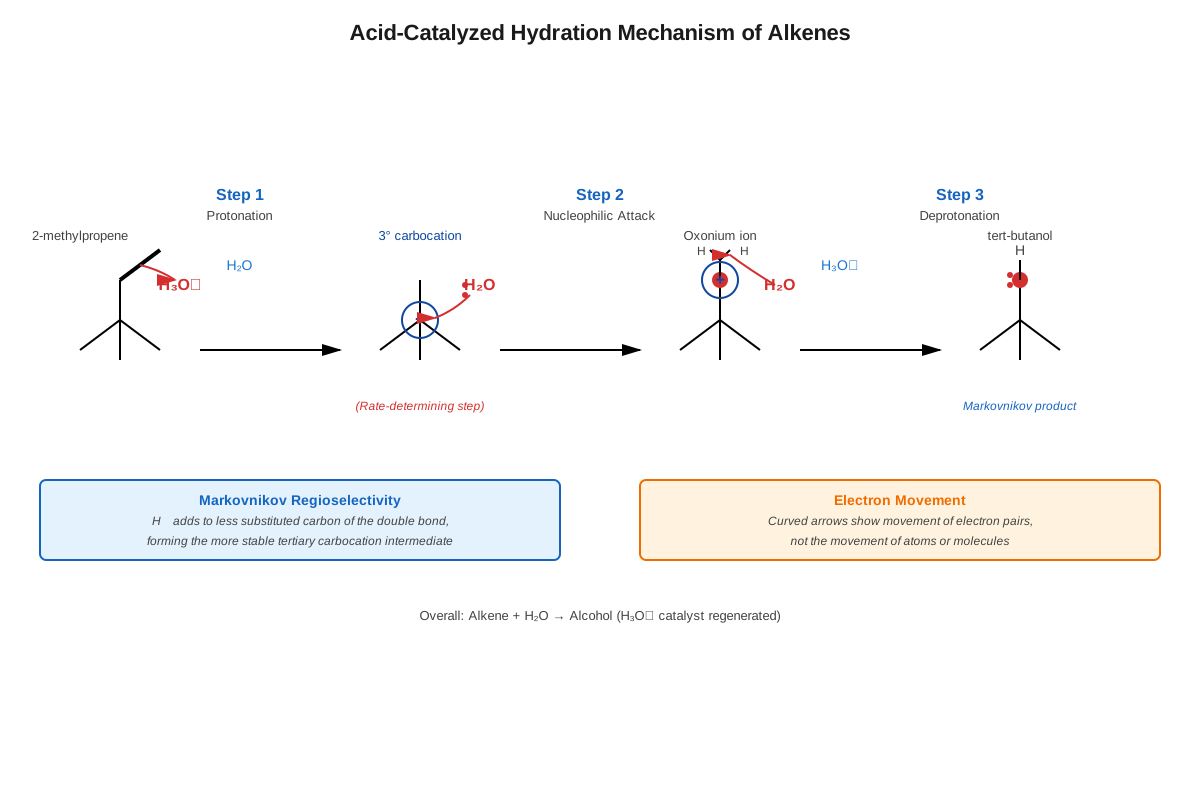
The mechanism of acid-catalyzed hydration proceeds through three distinct steps:
- Protonation of the alkene: The π electrons of the double bond act as a base and abstract a proton from the acid catalyst (H₃O⁺), forming a carbocation intermediate. This step follows Markovnikov's rule—the proton adds to the less substituted carbon, generating the more stable carbocation on the more substituted carbon.
- Nucleophilic attack by water: A water molecule acts as a nucleophile and attacks the positively charged carbocation, forming a protonated alcohol (oxonium ion).
- Deprotonation: Another water molecule acts as a base and removes a proton from the oxonium ion, yielding the neutral alcohol product and regenerating the acid catalyst (H₃O⁺).
The rate-determining step is typically the formation of the carbocation intermediate, making this an SN1-type mechanism. The stability of the carbocation intermediate determines both the rate and regioselectivity of the reaction.
Markovnikov's Rule and Regioselectivity
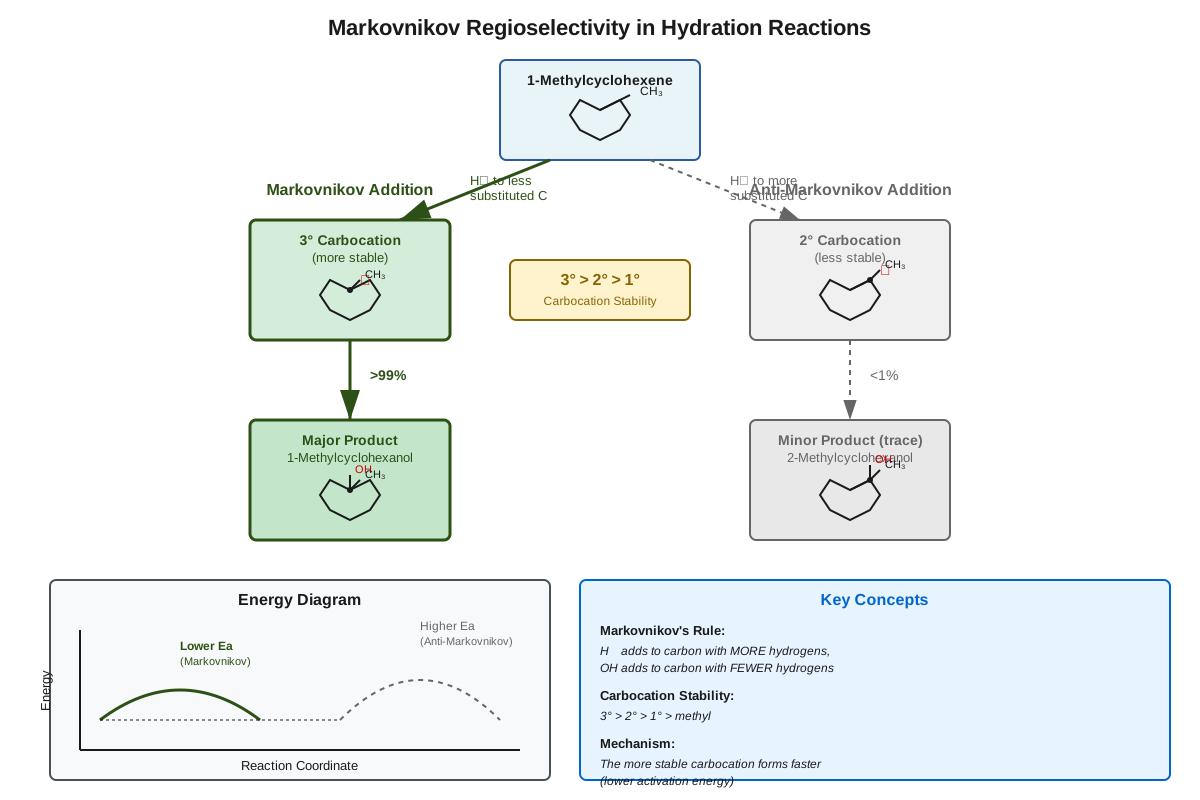
Markovnikov's rule states that in the addition of HX (where X = OH, halogen, etc.) to an unsymmetrical alkene, the hydrogen atom bonds to the carbon with more hydrogen substituents, while the X group bonds to the carbon with fewer hydrogen substituents. This rule reflects the preference for forming the most stable carbocation intermediate.
For hydration reactions, Markovnikov's rule predicts that the hydroxyl group (-OH) will add to the more substituted carbon. For example:
- Propene (CH₃-CH=CH₂) + H₂O/H⁺ → 2-propanol (CH₃-CH(OH)-CH₃) as the major product, not 1-propanol
The underlying reason is carbocation stability: tertiary (3°) > secondary (2°) > primary (1°) > methyl. The mechanism proceeds through the most stable carbocation, which forms when the proton adds to the less substituted carbon.
Carbocation Rearrangements
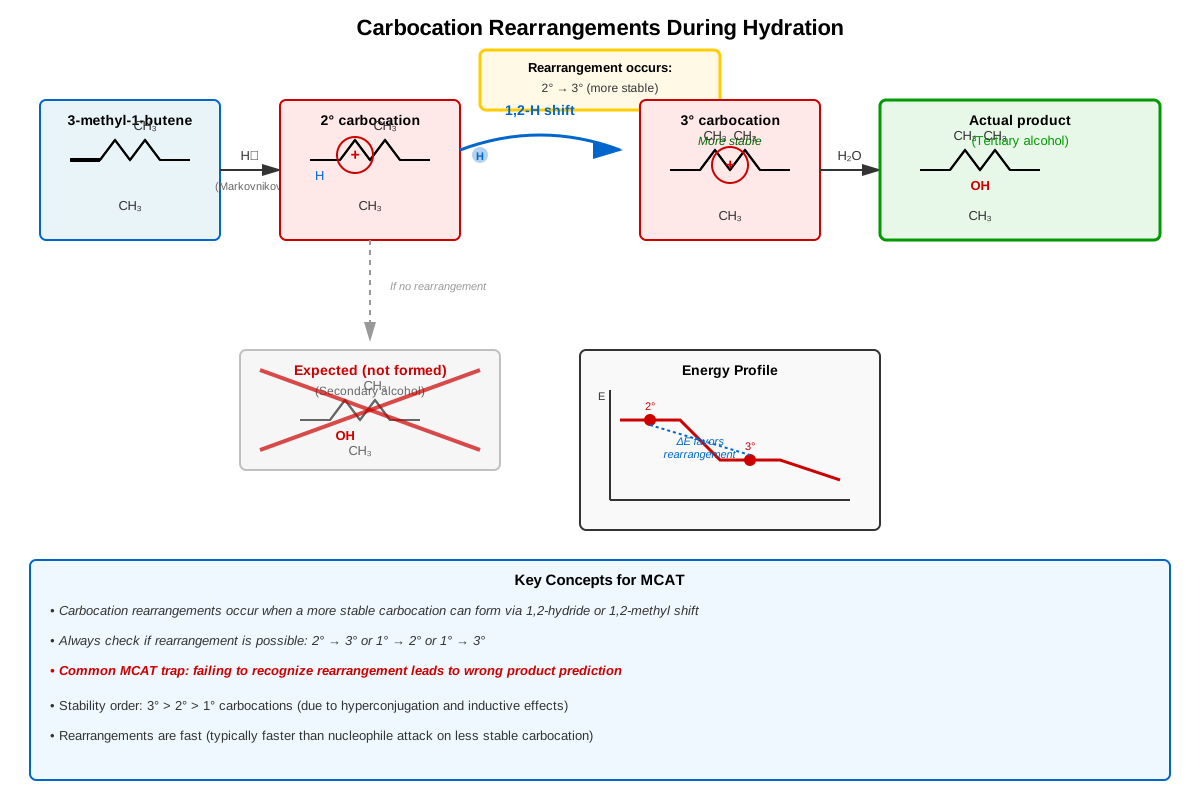
A critical consideration in hydration reactions is the possibility of carbocation rearrangements. If the initial carbocation can rearrange to a more stable carbocation through a hydride shift (H⁻ migration) or alkyl shift (R⁻ migration), this rearrangement will occur before water attacks. These rearrangements are particularly common when:
- A secondary carbocation can rearrange to a tertiary carbocation
- A primary carbocation can rearrange to a secondary or tertiary carbocation
- Ring expansion or contraction leads to greater stability
For example, hydration of 3-methyl-1-butene initially forms a secondary carbocation, which then undergoes a hydride shift to form a more stable tertiary carbocation before water attacks, yielding 2-methyl-2-butanol rather than 3-methyl-2-butanol.
Oxymercuration-Demercuration
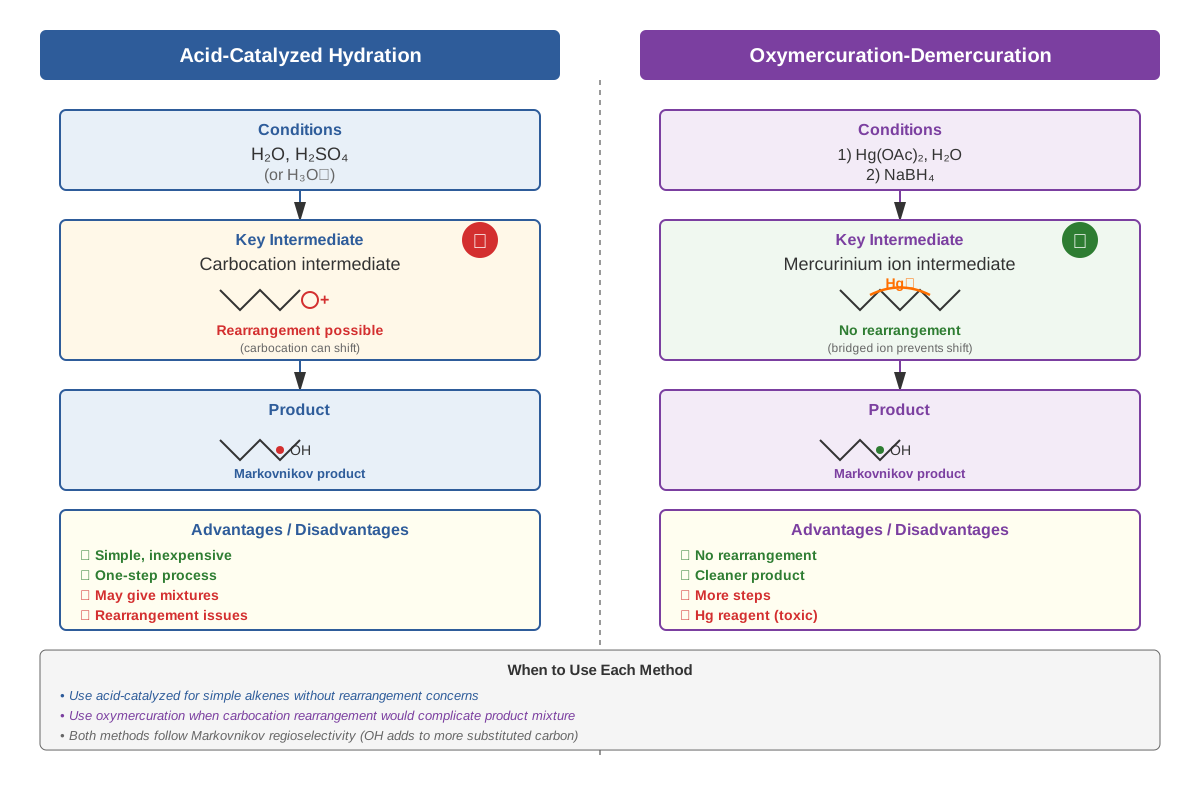
An alternative hydration method is oxymercuration-demercuration, which provides Markovnikov addition without carbocation rearrangements. This two-step process uses:
- Oxymercuration: Treatment with mercuric acetate [Hg(OAc)₂] in water forms a mercurinium ion intermediate, which is then attacked by water to give an organomercury compound
- Demercuration: Treatment with sodium borohydride (NaBH₄) replaces the mercury with hydrogen
This method is advantageous when carbocation rearrangements would complicate acid-catalyzed hydration. The mercurinium ion intermediate prevents rearrangements while still directing Markovnikov addition.
Hydroboration-Oxidation: Anti-Markovnikov Hydration
For anti-Markovnikov hydration (OH adds to the less substituted carbon), the hydroboration-oxidation sequence is used:
- Hydroboration: Treatment with borane (BH₃) or diborane (B₂H₆) adds boron to the less substituted carbon
- Oxidation: Treatment with hydrogen peroxide (H₂O₂) in basic conditions (NaOH) replaces boron with a hydroxyl group
This method provides syn addition (both H and OH add to the same face) and places the hydroxyl group on the less substituted carbon, opposite to Markovnikov's rule.
Comparison of Hydration Methods
| Method | Regioselectivity | Rearrangements? | Stereochemistry | Conditions |
|---|---|---|---|---|
| Acid-catalyzed | Markovnikov | Yes (common) | Racemic mixture | H₂O, H₂SO₄ or H₃PO₄ |
| Oxymercuration-demercuration | Markovnikov | No | Racemic mixture | 1) Hg(OAc)₂, H₂O 2) NaBH₄ |
| Hydroboration-oxidation | Anti-Markovnikov | No | Syn addition | 1) BH₃ or B₂H₆ 2) H₂O₂, NaOH |
Stereochemistry Considerations
When hydration occurs at a double bond that creates a new stereocenter, stereochemical outcomes must be considered:
- Acid-catalyzed hydration produces a planar carbocation intermediate that can be attacked from either face, yielding a racemic mixture of enantiomers
- Oxymercuration-demercuration also produces racemic mixtures because the mercurinium ion can be opened from either side
- Hydroboration-oxidation produces syn addition, meaning both H and OH add to the same face of the double bond, which can lead to specific stereoisomers
Reaction Conditions and Practical Considerations
Successful hydration reactions require careful attention to conditions:
- Temperature: Moderate heating (50-100°C) is often used to increase reaction rates
- Acid concentration: Dilute acid (typically 50-85% H₂SO₄) is preferred; concentrated acid can lead to dehydration (the reverse reaction)
- Equilibrium considerations: Hydration is reversible; excess water drives the reaction toward alcohol formation
- Competing reactions: Under harsh conditions, alkenes can undergo polymerization or rearrangement to other products
Concept Relationships
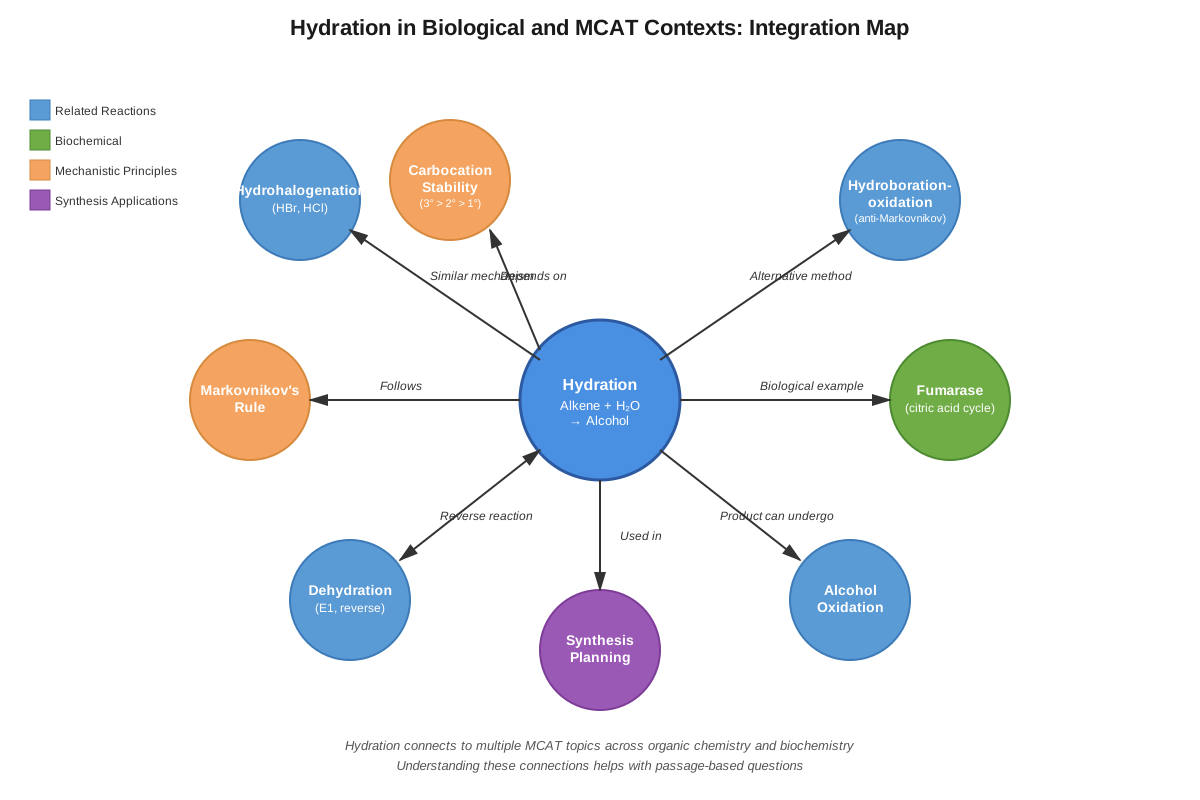
The concepts within hydration are hierarchically organized and interconnected. Acid-catalyzed hydration serves as the foundational mechanism, which depends on understanding carbocation formation and stability. Carbocation stability directly determines regioselectivity through Markovnikov's rule, creating a clear conceptual chain: alkene structure → protonation → carbocation stability → regioselectivity → product distribution.
Carbocation rearrangements branch from carbocation stability as a complicating factor that must be considered whenever secondary or primary carbocations form. This leads to the need for alternative methods: oxymercuration-demercuration addresses the rearrangement problem while maintaining Markovnikov selectivity, while hydroboration-oxidation provides the opposite regioselectivity entirely.
The relationship map flows as follows:
Alkene + H₂O/H⁺ → Protonation (follows Markovnikov) → Carbocation intermediate → [Potential rearrangement?] → Nucleophilic attack by H₂O → Deprotonation → Alcohol product
This topic connects to prerequisite knowledge of alkene structure (provides the reactive π bond), acid-base chemistry (explains catalyst function and protonation), and carbocation stability (predicts regioselectivity and rearrangements). It also connects forward to dehydration reactions (the reverse process), oxidation of alcohols (subsequent transformations of products), and biochemical pathways where enzymatic hydration occurs (citric acid cycle, fatty acid metabolism).
The stereochemical outcomes connect to broader principles of reaction mechanisms and stereochemistry, while the comparison of different hydration methods illustrates the general principle that alternative reagents can modify reaction outcomes to achieve different synthetic goals.
Quick check — test yourself on Hydration so far.
Try Flashcards →High-Yield Facts
⭐ Acid-catalyzed hydration follows Markovnikov's rule: the hydroxyl group adds to the more substituted carbon of the alkene
⭐ Carbocation stability order: tertiary > secondary > primary > methyl, which determines both rate and regioselectivity
⭐ Carbocation rearrangements occur when a more stable carbocation can form through hydride or alkyl shifts
⭐ Oxymercuration-demercuration provides Markovnikov addition without carbocation rearrangements
⭐ Hydroboration-oxidation provides anti-Markovnikov addition (OH on less substituted carbon) with syn stereochemistry
- The rate-determining step in acid-catalyzed hydration is carbocation formation
- Acid-catalyzed hydration produces racemic mixtures when new stereocenters form
- Dilute acid favors hydration; concentrated acid favors dehydration (the reverse reaction)
- Water acts as both nucleophile (attacking carbocation) and base (deprotonating oxonium ion)
- The acid catalyst is regenerated at the end of the mechanism, making it truly catalytic
- Hydration reactions are reversible; Le Chatelier's principle applies (excess water drives forward reaction)
- Terminal alkenes (RCH=CH₂) undergo hydration to form secondary alcohols under Markovnikov conditions
- Internal alkenes (RCH=CHR) can form alcohols but react more slowly due to steric hindrance
Common Misconceptions
Misconception: Water alone can hydrate alkenes without a catalyst → Correction: Water is not sufficiently electrophilic to attack the π bond; an acid catalyst is required to protonate the alkene first, creating a reactive carbocation intermediate that water can attack
Misconception: The hydroxyl group always adds to the less substituted carbon → Correction: Under standard acid-catalyzed conditions (Markovnikov addition), the hydroxyl group adds to the MORE substituted carbon; anti-Markovnikov addition requires special reagents like hydroboration-oxidation
Misconception: All hydration reactions produce the same stereochemistry → Correction: Acid-catalyzed hydration and oxymercuration-demercuration produce racemic mixtures (no stereoselectivity), while hydroboration-oxidation produces syn addition with specific stereochemistry
Misconception: Carbocation rearrangements are rare and can be ignored → Correction: Carbocation rearrangements are common and predictable whenever a more stable carbocation can form through a 1,2-shift; students must always check for possible rearrangements when secondary or primary carbocations form
Misconception: The acid catalyst is consumed during the reaction → Correction: The acid catalyst is regenerated in the final deprotonation step, making it truly catalytic; only a small amount is needed to facilitate the reaction
Misconception: Hydration and hydroboration-oxidation are the same reaction → Correction: These are fundamentally different processes with opposite regioselectivity; hydration (with acid) gives Markovnikov products, while hydroboration-oxidation gives anti-Markovnikov products
Misconception: The mechanism proceeds through a free hydroxide ion (OH⁻) attacking the carbocation → Correction: In acidic conditions, hydroxide ions are not present in significant concentrations; neutral water (H₂O) acts as the nucleophile, forming a protonated alcohol that is then deprotonated
Worked Examples
Example 1: Predicting the Major Product
Problem: What is the major product when 2-methylpropene reacts with water in the presence of sulfuric acid?
Solution:
Step 1: Identify the alkene structure. 2-methylpropene is (CH₃)₂C=CH₂, an unsymmetrical alkene with one carbon bearing two methyl groups and the other bearing two hydrogens.
Step 2: Apply the mechanism. In acid-catalyzed hydration, the first step is protonation of the double bond. Following Markovnikov's rule, the proton will add to the carbon with MORE hydrogens (the CH₂ carbon), creating a carbocation on the carbon with FEWER hydrogens (the C with two methyls).
Step 3: Evaluate carbocation stability. The carbocation formed is (CH₃)₂C⁺-CH₃, a tertiary carbocation, which is highly stable. No rearrangement is possible because this is already the most stable carbocation.
Step 4: Nucleophilic attack. Water attacks the tertiary carbocation, forming (CH₃)₂C(OH₂⁺)-CH₃.
Step 5: Deprotonation. Water removes a proton, yielding the final product: (CH₃)₂C(OH)-CH₃, which is 2-methyl-2-propanol (tert-butanol).
Answer: The major product is 2-methyl-2-propanol, a tertiary alcohol. This example demonstrates straightforward Markovnikov addition without rearrangement.
Example 2: Recognizing Carbocation Rearrangement
Problem: When 3,3-dimethyl-1-butene undergoes acid-catalyzed hydration, the major product is not the expected Markovnikov product. Explain why and identify the actual major product.
Solution:
Step 1: Draw the starting material. 3,3-dimethyl-1-butene is (CH₃)₃C-CH₂-CH=CH₂.
Step 2: Initial protonation. Following Markovnikov's rule, the proton adds to the terminal carbon (CH₂), creating a secondary carbocation: (CH₃)₃C-CH₂-CH⁺-CH₃.
Step 3: Check for possible rearrangements. The secondary carbocation is adjacent to a carbon bearing three methyl groups (a quaternary carbon). A methyl group can shift from the quaternary carbon to the carbocation center, forming a tertiary carbocation: (CH₃)₂C⁺-CH(CH₃)-CH₃.
Step 4: Evaluate stability. The tertiary carbocation is more stable than the secondary carbocation, so the rearrangement occurs rapidly.
Step 5: Complete the mechanism. Water attacks the tertiary carbocation, followed by deprotonation, yielding (CH₃)₂C(OH)-CH(CH₃)-CH₃, which is 2,3-dimethyl-2-butanol.
Answer: The major product is 2,3-dimethyl-2-butanol, not 3,3-dimethyl-2-butanol. This occurs because the initially formed secondary carbocation undergoes a methyl shift to form a more stable tertiary carbocation before water attacks. This example illustrates the critical importance of checking for carbocation rearrangements.
Connection to learning objectives: These examples demonstrate application of hydration to exam-style questions (objective 3), show how to predict products using mechanistic reasoning, and highlight the common mistake of forgetting to check for rearrangements (objective 4).
Exam Strategy
When approaching MCAT questions on hydration, follow this systematic strategy:
Step 1: Identify the reaction type. Look for trigger words like "water," "H₂O," "acid catalyst," "H₂SO₄," or "hydration." Also watch for alternative methods: "Hg(OAc)₂" signals oxymercuration, while "BH₃" or "B₂H₆" indicates hydroboration.
Step 2: Determine regioselectivity. Ask: "Is this Markovnikov or anti-Markovnikov?" Standard acid-catalyzed hydration and oxymercuration-demercuration follow Markovnikov's rule (OH to more substituted carbon), while hydroboration-oxidation gives anti-Markovnikov products.
Step 3: Check for carbocation rearrangements. If the question involves acid-catalyzed hydration, always consider whether the initial carbocation can rearrange to a more stable form. Look for secondary carbocations adjacent to tertiary centers or primary carbocations that can shift to secondary or tertiary.
Step 4: Consider stereochemistry. If the product has a new stereocenter, determine whether the question asks about stereochemical outcomes. Acid-catalyzed methods give racemic mixtures, while hydroboration-oxidation gives syn addition.
Process of elimination tips:
- Eliminate any answer showing OH on the less substituted carbon for acid-catalyzed hydration
- Eliminate any answer showing OH on the more substituted carbon for hydroboration-oxidation
- Eliminate products that ignore obvious carbocation rearrangements
- Eliminate answers that show only one enantiomer when a racemic mixture should form
Time allocation: Hydration questions typically require 60-90 seconds. Spend 20 seconds identifying the reaction type and conditions, 30 seconds working through the mechanism mentally, and 20-30 seconds evaluating answer choices. If carbocation rearrangement is involved, allow an extra 15-20 seconds.
Exam Tip: The MCAT loves to test carbocation rearrangements in hydration reactions. If you see a secondary carbocation that can become tertiary through a simple shift, assume the rearrangement will occur unless the question specifically states otherwise.
Memory Techniques
Mnemonic for Markovnikov's Rule: "More Makes More" - The More substituted carbon gets the More important group (OH), making a More substituted alcohol.
Mnemonic for Carbocation Stability: "Tom Sells Peanuts Monthly" - Tertiary > Secondary > Primary > Methyl
Visualization Strategy: Picture the carbocation as a "positive charge magnet" that attracts the oxygen atom of water. The more stable the magnet (tertiary > secondary > primary), the more likely it forms and the longer it persists.
Acronym for Hydration Methods: "A-O-H" helps remember the three main approaches:
- Acid-catalyzed (Markovnikov, with rearrangements)
- Oxymercuration-demercuration (Markovnikov, no rearrangements)
- Hydroboration-oxidation (anti-Markovnikov)
Mechanism Memory Aid: "Please Never Drive" for the three steps of acid-catalyzed hydration:
- Protonation of alkene
- Nucleophilic attack by water
- Deprotonation to form alcohol
Rearrangement Check: Use the phrase "Shift Happens" to remember that whenever you see a Secondary carbocation, check if a Hydride or alkyl shift can create a more stable carbocation.
Summary
Hydration reactions represent essential addition transformations in organic chemistry that convert alkenes into alcohols through the addition of water across carbon-carbon double bonds. The standard acid-catalyzed mechanism proceeds through protonation to form a carbocation intermediate, nucleophilic attack by water, and deprotonation to yield the alcohol product. This mechanism follows Markovnikov's rule, placing the hydroxyl group on the more substituted carbon, and can involve carbocation rearrangements when more stable intermediates are accessible. Alternative methods include oxymercuration-demercuration, which provides Markovnikov addition without rearrangements, and hydroboration-oxidation, which gives anti-Markovnikov products. Understanding these reactions requires mastery of carbocation stability, regioselectivity principles, and mechanistic reasoning. For MCAT success, students must recognize reaction conditions, predict products including potential rearrangements, distinguish between different hydration methods, and apply stereochemical principles when new stereocenters form. The ability to quickly identify the reaction type, apply Markovnikov's rule correctly, and check for carbocation rearrangements distinguishes high-scoring students on exam day.
Key Takeaways
- Acid-catalyzed hydration adds water across alkenes following Markovnikov's rule (OH to more substituted carbon) through a carbocation mechanism
- Carbocation stability (tertiary > secondary > primary) determines both reaction rate and regioselectivity
- Always check for carbocation rearrangements when secondary or primary carbocations form; hydride and alkyl shifts to more stable carbocations are common
- Three main hydration methods exist: acid-catalyzed (Markovnikov with rearrangements), oxymercuration-demercuration (Markovnikov without rearrangements), and hydroboration-oxidation (anti-Markovnikov)
- Acid-catalyzed hydration produces racemic mixtures at new stereocenters due to planar carbocation intermediates
- The acid catalyst is regenerated, making it truly catalytic; water serves as both nucleophile and base
- Recognizing trigger words (H₂O/H⁺, Hg(OAc)₂, BH₃) immediately identifies which hydration method and expected regioselectivity
Related Topics
Dehydration of Alcohols: The reverse of hydration; understanding the forward reaction (hydration) provides insight into the reverse process where alcohols lose water to form alkenes under acidic conditions with heat. Mastering hydration mechanisms makes dehydration mechanisms intuitive.
Halogenation and Hydrohalogenation: Related addition reactions that follow similar mechanistic principles; hydrohalogenation (HX addition) proceeds through the same carbocation intermediate as hydration, making these topics highly complementary.
Oxidation of Alcohols: The products of hydration reactions (alcohols) can be further oxidized to carbonyl compounds; understanding hydration enables students to plan multi-step syntheses involving alcohol formation followed by oxidation.
Carbocation Chemistry: A deeper exploration of carbocation stability, rearrangements, and reactivity patterns that applies to hydration, SN1 reactions, E1 eliminations, and other transformations involving carbocation intermediates.
Biochemical Hydration Reactions: Enzymatic hydration in metabolic pathways (fumarase in the citric acid cycle, enoyl-CoA hydratase in fatty acid oxidation) demonstrates biological applications of hydration chemistry and connects organic chemistry to biochemistry for integrated MCAT questions.
Practice CTA
Now that you've mastered the core concepts of hydration reactions, it's time to solidify your understanding through active practice. Challenge yourself with the practice questions and flashcards designed specifically for this topic. Focus especially on problems involving carbocation rearrangements and distinguishing between different hydration methods—these are the highest-yield areas for MCAT success. Remember, the difference between knowing the material and scoring points on test day lies in your ability to apply these concepts under timed conditions. You've built a strong foundation; now transform that knowledge into exam performance through deliberate practice!
Sign up free to keep reading
Create a free AnvayaPrep account to finish this MCAT guide on Hydration — plus flashcards and practice questions.