Overview
Hydrogenation is a fundamental addition reaction in organic chemistry that involves the addition of molecular hydrogen (H₂) across a carbon-carbon multiple bond, typically converting alkenes to alkanes or alkynes to alkenes or alkanes. This reaction represents one of the most important transformations in organic synthesis and appears regularly on the MCAT in both discrete questions and passage-based contexts. Understanding hydrogenation requires mastery of reaction mechanisms, stereochemistry, and the role of catalysts in facilitating chemical transformations.
For the MCAT, hydrogenation serves as a cornerstone concept that bridges multiple areas of organic chemistry. It exemplifies how unsaturated compounds undergo reduction reactions, demonstrates the importance of heterogeneous catalysis, and provides insight into stereochemical outcomes of addition reactions. The reaction's mechanism, though not always tested in exhaustive detail, illustrates key principles about how reagents interact with π bonds and how reaction conditions influence product formation. Students must recognize hydrogenation reactions in various contexts, predict products, understand stereochemical implications, and connect this transformation to biological processes such as lipid metabolism.
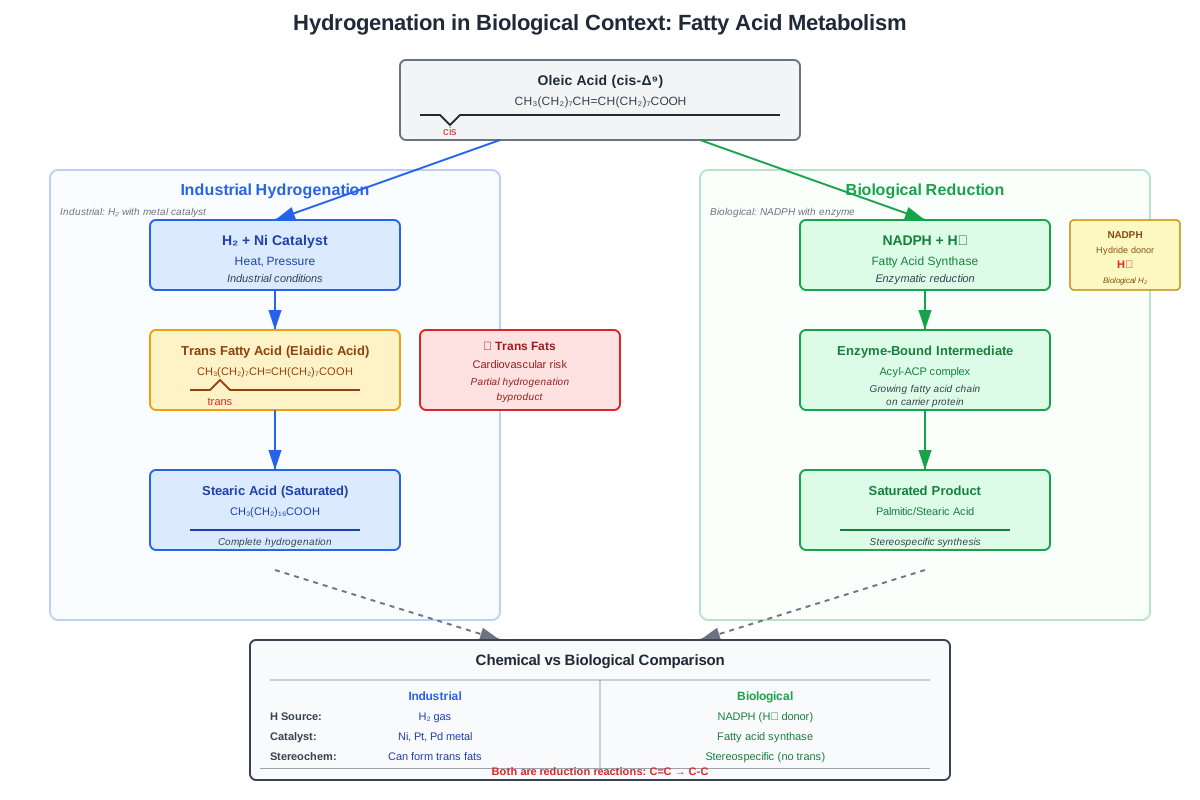
Beyond its chemical significance, hydrogenation has profound real-world applications that make it relevant to medical and biological contexts tested on the MCAT. The partial hydrogenation of vegetable oils produces trans fats, a topic frequently appearing in biochemistry passages. The enzyme-catalyzed hydrogenation reactions in fatty acid metabolism mirror the principles of catalytic hydrogenation. Additionally, understanding hydrogenation helps students grasp reduction-oxidation concepts that permeate biochemistry, including the function of NADH and FADH₂ as biological reducing agents. Mastering hydrogenation thus provides both specific knowledge for organic chemistry questions and conceptual frameworks applicable across multiple MCAT sections.
Learning Objectives
- [ ] Define hydrogenation using accurate organic chemistry terminology
- [ ] Explain why hydrogenation matters for the MCAT
- [ ] Apply hydrogenation to exam-style questions
- [ ] Identify common mistakes related to hydrogenation
- [ ] Connect hydrogenation to related organic chemistry concepts
- [ ] Predict the products of hydrogenation reactions given various starting materials and conditions
- [ ] Distinguish between catalytic hydrogenation and other reduction methods
- [ ] Analyze the stereochemical outcomes of hydrogenation reactions
- [ ] Evaluate the role of different catalysts in controlling reaction selectivity
Prerequisites
- Alkene and alkyne structure: Understanding π bonds and their reactivity is essential since hydrogenation targets these unsaturated bonds
- Basic reaction mechanisms: Familiarity with how bonds break and form allows comprehension of how H₂ adds across multiple bonds
- Oxidation-reduction concepts: Recognizing that hydrogenation is a reduction reaction helps classify it within broader reaction categories
- Stereochemistry fundamentals: Knowledge of syn/anti addition and stereoisomers is necessary to predict three-dimensional product structures
- Functional group identification: Ability to recognize alkenes, alkynes, carbonyls, and aromatics determines where hydrogenation can occur
Why This Topic Matters
Hydrogenation appears on the MCAT with moderate frequency, typically in 1-3 questions per exam, either as discrete items or embedded within organic chemistry passages. Questions may ask students to identify products, predict stereochemical outcomes, compare different reduction methods, or apply hydrogenation concepts to biological systems. The topic frequently appears in passages discussing lipid chemistry, industrial processes, or synthetic pathways where reduction reactions play key roles.
Clinically and biologically, hydrogenation connects to several high-yield MCAT topics. The partial hydrogenation of unsaturated fats produces trans fatty acids, which have documented cardiovascular health implications. This process appears in passages about nutrition, lipid metabolism, and public health interventions. Additionally, biological reduction reactions—such as those catalyzed by reductase enzymes—follow principles analogous to chemical hydrogenation, making this topic relevant to understanding metabolic pathways including fatty acid synthesis and the electron transport chain.
In real-world applications, hydrogenation is crucial in pharmaceutical synthesis, food processing, and industrial chemistry. The MCAT often presents passages describing drug synthesis or industrial processes where students must identify reaction types, predict products, or troubleshoot synthetic schemes. Understanding hydrogenation enables students to navigate these passages efficiently and answer questions about reaction conditions, selectivity, and product formation. The topic also serves as a gateway to understanding more complex transformations and demonstrates how reaction conditions (catalyst choice, pressure, temperature) influence chemical outcomes—a principle that extends throughout organic chemistry and biochemistry.
Core Concepts
Definition and Basic Mechanism
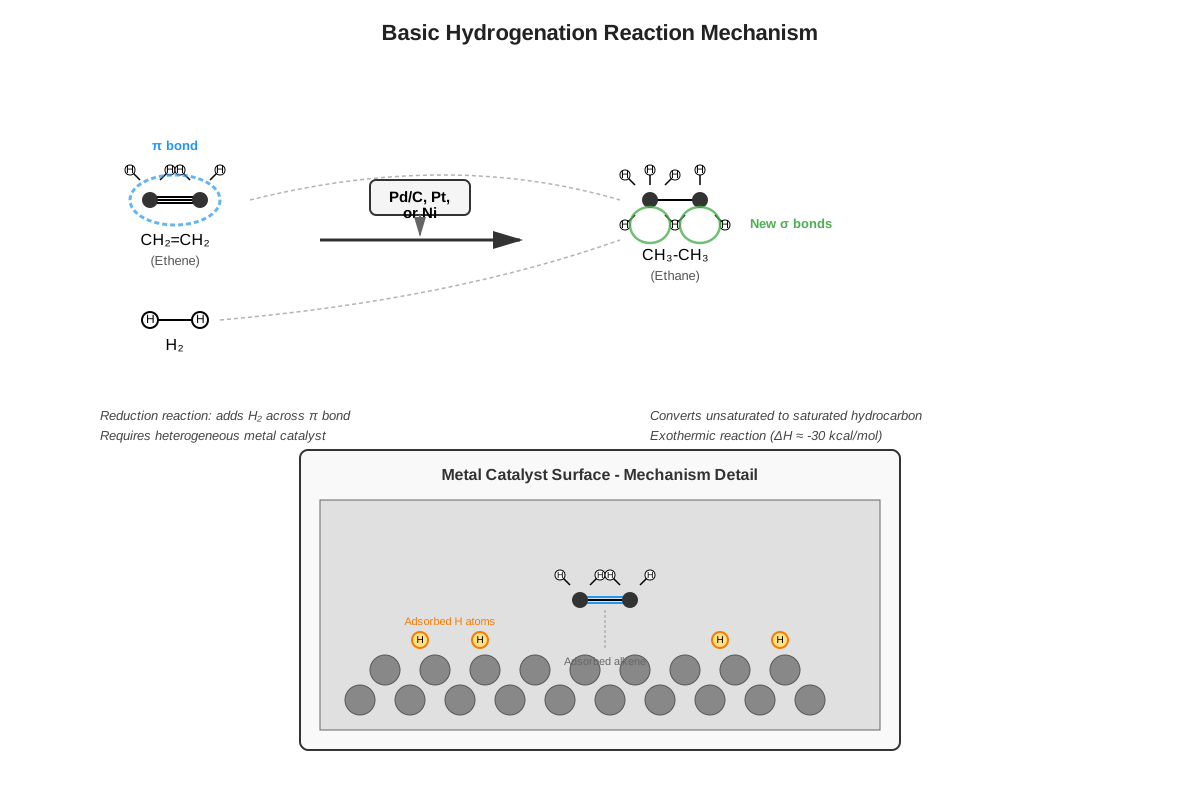
Hydrogenation is an addition reaction in which molecular hydrogen (H₂) adds across a carbon-carbon multiple bond in the presence of a metal catalyst. This process converts unsaturated compounds (alkenes, alkynes) into more saturated products (alkanes or alkenes). The reaction is classified as a reduction because it increases the hydrogen content of the molecule and decreases the oxidation state of the carbon atoms involved.
The general reaction for alkene hydrogenation follows this pattern:
R-CH=CH-R' + H₂ → R-CH₂-CH₂-R'
(alkene)         (catalyst)    (alkane)
For alkynes, hydrogenation can proceed in two stages:
R-C≡C-R' + H₂ → R-CH=CH-R' + H₂ → R-CH₂-CH₂-R'
(alkyne)      (catalyst)  (alkene)      (catalyst)    (alkane)
The mechanism involves heterogeneous catalysis, where the reaction occurs on the surface of a solid metal catalyst. The process includes several steps: (1) adsorption of H₂ onto the metal surface, causing H-H bond cleavage; (2) adsorption of the alkene onto the metal surface through π-bond interaction; (3) stepwise transfer of hydrogen atoms to the carbon atoms; and (4) desorption of the saturated product from the catalyst surface.
Catalysts and Reaction Conditions
Catalytic hydrogenation requires a transition metal catalyst to proceed at reasonable rates under laboratory conditions. The most common catalysts include:
| Catalyst | Properties | Common Applications |
|---|---|---|
| Platinum (Pt) | Highly active, expensive | Complete hydrogenation, research applications |
| Palladium (Pd) | Very active, versatile | Most common for alkene reduction, Pd/C widely used |
| Nickel (Ni) | Active, inexpensive | Industrial applications, Raney nickel for ketone reduction |
| Rhodium (Rh) | Highly selective | Specialized applications, asymmetric catalysis |
| Ruthenium (Ru) | Selective for certain functional groups | Research applications |
The reaction typically requires elevated hydrogen pressure (1-100 atm) and may be conducted at room temperature or with heating depending on substrate reactivity. The catalyst is usually employed as a finely divided powder to maximize surface area, often supported on carbon (e.g., Pd/C, Pt/C) to improve handling and efficiency.
Lindlar's catalyst (Pd/CaCO₃ with lead acetate and quinoline) represents a special case—a "poisoned" catalyst that selectively reduces alkynes to cis-alkenes without further reduction to alkanes. This selectivity makes Lindlar's catalyst invaluable for preparing alkenes from alkynes with controlled stereochemistry.
Stereochemistry of Hydrogenation
The stereochemical outcome of hydrogenation is a critical concept for the MCAT. Because both hydrogen atoms add from the same face of the π bond (the face in contact with the catalyst surface), hydrogenation is a syn addition reaction. This means both hydrogens add to the same side of the double bond simultaneously.
For cyclic alkenes, syn addition has important stereochemical consequences:
Cyclohexene + H₂ (Pt) → Cyclohexane
(Both H atoms add from the same face)
When hydrogenating substituted cyclic alkenes, syn addition can create specific stereoisomers. For example, if a cyclic alkene has substituents, the two new C-H bonds formed will be cis to each other. However, because the alkene can adsorb onto the catalyst surface from either face with equal probability, hydrogenation of an unsymmetrical alkene typically produces a racemic mixture when chiral centers are created.
For acyclic alkenes, syn addition still occurs, but the stereochemical outcome may be less obvious unless the molecule has existing stereocenters or the product contains restricted rotation. The key principle remains: both hydrogens add from the same face of the double bond.
Selectivity and Functional Group Compatibility
Understanding which functional groups undergo hydrogenation and under what conditions is essential for predicting reaction outcomes. The relative reactivity order for hydrogenation is:
- Alkynes (most reactive) - can be reduced to alkenes or alkanes
- Alkenes - readily reduced to alkanes
- Aromatic rings - require forcing conditions (high pressure, temperature)
- Aldehydes and ketones - reduced under specific conditions (Ni catalyst, high pressure)
- Esters, amides, carboxylic acids - generally resistant to catalytic hydrogenation
This selectivity allows chemists to reduce one functional group while leaving others intact. For example, an alkene can be hydrogenated in the presence of an ester group under mild conditions. However, under forcing conditions (high pressure, temperature, extended reaction time), multiple functional groups may be reduced.
Aromatic rings are particularly resistant to hydrogenation due to their resonance stabilization. Benzene rings require harsh conditions (high H₂ pressure, elevated temperature, extended reaction time) to undergo hydrogenation to cyclohexane. This resistance allows selective reduction of alkene side chains without affecting the aromatic core under standard conditions.
Comparison with Other Reduction Methods
While catalytic hydrogenation is the most common method for reducing alkenes, other reduction approaches exist and may appear on the MCAT:
Dissolving metal reduction (Na or Li in liquid NH₃) reduces alkynes to trans-alkenes, providing complementary stereochemistry to Lindlar reduction. This method involves radical intermediates and produces the thermodynamically more stable trans isomer.
Hydride reagents (LiAlH₄, NaBH₄) reduce carbonyl groups but do not affect alkenes or alkynes under normal conditions. These reagents provide selectivity for reducing aldehydes, ketones, esters, and carboxylic acids.
Hydroboration-oxidation adds water across alkenes with anti-Markovnikov regioselectivity and syn stereochemistry, but this is an addition reaction rather than a reduction.
Understanding these distinctions helps students select appropriate reagents for specific transformations and interpret synthetic schemes on the MCAT.
Thermodynamics and Energetics
Hydrogenation is an exothermic reaction, releasing energy as the strong H-H bond (436 kJ/mol) and π bond are broken and two new C-H bonds (approximately 413 kJ/mol each) are formed. The heat of hydrogenation provides information about alkene stability:
- More stable alkenes release less heat upon hydrogenation
- Less stable alkenes release more heat upon hydrogenation
This principle allows comparison of alkene stability. For example, trans-2-butene releases less heat upon hydrogenation than cis-2-butene, indicating the trans isomer is more stable due to reduced steric strain. Similarly, more substituted alkenes (tetrasubstituted > trisubstituted > disubstituted > monosubstituted) are more stable and release less heat upon hydrogenation.
The catalyst does not affect the thermodynamics (ΔH, ΔG) of the reaction but dramatically lowers the activation energy, making the reaction proceed at practical rates. Without a catalyst, hydrogenation would be thermodynamically favorable but kinetically prohibitive at room temperature.
Concept Relationships
Hydrogenation sits at the intersection of multiple organic chemistry concepts, making it a hub topic for understanding broader principles. The reaction directly builds on knowledge of alkene and alkyne structure, as the reactivity of π bonds drives the entire transformation. The electron-rich π bond acts as a nucleophile, interacting with the catalyst surface and accepting hydrogen atoms.
The concept flows naturally from addition reactions, the broader category that includes hydrohalogenation, hydration, and halogenation. All addition reactions share the common feature of breaking a π bond and forming two new σ bonds. Hydrogenation specifically represents reduction within the oxidation-reduction framework, connecting to concepts of oxidation states and electron transfer that appear throughout organic chemistry and biochemistry.
Stereochemically, hydrogenation relates to syn addition mechanisms and contrasts with anti addition reactions like halogenation. Understanding that both hydrogens add from the same face connects to broader stereochemical principles about reaction mechanisms and three-dimensional molecular structure. This knowledge enables prediction of stereoisomer formation and recognition of racemic versus enantiopure products.
The relationship map flows as follows:
Alkene/Alkyne Structure → π Bond Reactivity → Addition Reactions → Hydrogenation → Syn Addition → Stereochemical Outcomes
Simultaneously: Hydrogenation → Reduction Reactions → Oxidation States → Biological Reductions (NADH, FADH₂)
And: Hydrogenation → Catalysis Concepts → Reaction Kinetics → Activation Energy → Enzyme Catalysis
This web of connections means that mastering hydrogenation reinforces understanding of mechanisms, stereochemistry, catalysis, and reduction-oxidation chemistry—all high-yield MCAT topics. The concept also bridges to biochemistry through fatty acid metabolism, where enzyme-catalyzed reductions mirror chemical hydrogenation principles.
High-Yield Facts
⭐ Hydrogenation is a syn addition reaction where both hydrogen atoms add to the same face of the π bond simultaneously
⭐ Common catalysts for hydrogenation include Pt, Pd, and Ni, with Pd/C being the most frequently used in laboratory settings
⭐ Lindlar's catalyst selectively reduces alkynes to cis-alkenes without further reduction to alkanes
⭐ Dissolving metal reduction (Na/NH₃) converts alkynes to trans-alkenes, providing complementary stereochemistry to Lindlar reduction
⭐ Hydrogenation is exothermic, and the heat released indicates alkene stability (more stable alkenes release less heat)
- Aromatic rings require forcing conditions (high pressure and temperature) for hydrogenation due to resonance stabilization
- Hydrogenation typically produces racemic mixtures when new chiral centers are created because the alkene can adsorb onto the catalyst from either face
- The reaction is classified as a reduction because it decreases the oxidation state of carbon atoms
- Catalytic hydrogenation occurs through heterogeneous catalysis on the metal surface
- More substituted alkenes are more stable and release less heat upon hydrogenation than less substituted alkenes
- Partial hydrogenation of polyunsaturated fats can produce trans fatty acids, a topic relevant to biochemistry passages
- The catalyst lowers activation energy but does not change the thermodynamics (ΔG or ΔH) of the reaction
Quick check — test yourself on Hydrogenation so far.
Try Flashcards →Common Misconceptions
Misconception: Hydrogenation is an anti addition reaction like halogenation.
Correction: Hydrogenation is a syn addition reaction. Both hydrogen atoms add from the same face of the π bond because the reaction occurs on the catalyst surface, where both hydrogens are delivered simultaneously from the same side.
Misconception: Lindlar's catalyst completely reduces alkynes to alkanes.
Correction: Lindlar's catalyst is a "poisoned" catalyst specifically designed to stop at the alkene stage. It selectively reduces alkynes to cis-alkenes without further reduction. Complete reduction to alkanes requires a more active catalyst like Pd/C or Pt.
Misconception: Hydrogenation always produces a single stereoisomer.
Correction: While hydrogenation is syn addition, the alkene can adsorb onto the catalyst surface from either face with equal probability. This typically produces racemic mixtures when new chiral centers are created, unless the substrate has existing stereocenters that block one face.
Misconception: All functional groups are reduced equally during hydrogenation.
Correction: Different functional groups have vastly different reactivity toward hydrogenation. Alkenes and alkynes are readily reduced under mild conditions, while aromatic rings require forcing conditions, and esters/amides are generally resistant. This selectivity allows targeted reduction of specific groups.
Misconception: The catalyst is consumed during hydrogenation.
Correction: The catalyst is not consumed; it facilitates the reaction by providing a surface for H₂ activation and substrate binding but is regenerated after product desorption. This is why catalytic amounts (much less than stoichiometric) are sufficient.
Misconception: Hydrogenation and hydration are the same reaction.
Correction: Hydrogenation adds H₂ across a multiple bond (reduction), while hydration adds H₂O across a multiple bond (addition but not reduction). Hydrogenation produces alkanes from alkenes; hydration produces alcohols from alkenes. The reagents, mechanisms, and products are completely different.
Misconception: Heat of hydrogenation is the same for all alkenes.
Correction: Heat of hydrogenation varies with alkene stability. More substituted and more stable alkenes release less heat upon hydrogenation than less substituted, less stable alkenes. This difference allows comparison of relative alkene stabilities.
Worked Examples
Example 1: Predicting Products and Stereochemistry
Question: Consider the hydrogenation of (E)-3-methylpent-2-ene using H₂ and Pd/C catalyst. Draw the product and explain the stereochemical outcome.
Solution:
Step 1: Identify the functional group undergoing reaction.
The substrate contains a carbon-carbon double bond (alkene), which is the target for hydrogenation.
Step 2: Recognize the reaction type.
Hydrogenation with Pd/C is a syn addition that will add H₂ across the double bond, converting the alkene to an alkane.
Step 3: Determine the product structure.
CH₃-CH₂-CH=C(CH₃)-CH₃  +  H₂  →  CH₃-CH₂-CH₂-CH(CH₃)-CH₃
(E)-3-methylpent-2-ene      (Pd/C)      3-methylpentane
Step 4: Analyze stereochemistry.
The starting alkene is achiral (no stereocenters). After hydrogenation, carbon-3 becomes a stereocenter (attached to H, CH₃, CH₂CH₃, and CH₂CH₃). Wait—actually, carbon-3 is attached to H, CH₃, and two CH₂ groups, making it a stereocenter only if the two CH₂ groups are different. Let me reconsider.
Actually, in 3-methylpentane, carbon-3 is attached to: H (from hydrogenation), CH₃ (methyl substituent), CH₂CH₃ (one side), and CH₂CH₃ (other side). Since both sides are ethyl groups, carbon-3 is NOT a stereocenter—it has two identical substituents.
Therefore, the product is achiral 3-methylpentane with no stereoisomers.
Key Concept: Even though hydrogenation is syn addition, stereochemistry only matters when new chiral centers are created or when the product has restricted rotation. In this case, the product is achiral, so stereochemistry is not a concern.
Example 2: Comparing Reduction Methods
Question: A chemist needs to convert 3-hexyne to (Z)-3-hexene. Which reagent(s) would accomplish this transformation: (a) H₂, Pd/C; (b) H₂, Lindlar's catalyst; (c) Na, NH₃(l); or (d) LiAlH₄?
Solution:
Step 1: Identify the transformation.
The starting material is an alkyne (3-hexyne: CH₃CH₂-C≡C-CH₂CH₃), and the desired product is a cis-alkene ((Z)-3-hexene: CH₃CH₂-CH=CH-CH₂CH₃ with cis geometry).
Step 2: Evaluate each option.
(a) H₂, Pd/C: This is standard catalytic hydrogenation. Pd/C is a highly active catalyst that would reduce the alkyne completely to the alkane (hexane), not stopping at the alkene stage. Incorrect.
(b) H₂, Lindlar's catalyst: Lindlar's catalyst is specifically designed for partial reduction of alkynes to cis-alkenes. The "poisoned" catalyst (Pd/CaCO₃ with lead acetate and quinoline) has reduced activity that stops at the alkene stage. The syn addition mechanism produces the cis (Z) isomer. Correct.
(c) Na, NH₃(l): Dissolving metal reduction reduces alkynes to trans-alkenes through a radical mechanism. This would produce (E)-3-hexene, not the desired (Z) isomer. Incorrect.
(d) LiAlH₄: This is a hydride reducing agent that reduces carbonyl groups (aldehydes, ketones, esters, carboxylic acids) but does not reduce alkynes or alkenes. Incorrect.
Answer: (b) H₂, Lindlar's catalyst
Key Concept: Different reduction methods provide complementary stereochemical outcomes. Lindlar's catalyst gives cis-alkenes from alkynes, while dissolving metal reduction gives trans-alkenes. Understanding these distinctions is essential for predicting products and selecting appropriate reagents.
Example 3: Application to Biochemistry
Question: A passage describes the industrial production of margarine through partial hydrogenation of vegetable oils. The passage notes that this process can produce trans fatty acids. Explain why trans fats form during partial hydrogenation, even though catalytic hydrogenation is a syn addition reaction.
Solution:
Step 1: Understand the chemistry of vegetable oils.
Vegetable oils contain polyunsaturated fatty acids with multiple cis double bonds. These oils are liquid at room temperature due to the kinks created by cis double bonds, which prevent tight packing.
Step 2: Recognize the goal of partial hydrogenation.
Partial hydrogenation aims to reduce some (but not all) double bonds to create a semi-solid fat suitable for margarine. Complete hydrogenation would produce a hard, waxy solid.
Step 3: Explain trans fat formation.
During partial hydrogenation at elevated temperatures, the catalyst surface can facilitate isomerization of cis double bonds to trans double bonds before hydrogenation occurs. The mechanism involves:
- Adsorption of the fatty acid onto the catalyst surface
- Partial breaking of the π bond, creating a surface-bound intermediate
- Rotation around the C-C single bond while bound to the surface
- Re-formation of the π bond in trans configuration
- Desorption from the surface
This isomerization competes with hydrogenation. Some double bonds are reduced (hydrogenated), some remain cis, and some isomerize to trans before desorbing from the catalyst.
Step 4: Connect to health implications.
Trans fatty acids have straighter molecular geometry (like saturated fats), allowing tighter packing and raising the melting point. However, trans fats have adverse health effects, including raising LDL cholesterol and lowering HDL cholesterol, increasing cardiovascular disease risk.
Key Concept: While hydrogenation itself is syn addition, the catalyst can facilitate other processes (like isomerization) under reaction conditions. Understanding both the intended reaction and side reactions is important for interpreting passages about industrial processes and their biological consequences.
Exam Strategy
When approaching hydrogenation questions on the MCAT, begin by identifying the functional groups present in the substrate. Look for alkenes, alkynes, aromatic rings, and carbonyl groups, then determine which will react under the given conditions. The question stem will typically specify the catalyst and conditions—use these clues to predict selectivity and extent of reaction.
Trigger words and phrases to watch for include:
- "Catalytic hydrogenation" or "H₂, Pd/C" → complete reduction of alkenes/alkynes
- "Lindlar's catalyst" → partial reduction of alkynes to cis-alkenes
- "Dissolving metal reduction" or "Na, NH₃" → reduction of alkynes to trans-alkenes
- "Syn addition" → both groups add from the same face
- "Heat of hydrogenation" → questions about alkene stability
- "Partial hydrogenation" → may involve trans fat formation or incomplete reduction
For stereochemistry questions, remember that hydrogenation is syn addition but typically produces racemic mixtures when creating new chiral centers (unless substrate has existing stereocenters that block one face). Draw out the three-dimensional structure if needed to visualize stereochemical outcomes.
Process of elimination strategies:
- Eliminate answer choices showing anti addition (hydrogens on opposite faces)
- Eliminate choices showing reduction of functional groups that don't react under the given conditions (e.g., esters under mild hydrogenation)
- Eliminate choices showing trans-alkenes from Lindlar reduction or cis-alkenes from dissolving metal reduction
- For stability questions, eliminate choices that contradict the principle that more substituted alkenes are more stable
Time allocation: Discrete hydrogenation questions should take 45-60 seconds. Passage-based questions may require 60-90 seconds, especially if they involve interpreting experimental data or comparing multiple reaction conditions. Don't spend excessive time drawing detailed mechanisms unless specifically asked—focus on predicting products and understanding stereochemical outcomes.
Exam Tip: If a question asks about "partial hydrogenation" in a biochemistry context, it's likely testing your knowledge of trans fat formation. If it asks about "catalytic hydrogenation" in an organic chemistry context, focus on syn addition and product prediction.
Memory Techniques
Mnemonic for catalyst selectivity: "Lindlar Leaves Cis" (Lindlar's catalyst produces cis-alkenes from alkynes)
Mnemonic for dissolving metal reduction: "Sodium Turns Triple bonds Trans" (Sodium in ammonia produces trans-alkenes from alkynes)
Visualization for syn addition: Picture the alkene lying flat on a metal surface (like a piece of paper on a table). Both hydrogen atoms come from above the surface, so they must add to the same face—syn addition. This mental image reinforces why hydrogenation is syn while also explaining the heterogeneous catalysis mechanism.
Acronym for common catalysts: "Please Practice New Reactions" (Platinum, Palladium, Nickel, Rhodium—the four most common hydrogenation catalysts)
Memory aid for alkene stability and heat of hydrogenation: "Stable Students Study Less" (more Stable alkenes release less heat; more Substituted alkenes are more Stable and release Less heat upon hydrogenation)
Conceptual anchor: Connect hydrogenation to biological reduction reactions. Just as H₂ reduces alkenes in the lab, NADH and FADH₂ reduce substrates in cells. Both involve transfer of hydrogen (as H⁻ or H atoms) to unsaturated systems. This connection helps remember that hydrogenation is a reduction and links organic chemistry to biochemistry.
Summary
Hydrogenation is a fundamental addition reaction in organic chemistry where molecular hydrogen (H₂) adds across carbon-carbon multiple bonds in the presence of a metal catalyst, converting unsaturated compounds to more saturated products. This syn addition reaction proceeds through heterogeneous catalysis on metal surfaces (commonly Pt, Pd, or Ni) and represents a reduction process that decreases carbon oxidation states. The stereochemistry of hydrogenation—syn addition from the catalyst surface—typically produces racemic mixtures when new chiral centers are created. Selectivity is achieved through catalyst choice: standard catalysts (Pd/C, Pt) completely reduce alkenes and alkynes to alkanes, Lindlar's catalyst selectively produces cis-alkenes from alkynes, and dissolving metal reduction yields trans-alkenes from alkynes. Understanding functional group reactivity, stereochemical outcomes, and the relationship between alkene stability and heat of hydrogenation is essential for predicting products and interpreting MCAT questions. The concept connects to broader themes including addition reactions, reduction-oxidation chemistry, catalysis, and biological reductions, making it a high-yield topic that bridges organic chemistry and biochemistry.
Key Takeaways
- Hydrogenation is syn addition of H₂ across π bonds, catalyzed by transition metals (Pt, Pd, Ni), converting alkenes to alkanes and alkynes to alkenes or alkanes
- Lindlar's catalyst selectively reduces alkynes to cis-alkenes, while dissolving metal reduction (Na/NH₃) produces trans-alkenes—complementary stereochemical outcomes
- The reaction is exothermic and classified as a reduction; more stable (more substituted) alkenes release less heat upon hydrogenation
- Stereochemistry: syn addition occurs, but racemic mixtures typically form when new chiral centers are created because the substrate can adsorb from either face
- Functional group selectivity: alkenes and alkynes react readily under mild conditions, aromatic rings require forcing conditions, and carbonyl groups need specific catalysts
- Hydrogenation connects to biochemistry through fatty acid metabolism, trans fat formation during partial hydrogenation, and biological reduction reactions (NADH, FADH₂)
- Catalyst choice determines reaction selectivity and extent—understanding which catalyst to use for specific transformations is essential for synthesis problems
Related Topics
Alkene Addition Reactions: Hydrogenation is one of several addition reactions alkenes undergo. Mastering hydrogenation provides a foundation for understanding hydrohalogenation, hydration, halogenation, and epoxidation—all of which involve breaking π bonds and forming new σ bonds with different stereochemical outcomes.
Oxidation-Reduction in Organic Chemistry: Hydrogenation exemplifies reduction reactions. Understanding this concept enables progression to oxidation reactions (ozonolysis, epoxidation, oxidative cleavage) and the broader framework of redox chemistry that appears throughout organic chemistry and biochemistry.
Stereochemistry and Chirality: The stereochemical outcomes of hydrogenation connect to broader concepts of syn/anti addition, racemic mixtures, and chiral center formation. Mastering these principles in the context of hydrogenation prepares students for more complex stereochemical problems.
Catalysis and Reaction Kinetics: Hydrogenation demonstrates heterogeneous catalysis and the role of catalysts in lowering activation energy. This foundation extends to enzyme catalysis, reaction coordinate diagrams, and kinetic versus thermodynamic control—all high-yield MCAT topics.
Fatty Acid Metabolism: The biological reduction of fatty acids during synthesis mirrors chemical hydrogenation principles. Understanding hydrogenation facilitates comprehension of fatty acid synthase, β-oxidation, and the role of NADH/FADH₂ as biological reducing agents.
Practice CTA
Now that you've mastered the core concepts of hydrogenation, it's time to solidify your understanding through active practice. Work through the practice questions to apply these principles to MCAT-style scenarios, and use the flashcards to reinforce high-yield facts and common reaction patterns. Remember, the difference between recognizing hydrogenation in a passage and confidently predicting products under time pressure comes from deliberate practice. Challenge yourself to explain the stereochemical outcomes, compare different reduction methods, and connect this organic chemistry concept to biological systems. Your investment in mastering hydrogenation will pay dividends not only in organic chemistry questions but also in biochemistry passages where reduction reactions play central roles. You've got this—now prove it through practice!
Sign up free to keep reading
Create a free AnvayaPrep account to finish this MCAT guide on Hydrogenation — plus flashcards and practice questions.