Overview
Oxymercuration reduction is a two-step addition reaction in Organic Chemistry that converts alkenes into alcohols with Markovnikov regioselectivity but without carbocation rearrangements. This reaction sequence involves treating an alkene with mercuric acetate [Hg(OAc)₂] in the presence of water, followed by reduction with sodium borohydride (NaBH₄). The result is the net addition of water across a carbon-carbon double bond, producing an alcohol where the hydroxyl group attaches to the more substituted carbon—exactly what Markovnikov's rule predicts—but through a mechanism that avoids the formation of free carbocations.
For the MCAT, oxymercuration reduction represents a critical tool in the synthetic chemist's arsenal for alcohol preparation. Unlike acid-catalyzed hydration, which proceeds through carbocation intermediates and can lead to rearranged products, oxymercuration reduction provides a clean, predictable route to alcohols. This distinction becomes particularly important when dealing with alkenes that could potentially undergo hydride or methyl shifts. The MCAT frequently tests students' ability to predict products of various alkene addition reactions and to distinguish between mechanisms that do and do not involve carbocation intermediates.
Within the broader context of Addition Reactions in Organic Chemistry, oxymercuration reduction occupies a unique position. It bridges the gap between simple electrophilic additions (like HBr addition) and more complex transformations (like hydroboration-oxidation). Understanding this reaction deepens comprehension of regioselectivity, stereochemistry, and the relationship between mechanism and product distribution. The reaction also illustrates how chemists can manipulate reaction conditions and reagents to achieve specific synthetic outcomes, a recurring theme throughout organic chemistry that appears regularly on standardized examinations.
Learning Objectives
- [ ] Define oxymercuration reduction using accurate Organic Chemistry terminology
- [ ] Explain why oxymercuration reduction matters for the MCAT
- [ ] Apply oxymercuration reduction to exam-style questions
- [ ] Identify common mistakes related to oxymercuration reduction
- [ ] Connect oxymercuration reduction to related Organic Chemistry concepts
- [ ] Predict the regiochemical outcome of oxymercuration reduction on various alkene substrates
- [ ] Compare and contrast oxymercuration reduction with other alkene hydration methods
- [ ] Explain the mechanistic basis for the absence of carbocation rearrangements in oxymercuration reduction
- [ ] Determine the stereochemical outcome of oxymercuration reduction reactions
Prerequisites
- Alkene structure and nomenclature: Essential for identifying the starting materials and predicting where functional groups will be added
- Markovnikov's rule: Necessary to understand the regioselectivity of the reaction and predict which carbon receives the hydroxyl group
- Carbocation stability and rearrangements: Required to appreciate why oxymercuration reduction is superior to acid-catalyzed hydration in certain cases
- Basic reaction mechanisms: Fundamental for following the electron movement in both the oxymercuration and reduction steps
- Electrophilic addition reactions: Provides the conceptual framework for understanding how reagents add across double bonds
- Oxidation and reduction in organic chemistry: Needed to understand the role of NaBH₄ in the second step
Why This Topic Matters
Oxymercuration reduction appears on the MCAT with moderate frequency, typically in passages or discrete questions that test alkene reactivity and synthetic strategy. The reaction is particularly valuable because it demonstrates key principles of organic synthesis: regiocontrol, mechanistic reasoning, and the relationship between structure and reactivity. Medical students encounter similar principles when studying drug metabolism, where regioselective oxidations and reductions determine the fate of pharmaceutical compounds in the body.
From a clinical perspective, understanding selective addition reactions helps explain how the body processes xenobiotics (foreign compounds). Many drug molecules contain alkene functionalities or are metabolized to intermediates with double bonds. The liver's cytochrome P450 enzymes perform regioselective oxidations analogous to laboratory reactions like oxymercuration reduction. Recognizing these patterns helps future physicians understand drug-drug interactions, toxicity, and individual variations in drug response.
On the MCAT, oxymercuration reduction typically appears in three contexts: (1) discrete questions asking students to predict products of alkene reactions, (2) passage-based questions comparing different synthetic routes to alcohols, and (3) questions testing mechanistic understanding by asking why certain products form or don't form. Approximately 2-3% of Organic Chemistry questions on the MCAT involve alkene addition reactions, with oxymercuration reduction representing a significant subset. The reaction frequently appears alongside hydroboration-oxidation, allowing test-makers to assess whether students can distinguish between Markovnikov and anti-Markovnikov additions.
Core Concepts
Definition and Overall Transformation
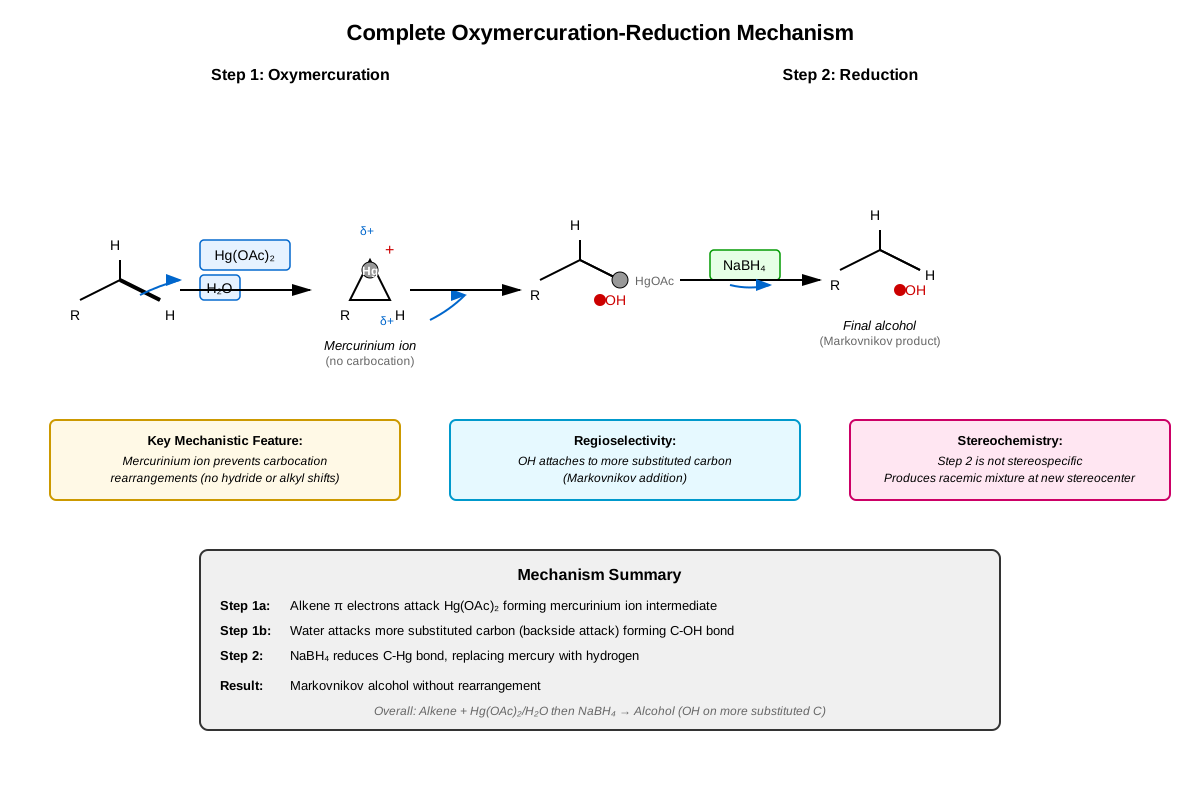
Oxymercuration reduction is a two-step reaction sequence that converts alkenes to alcohols through initial formation of an organomercury intermediate followed by reductive cleavage. The first step, oxymercuration, involves treating an alkene with mercuric acetate [Hg(OAc)₂] in aqueous solution (often with THF as co-solvent). This generates a β-hydroxyalkylmercury compound. The second step, reduction, employs sodium borohydride (NaBH₄) to replace the mercury-carbon bond with a carbon-hydrogen bond, yielding the final alcohol product.
The net result is the addition of H and OH across the carbon-carbon double bond, with the hydroxyl group attaching to the more substituted carbon (Markovnikov orientation). Unlike acid-catalyzed hydration, this reaction proceeds without forming free carbocation intermediates, thus avoiding rearrangement products.
Mechanism of Oxymercuration (Step 1)
The oxymercuration step begins when the alkene's π electrons attack the mercury atom of Hg(OAc)₂, forming a mercurinium ion intermediate. This three-membered ring structure contains a positively charged mercury atom bridging two carbon atoms. The mercurinium ion is analogous to a bromonium ion in bromination reactions—both are cyclic, positively charged intermediates that prevent carbocation formation.
The mercurinium ion intermediate is not symmetrical when the alkene is unsymmetrical. The mercury atom bears partial positive charge, and this charge is distributed unequally between the two carbon atoms. The more substituted carbon bears more positive character due to hyperconjugation and inductive effects. When water (the nucleophile) attacks the mercurinium ion, it preferentially attacks the more substituted carbon—the one with greater partial positive charge. This attack occurs from the backside (SN2-like), opening the three-membered ring and forming a β-hydroxyalkylmercury acetate compound.
Mechanism of Reduction (Step 2)
The reduction step involves treatment with sodium borohydride (NaBH₄), a mild reducing agent. The borohydride anion (BH₄⁻) delivers a hydride ion (H⁻) to the carbon bearing the mercury substituent. This process cleaves the carbon-mercury bond, replacing mercury with hydrogen. The mechanism likely proceeds through a radical pathway, though the exact details are less important for MCAT purposes than understanding the overall transformation.
Importantly, this reduction step does not alter the stereochemistry at the carbon center significantly, and it does not involve carbocation intermediates. The mercury is simply replaced by hydrogen, preserving the regiochemistry established in the oxymercuration step.
Regioselectivity: Markovnikov Addition
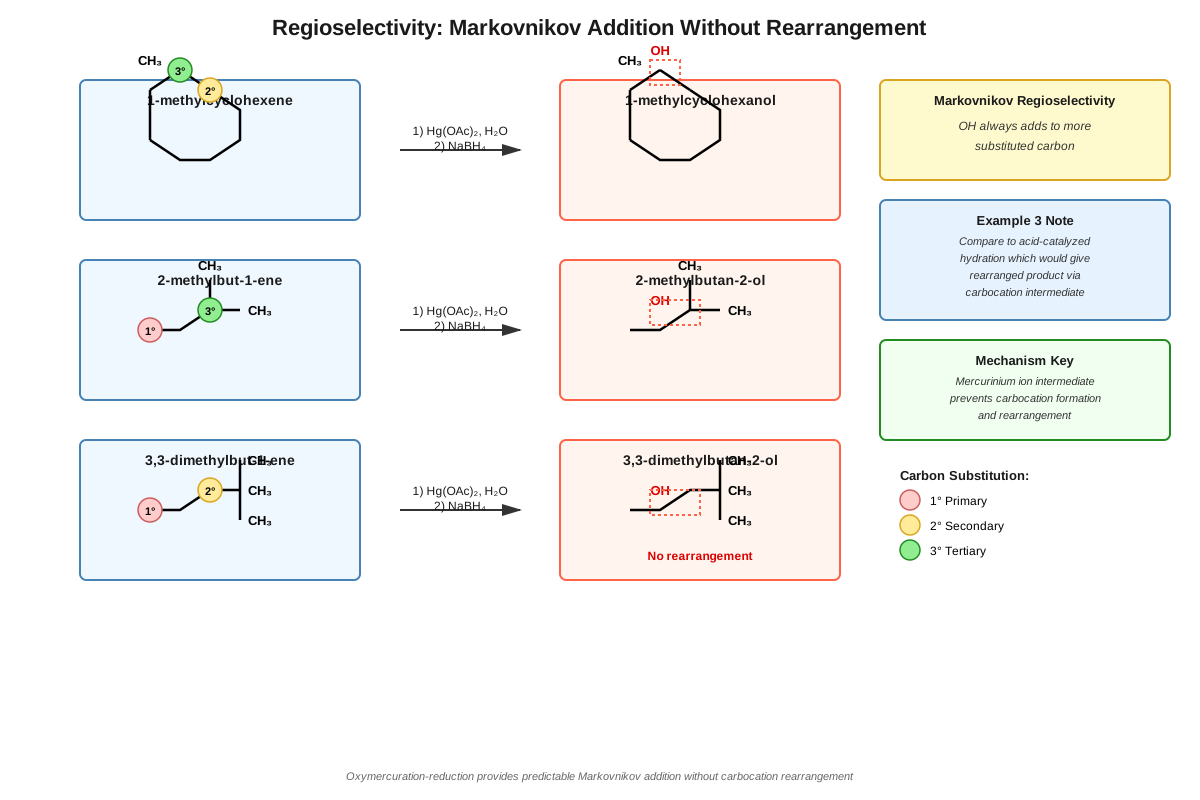
Oxymercuration reduction follows Markovnikov's rule: the hydroxyl group adds to the more substituted carbon of the alkene, while hydrogen adds to the less substituted carbon. This regioselectivity arises from the mechanism—specifically, from the preferential attack of water on the more substituted carbon of the mercurinium ion intermediate.
For example, when 2-methylpropene undergoes oxymercuration reduction, the hydroxyl group attaches to the tertiary carbon (the more substituted position), yielding tert-butanol rather than isobutanol. This Markovnikov selectivity makes oxymercuration reduction complementary to hydroboration-oxidation, which gives anti-Markovnikov products.
Stereochemistry
The stereochemical outcome of oxymercuration reduction is generally not stereospecific in the same way that bromination is. While the initial formation of the mercurinium ion and its opening by water might suggest anti addition (similar to bromonium ion opening), the subsequent reduction step can scramble stereochemistry. For MCAT purposes, the key point is that oxymercuration reduction does not reliably produce a single stereoisomer when stereoisomers are possible. The reaction is best characterized as producing a mixture of stereoisomers or as being non-stereospecific.
This contrasts with hydroboration-oxidation, which proceeds with syn addition and produces predictable stereochemistry. On the MCAT, questions about stereochemistry in oxymercuration reduction are less common than questions about regioselectivity.
Comparison with Other Alkene Hydration Methods
Understanding oxymercuration reduction requires comparing it with alternative methods for converting alkenes to alcohols:
| Method | Regioselectivity | Rearrangements? | Stereochemistry | Mechanism |
|---|---|---|---|---|
| Acid-catalyzed hydration | Markovnikov | Yes (carbocation) | Not stereospecific | Carbocation intermediate |
| Oxymercuration reduction | Markovnikov | No | Not stereospecific | Mercurinium ion intermediate |
| Hydroboration-oxidation | Anti-Markovnikov | No | Syn addition | Concerted addition, no carbocation |
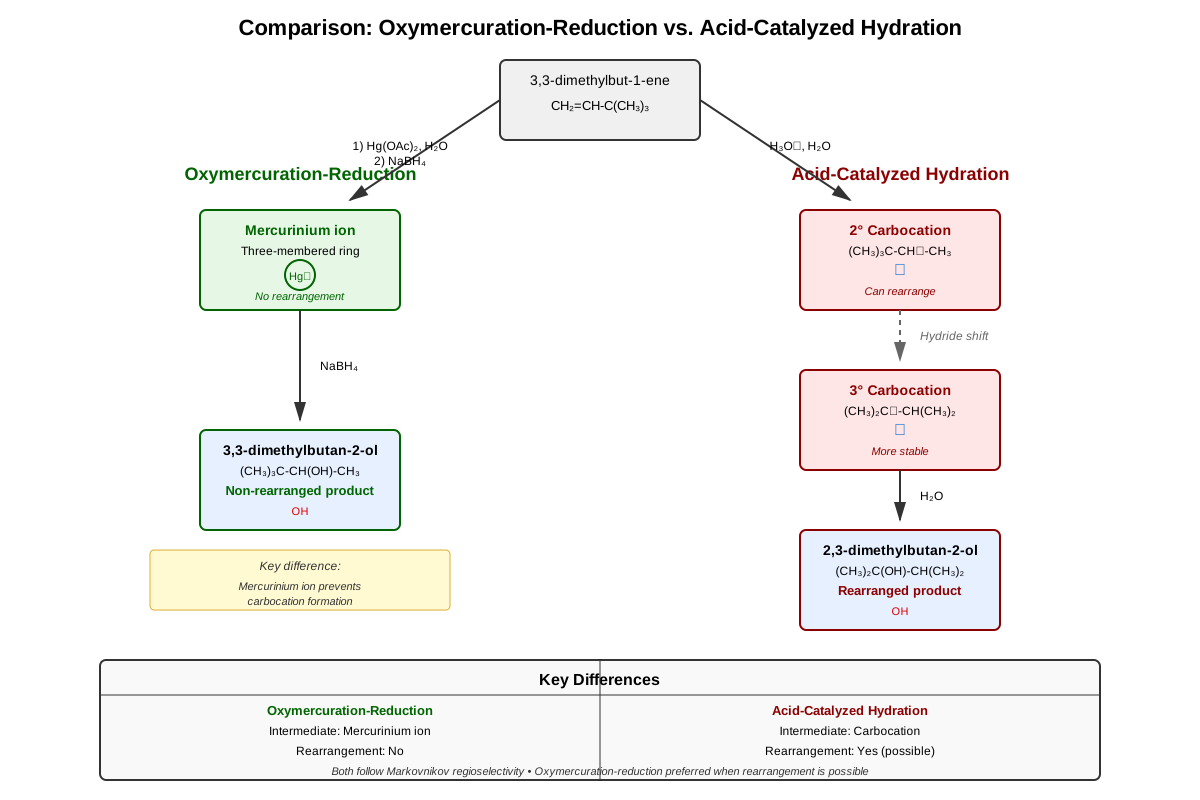
The absence of carbocation rearrangements is the primary advantage of oxymercuration reduction over acid-catalyzed hydration. When working with alkenes that could undergo hydride or alkyl shifts (such as 3-methyl-1-butene), oxymercuration reduction provides the Markovnikov product without rearrangement, whereas acid-catalyzed hydration would yield rearranged products.
Reaction Conditions and Reagents
The typical reaction conditions for oxymercuration reduction are:
- Step 1: Alkene + Hg(OAc)₂ in H₂O/THF mixture
- Step 2: NaBH₄ in aqueous base (often NaOH)
The use of THF (tetrahydrofuran) as a co-solvent helps dissolve the organic alkene substrate in the aqueous reaction medium. The mercuric acetate serves as the electrophilic mercury source. In the reduction step, sodium borohydride is mild enough to reduce the carbon-mercury bond without affecting other functional groups that might be present in the molecule.
Synthetic Applications
Oxymercuration reduction is particularly useful when:
- Markovnikov addition of water is desired
- The alkene substrate is prone to carbocation rearrangement
- Mild conditions are required (compared to concentrated acid)
- Other functional groups in the molecule must be preserved
For example, converting 3,3-dimethyl-1-butene to 3,3-dimethyl-2-butanol requires a method that gives Markovnikov addition without rearrangement. Acid-catalyzed hydration would produce rearranged products due to the potential for hydride shifts, but oxymercuration reduction cleanly provides the desired alcohol.
Concept Relationships
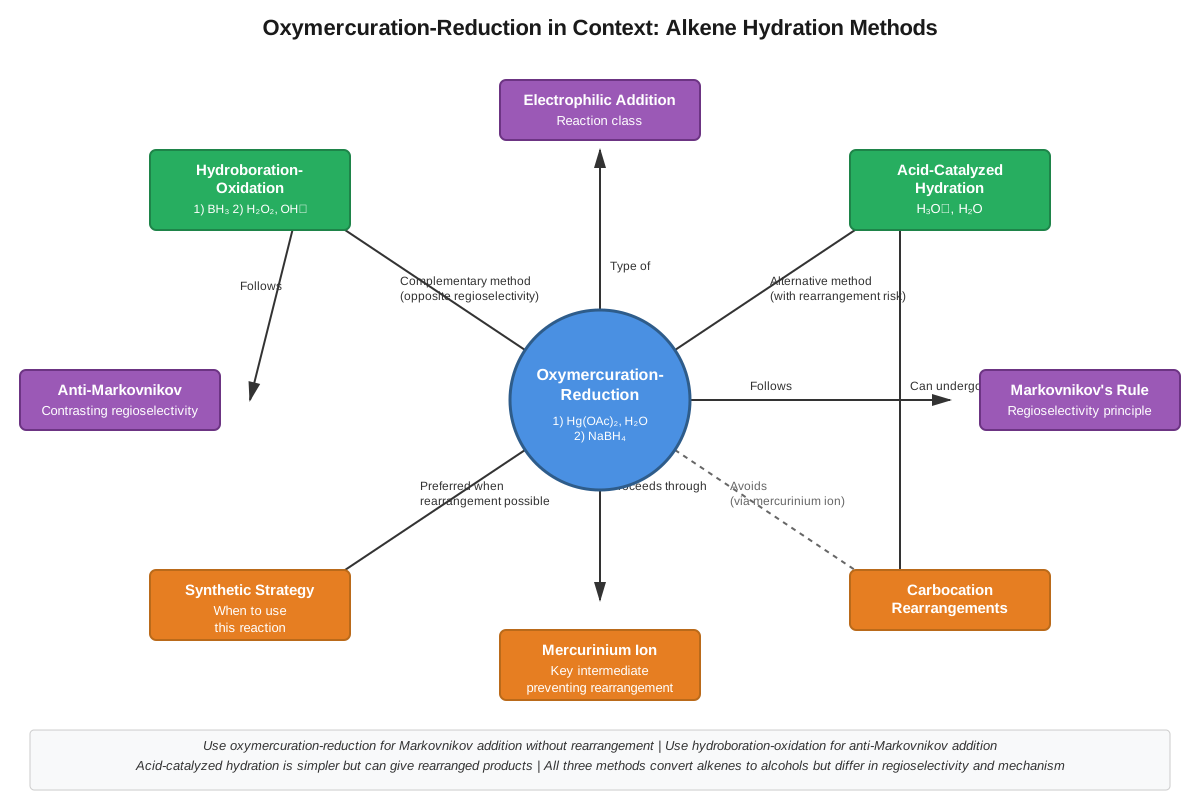
The concepts within oxymercuration reduction are hierarchically organized: the overall transformation (alkene → alcohol) depends on understanding both the oxymercuration mechanism and the reduction mechanism. The oxymercuration step determines regioselectivity through the mercurinium ion intermediate, which in turn explains why Markovnikov orientation is observed. The reduction step completes the transformation by removing mercury, but it's the first step that controls product identity.
Oxymercuration reduction connects to prerequisite knowledge of alkene structure and reactivity. Understanding why alkenes are nucleophilic (due to the π bond) explains why they attack electrophilic mercury. Knowledge of Markovnikov's rule provides the framework for predicting regioselectivity, while understanding carbocation stability explains why avoiding carbocations prevents rearrangements.
The relationship map flows as follows:
- Alkene structure → determines reactivity and regioselectivity
- Electrophilic addition mechanism → provides framework for mercurinium ion formation
- Mercurinium ion intermediate → prevents carbocation formation → eliminates rearrangements
- Nucleophilic attack on mercurinium ion → determines Markovnikov regioselectivity
- Reduction with NaBH₄ → completes transformation to alcohol
Oxymercuration reduction also connects forward to more advanced topics in organic synthesis, including protecting group strategies, multi-step synthesis, and retrosynthetic analysis. When planning a synthesis, chemists must choose between various methods for introducing hydroxyl groups, and oxymercuration reduction represents one important option in that toolkit.
Quick check — test yourself on Oxymercuration reduction so far.
Try Flashcards →High-Yield Facts
⭐ Oxymercuration reduction converts alkenes to alcohols with Markovnikov regioselectivity (OH adds to more substituted carbon)
⭐ The reaction proceeds through a mercurinium ion intermediate, NOT a carbocation, which prevents rearrangements
⭐ The two-step sequence is: (1) Hg(OAc)₂/H₂O, then (2) NaBH₄
⭐ Unlike acid-catalyzed hydration, oxymercuration reduction does NOT produce rearranged products
⭐ The reaction is complementary to hydroboration-oxidation, which gives anti-Markovnikov products
- Mercuric acetate [Hg(OAc)₂] serves as the electrophilic mercury source in step 1
- Sodium borohydride (NaBH₄) is a mild reducing agent that replaces C-Hg bonds with C-H bonds
- The mercurinium ion is a three-membered ring intermediate analogous to a bromonium ion
- Water acts as the nucleophile that opens the mercurinium ion, attacking the more substituted carbon
- The stereochemistry of oxymercuration reduction is generally not stereospecific (unlike hydroboration-oxidation)
- THF (tetrahydrofuran) is commonly used as a co-solvent to dissolve organic substrates in aqueous reaction medium
- The reaction works best with alkenes that would undergo rearrangement under acidic conditions
Common Misconceptions
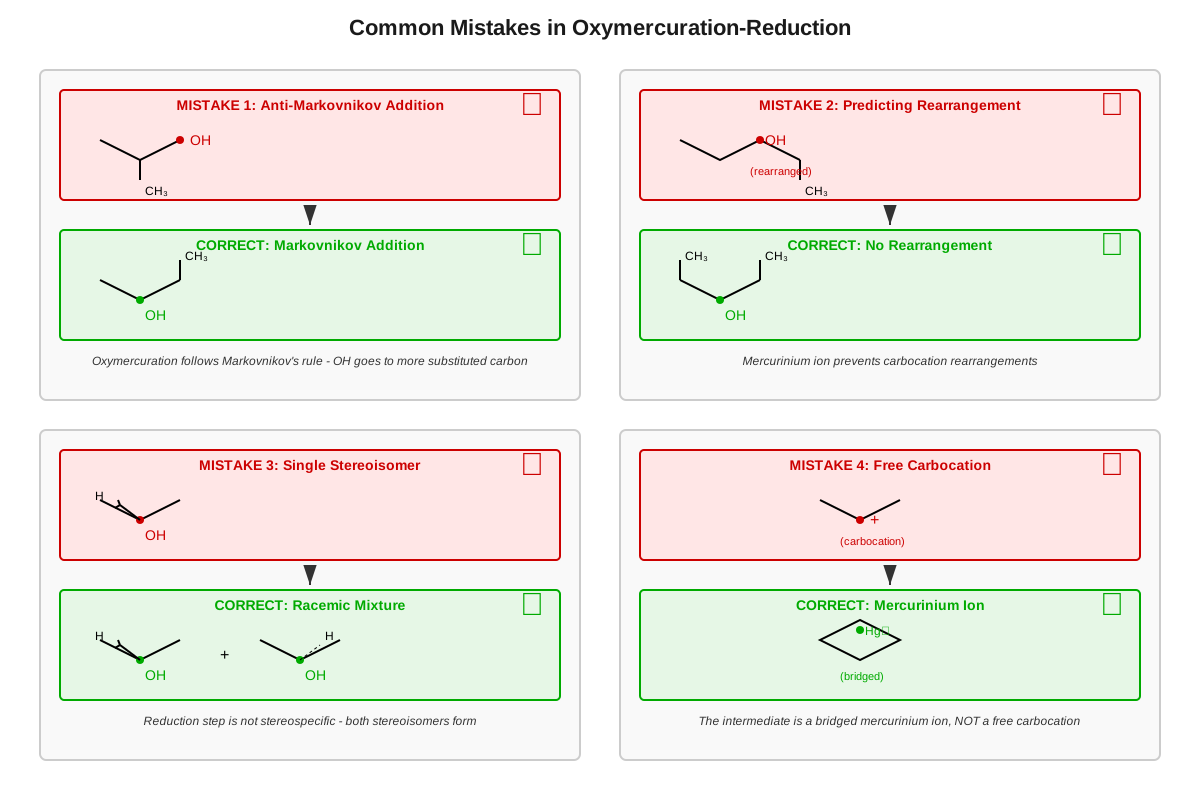
Misconception: Oxymercuration reduction proceeds through a carbocation intermediate like acid-catalyzed hydration.
Correction: The reaction proceeds through a mercurinium ion intermediate, which is a cyclic, three-membered ring structure. This prevents carbocation formation and eliminates the possibility of rearrangements through hydride or alkyl shifts.
Misconception: The hydroxyl group adds to the less substituted carbon (anti-Markovnikov).
Correction: Oxymercuration reduction follows Markovnikov's rule—the hydroxyl group adds to the MORE substituted carbon. Students may confuse this with hydroboration-oxidation, which gives anti-Markovnikov products. A helpful distinction: "oxy-mercury = Markovnikov; hydro-boration = anti-Markovnikov."
Misconception: Sodium borohydride (NaBH₄) in step 2 reduces the alcohol product to an alkane.
Correction: NaBH₄ is a mild reducing agent that specifically targets the carbon-mercury bond, replacing mercury with hydrogen. It does NOT reduce alcohols to alkanes under these conditions. Only the C-Hg bond is affected; the C-OH bond remains intact.
Misconception: Oxymercuration reduction and acid-catalyzed hydration always give the same products.
Correction: While both reactions follow Markovnikov's rule, they differ critically in whether rearrangements occur. Acid-catalyzed hydration proceeds through carbocations and CAN produce rearranged products when hydride or alkyl shifts are possible. Oxymercuration reduction NEVER produces rearranged products because it avoids carbocation intermediates entirely.
Misconception: The stereochemistry of oxymercuration reduction is always syn addition.
Correction: Unlike hydroboration-oxidation (which is syn), oxymercuration reduction is generally NOT stereospecific. While the opening of the mercurinium ion might suggest anti addition, the subsequent reduction step can scramble stereochemistry. The reaction typically produces mixtures of stereoisomers when stereochemistry is relevant.
Misconception: Any reducing agent can be used in step 2 to replace mercury with hydrogen.
Correction: Sodium borohydride is specifically chosen because it's mild and selective for C-Hg bonds. Stronger reducing agents (like LiAlH₄) might reduce other functional groups in the molecule. The choice of NaBH₄ is deliberate and important for the reaction's selectivity.
Worked Examples
Example 1: Predicting the Product of Oxymercuration Reduction
Question: What is the major product when 2-methyl-2-butene undergoes oxymercuration reduction?
Solution:
Step 1: Identify the alkene structure. 2-Methyl-2-butene has the structure:
    CH₃
     |
CH₃-C=CH-CH₃
Step 2: Apply Markovnikov's rule. The hydroxyl group will add to the more substituted carbon of the double bond. Both carbons of the double bond are disubstituted (each has two alkyl groups), but we need to consider which carbon is more substituted after the double bond is broken.
Step 3: Recognize that both carbons are equally substituted in this symmetrical alkene. The carbon on the left has three methyl groups attached (including the one above), while the carbon on the right has one methyl and one ethyl group. The left carbon is more substituted (tertiary position).
Step 4: Draw the product. The OH group adds to the more substituted carbon (the one bearing two methyl groups), and H adds to the other carbon:
    CH₃  OH
     |   |
CH₃-C---CH-CH₃
     |
    CH₃
This is 2-methyl-2-butanol (a tertiary alcohol).
Key reasoning: This example reinforces that oxymercuration reduction follows Markovnikov's rule. The reaction does not involve carbocation rearrangement, so we don't need to consider shifts. The product is the straightforward Markovnikov addition product.
Example 2: Comparing Reaction Outcomes
Question: A student wants to convert 3-methyl-1-butene to an alcohol. Compare the products obtained from (a) acid-catalyzed hydration and (b) oxymercuration reduction.
Solution:
The starting material is:
    CH₃
     |
CH₃-CH-CH₂-CH=CH₂
(a) Acid-catalyzed hydration (H₂SO₄/H₂O):
Step 1: The alkene is protonated to form a carbocation. Following Markovnikov's rule, the proton adds to the terminal carbon (less substituted), forming a secondary carbocation at C-2:
    CH₃
     |
CH₃-CH-CH₂-CH⁺-CH₃
Step 2: This secondary carbocation can undergo a hydride shift from C-3 to C-2, forming a more stable tertiary carbocation:
    CH₃
     |
CH₃-C⁺-CH₂-CH₂-CH₃
Step 3: Water attacks the tertiary carbocation, yielding 2-methyl-2-butanol after deprotonation (a rearranged product).
(b) Oxymercuration reduction:
Step 1: The alkene reacts with Hg(OAc)₂/H₂O to form a mercurinium ion. No carbocation forms, so no rearrangement occurs.
Step 2: Water attacks the more substituted carbon of the mercurinium ion (C-2), following Markovnikov's rule.
Step 3: NaBH₄ reduction replaces mercury with hydrogen, yielding 3-methyl-2-butanol (the non-rearranged Markovnikov product).
Comparison: Acid-catalyzed hydration gives 2-methyl-2-butanol (rearranged), while oxymercuration reduction gives 3-methyl-2-butanol (non-rearranged). This example illustrates the key advantage of oxymercuration reduction: it provides Markovnikov products without rearrangement.
MCAT relevance: This type of comparison question is common on the MCAT. Students must recognize when rearrangements are possible and choose the appropriate synthetic method to avoid or allow them.
Exam Strategy
When approaching MCAT questions on oxymercuration reduction, follow this systematic strategy:
Step 1: Identify the reaction type. Look for trigger phrases like "Hg(OAc)₂ followed by NaBH₄," "oxymercuration reduction," or "mercuric acetate then sodium borohydride." These immediately signal this specific reaction.
Step 2: Determine regioselectivity. Remember that oxymercuration reduction follows Markovnikov's rule. The OH group adds to the more substituted carbon. Quickly identify which carbon of the double bond is more substituted by counting alkyl groups.
Step 3: Check for potential rearrangements. If the question asks you to compare products or if the alkene structure could undergo carbocation rearrangement, remember that oxymercuration reduction does NOT produce rearranged products. This is often the key to eliminating wrong answer choices.
Step 4: Consider stereochemistry only if explicitly asked. Most MCAT questions on this topic focus on regioselectivity and rearrangements rather than stereochemistry. Don't waste time worrying about stereoisomers unless the question specifically addresses them.
Process of elimination tips:
- Eliminate any answer showing anti-Markovnikov addition (OH on less substituted carbon)
- Eliminate any answer showing rearranged products (shifted carbon skeleton)
- Eliminate any answer showing reduction of the alcohol to an alkane
- If comparing with hydroboration-oxidation, remember: oxymercuration = Markovnikov; hydroboration = anti-Markovnikov
Time allocation: Discrete questions on oxymercuration reduction should take 45-60 seconds. Passage-based questions comparing multiple synthetic routes may take 90-120 seconds. Don't get bogged down drawing detailed mechanisms—focus on predicting the product using Markovnikov's rule and the no-rearrangement principle.
Trigger words to watch for:
- "Mercuric acetate" or "Hg(OAc)₂" → oxymercuration step
- "Sodium borohydride" or "NaBH₄" → reduction step
- "Without rearrangement" → suggests oxymercuration reduction over acid-catalyzed hydration
- "Markovnikov addition" → OH to more substituted carbon
- "Complementary to hydroboration" → emphasizes the Markovnikov vs. anti-Markovnikov distinction
Memory Techniques
Mnemonic for regioselectivity: "Oxy-Mercury Makes Markovnikov" (the three M's remind you that oxymercuration reduction follows Markovnikov's rule)
Mnemonic for no rearrangements: "Mercury Blocks Rearrangements" (MBR) - the mercurinium ion intermediate blocks carbocation formation and thus prevents rearrangements
Two-step sequence mnemonic: "Hg first, H later" (Mercury in step 1, Hydrogen replaces it in step 2)
Visualization strategy: Picture the mercurinium ion as a "protective bridge" over the double bond. This bridge prevents carbocations from forming (no rearrangements) but still allows water to attack the more substituted carbon (Markovnikov selectivity). The bridge is then removed and replaced with hydrogen in step 2.
Comparison acronym for alkene hydration methods:
- ACH = Acid-Catalyzed Hydration → Markovnikov WITH rearrangements
- OXY = Oxymercuration reduction → Markovnikov WITHOUT rearrangements
- HYDRO = Hydroboration-oxidation → anti-Markovnikov WITHOUT rearrangements
Reagent memory aid: Think of the reaction as "Hg-Water-Borohydride" in sequence. The mercury comes first with water, then borohydride finishes the job. This helps you remember both steps and their order.
Summary
Oxymercuration reduction is a two-step synthetic method for converting alkenes to alcohols with Markovnikov regioselectivity but without carbocation rearrangements. The reaction proceeds through initial treatment with mercuric acetate in aqueous solution, forming a mercurinium ion intermediate that prevents carbocation formation. Water then attacks the more substituted carbon of this intermediate, establishing Markovnikov regioselectivity. Subsequent reduction with sodium borohydride replaces the carbon-mercury bond with a carbon-hydrogen bond, completing the transformation. This reaction is particularly valuable when the alkene substrate is prone to rearrangement under acidic conditions, as it provides clean Markovnikov products without skeletal rearrangements. For the MCAT, students must be able to predict products using Markovnikov's rule, recognize when oxymercuration reduction is preferable to acid-catalyzed hydration, and distinguish it from hydroboration-oxidation (which gives anti-Markovnikov products). The key mechanistic feature—the mercurinium ion intermediate—explains both the regioselectivity and the absence of rearrangements, making this reaction a high-yield topic for understanding the relationship between mechanism and product distribution in organic chemistry.
Key Takeaways
- Oxymercuration reduction converts alkenes to alcohols following Markovnikov's rule (OH to more substituted carbon)
- The reaction proceeds through a mercurinium ion intermediate, NOT a carbocation, which prevents rearrangements
- The two-step sequence is: (1) Hg(OAc)₂/H₂O, then (2) NaBH₄
- Unlike acid-catalyzed hydration, oxymercuration reduction produces no rearranged products
- The reaction is complementary to hydroboration-oxidation: oxymercuration gives Markovnikov products, while hydroboration gives anti-Markovnikov products
- For MCAT questions, focus on regioselectivity and the absence of rearrangements rather than stereochemistry
- The mercurinium ion is analogous to a bromonium ion—both are cyclic intermediates that prevent carbocation formation
Related Topics
Hydroboration-Oxidation: This complementary reaction also converts alkenes to alcohols but with anti-Markovnikov regioselectivity and syn stereochemistry. Mastering oxymercuration reduction enables direct comparison with hydroboration-oxidation, a common MCAT question type.
Acid-Catalyzed Hydration: Understanding this alternative alkene hydration method highlights the advantages of oxymercuration reduction, particularly regarding carbocation rearrangements. Both follow Markovnikov's rule, but only acid-catalyzed hydration produces rearranged products.
Electrophilic Addition Mechanisms: Oxymercuration reduction exemplifies electrophilic addition through a cyclic intermediate. This concept extends to bromination (bromonium ion) and other addition reactions.
Carbocation Rearrangements: Recognizing when and why carbocations rearrange is essential for predicting when oxymercuration reduction is superior to acid-catalyzed hydration.
Alcohol Synthesis and Reactions: Oxymercuration reduction is one of several methods for preparing alcohols. Understanding this reaction enables progression to alcohol oxidation, substitution, and elimination reactions.
Synthetic Strategy and Retrosynthesis: Choosing between different methods for introducing functional groups is a key skill in organic synthesis. Mastering oxymercuration reduction contributes to broader synthetic planning abilities.
Practice CTA
Now that you've mastered the core concepts of oxymercuration reduction, it's time to solidify your understanding through active practice. Work through the practice questions and flashcards to test your ability to predict products, compare reaction mechanisms, and apply this knowledge to MCAT-style scenarios. Remember, the difference between passive reading and true mastery lies in application—challenge yourself to work through problems without looking back at the guide. Each question you answer correctly builds confidence and reinforces the high-yield concepts that will serve you on test day. You've got this!
Sign up free to keep reading
Create a free AnvayaPrep account to finish this MCAT guide on Oxymercuration reduction — plus flashcards and practice questions.