Overview
Pyridinium chlorochromate (PCC) is a selective oxidizing agent that holds a critical position in the arsenal of organic chemistry reagents tested on the MCAT. Unlike stronger oxidizing agents such as potassium permanganate (KMnO₄) or chromic acid (H₂CrO₄), PCC offers chemists—and MCAT test-takers—the ability to perform controlled oxidations that stop at specific oxidation states. This selectivity makes PCC an indispensable tool for transforming primary alcohols into aldehydes without further oxidation to carboxylic acids, and for converting secondary alcohols into ketones.
Understanding PCC is essential for mastering the Oxidation and Reduction unit within Organic Chemistry, as it represents a fundamental principle: not all oxidizing agents are created equal. The MCAT frequently tests students' ability to predict reaction products based on reagent choice, and PCC questions often appear in discrete questions, passage-based problems involving synthetic pathways, and laboratory technique scenarios. The reagent's mild, anhydrous conditions and chromium-based mechanism distinguish it from aqueous oxidizing agents, making it a favorite topic for testing conceptual understanding rather than mere memorization.
PCC connects to broader themes in organic chemistry including functional group interconversions, reaction mechanisms involving chromium species, and the strategic planning of multi-step syntheses. Mastery of this reagent enables students to navigate complex synthesis problems, predict product distributions, and understand the relationship between reagent structure and reactivity—all high-yield skills for achieving a competitive MCAT score in the Chemical and Physical Foundations of Biological Systems section.
Learning Objectives
- [ ] Define PCC using accurate Organic Chemistry terminology
- [ ] Explain why PCC matters for the MCAT
- [ ] Apply PCC to exam-style questions
- [ ] Identify common mistakes related to PCC
- [ ] Connect PCC to related Organic Chemistry concepts
- [ ] Predict the products of PCC oxidation reactions given various alcohol substrates
- [ ] Compare and contrast PCC with other chromium-based and non-chromium oxidizing agents
- [ ] Explain the mechanistic basis for PCC's selectivity in oxidation reactions
Prerequisites
- Alcohol functional groups and nomenclature: Understanding primary (1°), secondary (2°), and tertiary (3°) alcohols is essential because PCC reactivity depends entirely on alcohol classification
- Oxidation states and oxidation numbers: PCC reactions involve changes in oxidation state, requiring familiarity with how to assign and track oxidation numbers in organic molecules
- Aldehyde and ketone structures: These are the products of PCC oxidation, so recognizing their structural features and properties is necessary
- Carboxylic acid functional groups: Understanding why PCC does NOT produce carboxylic acids (unlike other oxidizing agents) requires knowledge of this functional group
- Basic reaction mechanisms: Familiarity with curved arrow notation and electron movement helps understand how PCC transfers oxygen to substrates
Why This Topic Matters
PCC Organic Chemistry represents a cornerstone concept in synthetic organic chemistry with direct applications in pharmaceutical development, natural product synthesis, and biochemical research. In medicinal chemistry, the selective oxidation of alcohols to aldehydes or ketones is a critical transformation for modifying drug candidates and optimizing their biological activity. The ability to stop oxidation at the aldehyde stage prevents over-oxidation that would destroy valuable synthetic intermediates.
For the MCAT, PCC appears with moderate frequency in the Organic Chemistry subsection, typically in 2-4 questions per exam either directly or as part of multi-step synthesis problems. Questions involving PCC test multiple competencies: reagent selection, product prediction, mechanism understanding, and synthetic strategy. The MCAT favors PCC because it efficiently assesses whether students understand selectivity in oxidation reactions—a concept that extends to biological oxidation-reduction processes involving NAD⁺/NADH and FAD/FADH₂.
Common exam presentations include: (1) discrete questions asking students to identify the product when PCC reacts with a specific alcohol; (2) passage-based questions describing a synthetic route where students must select appropriate reagents for each step; (3) questions comparing PCC to other oxidizing agents like Jones reagent or sodium dichromate; and (4) laboratory technique passages where students must explain why PCC was chosen over alternative reagents. Understanding PCC also provides insight into the broader principle that reaction conditions (aqueous vs. anhydrous, acidic vs. neutral) dramatically affect outcomes—a principle that appears throughout MCAT biochemistry and organic chemistry content.
Core Concepts
Definition and Structure of PCC
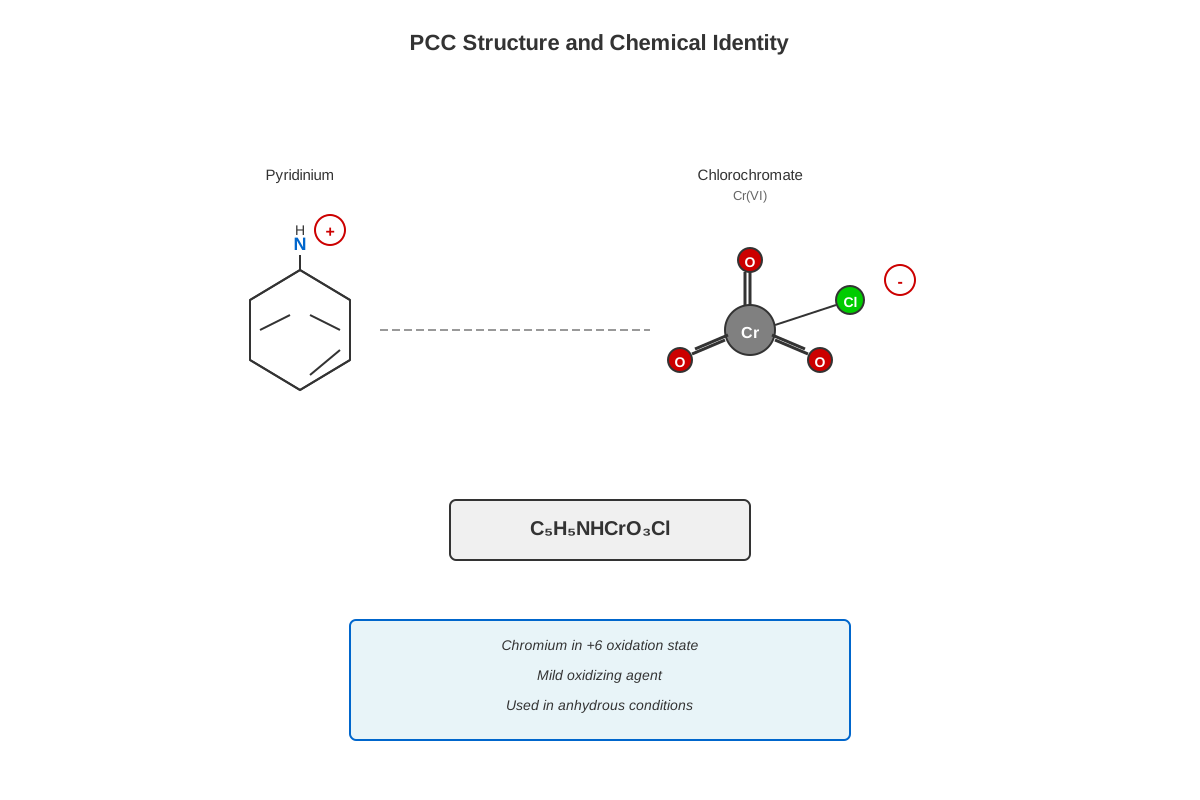
Pyridinium chlorochromate (PCC) is an orange-colored, chromium(VI)-based oxidizing agent with the chemical formula C₅H₅NH⁺CrO₃Cl⁻. The reagent consists of a pyridinium cation (protonated pyridine) paired with a chlorochromate anion. The chromium atom exists in the +6 oxidation state, making it a strong oxidizing agent, yet the overall complex exhibits remarkable selectivity due to its structural features and reaction conditions.
PCC is typically used dissolved in dichloromethane (CH₂Cl₂), an anhydrous (water-free) solvent. This anhydrous environment is crucial to PCC's selectivity—the absence of water prevents the formation of hydrates and subsequent over-oxidation. The reagent was developed by E.J. Corey and William Suggs in 1975 as a milder alternative to chromic acid-based oxidations, specifically designed to oxidize primary alcohols to aldehydes without further oxidation to carboxylic acids.
Mechanism of PCC Oxidation
The PCC MCAT mechanism involves several key steps that demonstrate how chromium(VI) facilitates the oxidation process:
- Formation of chromate ester: The alcohol oxygen attacks the electrophilic chromium center, displacing chloride and forming a chromate ester intermediate
- E2-type elimination: A base (often the pyridine component or another alcohol molecule) abstracts a proton from the carbon bearing the hydroxyl group, while the C-O bond to chromium breaks, forming the C=O double bond
- Reduction of chromium: Chromium is reduced from Cr(VI) to Cr(IV), and in subsequent steps to Cr(III), which appears as a green precipitate
- Product release: The aldehyde or ketone product is released, and the chromium byproducts remain in the reaction mixture
This mechanism explains why PCC works: the chromate ester formation activates the alcohol for elimination, and the E2-like elimination creates the carbonyl group. The anhydrous conditions prevent aldehydes from forming hydrates (geminal diols), which would be susceptible to further oxidation.
Selectivity and Substrate Scope
PCC exhibits highly predictable selectivity based on alcohol structure:
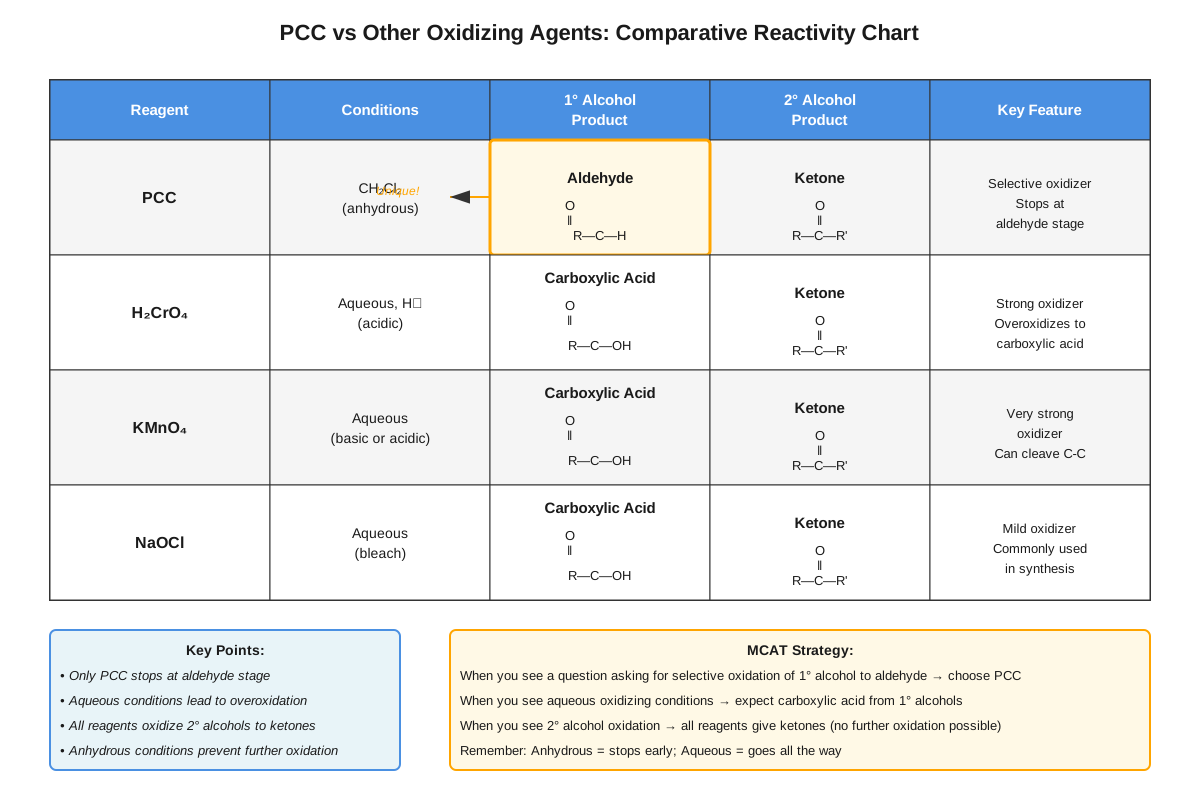
| Alcohol Type | PCC Product | Further Oxidation? |
|---|---|---|
| Primary (1°) alcohol (RCH₂OH) | Aldehyde (RCHO) | No - stops at aldehyde |
| Secondary (2°) alcohol (R₂CHOH) | Ketone (R₂C=O) | No - ketones resist further oxidation |
| Tertiary (3°) alcohol (R₃COH) | No reaction | N/A - no α-hydrogen available |
Primary alcohols are oxidized to aldehydes because PCC's anhydrous conditions prevent the aldehyde from hydrating to a geminal diol (which would be oxidized to a carboxylic acid). This is PCC's signature transformation and its most important distinction from aqueous chromium oxidants.
Secondary alcohols are oxidized to ketones efficiently. Since ketones lack an α-hydrogen on the carbonyl carbon (the carbon is bonded to two other carbons and has no C-H bond), they cannot undergo further oxidation under normal conditions.
Tertiary alcohols do not react with PCC because they lack a hydrogen atom on the carbon bearing the hydroxyl group. The oxidation mechanism requires this α-hydrogen for the elimination step, so tertiary alcohols remain unchanged.
Comparison with Other Oxidizing Agents
Understanding PCC requires distinguishing it from related Oxidation and Reduction reagents:
PCC vs. Chromic Acid (Jones Reagent, H₂CrO₄/H₂SO₄):
- Chromic acid is used in aqueous acidic conditions
- Primary alcohols → carboxylic acids (over-oxidation occurs)
- Secondary alcohols → ketones (same as PCC)
- The aqueous environment allows aldehyde hydration, enabling further oxidation
PCC vs. Potassium Dichromate (K₂Cr₂O₇):
- Dichromate in aqueous acid behaves like chromic acid
- Primary alcohols → carboxylic acids
- Requires aqueous conditions, leading to over-oxidation
PCC vs. Pyridinium Dichromate (PDC):
- PDC is a related chromium(VI) reagent, also anhydrous
- Slightly milder than PCC
- Same selectivity pattern but sometimes slower reaction rates
PCC vs. Swern Oxidation:
- Swern uses DMSO and oxalyl chloride, not chromium
- Also stops at aldehydes for primary alcohols
- Milder conditions, no heavy metal waste
- More complex procedure, less commonly tested on MCAT
PCC vs. Biological Oxidizing Agents (NAD⁺):
- NAD⁺ oxidizes alcohols in biological systems
- Enzyme-catalyzed, highly specific
- Represents the biological parallel to chemical oxidations
Reaction Conditions and Practical Considerations
PCC oxidations typically proceed under the following conditions:
- Solvent: Dichloromethane (CH₂Cl₂), anhydrous
- Temperature: Room temperature (no heating required)
- Atmosphere: Anhydrous conditions maintained (moisture-free)
- Stoichiometry: Approximately 1.5 equivalents of PCC per equivalent of alcohol
- Workup: Filtration to remove chromium salts, followed by standard extraction
The mild conditions make PCC compatible with many functional groups that would be destroyed by harsher oxidants. Esters, ethers, alkenes, and aromatic rings typically survive PCC oxidation unchanged, though highly electron-rich alkenes may be susceptible to oxidation.
Limitations and Side Reactions
While PCC is selective, it has limitations:
- Chromium waste: Produces toxic chromium byproducts requiring special disposal
- Cost: More expensive than simple chromic acid oxidations
- Moisture sensitivity: Water contamination leads to over-oxidation
- Allylic oxidation: Can oxidize allylic positions (carbons adjacent to C=C bonds) in some cases
- Functional group compatibility: Strong acids, bases, and easily oxidized groups may interfere
Concept Relationships
The selectivity of PCC directly stems from its anhydrous reaction conditions, which prevent aldehyde hydration. This connects to the broader concept that aldehydes in aqueous solution exist in equilibrium with their geminal diol (hydrate) forms, and these hydrates can be further oxidized. By maintaining anhydrous conditions, PCC blocks this equilibrium, protecting the aldehyde product.
PCC's mechanism connects to E2 elimination reactions studied in alkyl halide chemistry—both involve concerted proton abstraction and bond breaking. Understanding E2 mechanisms helps predict PCC's requirement for an α-hydrogen and explains why tertiary alcohols are unreactive.
The concept flows as follows: Alcohol structure → determines oxidation product → which depends on reagent choice → influenced by reaction conditions → ultimately controlled by mechanism requirements. This chain of reasoning applies throughout organic synthesis planning.
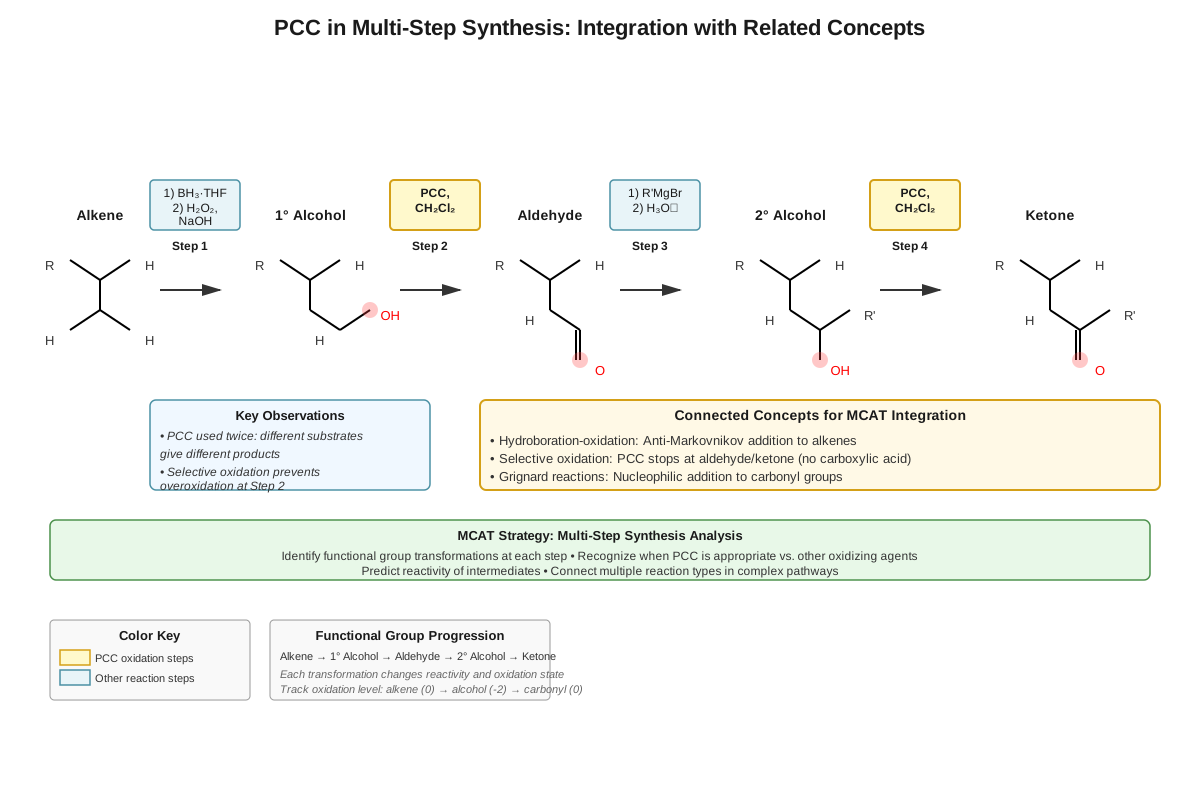
PCC also connects forward to retrosynthetic analysis, where chemists work backward from target molecules to identify necessary starting materials and reagents. Recognizing that an aldehyde in a target molecule could come from PCC oxidation of a primary alcohol is a key retrosynthetic disconnection.
The broader theme of oxidation state changes links PCC to biochemistry topics including cellular respiration, where NAD⁺ and FAD serve as biological oxidizing agents. Both PCC and NAD⁺ oxidize alcohols to carbonyls, illustrating how chemical principles transcend the boundary between synthetic and biological chemistry.
Quick check — test yourself on PCC so far.
Try Flashcards →High-Yield Facts
⭐ PCC oxidizes primary alcohols to aldehydes and stops—it does NOT produce carboxylic acids
⭐ PCC oxidizes secondary alcohols to ketones
⭐ PCC does NOT react with tertiary alcohols (no α-hydrogen available)
⭐ PCC requires anhydrous conditions (typically dichloromethane solvent)
⭐ PCC is a chromium(VI)-based oxidizing agent that is reduced to chromium(III) during the reaction
- PCC stands for pyridinium chlorochromate, with the formula C₅H₅NH⁺CrO₃Cl⁻
- The anhydrous conditions prevent aldehyde hydration, which is why over-oxidation to carboxylic acids doesn't occur
- PCC is milder than chromic acid (Jones reagent) but achieves the same oxidation for secondary alcohols
- The mechanism involves chromate ester formation followed by E2-like elimination
- PCC produces a green chromium(III) precipitate as a byproduct, while the starting reagent is orange
- PCC is compatible with many functional groups including esters, ethers, and alkenes
- Pyridinium dichromate (PDC) is a related reagent with similar selectivity but slightly milder conditions
- PCC was developed by E.J. Corey in 1975 specifically to solve the over-oxidation problem
- The pyridinium cation serves as both a counterion and a mild base in the mechanism
- PCC reactions typically proceed at room temperature without heating
Common Misconceptions
Misconception: PCC can oxidize primary alcohols all the way to carboxylic acids like other chromium reagents.
Correction: PCC's defining characteristic is that it stops at the aldehyde stage for primary alcohols due to anhydrous conditions that prevent aldehyde hydration. Only aqueous chromium oxidants (chromic acid, Jones reagent, dichromate in acid) produce carboxylic acids from primary alcohols.
Misconception: PCC and PDC (pyridinium dichromate) are the same reagent.
Correction: While both are chromium(VI)-based oxidants used in anhydrous conditions with similar selectivity, PDC is slightly milder and sometimes slower. PCC contains chlorochromate (CrO₃Cl⁻) while PDC contains dichromate (Cr₂O₇²⁻). For MCAT purposes, they behave similarly, but they are distinct reagents.
Misconception: Tertiary alcohols are oxidized by PCC to form ketones.
Correction: Tertiary alcohols do NOT react with PCC because they lack a hydrogen atom on the carbon bearing the hydroxyl group (α-hydrogen). The oxidation mechanism requires this hydrogen for the elimination step. Tertiary alcohols are generally resistant to oxidation by most reagents.
Misconception: PCC works in aqueous solution just like other oxidizing agents.
Correction: PCC specifically requires anhydrous (water-free) conditions, typically in dichloromethane solvent. Water would destroy PCC's selectivity by allowing aldehydes to form hydrates, which would then be oxidized to carboxylic acids. The anhydrous environment is essential to PCC's utility.
Misconception: The pyridine component of PCC is just a spectator ion with no role in the reaction.
Correction: The pyridinium cation plays multiple roles: it serves as a counterion to stabilize the chlorochromate anion, and pyridine (released during the reaction) can act as a base to facilitate proton abstraction in the elimination step. The choice of pyridine as the cation is deliberate and functional.
Misconception: PCC and chromic acid give the same products for all alcohols.
Correction: While both oxidize secondary alcohols to ketones identically, they differ dramatically for primary alcohols: PCC produces aldehydes while chromic acid produces carboxylic acids. This difference is the primary reason PCC was developed and is the most commonly tested distinction on the MCAT.
Worked Examples
Example 1: Product Prediction with Multiple Alcohol Groups
Question: A compound contains both a primary alcohol and a secondary alcohol functional group. When treated with PCC in dichloromethane, what products form?
Solution:
Step 1: Identify the functional groups and their classifications
- Primary alcohol: RCH₂OH (has one carbon attached to the carbon bearing OH)
- Secondary alcohol: R₂CHOH (has two carbons attached to the carbon bearing OH)
Step 2: Apply PCC selectivity rules
- Primary alcohol + PCC → Aldehyde (RCHO)
- Secondary alcohol + PCC → Ketone (R₂C=O)
Step 3: Consider stoichiometry
- Each alcohol group requires approximately 1.5 equivalents of PCC
- With excess PCC, both groups will be oxidized
Step 4: Predict the product
- The primary alcohol is oxidized to an aldehyde
- The secondary alcohol is oxidized to a ketone
- The product contains both an aldehyde and a ketone functional group
Key Insight: PCC will oxidize all primary and secondary alcohols present in a molecule simultaneously if sufficient reagent is available. This is important for synthesis planning—if you want to oxidize only one alcohol in a molecule with multiple alcohol groups, you need to use protecting groups or carefully control stoichiometry.
Connection to Learning Objectives: This example demonstrates applying PCC to exam-style questions and connecting PCC to related concepts (functional group selectivity and synthesis planning).
Example 2: Reagent Selection in Multi-Step Synthesis
Question: Design a synthesis to convert 1-butanol (CH₃CH₂CH₂CH₂OH) to butanoic acid (CH₃CH₂CH₂COOH). A student proposes using PCC as the oxidizing agent. Will this work? If not, what reagent should be used?
Solution:
Step 1: Analyze the transformation
- Starting material: 1-butanol (primary alcohol)
- Target product: butanoic acid (carboxylic acid)
- Required change: Oxidation by two levels (alcohol → aldehyde → carboxylic acid)
Step 2: Evaluate PCC for this transformation
- PCC oxidizes primary alcohols to aldehydes
- PCC stops at the aldehyde stage (butanal, CH₃CH₂CH₂CHO)
- PCC does NOT oxidize aldehydes to carboxylic acids under standard conditions
Step 3: Conclusion about PCC
- PCC will NOT work for this synthesis
- PCC would produce butanal, not butanoic acid
Step 4: Select appropriate alternative reagent
- Need an oxidizing agent that converts primary alcohols to carboxylic acids
- Options include:
- Chromic acid (H₂CrO₄, Jones reagent)
- Potassium dichromate in aqueous acid (K₂Cr₂O₇/H₂SO₄/H₂O)
- Potassium permanganate (KMnO₄) in acidic or basic conditions
Step 5: Best answer
- Use chromic acid (Jones reagent) or K₂Cr₂O₇/H₂SO₄/H₂O
- These aqueous chromium oxidants will oxidize 1-butanol all the way to butanoic acid
Key Insight: This is a classic MCAT trap. Students who memorize "chromium oxidizes alcohols" without understanding the critical difference between PCC (anhydrous) and chromic acid (aqueous) will incorrectly choose PCC. The question tests whether you understand that reagent selection depends on the desired oxidation level.
Connection to Learning Objectives: This example addresses identifying common mistakes (choosing PCC when a stronger oxidant is needed) and connecting PCC to related concepts (other chromium oxidants and multi-step synthesis).
Exam Strategy
When approaching PCC MCAT questions, use this systematic strategy:
Step 1: Identify the alcohol type
Look for the carbon bearing the -OH group and count how many carbons are attached to it. This immediately tells you whether PCC will react and what product to expect. Primary = aldehyde, secondary = ketone, tertiary = no reaction.
Step 2: Check for trigger words indicating anhydrous vs. aqueous conditions
- "PCC in dichloromethane" or "anhydrous conditions" → stops at aldehyde
- "Chromic acid," "Jones reagent," "aqueous acid," or "K₂Cr₂O₇/H₂SO₄" → goes to carboxylic acid
- These trigger words are the key to distinguishing between similar-looking answer choices
Step 3: Watch for distractors involving over-oxidation
The MCAT loves to include carboxylic acid as a wrong answer choice for PCC oxidation of primary alcohols. If you see this, it's almost certainly a trap—PCC stops at aldehydes.
Step 4: Consider functional group compatibility
If the molecule contains other functional groups, quickly assess whether they'll survive PCC oxidation. Most common groups (esters, ethers, alkenes, aromatics) are stable, but this can be a secondary layer of complexity in passage-based questions.
Step 5: Use process of elimination for reagent selection questions
- If the question shows primary alcohol → aldehyde, eliminate any aqueous chromium oxidants
- If the question shows primary alcohol → carboxylic acid, eliminate PCC
- If the question shows tertiary alcohol → any product, eliminate all oxidizing agents
Time allocation: Discrete PCC questions should take 45-60 seconds. Passage-based synthesis questions involving PCC may take 90-120 seconds if they require multi-step reasoning. Don't overthink—PCC selectivity is straightforward once you know the rules.
Exam Tip: If you're stuck between PCC and another chromium reagent, ask yourself: "Does the product have an aldehyde or a carboxylic acid?" Aldehyde = PCC, carboxylic acid = aqueous chromium oxidant. This simple decision tree resolves most ambiguity.
Memory Techniques
Mnemonic for PCC selectivity: "PCC Protects Primary alcohols from Producing carboxylic acids—it Pauses at aldehydes"
Mnemonic for alcohol reactivity: "1° → Aldehyde, 2° → Ketone, 3° → Nothing" (Remember: 1-A, 2-K, 3-N)
Visualization strategy: Picture PCC as a "gentle" oxidizing agent wearing kid gloves (anhydrous = gentle, careful conditions). In contrast, visualize chromic acid as wearing heavy-duty industrial gloves (aqueous = harsh, goes all the way). This mental image helps remember that PCC is the milder, more selective reagent.
Acronym for PCC conditions: DAD
- Dichloromethane (solvent)
- Anhydrous (no water)
- Don't over-oxidize (stops at aldehyde)
Association technique: Connect "Chromic acid" with "Carboxylic acid"—both start with C, and chromic acid produces carboxylic acids. PCC doesn't start with C (it starts with P), so it doesn't make carboxylic acids. This simple phonetic association prevents confusion.
Mechanism memory aid: Think of the mechanism as "Chromate Ester Elimination" (CEE). The chromate ester forms first, then elimination occurs. This two-step memory aid captures the essential mechanism.
Summary
Pyridinium chlorochromate (PCC) is a chromium(VI)-based oxidizing agent that selectively oxidizes primary alcohols to aldehydes and secondary alcohols to ketones under anhydrous conditions, typically in dichloromethane solvent. Its defining characteristic—stopping at the aldehyde stage rather than over-oxidizing to carboxylic acids—distinguishes it from aqueous chromium oxidants like chromic acid and makes it invaluable in organic synthesis. The mechanism involves chromate ester formation followed by E2-like elimination, requiring an α-hydrogen and thus rendering tertiary alcohols unreactive. For the MCAT, mastering PCC means understanding its selectivity pattern, recognizing when to choose it over other oxidizing agents, and avoiding the common trap of predicting carboxylic acid formation from primary alcohols. PCC questions test conceptual understanding of how reaction conditions (anhydrous vs. aqueous) control product distribution, a principle that extends throughout organic chemistry and biochemistry. Success with PCC requires recognizing alcohol types, applying selectivity rules, and distinguishing PCC from related reagents based on trigger words in question stems.
Key Takeaways
- PCC oxidizes primary alcohols to aldehydes (not carboxylic acids) and secondary alcohols to ketones; tertiary alcohols do not react
- Anhydrous conditions (dichloromethane solvent) are essential to PCC's selectivity—water would enable over-oxidation
- PCC is a chromium(VI) reagent that is milder and more selective than aqueous chromium oxidants like chromic acid
- The mechanism requires an α-hydrogen on the alcohol carbon, explaining why tertiary alcohols are unreactive
- On the MCAT, distinguish PCC from chromic acid by the final oxidation product: aldehyde (PCC) vs. carboxylic acid (chromic acid) for primary alcohols
- PCC questions often test reagent selection in synthesis problems—choose PCC when you need to stop at the aldehyde stage
- Understanding PCC connects to broader themes of functional group interconversions, reaction selectivity, and the relationship between reaction conditions and product outcomes
Related Topics
Chromic Acid and Jones Oxidation: Understanding aqueous chromium(VI) oxidations provides essential contrast to PCC and completes the picture of chromium-based oxidizing agents. Mastering both allows strategic reagent selection in synthesis problems.
Swern Oxidation and Other Mild Oxidations: Learning alternative methods for oxidizing alcohols to aldehydes (Swern, Dess-Martin periodinane) deepens understanding of why chemists choose specific reagents and prepares for advanced synthesis questions.
Reduction Reactions (LiAlH₄, NaBH₄): Studying the reverse transformations (carbonyl → alcohol) creates a complete picture of oxidation-reduction interconversions and enables retrosynthetic analysis.
Biological Oxidation-Reduction (NAD⁺/NADH): Connecting PCC to biological oxidizing agents bridges organic chemistry and biochemistry, a high-yield integration for MCAT success.
Protecting Groups in Synthesis: Understanding how to selectively protect and deprotect functional groups enables complex multi-step syntheses where only specific alcohols should be oxidized.
Practice CTA
Now that you've mastered the core concepts of PCC oxidation, it's time to solidify your understanding through active practice. Attempt the practice questions and flashcards associated with this topic to test your ability to predict products, select appropriate reagents, and avoid common traps. Focus especially on questions that require distinguishing PCC from other oxidizing agents—this is where most students lose points. Remember: understanding PCC isn't just about memorizing "primary alcohol → aldehyde"—it's about grasping the underlying principle that reaction conditions control selectivity. This conceptual mastery will serve you throughout organic chemistry and biochemistry on the MCAT. You've got this!
Sign up free to keep reading
Create a free AnvayaPrep account to finish this MCAT guide on PCC — plus flashcards and practice questions.