Overview
UV-visible spectroscopy basics is a fundamental analytical technique in Organic Chemistry that measures the absorption of ultraviolet and visible light by molecules. This spectroscopic method provides critical information about the electronic structure of organic compounds, particularly those containing conjugated systems, aromatic rings, and chromophores. When molecules absorb light in the UV-visible range (typically 200-800 nm), electrons transition from lower-energy molecular orbitals to higher-energy orbitals, creating characteristic absorption patterns that can be used to identify and characterize compounds.
For the MCAT, understanding UV visible spectroscopy basics is essential because it appears regularly in both the Chemical and Physical Foundations of Biological Systems section and occasionally in passages involving biochemical analysis. The MCAT tests not only the theoretical principles of how molecules absorb light but also the practical applications of interpreting spectra, predicting which compounds will absorb at specific wavelengths, and understanding how structural features affect absorption patterns. This topic integrates seamlessly with other concepts in Separations and Spectroscopy, including IR spectroscopy, NMR spectroscopy, and mass spectrometry, forming a comprehensive toolkit for molecular identification.
The big-picture relationship of UV visible spectroscopy basics MCAT content to broader Organic Chemistry concepts is significant. UV-visible spectroscopy directly connects to molecular orbital theory, conjugation, resonance, and aromatic chemistry. Understanding how extended pi systems affect light absorption helps reinforce concepts about electron delocalization and molecular stability. Additionally, this spectroscopic technique has practical applications in biochemistry, particularly in quantifying protein concentrations, analyzing enzyme kinetics, and studying nucleic acids—all topics that may appear in MCAT passages requiring integrated knowledge across multiple disciplines.
Learning Objectives
- [ ] Define UV visible spectroscopy basics using accurate Organic Chemistry terminology
- [ ] Explain why UV visible spectroscopy basics matters for the MCAT
- [ ] Apply UV visible spectroscopy basics to exam-style questions
- [ ] Identify common mistakes related to UV visible spectroscopy basics
- [ ] Connect UV visible spectroscopy basics to related Organic Chemistry concepts
- [ ] Predict the relative wavelengths of maximum absorption (λmax) for compounds with different degrees of conjugation
- [ ] Interpret UV-visible spectra to determine the presence or absence of chromophores in organic molecules
- [ ] Calculate molar absorptivity and concentration using the Beer-Lambert Law
Prerequisites
- Molecular orbital theory (bonding and antibonding orbitals): Understanding electron transitions between orbitals is fundamental to comprehending how molecules absorb UV-visible light
- Conjugation and resonance in organic molecules: Extended pi systems are the primary structural features that absorb in the UV-visible range
- Basic understanding of electromagnetic radiation: Knowledge of wavelength, frequency, and energy relationships is necessary to understand spectroscopic principles
- Aromatic chemistry fundamentals: Aromatic compounds are common chromophores that frequently appear in MCAT UV-visible spectroscopy questions
- Basic algebra and logarithms: Required for calculations involving the Beer-Lambert Law
Why This Topic Matters
UV-visible spectroscopy has profound clinical and real-world significance that extends far beyond the chemistry laboratory. In clinical settings, UV-visible spectroscopy is routinely used to measure hemoglobin levels in blood samples, quantify bilirubin concentrations in jaundice diagnosis, and analyze drug concentrations in pharmacokinetic studies. Biochemistry laboratories use this technique daily to measure protein concentrations using the Bradford or Lowry assays, to monitor enzyme activity by tracking substrate or product formation, and to quantify nucleic acid purity and concentration using the 260/280 nm absorbance ratio. These practical applications make UV-visible spectroscopy a bridge between pure chemistry and medical practice.
On the MCAT, UV-visible spectroscopy appears with medium frequency, typically showing up in 1-3 questions per exam either as discrete questions or embedded within research-based passages. The most common question types include: (1) interpreting spectra to identify structural features, (2) predicting how structural modifications will affect λmax, (3) applying the Beer-Lambert Law to calculate concentrations, and (4) comparing the UV-visible properties of related compounds. According to AAMC data, approximately 60% of UV-visible spectroscopy questions appear in passage-based formats, often integrated with biochemistry or experimental design content.
This topic commonly appears in MCAT passages describing experimental procedures where researchers use spectrophotometry to measure reaction progress, quantify protein expression, or analyze the purity of synthesized compounds. Passages may present absorption spectra and ask students to interpret peaks, explain why certain compounds absorb at specific wavelengths, or troubleshoot experimental issues related to spectroscopic measurements. Understanding the fundamental principles enables students to quickly navigate these passages and answer questions confidently.
Core Concepts
Fundamental Principles of UV-Visible Spectroscopy
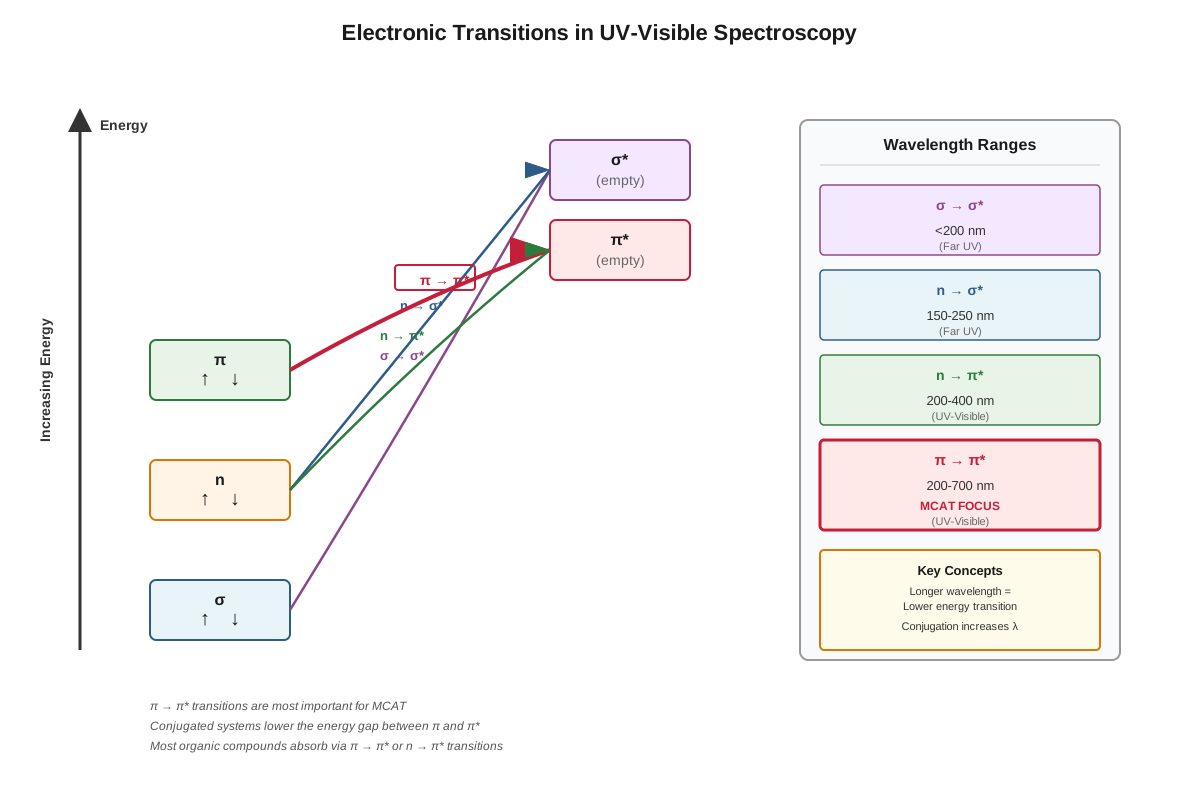
UV-visible spectroscopy is an analytical technique that measures the absorption of electromagnetic radiation in the ultraviolet (200-400 nm) and visible (400-800 nm) regions of the spectrum. When a molecule absorbs a photon of light with appropriate energy, an electron undergoes a transition from a ground-state molecular orbital to a higher-energy excited-state orbital. The specific wavelength absorbed depends on the energy gap between these orbitals, which is determined by the molecule's electronic structure.
The most common electronic transitions in organic molecules involve π to π (pi to pi-star) transitions and n to π (n to pi-star) transitions. Pi to π transitions occur in molecules containing carbon-carbon double bonds, aromatic rings, or other conjugated systems, where electrons in bonding π orbitals are promoted to antibonding π orbitals. These transitions typically require higher energy (shorter wavelengths) and appear in the UV region. The n to π transitions involve the promotion of non-bonding electrons (lone pairs on heteroatoms like oxygen or nitrogen) to antibonding π orbitals. These transitions generally require less energy than π to π* transitions and may appear at longer wavelengths.
Chromophores and Auxochromes
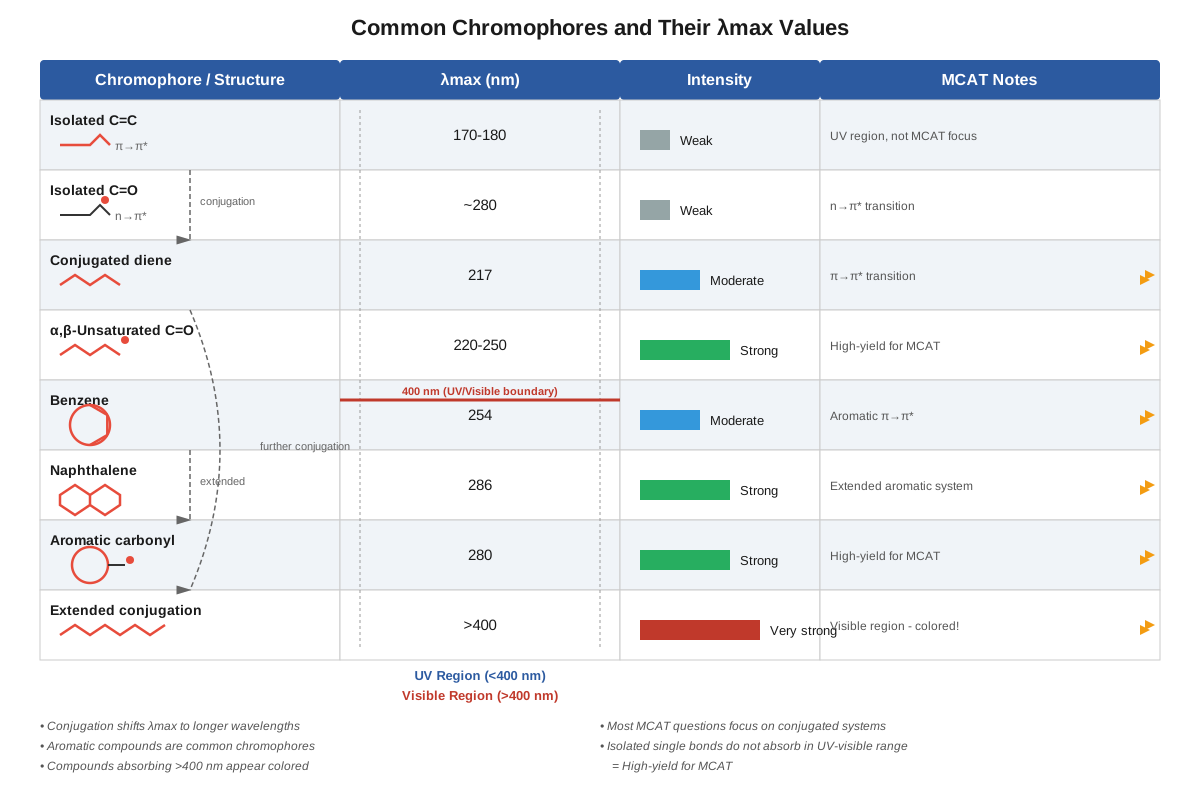
A chromophore is a structural feature within a molecule that is responsible for light absorption in the UV-visible region. Common chromophores include carbon-carbon double bonds (C=C), carbonyl groups (C=O), aromatic rings, and conjugated systems. The presence of a chromophore is necessary but not always sufficient for a compound to absorb visible light; many simple chromophores absorb only in the UV region and appear colorless to the human eye.
An auxochrome is a substituent group that, while not itself a chromophore, modifies the absorption characteristics of a chromophore when attached to it. Common auxochromes include hydroxyl groups (-OH), amino groups (-NH₂), and alkoxy groups (-OR). These groups typically contain lone pairs of electrons that can participate in resonance with adjacent chromophores, extending the conjugated system and shifting absorption to longer wavelengths (bathochromic shift or red shift).
Conjugation and Wavelength of Maximum Absorption
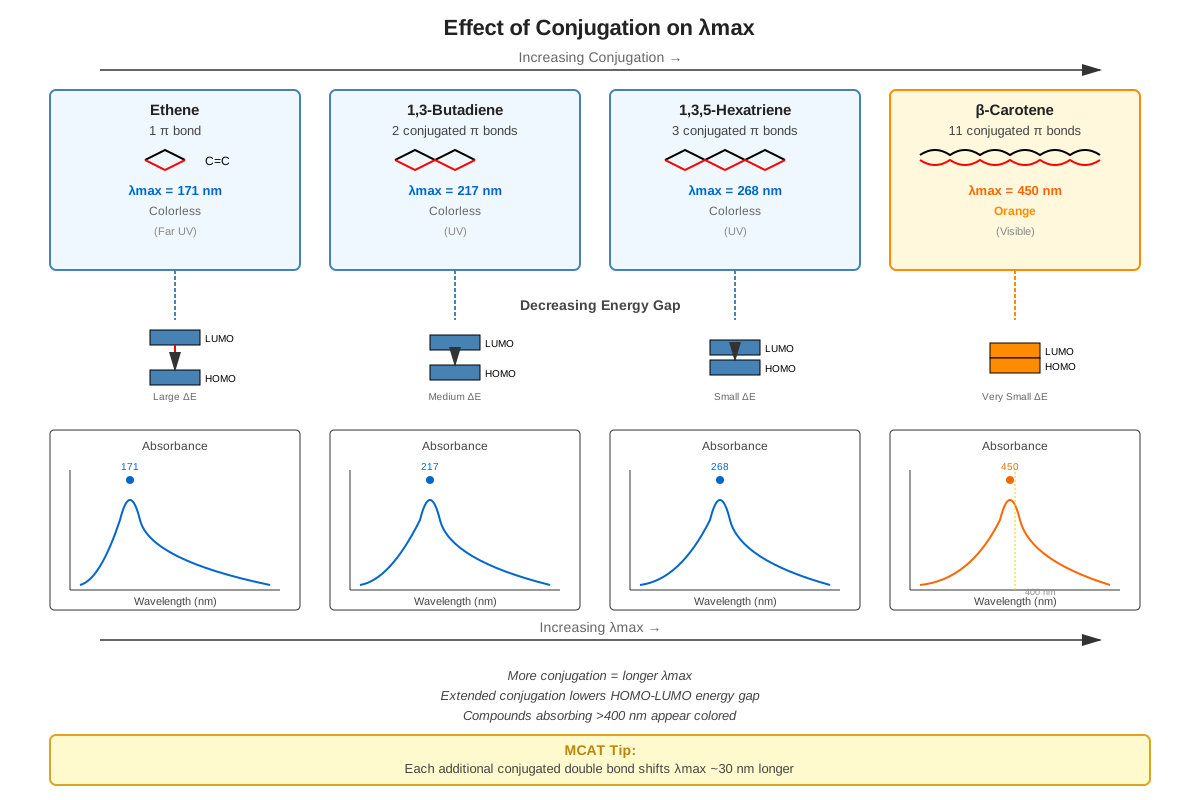
The extent of conjugation in a molecule has a profound effect on its UV-visible absorption properties. As the number of conjugated double bonds increases, the energy gap between the highest occupied molecular orbital (HOMO) and the lowest unoccupied molecular orbital (LUMO) decreases. This decreased energy gap means that lower-energy (longer-wavelength) photons can promote electronic transitions.
For example, ethene (one double bond) absorbs at approximately 171 nm, 1,3-butadiene (two conjugated double bonds) absorbs at 217 nm, and 1,3,5-hexatriene (three conjugated double bonds) absorbs at 258 nm. This progressive shift to longer wavelengths with increasing conjugation is called a bathochromic shift or red shift. Conversely, factors that decrease conjugation or increase the HOMO-LUMO gap cause a hypsochromic shift or blue shift to shorter wavelengths.
| Number of Conjugated Double Bonds | Example Compound | Approximate λmax (nm) |
|---|---|---|
| 1 | Ethene | 171 |
| 2 | 1,3-Butadiene | 217 |
| 3 | 1,3,5-Hexatriene | 258 |
| 4 | 1,3,5,7-Octatetraene | 290 |
The Beer-Lambert Law
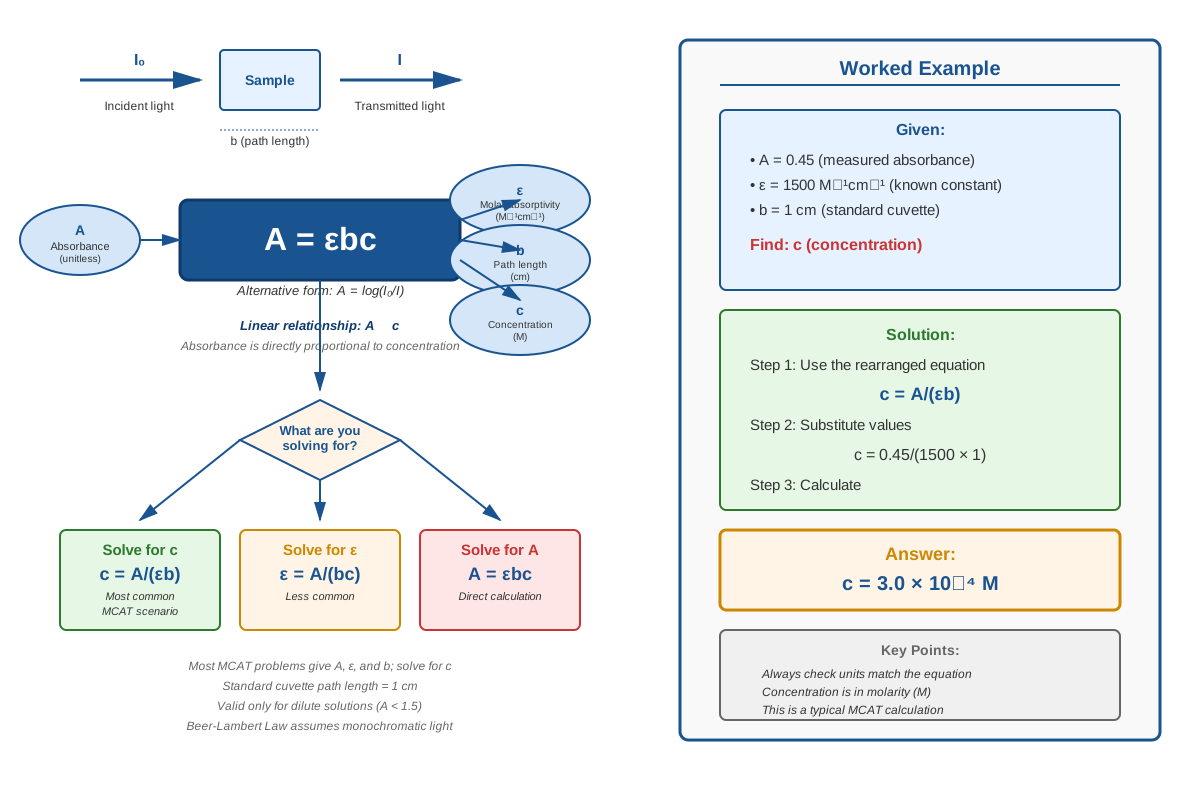
The Beer-Lambert Law (also called Beer's Law) is the fundamental quantitative relationship in UV-visible spectroscopy. It relates the absorbance of light by a solution to the concentration of the absorbing species and the path length through which light travels:
A = εbcWhere:
- A = absorbance (unitless)
- ε (epsilon) = molar absorptivity or molar extinction coefficient (M⁻¹cm⁻¹)
- b = path length of the sample cell (cm)
- c = concentration of the absorbing species (M)
Absorbance is related to transmittance (T) by the equation:
A = -log₁₀(T) = -log₁₀(I/I₀)Where I₀ is the intensity of incident light and I is the intensity of transmitted light.
The molar absorptivity (ε) is a constant that characterizes how strongly a chemical species absorbs light at a particular wavelength. Compounds with large molar absorptivities (ε > 10,000 M⁻¹cm⁻¹) are strong absorbers, while those with small values are weak absorbers. The Beer-Lambert Law is valid only for dilute solutions where molecules do not interact significantly with each other.
Spectral Characteristics and Interpretation
A typical UV-visible spectrum plots absorbance (y-axis) versus wavelength (x-axis). The wavelength of maximum absorption (λmax) is the wavelength at which the compound absorbs most strongly, corresponding to the peak of the absorption band. The position of λmax provides structural information about the molecule, particularly regarding the extent of conjugation and the types of chromophores present.
The intensity of absorption at λmax reflects the molar absorptivity and concentration of the compound. Broad absorption bands are characteristic of UV-visible spectra because electronic transitions are accompanied by simultaneous vibrational and rotational transitions, creating an envelope of closely spaced absorption lines that merge into a broad peak.
Factors Affecting UV-Visible Absorption
Several structural and environmental factors influence UV-visible absorption:
- Conjugation length: Longer conjugated systems absorb at longer wavelengths
- Substituent effects: Electron-donating groups (EDGs) typically cause red shifts; electron-withdrawing groups (EWGs) may cause blue shifts
- Solvent polarity: Polar solvents can stabilize or destabilize excited states differently than ground states, affecting λmax
- pH: For compounds with ionizable groups, pH changes can alter the electronic structure and absorption properties
- Ring strain: Strained conjugated systems may have altered absorption characteristics
Concept Relationships
The concepts within UV-visible spectroscopy are hierarchically interconnected. At the foundation lies molecular orbital theory, which explains why electrons can transition between energy levels when absorbing photons. This fundamental principle leads directly to understanding electronic transitions (π to π and n to π), which determine which molecules can absorb UV-visible light. The presence of chromophores in molecular structures enables these transitions, and the extent of conjugation modulates the energy required for transitions, thereby determining λmax.
The Beer-Lambert Law connects the molecular property (molar absorptivity) to macroscopic measurements (absorbance), enabling quantitative analysis. This relationship bridges theoretical understanding with practical applications, allowing chemists and biochemists to determine concentrations of unknown samples.
Connections to prerequisite topics are essential for complete understanding. Molecular orbital theory provides the electronic framework for understanding why certain transitions occur. Conjugation and resonance concepts explain why extended pi systems have characteristic absorption patterns and why λmax shifts with structural changes. Aromatic chemistry is particularly relevant because aromatic rings are ubiquitous chromophores in both synthetic and biological molecules.
The relationship map flows as follows: Molecular Orbital Theory → Electronic Transitions → Chromophores → Conjugation Effects → λmax Prediction → Beer-Lambert Law → Quantitative Analysis. Additionally, this topic connects forward to other spectroscopic techniques in the Separations and Spectroscopy unit, particularly IR spectroscopy (which probes vibrational rather than electronic transitions) and NMR spectroscopy (which examines nuclear spin states).
Quick check — test yourself on UV visible spectroscopy basics so far.
Try Flashcards →High-Yield Facts
⭐ UV-visible spectroscopy measures electronic transitions, primarily π to π and n to π transitions in organic molecules
⭐ Increasing conjugation causes a bathochromic shift (red shift) to longer wavelengths due to decreased HOMO-LUMO gap
⭐ The Beer-Lambert Law (A = εbc) relates absorbance to concentration, with ε being the molar absorptivity
⭐ Aromatic compounds and conjugated systems are the most common chromophores tested on the MCAT
⭐ λmax shifts to longer wavelengths as the number of conjugated double bonds increases
- Simple alkenes and alkynes without conjugation typically absorb below 200 nm (outside the standard UV-visible range)
- Compounds that absorb in the visible region (400-800 nm) appear colored; those absorbing only in UV appear colorless
- Electron-donating groups (like -OH, -NH₂, -OR) attached to chromophores generally cause red shifts
- The molar absorptivity (ε) is an intrinsic property of a molecule at a specific wavelength and does not depend on concentration
- UV-visible spectroscopy is commonly used to quantify protein (280 nm), DNA/RNA (260 nm), and monitor enzyme kinetics
Common Misconceptions
Misconception: All organic compounds absorb in the UV-visible range and can be detected by this technique.
Correction: Only compounds containing chromophores (conjugated systems, aromatic rings, carbonyl groups, etc.) absorb in the UV-visible range. Saturated hydrocarbons without functional groups absorb at wavelengths below 200 nm and cannot be detected by standard UV-visible spectrophotometers.
Misconception: Higher absorbance always means higher concentration.
Correction: While absorbance is directly proportional to concentration according to the Beer-Lambert Law, absorbance also depends on molar absorptivity (ε) and path length (b). A dilute solution of a compound with high ε can have the same absorbance as a concentrated solution of a compound with low ε.
Misconception: Longer wavelength absorption always indicates a larger molecule.
Correction: Longer wavelength absorption indicates greater conjugation or electron delocalization, not necessarily molecular size. A small, highly conjugated molecule like benzene absorbs at longer wavelengths than a large saturated hydrocarbon.
Misconception: The Beer-Lambert Law is valid at all concentrations.
Correction: The Beer-Lambert Law is only valid for dilute solutions (typically below 0.01 M). At high concentrations, molecular interactions, aggregation, and changes in refractive index cause deviations from linearity.
Misconception: UV-visible spectroscopy can distinguish between all structural isomers.
Correction: UV-visible spectroscopy provides information about chromophores and conjugation but cannot distinguish between isomers with identical chromophoric systems. For example, ortho-, meta-, and para-substituted benzene derivatives may have very similar UV-visible spectra despite being different compounds.
Misconception: A compound with multiple chromophores will show multiple distinct peaks in its UV-visible spectrum.
Correction: While some compounds do show multiple peaks, many compounds with multiple chromophores show broad, overlapping absorption bands that merge into a single broad peak. UV-visible spectra are generally less detailed than IR or NMR spectra.
Misconception: Transmittance and absorbance are directly proportional.
Correction: Transmittance and absorbance have a logarithmic relationship (A = -log T), not a linear one. A transmittance of 50% corresponds to an absorbance of 0.3, not 0.5.
Worked Examples
Example 1: Predicting Relative λmax Values
Question: Rank the following compounds in order of increasing λmax (shortest to longest wavelength of maximum absorption):
- Compound A: Ethene (CH₂=CH₂)
- Compound B: 1,3-Butadiene (CH₂=CH-CH=CH₂)
- Compound C: Benzene (C₆H₆)
- Compound D: 1,3,5-Hexatriene (CH₂=CH-CH=CH-CH=CH₂)
Solution:
Step 1: Identify the degree of conjugation in each compound.
- Compound A: One isolated double bond (no conjugation)
- Compound B: Two conjugated double bonds
- Compound C: Aromatic ring with six π electrons in a cyclic conjugated system
- Compound D: Three conjugated double bonds
Step 2: Apply the principle that increasing conjugation decreases the HOMO-LUMO gap and increases λmax.
- Compound A has the least conjugation, so it will have the shortest λmax
- Compound B has two conjugated double bonds
- Compound D has three conjugated double bonds, more than B
- Compound C (benzene) has special aromatic stability but significant conjugation
Step 3: Consider that benzene's aromatic system provides substantial conjugation, but linear conjugated systems with more double bonds typically absorb at longer wavelengths.
Step 4: Rank the compounds.
Order of increasing λmax: A < B < C < D
Answer: Ethene < 1,3-Butadiene < Benzene < 1,3,5-Hexatriene
This example demonstrates Learning Objective: "Predict the relative wavelengths of maximum absorption (λmax) for compounds with different degrees of conjugation."
Example 2: Beer-Lambert Law Calculation
Question: A solution of a compound with a molar absorptivity (ε) of 15,000 M⁻¹cm⁻¹ at 280 nm is measured in a 1.0 cm cuvette and shows an absorbance of 0.45. What is the concentration of the compound in the solution? If the absorbance needs to be reduced to 0.30 for accurate measurement, what dilution should be performed?
Solution:
Step 1: Write the Beer-Lambert Law equation.
A = εbc
Step 2: Identify the known values.
- A = 0.45
- ε = 15,000 M⁻¹cm⁻¹
- b = 1.0 cm
- c = unknown
Step 3: Solve for concentration.
c = A / (εb)
c = 0.45 / (15,000 M⁻¹cm⁻¹ × 1.0 cm)
c = 0.45 / 15,000 M⁻¹
c = 3.0 × 10⁻⁵ M or 30 μM
Step 4: Calculate the dilution needed to achieve A = 0.30.
Using A = εbc again:
c₂ = 0.30 / (15,000 M⁻¹cm⁻¹ × 1.0 cm)
c₂ = 2.0 × 10⁻⁵ M or 20 μM
Step 5: Determine the dilution factor.
Dilution factor = c₁/c₂ = (3.0 × 10⁻⁵ M) / (2.0 × 10⁻⁵ M) = 1.5
This means the solution should be diluted 1.5-fold (e.g., mix 2 parts solution with 1 part solvent, or 2 mL solution + 1 mL solvent = 3 mL total).
Answer: The original concentration is 30 μM. To reduce absorbance to 0.30, perform a 1.5-fold dilution.
This example demonstrates Learning Objectives: "Apply UV visible spectroscopy basics to exam-style questions" and "Calculate molar absorptivity and concentration using the Beer-Lambert Law."
Exam Strategy
When approaching MCAT questions on UV-visible spectroscopy, begin by identifying what type of question is being asked: qualitative (predicting or comparing λmax values) or quantitative (Beer-Lambert Law calculations). For qualitative questions, immediately assess the degree of conjugation in the molecules presented—this is the single most important factor determining λmax. Look for extended pi systems, aromatic rings, and conjugated carbonyl groups.
Trigger words and phrases to watch for include: "maximum absorption," "λmax," "bathochromic shift" or "red shift" (indicating longer wavelength), "hypsochromic shift" or "blue shift" (indicating shorter wavelength), "chromophore," "conjugated system," "molar absorptivity," and "absorbance." When you see "quantitative analysis" or "concentration determination," expect a Beer-Lambert Law calculation.
For process-of-elimination strategies, remember these key principles:
- Eliminate answer choices that violate the conjugation-wavelength relationship (more conjugation = longer λmax)
- For Beer-Lambert calculations, eliminate answers that don't have appropriate units (concentration in M, absorbance unitless)
- If comparing two compounds, eliminate choices that suggest saturated hydrocarbons absorb at longer wavelengths than conjugated systems
- When asked about color, eliminate choices suggesting compounds absorbing only in UV (below 400 nm) appear colored
Time allocation advice: Discrete UV-visible spectroscopy questions should take 60-90 seconds. If a Beer-Lambert calculation is required, allocate up to 90 seconds for careful arithmetic. For passage-based questions, spend 30-45 seconds per question after reading the passage. If a question requires comparing multiple structures for conjugation, quickly sketch or mentally visualize the pi systems rather than trying to hold complex structures in working memory.
A powerful strategy is to create a mental hierarchy: isolated double bond < two conjugated double bonds < three conjugated double bonds < aromatic ring < extended conjugated system. This hierarchy allows rapid ranking of compounds by λmax without detailed calculations.
Memory Techniques
Mnemonic for electronic transitions: "People Need Pizza Sometimes" represents the order of increasing energy: π to π (lowest energy, longest wavelength), n to π, then σ to σ* (highest energy, shortest wavelength, not typically observed in standard UV-visible spectroscopy).
Mnemonic for Beer-Lambert Law: "All Engineers Build Circuits" represents A = ε × b × c. The multiplication order doesn't matter mathematically, but this mnemonic helps recall all four variables.
Visualization strategy for conjugation: Picture conjugated systems as "electron highways"—the longer the highway (more conjugated double bonds), the easier electrons can travel (lower energy required), and the longer the wavelength absorbed. This concrete metaphor helps remember that extended conjugation shifts absorption to longer wavelengths.
Acronym for factors affecting λmax: "Cats Sleep Soundly Peacefully Regularly" represents Conjugation, Substituents, Solvent, pH, and Ring strain—the five major factors affecting UV-visible absorption.
Color memory aid: Remember "ROY G. BIV" (Red, Orange, Yellow, Green, Blue, Indigo, Violet) for the visible spectrum. Red has the longest wavelength (~700 nm) and lowest energy; violet has the shortest wavelength (~400 nm) and highest energy. A compound that absorbs red light appears blue-green (the complementary color).
Summary
UV-visible spectroscopy is an essential analytical technique that measures the absorption of ultraviolet and visible light by molecules containing chromophores. The fundamental principle involves electronic transitions, primarily π to π and n to π transitions, where electrons move from ground-state orbitals to excited-state orbitals upon absorbing photons of appropriate energy. The wavelength of maximum absorption (λmax) is primarily determined by the extent of conjugation in the molecule—greater conjugation leads to smaller HOMO-LUMO gaps and longer wavelength absorption (bathochromic shift). The Beer-Lambert Law (A = εbc) provides the quantitative foundation for spectroscopy, relating absorbance to concentration through the molar absorptivity and path length. For the MCAT, students must be able to predict relative λmax values based on molecular structure, perform Beer-Lambert calculations, and interpret UV-visible spectra in the context of experimental passages. This technique connects deeply to concepts of molecular orbital theory, conjugation, and aromatic chemistry while providing practical applications in biochemistry and clinical diagnostics.
Key Takeaways
- UV-visible spectroscopy measures electronic transitions in molecules containing chromophores, with π to π* transitions being most common in organic compounds
- Increasing conjugation decreases the HOMO-LUMO energy gap, causing bathochromic shifts (red shifts) to longer wavelengths
- The Beer-Lambert Law (A = εbc) is the fundamental quantitative relationship, where absorbance is directly proportional to concentration, molar absorptivity, and path length
- Aromatic compounds and conjugated systems are the most important chromophores for MCAT purposes
- Saturated hydrocarbons without functional groups do not absorb in the standard UV-visible range (200-800 nm)
- UV-visible spectroscopy has critical applications in biochemistry, including protein quantification, enzyme kinetics, and nucleic acid analysis
- Structural features like electron-donating substituents and extended pi systems predictably affect λmax values
Related Topics
Infrared (IR) Spectroscopy: While UV-visible spectroscopy probes electronic transitions, IR spectroscopy examines vibrational transitions in molecules. Mastering UV-visible spectroscopy provides a foundation for understanding how different regions of the electromagnetic spectrum interact with matter in characteristic ways.
Nuclear Magnetic Resonance (NMR) Spectroscopy: NMR examines nuclear spin states rather than electronic transitions, but the analytical approach to interpreting spectra and deducing molecular structure shares similarities with UV-visible spectroscopy interpretation.
Conjugation and Resonance in Organic Chemistry: Deep understanding of electron delocalization in conjugated systems directly enhances the ability to predict UV-visible absorption patterns and explain bathochromic shifts.
Molecular Orbital Theory: Advanced understanding of HOMO-LUMO gaps, bonding and antibonding orbitals, and orbital symmetry provides the theoretical foundation for all spectroscopic techniques, including UV-visible spectroscopy.
Biochemical Assays and Quantitative Analysis: Many biochemistry laboratory techniques rely on UV-visible spectroscopy for quantification, making this topic essential for understanding experimental passages in the Biological and Biochemical Foundations section.
Practice CTA
Now that you've mastered the fundamentals of UV-visible spectroscopy, it's time to reinforce your understanding through active practice. Attempt the practice questions and flashcards associated with this topic to test your ability to predict λmax values, perform Beer-Lambert calculations, and interpret spectra in exam-style contexts. Remember, spectroscopy questions on the MCAT reward systematic thinking and pattern recognition—skills that improve dramatically with deliberate practice. Each practice question you complete strengthens your ability to quickly identify chromophores, assess conjugation, and apply quantitative relationships under time pressure. You've built a solid foundation; now transform that knowledge into test-day confidence through consistent practice!
Sign up free to keep reading
Create a free AnvayaPrep account to finish this MCAT guide on UV visible spectroscopy basics — plus flashcards and practice questions.