Overview
Axial and equatorial positions represent one of the most fundamental concepts in three-dimensional organic chemistry, specifically within the study of cyclohexane conformations. Understanding these positions is critical for predicting molecular stability, reactivity, and stereochemical outcomes in cyclic systems. On the MCAT, this topic bridges structural organic chemistry with thermodynamics and reaction mechanisms, making it an essential component of Stereochemistry and Conformation knowledge. The ability to visualize and manipulate chair conformations of cyclohexane—and to distinguish between axial and equatorial substituent positions—directly impacts performance on questions involving conformational analysis, relative stability comparisons, and prediction of reaction products.
The significance of axial and equatorial positions in Organic Chemistry extends beyond simple nomenclature. These positions determine the spatial arrangement of substituents around a six-membered ring, which in turn affects steric interactions, conformational preferences, and ultimately the physical and chemical properties of molecules. The MCAT frequently tests this concept through questions requiring students to identify the most stable conformation of substituted cyclohexanes, predict which conformer predominates at equilibrium, or explain why certain reactions proceed with specific stereochemical outcomes. Mastery of this topic requires both conceptual understanding and spatial visualization skills.
Within the broader context of Organic Chemistry MCAT preparation, axial and equatorial positions serve as a gateway to understanding more complex topics including stereoisomerism, conformational energy analysis, and the behavior of carbohydrates (which contain multiple six-membered rings). This topic integrates principles from general chemistry (potential energy and stability), physics (spatial reasoning), and biochemistry (sugar conformations), making it a high-yield area that appears across multiple sections of the exam. Students who develop strong visualization skills and understand the energetic consequences of substituent positioning will find themselves better equipped to tackle a wide range of MCAT questions.
Learning Objectives
- [ ] Define axial and equatorial positions using accurate Organic Chemistry terminology
- [ ] Explain why axial and equatorial positions matter for the MCAT
- [ ] Apply axial and equatorial positions to exam-style questions
- [ ] Identify common mistakes related to axial and equatorial positions
- [ ] Connect axial and equatorial positions to related Organic Chemistry concepts
- [ ] Draw accurate chair conformations of cyclohexane with substituents in both axial and equatorial positions
- [ ] Calculate the relative energy difference between conformers based on substituent positions
- [ ] Predict the predominant conformer of substituted cyclohexanes at room temperature
- [ ] Analyze disubstituted cyclohexanes to determine the most stable conformation
Prerequisites
- Basic bonding theory and molecular geometry: Understanding sp³ hybridization and tetrahedral geometry is essential for visualizing the three-dimensional structure of cyclohexane
- Newman projections and conformational analysis: Prior experience with conformational analysis in acyclic systems provides the foundation for understanding ring conformations
- Steric strain and torsional strain: Knowledge of different types of molecular strain helps explain why certain conformations are more stable than others
- Basic thermodynamics: Understanding that systems favor lower energy states explains why certain conformers predominate at equilibrium
- Wedge-and-dash notation: Ability to interpret three-dimensional representations is crucial for working with chair conformations
Why This Topic Matters
Clinical and Real-World Significance
The principles of axial and equatorial positioning have profound implications in biochemistry and pharmacology. Carbohydrates, which exist predominantly as six-membered pyranose rings, adopt chair conformations where the positioning of hydroxyl groups determines their reactivity and biological function. For example, glucose exists primarily in the chair conformation with all hydroxyl groups and the bulky CH₂OH group in equatorial positions, maximizing stability. This conformational preference affects how enzymes recognize and process sugars, influencing metabolic pathways tested on the MCAT. Additionally, many pharmaceutical compounds contain cyclohexane rings, and their biological activity depends critically on the three-dimensional arrangement of functional groups—a direct consequence of axial versus equatorial positioning.
Exam Statistics and Question Types
Axial and equatorial positions MCAT questions appear with moderate frequency across both the Chemical and Physical Foundations of Biological Systems section and the Biological and Biochemical Foundations of Living Systems section. Approximately 2-4 questions per exam either directly test this concept or require it as prerequisite knowledge. Questions typically fall into several categories: (1) identifying the most stable conformer of a substituted cyclohexane, (2) calculating energy differences between conformers, (3) predicting stereochemical outcomes of reactions involving cyclic compounds, and (4) analyzing carbohydrate structures. The MCAT favors questions that integrate multiple concepts, so axial and equatorial positions often appear alongside topics like stereoisomerism, reaction mechanisms, or biochemical pathways.
Common Exam Contexts
This topic most frequently appears in discrete questions showing a cyclohexane derivative and asking students to identify the lowest energy conformation. Passage-based questions might present experimental data on conformational equilibria, require interpretation of NMR spectra showing different conformers, or discuss the stereochemistry of reactions on cyclic substrates. Biochemistry passages involving carbohydrate metabolism or glycoprotein structure regularly require understanding of chair conformations. The MCAT particularly favors questions that test whether students can recognize that bulky substituents prefer equatorial positions and can apply this principle to predict molecular behavior.
Core Concepts
Chair Conformation of Cyclohexane
Cyclohexane adopts a chair conformation as its most stable three-dimensional structure, avoiding the angle strain that would exist in a planar hexagon. In this conformation, all carbon-carbon-carbon bond angles are approximately 109.5°, matching the ideal tetrahedral angle for sp³ hybridized carbons. The chair conformation also minimizes torsional strain by positioning all adjacent C-H bonds in staggered arrangements, similar to the anti conformation in butane. This combination of minimal angle strain and torsional strain makes the chair conformation approximately 25 kJ/mol more stable than the next most stable conformation (the twist-boat).
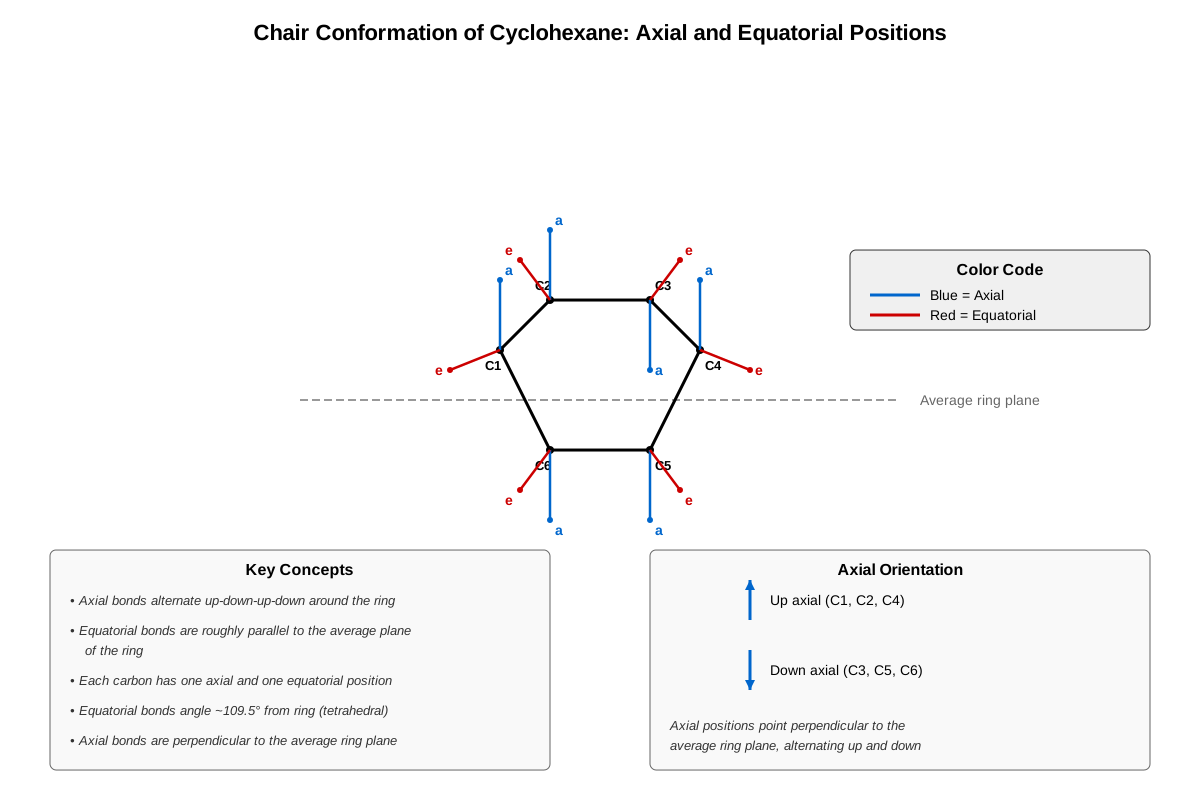
The chair conformation features twelve hydrogen atoms (or substituent positions) arranged in two distinct orientations: axial and equatorial. Each carbon atom bears one axial and one equatorial position, resulting in six axial positions and six equatorial positions total. Understanding the spatial arrangement of these positions is fundamental to predicting molecular properties and behavior.
Axial Positions
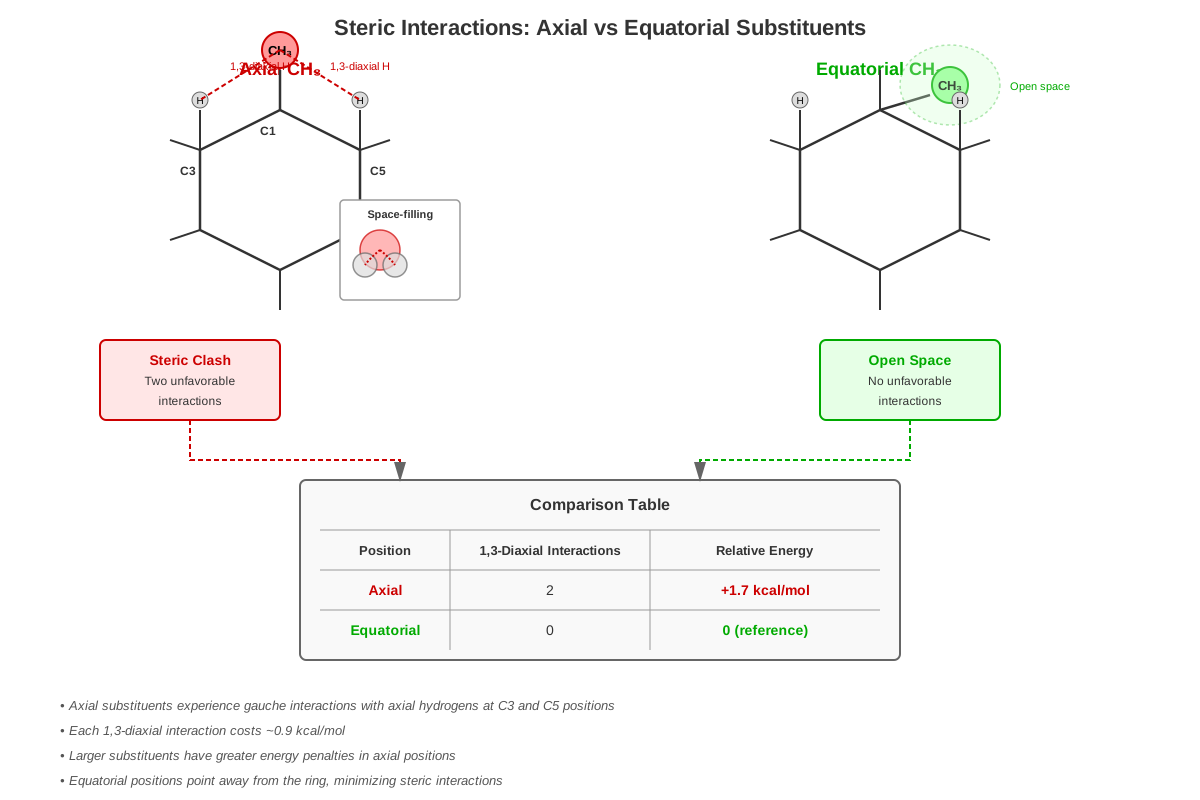
Axial positions are oriented perpendicular to the average plane of the ring, pointing either straight up or straight down. Three axial positions point upward, and three point downward, alternating around the ring. When viewing a chair conformation from the side, axial bonds appear vertical or nearly vertical. A critical feature of axial positions is that they experience 1,3-diaxial interactions—steric repulsions between an axial substituent and the two axial hydrogens located on carbons 1 and 3 positions away on the same face of the ring.
For a substituent larger than hydrogen, occupying an axial position creates significant steric strain. For example, an axial methyl group experiences two 1,3-diaxial interactions with axial hydrogens, each contributing approximately 3.8 kJ/mol of destabilization. This steric penalty increases with substituent size: an axial tert-butyl group experiences approximately 23 kJ/mol of destabilization, making conformations with axial tert-butyl groups extremely unfavorable.
Equatorial Positions
Equatorial positions extend outward from the ring at approximately the same angle as the average plane of the ring, pointing slightly upward or downward but predominantly outward. These positions alternate around the ring in an up-down pattern complementary to the axial positions. When viewing a chair conformation, equatorial bonds appear to radiate outward at angles, roughly parallel to certain ring bonds.
Substituents in equatorial positions experience minimal steric interactions because they project away from the ring into open space, avoiding close contacts with other atoms. This spatial arrangement makes equatorial positions strongly preferred for bulky substituents. The energy difference between having a substituent in an equatorial versus axial position is called the A-value or conformational energy, and it increases with substituent size.
Ring Flipping and Conformational Equilibrium
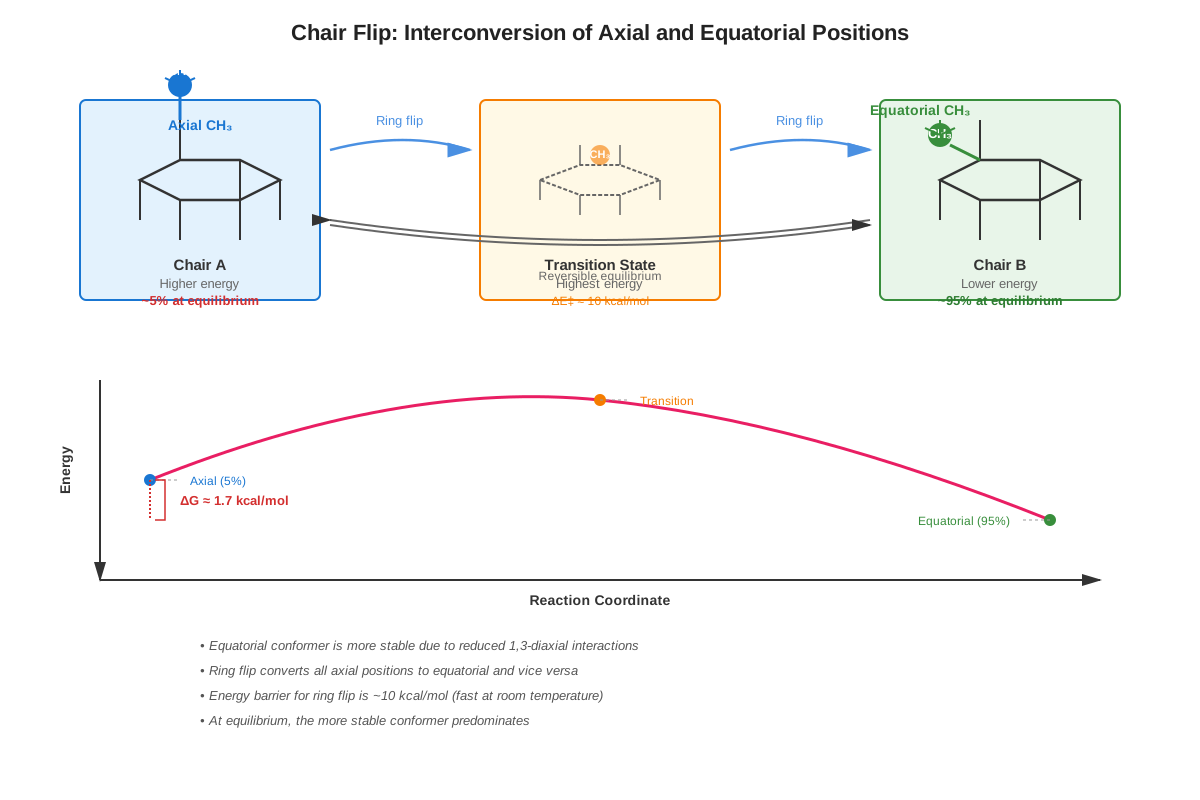
Cyclohexane undergoes rapid ring flipping (also called chair-chair interconversion) at room temperature, with an energy barrier of only about 45 kJ/mol. During a ring flip, the chair conformation inverts: the "top" of the chair becomes the "bottom" and vice versa. Critically, this process interconverts all axial positions to equatorial positions and all equatorial positions to axial positions. A substituent that was axial becomes equatorial after a ring flip, and vice versa.
For monosubstituted cyclohexanes, two chair conformers exist in equilibrium: one with the substituent axial and one with the substituent equatorial. The conformer with the substituent in the equatorial position is lower in energy and therefore predominates at equilibrium. The ratio of conformers follows the Boltzmann distribution and can be calculated using the energy difference (ΔG) between conformers:
K_eq = e^(-ΔG/RT)For a methyl group (ΔG ≈ 7.6 kJ/mol), approximately 95% of molecules exist in the equatorial conformation at room temperature. For a tert-butyl group (ΔG ≈ 23 kJ/mol), more than 99.9% of molecules have the tert-butyl group equatorial.
A-Values and Conformational Energy
The A-value quantifies the energy preference for a substituent to occupy an equatorial rather than axial position. A-values have been experimentally determined for many common substituents and serve as a practical tool for predicting conformational preferences:
| Substituent | A-value (kJ/mol) | A-value (kcal/mol) |
|---|---|---|
| H | 0 | 0 |
| F | 1.0 | 0.24 |
| Cl | 2.2 | 0.53 |
| Br | 2.4 | 0.57 |
| OH | 3.9 | 0.93 |
| CH₃ | 7.6 | 1.82 |
| CH₂CH₃ | 7.9 | 1.89 |
| CH(CH₃)₂ | 9.2 | 2.20 |
| C(CH₃)₃ | 23 | 5.5 |
| C₆H₅ | 12.6 | 3.0 |
These values reflect the steric bulk of substituents and the severity of 1,3-diaxial interactions. The dramatically large A-value for tert-butyl groups makes them useful as "conformational locks"—when a tert-butyl group is present, the molecule exists almost exclusively in the conformation with the tert-butyl group equatorial.
Disubstituted Cyclohexanes
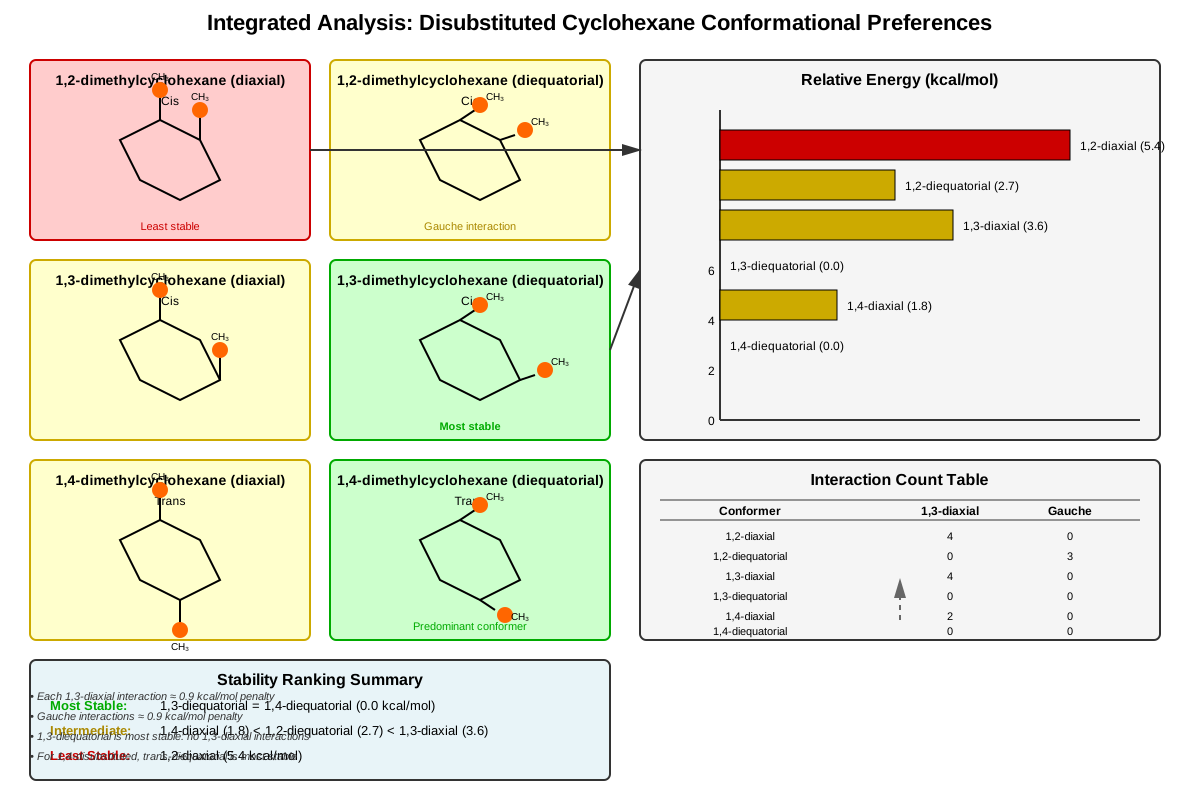
For disubstituted cyclohexanes, determining the most stable conformation requires analyzing both substituents simultaneously. The key principle is that the most stable conformation minimizes the total steric strain by placing the bulkier substituent(s) in equatorial positions when possible.
For 1,2-disubstituted cyclohexanes, cis and trans isomers behave differently:
- Trans-1,2-disubstituted: One substituent must be axial and one equatorial in each chair conformation. The more stable conformer has the larger substituent equatorial.
- Cis-1,2-disubstituted: Both substituents are either both axial or both equatorial. The conformation with both equatorial is strongly preferred.
For 1,3-disubstituted cyclohexanes:
- Trans-1,3-disubstituted: Both substituents can be equatorial simultaneously, making this the most stable arrangement.
- Cis-1,3-disubstituted: One substituent must be axial and one equatorial. The larger substituent should be equatorial.
For 1,4-disubstituted cyclohexanes:
- Trans-1,4-disubstituted: One substituent is axial and one is equatorial in each conformer.
- Cis-1,4-disubstituted: Both substituents are on the same face, either both axial or both equatorial. Both equatorial is strongly preferred.
Drawing Chair Conformations
Accurate drawing of chair conformations is essential for MCAT success. The systematic approach involves:
- Draw the chair framework with the "seat" carbons horizontal and the "back" and "footrest" carbons angled
- Add axial bonds perpendicular to the ring plane (straight up and down), alternating around the ring
- Add equatorial bonds roughly parallel to ring bonds two carbons away, alternating the up-down pattern
- Place substituents according to stereochemical requirements
- Evaluate the conformation for steric interactions
When drawing the alternate chair conformation after ring flip, remember that the carbon numbering remains the same, but all axial positions become equatorial and vice versa. Substituents that were "up" remain "up," and those that were "down" remain "down"—only their axial/equatorial designation changes.
Concept Relationships
The concept of axial and equatorial positions emerges directly from the three-dimensional structure of cyclohexane's chair conformation, which itself results from minimizing angle strain and torsional strain (prerequisite concepts). The distinction between these two types of positions leads to the concept of 1,3-diaxial interactions, which explains why axial substituents are disfavored. This steric destabilization creates conformational preferences quantified by A-values, which in turn determine the position of conformational equilibria through thermodynamic principles.
Concept flow: Chair conformation → Axial and equatorial positions → 1,3-diaxial interactions → A-values → Conformational equilibrium → Prediction of predominant conformer
These concepts connect forward to stereochemistry topics including cis-trans isomerism in cyclic systems, where the relative stereochemistry of substituents determines which combinations can be simultaneously equatorial. The principles also extend to carbohydrate chemistry, where pyranose rings adopt chair conformations and the anomeric effect influences conformational preferences. Additionally, understanding conformational preferences is essential for predicting reaction stereochemistry, particularly in elimination reactions (E2 mechanism requires antiperiplanar geometry, which may require specific conformations) and substitution reactions on cyclic substrates.
The relationship to Newman projections and conformational analysis of acyclic molecules is one of conceptual parallel: both involve analyzing different spatial arrangements of the same molecule and identifying the lowest energy conformation based on steric and torsional interactions. However, cyclic systems add the constraint that conformational changes must preserve ring connectivity, making ring flipping the only way to interconvert axial and equatorial positions.
High-Yield Facts
⭐ Equatorial positions are always more stable than axial positions for substituents larger than hydrogen due to 1,3-diaxial interactions
⭐ During a ring flip, all axial positions become equatorial and all equatorial positions become axial, but "up" substituents stay up and "down" substituents stay down
⭐ The A-value for a methyl group is approximately 7.6 kJ/mol (1.8 kcal/mol), meaning ~95% of methylcyclohexane molecules have the methyl group equatorial at room temperature
⭐ A tert-butyl group has such a large A-value (~23 kJ/mol) that it effectively locks the ring in the conformation with the tert-butyl group equatorial
⭐ For disubstituted cyclohexanes, the most stable conformation generally has the largest substituent in an equatorial position
- Each carbon in cyclohexane has exactly one axial and one equatorial position, for a total of six axial and six equatorial positions
- Axial positions alternate up-down-up-down around the ring; equatorial positions also alternate but in the opposite pattern
- 1,3-diaxial interactions occur between an axial substituent and the two axial hydrogens three carbons away on the same face of the ring
- Trans-1,3-disubstituted cyclohexanes can have both substituents equatorial simultaneously, making this arrangement particularly stable
- Cis-1,4-disubstituted cyclohexanes can have both substituents equatorial, while trans-1,4 must have one axial and one equatorial
- The chair conformation is approximately 25 kJ/mol more stable than the twist-boat conformation
- Glucose exists predominantly with all substituents equatorial in its most stable chair conformation (β-D-glucopyranose)
- The energy barrier for ring flipping is about 45 kJ/mol, allowing rapid interconversion at room temperature
- Substituents on adjacent carbons (1,2-positions) that are both equatorial must be trans to each other
- The conformational preference increases with temperature according to the Boltzmann distribution, but the equatorial position remains favored
Quick check — test yourself on Axial and equatorial positions so far.
Try Flashcards →Common Misconceptions
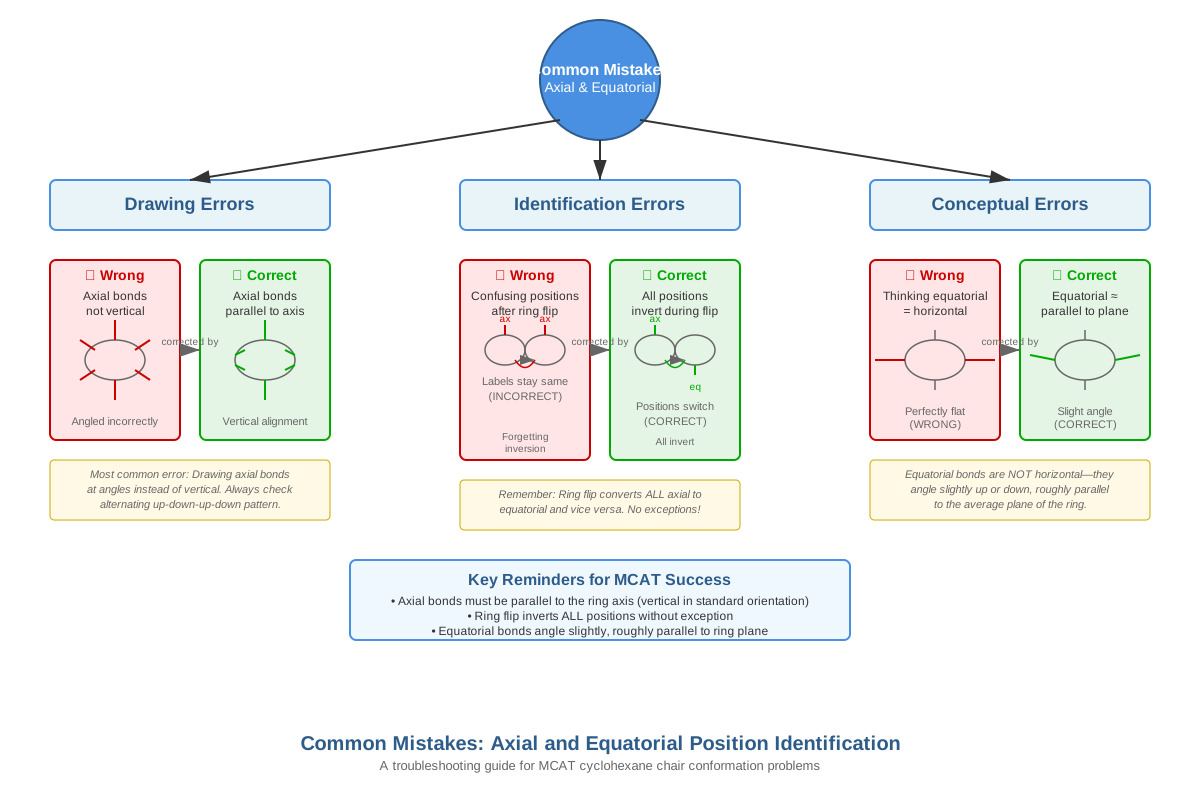
Misconception: Axial positions are always "up" and equatorial positions are always "down" (or vice versa).
Correction: Both axial and equatorial positions alternate around the ring in up-down patterns. Each carbon has one axial position (either up or down) and one equatorial position (either up or down). Three axial positions point up and three point down; similarly, three equatorial positions point up and three point down.
Misconception: During a ring flip, substituents that were pointing "up" flip to pointing "down."
Correction: During a ring flip, the absolute direction (up or down) of a substituent remains unchanged. What changes is whether that position is axial or equatorial. A substituent that was axial-up becomes equatorial-up after a ring flip, not axial-down.
Misconception: The most stable conformation of any substituted cyclohexane always has all substituents equatorial.
Correction: While having substituents equatorial is generally favorable, it's not always possible for all substituents to be equatorial simultaneously, particularly in certain disubstituted systems. For example, in trans-1,2-disubstituted cyclohexane, one substituent must be axial in any chair conformation. The most stable conformation is the one that minimizes total strain, which usually means placing the largest substituent equatorial.
Misconception: A-values represent the total energy of a molecule.
Correction: A-values represent the energy difference between having a specific substituent in an equatorial versus axial position—essentially the cost of placing that substituent axial. They do not represent absolute energies but rather relative conformational preferences.
Misconception: Cis and trans designations in cyclohexanes refer to axial and equatorial positions.
Correction: Cis and trans describe the relative stereochemistry of substituents (whether they're on the same face or opposite faces of the ring), which is independent of whether they're axial or equatorial. A cis relationship means both substituents are on the same face (both up or both down), regardless of whether they're axial or equatorial. After a ring flip, cis substituents remain cis, but their axial/equatorial designations change.
Misconception: Ring flipping changes the molecule into a different stereoisomer.
Correction: Ring flipping interconverts two conformers of the same molecule—these are not stereoisomers but rather different conformations that can rapidly interconvert. The stereochemical relationships between substituents (cis or trans) remain unchanged during ring flipping. Only the conformational arrangement (axial or equatorial) changes.
Misconception: Equatorial bonds are perpendicular to the ring plane.
Correction: Axial bonds are perpendicular to the average plane of the ring. Equatorial bonds extend outward at angles roughly parallel to certain ring bonds, approximately 109.5° from the axial bonds at the same carbon (reflecting the tetrahedral geometry of sp³ carbons).
Worked Examples
Example 1: Determining the Most Stable Conformation of Methylcyclohexane
Question: Draw both chair conformations of methylcyclohexane and determine which is more stable. Calculate the percentage of molecules in each conformation at 25°C given that the A-value for a methyl group is 7.6 kJ/mol.
Solution:
Step 1: Draw the first chair conformation with the methyl group in an equatorial position.
- Draw a standard chair conformation
- Place the methyl group on C1 in an equatorial position (pointing outward and slightly up or down)
- Add hydrogens to all other positions (one axial and one equatorial per carbon)
Step 2: Draw the second chair conformation with the methyl group in an axial position.
- Draw the alternate chair (ring-flipped version)
- The methyl group is now in an axial position (pointing straight up or down)
- The methyl group maintains its absolute direction (if it was "up" in the first drawing, it remains "up")
Step 3: Identify which conformation is more stable.
- The equatorial conformation is more stable because the methyl group avoids 1,3-diaxial interactions
- In the axial conformation, the methyl group experiences steric repulsion with two axial hydrogens on C3 and C5
- The energy difference is 7.6 kJ/mol (the A-value for methyl)
Step 4: Calculate the conformer ratio using the Boltzmann distribution.
K_eq = e^(-ΔG/RT)
K_eq = e^(-7600 J/mol / (8.314 J/mol·K × 298 K))
K_eq = e^(-3.07)
K_eq = 0.046
This equilibrium constant represents the ratio [axial]/[equatorial] = 0.046
Step 5: Convert to percentages.
- If [axial]/[equatorial] = 0.046, then for every 1 molecule in the axial conformation, there are 21.7 molecules in the equatorial conformation
- Percentage equatorial = 21.7/(21.7 + 1) × 100% = 95.6%
- Percentage axial = 1/(21.7 + 1) × 100% = 4.4%
Answer: The conformation with the methyl group equatorial is more stable. At 25°C, approximately 95.6% of molecules exist in the equatorial conformation and 4.4% in the axial conformation.
Connection to learning objectives: This example demonstrates the application of A-values to predict conformational preferences and uses thermodynamic principles to calculate equilibrium populations—both essential skills for MCAT questions on this topic.
Example 2: Analyzing Trans-1,4-Dimethylcyclohexane
Question: Draw both chair conformations of trans-1,4-dimethylcyclohexane. Determine which conformation is more stable and explain your reasoning. Would cis-1,4-dimethylcyclohexane have the same conformational preference?
Solution:
Step 1: Understand the stereochemistry.
- Trans-1,4 means the two methyl groups are on opposite faces of the ring
- If one methyl is "up," the other must be "down"
Step 2: Draw the first chair conformation.
- Place one methyl group at C1 in an equatorial-up position
- Place the second methyl group at C4 in an equatorial-down position
- In this conformation, both methyls are equatorial but on opposite faces (trans relationship maintained)
Step 3: Draw the second chair conformation (after ring flip).
- After ring flipping, the methyl at C1 becomes axial-up
- The methyl at C4 becomes axial-down
- Both methyls are now axial but still on opposite faces (trans relationship maintained)
Step 4: Compare the stability of the two conformations.
- First conformation: both methyls equatorial → no 1,3-diaxial interactions → more stable
- Second conformation: both methyls axial → each experiences two 1,3-diaxial interactions → less stable by 2 × 7.6 kJ/mol = 15.2 kJ/mol
Step 5: Analyze cis-1,4-dimethylcyclohexane.
- Cis-1,4 means both methyls are on the same face of the ring
- In one chair conformation: one methyl is equatorial-up and the other is axial-up
- In the alternate chair conformation: one methyl is axial-down and the other is equatorial-down
- Each conformation has one axial and one equatorial methyl
- Both conformations have the same energy (each has one methyl experiencing 1,3-diaxial interactions)
- The conformers exist in approximately equal amounts at equilibrium
Answer: For trans-1,4-dimethylcyclohexane, the conformation with both methyls equatorial is much more stable (by 15.2 kJ/mol) and predominates at equilibrium. For cis-1,4-dimethylcyclohexane, both chair conformations have equal energy because each has one axial and one equatorial methyl, so they exist in equal amounts.
Connection to learning objectives: This example illustrates how stereochemical relationships (cis vs. trans) interact with conformational preferences, a common source of MCAT questions. It also demonstrates that the most stable conformation depends on both the positions of substituents and their stereochemical relationships.
Exam Strategy
Approaching MCAT Questions on Axial and Equatorial Positions
When encountering questions on this topic, follow a systematic approach:
- Identify what the question is asking: Is it asking for the most stable conformation, the energy difference between conformers, the stereochemical relationship between substituents, or the effect on reactivity?
- Draw both chair conformations: Even if the question provides one conformation, quickly sketch the alternate chair to compare them. This prevents errors and helps visualize the relationship between conformers.
- Identify all substituents and their positions: Mark each substituent as axial or equatorial in each conformation. Remember that ring flipping interconverts these designations.
- Apply the "big group equatorial" rule: The most stable conformation generally has the largest substituent(s) in equatorial positions. For disubstituted systems, consider both substituents.
- Calculate or estimate energy differences when needed: Use A-values to determine relative stability. Remember that multiple axial substituents have additive effects on destabilization.
Trigger Words and Phrases
Watch for these key phrases that signal axial/equatorial questions:
- "Most stable conformation"
- "Predominant conformer"
- "Chair conformation"
- "Ring flip" or "chair-chair interconversion"
- "1,3-diaxial interaction"
- "Conformational preference"
- "A-value"
- "Equatorial position"
- "Steric strain"
Questions about carbohydrates, particularly those mentioning "pyranose" or "chair form," almost always require understanding of axial and equatorial positions. Phrases like "anomeric effect" or "glycosidic bond" may also indicate that conformational analysis is relevant.
Process of Elimination Tips
When using process of elimination:
- Eliminate answers that place large groups axial when they could be equatorial: The MCAT rarely asks about unusual cases where axial is preferred (such as the anomeric effect), so default to equatorial being more stable.
- Eliminate answers that confuse cis/trans with axial/equatorial: These are independent concepts. An answer that states "cis substituents must both be axial" is incorrect.
- Eliminate answers that suggest ring flipping changes stereochemistry: Ring flipping only changes conformation, not configuration. Stereoisomers cannot interconvert without breaking bonds.
- Watch for answers that ignore the size of substituents: If comparing two conformations, the one with the larger group equatorial is almost always more stable.
Time Allocation
For discrete questions on axial and equatorial positions, allocate 60-90 seconds. These questions typically require drawing or visualizing chair conformations, which takes time but is essential for accuracy. Don't rush the visualization step—errors in determining axial versus equatorial positions lead to wrong answers.
For passage-based questions, the passage may provide conformational data or structures. Spend 30-45 seconds per question, using the passage information to guide your analysis. If the passage includes experimental data on conformational equilibria, use it to verify your predictions rather than recalculating from first principles.
Exam Tip: If a question seems to require complex calculations of conformational energies, check whether the answer choices differ significantly. Often, you can eliminate wrong answers by recognizing that one conformation is clearly more stable without precise calculations.
Memory Techniques
Mnemonics
"Equatorial = Easier": Equatorial positions are easier on the molecule (less strain) and easier to remember as the preferred position for substituents.
"Axial = Awful interactions": Axial substituents experience awful 1,3-diaxial interactions that destabilize the conformation.
"Up-Down-Up-Down-Up-Down": When adding axial bonds to a chair conformation, alternate up-down-up-down around the ring. Start with the "back" carbon pointing up, and continue alternating.
"Parallel Equatorial": Equatorial bonds are roughly parallel to ring bonds two carbons away. This helps with drawing accurate chair conformations.
"Flip = Switch": When you flip the ring, axial and equatorial switch, but up stays up and down stays down.
Visualization Strategies
The "Flagpole" visualization: Think of axial bonds as flagpoles sticking straight up or down from the ring. Equatorial bonds are like ropes extending outward from the flagpoles at angles.
The "Crown and Floor" method: Imagine the three "up" axial positions as points on a crown above the ring, and the three "down" axial positions as points on a floor below the ring. Equatorial positions extend outward between these levels.
Color coding practice: When practicing, use different colors for axial (e.g., red) and equatorial (e.g., blue) bonds. This reinforces the distinction and helps with pattern recognition.
Physical models: If possible, use molecular model kits to build cyclohexane and manipulate it. The tactile experience of performing ring flips and seeing how positions change dramatically improves spatial understanding.
Acronyms
AEAE: Axial-Equatorial-Axial-Equatorial—the alternating pattern around the ring (though remember each carbon has both one axial and one equatorial position).
BEST: Big groups Equatorial for Stability and Thermodynamic preference—a reminder that large substituents prefer equatorial positions for the most stable conformation.
Summary
Axial and equatorial positions represent the two distinct orientations of substituents in the chair conformation of cyclohexane, with axial positions perpendicular to the ring plane and equatorial positions extending outward at angles. Equatorial positions are strongly preferred for substituents larger than hydrogen because axial substituents experience destabilizing 1,3-diaxial interactions with other axial groups three carbons away. The energy difference between axial and equatorial placement, quantified by A-values, determines the conformational equilibrium, with larger substituents showing stronger preferences for equatorial positions. Ring flipping interconverts axial and equatorial positions while maintaining stereochemical relationships, allowing molecules to access both chair conformations. For disubstituted cyclohexanes, the most stable conformation typically places the largest substituent equatorial, though the specific stereochemistry (cis or trans) and substitution pattern (1,2-, 1,3-, or 1,4-) determine whether both substituents can be equatorial simultaneously. Mastery of this topic requires both conceptual understanding of steric interactions and spatial visualization skills to accurately draw and analyze chair conformations—abilities that are essential for success on MCAT questions involving conformational analysis, stereochemistry, and carbohydrate chemistry.
Key Takeaways
- Axial positions point perpendicular to the ring (up or down), while equatorial positions extend outward at angles; each carbon has one of each
- Equatorial positions are more stable than axial positions for all substituents larger than hydrogen due to 1,3-diaxial interactions
- Ring flipping interconverts axial and equatorial positions but does not change stereochemical relationships or the absolute direction (up/down) of substituents
- A-values quantify the energy preference for equatorial placement, with larger substituents having larger A-values (methyl ≈ 7.6 kJ/mol, tert-butyl ≈ 23 kJ/mol)
- The most stable conformation of substituted cyclohexanes generally has the largest substituent(s) in equatorial positions
- For disubstituted cyclohexanes, both the substitution pattern (1,2-, 1,3-, or 1,4-) and stereochemistry (cis or trans) determine which conformations are possible and most stable
- Understanding axial and equatorial positions is essential for predicting the behavior of cyclic molecules, including carbohydrates, and for analyzing reaction stereochemistry
Related Topics
Stereoisomerism and Chirality: Understanding axial and equatorial positions provides the foundation for analyzing stereoisomers of cyclic compounds, including determining whether substituents are cis or trans and identifying chiral centers in cyclic systems.
Carbohydrate Chemistry: Monosaccharides exist predominantly as six-membered pyranose rings in chair conformations. The anomeric effect and the positioning of hydroxyl groups in axial or equatorial positions determine sugar stability and reactivity.
E2 Elimination Reactions: The E2 mechanism requires antiperiplanar geometry between the leaving group and the β-hydrogen. In cyclohexanes, this requirement means both groups must be axial, making conformational analysis essential for predicting elimination products.
Conformational Analysis of Other Ring Systems: The principles learned for cyclohexane extend to other six-membered rings (including heterocycles like piperidine) and provide a foundation for understanding five-membered rings and polycyclic systems.
Thermodynamics and Equilibrium: The conformational equilibria of substituted cyclohexanes provide concrete examples of how energy differences determine population distributions according to the Boltzmann distribution.
Practice CTA
Now that you've mastered the core concepts of axial and equatorial positions, it's time to reinforce your understanding through active practice. Work through the practice questions to test your ability to draw chair conformations, predict conformational preferences, and analyze disubstituted cyclohexanes. Use the flashcards to drill the A-values of common substituents and to practice rapid identification of axial versus equatorial positions. Remember that spatial visualization is a skill that improves with practice—the more chair conformations you draw and analyze, the more intuitive this topic becomes. Your investment in mastering this foundational concept will pay dividends across multiple areas of the MCAT, from discrete organic chemistry questions to complex biochemistry passages involving carbohydrates. You've got this!
Sign up free to keep reading
Create a free AnvayaPrep account to finish this MCAT guide on Axial and equatorial positions — plus flashcards and practice questions.