Overview
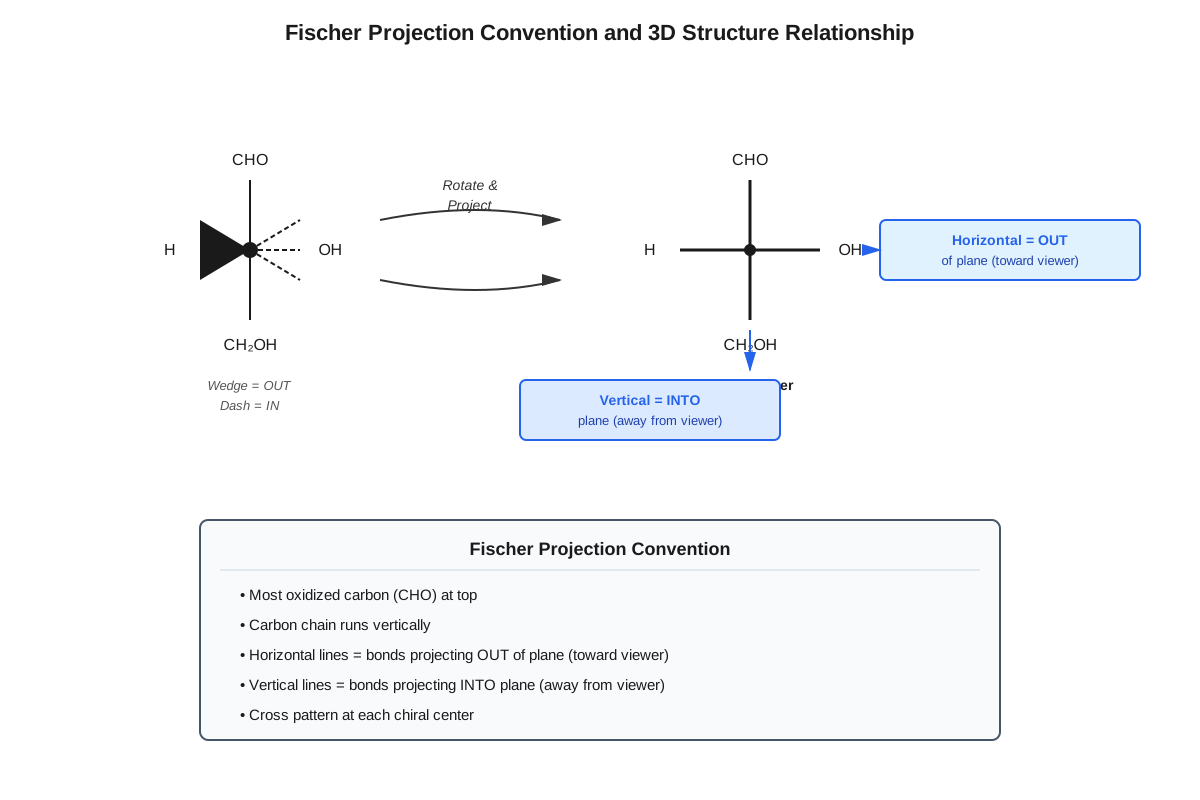
Fischer projections are a two-dimensional representation system used in Organic Chemistry to depict the three-dimensional structure of molecules, particularly carbohydrates and amino acids. Named after German chemist Emil Fischer, this notation system provides a standardized method for representing stereochemistry by projecting a three-dimensional molecule onto a flat surface. In a Fischer projection, the carbon chain is drawn vertically with the most oxidized carbon (typically the aldehyde or carboxylic acid group) positioned at the top. Horizontal lines represent bonds projecting out of the plane toward the viewer, while vertical lines represent bonds projecting away from the viewer into the plane. This convention is critical for understanding and communicating stereochemical relationships in biological molecules.
For the MCAT, Fischer projections serve as an essential tool in Stereochemistry and Conformation because they allow rapid visualization and comparison of stereoisomers, particularly in carbohydrate chemistry and amino acid structures. The MCAT frequently tests the ability to interconvert between different molecular representations (wedge-dash, Newman projections, and Fischer projections) and to determine stereochemical relationships such as enantiomers, diastereomers, and meso compounds. Understanding Fischer projections enables students to quickly identify chiral centers, assign R/S configurations, and recognize biologically relevant molecules like D- and L-sugars or amino acids.
The mastery of Fischer projections MCAT content connects directly to broader concepts in organic chemistry, including optical activity, carbohydrate metabolism, amino acid structure, and enzyme-substrate specificity. Since biological systems are highly stereospecific—with enzymes recognizing only particular stereoisomers—the ability to accurately interpret and manipulate Fischer projections becomes fundamental to understanding biochemical pathways tested on the MCAT. This representational system bridges pure organic chemistry with the biological and biochemical sections of the exam, making it a high-yield topic that appears across multiple MCAT disciplines.
Learning Objectives
- [ ] Define Fischer projections using accurate Organic Chemistry terminology
- [ ] Explain why Fischer projections matters for the MCAT
- [ ] Apply Fischer projections to exam-style questions
- [ ] Identify common mistakes related to Fischer projections
- [ ] Connect Fischer projections to related Organic Chemistry concepts
- [ ] Interconvert Fischer projections with wedge-dash and other three-dimensional representations
- [ ] Determine stereochemical relationships (enantiomers, diastereomers, meso compounds) using Fischer projections
- [ ] Assign R/S configurations to chiral centers depicted in Fischer projections
- [ ] Recognize and distinguish D- and L-configurations in carbohydrates and amino acids using Fischer projections
Prerequisites
- Chirality and chiral centers: Understanding tetrahedral carbon atoms with four different substituents is essential because Fischer projections specifically represent chiral molecules
- Stereoisomers (enantiomers and diastereomers): Knowledge of stereochemical relationships allows proper interpretation of Fischer projections and comparison between molecules
- R/S nomenclature (Cahn-Ingold-Prelog priority rules): This system is necessary for assigning absolute configurations to chiral centers in Fischer projections
- Three-dimensional molecular geometry: Spatial reasoning about tetrahedral geometry underlies the correct interpretation of Fischer projection conventions
- Wedge-dash notation: Familiarity with this representation system facilitates conversion to and from Fischer projections
- Basic carbohydrate and amino acid structure: These biomolecules are the primary applications of Fischer projections on the MCAT
Why This Topic Matters
Fischer projections hold significant clinical and biochemical relevance because biological systems exhibit remarkable stereoselectivity. Enzymes, receptors, and transport proteins distinguish between stereoisomers with extraordinary precision. For example, D-glucose is the primary energy source for human cells and is readily metabolized, while L-glucose cannot be utilized by human metabolic pathways. Similarly, only L-amino acids are incorporated into human proteins, and pharmaceutical compounds often exhibit dramatically different biological activities between enantiomers. The drug thalidomide tragically demonstrated this principle: one enantiomer treated morning sickness effectively, while the other caused severe birth defects.
On the MCAT, Fischer projections appear with moderate frequency across multiple sections. In the Chemical and Physical Foundations of Biological Systems section, questions test the ability to identify stereochemical relationships, interconvert representations, and predict physical properties like optical rotation. The Biological and Biochemical Foundations of Living Systems section incorporates Fischer projections when discussing carbohydrate metabolism, glycolysis, gluconeogenesis, and amino acid structure. Approximately 3-5 questions per exam directly or indirectly involve Fischer projections, with additional questions requiring this knowledge as foundational understanding.
Common MCAT question formats include: (1) passage-based questions presenting carbohydrate structures and asking students to identify epimers, anomers, or reducing sugars; (2) discrete questions requiring interconversion between Fischer projections and other representations; (3) questions testing D/L designation or R/S configuration assignment; and (4) biochemical pathway questions where recognizing specific sugar stereochemistry is necessary to predict metabolic outcomes. The ability to rapidly interpret Fischer projections and manipulate them mentally provides a significant time advantage on test day.
Core Concepts
Definition and Convention of Fischer Projections
A Fischer projection is a two-dimensional representation of a three-dimensional molecule where the carbon chain is arranged vertically, with horizontal lines representing bonds projecting toward the viewer and vertical lines representing bonds projecting away from the viewer. This standardized convention was developed specifically for representing molecules with multiple chiral centers, particularly carbohydrates. The most oxidized carbon (aldehyde, ketone, or carboxylic acid) is positioned at the top of the projection, and the carbon chain is numbered from this position downward.
The critical stereochemical convention states that horizontal lines always project out of the plane (toward the observer), while vertical lines always project into the plane (away from the observer). This is the opposite of what might seem intuitive when first learning the system. At each chiral center (typically a carbon atom), the four substituents are arranged according to this convention, creating a cross-like appearance. The intersection point represents the chiral carbon atom itself.
Drawing Fischer Projections from Three-Dimensional Structures
Converting a wedge-dash structure to a Fischer projection requires systematic orientation of the molecule. First, position the carbon chain vertically with the most oxidized carbon at the top. Second, rotate the molecule so that horizontal substituents point toward the viewer (wedges) and vertical substituents point away (dashes). Third, remove the wedges and dashes, replacing them with simple lines while maintaining the horizontal-out, vertical-in convention.
For example, consider a simple chiral molecule like (R)-glyceraldehyde. In wedge-dash notation, the aldehyde group (CHO) is at the top, the hydroxyl group (OH) projects out on the right (wedge), the hydrogen projects back on the left (dash), and the CH₂OH group extends downward. In Fischer projection, this becomes a vertical line with CHO at top, CH₂OH at bottom, OH extending right, and H extending left—all drawn as simple straight lines.
Manipulating Fischer Projections: Allowed Rotations
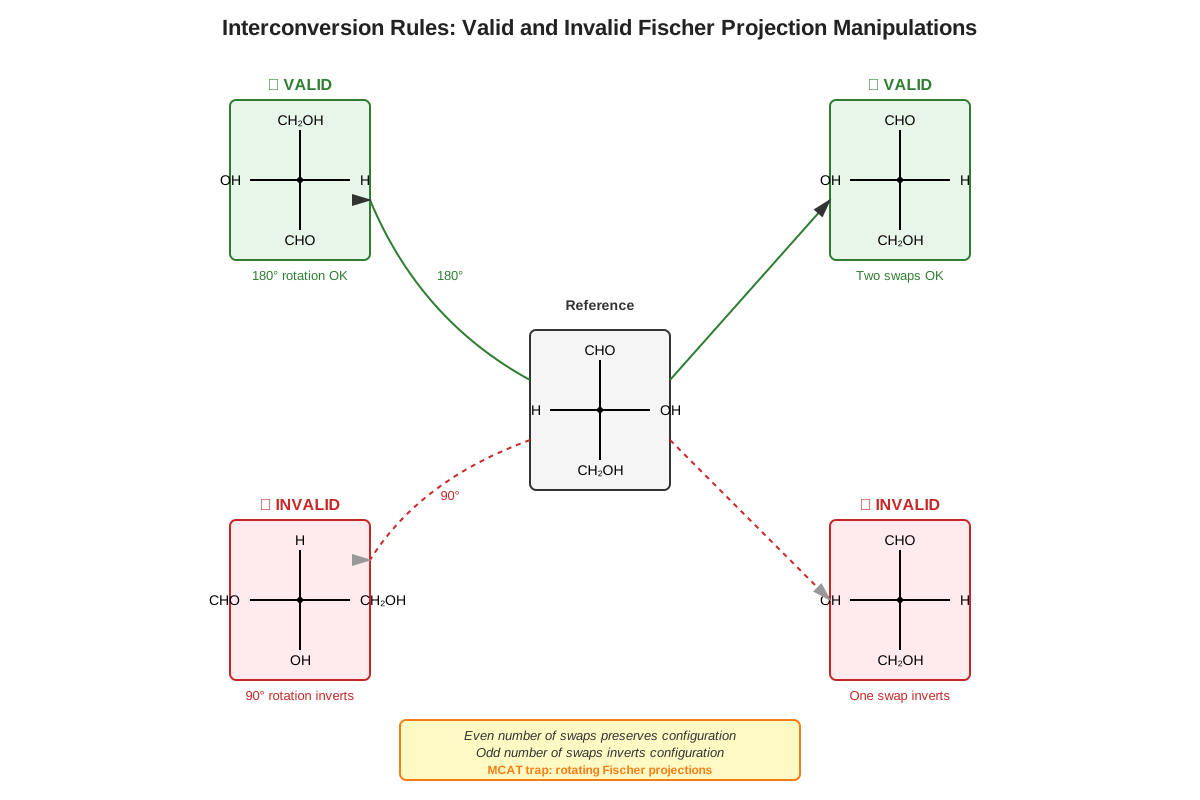
Understanding which manipulations preserve stereochemistry is crucial for MCAT success. Rotating a Fischer projection 180° in the plane of the paper preserves the stereochemistry because this operation maintains the relative positions of all substituents. After a 180° rotation, groups that were horizontal remain horizontal (still projecting out), and groups that were vertical remain vertical (still projecting in).
However, rotating a Fischer projection 90° inverts the stereochemistry, converting a molecule to its enantiomer. This occurs because horizontal groups become vertical (changing from out to in) and vertical groups become horizontal (changing from in to out). Similarly, rotating a Fischer projection out of the plane (flipping it over like a page) also inverts stereochemistry. These operations are forbidden when comparing Fischer projections unless the goal is to generate the enantiomer.
Exchanging any two groups at a chiral center inverts the configuration at that center. Exchanging two pairs of groups returns to the original configuration. This principle allows systematic comparison of Fischer projections to determine stereochemical relationships.
Assigning R/S Configuration in Fischer Projections
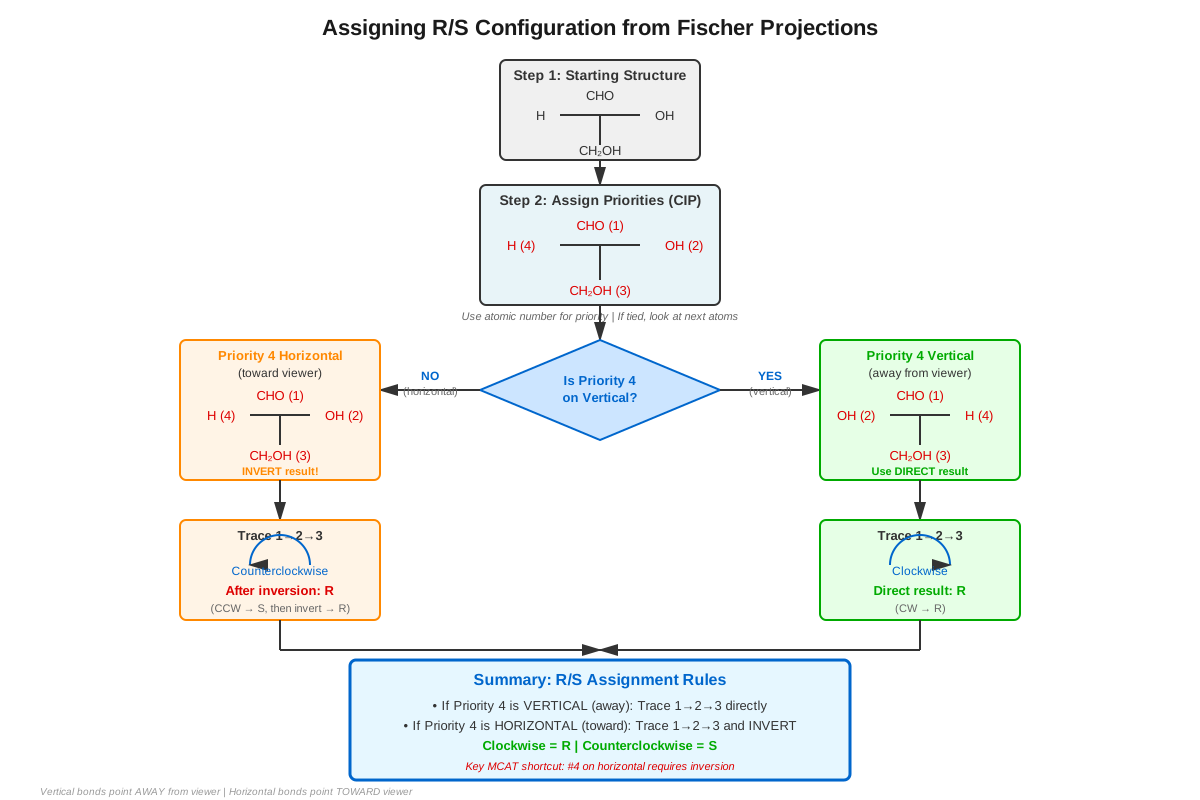
Assigning R/S configuration using the Cahn-Ingold-Prelog priority rules requires careful attention to the three-dimensional implications of Fischer projections. First, assign priorities (1-4) to the four substituents based on atomic number, with 1 being highest priority. Second, identify the position of the lowest priority group (4). If this group is on a vertical line (projecting away from the viewer), observe the remaining three groups directly. If groups 1→2→3 proceed clockwise, the configuration is R; counterclockwise indicates S.
If the lowest priority group is on a horizontal line (projecting toward the viewer), the observed configuration must be inverted. When viewing from the wrong side (with priority 4 toward you rather than away), a clockwise arrangement actually represents S configuration, and counterclockwise represents R configuration. This inversion is a common source of errors and requires careful attention.
D and L Nomenclature for Carbohydrates and Amino Acids
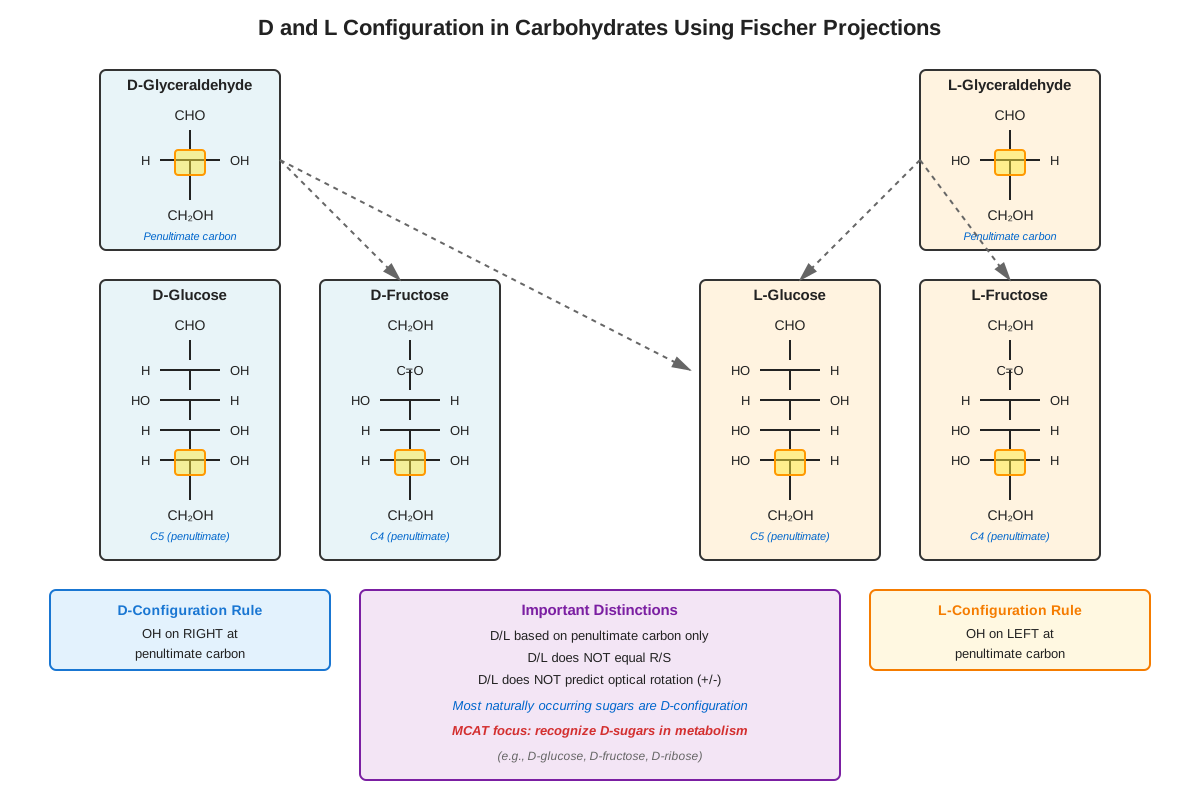
The D/L system is a relative configurational nomenclature specific to carbohydrates and amino acids, distinct from the absolute R/S system. For carbohydrates, the D/L designation is determined by the configuration of the chiral center farthest from the carbonyl group (the bottom-most chiral center in a Fischer projection). If the hydroxyl group on this carbon is on the right, the sugar is D; if on the left, it is L. This system relates all carbohydrates to the reference compound glyceraldehyde.
For amino acids, the D/L designation is determined by the configuration at the α-carbon (the carbon adjacent to the carboxylic acid). When the Fischer projection is drawn with the carboxylic acid at the top and the R group at the bottom, an amino group on the right indicates D-configuration, while an amino group on the left indicates L-configuration. Naturally occurring amino acids in proteins are almost exclusively L-amino acids, while naturally occurring sugars are predominantly D-sugars.
Identifying Stereochemical Relationships
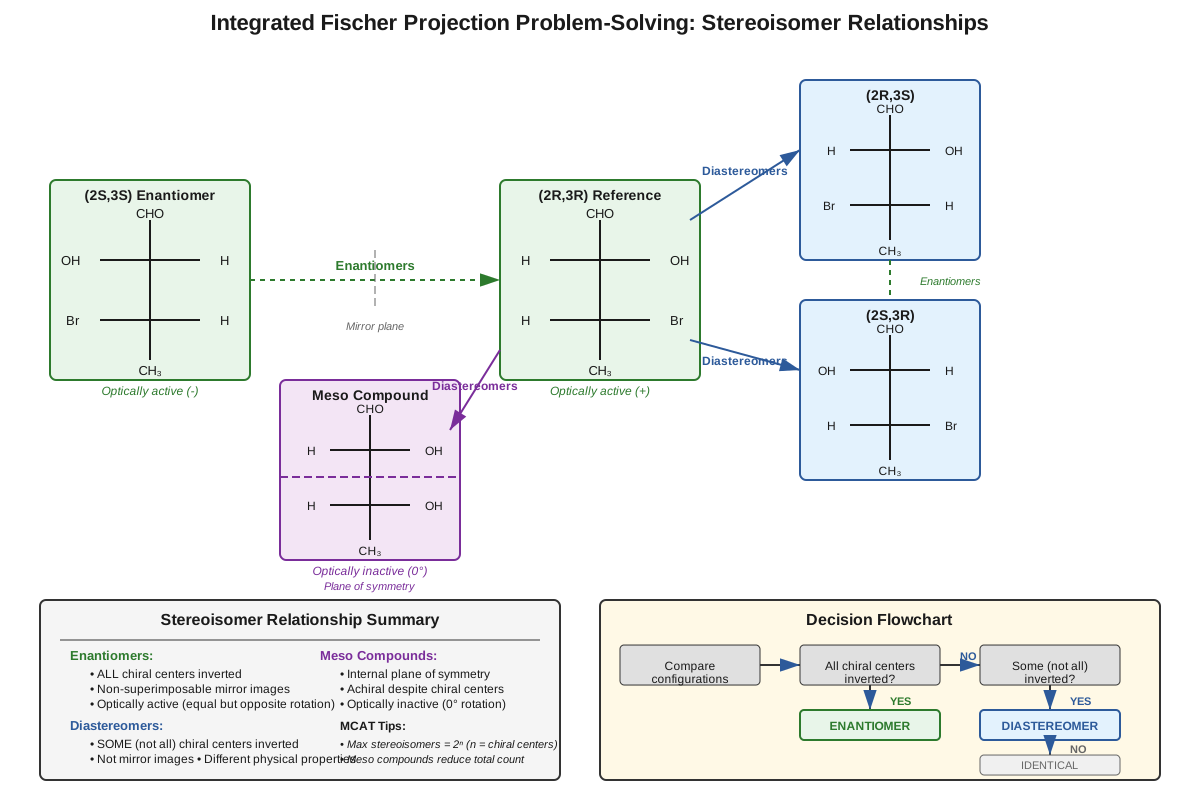
Fischer projections facilitate rapid identification of stereochemical relationships. Enantiomers are non-superimposable mirror images; in Fischer projections, enantiomers have opposite configurations at every chiral center. If a molecule has n chiral centers, its enantiomer can be drawn by switching all horizontal substituents (left↔right at every chiral center).
Diastereomers are stereoisomers that are not mirror images; they have opposite configurations at some (but not all) chiral centers. Epimers are a special class of diastereomers that differ in configuration at exactly one chiral center. For example, D-glucose and D-mannose are C-2 epimers (they differ only at carbon 2), while D-glucose and D-galactose are C-4 epimers.
Meso compounds contain chiral centers but are achiral overall due to an internal plane of symmetry. In Fischer projections, meso compounds can be identified by finding a horizontal plane of symmetry that divides the molecule into two halves that are mirror images of each other.
Common Carbohydrate Fischer Projections
The MCAT frequently tests recognition of common monosaccharides in Fischer projection. D-glucose, the most important sugar in human metabolism, has the hydroxyl groups on carbons 2, 3, 4, and 5 arranged as right, left, right, right (reading from top to bottom). D-galactose, which differs from glucose only at C-4, has the pattern right, left, left, right. D-mannose, a C-2 epimer of glucose, shows left, left, right, right.
D-fructose, a ketohexose, has its carbonyl group at C-2 rather than C-1, creating a different Fischer projection structure. Understanding these common sugars and their relationships (epimers, products of metabolic pathways) is high-yield for the MCAT.
| Sugar | C-2 OH | C-3 OH | C-4 OH | C-5 OH | Relationship to Glucose |
|---|---|---|---|---|---|
| D-Glucose | Right | Left | Right | Right | Reference |
| D-Mannose | Left | Left | Right | Right | C-2 epimer |
| D-Galactose | Right | Left | Left | Right | C-4 epimer |
| D-Allose | Right | Right | Right | Right | C-3 epimer |
Concept Relationships
Fischer projections serve as the central representational tool connecting multiple stereochemistry concepts. The foundation begins with chirality and chiral centers, which define which molecules require Fischer projections. Understanding tetrahedral geometry and three-dimensional molecular structure enables proper interpretation of the Fischer projection convention (horizontal = out, vertical = in).
The relationship flows as: Chiral molecules → require stereochemical representation → Fischer projections provide standardized 2D representation → enables identification of stereochemical relationships (enantiomers, diastereomers, epimers, meso compounds) → which determines physical properties (optical rotation, melting point) and biological activity (enzyme specificity, metabolic pathways).
Fischer projections connect directly to R/S nomenclature through the Cahn-Ingold-Prelog priority rules, allowing assignment of absolute configuration. They also connect to the D/L system, which provides relative configuration for biologically important molecules. This dual nomenclature system (R/S and D/L) can be confusing because they are independent—a D-sugar might be R or S at various positions.
The concept extends to carbohydrate chemistry, where Fischer projections are the standard representation for monosaccharides, enabling recognition of glucose, galactose, mannose, and fructose. This connects to biochemical pathways like glycolysis and gluconeogenesis, where specific stereoisomers are substrates. Similarly, Fischer projections connect to amino acid structure, where L-amino acids are the building blocks of proteins.
The relationship map: Chirality → Fischer projections → Stereochemical relationships → D/L nomenclature → Carbohydrate/amino acid recognition → Biochemical pathways → Enzyme specificity → Biological function
Quick check — test yourself on Fischer projections so far.
Try Flashcards →High-Yield Facts
⭐ In Fischer projections, horizontal lines always project OUT toward the viewer, and vertical lines always project IN away from the viewer
⭐ Rotating a Fischer projection 180° in the plane preserves stereochemistry; rotating 90° or flipping out of the plane inverts stereochemistry
⭐ For carbohydrates, D/L configuration is determined by the hydroxyl position on the bottom-most chiral center: right = D, left = L
⭐ D-glucose has hydroxyl groups arranged as R-L-R-R (reading C-2 through C-5 from top to bottom)
⭐ Enantiomers have opposite configurations at ALL chiral centers; diastereomers have opposite configurations at SOME (but not all) chiral centers
- Epimers are diastereomers that differ in configuration at exactly one chiral center
- When assigning R/S configuration, if the lowest priority group is horizontal (toward viewer), the observed configuration must be inverted
- Meso compounds have chiral centers but possess an internal plane of symmetry, making them achiral overall
- Naturally occurring amino acids in proteins are L-amino acids; naturally occurring sugars are predominantly D-sugars
- Exchanging any two groups at a chiral center in a Fischer projection inverts the configuration at that center
- D-mannose and D-glucose are C-2 epimers; D-galactose and D-glucose are C-4 epimers
- The most oxidized carbon (aldehyde or carboxylic acid) is always placed at the top of a Fischer projection
Common Misconceptions
Misconception: Horizontal lines in Fischer projections point away from the viewer, like the vertical line in wedge-dash notation.
Correction: This is backwards. Horizontal lines in Fischer projections represent bonds projecting OUT toward the viewer (equivalent to wedges), while vertical lines project IN away from the viewer (equivalent to dashes). This counterintuitive convention is the source of many errors.
Misconception: Rotating a Fischer projection 90° is acceptable for comparing molecules because it's still in the plane of the paper.
Correction: Rotating 90° inverts the stereochemistry, converting the molecule to its enantiomer. Only 180° rotations in the plane preserve stereochemistry. The 90° rotation changes horizontal bonds (out) to vertical bonds (in) and vice versa, completely inverting the three-dimensional structure.
Misconception: D-configuration always corresponds to R-configuration, and L-configuration always corresponds to S-configuration.
Correction: The D/L system and R/S system are independent nomenclature systems. A D-sugar can have R or S configuration at various chiral centers. D/L is a relative system based on comparison to glyceraldehyde, while R/S is an absolute system based on priority rules. They do not directly correlate.
Misconception: To find an enantiomer in Fischer projection, simply flip the entire structure horizontally.
Correction: While this might work for simple molecules, the correct method is to invert the configuration at EVERY chiral center by switching left and right substituents at each chiral carbon. Simply flipping the structure can lead to errors with complex molecules or when comparing to other representations.
Misconception: The carbon chain in a Fischer projection can be drawn horizontally if that's more convenient.
Correction: The convention requires the carbon chain to be vertical with the most oxidized carbon at the top. Drawing the chain horizontally violates the Fischer projection convention and makes the representation meaningless, as the horizontal-out/vertical-in rule would no longer apply correctly.
Misconception: When the lowest priority group is horizontal in R/S assignment, you should rotate the molecule to put it in a vertical position.
Correction: You should not physically rotate the Fischer projection (which would change stereochemistry). Instead, assign R/S based on the current orientation and then invert your answer. If you observe clockwise with priority 4 horizontal, the actual configuration is S (not R).
Worked Examples
Example 1: Converting Wedge-Dash to Fischer Projection and Assigning Configuration
Problem: Convert the following wedge-dash structure to a Fischer projection and assign the R/S configuration. The molecule is 2,3-dihydroxypropanal (glyceraldehyde) with the hydroxyl group on C-2 projecting out on the right (wedge) and the hydrogen projecting back on the left (dash).
Solution:
Step 1: Identify the carbon chain and most oxidized carbon. The aldehyde (CHO) is the most oxidized group, so it goes at the top of the Fischer projection.
Step 2: Orient the molecule with the carbon chain vertical. The structure from top to bottom is: CHO (C-1), CHOH (C-2), CH₂OH (C-3).
Step 3: Apply the Fischer convention. The hydroxyl group on C-2 projects out (wedge), so it goes on a horizontal line to the right. The hydrogen projects back (dash), so it goes on a horizontal line to the left. The result is:
        CHO
         |
    H — C — OH
         |
       CH₂OH
Step 4: Assign R/S configuration at C-2. Assign priorities: OH (1), CHO (2), CH₂OH (3), H (4). The lowest priority (H) is on a horizontal line (projecting toward viewer), so we must invert our observation. Looking at priorities 1→2→3: OH→CHO→CH₂OH proceeds counterclockwise. Since H is horizontal (toward us), we invert: the actual configuration is R. This is (R)-glyceraldehyde, which is also D-glyceraldehyde (OH on the right at the bottom-most chiral center).
Key Insight: This example demonstrates the critical importance of recognizing when the lowest priority group is horizontal, requiring inversion of the observed R/S assignment. This is a frequent MCAT trap.
Example 2: Identifying Stereochemical Relationships Between Sugars
Problem: Given Fischer projections of three aldohexoses, identify which are enantiomers, which are diastereomers, and which are epimers.
Molecule A:
        CHO
         |
    H — C — OH
         |
   HO — C — H
         |
    H — C — OH
         |
    H — C — OH
         |
       CH₂OH
Molecule B:
        CHO
         |
   HO — C — H
         |
    H — C — OH
         |
   HO — C — H
         |
   HO — C — H
         |
       CH₂OH
Molecule C:
        CHO
         |
    H — C — OH
         |
   HO — C — H
         |
   HO — C — H
         |
    H — C — OH
         |
CH₂OHSolution:
Step 1: Identify the configuration at each chiral center for all three molecules.
Molecule A (reading C-2 through C-5): R, L, R, R (this is D-glucose)
Molecule B (reading C-2 through C-5): L, R, L, L (all positions inverted from A)
Molecule C (reading C-2 through C-5): R, L, L, R (differs from A at C-4 only)
Step 2: Compare molecules pairwise.
A vs B: All four chiral centers have opposite configurations. These are enantiomers (mirror images). Molecule B is L-glucose.
A vs C: Three chiral centers match (C-2, C-3, C-5), but C-4 differs. These are diastereomers and specifically epimers (differ at exactly one position). Molecule C is D-galactose, the C-4 epimer of D-glucose.
B vs C: Multiple chiral centers differ, but not all. These are diastereomers but not epimers (they differ at more than one position).
Step 3: Verify D/L designations. For A and C, the bottom-most chiral center (C-5) has OH on the right, confirming D-configuration. For B, the bottom-most chiral center has OH on the left, confirming L-configuration.
Key Insight: This example demonstrates the systematic approach to comparing Fischer projections: examine each chiral center individually, count differences, and classify relationships. Recognizing D-glucose and its common epimers is high-yield for the MCAT.
Exam Strategy
When approaching MCAT questions involving Fischer projections, begin by identifying what the question is actually asking: stereochemical relationship, configuration assignment, or structural recognition. Many students waste time on unnecessary analysis. If the question asks about D/L designation, focus only on the bottom-most chiral center—don't analyze every position.
Trigger words to watch for include: "enantiomer" (all chiral centers inverted), "diastereomer" (some but not all inverted), "epimer" (exactly one center different), "meso" (internal symmetry), "D-configuration" (bottom-most OH on right), "R/S configuration" (requires priority rules), and "optically active" (chiral, no internal symmetry). When you see "rotate 180°," recognize that stereochemistry is preserved; "rotate 90°" or "flip" means stereochemistry is inverted.
For process of elimination, use these strategies: (1) If comparing two structures and ALL chiral centers are inverted, eliminate any answer choice saying "diastereomer" or "same compound"—they must be enantiomers. (2) If a question asks about naturally occurring sugars or amino acids, eliminate L-sugars and D-amino acids immediately (with rare exceptions). (3) If a molecule has an internal plane of symmetry, eliminate any answer suggesting it's optically active. (4) When assigning R/S with the lowest priority horizontal, if you observe clockwise, eliminate R and select S (and vice versa).
Time allocation: Don't spend more than 60-90 seconds on a discrete Fischer projection question. If you need to interconvert representations or assign multiple configurations, budget up to 2 minutes. For passage-based questions, use the passage content to eliminate wrong answers before detailed analysis. If a question requires extensive manipulation of Fischer projections, consider flagging it and returning after completing easier questions—these can be time sinks.
Mental manipulation strategy: Practice visualizing 180° rotations mentally rather than redrawing. For enantiomer identification, mentally flip all horizontal substituents without redrawing. For epimer identification, scan vertically and count differences—if you find more than one, stop (it's not an epimer). These mental shortcuts save valuable time.
Memory Techniques
Mnemonic for Fischer Projection Convention: "Horizontal = Hello (toward you), Vertical = Vanish (away from you)" or "Horizontal Hugs you, Vertical Vacates." This reinforces that horizontal lines project out toward the viewer.
Mnemonic for D-Glucose Configuration: "Right, Left, Right, Right = ReaLly Right Right" for the hydroxyl positions at C-2, C-3, C-4, C-5. Alternatively, "Glucose Loves Right Right" (after the first right, it's left once, then right right).
Mnemonic for Allowed Rotations: "180 = OK" (both have circles/zeros, representing rotation in plane). "90 = NO" (the 9 looks like an inverted 6, representing inversion of stereochemistry).
Mnemonic for D/L Designation: "Dexterity = Right hand" (D-sugars have OH on the right at the bottom). "Left = L-configuration." For amino acids: "Life uses L-amino acids" (naturally occurring amino acids in proteins are L).
Visualization Strategy for Enantiomers: Imagine a mirror placed vertically down the center of the Fischer projection. Everything on the right reflects to the left and vice versa. This mental mirror helps quickly generate or recognize enantiomers.
Acronym for Stereochemical Relationships: "EDEM" = Enantiomers (all different), Diastereomers (some different), Epimers (one different), Meso (internal symmetry). This sequence moves from most different to special cases.
Summary
Fischer projections are a standardized two-dimensional representation system for depicting three-dimensional chiral molecules, particularly carbohydrates and amino acids. The critical convention—horizontal lines project out toward the viewer while vertical lines project away—enables consistent communication of stereochemistry. Mastery requires understanding allowed manipulations (180° rotation preserves stereochemistry; 90° rotation or flipping inverts it), the ability to assign R/S configurations (remembering to invert when the lowest priority is horizontal), and facility with the D/L system for biological molecules (determined by the bottom-most chiral center for sugars, the α-carbon for amino acids). Fischer projections enable rapid identification of stereochemical relationships: enantiomers differ at all chiral centers, diastereomers at some, and epimers at exactly one. For the MCAT, recognizing common sugars like D-glucose and understanding that naturally occurring sugars are predominantly D-configuration while amino acids are L-configuration is essential. The ability to interconvert between Fischer projections and other representations, combined with systematic analysis of stereochemical relationships, provides the foundation for success on stereochemistry questions across multiple MCAT sections.
Key Takeaways
- Fischer projections use the convention that horizontal lines project OUT toward the viewer and vertical lines project IN away from the viewer—this is counterintuitive but critical
- Only 180° rotations in the plane preserve stereochemistry; 90° rotations and out-of-plane flips invert stereochemistry and create enantiomers
- D/L configuration for carbohydrates is determined solely by the bottom-most chiral center (right = D, left = L), independent of R/S configuration at individual centers
- Enantiomers have opposite configurations at ALL chiral centers; diastereomers differ at SOME; epimers differ at exactly ONE chiral center
- When assigning R/S configuration with the lowest priority group horizontal, the observed configuration must be inverted to obtain the correct answer
- D-glucose (R-L-R-R pattern) and its common epimers (D-mannose at C-2, D-galactose at C-4) are high-yield for MCAT carbohydrate questions
- Naturally occurring sugars are predominantly D-configuration; naturally occurring amino acids in proteins are L-configuration
Related Topics
Wedge-Dash Notation and Three-Dimensional Representations: Understanding alternative methods for depicting stereochemistry enables interconversion with Fischer projections and provides flexibility in problem-solving approaches.
Newman Projections: This representation system for visualizing conformational isomers complements Fischer projections by showing rotation around single bonds, important for understanding molecular flexibility.
Carbohydrate Chemistry and Cyclic Forms: Fischer projections of linear sugars connect to Haworth projections and chair conformations of cyclic sugars, essential for understanding carbohydrate reactivity and biochemistry.
Amino Acid Structure and Protein Chemistry: Fischer projections of amino acids relate to their incorporation into proteins and the stereochemical requirements for biological activity.
Optical Activity and Polarimetry: The stereochemistry depicted in Fischer projections determines whether molecules rotate plane-polarized light, connecting structure to measurable physical properties.
Enzyme Specificity and Stereochemistry: Understanding why enzymes recognize only specific stereoisomers (depicted in Fischer projections) is fundamental to biochemical pathway questions on the MCAT.
Practice CTA
Now that you've mastered the core concepts of Fischer projections, it's time to solidify your understanding through active practice. Attempt the practice questions and work through the flashcards to reinforce the conventions, manipulations, and stereochemical relationships covered in this guide. Focus particularly on interconverting representations, assigning configurations, and identifying stereochemical relationships—these skills will serve you across multiple MCAT sections. Remember, stereochemistry questions reward systematic analysis and careful attention to conventions. With focused practice, Fischer projections will become a reliable source of points on test day. You've got this!
Sign up free to keep reading
Create a free AnvayaPrep account to finish this MCAT guide on Fischer projections — plus flashcards and practice questions.