Overview
Cis-trans isomerism is a fundamental type of stereoisomerism that arises from restricted rotation around chemical bonds, most commonly carbon-carbon double bonds and within cyclic structures. This form of geometric isomerism represents one of the most clinically and biochemically relevant topics in Organic Chemistry, as the spatial arrangement of substituents can dramatically affect molecular properties, biological activity, and pharmacological effects. Understanding cis-trans isomerism is essential for MCAT success because it bridges multiple disciplines tested on the exam: it appears in organic chemistry passages, biochemistry questions involving fatty acids and membrane lipids, and even in biology contexts discussing vision (retinal isomerization) and cellular signaling.
The MCAT frequently tests cis-trans isomerism through structure identification questions, property comparison problems, and passage-based questions that require students to predict how geometric configuration affects molecular behavior. This topic sits at the intersection of Stereochemistry and Conformation, requiring students to visualize three-dimensional molecular arrangements and understand how restricted rotation creates distinct isomers with different physical and chemical properties. Unlike conformational isomers that interconvert freely, cis and trans isomers are configurational isomers that cannot interconvert without breaking bonds—a distinction that carries significant biological implications.
Mastery of cis-trans isomerism MCAT content requires more than memorization; students must develop the ability to rapidly identify sites of geometric isomerism, assign configurations correctly, predict relative stability, and connect structural features to functional consequences. This topic integrates with alkene chemistry, cycloalkane structure, E/Z nomenclature systems, and broader stereochemistry principles, making it a high-yield area that appears across multiple question types and difficulty levels on the exam.
Learning Objectives
- [ ] Define cis-trans isomerism using accurate Organic Chemistry terminology
- [ ] Explain why cis-trans isomerism matters for the MCAT
- [ ] Apply cis-trans isomerism to exam-style questions
- [ ] Identify common mistakes related to cis-trans isomerism
- [ ] Connect cis-trans isomerism to related Organic Chemistry concepts
- [ ] Distinguish between cis-trans and E/Z nomenclature systems and determine when each applies
- [ ] Predict relative physical properties (boiling point, melting point, polarity) based on geometric configuration
- [ ] Recognize biological molecules that exhibit cis-trans isomerism and explain functional consequences
- [ ] Evaluate molecular structures to determine whether cis-trans isomerism is possible
Prerequisites
- Basic bonding theory and hybridization: Understanding sp² hybridization and the planar geometry of double bonds is essential for recognizing why rotation is restricted
- Molecular geometry and VSEPR theory: Ability to visualize three-dimensional molecular arrangements enables proper identification of cis versus trans configurations
- Constitutional isomers versus stereoisomers: Distinguishing between isomers that differ in connectivity versus spatial arrangement provides the foundation for understanding geometric isomerism
- Alkene structure and nomenclature: Familiarity with carbon-carbon double bonds and basic naming conventions is necessary before adding geometric descriptors
- Intermolecular forces: Knowledge of dipole-dipole interactions, London dispersion forces, and hydrogen bonding helps predict how geometric configuration affects physical properties
Why This Topic Matters
Clinical and Real-World Significance
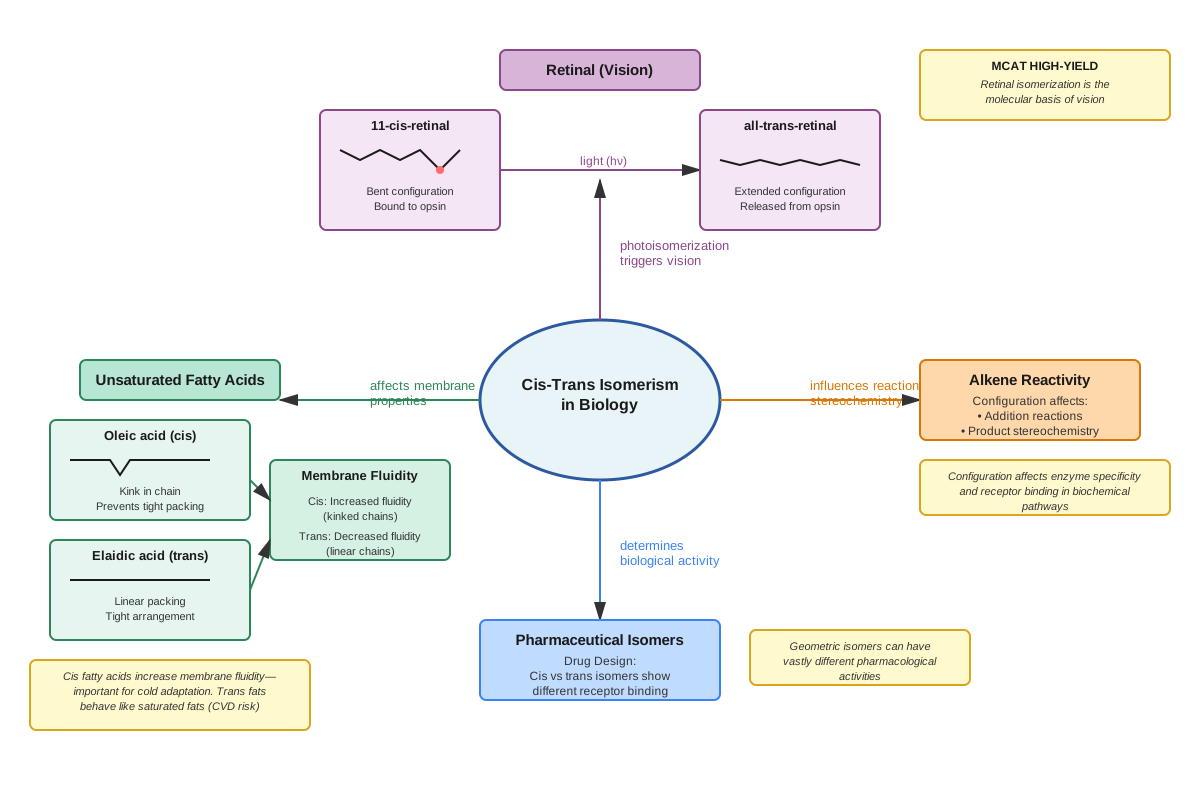
Cis-trans isomerism has profound biological and medical implications. The most famous example is retinal, the light-sensitive molecule in the eye that exists as 11-cis-retinal in the dark-adapted state and isomerizes to all-trans-retinal upon light absorption, triggering the visual cascade. Unsaturated fatty acids in cell membranes predominantly exist in the cis configuration, creating kinks that increase membrane fluidity—trans fatty acids (often from partially hydrogenated oils) pack more tightly, raising cardiovascular disease risk. Many pharmaceutical compounds exhibit geometric isomerism, with one isomer showing therapeutic activity while the other may be inactive or even harmful.
MCAT Exam Statistics
Cis-trans isomerism appears in approximately 3-5% of Chemical and Physical Foundations questions and 2-3% of Biological and Biochemical Foundations questions. The topic most commonly appears in:
- Discrete questions asking students to identify or count stereoisomers
- Passage-based questions involving lipid biochemistry, membrane structure, or organic synthesis
- Pseudo-discrete questions embedded in biochemistry passages about fatty acid metabolism or vitamin A chemistry
Common Exam Contexts
MCAT passages frequently present cis-trans isomerism in the context of:
- Fatty acid structure and membrane fluidity comparisons
- Alkene addition reactions where stereochemistry must be tracked
- Cyclic compounds (especially cycloalkanes and sugars) with substituents
- Vision biochemistry and photoisomerization
- Drug design scenarios where geometric isomers have different activities
- Organic synthesis schemes requiring stereochemical analysis
Core Concepts
Definition and Structural Requirements
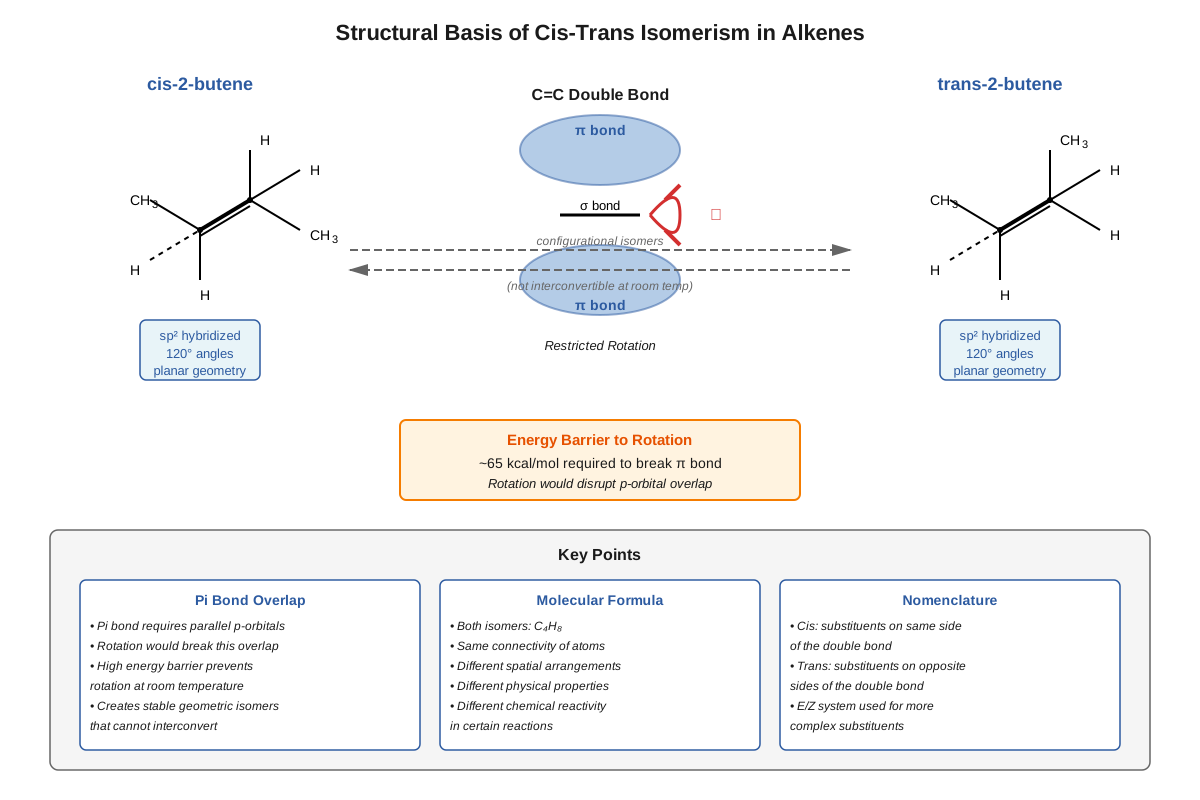
Cis-trans isomerism (also called geometric isomerism) occurs when molecules have the same molecular formula and connectivity but differ in the spatial arrangement of substituents due to restricted rotation. This type of stereoisomerism requires two essential structural features:
- Restricted rotation: Most commonly from a carbon-carbon double bond (C=C) or a ring structure
- Two different substituents on each carbon of the double bond or ring positions being compared
The cis isomer has similar or priority substituents on the same side of the reference plane (the double bond or ring), while the trans isomer has them on opposite sides. The term "cis" derives from Latin meaning "on this side," and "trans" means "across."
For a carbon-carbon double bond, the sp² hybridization creates a planar geometry with a π bond formed by overlap of unhybridized p orbitals. Rotation around the double bond would require breaking this π bond (requiring approximately 65 kcal/mol), which does not occur under normal conditions. This energy barrier makes cis and trans isomers distinct, isolable compounds rather than rapidly interconverting conformers.
Identifying Sites of Geometric Isomerism
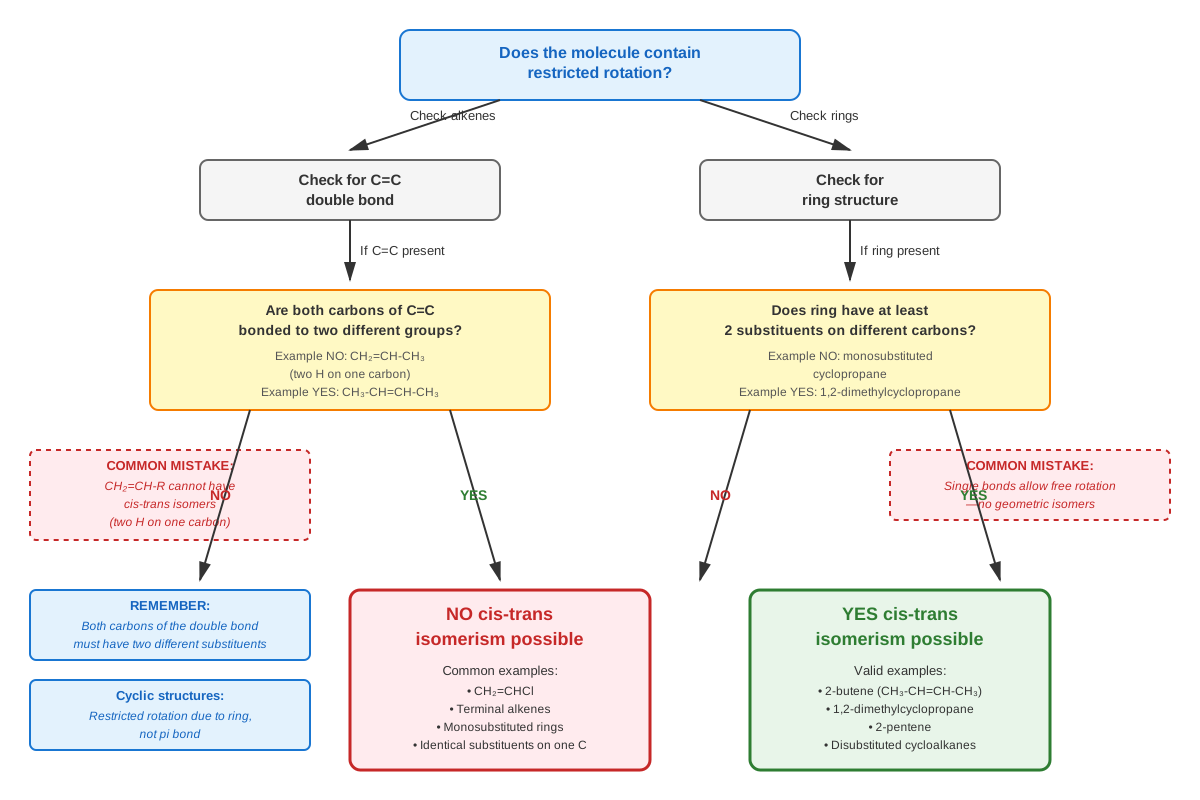
To determine whether a molecule can exhibit cis-trans isomerism, systematically evaluate each potential site:
For alkenes:
- Locate all carbon-carbon double bonds
- Examine each carbon of the double bond independently
- Verify that each carbon has two different substituents
- If both carbons meet this criterion, geometric isomerism is possible
For cyclic compounds:
- Identify the ring structure that restricts rotation
- Locate substituents on the ring
- Determine if substituents can be on the same side (cis) or opposite sides (trans) of the ring plane
- Remember that single substituents on a ring do not create geometric isomerism—at least two substituents are required
Structures that CANNOT exhibit cis-trans isomerism:
- Terminal alkenes (R-CH=CH₂) because one carbon has two identical hydrogen substituents
- Double bonds where one carbon has two identical groups (R₂C=CHR')
- Monosubstituted cycloalkanes (only one substituent on the ring)
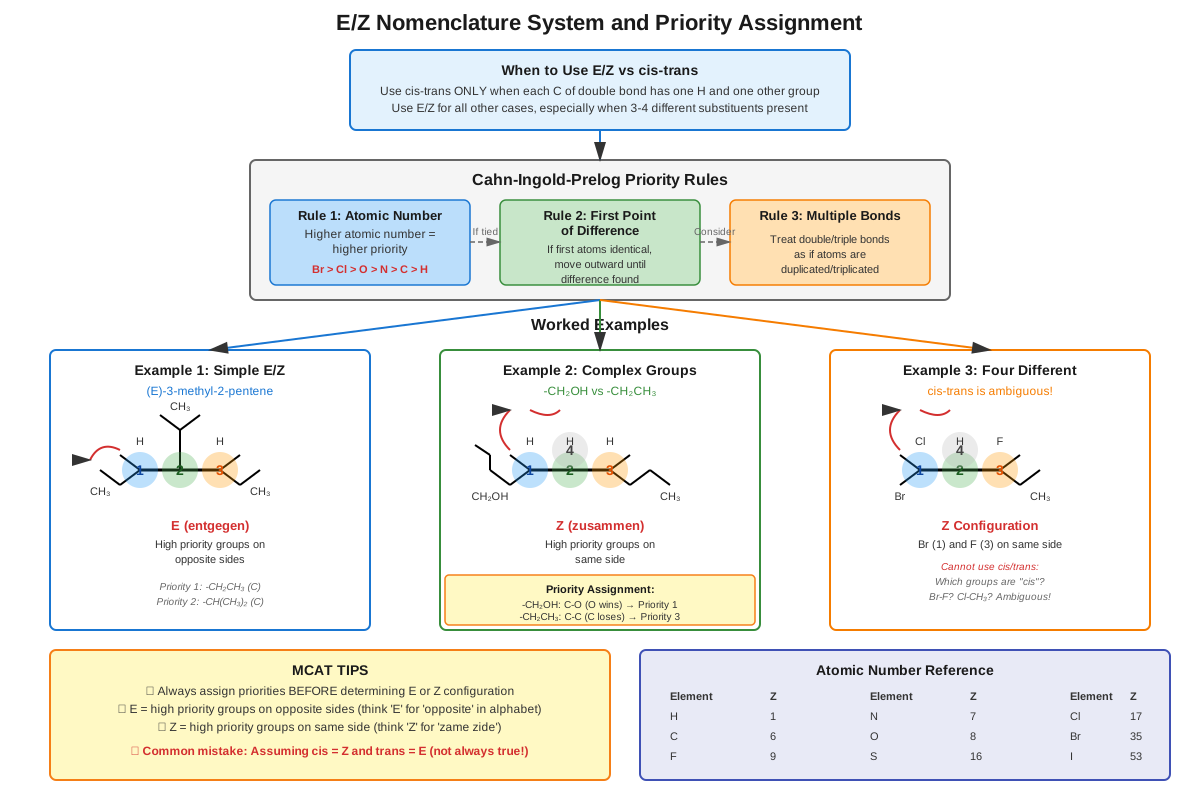
Cis-Trans versus E/Z Nomenclature
While cis-trans nomenclature works well for simple cases, it becomes ambiguous when each carbon of the double bond has two different substituents. The E/Z system (from German Entgegen = opposite, Zusammen = together) provides unambiguous nomenclature using Cahn-Ingold-Prelog (CIP) priority rules:
| Feature | Cis-Trans System | E/Z System |
|---|---|---|
| Applicability | Simple alkenes with clear reference groups | All geometric isomers, regardless of complexity |
| Priority determination | Based on similar/different groups | Based on atomic number (CIP rules) |
| Nomenclature | Cis (same side), Trans (opposite side) | Z (priority groups together), E (priority groups opposite) |
| Limitations | Ambiguous for complex substituents | None—universally applicable |
CIP Priority Rules (brief review):
- Higher atomic number = higher priority
- If tied, examine atoms one bond away
- Multiple bonds count as multiple single bonds to that atom
- Continue outward until a difference is found
Relationship between systems:
- When the two highest-priority groups are on the same side: Z configuration (often corresponds to cis)
- When the two highest-priority groups are on opposite sides: E configuration (often corresponds to trans)
- However, cis does not always equal Z, and trans does not always equal E—priority assignments can reverse this relationship
Physical Properties and Stability
Geometric configuration profoundly affects physical properties:
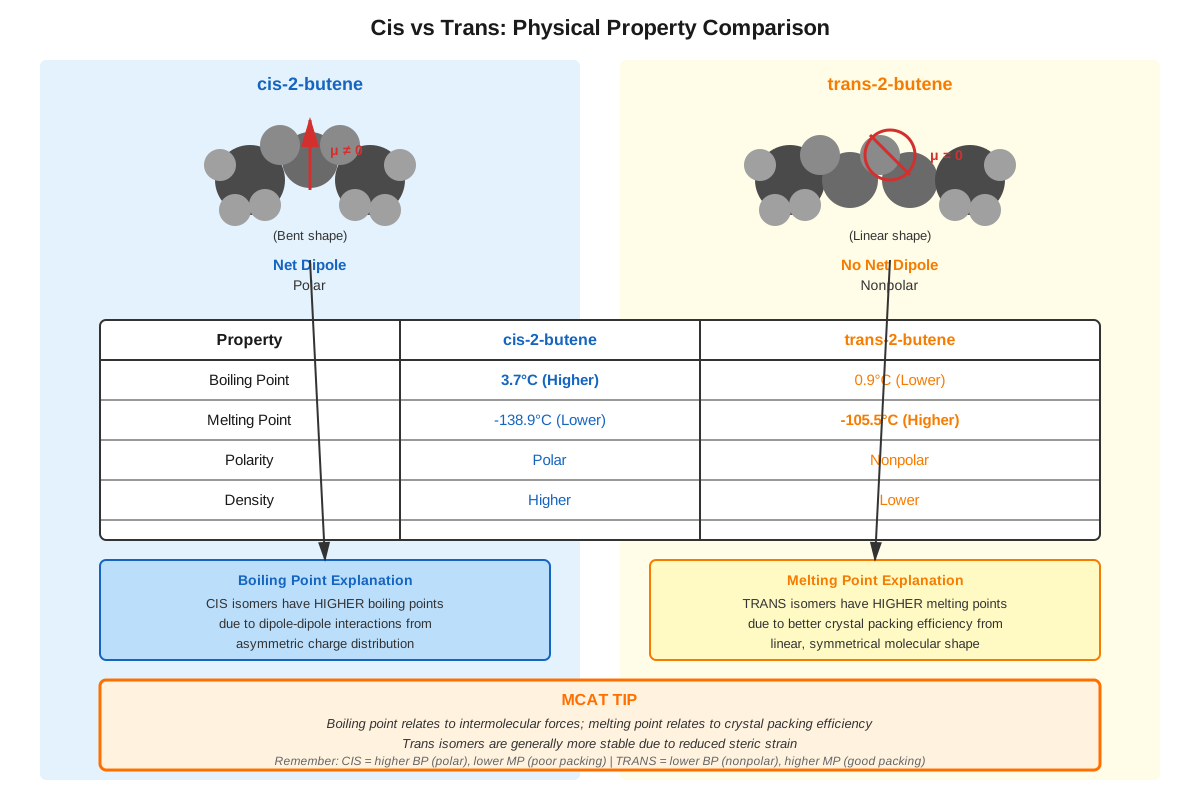
Polarity and Dipole Moment:
- Cis isomers often have higher dipole moments because bond dipoles do not cancel
- Trans isomers frequently have lower or zero dipole moments due to symmetry
- Example: cis-1,2-dichloroethene has a net dipole moment; trans-1,2-dichloroethene has zero dipole moment
Boiling Points:
- Cis isomers typically have higher boiling points due to greater polarity and stronger dipole-dipole interactions
- Exception: When molecular symmetry or specific intermolecular interactions dominate
Melting Points:
- Trans isomers usually have higher melting points because their symmetry allows better crystal packing
- More efficient packing creates stronger cumulative intermolecular forces in the solid state
Stability:
- Trans isomers are generally more thermodynamically stable due to reduced steric strain
- In cis isomers, substituents on the same side create steric repulsion
- Energy difference typically ranges from 0.5-1.0 kcal/mol, with trans being lower in energy
Cycloalkanes and Ring Systems
Cis-trans isomerism in cyclic compounds follows similar principles but with important distinctions:
Disubstituted Cycloalkanes:
- The ring restricts rotation just as a double bond does
- Cis configuration: Both substituents on the same face of the ring (both "up" or both "down")
- Trans configuration: Substituents on opposite faces (one "up," one "down")
Stability Considerations:
- For small rings (cyclopropane, cyclobutane), cis isomers may be more stable due to angle strain considerations
- For larger rings (cyclohexane and above), trans isomers typically minimize steric interactions
- In cyclohexane specifically, trans-1,2-disubstituted compounds can place both groups equatorial, minimizing 1,3-diaxial interactions
Fused Ring Systems:
- Decalin (two fused cyclohexane rings) exists as cis-decalin and trans-decalin
- Trans-decalin is more stable and more rigid
- Cis-decalin has a flexible ring junction
Biological Examples
Fatty Acids:
- Naturally occurring unsaturated fatty acids predominantly have cis double bonds
- The cis configuration creates a "kink" in the hydrocarbon chain
- This kink prevents tight packing, increasing membrane fluidity
- Trans fatty acids (from partial hydrogenation) pack like saturated fats, decreasing fluidity and raising health concerns
Retinal and Vision:
- 11-cis-retinal binds to opsin protein in rod cells
- Light absorption causes isomerization to all-trans-retinal
- This conformational change triggers the visual signal cascade
- The trans isomer dissociates from opsin and must be enzymatically converted back to cis
Alkene Biosynthesis:
- Many natural products contain specific geometric configurations
- Pheromones often require precise cis or trans configuration for biological activity
- Enzyme active sites can distinguish between geometric isomers
Concept Relationships
Cis-trans isomerism sits within the broader framework of stereochemistry, which encompasses all aspects of three-dimensional molecular structure. The hierarchy flows: Isomers → Stereoisomers → Diastereomers → Geometric Isomers (cis-trans). This distinguishes geometric isomers from enantiomers (mirror-image stereoisomers) and constitutional isomers (different connectivity).
The concept directly builds on alkene structure and bonding, specifically the sp² hybridization that creates planar geometry and the π bond that restricts rotation. Understanding molecular orbital theory explains why the energy barrier to rotation is so high—breaking the π bond requires significant energy input.
Cis-trans isomerism connects forward to reaction stereochemistry, particularly in addition reactions across double bonds. Syn addition (both groups adding to the same face) versus anti addition (opposite faces) determines product stereochemistry. The topic also links to conformational analysis in cyclic systems, where cis-trans configuration affects which conformers are accessible and stable.
In biochemistry contexts, cis-trans isomerism relates to lipid structure and membrane biology, vitamin biochemistry (vitamin A and vision), and enzyme specificity (how enzymes recognize and distinguish geometric isomers). The concept also appears in pharmacology discussions of drug isomers with different activities.
Relationship Map:
Bonding Theory (sp² hybridization) → Restricted Rotation → Geometric Isomerism Possible → Cis-Trans Assignment → Physical Property Differences → Biological Function Consequences → Clinical Relevance
High-Yield Facts
⭐ Cis-trans isomerism requires restricted rotation (double bond or ring) AND two different substituents on each relevant carbon
⭐ Trans isomers are generally more thermodynamically stable than cis isomers due to reduced steric strain
⭐ Cis isomers typically have higher boiling points (greater polarity) while trans isomers have higher melting points (better packing)
⭐ The E/Z system uses CIP priority rules and is unambiguous for all cases; cis-trans nomenclature only works for simple alkenes
⭐ Naturally occurring unsaturated fatty acids predominantly have cis double bonds, creating membrane fluidity
- Terminal alkenes (R-CH=CH₂) cannot exhibit cis-trans isomerism because one carbon has two identical hydrogens
- In the E/Z system, Z means priority groups are on the same side (Zusammen = together); E means opposite sides (Entgegen = opposite)
- Cis-trans isomers are diastereomers (stereoisomers that are not mirror images), not enantiomers
- The energy barrier to rotation around a C=C double bond is approximately 65 kcal/mol, preventing interconversion at room temperature
- 11-cis-retinal isomerizes to all-trans-retinal upon light absorption, initiating the visual signal cascade
- Trans fatty acids from partial hydrogenation increase cardiovascular disease risk by affecting membrane properties and lipid metabolism
- For cyclohexane derivatives, trans-1,2-disubstituted compounds can achieve both substituents in equatorial positions
- Cis-trans isomerism affects drug activity—geometric isomers may have different pharmacological profiles
- Alkene addition reactions must consider stereochemistry: syn addition produces cis products, anti addition produces trans products
- The dipole moment of trans isomers is often zero or reduced due to symmetry, while cis isomers have net dipole moments
Quick check — test yourself on Cis trans isomerism so far.
Try Flashcards →Common Misconceptions
Misconception: All molecules with double bonds exhibit cis-trans isomerism.
Correction: Cis-trans isomerism requires that BOTH carbons of the double bond have two different substituents. Terminal alkenes (R-CH=CH₂) and double bonds where one carbon has two identical groups (R₂C=CHR') cannot exhibit geometric isomerism because there is no meaningful "cis" versus "trans" distinction.
Misconception: Cis and trans isomers can interconvert by rotation at room temperature, like conformational isomers.
Correction: Cis and trans isomers are configurational isomers that cannot interconvert without breaking the π bond, which requires approximately 65 kcal/mol of energy. They are isolable, distinct compounds with different physical properties. Only under special conditions (heat, light, or catalysis) can geometric isomers interconvert.
Misconception: Cis always equals Z, and trans always equals E in nomenclature.
Correction: While cis often corresponds to Z and trans to E, this is not always true. The E/Z system uses CIP priority rules based on atomic number, which can result in a cis isomer being designated E or a trans isomer being designated Z, depending on which substituents have higher priority. The two nomenclature systems use different criteria for assignment.
Misconception: Trans isomers always have higher boiling points than cis isomers.
Correction: Trans isomers typically have higher MELTING points due to better crystal packing, but cis isomers often have higher BOILING points due to greater polarity and stronger dipole-dipole interactions in the liquid phase. Students frequently confuse these two properties.
Misconception: Cis-trans isomerism only occurs in alkenes with double bonds.
Correction: Geometric isomerism also occurs in cyclic compounds where the ring restricts rotation. Disubstituted cycloalkanes can have cis (both substituents on the same face) or trans (substituents on opposite faces) configurations. The principle is the same—restricted rotation creates distinct spatial arrangements.
Misconception: If a molecule has multiple double bonds, all must be considered together when assigning cis-trans configuration.
Correction: Each double bond is evaluated independently for geometric isomerism. A molecule with two double bonds could be cis at one position and trans at another (e.g., cis,trans-2,4-hexadiene). The configuration at each site of unsaturation is specified separately in the name.
Worked Examples
Example 1: Identifying and Naming Geometric Isomers
Question: Consider 2-pentene (CH₃-CH=CH-CH₂-CH₃). Draw both geometric isomers, assign cis-trans and E/Z nomenclature, and predict which has the higher boiling point.
Solution:
Step 1: Verify that geometric isomerism is possible.
- The double bond is between C2 and C3
- C2 has a methyl group and a hydrogen
- C3 has an ethyl group and a hydrogen
- Both carbons have two different substituents ✓
Step 2: Draw both isomers.
- Isomer 1: Methyl and ethyl on the same side of the double bond
- Isomer 2: Methyl and ethyl on opposite sides of the double bond
Step 3: Assign cis-trans nomenclature.
- Isomer 1: The alkyl groups (methyl and ethyl) are on the same side → cis-2-pentene
- Isomer 2: The alkyl groups are on opposite sides → trans-2-pentene
Step 4: Assign E/Z nomenclature using CIP rules.
- At C2: Methyl (C) has higher priority than hydrogen (H)
- At C3: Ethyl (starts with C) has higher priority than hydrogen (H)
- Isomer 1: Priority groups (methyl and ethyl) on same side → Z-2-pentene
- Isomer 2: Priority groups on opposite sides → E-2-pentene
Note: In this case, cis = Z and trans = E because the priority assignments align with the alkyl groups.
Step 5: Predict boiling points.
- Cis-2-pentene has a net dipole moment (alkyl groups on same side create asymmetry)
- Trans-2-pentene has reduced dipole moment (more symmetrical)
- Prediction: cis-2-pentene has the higher boiling point due to stronger dipole-dipole interactions
- Actual values: cis-2-pentene: 37°C; trans-2-pentene: 36°C (very close, as expected for small molecules)
Connection to Learning Objectives: This example demonstrates identification of geometric isomerism sites, proper nomenclature application, and prediction of physical properties based on molecular geometry.
Example 2: Cycloalkane Stereochemistry and Stability
Question: Draw both geometric isomers of 1,3-dimethylcyclohexane. Determine which is more stable and explain your reasoning using chair conformations.
Solution:
Step 1: Identify the two geometric isomers.
- Cis-1,3-dimethylcyclohexane: Both methyl groups on the same face of the ring
- Trans-1,3-dimethylcyclohexane: Methyl groups on opposite faces of the ring
Step 2: Draw chair conformations for the cis isomer.
- Conformation A: Both methyls equatorial (one up-equatorial, one down-equatorial, but same face)
- Conformation B: Both methyls axial
- The cis isomer can achieve both substituents equatorial by proper positioning
Step 3: Draw chair conformations for the trans isomer.
- Conformation A: One methyl equatorial, one methyl axial
- Conformation B: One methyl axial, one methyl equatorial (ring flip)
- The trans isomer CANNOT have both methyls equatorial simultaneously
Step 4: Evaluate stability.
- Axial substituents experience 1,3-diaxial interactions (steric strain)
- Each axial methyl group adds approximately 1.8 kcal/mol of strain
- Cis isomer: Can adopt conformation with both methyls equatorial → minimal strain
- Trans isomer: Must always have one methyl axial → approximately 1.8 kcal/mol additional strain
Conclusion: Cis-1,3-dimethylcyclohexane is more stable than the trans isomer because it can achieve a conformation with both substituents equatorial, minimizing steric interactions.
Important Note: This is opposite to the general rule that trans isomers are more stable! The 1,3-positioning on cyclohexane is a special case where cis allows both groups equatorial. For 1,2- or 1,4-disubstituted cyclohexanes, trans is typically more stable.
Connection to Learning Objectives: This example illustrates how geometric configuration in rings affects conformational preferences and relative stability, requiring integration of cis-trans concepts with conformational analysis—a common MCAT synthesis question type.
Exam Strategy
Question Recognition
MCAT questions on cis-trans isomerism typically contain these trigger phrases:
- "Geometric isomers"
- "Stereoisomers that are not mirror images"
- "Configuration around the double bond"
- "Cis versus trans"
- "E/Z nomenclature"
- "Membrane fluidity" (in biochemistry contexts)
- "Isomerization upon light absorption" (retinal/vision)
Systematic Approach
For structure identification questions:
- Locate all sites of restricted rotation (double bonds and rings)
- Check each site: Do both relevant carbons have two different substituents?
- If yes, geometric isomerism is possible
- Count total stereoisomers: 2ⁿ where n = number of sites with geometric isomerism
For nomenclature questions:
- Determine if cis-trans or E/Z nomenclature is requested
- For cis-trans: Identify reference groups and determine if same side or opposite
- For E/Z: Apply CIP priority rules to each carbon, then check if priority groups are together (Z) or opposite (E)
- Double-check that you've assigned priorities correctly—this is where most errors occur
For property prediction questions:
- Draw both isomers if not provided
- Assess symmetry and polarity (affects boiling point)
- Assess packing efficiency (affects melting point)
- Assess steric strain (affects stability)
- Remember: Trans = higher melting point, more stable; Cis = higher boiling point (usually)
Process of Elimination Tips
- If a question asks about stereoisomers and mentions "mirror images," it's about enantiomers, not geometric isomers—eliminate answers discussing cis-trans
- If a structure has a terminal alkene, eliminate any answer claiming it shows geometric isomerism
- If comparing boiling points, eliminate answers that claim trans always has higher boiling point
- If comparing melting points, eliminate answers that claim cis has higher melting point (rare exceptions exist but trans is the safe choice)
- For biological contexts, remember cis fatty acids are natural—eliminate answers suggesting trans is the predominant natural form
Time Management
- Spend 30-45 seconds drawing structures if they help visualize the problem
- Don't get bogged down in complex E/Z assignments—if cis-trans is unambiguous, use it
- For passage-based questions, identify whether geometric isomerism is central to the passage or peripheral—allocate time accordingly
- If a discrete question seems to require extensive calculation, look for a conceptual shortcut
Memory Techniques
Mnemonics
"Z = Zame Zide" (pronounce the Z's like S's): In E/Z nomenclature, Z means priority groups are on the same side (Zusammen = together)
"Trans = Transportation across": Trans isomers have groups across from each other, and trans fats transport you to the hospital (health risks)
"Cis Creates Curves": Cis fatty acids create kinks/curves in hydrocarbon chains, increasing membrane fluidity
"BPMC" (Boiling Point More Cis): Cis isomers typically have higher boiling points due to greater polarity
"MPMT" (Melting Point More Trans): Trans isomers typically have higher melting points due to better packing
Visualization Strategies
The Handshake Method:
- Hold your hands in front of you, palms facing each other
- For cis: Keep palms facing each other (same side)
- For trans: Rotate one hand 180° so palms face opposite directions
- This physical model helps remember spatial relationships
The Book Method for Rings:
- Imagine the ring as an open book
- Cis substituents are both on the top page or both on the bottom page
- Trans substituents are one on top page, one on bottom page
Priority Assignment Memory:
- "Atomic Number = Priority Number": Higher atomic number always wins in CIP rules
- Visualize the periodic table: Elements to the right have higher priority (within a period)
Concept Clustering
Group related facts together:
- Stability cluster: Trans more stable, less steric strain, lower energy
- Boiling point cluster: Cis higher BP, more polar, stronger dipole-dipole
- Melting point cluster: Trans higher MP, better packing, more symmetrical
- Biological cluster: Cis fatty acids natural, create fluidity, trans fatty acids harmful
Summary
Cis-trans isomerism represents a fundamental type of stereoisomerism arising from restricted rotation around double bonds or within ring systems. This geometric isomerism requires that both carbons of a double bond (or relevant ring positions) have two different substituents, creating distinct spatial arrangements that cannot interconvert without bond breaking. The cis configuration places similar or priority groups on the same side of the reference plane, while trans places them on opposite sides. For complex molecules, the E/Z nomenclature system using Cahn-Ingold-Prelog priority rules provides unambiguous assignment. Geometric configuration profoundly affects physical properties: trans isomers are generally more stable and have higher melting points due to symmetry and efficient packing, while cis isomers typically have higher boiling points due to greater polarity. Biologically, cis-trans isomerism appears in fatty acid structure (affecting membrane fluidity), retinal photoisomerization (enabling vision), and numerous pharmaceutical compounds where geometric configuration determines activity. MCAT questions test the ability to identify sites of geometric isomerism, assign nomenclature correctly, predict relative properties, and connect structural features to biological function. Mastery requires systematic analysis of molecular structure, understanding of the physical basis for property differences, and recognition of common biological contexts where geometric isomerism plays critical roles.
Key Takeaways
- Cis-trans isomerism requires restricted rotation (C=C or ring) AND two different substituents on each relevant carbon—without both conditions, geometric isomerism is impossible
- Trans isomers are more stable (less steric strain) and have higher melting points (better packing); cis isomers typically have higher boiling points (greater polarity)
- E/Z nomenclature uses CIP priority rules and works for all cases; cis-trans nomenclature only applies to simple alkenes where reference groups are obvious
- Naturally occurring unsaturated fatty acids are predominantly cis, creating membrane fluidity; trans fatty acids from partial hydrogenation have adverse health effects
- Geometric isomers are diastereomers (stereoisomers that are not mirror images), distinguishing them from enantiomers
- The ~65 kcal/mol energy barrier to π bond rotation makes cis and trans isomers distinct, isolable compounds that don't interconvert at room temperature
- For cyclohexane derivatives, analyze chair conformations to determine relative stability—1,3-disubstituted cis isomers can be more stable than trans (exception to the general rule)
Related Topics
E/Z Nomenclature and CIP Priority Rules: Deep dive into the Cahn-Ingold-Prelog system for assigning absolute configuration, including complex cases with multiple stereocenters and functional groups. Mastering cis-trans isomerism provides the foundation for this more comprehensive nomenclature system.
Alkene Reactions and Stereochemistry: Study how geometric configuration affects reactivity and how addition reactions (hydrogenation, halogenation, hydration) produce stereochemically defined products. Understanding starting material geometry is essential for predicting product stereochemistry.
Conformational Analysis of Cycloalkanes: Explore chair conformations, ring flips, and A-values in greater depth. Cis-trans isomerism in rings connects directly to conformational preferences and relative stability calculations.
Fatty Acid Biochemistry and Membrane Structure: Investigate how cis double bonds in phospholipids affect membrane fluidity, phase transitions, and biological function. This topic builds on geometric isomerism concepts in a biochemical context.
Diastereomers and Stereoisomer Relationships: Expand understanding of stereoisomer classification, including molecules with multiple stereocenters. Geometric isomers are one type of diastereomer, and this broader topic integrates multiple stereochemistry concepts.
Retinal Photochemistry and Vision: Examine the detailed mechanism of photoisomerization, the visual cycle, and how geometric configuration changes trigger biological responses. This represents a high-yield MCAT application of cis-trans isomerism.
Practice CTA
Now that you've mastered the core concepts of cis-trans isomerism, it's time to solidify your understanding through active practice. Work through the practice questions to test your ability to identify geometric isomers, assign nomenclature, and predict properties under exam conditions. Use the flashcards to reinforce high-yield facts and ensure rapid recall of key concepts. Remember: understanding the theory is essential, but MCAT success requires the ability to apply these concepts quickly and accurately under time pressure. Each practice question you complete strengthens your pattern recognition and builds the confidence needed for test day. You've built a strong foundation—now prove to yourself that you can execute under exam conditions!
Sign up free to keep reading
Create a free AnvayaPrep account to finish this MCAT guide on Cis trans isomerism — plus flashcards and practice questions.