Overview
Diastereomers represent a critical category of stereoisomers that students must master for success on the MCAT Organic Chemistry section. Unlike enantiomers, which are non-superimposable mirror images of each other, diastereomers are stereoisomers that are not mirror images. This distinction is fundamental to understanding molecular behavior, reactivity, and biological activity—all of which are frequently tested concepts in Stereochemistry and Conformation.
The concept of diastereomers extends far beyond simple academic classification. These molecules possess different physical properties (melting points, boiling points, solubility) and different chemical reactivities, making them distinguishable through standard laboratory techniques. This contrasts sharply with enantiomers, which share identical physical properties except for their interaction with plane-polarized light and chiral environments. On the MCAT, questions involving diastereomers often appear in passage-based formats discussing drug synthesis, carbohydrate chemistry, or amino acid configurations, making this topic both high-yield and practically relevant.
Understanding diastereomers provides the foundation for comprehending more complex stereochemical relationships in Organic Chemistry. This knowledge directly connects to topics such as meso compounds, E/Z isomerism in alkenes, conformational analysis of cyclic compounds, and the behavior of molecules with multiple stereocenters. The ability to quickly identify diastereomeric relationships and predict their distinct properties is essential for efficiently navigating MCAT questions that integrate stereochemistry with reaction mechanisms, spectroscopy, and biochemical processes.
Learning Objectives
- [ ] Define diastereomers using accurate Organic Chemistry terminology
- [ ] Explain why diastereomers matter for the MCAT
- [ ] Apply diastereomers concepts to exam-style questions
- [ ] Identify common mistakes related to diastereomers
- [ ] Connect diastereomers to related Organic Chemistry concepts
- [ ] Calculate the maximum number of stereoisomers for molecules with multiple stereocenters
- [ ] Distinguish between diastereomers and enantiomers in complex molecular structures
- [ ] Predict the physical and chemical property differences between diastereomers
- [ ] Recognize meso compounds as special cases within diastereomeric relationships
Prerequisites
- Chirality and Stereocenters: Understanding what makes a carbon atom chiral (four different substituents) is essential for identifying molecules that can have diastereomers
- Enantiomers: Knowledge of mirror-image stereoisomers provides the necessary contrast to understand what diastereomers are NOT
- R/S Configuration: The Cahn-Ingold-Prelog priority system is required to assign absolute configurations at stereocenters
- Constitutional Isomers: Distinguishing structural isomers from stereoisomers establishes the hierarchy of isomeric relationships
- Fischer Projections: This representation system is commonly used to depict molecules with multiple stereocenters, especially in carbohydrate chemistry
- Basic Alkene Geometry: Understanding cis/trans or E/Z isomerism provides an introduction to diastereomeric relationships in simpler systems
Why This Topic Matters
Clinical and Real-World Significance
Diastereomers have profound implications in pharmaceutical chemistry and drug development. Many biologically active compounds contain multiple stereocenters, and different diastereomers of the same molecular formula can exhibit dramatically different pharmacological effects. For example, ephedrine and pseudoephedrine are diastereomers with distinct physiological activities—ephedrine acts as a bronchodilator and stimulant, while pseudoephedrine is primarily used as a nasal decongestant. Unlike enantiomers, which can be separated only through chiral resolution techniques, diastereomers can be separated using conventional methods like distillation, crystallization, or standard chromatography, making their isolation more practical in industrial settings.
MCAT Exam Statistics and Question Types
Diastereomers appear in approximately 15-20% of MCAT Organic Chemistry questions, either as the primary focus or as part of more complex stereochemistry problems. The topic most commonly appears in:
- Passage-based questions involving carbohydrate chemistry (D-glucose vs. D-galactose)
- Discrete questions asking students to count stereoisomers or identify relationships between structures
- Amino acid and peptide chemistry questions involving multiple stereocenters
- Reaction mechanism passages where stereochemical outcomes must be predicted
- Spectroscopy questions where students must explain why diastereomers show different NMR or IR spectra
The MCAT frequently tests the ability to distinguish diastereomers from enantiomers, calculate the number of possible stereoisomers, and recognize meso compounds. Questions often integrate diastereomer concepts with reaction mechanisms, requiring students to predict whether a reaction will produce diastereomeric products and whether they can be separated.
Core Concepts
Definition and Fundamental Characteristics
Diastereomers are stereoisomers that are not mirror images of each other. More precisely, they are stereoisomers that are not enantiomers. This definition encompasses several distinct structural situations, all sharing the common feature that the molecules have the same molecular formula and the same connectivity of atoms but differ in the three-dimensional arrangement of atoms in space in a non-mirror-image fashion.
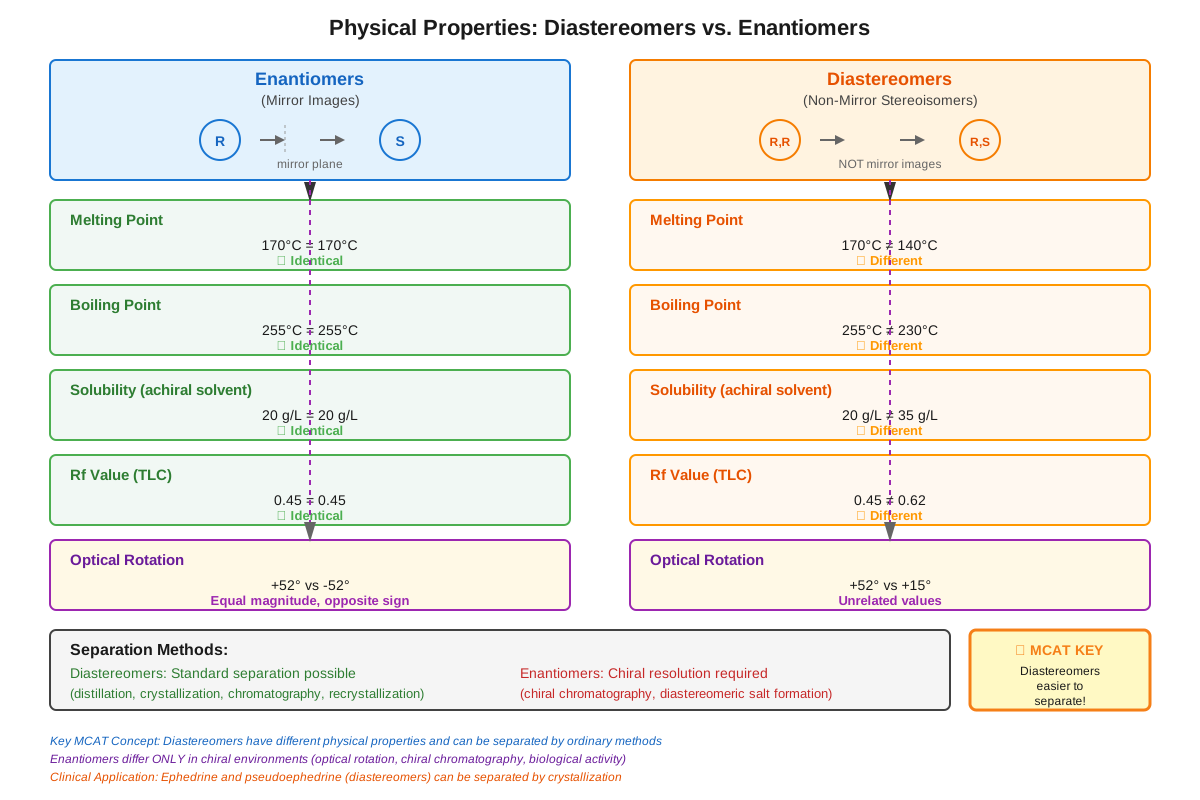
The key distinguishing feature of diastereomers compared to enantiomers is that diastereomers have different physical properties. While enantiomers share identical melting points, boiling points, solubilities, and refractive indices (differing only in optical rotation direction), diastereomers exhibit distinct values for all these properties. This fundamental difference makes diastereomers separable by conventional techniques and gives them different chemical reactivities in achiral environments.
Molecules with Multiple Stereocenters
The most common source of diastereomers involves molecules containing two or more stereocenters. For a molecule with n stereocenters, the maximum number of stereoisomers is 2^n (though this number may be reduced by molecular symmetry, as in meso compounds). Among these stereoisomers, any pair that are not mirror images of each other are diastereomers.
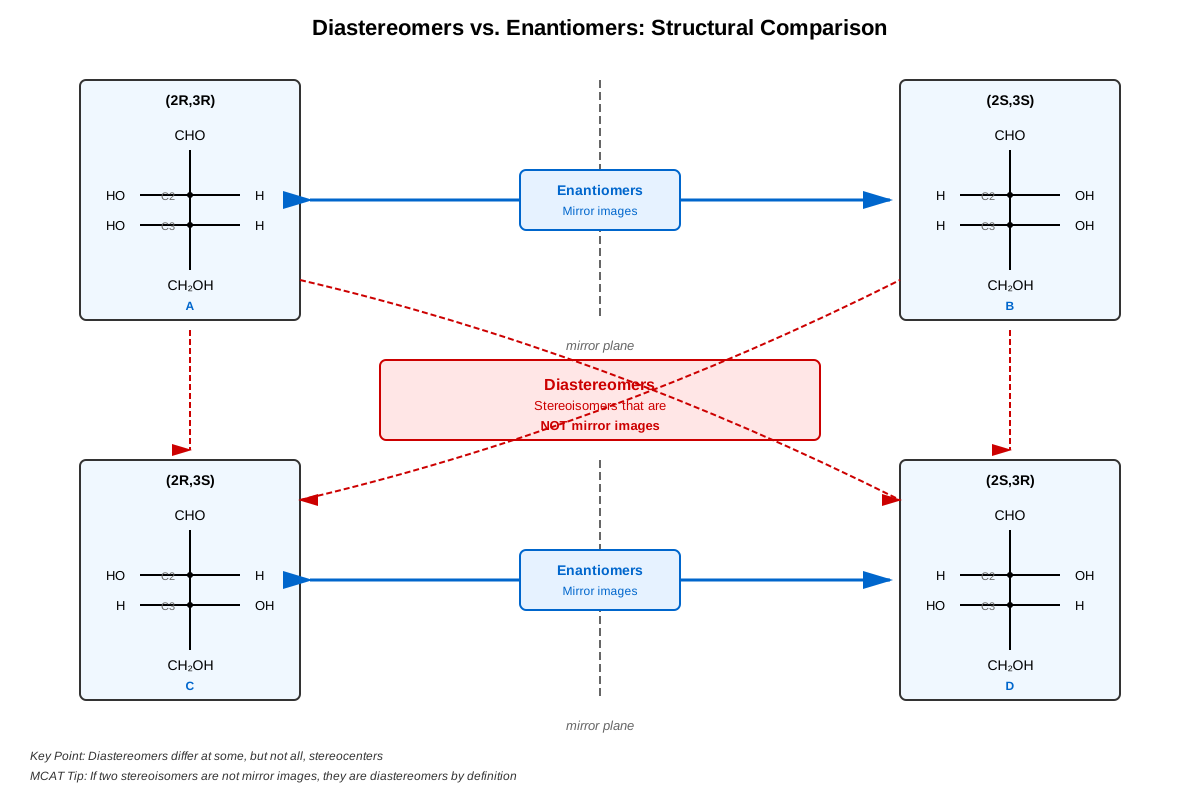
Consider 2,3-dibromobutane, which has two stereocenters (C-2 and C-3). This molecule can exist as four stereoisomers:
- (2R,3R)-2,3-dibromobutane
- (2S,3S)-2,3-dibromobutane
- (2R,3S)-2,3-dibromobutane
- (2S,3R)-2,3-dibromobutane
The (2R,3R) and (2S,3S) forms are enantiomers of each other (mirror images). The (2R,3S) and (2S,3R) forms are also enantiomers of each other. However, the (2R,3R) form and the (2R,3S) form are diastereomers—they are stereoisomers but not mirror images. In fact, any comparison between stereoisomers from these two enantiomeric pairs yields a diastereomeric relationship.
Geometric (Cis/Trans) Isomers as Diastereomers
Geometric isomers of alkenes and cyclic compounds represent another important class of diastereomers. The cis and trans isomers of 2-butene, for example, are diastereomers. They have the same molecular formula (C₄H₈) and the same connectivity but differ in the spatial arrangement of substituents around the double bond. These isomers exhibit different physical properties: cis-2-butene has a boiling point of 3.7°C, while trans-2-butene boils at 0.9°C.
Similarly, cis and trans isomers of disubstituted cyclohexanes are diastereomers. Cis-1,2-dimethylcyclohexane and trans-1,2-dimethylcyclohexane cannot be interconverted without breaking bonds, and they possess different physical and chemical properties. The MCAT frequently tests the recognition that geometric isomers fall under the broader category of diastereomers.
Meso Compounds
Meso compounds represent a special case in stereochemistry—molecules that contain stereocenters but are achiral due to an internal plane of symmetry. These compounds are diastereomers of their chiral stereoisomers. For example, meso-tartaric acid has two stereocenters but possesses a plane of symmetry that makes the molecule achiral. It is a diastereomer of both (2R,3R)-tartaric acid and (2S,3S)-tartaric acid (which are enantiomers of each other).
The presence of meso compounds reduces the number of stereoisomers below the theoretical maximum of 2^n. For tartaric acid with two stereocenters, instead of four stereoisomers (2² = 4), there are only three: the (R,R) enantiomer, the (S,S) enantiomer, and the meso form. Recognizing meso compounds is crucial for correctly counting stereoisomers on MCAT questions.
Epimers
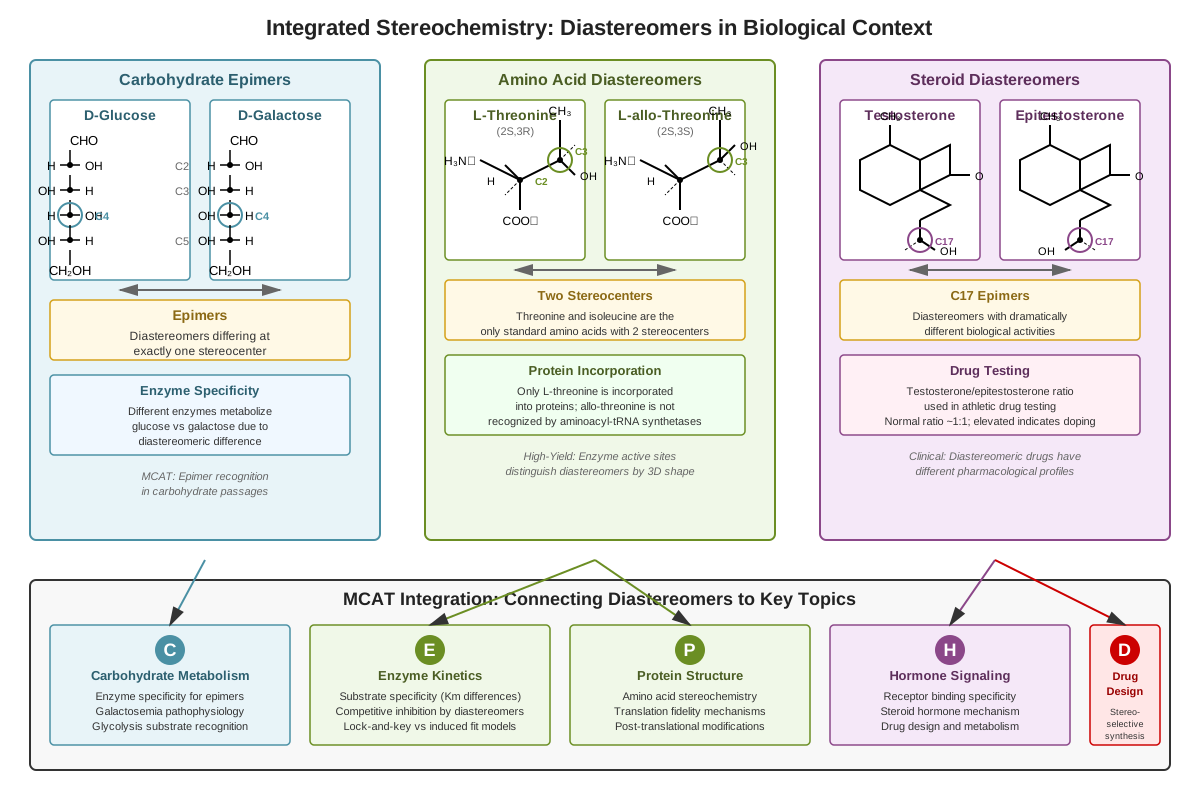
Epimers are a specific type of diastereomer that differ in configuration at only one stereocenter. This term is particularly important in carbohydrate chemistry. For example, D-glucose and D-mannose are epimers—they differ only at C-2. Similarly, D-glucose and D-galactose are epimers, differing only at C-4. Because they differ at one stereocenter but not all stereocenters, they are not enantiomers; they are diastereomers with a specific relationship.
The concept of epimers is high-yield for MCAT biochemistry passages involving carbohydrate metabolism and structure. Understanding that epimers are diastereomers helps predict that they will have different physical properties and different biological activities.
Anomers
Anomers are a special type of epimer that occur in cyclic forms of sugars. When a sugar cyclizes, the carbonyl carbon becomes a new stereocenter (the anomeric carbon). The two possible configurations at this position are designated α and β. For example, α-D-glucopyranose and β-D-glucopyranose are anomers—they are diastereomers that differ only at the anomeric carbon (C-1 in glucose).
Anomers are critical for understanding carbohydrate chemistry on the MCAT, particularly in passages about glycosidic bond formation, mutarotation, and reducing sugars. The ability to recognize that anomers are diastereomers explains why they have different physical properties and different reactivities.
Property Differences Between Diastereomers
The following table summarizes the key property differences between diastereomers and enantiomers:
| Property | Enantiomers | Diastereomers |
|---|---|---|
| Relationship | Mirror images | Not mirror images |
| Melting point | Identical | Different |
| Boiling point | Identical | Different |
| Solubility | Identical | Different |
| Refractive index | Identical | Different |
| Optical rotation magnitude | Identical (opposite sign) | Different |
| Chemical reactivity (achiral environment) | Identical | Different |
| Chemical reactivity (chiral environment) | Different | Different |
| Separation method | Requires chiral resolution | Standard techniques work |
| NMR spectra | Identical | Different |
This table is extremely high-yield for MCAT questions that ask students to predict experimental outcomes or explain why certain separation techniques will or will not work.
Calculating Stereoisomer Numbers
For molecules with n stereocenters and no internal symmetry, the maximum number of stereoisomers is 2^n. These stereoisomers can be organized into enantiomeric pairs, and all relationships between non-mirror-image stereoisomers are diastereomeric.
For a molecule with three stereocenters (like glyceraldehyde-3-phosphate derivatives), there are 2³ = 8 possible stereoisomers, forming four enantiomeric pairs. Each stereoisomer has one enantiomer and six diastereomers.
When internal symmetry exists (creating meso compounds), the actual number of stereoisomers is less than 2^n. The MCAT frequently tests this concept by presenting molecules and asking students to determine the number of stereoisomers or identify which structures are diastereomers.
Concept Relationships
The concept of diastereomers sits at the intersection of multiple stereochemical principles. Understanding chirality and stereocenters → enables recognition of molecules that can exist as stereoisomers → which are classified as either enantiomers (mirror images) or diastereomers (non-mirror images).
Within the category of diastereomers, several specialized relationships exist: geometric isomers (cis/trans or E/Z) represent diastereomers arising from restricted rotation → epimers represent diastereomers differing at exactly one stereocenter → anomers represent epimers specifically at the anomeric carbon of cyclic sugars. The concept of meso compounds intersects with diastereomers because meso forms are diastereomers of the chiral stereoisomers of the same molecule.
Diastereomers connect forward to more advanced topics: understanding diastereomeric relationships is essential for predicting stereochemical outcomes of reactions → analyzing conformational isomers of cyclic systems → interpreting NMR spectroscopy data where diastereomers show different splitting patterns → and understanding carbohydrate chemistry where most monosaccharides are diastereomers of each other.
The property differences between diastereomers (unlike enantiomers) directly enable separation techniques and explain why biological systems can distinguish between diastereomers even in achiral environments. This connects stereochemistry to practical laboratory techniques and biochemical function.
Quick check — test yourself on Diastereomers so far.
Try Flashcards →High-Yield Facts
⭐ Diastereomers are stereoisomers that are NOT mirror images of each other; this is the fundamental defining characteristic
⭐ Diastereomers have different physical properties (melting point, boiling point, solubility), unlike enantiomers which share identical physical properties
⭐ For a molecule with n stereocenters and no symmetry, there are 2^n stereoisomers; meso compounds reduce this number
⭐ Cis and trans isomers of alkenes and cyclic compounds are diastereomers
⭐ Diastereomers can be separated using standard laboratory techniques (distillation, crystallization, regular chromatography), while enantiomers require chiral resolution
- Epimers are diastereomers that differ in configuration at exactly one stereocenter
- Anomers (α and β forms of cyclic sugars) are diastereomers that differ at the anomeric carbon
- Meso compounds are achiral molecules with stereocenters; they are diastereomers of their chiral stereoisomers
- Diastereomers have different chemical reactivities even in achiral environments
- In a molecule with multiple stereocenters, changing the configuration at some (but not all) stereocenters converts an enantiomer into a diastereomer
- Diastereomers produce different NMR spectra, while enantiomers produce identical NMR spectra
- D-glucose and D-galactose are diastereomers (specifically, C-4 epimers)
- Threonine has two stereocenters; L-threonine and L-allothreonine are diastereomers
Common Misconceptions
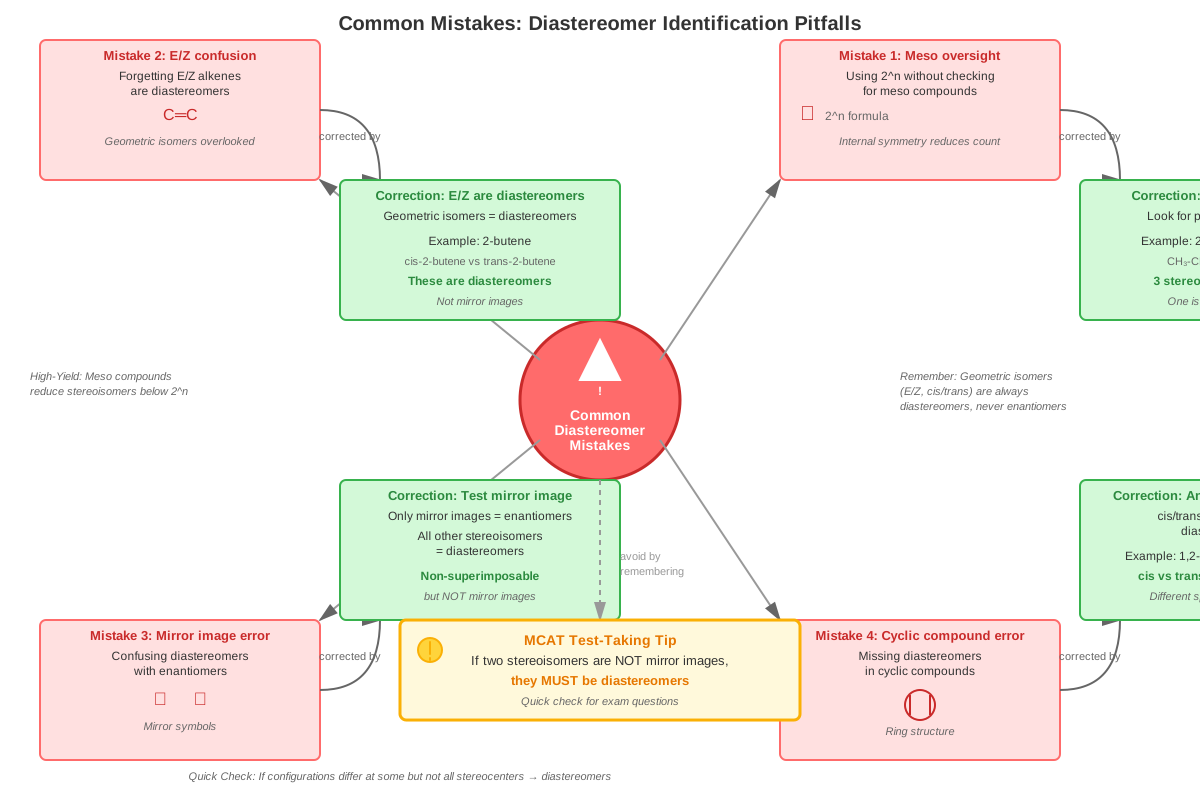
Misconception: All stereoisomers are either enantiomers or diastereomers in equal numbers.
Correction: For a molecule with n stereocenters, there are 2^n stereoisomers total, but they don't divide evenly into enantiomers and diastereomers. Stereoisomers form enantiomeric pairs (each stereoisomer has exactly one enantiomer), and all other relationships are diastereomeric. A molecule with three stereocenters has 8 stereoisomers: each has 1 enantiomer and 6 diastereomers.
Misconception: Diastereomers must have multiple stereocenters.
Correction: While molecules with multiple stereocenters commonly produce diastereomers, geometric isomers (cis/trans alkenes or cyclic compounds) are also diastereomers, and these may have zero stereocenters. For example, cis-2-butene and trans-2-butene are diastereomers but contain no stereocenters.
Misconception: Changing the configuration at any stereocenter converts a molecule to its enantiomer.
Correction: Changing the configuration at ALL stereocenters converts a molecule to its enantiomer. Changing the configuration at only SOME stereocenters produces a diastereomer. For example, converting (2R,3R)-dibromobutane to (2S,3S) gives the enantiomer, but converting it to (2S,3R) gives a diastereomer.
Misconception: Diastereomers have identical chemical reactivity.
Correction: Diastereomers have different chemical reactivities, even in achiral environments. This is a key distinction from enantiomers, which react identically in achiral environments. For example, cis and trans alkenes undergo addition reactions at different rates due to steric differences.
Misconception: Meso compounds are enantiomers of their chiral stereoisomers.
Correction: Meso compounds are diastereomers of their chiral stereoisomers, not enantiomers. A meso compound is achiral (not optically active) due to internal symmetry, so it cannot be an enantiomer of anything. Meso-tartaric acid is a diastereomer of (R,R)-tartaric acid and (S,S)-tartaric acid.
Misconception: If two molecules have the same molecular formula but different properties, they must be diastereomers.
Correction: Different properties alone don't establish a diastereomeric relationship. The molecules must be stereoisomers (same connectivity, different 3D arrangement) that are not mirror images. Constitutional isomers also have different properties but are not diastereomers because they have different connectivity.
Misconception: Anomers are enantiomers because they're mirror images at one carbon.
Correction: Anomers are diastereomers, not enantiomers. While α and β anomers differ at the anomeric carbon, they are not mirror images of the entire molecule. They differ in configuration at one stereocenter while maintaining the same configuration at all other stereocenters, making them epimers (a type of diastereomer).
Worked Examples
Example 1: Identifying Diastereomeric Relationships
Question: Consider 2,3,4-trihydroxybutanal (a molecule with three stereocenters at C-2, C-3, and C-4). How many stereoisomers exist? For the (2R,3R,4R) stereoisomer, how many diastereomers does it have?
Solution:
Step 1: Calculate the maximum number of stereoisomers.
- The molecule has 3 stereocenters
- Maximum stereoisomers = 2^n = 2³ = 8 stereoisomers
- Check for internal symmetry: this molecule has no plane of symmetry, so all 8 stereoisomers exist
Step 2: Identify the enantiomer of (2R,3R,4R).
- The enantiomer has the opposite configuration at ALL stereocenters
- Enantiomer: (2S,3S,4S)
Step 3: Determine the number of diastereomers.
- Total stereoisomers: 8
- Subtract the molecule itself: 8 - 1 = 7 other stereoisomers
- Subtract the enantiomer: 7 - 1 = 6 diastereomers
Step 4: List the diastereomers to verify.
The diastereomers of (2R,3R,4R) are:
- (2S,3R,4R) - differs at C-2 only
- (2R,3S,4R) - differs at C-3 only
- (2R,3R,4S) - differs at C-4 only
- (2S,3S,4R) - differs at C-2 and C-3
- (2S,3R,4S) - differs at C-2 and C-4
- (2R,3S,4S) - differs at C-3 and C-4
Answer: There are 8 stereoisomers total, and (2R,3R,4R) has 6 diastereomers.
Connection to Learning Objectives: This problem directly applies the 2^n rule for counting stereoisomers and demonstrates that each stereoisomer has exactly one enantiomer and all other stereoisomers are diastereomers. This is a common MCAT question format.
Example 2: Meso Compounds and Diastereomers
Question: 2,3-dibromobutane has two stereocenters. A student calculates that there should be 2² = 4 stereoisomers. However, upon drawing all possibilities, the student finds only 3 distinct compounds. Explain this discrepancy and identify the diastereomeric relationships.
Solution:
Step 1: Draw all possible stereoisomers based on configurations.
- (2R,3R)-2,3-dibromobutane
- (2S,3S)-2,3-dibromobutane
- (2R,3S)-2,3-dibromobutane
- (2S,3R)-2,3-dibromobutane
Step 2: Check for internal symmetry.
- Examine (2R,3S): C-2 has configuration R (Br on wedge, H on dash), C-3 has configuration S (Br on dash, H on wedge)
- When drawn in a Fischer projection or examined carefully, this molecule has a plane of symmetry through the C2-C3 bond
- The (2R,3S) and (2S,3R) forms are actually identical—they are the same meso compound
- Rotating (2R,3S) by 180° gives (2S,3R), confirming they are the same molecule
Step 3: Count the actual stereoisomers.
- (2R,3R) - chiral
- (2S,3S) - chiral, enantiomer of (2R,3R)
- (2R,3S) = (2S,3R) - meso compound (achiral)
- Total: 3 distinct stereoisomers
Step 4: Identify diastereomeric relationships.
- (2R,3R) and (2S,3S) are enantiomers of each other
- (2R,3R) and meso are diastereomers
- (2S,3S) and meso are diastereomers
Answer: The discrepancy occurs because (2R,3S) and (2S,3R) are the same meso compound due to internal symmetry. There are only 3 stereoisomers: two enantiomers and one meso form. The meso compound is a diastereomer of both chiral forms.
Connection to Learning Objectives: This example addresses the common mistake of not recognizing meso compounds and demonstrates how internal symmetry reduces the number of stereoisomers below 2^n. It also shows that meso compounds are diastereomers of their chiral counterparts, a frequently tested concept on the MCAT.
Exam Strategy
Approaching MCAT Questions on Diastereomers
When encountering stereochemistry questions on the MCAT, follow this systematic approach:
- Identify all stereocenters in the molecule first (look for sp³ carbons with four different groups)
- Calculate the maximum number of stereoisomers using 2^n
- Check for internal symmetry that might create meso compounds
- Determine what the question is asking: relationship between specific structures, number of stereoisomers, or property differences
Trigger Words and Phrases
Watch for these high-yield terms that signal diastereomer-related questions:
- "How many stereoisomers..." → Use 2^n rule, check for meso
- "Different physical properties" → Indicates diastereomers, not enantiomers
- "Can be separated by distillation/crystallization" → Diastereomers
- "Epimer" → Diastereomers differing at one stereocenter
- "Anomer" → Diastereomers at the anomeric carbon
- "Cis and trans" → Geometric isomers are diastereomers
- "Meso compound" → Achiral molecule with stereocenters, diastereomer of chiral forms
Process of Elimination Tips
When evaluating answer choices:
- Eliminate options that confuse enantiomers with diastereomers: If the question asks about property differences and an answer says "identical properties," eliminate it if discussing diastereomers
- Rule out answers that give 2^n stereoisomers when symmetry exists: If you identify a meso compound, the answer must be less than 2^n
- Eliminate choices that claim diastereomers require chiral separation: Diastereomers can be separated by standard techniques
- Watch for answers that incorrectly classify geometric isomers: Cis/trans isomers are always diastereomers, never enantiomers
Time Allocation Advice
For discrete questions on diastereomers (2-3 minutes):
- Spend 30 seconds identifying stereocenters and calculating 2^n
- Spend 30 seconds checking for meso compounds
- Spend 60 seconds evaluating answer choices
- Spend 30 seconds verifying your answer
For passage-based questions (6-8 minutes per passage):
- During passage reading, note any molecules with multiple stereocenters
- Flag mentions of separation techniques or property measurements
- When a question asks about stereoisomers, refer back to structures in the passage
- Use the passage context to eliminate impossible answers
Memory Techniques
Mnemonics
"DIME" for Diastereomer Properties:
- Different physical properties
- Isomers (stereo-) that aren't mirror images
- Multiple stereocenters often involved
- Easily separated (standard techniques)
"MEND" for Meso Compounds:
- Mirror plane present
- Equal and opposite stereocenters
- Not optically active
- Diastereomer of chiral forms
"CAGE" for Counting Stereoisomers:
- Count stereocenters (n)
- Apply 2^n formula
- Gauge for symmetry (meso)
- Evaluate actual number
Visualization Strategies
The Stereoisomer Family Tree: Visualize all stereoisomers of a molecule as a family tree. At the top level, divide them into enantiomeric pairs (siblings who are mirror images). Any relationship between members of different pairs is diastereomeric (cousins, not siblings).
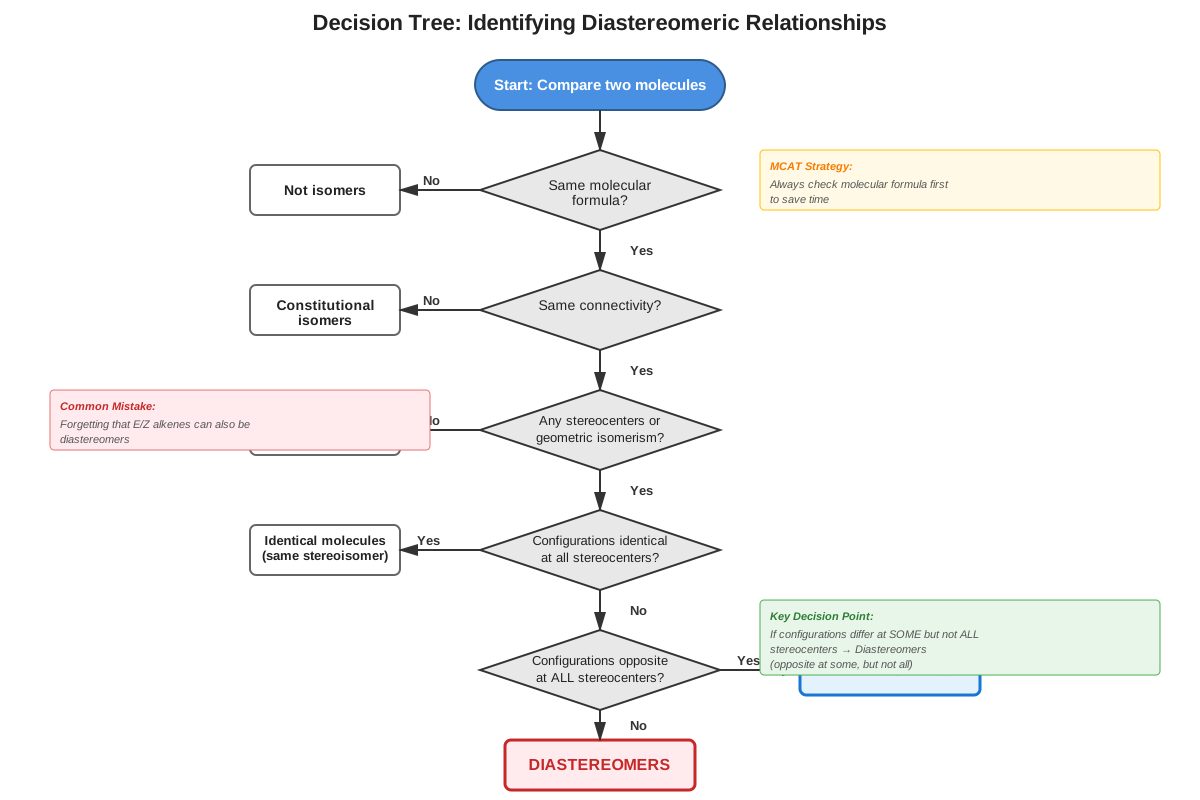
The Configuration Flip Test: When comparing two structures, mentally flip the configuration at each stereocenter one at a time. If you flip ALL stereocenters and get the second structure, they're enantiomers. If you flip SOME (but not all) and get the second structure, they're diastereomers.
The Property Difference Reminder: Picture enantiomers as identical twins wearing opposite gloves (same in all ways except mirror image). Picture diastereomers as siblings who look similar but have different heights, weights, and personalities (different in measurable ways).
Acronyms
ENDO - Enantiomers Need Different Optics (only optical rotation differs)
DAPS - Diastereomers Are Physically Separate (different properties allow separation)
Summary
Diastereomers are stereoisomers that are not mirror images of each other, representing a fundamental category in stereochemistry distinct from enantiomers. Unlike enantiomers, which share identical physical properties, diastereomers exhibit different melting points, boiling points, solubilities, and chemical reactivities, making them separable through standard laboratory techniques. Diastereomers arise from molecules with multiple stereocenters (where the maximum number of stereoisomers is 2^n), from geometric isomers of alkenes and cyclic compounds, and from special cases like meso compounds. Key subcategories include epimers (diastereomers differing at one stereocenter) and anomers (epimers at the anomeric carbon of cyclic sugars). For MCAT success, students must rapidly identify diastereomeric relationships, calculate stereoisomer numbers while accounting for meso compounds, and predict property differences that enable separation and explain biological selectivity. The ability to distinguish diastereomers from enantiomers and connect this knowledge to carbohydrate chemistry, amino acid configurations, and reaction mechanisms is essential for high-yield performance on stereochemistry questions.
Key Takeaways
- Diastereomers are stereoisomers that are NOT mirror images, distinguishing them fundamentally from enantiomers
- Diastereomers have different physical and chemical properties, unlike enantiomers which share identical properties except optical rotation direction
- The maximum number of stereoisomers for n stereocenters is 2^n, but meso compounds reduce this number
- Geometric isomers (cis/trans), epimers, and anomers are all types of diastereomers commonly tested on the MCAT
- Diastereomers can be separated using standard techniques (distillation, crystallization, regular chromatography), while enantiomers require chiral resolution
- Each stereoisomer has exactly one enantiomer and all other stereoisomers are diastereomers, a relationship critical for counting problems
- Meso compounds are achiral molecules with stereocenters that are diastereomers of their chiral stereoisomers, reducing the total number of distinct stereoisomers
Related Topics
Enantiomers and Optical Activity: Understanding the mirror-image relationship and optical rotation provides essential contrast to diastereomers; mastering diastereomers enables deeper comprehension of why only enantiomers have identical physical properties.
Fischer Projections: This representation system is crucial for visualizing molecules with multiple stereocenters and identifying meso compounds; proficiency with diastereomers makes Fischer projections more intuitive.
Carbohydrate Chemistry: Monosaccharides are polyhydroxy aldehydes or ketones with multiple stereocenters; understanding diastereomers is essential for distinguishing glucose, galactose, mannose, and other sugars.
Amino Acid Stereochemistry: Threonine and isoleucine have two stereocenters, creating diastereomeric relationships; mastering diastereomers enables understanding of why L-threonine and L-allothreonine are different amino acids.
Reaction Stereochemistry: Many reactions create new stereocenters; understanding diastereomers is necessary for predicting whether products will be separable and analyzing stereochemical outcomes.
Conformational Analysis: Ring systems like cyclohexane can have diastereomeric substituent arrangements (cis vs. trans); diastereomer knowledge connects to conformational stability and reactivity.
Practice CTA
Now that you've mastered the core concepts of diastereomers, it's time to reinforce your understanding through active practice. Work through the practice questions to test your ability to identify diastereomeric relationships, count stereoisomers, and predict property differences. Use the flashcards to drill high-yield facts until you can instantly recognize diastereomers in any context. Remember: stereochemistry questions are among the most predictable on the MCAT—consistent practice with diastereomers will translate directly into points on test day. You've built the foundation; now solidify it through repetition and application!
Sign up free to keep reading
Create a free AnvayaPrep account to finish this MCAT guide on Diastereomers — plus flashcards and practice questions.