Overview
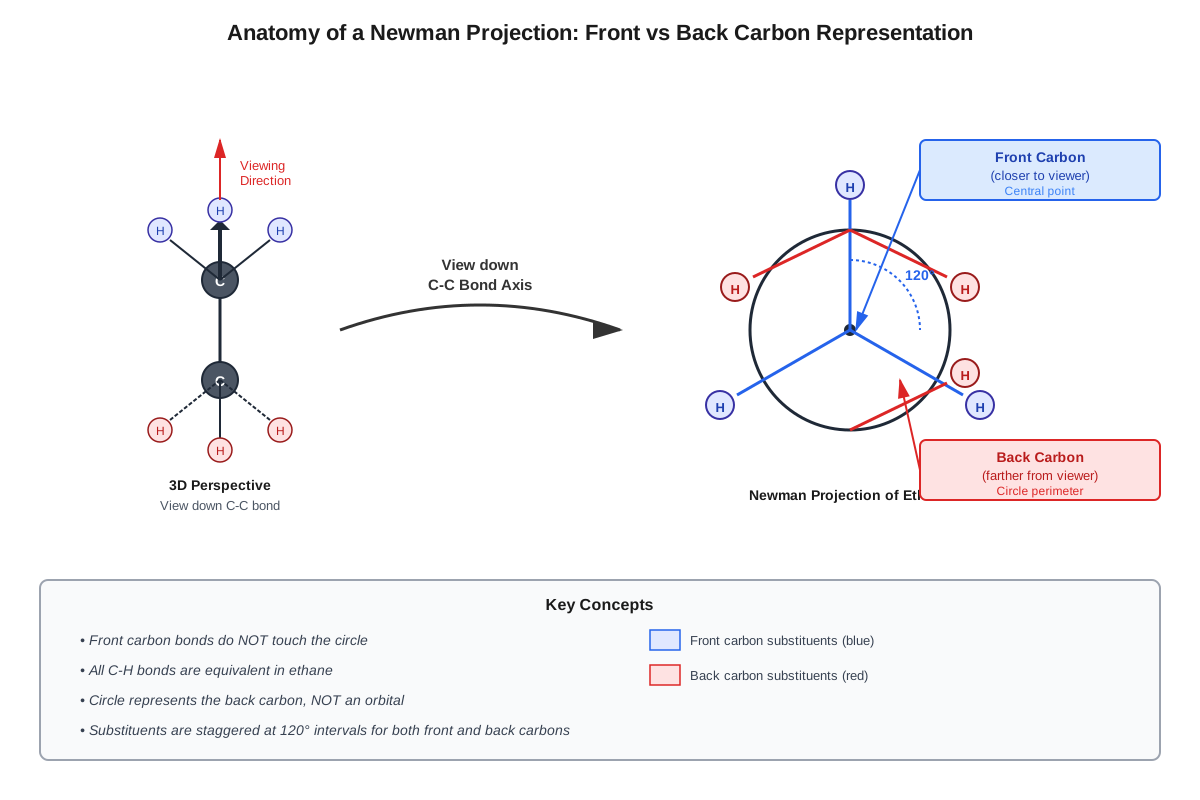
Newman projections are a fundamental visualization tool in Organic Chemistry that allow chemists and students to represent the three-dimensional spatial arrangement of atoms in a molecule by looking directly down a carbon-carbon bond axis. This projection method, named after Melvin Spencer Newman who introduced it in 1952, transforms complex three-dimensional molecular structures into simplified two-dimensional representations that clearly show the dihedral angles and spatial relationships between substituents on adjacent carbon atoms. In a Newman projection, the front carbon is represented as a point (or dot) at the center of a circle, while the back carbon is represented by the circle itself, with bonds radiating outward at 120° angles to show the three substituents attached to each carbon.
For the MCAT, Newman projections serve as an essential bridge between two-dimensional structural formulas and the actual three-dimensional conformations that molecules adopt in biological systems. Understanding Newman projections is critical for analyzing Stereochemistry and Conformation, predicting molecular stability, and explaining the physical and chemical properties of organic compounds. The MCAT frequently tests students' ability to interconvert between different molecular representations, identify the most stable conformations of molecules, and understand how conformational changes affect reactivity and biological function. Questions may appear in both the Chemical and Physical Foundations of Biological Systems section and in passage-based contexts involving enzyme-substrate interactions, drug design, or metabolic pathways.
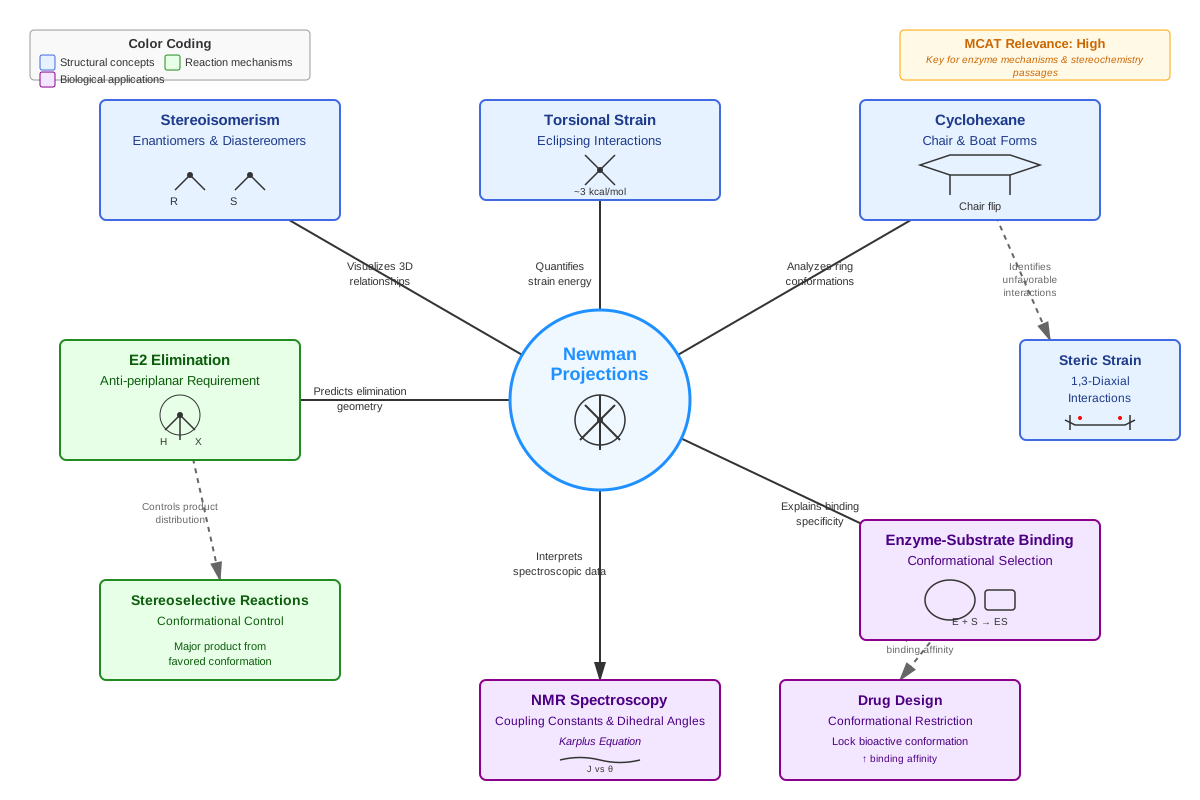
Newman projections connect directly to broader concepts in Organic Chemistry including stereoisomerism, conformational analysis, steric strain, torsional strain, and the relationship between molecular structure and energy. Mastery of Newman projections enables students to predict reaction outcomes, understand the conformational preferences of cyclic compounds, and appreciate how subtle changes in molecular geometry can dramatically affect biological activity. This topic integrates mathematical concepts (dihedral angles), physical chemistry principles (potential energy diagrams), and biological applications (protein folding, membrane fluidity), making it a high-yield area for interdisciplinary MCAT questions.
Learning Objectives
- [ ] Define Newman projections using accurate Organic Chemistry terminology
- [ ] Explain why Newman projections matters for the MCAT
- [ ] Apply Newman projections to exam-style questions
- [ ] Identify common mistakes related to Newman projections
- [ ] Connect Newman projections to related Organic Chemistry concepts
- [ ] Draw accurate Newman projections from wedge-dash structures and vice versa
- [ ] Calculate and compare the relative energies of different conformations using Newman projections
- [ ] Predict the most stable conformation of substituted alkanes using steric and electronic considerations
- [ ] Analyze conformational energy diagrams and relate them to Newman projection representations
Prerequisites
- Basic bonding theory and molecular geometry: Understanding sp³ hybridization and tetrahedral geometry is essential for visualizing the three-dimensional arrangement of substituents in Newman projections
- Wedge-dash notation: Familiarity with representing three-dimensional structures on paper enables conversion between different representational systems
- Alkane nomenclature and structure: Knowledge of carbon chain structures provides the foundation for analyzing conformational isomers
- Basic thermodynamics and energy concepts: Understanding that molecules adopt lower-energy conformations helps explain conformational preferences
- Stereochemistry fundamentals: Recognition of chirality and spatial relationships prepares students for more complex conformational analysis
Why This Topic Matters
Newman projections appear regularly on the MCAT, typically in 2-4 questions per exam either as standalone discrete questions or embedded within passage-based scenarios. The MCAT tests Newman projections most frequently in the context of conformational analysis, asking students to identify the most stable conformation, calculate energy differences between conformers, or predict how conformational changes affect molecular properties. Questions often integrate Newman projections with other topics such as cyclohexane chair conformations, stereoisomer relationships, or reaction mechanisms where conformational effects influence reactivity.
In real-world and clinical contexts, conformational analysis using Newman projections helps explain drug-receptor interactions, where the bioactive conformation of a pharmaceutical compound determines its efficacy. The conformational flexibility of molecules affects membrane permeability, enzyme catalysis, and protein-ligand binding. For example, the anti and gauche conformations of butane have different dipole moments and physical properties, which influences how similar molecules behave in biological systems. Understanding conformational preferences also explains why certain stereoisomers of drugs have different pharmacological activities—the three-dimensional shape adopted by the molecule determines how it fits into binding sites.
Common MCAT passage contexts include: analyzing the conformational preferences of sugar molecules in biochemical pathways, explaining why certain reaction intermediates are more stable based on their conformations, predicting the products of reactions where conformational effects control stereochemical outcomes, and interpreting experimental data (such as NMR coupling constants or energy barriers) that relate to molecular conformations. Discrete questions often present a molecule in one representation and ask students to identify the corresponding Newman projection or determine which conformation has the lowest energy.
Core Concepts
Definition and Basic Structure of Newman Projections
A Newman projection is a specific type of molecular representation that depicts a molecule by viewing it along a particular carbon-carbon bond axis. The observer's line of sight is directed straight down the bond, with the front carbon appearing as a point at the center and the back carbon represented as a circle. Each carbon atom has three substituents (which may be hydrogen atoms or other groups), and these are drawn as lines radiating from either the central point (front carbon) or from the edge of the circle (back carbon). The three bonds from each carbon are drawn at 120° angles from each other, even though the actual tetrahedral geometry has 109.5° bond angles—this is a convention of the projection method that simplifies visualization.
The dihedral angle (also called the torsion angle) is the angle between a substituent on the front carbon and a substituent on the back carbon when viewed down the bond axis. This angle is crucial for describing different conformations and ranges from 0° to 360°. When drawing Newman projections, the front carbon's bonds are typically drawn as lines meeting at the center point, while the back carbon's bonds extend from the circle's perimeter. This clear visual distinction helps prevent confusion about which substituents belong to which carbon.
Conformational Isomers and Rotation
Conformational isomers (or conformers) are different spatial arrangements of the same molecule that result from rotation around single bonds. Unlike constitutional isomers or stereoisomers, conformers can interconvert simply by rotating around sigma bonds without breaking any bonds. Newman projections are the ideal tool for visualizing and comparing these conformers because they clearly show the spatial relationships between substituents on adjacent carbons.
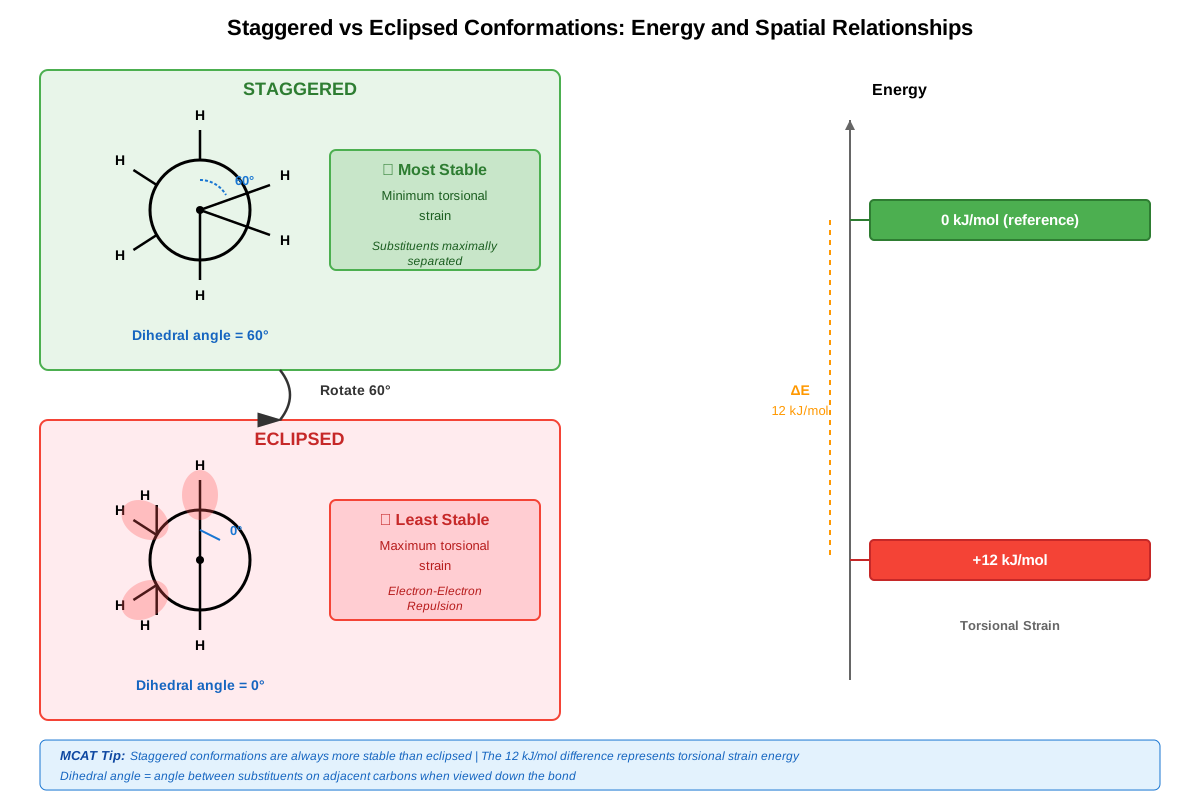
For ethane (C₂H₆), rotation around the C-C bond generates an infinite number of conformations, but two are particularly important: the eclipsed conformation (where substituents on adjacent carbons are aligned, with 0° dihedral angles) and the staggered conformation (where substituents are offset by 60° dihedral angles). The staggered conformation is approximately 3 kcal/mol more stable than the eclipsed conformation due to reduced torsional strain—the repulsion between electron clouds in bonds on adjacent atoms when they are aligned.
Types of Conformations
| Conformation | Dihedral Angle | Relative Energy | Key Features |
|---|---|---|---|
| Eclipsed | 0°, 120°, 240° | Highest | Maximum torsional strain; substituents aligned |
| Staggered | 60°, 180°, 300° | Lowest | Minimum torsional strain; substituents offset |
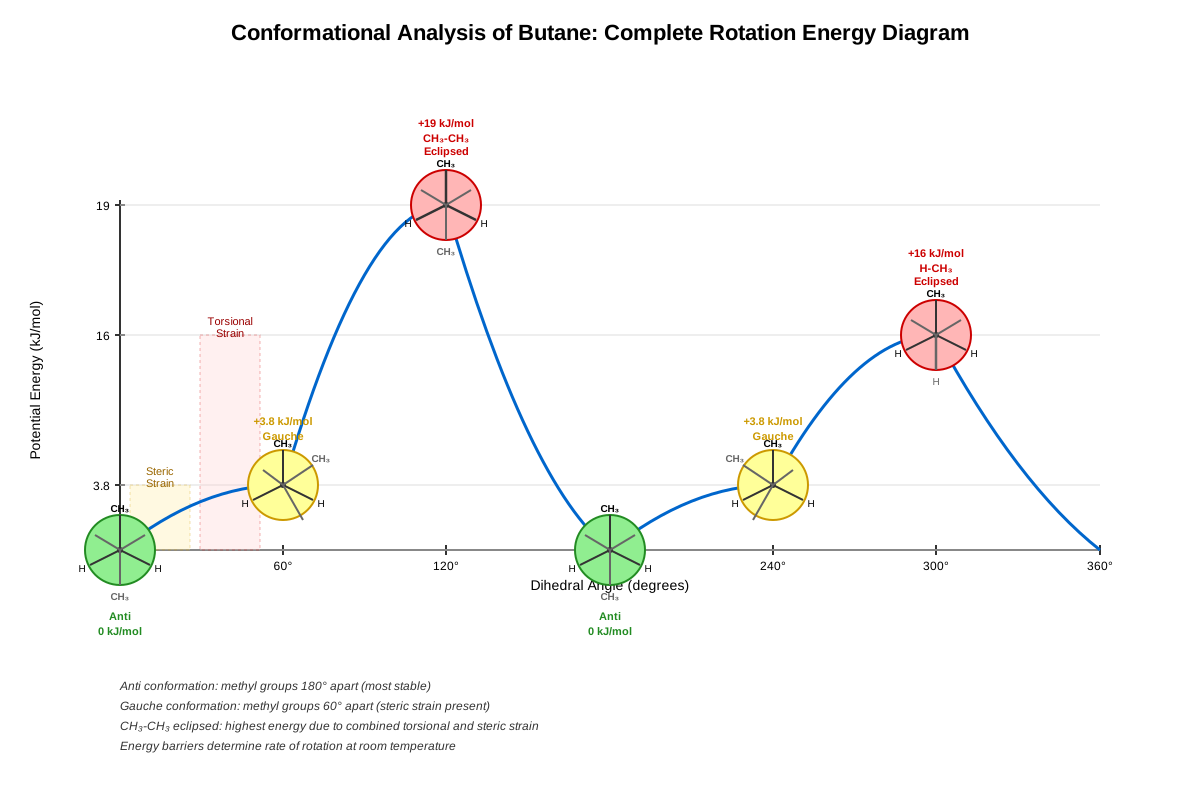
| Gauche | 60°, 300° | Intermediate | Staggered but with large groups close (±60°) |
| Anti | 180° | Lowest | Staggered with large groups opposite (most stable) |
For butane (CH₃-CH₂-CH₂-CH₃), analyzing the C2-C3 bond rotation reveals additional complexity. The molecule has both staggered and eclipsed conformations, but the staggered conformations are not all equivalent. The anti conformation (with methyl groups at 180° dihedral angle) is the most stable because the bulky methyl groups are as far apart as possible. The gauche conformations (with methyl groups at 60° or 300° dihedral angles) are staggered but less stable than anti due to steric strain—the repulsion between electron clouds of atoms or groups that are forced close together in space. The gauche conformation is approximately 0.9 kcal/mol higher in energy than the anti conformation.
Energy Considerations and Conformational Analysis
The conformational energy diagram plots potential energy versus dihedral angle for a complete 360° rotation around a bond. For butane, this diagram shows three energy maxima (eclipsed conformations) and three energy minima (staggered conformations). The highest energy conformation occurs when the two methyl groups are eclipsed (0° dihedral angle), combining both torsional strain and steric strain. This conformation is approximately 4-5 kcal/mol higher in energy than the anti conformation.
Understanding these energy differences is crucial for MCAT Organic Chemistry because:
- Molecules spend more time in lower-energy conformations (Boltzmann distribution)
- Conformational preferences affect reaction rates and mechanisms
- The energy barrier for rotation determines whether conformers can be isolated
- Biological molecules adopt specific conformations that optimize function
Drawing and Interconverting Newman Projections
To convert a wedge-dash structure to a Newman projection:
- Identify the bond of interest (the one you'll look down)
- Determine which carbon is "front" and which is "back"
- Draw a circle with a point at the center
- Place the three substituents from the front carbon as lines radiating from the center point
- Place the three substituents from the back carbon as lines radiating from the circle's edge
- Ensure proper dihedral angles between corresponding substituents
To convert a Newman projection back to a wedge-dash structure:
- Recognize that the central point represents the front carbon
- The circle represents the back carbon
- Bonds pointing up from the center are typically drawn as wedges (coming toward you)
- Bonds pointing down from the center are typically drawn as dashes (going away)
- Reconstruct the three-dimensional structure maintaining proper stereochemistry
Substituent Effects and Conformational Preferences
When substituents larger than hydrogen are present, conformational preferences become more pronounced. Electron-withdrawing groups and electron-donating groups can influence conformational stability through both steric and electronic effects. For example, in 1,2-disubstituted ethanes with polar substituents, the anti conformation is strongly favored not only for steric reasons but also to minimize dipole-dipole repulsions.
The gauche effect is an interesting exception where certain polar substituents (particularly those with lone pairs adjacent to the bond of rotation) actually prefer gauche conformations over anti due to favorable orbital interactions. This phenomenon, while less commonly tested on the MCAT, demonstrates that conformational analysis must consider both steric and electronic factors.
Concept Relationships
Newman projections serve as the central visualization tool that connects multiple concepts in stereochemistry and conformational analysis. The relationship flow begins with molecular structure → Newman projection representation → conformational analysis → energy predictions → physical and chemical properties.
The prerequisite knowledge of sp³ hybridization and tetrahedral geometry directly enables understanding of why substituents are arranged as they are in Newman projections. The 109.5° tetrahedral angle is approximated as 120° in the projection for visual clarity, but the underlying geometry remains tetrahedral. Wedge-dash notation and Newman projections are complementary representation systems—both convey three-dimensional information but emphasize different aspects (overall structure versus specific bond rotation).
Within the topic itself, torsional strain and steric strain are the two fundamental energy components that determine conformational stability. These concepts combine to explain why certain conformations (anti, staggered) are preferred over others (eclipsed, gauche). The conformational energy diagram integrates all these concepts into a single visual representation that shows how energy varies with rotation.
Newman projections connect forward to cyclohexane conformations (chair and boat forms can be analyzed using Newman-like projections of specific C-C bonds), stereoisomer relationships (conformational analysis helps distinguish between enantiomers and diastereomers), and reaction mechanisms (conformational effects can control stereochemical outcomes in elimination and substitution reactions). The concept also relates to spectroscopy, as NMR coupling constants depend on dihedral angles that are easily visualized using Newman projections (Karplus equation).
Quick check — test yourself on Newman projections so far.
Try Flashcards →High-Yield Facts
⭐ The anti conformation is always the most stable staggered conformation for molecules with two large substituents on adjacent carbons
⭐ Eclipsed conformations are approximately 3 kcal/mol higher in energy than staggered conformations due to torsional strain
⭐ The gauche conformation of butane is approximately 0.9 kcal/mol less stable than the anti conformation due to steric strain between methyl groups
⭐ In Newman projections, the front carbon is represented as a point at the center, and the back carbon is represented as a circle
⭐ Dihedral angles of 0° indicate eclipsed conformations, while angles of 60° and 180° indicate staggered conformations
- The most unstable conformation of butane occurs when both methyl groups are eclipsed (0° dihedral angle), with an energy approximately 4-5 kcal/mol higher than the anti conformation
- At room temperature, molecules rapidly interconvert between conformations, but spend more time in lower-energy forms according to the Boltzmann distribution
- Newman projections are particularly useful for analyzing conformational effects in elimination reactions (E2 mechanism requires anti-periplanar geometry)
- The barrier to rotation around a C-C single bond in ethane is approximately 3 kcal/mol, which is easily overcome at room temperature
- Conformational analysis using Newman projections helps predict the stereochemical outcome of reactions where the reactive conformation determines product formation
- Multiple substituents on adjacent carbons create more complex conformational landscapes with multiple local energy minima
- Newman projections can be used to analyze any single bond, not just C-C bonds, though C-C bonds are most commonly examined on the MCAT
Common Misconceptions
Misconception: Newman projections show the actual bond angles in molecules (120°).
Correction: Newman projections use 120° angles for visual clarity and simplicity, but the actual bond angles around sp³ hybridized carbons are 109.5° (tetrahedral geometry). The projection is a representational tool, not a geometrically accurate depiction.
Misconception: Eclipsed and staggered conformations are different types of stereoisomers that cannot interconvert.
Correction: Eclipsed and staggered conformations are conformational isomers (conformers) that rapidly interconvert through rotation around single bonds at room temperature. They are not stereoisomers like enantiomers or diastereomers, which require bond breaking to interconvert.
Misconception: The gauche conformation is always unstable and should be avoided.
Correction: While the gauche conformation is higher in energy than the anti conformation for simple alkanes like butane, it is still a staggered conformation and is significantly more stable than any eclipsed conformation. Additionally, in some molecules with polar substituents, gauche conformations can be favored due to the gauche effect.
Misconception: All staggered conformations have the same energy.
Correction: Staggered conformations differ in energy depending on the size and nature of the substituents. The anti conformation (180° dihedral angle between large groups) is lower in energy than gauche conformations (60° dihedral angle) when bulky substituents are present due to reduced steric strain.
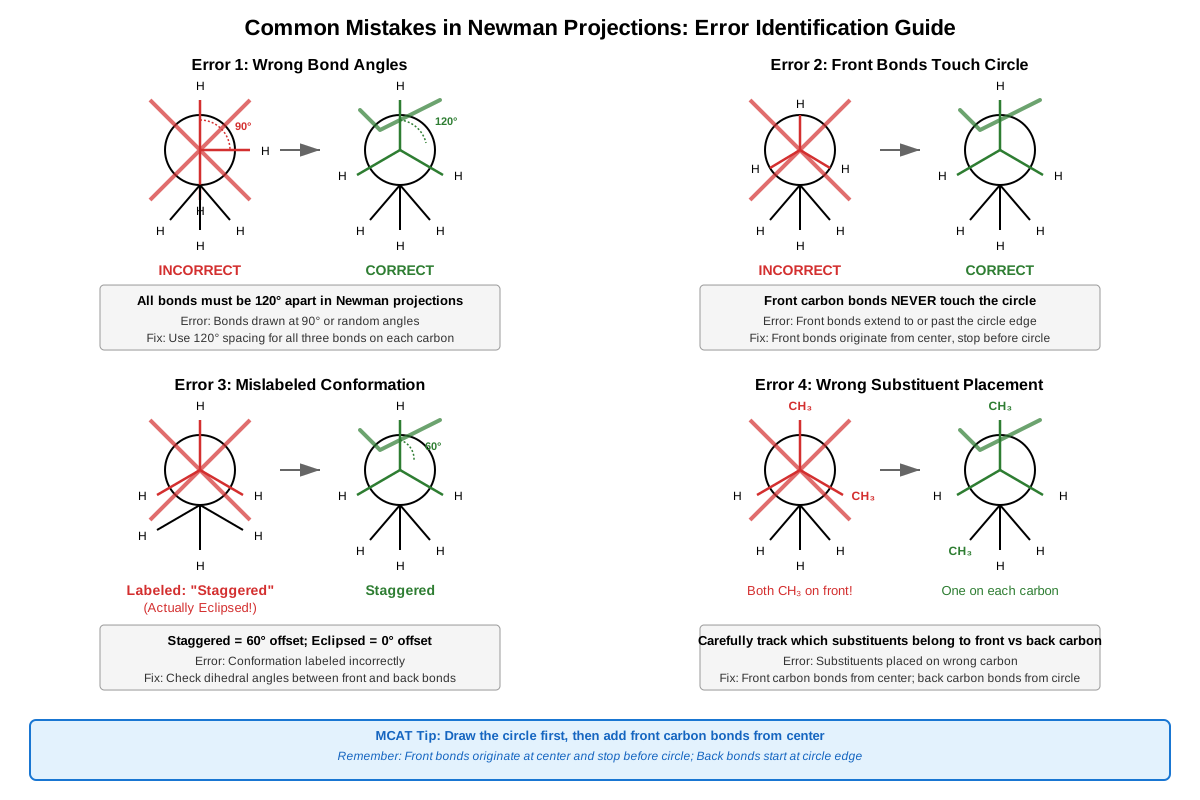
Misconception: The bonds drawn from the circle's edge in a Newman projection belong to the front carbon.
Correction: The bonds radiating from the circle's edge represent substituents on the back carbon. The front carbon's bonds are drawn as lines meeting at the central point. Confusing these assignments is one of the most common errors when drawing or interpreting Newman projections.
Misconception: Newman projections can only be used for ethane and butane.
Correction: Newman projections can be drawn for any molecule with a single bond, including more complex organic molecules, molecules with heteroatoms, and even portions of cyclic structures. The technique is universally applicable to conformational analysis of any single bond.
Worked Examples
Example 1: Identifying the Most Stable Conformation
Question: Consider 2-methylbutane (isopentane). Draw the Newman projection looking down the C2-C3 bond and identify the most stable conformation.
Solution:
Step 1: Identify the structure of 2-methylbutane: CH₃-CH(CH₃)-CH₂-CH₃
Step 2: Identify the C2-C3 bond. C2 has a methyl group, a hydrogen, and an ethyl group (CH₂CH₃) attached. C3 has two hydrogens and a methyl group attached.
Step 3: Draw the Newman projection with C2 as the front carbon. The three substituents on C2 are: -CH₃, -H, and -CH₂CH₃. The three substituents on C3 are: -CH₃, -H, and -H.
Step 4: Consider the possible staggered conformations:
- Anti conformation: The largest groups (ethyl on C2 and methyl on C3) are 180° apart
- Gauche conformations: The ethyl and methyl groups are 60° apart
Step 5: Apply conformational analysis principles. The anti conformation minimizes steric strain between the two largest substituents (ethyl and methyl groups). This will be the most stable conformation.
Step 6: Draw the most stable Newman projection with the ethyl group on C2 and the methyl group on C3 positioned anti (180° apart), with the remaining hydrogens and methyl group on C2 arranged to maintain staggered geometry.
Answer: The most stable conformation is the anti conformation with the ethyl group (on C2) and the methyl group (on C3) positioned 180° apart. This minimizes steric strain and represents the lowest energy arrangement.
Connection to Learning Objectives: This example demonstrates the application of Newman projections to determine conformational stability (LO: Apply Newman projections to exam-style questions) and connects conformational analysis to energy considerations (LO: Connect Newman projections to related Organic Chemistry concepts).
Example 2: Converting Between Representations and Calculating Energy Differences
Question: A student draws the following wedge-dash structure for a portion of a molecule and needs to analyze the conformational energy. Convert this to a Newman projection looking down the indicated bond, identify the conformation type, and estimate the energy difference from the most stable conformation.
Structure: CH₃-CH₂-CH₂-CH₃ (butane) with the C2-C3 bond of interest, where the two methyl groups are positioned at a 60° dihedral angle (gauche).
Solution:
Step 1: Identify the bond of interest (C2-C3) and determine which carbon will be "front" (C2) and which will be "back" (C3).
Step 2: Draw the Newman projection:
- Front carbon (C2): has -CH₃, -H, and -H attached
- Back carbon (C3): has -CH₃, -H, and -H attached
- Position the methyl groups at 60° dihedral angle
Step 3: Identify the conformation type. With the methyl groups at 60° apart and all other substituents staggered, this is a gauche conformation.
Step 4: Recall that for butane:
- The most stable conformation is anti (methyl groups at 180°)
- The gauche conformation is approximately 0.9 kcal/mol higher in energy than anti
- This energy difference is due to steric strain between the methyl groups when they are closer together
Step 5: Calculate the energy difference. The gauche conformation shown is approximately 0.9 kcal/mol less stable than the most stable (anti) conformation.
Step 6: Consider the biological/chemical significance. At room temperature (RT ≈ 0.6 kcal/mol of thermal energy), this energy difference means that while the anti conformation is favored, a significant population of molecules will exist in the gauche conformation. Using the Boltzmann distribution, approximately 20-25% of butane molecules exist in gauche conformations at room temperature.
Answer: The Newman projection shows a gauche conformation with the methyl groups at 60° dihedral angle. This conformation is approximately 0.9 kcal/mol higher in energy than the most stable anti conformation. The energy difference is small enough that both conformations are populated at room temperature, though anti is favored.
Connection to Learning Objectives: This example demonstrates conversion between representations (LO: Draw accurate Newman projections from wedge-dash structures), energy calculations (LO: Calculate and compare the relative energies of different conformations), and connects to thermodynamic principles (LO: Connect Newman projections to related Organic Chemistry concepts).
Exam Strategy
When approaching Newman projections MCAT questions, first identify what the question is asking: representation conversion, conformation identification, stability ranking, or energy calculation. Questions often present a molecule in one form and ask you to identify the corresponding Newman projection from multiple choices—use the systematic approach of identifying front and back carbons, then checking substituent positions.
Trigger words and phrases to watch for include: "most stable conformation" (look for anti with large groups), "highest energy conformation" (look for eclipsed with large groups aligned), "dihedral angle" (indicates you need to measure or identify angles between substituents), "staggered" or "eclipsed" (conformational descriptors), "rotation around the bond" (conformational analysis), and "energy barrier" (difference between conformational energy minima and maxima).
For process-of-elimination strategies specific to Newman projections:
- Eliminate any answer choices that show incorrect bonding (wrong number of substituents on each carbon)
- Eliminate conformations that violate the question's constraints (if asked for staggered, eliminate all eclipsed)
- When ranking stability, immediately eliminate any eclipsed conformations as less stable than staggered
- For "most stable" questions, look for the anti conformation first—it's usually the answer when large substituents are present
- Check dihedral angles carefully—a difference between 60° and 180° is the difference between gauche and anti
Time allocation advice: Newman projection questions typically take 45-60 seconds for discrete questions and up to 90 seconds when embedded in passages. Don't spend excessive time drawing perfect projections—rough sketches that show correct substituent relationships are sufficient. If a question asks you to draw multiple conformations, start with the most stable (anti) and most unstable (eclipsed with large groups aligned) to establish the energy range, then fill in intermediate conformations if needed.
Exam Tip: If you're unsure about a conformation's stability, remember the hierarchy: anti staggered > gauche staggered > eclipsed with small groups aligned > eclipsed with large groups aligned. This ranking applies to nearly all simple alkane conformational analysis questions.
Memory Techniques
Mnemonic for conformation stability: "Anti Gets Everything" (AGE)
- Anti = most stable staggered
- Gauche = intermediate staggered
- Eclipsed = least stable
Mnemonic for energy differences: "Three for torsion, one for steric"
- Eclipsed vs. staggered (torsional strain) ≈ 3 kcal/mol
- Anti vs. gauche (steric strain) ≈ 1 kcal/mol (actually 0.9)
Visualization strategy: Think of Newman projections as looking down the barrel of a gun—the front sight (front carbon) is a point, and the rear sight (back carbon) is a circle. The "bullets" (substituents) radiate outward from both.
Acronym for drawing Newman projections: "FPCB" (Front Point, Circle Back)
- Front carbon = Point at center
- Circle = Back carbon
Memory aid for dihedral angles:
- 0° = "Zero stability" (eclipsed, least stable)
- 60° = "Sixty is so-so" (gauche, intermediate)
- 180° = "One-eighty is great" (anti, most stable)
Conceptual visualization: Imagine two gears trying to mesh. When the teeth align (eclipsed), they clash and create strain. When the teeth are offset (staggered), they fit together smoothly with less resistance. This models torsional strain in conformations.
Summary
Newman projections are essential visualization tools in Organic Chemistry that represent molecules by looking directly down a carbon-carbon bond axis, with the front carbon shown as a central point and the back carbon as a circle. These projections enable analysis of conformational isomers—different spatial arrangements arising from rotation around single bonds. The key conformations are eclipsed (0° dihedral angles, highest energy due to torsional strain) and staggered (60° and 180° dihedral angles, lower energy). For molecules with bulky substituents like butane, the anti conformation (180° between large groups) is most stable, while gauche conformations (60° between large groups) are intermediate in energy due to steric strain. The energy differences between conformations—approximately 3 kcal/mol for torsional strain and 0.9 kcal/mol for steric strain in butane—determine conformational populations and affect molecular properties. For the MCAT, students must be able to draw Newman projections from other representations, identify conformation types, rank conformational stability, and connect conformational analysis to reaction mechanisms and biological function. Mastery requires understanding both the representational conventions and the underlying physical principles of molecular strain and stability.
Key Takeaways
- Newman projections visualize molecules along a C-C bond axis with the front carbon as a point and back carbon as a circle, showing dihedral angles between substituents
- Staggered conformations (60°, 180° dihedral angles) are more stable than eclipsed conformations (0° dihedral angles) by approximately 3 kcal/mol due to reduced torsional strain
- The anti conformation (180° between large groups) is the most stable arrangement for substituted alkanes, favored over gauche conformations (60° between large groups) by approximately 0.9 kcal/mol
- Conformational energy diagrams plot potential energy versus dihedral angle, showing energy maxima at eclipsed conformations and minima at staggered conformations
- Both steric strain (repulsion between atoms forced close together) and torsional strain (repulsion between aligned bonds) determine conformational stability
- Newman projections connect to MCAT topics including reaction mechanisms, stereochemistry, and biological molecule conformations
- At room temperature, molecules rapidly interconvert between conformations but spend more time in lower-energy forms according to the Boltzmann distribution
Related Topics
Cyclohexane Chair Conformations: Building on Newman projection principles, cyclohexane conformational analysis examines ring systems where multiple C-C bonds must be considered simultaneously. Understanding Newman projections of individual C-C bonds in cyclohexane helps explain axial-equatorial relationships and ring-flip energetics.
E2 Elimination Mechanism and Stereochemistry: The E2 mechanism requires anti-periplanar geometry between the leaving group and the β-hydrogen, which is best visualized using Newman projections. Mastering conformational analysis enables prediction of elimination product stereochemistry.
Stereoisomers and Chirality: While Newman projections primarily address conformational isomers, they also help distinguish between enantiomers and diastereomers by clearly showing three-dimensional spatial relationships. This connection is crucial for advanced stereochemistry problems.
Spectroscopy and Karplus Equation: NMR coupling constants depend on dihedral angles between protons, which are easily determined from Newman projections. The Karplus equation quantitatively relates dihedral angle to ³J coupling constants.
Reaction Mechanisms and Conformational Control: Many organic reactions proceed through specific conformations that minimize energy or optimize orbital overlap. Understanding conformational preferences helps predict reaction rates and stereochemical outcomes.
Practice CTA
Now that you've mastered the fundamentals of Newman projections, it's time to reinforce your understanding through active practice. Challenge yourself with the practice questions and flashcards designed specifically for this topic—they'll help you identify any remaining gaps in your knowledge and build the pattern recognition skills essential for rapid problem-solving on test day. Remember, conformational analysis is a skill that improves dramatically with practice. Each problem you work through strengthens your ability to visualize three-dimensional molecular structures and predict their behavior. You've built a solid foundation—now apply it with confidence!
Sign up free to keep reading
Create a free AnvayaPrep account to finish this MCAT guide on Newman projections — plus flashcards and practice questions.