Overview
R and S configuration is a systematic nomenclature method used in Organic Chemistry to describe the three-dimensional arrangement of substituents around a chiral center (stereocenter). This naming system, developed by Cahn, Ingold, and Prelog, provides an unambiguous way to communicate the absolute configuration of stereoisomers—molecules that have the same molecular formula and connectivity but differ in spatial arrangement. Understanding R and S configuration is fundamental to mastering Stereochemistry and Conformation, as it allows chemists and medical professionals to distinguish between enantiomers that may have drastically different biological activities.
For the MCAT, R and S configuration represents a critical skill set that bridges pure chemistry knowledge with biological and pharmacological applications. The exam frequently tests the ability to assign absolute configuration to chiral centers, recognize relationships between stereoisomers, and predict how stereochemistry affects molecular properties and biological function. Questions may appear as discrete items testing nomenclature skills or embedded within passages discussing drug mechanisms, enzyme specificity, or metabolic pathways where stereochemistry plays a crucial role.
The broader significance of R and S configuration MCAT content extends throughout organic chemistry and biochemistry. This topic connects directly to concepts such as optical activity, enantiomers and diastereomers, Fischer projections, and the biological specificity of enzymes and receptors. Mastery of R and S assignment enables students to predict and explain why one enantiomer of a drug may be therapeutic while its mirror image is inactive or even harmful—a concept with profound implications for pharmacology and medical practice.
Learning Objectives
- [ ] Define R and S configuration using accurate Organic Chemistry terminology
- [ ] Explain why R and S configuration matters for the MCAT
- [ ] Apply R and S configuration to exam-style questions
- [ ] Identify common mistakes related to R and S configuration
- [ ] Connect R and S configuration to related Organic Chemistry concepts
- [ ] Assign R or S configuration to chiral centers in complex molecules within 60 seconds
- [ ] Distinguish between absolute configuration (R/S) and relative configuration (D/L)
- [ ] Predict the number of stereoisomers in molecules with multiple chiral centers
- [ ] Evaluate the relationship between R/S configuration and biological activity in drug molecules
Prerequisites
- Tetrahedral geometry and sp³ hybridization: Understanding the three-dimensional shape around carbon atoms is essential for visualizing chiral centers and spatial arrangements of substituents
- Basic IUPAC nomenclature: Familiarity with naming organic compounds provides the foundation for adding stereochemical descriptors to chemical names
- Electronegativity and atomic number: The Cahn-Ingold-Prelog priority rules rely on atomic number comparisons to rank substituents
- Constitutional isomers vs. stereoisomers: Distinguishing these isomer types helps contextualize where R and S configuration fits within the broader classification of molecular diversity
- Chirality and chiral centers: Recognizing when a carbon atom is a stereocenter (has four different substituents) is the prerequisite for applying R/S nomenclature
Why This Topic Matters
Clinical and Real-World Significance
Stereochemistry has profound implications in medicine and pharmacology. Many drugs contain chiral centers, and the different enantiomers (R vs. S forms) can exhibit dramatically different biological activities. Thalidomide serves as a tragic historical example: one enantiomer treated morning sickness effectively, while the other caused severe birth defects. Modern examples include ibuprofen (where S-ibuprofen is the active anti-inflammatory agent) and citalopram (where S-citalopram, escitalopram, is the more potent antidepressant). Enzymes, receptors, and other biological molecules are themselves chiral and interact selectively with specific stereoisomers, making R and S configuration directly relevant to understanding drug design, metabolism, and therapeutic efficacy.
MCAT Exam Statistics and Question Types
R and S configuration appears in approximately 3-5% of Chemical and Physical Foundations questions and occasionally in Biological and Biochemical Foundations passages. The topic typically appears in three formats: (1) discrete questions asking students to assign configuration to a drawn structure, (2) passage-based questions where stereochemistry affects biological activity or reaction outcomes, and (3) questions requiring students to identify relationships between stereoisomers (enantiomers vs. diastereomers). The MCAT particularly favors questions that integrate stereochemistry with biological concepts, such as enzyme-substrate specificity or drug receptor interactions.
Common Exam Passage Contexts
MCAT passages incorporating R and S configuration frequently discuss pharmaceutical development, where researchers must separate or selectively synthesize specific enantiomers. Other common contexts include amino acid stereochemistry (all naturally occurring amino acids except glycine have S configuration at the α-carbon), carbohydrate chemistry (D and L sugars relate to R and S configuration), and enzyme mechanisms where substrate stereochemistry determines reaction outcomes. Passages may present experimental data comparing the biological activities of different stereoisomers or describe synthetic routes that produce specific configurations.
Core Concepts
Chiral Centers and Stereogenic Atoms
A chiral center (also called a stereocenter or stereogenic center) is an atom, typically carbon, bonded to four different substituents. This arrangement creates a non-superimposable mirror image, much like left and right hands. The presence of a chiral center is the prerequisite for assigning R or S configuration. Not all carbons are chiral centers—only those with four distinct groups attached qualify. For example, in 2-butanol (CH₃-CHOH-CH₂-CH₃), the second carbon is a chiral center because it's bonded to -H, -OH, -CH₃, and -CH₂CH₃ (four different groups).
The Cahn-Ingold-Prelog Priority Rules
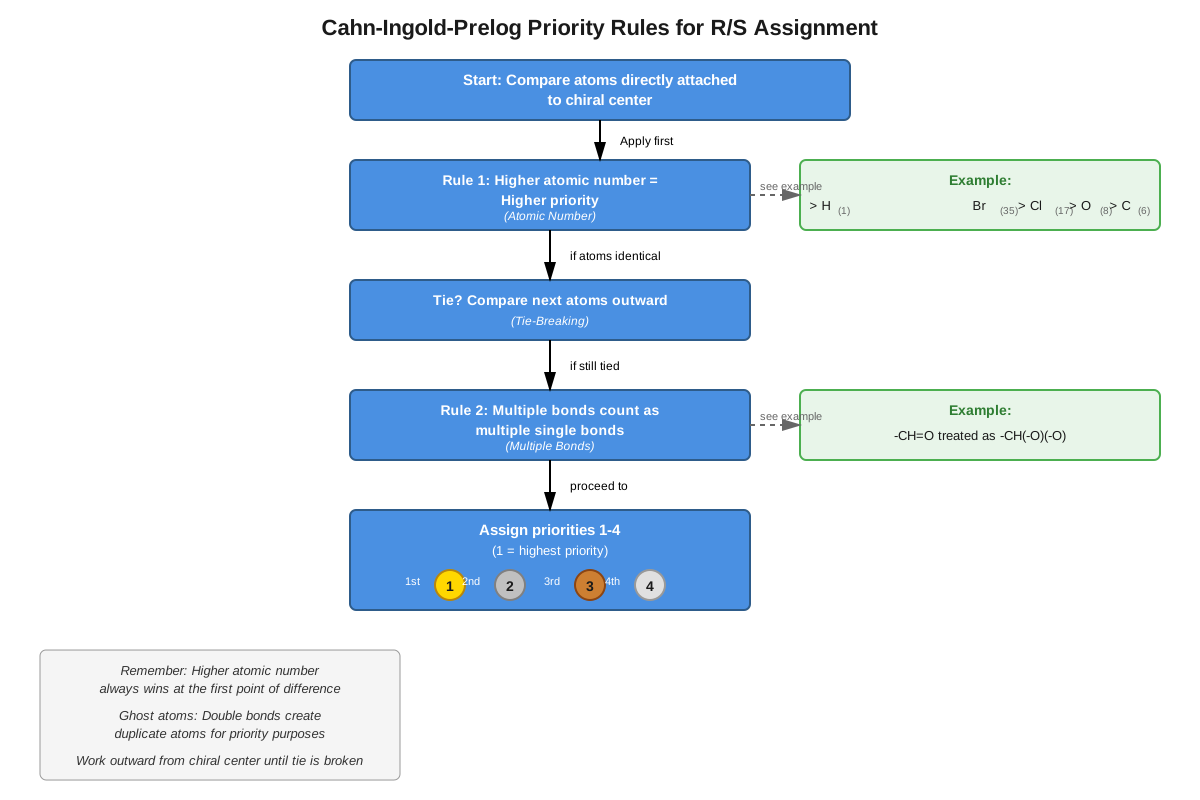
The Cahn-Ingold-Prelog (CIP) priority rules provide a systematic method for ranking the four substituents attached to a chiral center. These rules are essential for determining whether a stereocenter has R or S configuration:
- Rule 1 - Atomic Number: Compare the atoms directly attached to the chiral center. Higher atomic number = higher priority. For example, Br > Cl > O > N > C > H.
- Rule 2 - First Point of Difference: If the directly attached atoms are the same, move outward along the chain until reaching the first point of difference. For example, -CH₂CH₃ has higher priority than -CH₃ because at the second position, C (in ethyl) beats H (in methyl).
- Rule 3 - Multiple Bonds: Treat double and triple bonds as if the atoms were duplicated or triplicated. A carbonyl carbon (C=O) is treated as a carbon bonded to two oxygens, and the oxygen is treated as bonded to two carbons.
- Rule 4 - Isotopes: Heavier isotopes receive higher priority (deuterium > hydrogen).
Assigning R and S Configuration: The Step-by-Step Process
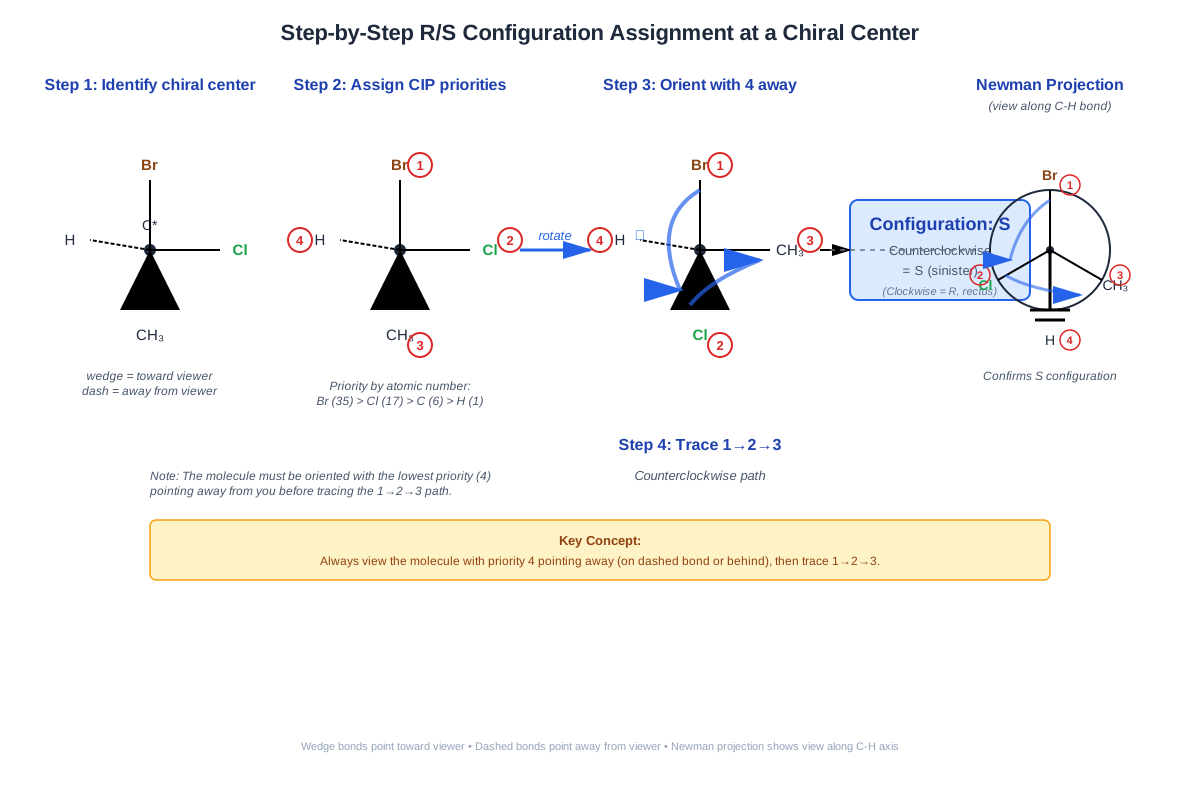
The systematic assignment of R and S configuration follows a precise protocol:
- Identify the chiral center: Locate the carbon (or other atom) with four different substituents.
- Assign priorities: Use the CIP rules to rank the four substituents from 1 (highest priority) to 4 (lowest priority).
- Orient the molecule: Position the molecule so the lowest priority group (4) points away from you, into the page. This is the critical viewing angle.
- Trace the path: Draw a circular path from priority 1 → 2 → 3.
- Determine configuration:
- If the path moves clockwise, the configuration is R (from Latin rectus, meaning right)
- If the path moves counterclockwise, the configuration is S (from Latin sinister, meaning left)
Handling Different Molecular Representations
MCAT questions present molecules in various formats, and students must adapt their R/S assignment technique accordingly:
Wedge-and-Dash Notation: Solid wedges project toward the viewer, dashed wedges project away. If the lowest priority group is already on a dashed wedge (pointing away), proceed directly with the 1→2→3 trace. If it's on a solid wedge (pointing toward you), the observed direction must be inverted.
Fischer Projections: In Fischer projections, horizontal lines project toward the viewer and vertical lines project away. To assign R/S configuration, either convert to wedge-and-dash notation or use the shortcut: if the lowest priority group is on a vertical line (pointing away), assign configuration normally; if on a horizontal line, assign the opposite of what you observe.
Newman Projections: These show the molecule along a C-C bond axis. To assign configuration, mentally convert to a standard tetrahedral representation or use the front carbon's substituents to determine configuration.
Multiple Chiral Centers and Stereoisomer Count
Molecules with multiple chiral centers generate multiple stereoisomers. The maximum number of stereoisomers for a molecule with n chiral centers is 2ⁿ (assuming no meso compounds). Each chiral center can independently be R or S, creating different combinations. For example, a molecule with two chiral centers can have up to four stereoisomers: (R,R), (R,S), (S,R), and (S,S). The (R,R) and (S,S) forms are enantiomers of each other, as are the (R,S) and (S,R) forms. However, (R,R) and (R,S) are diastereomers—stereoisomers that are not mirror images.
Relationship Between R/S and Optical Activity
It's crucial to understand that R and S configuration describes absolute three-dimensional arrangement, while (+) and (−) (or d and l) describe the direction of plane-polarized light rotation. These are independent properties. An R enantiomer might rotate light clockwise (+) or counterclockwise (−)—this cannot be predicted from configuration alone and must be determined experimentally. The MCAT may test whether students incorrectly assume R always corresponds to (+) rotation.
R/S vs. D/L Nomenclature
The D/L system (Fischer-Rosanoff convention) is an older nomenclature still used for amino acids and carbohydrates. It relates to the configuration of glyceraldehyde as a reference standard, not to absolute R/S configuration. For amino acids, all naturally occurring forms (except glycine, which is achiral) have S configuration at the α-carbon but are designated L-amino acids in the D/L system. This apparent contradiction confuses many students—the two systems use different reference standards and are not directly interconvertible without knowing the specific structure.
| Property | R/S System | D/L System |
|---|---|---|
| Basis | Absolute 3D configuration using CIP rules | Configuration relative to glyceraldehyde |
| Application | Universal for all chiral molecules | Primarily amino acids and carbohydrates |
| Determination | Systematic priority rules | Comparison to reference compound |
| Optical Activity | No correlation | No correlation |
| IUPAC Status | Preferred modern system | Historical, still used in biochemistry |
Concept Relationships
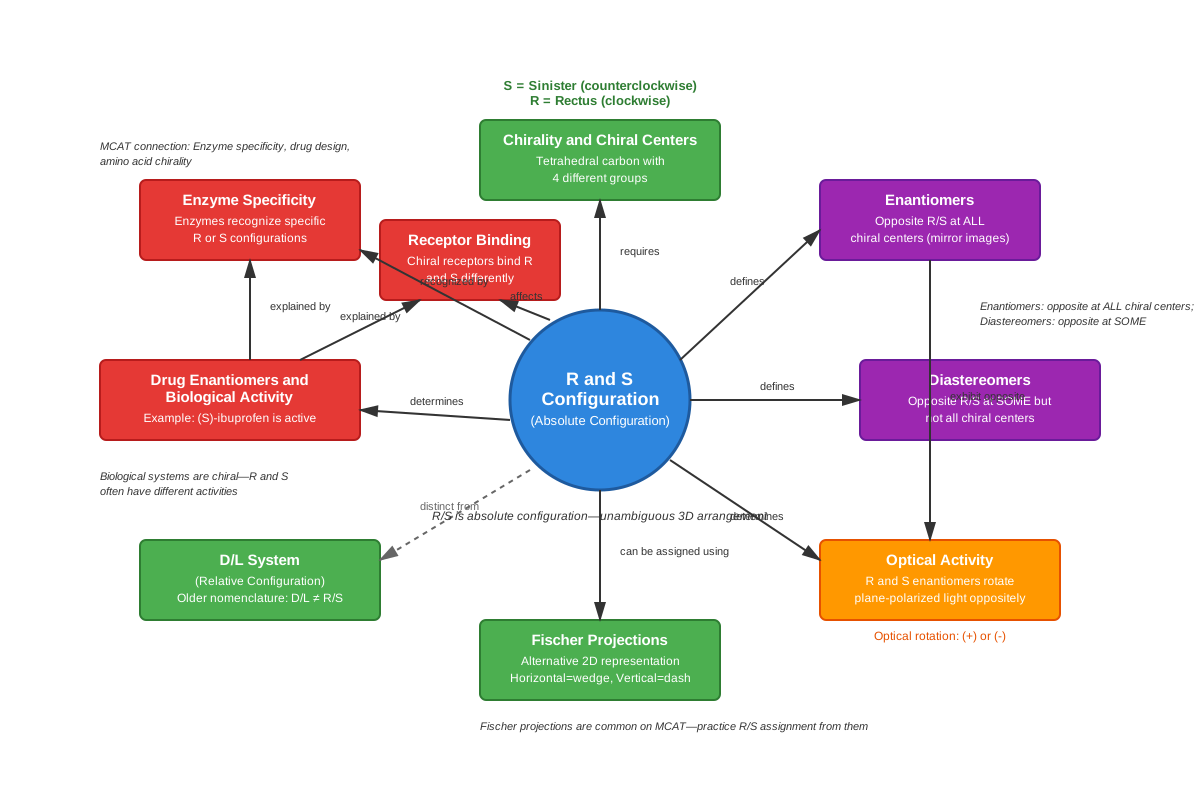
The assignment of R and S configuration builds directly on understanding chirality and chiral centers—without recognizing that a carbon has four different substituents, configuration assignment cannot begin. The Cahn-Ingold-Prelog priority rules serve as the algorithmic tool that converts structural information into ranked substituents, which then enables the directional determination of R or S.
R and S configuration connects forward to enantiomers and diastereomers: two molecules that differ only in configuration at a single chiral center are enantiomers (one R, one S), while molecules differing at some but not all chiral centers are diastereomers. This relationship flows into understanding optical activity, where enantiomers rotate plane-polarized light equally but in opposite directions, while diastereomers have different rotation values.
The concept extends laterally to conformational analysis: while R and S describe fixed configuration (which requires bond breaking to change), conformations represent rotational isomers that interconvert freely. Both concepts address three-dimensional molecular structure but at different levels of permanence.
In biochemical contexts, R and S configuration connects to enzyme specificity and receptor binding. Enzymes are chiral environments that discriminate between R and S substrates, explaining why only L-amino acids (S-configuration) are incorporated into proteins and why only D-glucose (specific configuration at multiple centers) is the primary metabolic fuel.
Conceptual Flow: Tetrahedral geometry → Chirality recognition → CIP priority assignment → R/S determination → Stereoisomer relationships → Biological activity prediction
High-Yield Facts
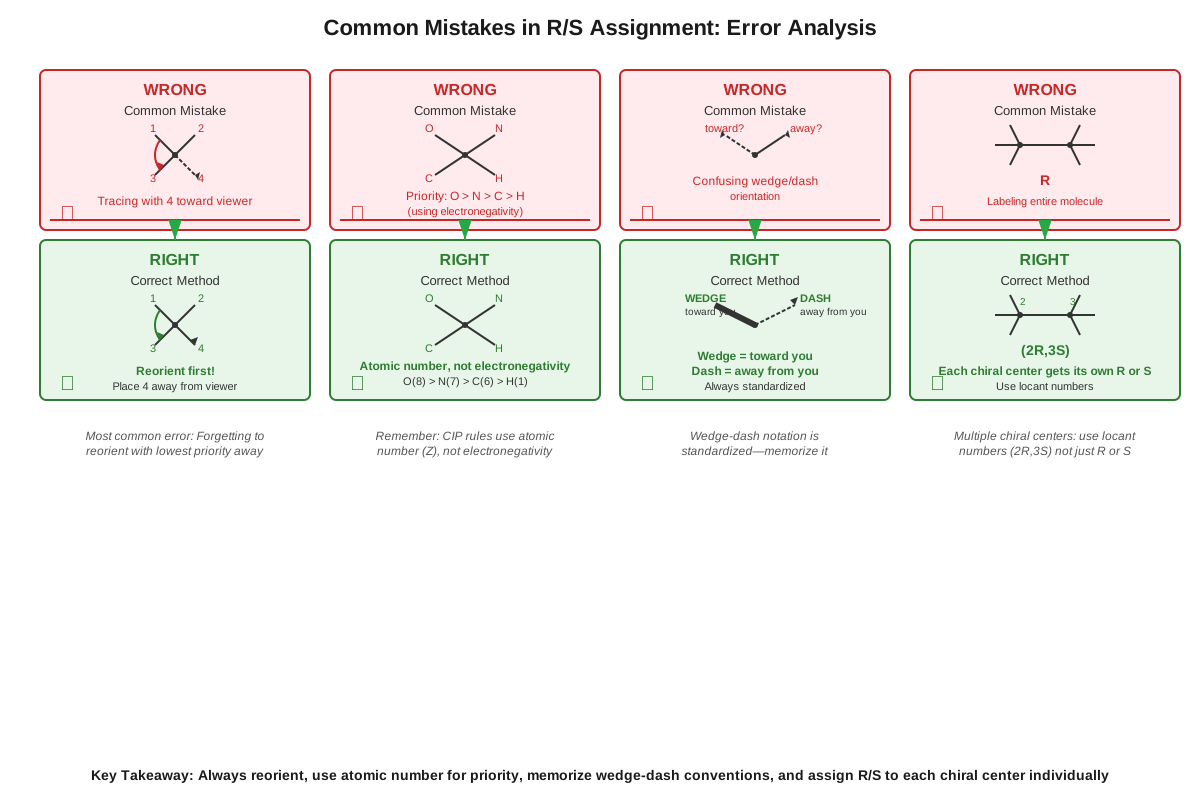
⭐ The lowest priority group (4) must point away from the viewer when determining R or S configuration; if it points toward you, the observed direction must be inverted
⭐ R and S configuration is determined by absolute three-dimensional arrangement and is completely independent of (+)/(-) optical rotation
⭐ All naturally occurring amino acids (except glycine) have S configuration at the α-carbon, despite being designated L-amino acids in the D/L system
⭐ A molecule with n chiral centers has a maximum of 2ⁿ stereoisomers (fewer if meso compounds exist)
⭐ Enantiomers have opposite configuration at all chiral centers (R↔S at every position), while diastereomers have opposite configuration at some but not all chiral centers
- The Cahn-Ingold-Prelog priority rules rank substituents by atomic number of the directly attached atom first, moving outward only when necessary
- Multiple bonds are treated as if the atoms were duplicated: C=O is treated as C bonded to two O atoms
- In Fischer projections, horizontal lines project toward the viewer and vertical lines project away
- Meso compounds contain chiral centers but are achiral overall due to an internal plane of symmetry
- Changing configuration at a chiral center requires breaking and reforming bonds; it does not occur through simple rotation
- The terms "absolute configuration" (R/S) and "relative configuration" (D/L) describe different aspects of stereochemistry and are not interchangeable
- Enzymes exhibit stereoselectivity because their active sites are chiral environments that preferentially bind one stereoisomer
Quick check — test yourself on R and S configuration so far.
Try Flashcards →Common Misconceptions
Misconception: R configuration always corresponds to (+) optical rotation and S to (-) rotation.
Correction: R and S describe absolute three-dimensional configuration based on CIP priority rules, while (+) and (-) describe the experimental observation of light rotation direction. These properties are independent—an R enantiomer might be (+) or (-), which must be determined experimentally, not predicted from configuration.
Misconception: If the lowest priority group is pointing toward you, you cannot assign configuration and must redraw the molecule.
Correction: You can assign configuration from any orientation by applying the inversion rule. If the lowest priority group points toward you and you observe clockwise rotation (1→2→3), the actual configuration is S (the opposite). If you observe counterclockwise, the configuration is R. Alternatively, redrawing is valid but takes more time on the exam.
Misconception: All L-amino acids have S configuration, and all D-sugars have R configuration.
Correction: While all L-amino acids do have S configuration at the α-carbon, the D/L system for sugars is based on the configuration at the highest-numbered chiral center (farthest from the carbonyl), not systematic R/S assignment. D-glucose has R configuration at C-5 but mixed R and S configurations at other positions. The D/L and R/S systems use different reference points and are not directly equivalent.
Misconception: Rotating a molecule 180° changes its R/S configuration.
Correction: R and S configuration is an intrinsic property of the molecule's three-dimensional structure. Physical rotation or redrawing the molecule in different orientations does not change the actual configuration—it only changes your viewing angle. Configuration changes only when bonds are broken and reformed in different arrangements.
Misconception: A molecule with two chiral centers must have four stereoisomers.
Correction: The maximum number is 2ⁿ = 4, but meso compounds reduce this number. A meso compound has chiral centers but possesses an internal plane of symmetry, making it achiral overall. For example, meso-tartaric acid has two chiral centers but only three stereoisomers exist (two enantiomers plus the meso form), not four.
Misconception: Priority is assigned based on molecular weight of the entire substituent.
Correction: The CIP rules compare atomic numbers at the first point of difference, not total molecular weight. For example, -CH₂Cl has higher priority than -CH₂CH₂CH₂CH₃ because Cl (atomic number 17) beats C (atomic number 6) at the first carbon position, despite the butyl group having greater molecular weight.
Worked Examples
Example 1: Assigning R/S Configuration to 2-Bromobutane
Problem: Assign the R or S configuration to the chiral center in 2-bromobutane: CH₃-CHBr-CH₂-CH₃
Solution:
Step 1 - Identify the chiral center: The second carbon is bonded to four different groups: -H, -Br, -CH₃, and -CH₂CH₃. This is our chiral center.
Step 2 - Assign priorities using CIP rules:
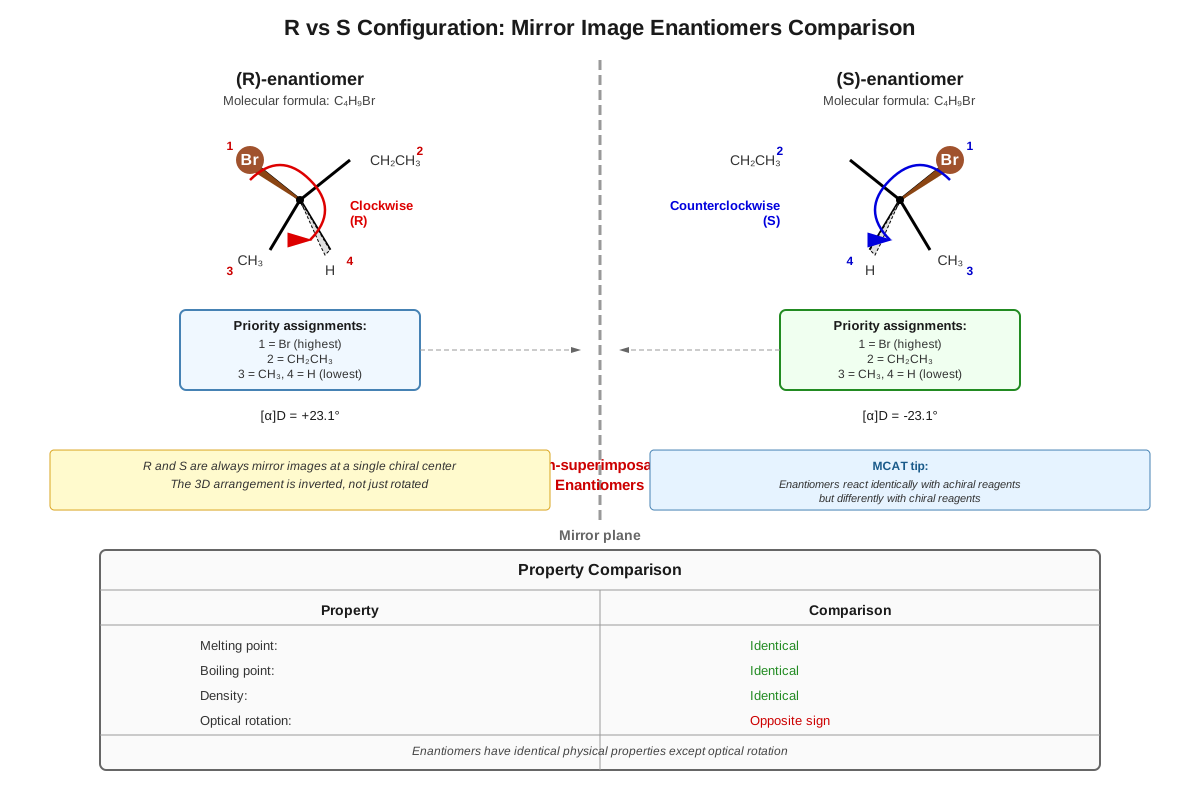
- Priority 1: -Br (atomic number 35, highest)
- Priority 2: -CH₂CH₃ (carbon attached to C, H, H)
- Priority 3: -CH₃ (carbon attached to H, H, H)
- Priority 4: -H (atomic number 1, lowest)
The ethyl group (-CH₂CH₃) beats the methyl group (-CH₃) because when we compare the atoms attached to the first carbon in each chain, ethyl has C, H, H while methyl has H, H, H. Carbon beats hydrogen at the first point of difference.
Step 3 - Orient the molecule: We need the lowest priority group (H) pointing away from us. Drawing the molecule in wedge-and-dash notation with H on a dashed wedge:
        Br (1)
        |
   CH₃--C--CH₂CH₃
        |
        H (4, dashed wedge)
Step 4 - Trace the path: From Br (1) → CH₂CH₃ (2) → CH₃ (3), the path moves counterclockwise.
Step 5 - Assign configuration: Counterclockwise = S configuration
Answer: (S)-2-bromobutane
Connection to learning objectives: This example demonstrates the systematic application of CIP priority rules and the step-by-step process for configuration assignment, directly addressing the objective to apply R and S configuration to exam-style questions.
Example 2: Multiple Chiral Centers and Stereoisomer Relationships
Problem: Consider 3-bromo-2-butanol (CH₃-CHBr-CHOH-CH₃). How many stereoisomers exist? Assign R/S configuration to both chiral centers in one stereoisomer and identify its relationship to the other stereoisomers.
Solution:
Step 1 - Identify chiral centers:
- C-2 (the carbon bearing Br): bonded to H, Br, CH₃, and CHBrCH₃ → chiral
- C-3 (the carbon bearing OH): bonded to H, OH, CH₃, and CHBrCH₃ → chiral
Step 2 - Calculate maximum stereoisomers: With n = 2 chiral centers, maximum = 2² = 4 stereoisomers. No internal symmetry exists, so all four stereoisomers are possible: (R,R), (R,S), (S,R), and (S,S).
Step 3 - Assign configuration to the (R,R) stereoisomer:
For C-2 (bearing Br):
- Priority 1: Br (highest atomic number)
- Priority 2: CHOH-CH₃ (carbon bearing O beats carbon bearing only C and H)
- Priority 3: CH₃
- Priority 4: H
With H pointing away, if Br → CHOH-CH₃ → CH₃ traces clockwise, this is R configuration at C-2.
For C-3 (bearing OH):
- Priority 1: OH (oxygen, atomic number 8)
- Priority 2: CHBr-CH₃ (carbon bearing Br beats carbon bearing only H)
- Priority 3: CH₃
- Priority 4: H
With H pointing away, if OH → CHBr-CH₃ → CH₃ traces clockwise, this is R configuration at C-3.
Step 4 - Identify relationships:
- (R,R) and (S,S) are enantiomers (opposite at all chiral centers, mirror images)
- (R,S) and (S,R) are enantiomers of each other
- (R,R) and (R,S) are diastereomers (opposite at some but not all chiral centers)
- (R,R) and (S,R) are diastereomers
Answer: Four stereoisomers exist. The (2R,3R) stereoisomer has R configuration at both centers. It is the enantiomer of (2S,3S) and a diastereomer of both (2R,3S) and (2S,3R).
Connection to learning objectives: This example integrates multiple concepts—assigning configuration to multiple centers, predicting stereoisomer count, and identifying stereoisomer relationships—demonstrating how R and S configuration connects to broader stereochemistry concepts.
Exam Strategy
Approaching MCAT Questions on R/S Configuration
Time management: Allocate 45-60 seconds for discrete R/S assignment questions. If a question requires assigning configuration to multiple centers or involves complex priority determinations, allow up to 90 seconds. Practice until the CIP priority rules become automatic—hesitation on priority assignment is the most common time sink.
Systematic approach: Always follow the five-step process in order: (1) identify chiral center, (2) assign priorities, (3) orient molecule, (4) trace path, (5) determine configuration. Skipping steps or attempting shortcuts increases error rates. On scratch paper, write the priority numbers directly on the structure to avoid confusion.
Trigger Words and Phrases
Watch for these exam signals that R/S configuration is being tested:
- "Absolute configuration" directly signals R/S assignment
- "Enantiomer" or "mirror image" indicates you may need to flip all R to S and vice versa
- "Chiral center" or "stereocenter" identifies where to focus configuration analysis
- "Stereoisomers" may require counting using the 2ⁿ rule
- "Optically active" relates to chirality but remember that R/S doesn't predict (+)/(-)
- "Diastereomer" means opposite configuration at some but not all chiral centers
Passages discussing drug development, enzyme specificity, or receptor binding frequently incorporate stereochemistry. When you see these contexts, anticipate questions about how configuration affects biological activity.
Process of Elimination Tips
For discrete questions: If you're unsure about priority assignment, eliminate answer choices that would require impossible priority rankings. For example, if the question shows -OH and -NH₂ groups, you know O (atomic number 8) beats N (atomic number 7), so eliminate any answer requiring the opposite.
For passage-based questions: If the passage describes two enantiomers with different biological activities, eliminate answer choices suggesting they would behave identically. Conversely, if the passage states two compounds are diastereomers, eliminate choices claiming they are mirror images or have identical physical properties.
Configuration vs. rotation: Eliminate any answer choice that assumes R configuration means (+) rotation or S means (-) rotation without experimental data. The MCAT frequently includes this as a distractor.
When to Skip and Return
If a molecule has three or more chiral centers and the question asks for complete stereoisomer enumeration, consider whether the time investment is worthwhile. If it's a late question in a section where you're running short on time, mark it and return if possible. Prioritize questions testing single chiral center assignment or conceptual understanding over complex multi-center calculations.
Memory Techniques
The "Steering Wheel" Mnemonic
Visualize the 1→2→3 path as turning a steering wheel:
- R = Right turn (clockwise)
- S = Sinister turn (counterclockwise, "sinister" is Latin for left)
When the lowest priority group points away (like the steering column going away from you), the direction you turn the wheel directly gives you R or S.
Priority Rules Acronym: "AFMD"
Remember the priority rule sequence with AFMD:
- Atomic number (first comparison)
- First point of difference (if atoms are the same)
- Multiple bonds (treat as duplicated atoms)
- Deuterium (isotope rule, heavier wins)
The "Thumb Rule" Visualization
Point your left thumb away from you (representing the lowest priority group pointing away). Curl your fingers from 1→2→3:
- Left hand curl = S (sinister)
- Right hand curl = R (rectus)
This kinesthetic technique helps students who learn through physical movement.
Fischer Projection Shortcut: "HAVOC"
For Fischer projections, remember HAVOC:
- Horizontal lines = Away from you (toward viewer)
- Vertical lines = Out from you (away from viewer)
- Check if lowest priority is vertical (normal assignment) or horizontal (invert)
The "2ⁿ Rule" for Stereoisomer Counting
"Two to the N": The maximum number of stereoisomers equals 2 raised to the power of the number of chiral centers. Visualize each chiral center as a binary switch (R or S), and the total combinations equal 2ⁿ. Remember to subtract meso compounds if internal symmetry exists.
Summary
R and S configuration provides the systematic nomenclature for describing absolute three-dimensional arrangement around chiral centers in organic molecules. Using the Cahn-Ingold-Prelog priority rules, substituents are ranked by atomic number and structural features, enabling unambiguous assignment of R (rectus, clockwise) or S (sinister, counterclockwise) configuration. This system is independent of optical rotation direction and distinct from the D/L nomenclature used in biochemistry. For the MCAT, mastery requires rapid priority assignment, correct molecular orientation (lowest priority group away), and accurate path tracing. The concept connects directly to stereoisomer relationships (enantiomers differ at all chiral centers, diastereomers at some), biological activity (enzymes and receptors discriminate between configurations), and pharmacology (different enantiomers often have different therapeutic effects). Understanding R and S configuration enables prediction of stereoisomer count (2ⁿ for n chiral centers), recognition of meso compounds, and interpretation of how molecular structure determines biological function—all high-yield topics for MCAT success.
Key Takeaways
- R and S configuration describes absolute three-dimensional arrangement using Cahn-Ingold-Prelog priority rules, independent of optical rotation direction
- The systematic assignment process requires: (1) identifying chiral centers, (2) ranking substituents by atomic number and first point of difference, (3) orienting with lowest priority away, (4) tracing 1→2→3, and (5) determining R (clockwise) or S (counterclockwise)
- Enantiomers have opposite configuration at all chiral centers, while diastereomers differ at some but not all positions
- A molecule with n chiral centers has up to 2ⁿ stereoisomers (fewer if meso compounds exist)
- R/S configuration has profound biological implications: enzymes and receptors are stereoselective, making configuration critical for drug activity and metabolism
- The D/L system (used for amino acids and sugars) is based on different reference standards than R/S and the two systems are not directly interconvertible
- Common MCAT traps include assuming R correlates with (+) rotation, confusing configuration with conformation, and misapplying priority rules at the first point of difference
Related Topics
Enantiomers and Diastereomers: Understanding R and S configuration enables classification of stereoisomer relationships. Enantiomers differ at all chiral centers (all R↔S), while diastereomers differ at some but not all. This distinction determines physical properties and biological activities.
Optical Activity and Polarimetry: R and S configuration describes structure, while optical activity describes behavior with plane-polarized light. Mastering both concepts allows prediction of which molecules will be optically active and understanding of racemic mixtures.
Fischer Projections: This specialized drawing convention for carbohydrates and amino acids requires adapted R/S assignment techniques. Understanding the relationship between Fischer projections and wedge-and-dash structures is essential for biochemistry passages.
Conformational Analysis: While R/S describes fixed configuration (requiring bond breaking to change), conformational analysis examines rotational isomers that interconvert freely. Both address three-dimensional structure at different timescales.
Enzyme Kinetics and Specificity: Enzymes are chiral environments that exhibit stereoselectivity. Understanding R and S configuration explains why enzymes process only specific stereoisomers, connecting organic chemistry to biochemistry and metabolism.
Drug Design and Pharmacology: Many pharmaceuticals contain chiral centers, and different enantiomers often have different therapeutic profiles. This topic bridges stereochemistry with medical applications, a favorite MCAT integration point.
Practice CTA
Now that you've mastered the core concepts of R and S configuration, it's time to solidify your understanding through active practice. Attempt the practice questions to test your ability to assign configuration under timed conditions, and use the flashcards to drill the Cahn-Ingold-Prelog priority rules until they become automatic. Remember: stereochemistry is a skill that improves dramatically with repetition. Each practice problem you work through builds the pattern recognition and spatial reasoning that will make you faster and more accurate on test day. You've built the foundation—now strengthen it through deliberate practice. Your ability to quickly and accurately assign R and S configuration will serve you not only on discrete questions but also in complex passage-based scenarios where stereochemistry determines biological outcomes. Keep pushing forward!
Sign up free to keep reading
Create a free AnvayaPrep account to finish this MCAT guide on R and S configuration — plus flashcards and practice questions.