Overview
Acidity and basicity represent fundamental concepts in Organic Chemistry that form the backbone of understanding chemical reactivity, reaction mechanisms, and molecular behavior. These principles govern how molecules interact, which bonds break and form, and ultimately determine the outcome of countless organic reactions tested on the MCAT. Mastery of acid-base chemistry is not merely an isolated skill—it is the lens through which students must view nearly every organic transformation, from nucleophilic substitutions to carbonyl chemistry and beyond.
On the MCAT, acidity and basicity questions appear with remarkable frequency across both the Chemical and Physical Foundations of Biological Systems section and the Biological and Biochemical Foundations of Living Systems section. The exam tests not only definitional knowledge but also the ability to predict relative acidity, explain trends using structure and bonding principles, and apply acid-base concepts to biological systems such as amino acid behavior at different pH values, buffer systems, and enzyme mechanisms. Understanding why certain functional groups are acidic or basic, and being able to rank compounds by their pKa values, is essential for success.
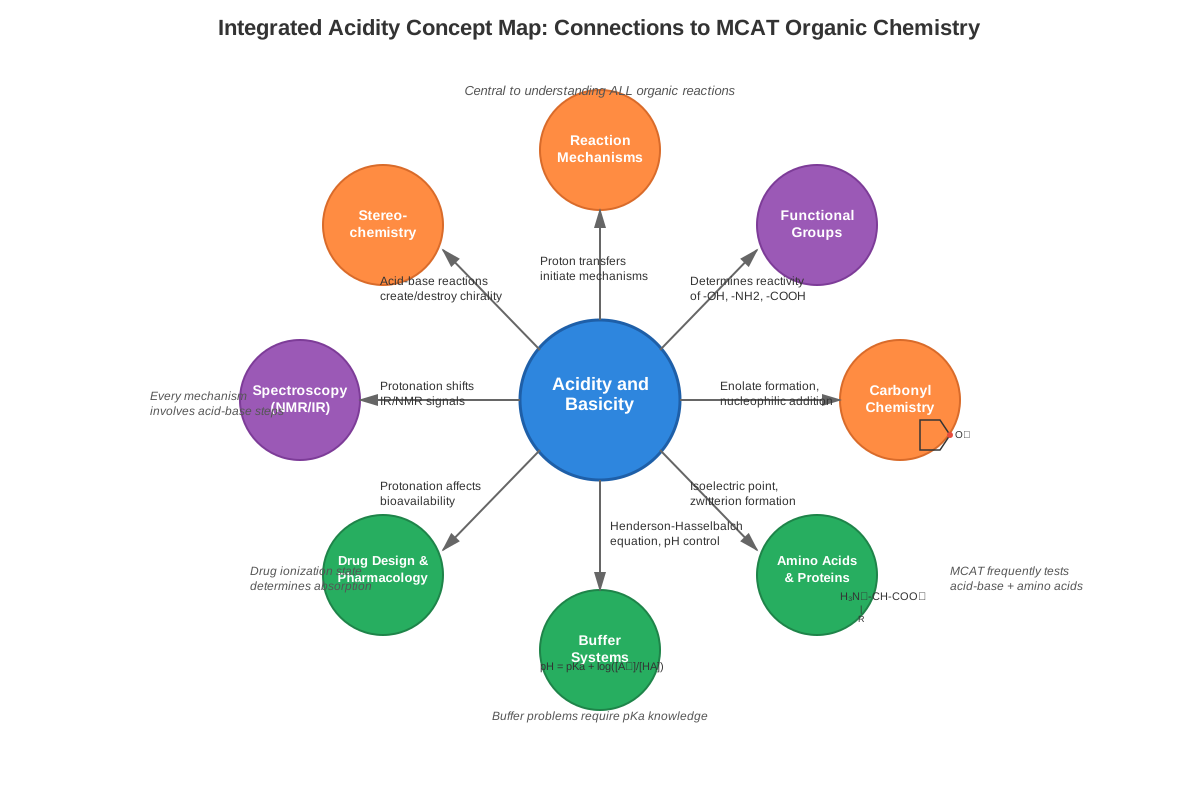
The relationship between acidity and basicity and other Organic Chemistry topics is profound and interconnected. These concepts directly influence reaction mechanisms (where proton transfers are often the first or last step), stereochemistry (where acid-base reactions can create or destroy chiral centers), and spectroscopy (where protonation states affect NMR and IR signals). Additionally, understanding Structure and Bonding principles—electronegativity, resonance, induction, hybridization, and atomic size—provides the theoretical foundation for predicting and explaining acid-base behavior. Without a solid grasp of acidity and basicity, students will struggle with virtually every subsequent topic in organic chemistry.
Learning Objectives
- [ ] Define acidity and basicity using accurate Organic Chemistry terminology
- [ ] Explain why acidity and basicity matters for the MCAT
- [ ] Apply acidity and basicity to exam-style questions
- [ ] Identify common mistakes related to acidity and basicity
- [ ] Connect acidity and basicity to related Organic Chemistry concepts
- [ ] Predict relative acidity of organic compounds using structural factors (electronegativity, resonance, induction, hybridization, and atomic size)
- [ ] Determine the position of acid-base equilibria using pKa values and the relationship between Ka, pKa, and equilibrium constants
- [ ] Analyze conjugate acid-base pairs and apply the inverse relationship between acid strength and conjugate base strength
Prerequisites
- General Chemistry acid-base theory: Understanding Brønsted-Lowry and Lewis definitions provides the foundational framework for organic acid-base chemistry
- Electronegativity trends: Essential for predicting how electron density distribution affects acidity and basicity
- Resonance structures: Required to evaluate stabilization of conjugate bases and acids through electron delocalization
- Hybridization and orbital theory: Necessary to understand how s-character affects acidity and how orbital availability affects basicity
- Basic functional group recognition: Students must identify alcohols, carboxylic acids, amines, and other common functional groups to apply acid-base principles
Why This Topic Matters
Clinical and Real-World Significance
Acid-base chemistry governs countless biological processes essential to human physiology. Drug design relies heavily on understanding the protonation states of molecules at physiological pH (7.4), as this determines membrane permeability, protein binding, and bioavailability. For example, aspirin (acetylsalicylic acid) functions as an anti-inflammatory precisely because of its acidic properties, which allow it to be absorbed in the stomach. Enzyme catalysis frequently involves acid-base chemistry, with amino acid residues acting as proton donors or acceptors in active sites. Buffer systems in blood, such as the bicarbonate buffer, maintain pH homeostasis through acid-base equilibria. Understanding these principles allows medical professionals to comprehend drug mechanisms, metabolic pathways, and physiological regulation.
Exam Statistics and Question Types
Acidity and basicity concepts appear in approximately 15-20% of Organic Chemistry questions on the MCAT, making this one of the highest-yield topics. Questions typically present in several formats: discrete questions asking students to rank compounds by acidity, passage-based questions requiring application of pKa values to predict reaction outcomes, and integrated questions connecting acid-base behavior to amino acid chemistry or buffer systems. The MCAT frequently tests the ability to identify the most acidic proton in a complex molecule, predict the products of acid-base reactions, and explain trends using structural reasoning.
Common Exam Passage Contexts
MCAT passages often embed acid-base concepts within biochemical contexts such as amino acid titrations, enzyme mechanism studies, or drug synthesis schemes. Students might encounter a passage describing a novel pharmaceutical compound and be asked to identify acidic or basic functional groups, predict behavior at different pH values, or explain why certain synthetic steps require acidic or basic conditions. Other passages present experimental data involving pH-dependent reactions and require interpretation using acid-base principles. Recognition of these contexts allows students to quickly activate relevant knowledge during the exam.
Core Concepts
Definitions and Fundamental Theory
Acidity refers to the ability of a molecule to donate a proton (H⁺), while basicity describes the ability to accept a proton. The Brønsted-Lowry definition states that acids are proton donors and bases are proton acceptors, which is the primary framework used in organic chemistry. The Lewis definition expands this concept: Lewis acids are electron pair acceptors, and Lewis bases are electron pair donors. While the Brønsted-Lowry definition applies to most organic acid-base reactions, the Lewis definition becomes essential when discussing reactions involving carbocations, boron compounds, and metal-catalyzed processes.
When an acid (HA) donates a proton, it forms its conjugate base (A⁻). Similarly, when a base (B) accepts a proton, it forms its conjugate acid (BH⁺). This relationship is fundamental:
HA + B ⇌ A⁻ + BH⁺
acid₁  base₂  base₁  acid₂
The strength of an acid is quantified by its acid dissociation constant (Ka), which measures the extent of proton dissociation in water:
Ka = [H⁺][A⁻]/[HA]The pKa is the negative logarithm of Ka:
pKa = -log(Ka)Lower pKa values indicate stronger acids (more complete dissociation), while higher pKa values indicate weaker acids. This logarithmic scale means that a difference of one pKa unit represents a tenfold difference in acidity. For the MCAT, students must memorize approximate pKa ranges for common functional groups and be able to use these values to predict reaction outcomes.
The Inverse Relationship Between Acid and Conjugate Base Strength
A critical principle states that the stronger the acid, the weaker its conjugate base, and vice versa. This inverse relationship explains why strong acids like HCl (pKa ≈ -7) have extremely weak conjugate bases (Cl⁻), while weak acids like water (pKa ≈ 15.7) have relatively strong conjugate bases (OH⁻). This concept is essential for predicting the direction of acid-base equilibria: reactions favor formation of the weaker acid and weaker base. Students can use pKa values to determine equilibrium position—the equilibrium favors the side with the acid that has the higher pKa (weaker acid).
Structural Factors Affecting Acidity
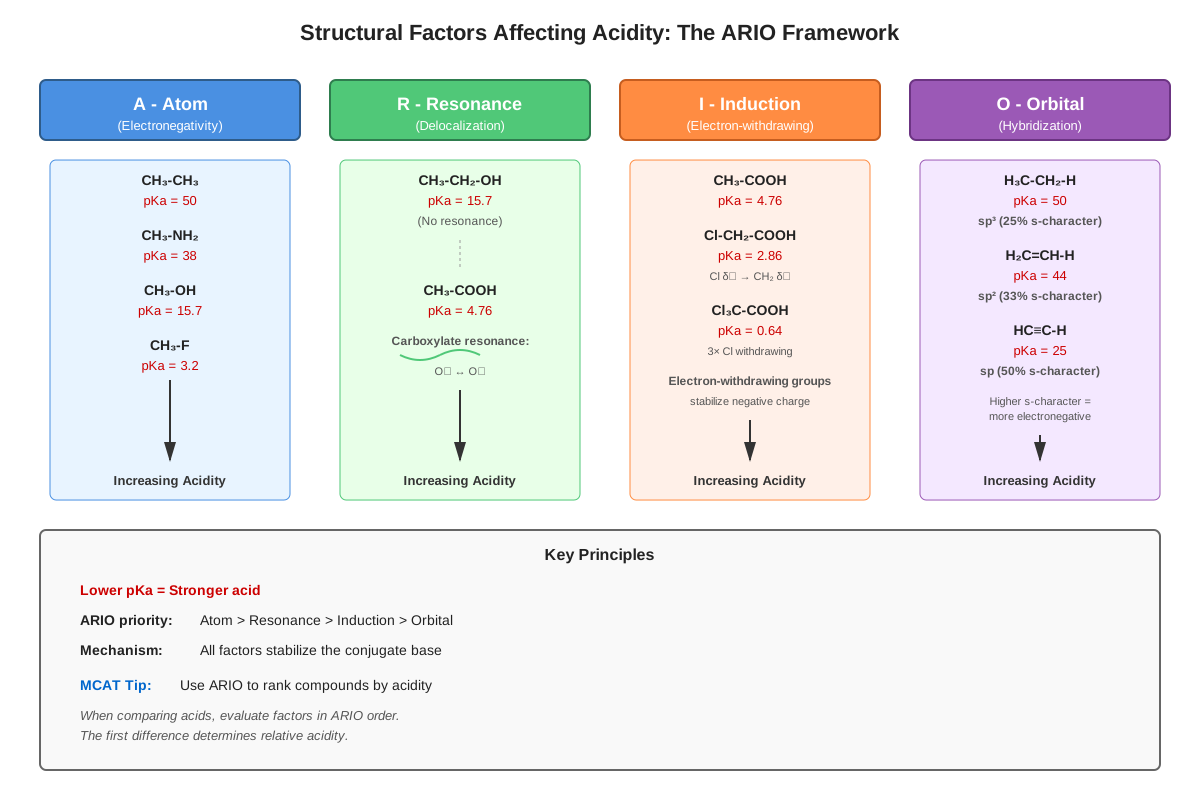
Five major structural factors determine the relative acidity of organic compounds, and the MCAT tests all of them extensively:
1. Electronegativity
Electronegativity measures an atom's ability to attract electrons. More electronegative atoms stabilize negative charge better, making their conjugate bases more stable and the corresponding acids stronger. Across a row in the periodic table, acidity increases with electronegativity:
| Compound | pKa | Explanation |
|---|---|---|
| CH₃-CH₃ | ~50 | Carbon is least electronegative |
| CH₃-NH₂ | ~38 | Nitrogen is more electronegative |
| CH₃-OH | ~15.7 | Oxygen is more electronegative |
| CH₃-F | ~25 | Fluorine is most electronegative (but C-F bond rarely breaks) |
The trend for acidity of hydrogen halides (HX) follows: HF < HCl < HBr < HI, but this involves a different factor (atomic size) discussed below.
2. Atomic Size
Down a group in the periodic table, atomic size increases, and acidity increases despite decreasing electronegativity. Larger atoms can better stabilize negative charge because the charge is spread over a larger volume (lower charge density). Additionally, larger orbitals form weaker bonds to hydrogen, making proton donation easier:
| Acid | pKa | Trend |
|---|---|---|
| H₂O | 15.7 | Weakest acid |
| H₂S | 7 | Stronger acid |
| H₂Se | 3.9 | Even stronger |
For organic compounds, this explains why thiols (R-SH, pKa ≈ 10) are more acidic than alcohols (R-OH, pKa ≈ 15-16).
3. Resonance Stabilization
Resonance stabilization of the conjugate base dramatically increases acidity. When negative charge can be delocalized over multiple atoms through resonance, the conjugate base is stabilized, making the acid stronger. This is why carboxylic acids (R-COOH, pKa ≈ 4-5) are much more acidic than alcohols (R-OH, pKa ≈ 15-16). The carboxylate anion (RCOO⁻) has two equivalent resonance structures with the negative charge shared equally between two oxygen atoms, while an alkoxide ion (RO⁻) has no such stabilization.
Phenol (C₆H₅OH, pKa ≈ 10) is more acidic than cyclohexanol (pKa ≈ 16) because the phenoxide anion's negative charge is delocalized into the aromatic ring through resonance. The MCAT frequently tests the ability to draw resonance structures and recognize when they stabilize conjugate bases.
4. Inductive Effects
Inductive effects involve the withdrawal or donation of electron density through sigma bonds. Electron-withdrawing groups (EWGs) stabilize negative charge on the conjugate base by pulling electron density away, increasing acidity. Electron-donating groups (EDGs) destabilize negative charge, decreasing acidity.
Electronegative atoms like fluorine, chlorine, and oxygen act as EWGs. For example:
- Acetic acid (CH₃COOH): pKa ≈ 4.76
- Chloroacetic acid (ClCH₂COOH): pKa ≈ 2.87
- Dichloroacetic acid (Cl₂CHCOOH): pKa ≈ 1.29
- Trichloroacetic acid (Cl₃CCOOH): pKa ≈ 0.65
Each additional chlorine atom increases acidity by withdrawing electron density inductively. The effect diminishes with distance—substituents closer to the acidic proton have stronger effects.
5. Hybridization
Hybridization affects acidity because s-orbitals hold electrons closer to the nucleus than p-orbitals. Greater s-character means electrons are held more tightly, stabilizing negative charge. The trend for carbon acids is:
| Hybridization | % s-character | Example | pKa |
|---|---|---|---|
| sp³ | 25% | CH₃-CH₃ | ~50 |
| sp² | 33% | CH₂=CH₂ | ~44 |
| sp | 50% | HC≡CH | ~25 |
Terminal alkynes are significantly more acidic than alkanes or alkenes because the conjugate base (acetylide anion) has its negative charge in an sp orbital with 50% s-character. This principle also explains why the proton on sp² hybridized nitrogen in pyrrole is more acidic than the proton on sp³ hybridized nitrogen in typical amines.
Basicity and Structural Factors
Basicity is the flip side of acidity. A strong base has a weak conjugate acid (high pKa), while a weak base has a strong conjugate acid (low pKa). The same structural factors that affect acidity also affect basicity, but in opposite ways:
- Electronegativity: Less electronegative atoms are more basic (they hold electrons less tightly and can donate them more readily)
- Resonance: Delocalization of the lone pair decreases basicity (the electrons are less available for protonation)
- Inductive effects: Electron-donating groups increase basicity; electron-withdrawing groups decrease basicity
- Hybridization: Lone pairs in orbitals with more s-character are less basic (held more tightly)
For example, comparing nitrogen bases:
| Base | Conjugate Acid pKa | Explanation |
|---|---|---|
| Ammonia (NH₃) | 9.3 | Baseline |
| Methylamine (CH₃NH₂) | 10.6 | Methyl group donates electrons inductively, increasing basicity |
| Aniline (C₆H₅NH₂) | 4.6 | Lone pair delocalized into aromatic ring, decreasing basicity |
| Pyridine (C₅H₅N) | 5.2 | Lone pair in sp² orbital, less available than sp³ |
Predicting Acid-Base Equilibria
To predict the direction of an acid-base reaction, compare the pKa values:
- Identify the acid on each side of the equation
- The equilibrium favors formation of the weaker acid (higher pKa)
- Alternatively, the equilibrium favors the side with the more stable (weaker) base
For example:
CH₃COOH + NH₃ ⇌ CH₃COO⁻ + NH₄⁺
pKa = 4.76        pKa = 9.3
The equilibrium strongly favors the right side because NH₄⁺ (pKa = 9.3) is a much weaker acid than CH₃COOH (pKa = 4.76). The difference in pKa values (ΔpKa = 4.54) corresponds to an equilibrium constant of approximately 10^4.54, meaning the reaction proceeds essentially to completion.
Concept Relationships
The concepts within acidity and basicity are deeply interconnected. Electronegativity and atomic size represent periodic trends that provide the foundation for understanding charge stabilization. These factors work in concert with resonance stabilization, which allows charge delocalization beyond a single atom. Inductive effects complement resonance by affecting charge distribution through sigma bonds rather than pi systems. Hybridization ties directly to orbital theory and explains trends that might otherwise seem counterintuitive.
These internal concepts connect to prerequisite knowledge: resonance structures from general chemistry become essential for evaluating conjugate base stability; electronegativity trends from periodic table studies explain why oxygen acids are stronger than nitrogen acids; hybridization from bonding theory explains why alkynes are acidic enough to react with strong bases.
Looking forward, acidity and basicity concepts enable understanding of:
- Reaction mechanisms → Proton transfers are often the first step (protonation of a carbonyl) or last step (deprotonation to form a product)
- Nucleophilic substitution and elimination → Basicity determines whether a species acts as a nucleophile or base
- Carbonyl chemistry → The acidity of α-protons drives enolate formation and subsequent reactions
- Amino acid chemistry → Isoelectric points and zwitterion formation depend on pKa values of amino and carboxyl groups
- Buffer systems → Henderson-Hasselbalch equation applications require understanding pKa
The relationship map flows: Structure and Bonding principles → determine conjugate base stability → which determines relative acidity → which predicts equilibrium position → which determines reaction outcomes → which enables understanding of complex mechanisms.
Quick check — test yourself on Acidity and basicity so far.
Try Flashcards →High-Yield Facts
⭐ The lower the pKa, the stronger the acid. A pKa difference of 1 unit represents a 10-fold difference in acidity.
⭐ Carboxylic acids (pKa ≈ 4-5) are more acidic than phenols (pKa ≈ 10), which are more acidic than alcohols (pKa ≈ 15-16). This trend is driven by resonance stabilization of the conjugate base.
⭐ Equilibrium favors formation of the weaker acid (higher pKa) and weaker base. Always compare pKa values to predict reaction direction.
⭐ Electron-withdrawing groups increase acidity; electron-donating groups decrease acidity. Inductive effects are distance-dependent and diminish rapidly.
⭐ Resonance stabilization of the conjugate base is the most powerful factor increasing acidity. It typically overrides inductive effects when both are present.
- Thiols (R-SH, pKa ≈ 10) are more acidic than alcohols (R-OH, pKa ≈ 15-16) due to sulfur's larger atomic size.
- Terminal alkynes (RC≡CH, pKa ≈ 25) are acidic enough to be deprotonated by strong bases like NaNH₂ or n-BuLi.
- Amines are basic (conjugate acid pKa ≈ 9-11), but aniline is weakly basic (conjugate acid pKa ≈ 4.6) due to resonance delocalization of the lone pair.
- Hybridization trend for acidity: sp > sp² > sp³ (more s-character = more acidic).
- The most acidic proton in a molecule is typically on a carboxylic acid, followed by phenolic OH, then alcoholic OH, then α to a carbonyl.
- Protonated alcohols (R-OH₂⁺) are strong acids (pKa ≈ -2), which is why acid-catalyzed reactions of alcohols are common.
- Carbonyl compounds have acidic α-protons (pKa ≈ 19-20) due to resonance stabilization of the resulting enolate anion.
Common Misconceptions
Misconception: Higher pKa means stronger acid.
Correction: Lower pKa indicates stronger acid. The pKa is the negative log of Ka, so as Ka increases (stronger acid), pKa decreases. Think of pKa as an inverse measure—the smaller the number, the stronger the acid.
Misconception: Resonance and inductive effects always work in the same direction.
Correction: These effects can oppose each other. For example, in para-nitrophenol, the nitro group withdraws electrons inductively (increasing acidity) but also withdraws electrons through resonance from the ring (which could affect the phenoxide anion's stability differently). Students must evaluate each effect independently and determine which dominates.
Misconception: All oxygen-containing compounds are acidic.
Correction: While carboxylic acids and phenols are acidic, ethers (R-O-R) are not acidic because they lack an O-H bond to donate a proton. Alcohols are weakly acidic (pKa ≈ 15-16), requiring very strong bases for deprotonation. The presence of oxygen alone doesn't guarantee acidity—the molecular context matters.
Misconception: A strong acid always reacts completely with any base.
Correction: Acid-base reactions reach equilibrium, and the position depends on relative pKa values. A strong acid will react completely only with a sufficiently strong base (one whose conjugate acid has a much higher pKa). For example, acetic acid (pKa 4.76) reacts completely with hydroxide (conjugate acid H₂O, pKa 15.7) but only partially with acetate ion (conjugate acid CH₃COOH, pKa 4.76).
Misconception: Basicity and nucleophilicity are the same property.
Correction: While related, basicity measures thermodynamic stability (equilibrium position of protonation), while nucleophilicity measures kinetic reactivity (rate of attack on an electrophile). A species can be a strong base but poor nucleophile (like tert-butoxide, which is sterically hindered) or a weak base but good nucleophile (like iodide, which is polarizable). For the MCAT, recognize that in protic solvents, basicity and nucleophilicity often correlate, but they are distinct concepts.
Misconception: The most electronegative atom always holds the most acidic proton.
Correction: While electronegativity is important, other factors can override it. For example, the proton on a carboxylic acid (attached to oxygen) is more acidic than the proton on an alcohol (also attached to oxygen) because of resonance stabilization in the carboxylate anion. Similarly, a proton α to a carbonyl (attached to carbon) can be more acidic than expected due to resonance stabilization of the enolate. Always consider all five factors: electronegativity, size, resonance, induction, and hybridization.
Misconception: Aromatic rings always stabilize adjacent charges through resonance.
Correction: Resonance stabilization requires proper orbital overlap. In aniline, the nitrogen lone pair can delocalize into the ring, decreasing basicity. However, in benzylic positions (like benzyl alcohol, C₆H₅CH₂OH), the oxygen's negative charge in the conjugate base (C₆H₅CH₂O⁻) cannot effectively delocalize into the ring because the CH₂ group disrupts conjugation. Benzyl alcohol has similar acidity to other primary alcohols, not enhanced acidity like phenol.
Worked Examples
Example 1: Ranking Compounds by Acidity
Question: Rank the following compounds in order of increasing acidity (least acidic to most acidic): ethanol (CH₃CH₂OH), phenol (C₆H₅OH), acetic acid (CH₃COOH), and ethane (CH₃CH₃).
Solution:
Step 1: Identify the acidic proton in each compound.
- Ethane: C-H bond (pKa ≈ 50)
- Ethanol: O-H bond (pKa ≈ 15.7)
- Phenol: O-H bond (pKa ≈ 10)
- Acetic acid: O-H bond of carboxyl group (pKa ≈ 4.76)
Step 2: Evaluate conjugate base stability for each compound.
- Ethane → CH₃CH₂⁻: Carbon is not very electronegative, and there's no stabilization of the negative charge. This is extremely unstable, making ethane the weakest acid.
- Ethanol → CH₃CH₂O⁻: Oxygen is electronegative and can stabilize negative charge better than carbon, but there's no resonance stabilization. This is moderately stable.
- Phenol → C₆H₅O⁻: The phenoxide anion has resonance stabilization—the negative charge delocalizes into the aromatic ring through multiple resonance structures. This is more stable than ethoxide.
- Acetic acid → CH₃COO⁻: The acetate anion has two equivalent resonance structures with the negative charge shared equally between two oxygen atoms. This is the most stable conjugate base.
Step 3: Apply the principle that more stable conjugate base = stronger acid.
Answer: Ethane < Ethanol < Phenol < Acetic acid (increasing acidity)
Connection to learning objectives: This example demonstrates application of structural factors (electronegativity and resonance) to predict relative acidity, directly addressing the objective of applying acidity concepts to exam-style questions.
Example 2: Predicting Acid-Base Reaction Outcome
Question: Consider the following reaction. Predict whether the equilibrium favors reactants or products and explain your reasoning.
CH₃CH₂OH + NaNH₂ ⇌ CH₃CH₂O⁻Na⁺ + NH₃Solution:
Step 1: Identify the acids on both sides of the equation.
- Left side: CH₃CH₂OH (ethanol) is the acid
- Right side: NH₃ (ammonia) is the acid
Step 2: Look up or recall pKa values.
- Ethanol: pKa ≈ 15.7
- Ammonia: pKa ≈ 38
Step 3: Apply the rule that equilibrium favors formation of the weaker acid (higher pKa).
Since ammonia (pKa ≈ 38) is a much weaker acid than ethanol (pKa ≈ 15.7), the equilibrium strongly favors the products (right side).
Step 4: Calculate the equilibrium constant (optional but demonstrates mastery).
ΔpKa = 38 - 15.7 = 22.3
Keq ≈ 10^22.3, an enormous number indicating the reaction proceeds essentially to completion.
Reasoning: Sodium amide (NaNH₂) is a very strong base because its conjugate acid (ammonia) is extremely weak. It can easily deprotonate ethanol, which is a much stronger acid than ammonia. The ethoxide ion (CH₃CH₂O⁻) is a much weaker base than amide ion (NH₂⁻), so the reverse reaction is unfavorable.
Answer: The equilibrium strongly favors products. This reaction would be used synthetically to generate ethoxide ion quantitatively.
Connection to learning objectives: This example demonstrates the application of pKa values to predict equilibrium position and connects to the broader concept of how acid-base chemistry enables synthetic transformations in organic chemistry.
Exam Strategy
Approaching MCAT Questions on Acidity and Basicity
When encountering acid-base questions on the MCAT, follow this systematic approach:
- Identify what's being asked: Are you ranking compounds by acidity? Predicting a reaction outcome? Identifying the most acidic proton? Explaining a trend?
- Locate all acidic/basic sites: In complex molecules, multiple functional groups may be present. Systematically identify all potential sites.
- Apply the five factors in order of importance:
- First, check for resonance stabilization (usually most important)
- Second, consider inductive effects from nearby groups
- Third, evaluate electronegativity and atomic size
- Fourth, consider hybridization
- Fifth, look for special cases (like protonated species)
- Use pKa values strategically: Memorize approximate pKa ranges for common functional groups. If exact values aren't recalled, use relative rankings.
- Draw conjugate bases when comparing acidity: Visualizing the conjugate base and its resonance structures often makes the answer clear.
Trigger Words and Phrases
Watch for these keywords that signal acid-base concepts:
- "Most acidic proton" → Identify all acidic sites and compare using structural factors
- "Predominant form at pH X" → Compare pH to pKa; if pH > pKa, deprotonated form dominates
- "Stronger acid" or "more acidic" → Compare pKa values or conjugate base stability
- "Equilibrium position" or "favors" → Compare pKa values of acids on both sides
- "Stabilization" → Look for resonance or inductive effects
- "Electron-withdrawing" or "electron-donating" → Inductive effects affecting acidity
Process of Elimination Tips
- Eliminate extreme answers first: If asked to rank acidity and one option places a carboxylic acid as less acidic than an alkane, eliminate it immediately.
- Use functional group pKa ranges: If you know carboxylic acids have pKa ≈ 4-5 and alcohols have pKa ≈ 15-16, you can eliminate any answer suggesting they're similar in acidity.
- Check for resonance: If two answer choices differ only in whether resonance is considered, the one accounting for resonance is almost always correct.
- Watch for trick answers involving basicity: Questions might ask about "strongest base" when showing pKa values of conjugate acids. Remember the inverse relationship—highest conjugate acid pKa = strongest base.
Time Allocation
For discrete acid-base questions, allocate 60-90 seconds. These are typically straightforward if you know the concepts. For passage-based questions, spend 30-45 seconds per question, using information from the passage (like pKa tables or reaction schemes) to support your reasoning. If a question requires drawing multiple resonance structures or comparing several factors, it may warrant up to 2 minutes, but this should be rare. Practice identifying the quickest path to the answer—often, recognizing one key structural feature (like resonance stabilization) is sufficient without exhaustive analysis.
Memory Techniques
Mnemonic for Factors Affecting Acidity: "ARIES"
Atomic size
Resonance
Inductive effects
Electronegativity
S-character (hybridization)
When comparing acidity, run through ARIES systematically. Resonance is typically the most powerful factor, so check it first in practice.
pKa Ranges Mnemonic: "Can People Always Remember Everything?"
Carboxylic acids: pKa ≈ 4-5
Phenols: pKa ≈ 10
Alcohols: pKa ≈ 15-16
R-H (alkanes): pKa ≈ 50
Everything else: Learn the exceptions (thiols ≈ 10, terminal alkynes ≈ 25, α-protons ≈ 19-20)
Visualization Strategy: The Stability Pyramid
Visualize conjugate base stability as a pyramid with the most stable (strongest acids) at the top:
        Carboxylate (RCOO⁻)
           /        \
      Phenoxide    Thiolate
         /            \
    Alkoxide         Enolate
       /                \
  Amide (R₂N⁻)      Acetylide
     /                    \
Alkyl anions (R⁻)    Alkyl anions
The higher on the pyramid, the more stable the conjugate base and the stronger the corresponding acid.
Acronym for Electron-Withdrawing Groups: "CHON-Halogens"
Carbonyl groups (C=O)
Halogens (F, Cl, Br, I)
Oxygen-containing groups (OR, OH)
Nitro groups (NO₂)
These groups withdraw electrons inductively and/or through resonance, increasing acidity when near an acidic proton.
Summary
Acidity and basicity represent foundational concepts in organic chemistry that govern molecular reactivity and reaction mechanisms. Acids donate protons while bases accept them, with strength quantified by pKa values—lower pKa indicates stronger acid. The inverse relationship between acid strength and conjugate base strength is central: strong acids have weak conjugate bases because the negative charge is well-stabilized. Five structural factors determine relative acidity: electronegativity (more electronegative atoms stabilize negative charge better), atomic size (larger atoms distribute charge over greater volume), resonance (delocalization stabilizes conjugate bases), inductive effects (electron-withdrawing groups stabilize negative charge), and hybridization (greater s-character holds electrons tighter). These same factors affect basicity in opposite ways. Predicting acid-base equilibria requires comparing pKa values—reactions favor formation of the weaker acid and weaker base. For the MCAT, students must rapidly identify acidic sites in complex molecules, rank compounds by acidity using structural reasoning, and apply these principles to biological contexts like amino acid chemistry and buffer systems. Mastery of acidity and basicity enables understanding of virtually all subsequent organic chemistry topics, making this one of the highest-yield areas for exam preparation.
Key Takeaways
- Lower pKa = stronger acid; memorize approximate pKa ranges for carboxylic acids (4-5), phenols (10), alcohols (15-16), and alkanes (50)
- Resonance stabilization of the conjugate base is the most powerful factor increasing acidity, typically overriding other effects
- Equilibrium favors the side with the weaker acid (higher pKa) and weaker base; use pKa comparison to predict reaction direction
- Five structural factors affect acidity: electronegativity, atomic size, resonance, inductive effects, and hybridization—remember ARIES
- Strong acids have weak conjugate bases (inverse relationship); this principle is essential for predicting reactivity
- Electron-withdrawing groups increase acidity by stabilizing negative charge; electron-donating groups decrease acidity
- Basicity and nucleophilicity are related but distinct—basicity is thermodynamic (equilibrium), nucleophilicity is kinetic (rate)
Related Topics
Nucleophilic Substitution Reactions (SN1 and SN2): Understanding basicity is essential because strong bases favor elimination over substitution, while weak bases/good nucleophiles favor substitution. The concepts learned here directly determine reaction pathways.
Carbonyl Chemistry and Enolate Formation: The acidity of α-protons (pKa ≈ 19-20) enables enolate formation, which is the basis for aldol reactions, Claisen condensations, and many other transformations. Mastering acidity concepts is prerequisite to understanding these mechanisms.
Amino Acid Chemistry and Protein Structure: Amino acids exist as zwitterions at physiological pH because of their acidic carboxyl groups (pKa ≈ 2) and basic amino groups (conjugate acid pKa ≈ 9). Understanding acid-base behavior enables prediction of amino acid charge states at different pH values.
Buffer Systems and Henderson-Hasselbalch Equation: Buffers resist pH change through acid-base equilibria. The Henderson-Hasselbalch equation (pH = pKa + log([A⁻]/[HA])) directly applies pKa concepts to calculate pH and buffer composition.
Reaction Mechanisms: Nearly every organic mechanism involves proton transfers as key steps. Acid-base concepts determine which steps are favorable, where protonation occurs, and how intermediates are stabilized.
Practice CTA
Now that you've mastered the core concepts of acidity and basicity, it's time to reinforce your understanding through active practice. Attempt the practice questions associated with this topic, focusing on applying the five structural factors to predict relative acidity and using pKa values to determine equilibrium positions. Work through the flashcards to memorize essential pKa ranges and key principles. Remember, the MCAT rewards not just knowledge but the ability to apply concepts rapidly under time pressure—practice is what builds that skill. You've built a strong foundation; now strengthen it through repetition and application. Every practice question you work through increases your confidence and speed for test day. You've got this!
Sign up free to keep reading
Create a free AnvayaPrep account to finish this MCAT guide on Acidity and basicity — plus flashcards and practice questions.