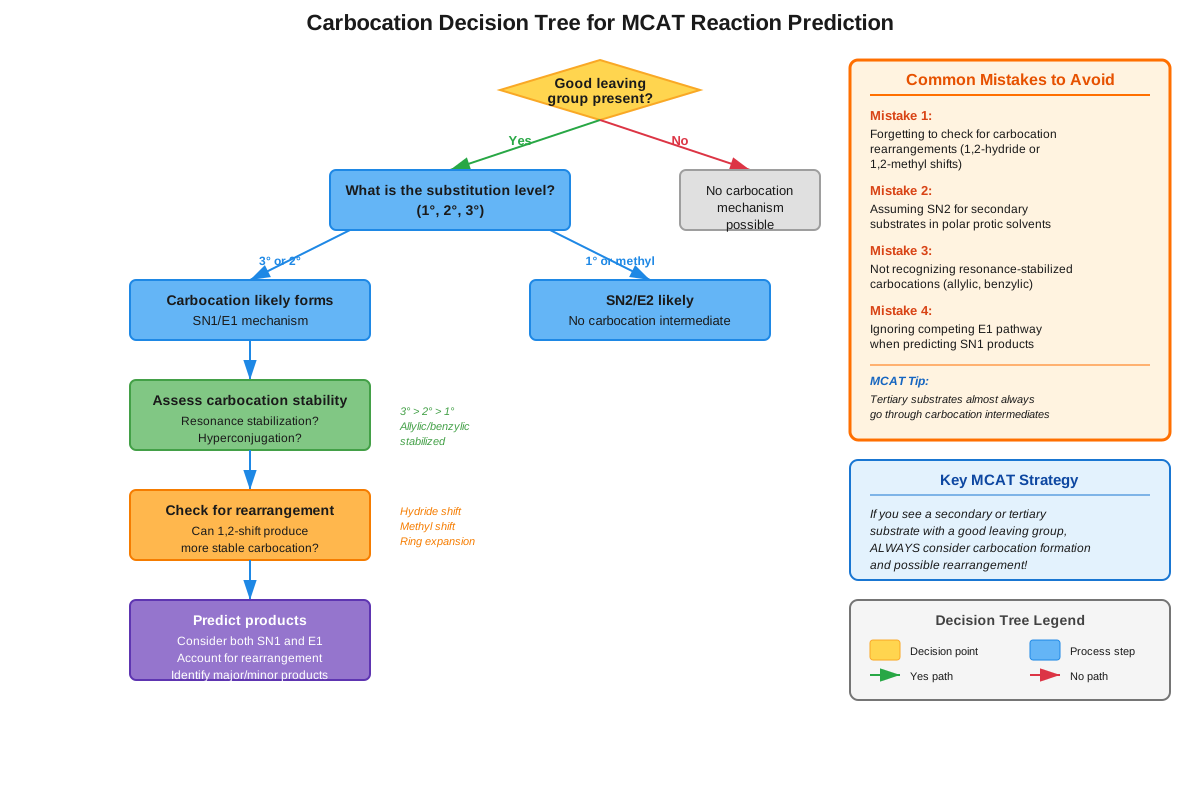
Overview
Carbocations are positively charged carbon species that play a central role in Organic Chemistry reactions, particularly in mechanisms involving Structure and Bonding principles. A carbocation forms when a carbon atom loses an electron pair and bears a formal positive charge, leaving it with only six valence electrons and an empty p orbital. Understanding carbocations is essential for predicting reaction pathways, explaining product distributions, and mastering reaction mechanisms that appear frequently on the MCAT.
For Carbocations MCAT preparation, this topic bridges fundamental concepts of electronic structure with practical applications in substitution and elimination reactions, addition reactions to alkenes, and rearrangement mechanisms. The stability patterns of carbocations—governed by hyperconjugation, inductive effects, and resonance—directly influence reaction rates and product selectivity. Students who master carbocation stability can predict major products in complex reaction schemes and understand why certain pathways are favored over others.
The Carbocations Organic Chemistry content tested on the MCAT extends beyond simple memorization of stability orders. Test-makers expect students to apply these principles to novel reaction conditions, identify carbocation intermediates in multi-step mechanisms, and recognize when carbocation rearrangements will occur. This topic connects intimately with nucleophilic substitution (SN1), elimination reactions (E1), electrophilic addition to alkenes, and Friedel-Crafts alkylation reactions—all high-yield areas for the Chemical and Physical Foundations of Biological Systems section.
Learning Objectives
- [ ] Define carbocations using accurate Organic Chemistry terminology
- [ ] Explain why carbocations matter for the MCAT
- [ ] Apply carbocations to exam-style questions
- [ ] Identify common mistakes related to carbocations
- [ ] Connect carbocations to related Organic Chemistry concepts
- [ ] Rank carbocation stability based on structural features and explain the underlying electronic principles
- [ ] Predict when carbocation rearrangements will occur and identify the rearranged products
- [ ] Distinguish between reaction mechanisms that proceed through carbocation intermediates versus those that do not
Prerequisites
- Lewis structures and formal charge: Essential for recognizing the electron deficiency and positive charge on carbocation carbon atoms
- Hybridization and molecular geometry: Necessary to understand that carbocations are sp² hybridized with trigonal planar geometry
- Electronegativity and inductive effects: Required to explain how electron-donating and electron-withdrawing groups affect carbocation stability
- Resonance structures: Critical for identifying stabilization through delocalization of positive charge
- Basic reaction mechanisms: Needed to recognize how carbocations form as intermediates in multi-step reactions
Why This Topic Matters
Carbocations represent one of the most clinically and industrially relevant reactive intermediates in organic chemistry. In biological systems, carbocation-like transition states appear in enzyme-catalyzed reactions, including those involving terpene biosynthesis and steroid metabolism. Understanding carbocation stability helps explain drug metabolism pathways, particularly those involving cytochrome P450 enzymes that generate reactive intermediates.
On the MCAT, carbocation questions appear in approximately 3-5% of Organic Chemistry passages and discrete questions, making this a medium-yield topic that can differentiate high-scoring students from average performers. Questions typically present reaction schemes where students must identify intermediates, predict major products based on carbocation stability, or explain why certain rearrangements occur. The MCAT frequently embeds carbocation concepts within SN1/E1 mechanism questions, electrophilic addition problems, or passages describing synthetic routes to pharmaceutical compounds.
Common exam presentations include: (1) comparing reaction rates for substrates that form carbocations of different stabilities, (2) predicting products when carbocation rearrangements are possible, (3) identifying which reaction conditions favor carbocation formation, and (4) explaining stereochemical outcomes in reactions proceeding through planar carbocation intermediates. The ability to quickly assess carbocation stability and predict rearrangements is a high-value skill that saves time and improves accuracy on test day.
Core Concepts
Definition and Electronic Structure
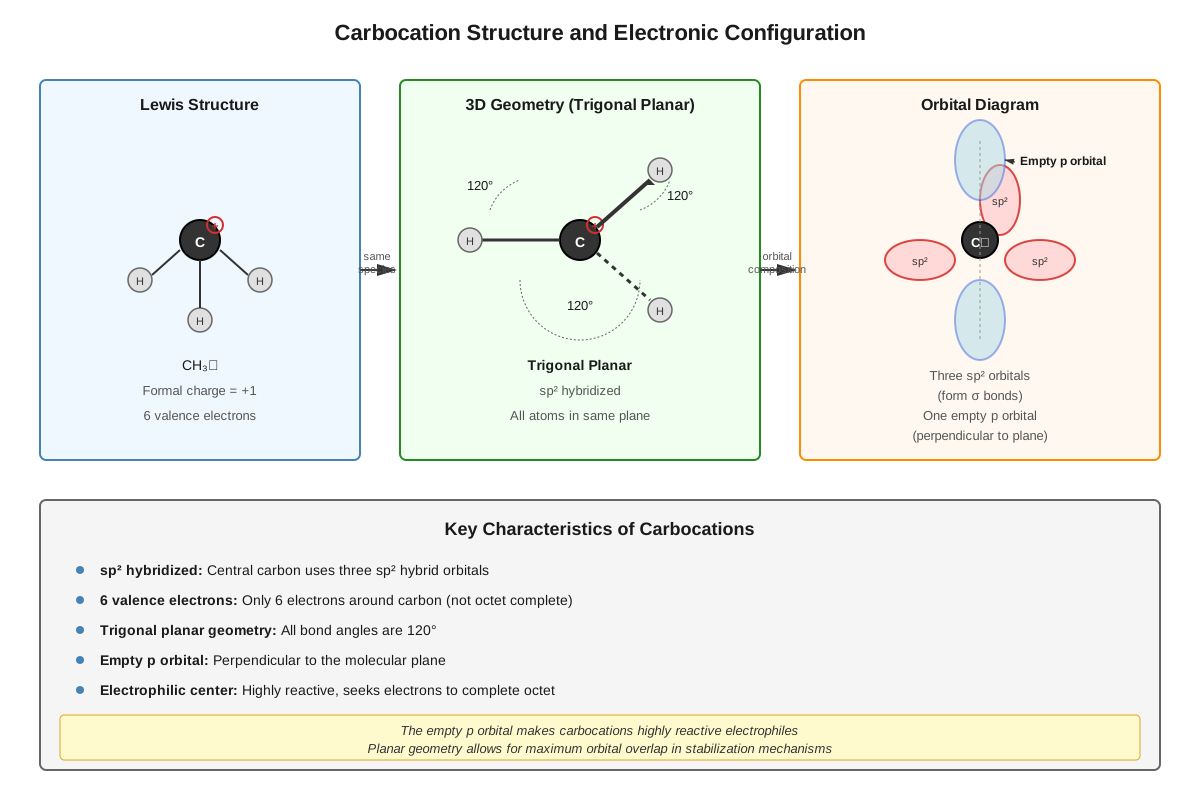
A carbocation is a carbon atom bearing a formal positive charge with only six valence electrons in its outer shell. The carbocation carbon is sp² hybridized, creating a trigonal planar geometry with bond angles of approximately 120°. The empty p orbital perpendicular to the plane of the three substituents makes carbocations highly electrophilic and reactive toward nucleophiles.
The electron deficiency creates an energy minimum when the carbocation can achieve maximum stabilization through electronic effects. Unlike neutral carbon atoms with four bonds and eight valence electrons (octet rule), carbocations violate the octet rule and exist as high-energy intermediates that rapidly react to regain stability.
Carbocation Stability Order
The stability of carbocations follows a predictable hierarchy based on the number and type of substituents attached to the positively charged carbon:
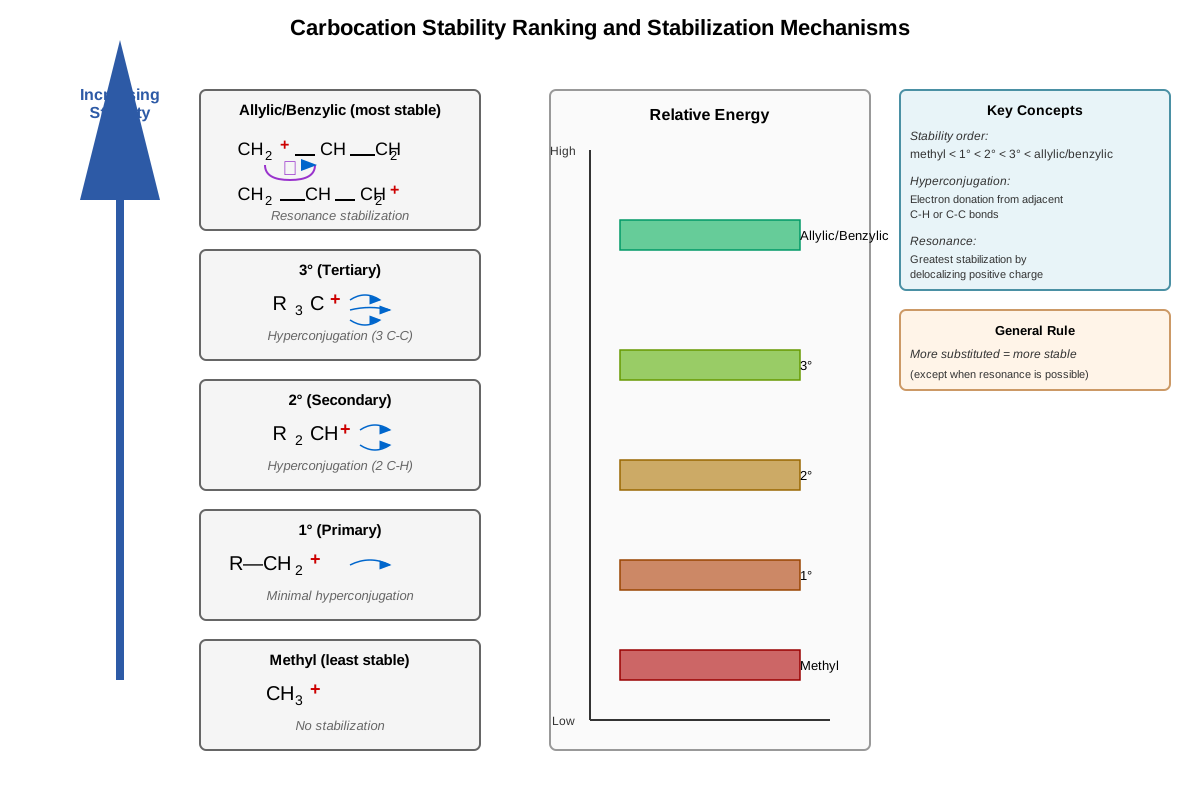
Methyl < Primary (1°) < Secondary (2°) < Tertiary (3°) < Allylic/Benzylic < Resonance-stabilized
This stability order determines reaction rates, product distributions, and the feasibility of reactions proceeding through carbocation intermediates. The MCAT expects students to apply this hierarchy rapidly when analyzing reaction mechanisms.
| Carbocation Type | Number of Alkyl Groups | Relative Stability | Example |
|---|---|---|---|
| Methyl | 0 | Least stable | CH₃⁺ |
| Primary (1°) | 1 | Very unstable | CH₃CH₂⁺ |
| Secondary (2°) | 2 | Moderately stable | (CH₃)₂CH⁺ |
| Tertiary (3°) | 3 | Stable | (CH₃)₃C⁺ |
| Allylic/Benzylic | Variable | Very stable | CH₂=CH-CH₂⁺ |
| Resonance-stabilized | Variable | Most stable | CH₂=CH-CH₂⁺ ↔ ⁺CH₂-CH=CH₂ |
Hyperconjugation
Hyperconjugation is the primary mechanism explaining why alkyl groups stabilize carbocations. This effect involves the overlap of filled σ bonds (particularly C-H bonds) from adjacent carbon atoms with the empty p orbital of the carbocation. The electron density from these σ bonds delocalizes into the empty orbital, partially satisfying the electron deficiency.
Each alkyl group attached to the carbocation carbon provides multiple C-H bonds capable of hyperconjugation. A tertiary carbocation has nine C-H bonds on the three adjacent methyl groups available for stabilization, while a primary carbocation has only three such bonds. This explains the dramatic stability difference: tertiary carbocations are approximately 10⁴ times more stable than primary carbocations.
Inductive Effects
Inductive effects involve the polarization of σ bonds due to electronegativity differences. Alkyl groups are weakly electron-donating through the inductive effect, pushing electron density toward the electron-deficient carbocation carbon. This effect operates through σ bonds and diminishes rapidly with distance.
Conversely, electron-withdrawing groups (like halogens, carbonyl groups, or nitro groups) destabilize carbocations by pulling electron density away from an already electron-deficient center. A carbocation adjacent to a carbonyl group is exceptionally unstable and rarely forms under normal conditions.
Resonance Stabilization
Resonance stabilization provides the most powerful stabilization mechanism for carbocations. When the positive charge can delocalize across multiple atoms through π systems, the energy of the carbocation decreases substantially. Allylic carbocations (positive charge adjacent to a C=C double bond) and benzylic carbocations (positive charge adjacent to a benzene ring) benefit from resonance stabilization.
For an allylic carbocation, two resonance structures distribute the positive charge between two carbon atoms:
CH₂=CH-CH₂⁺ ↔ ⁺CH₂-CH=CH₂
The actual structure is a hybrid where the positive charge is shared across the π system. Benzylic carbocations can delocalize the charge into the aromatic ring through multiple resonance structures, providing exceptional stability.
Carbocation Rearrangements
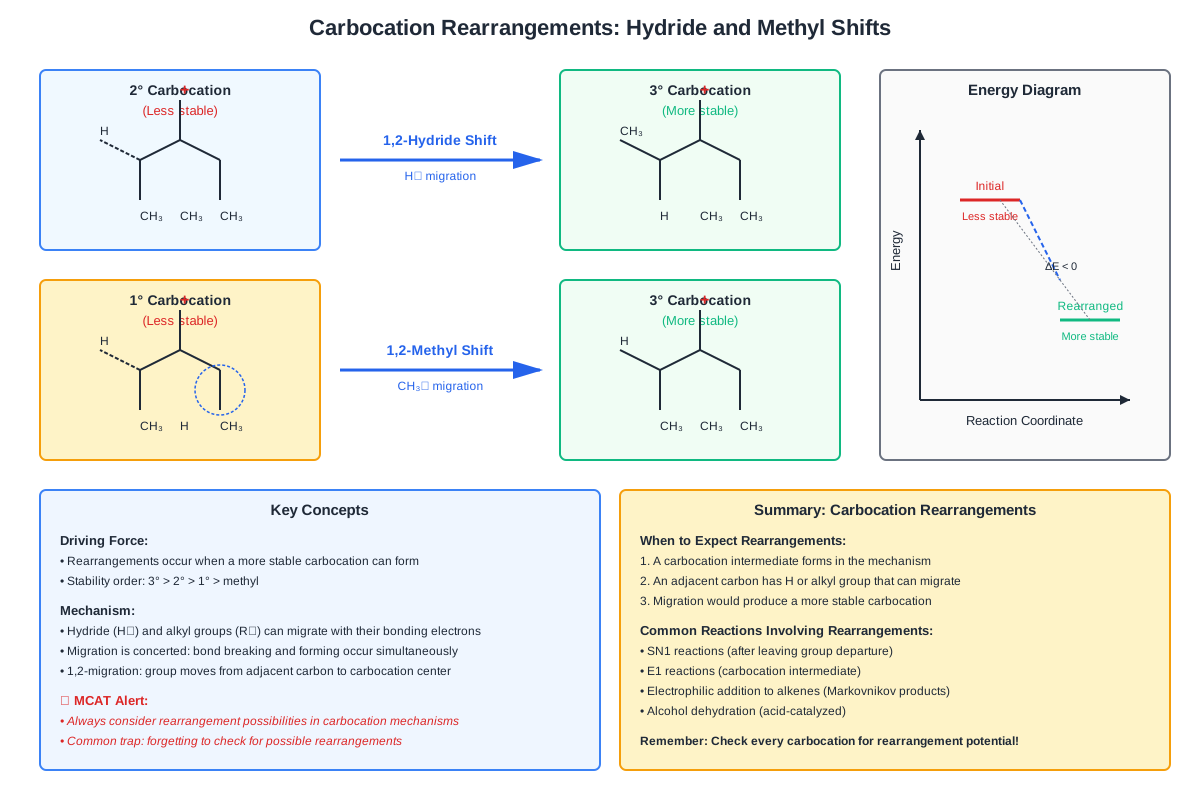
Carbocations can undergo rearrangements to form more stable carbocations through 1,2-hydride shifts or 1,2-alkyl shifts. These rearrangements occur when a hydrogen atom or alkyl group from an adjacent carbon migrates to the carbocation center, simultaneously moving the positive charge to the adjacent position.
Hydride shifts (movement of H with its bonding electrons) are most common and occur rapidly when they convert a less stable carbocation to a more stable one. For example, a secondary carbocation adjacent to a tertiary carbon will undergo hydride shift to form the more stable tertiary carbocation.
Alkyl shifts (movement of an alkyl group with its bonding electrons) follow similar principles but are less common than hydride shifts. Methyl shifts occur more readily than shifts of larger alkyl groups due to steric factors.
Rearrangements are particularly important in MCAT questions because they explain unexpected products. Students must recognize structural features that enable rearrangement: a carbocation with an adjacent carbon bearing a hydrogen or alkyl group that would create a more stable carbocation upon migration.
Formation of Carbocations
Carbocations form through several mechanisms relevant to MCAT content:
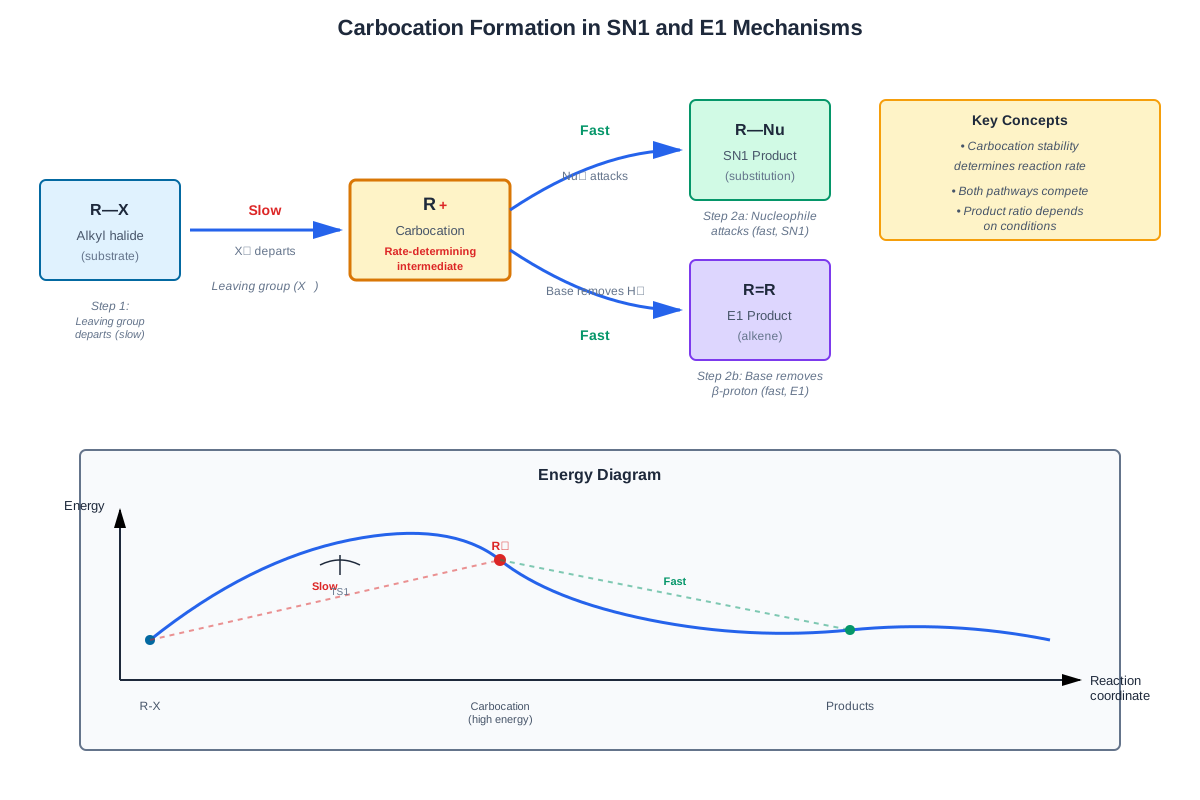
- Heterolytic bond cleavage: A leaving group departs with both bonding electrons, leaving behind a carbocation (SN1 and E1 reactions)
- Protonation of alkenes: Addition of H⁺ to a double bond creates a carbocation at the more substituted position (Markovnikov addition)
- Loss of water from protonated alcohols: Dehydration reactions proceed through carbocation intermediates
- Ionization of alkyl halides: In polar protic solvents, good leaving groups can depart spontaneously
The rate of carbocation formation depends critically on stability—tertiary carbocations form much faster than secondary, which form faster than primary. This rate difference explains regioselectivity in many reactions.
Reactions of Carbocations
Once formed, carbocations react rapidly through three main pathways:
- Nucleophilic attack: A nucleophile donates electrons to the empty p orbital, forming a new bond (completion of SN1)
- Deprotonation: A base removes a proton from a carbon adjacent to the carbocation, forming a double bond (E1 elimination)
- Rearrangement: Migration of hydride or alkyl groups to form more stable carbocations
The competition between these pathways determines product distributions. Strong nucleophiles favor substitution, while weak nucleophiles and elevated temperatures favor elimination. Rearrangement occurs before other reactions if a more stable carbocation is accessible.
Concept Relationships
Carbocation stability directly determines reaction mechanisms and product distributions in organic chemistry. The stability hierarchy (methyl < 1° < 2° < 3° < allylic/benzylic) governs whether reactions proceed through carbocation intermediates (SN1/E1) or alternative mechanisms (SN2/E2).
Hyperconjugation → Carbocation Stability → Reaction Rate: Greater hyperconjugation from alkyl substituents increases stability, which accelerates carbocation formation and favors SN1/E1 mechanisms over SN2/E2.
Resonance Stabilization → Regioselectivity: In electrophilic addition to alkenes, protonation occurs to generate the more stable carbocation (Markovnikov's rule), which then determines the final product structure.
Carbocation Stability → Rearrangement Tendency: Less stable carbocations adjacent to positions that could form more stable carbocations undergo rapid rearrangement, connecting carbocation stability to product prediction.
Leaving Group Ability + Carbocation Stability → Mechanism Selection: Good leaving groups combined with substrates that form stable carbocations favor SN1/E1 pathways, while poor leaving groups or substrates forming unstable carbocations require SN2/E2 mechanisms.
Solvent Polarity → Carbocation Formation: Polar protic solvents stabilize carbocations through solvation, facilitating their formation and favoring SN1/E1 mechanisms. This connects solvent effects to carbocation chemistry.
Quick check — test yourself on Carbocations so far.
Try Flashcards →High-Yield Facts
⭐ Carbocation stability order: Methyl < 1° < 2° < 3° < allylic/benzylic < resonance-stabilized
⭐ Tertiary carbocations are approximately 10⁴ times more stable than primary carbocations due to hyperconjugation and inductive effects
⭐ Carbocations are sp² hybridized with trigonal planar geometry and an empty p orbital
⭐ Carbocation rearrangements occur when they produce more stable carbocations through 1,2-hydride or 1,2-alkyl shifts
⭐ SN1 and E1 reactions proceed through carbocation intermediates, while SN2 and E2 do not
- Allylic and benzylic carbocations are stabilized by resonance delocalization of the positive charge
- Electron-withdrawing groups adjacent to carbocations destabilize them significantly
- Carbocations react with nucleophiles, undergo elimination, or rearrange depending on conditions
- Markovnikov addition to alkenes proceeds through the more stable carbocation intermediate
- Polar protic solvents stabilize carbocations and favor their formation in SN1/E1 reactions
Common Misconceptions
Misconception: All carbocations are equally unstable and reactive.
Correction: Carbocation stability varies dramatically based on substitution pattern. Tertiary carbocations are stable enough to form readily under mild conditions, while primary carbocations rarely form except under extreme conditions. This stability difference is quantitative—orders of magnitude in energy and reaction rates.
Misconception: Carbocations always rearrange to the most stable possible structure.
Correction: Carbocations only rearrange through 1,2-shifts (hydride or alkyl migration to an adjacent carbon). They cannot rearrange across multiple carbons in a single step. A secondary carbocation will rearrange to an adjacent tertiary position if possible, but cannot jump to a distant tertiary carbon.
Misconception: The positive charge in a carbocation is localized on a single atom.
Correction: In resonance-stabilized carbocations (allylic, benzylic), the positive charge is delocalized across multiple atoms through π systems. The actual structure is a resonance hybrid, not a single Lewis structure. This delocalization is the source of exceptional stability.
Misconception: Carbocations form in SN2 reactions.
Correction: SN2 reactions proceed through a concerted mechanism with simultaneous bond formation and breaking. No carbocation intermediate forms. Only SN1 reactions involve carbocation intermediates, which explains their different stereochemical outcomes and rate laws.
Misconception: Hyperconjugation and inductive effects are the same phenomenon.
Correction: Hyperconjugation involves overlap of filled σ bonds with the empty p orbital (orbital interaction), while inductive effects involve polarization of σ bonds through electronegativity differences (electrostatic effect). Both stabilize carbocations but through different mechanisms, and hyperconjugation is generally more powerful.
Misconception: Carbocations adjacent to electron-withdrawing groups are stabilized because the groups "pull away" the positive charge.
Correction: Electron-withdrawing groups destabilize carbocations by removing electron density from an already electron-deficient center. A carbocation needs electron donation, not further electron withdrawal. Carbocations next to carbonyl groups or halogens are exceptionally unstable.
Worked Examples
Example 1: Predicting Carbocation Stability and Rearrangement
Question: Rank the following carbocations in order of increasing stability and predict whether rearrangement will occur:
A) (CH₃)₂CH-CH₂⁺ (primary carbocation with adjacent tertiary carbon)
B) (CH₃)₃C⁺ (tertiary carbocation)
C) CH₃-CH₂⁺ (primary carbocation, no adjacent tertiary carbon)
D) CH₂=CH-CH₂⁺ (allylic carbocation)
Solution:
Step 1: Classify each carbocation by type.
- A: Primary carbocation (one alkyl group on the positive carbon)
- B: Tertiary carbocation (three alkyl groups on the positive carbon)
- C: Primary carbocation (one alkyl group on the positive carbon)
- D: Allylic carbocation (positive charge adjacent to C=C double bond)
Step 2: Apply the stability hierarchy.
- Primary carbocations (A and C) are least stable
- Tertiary carbocation (B) is more stable than primary
- Allylic carbocation (D) is most stable due to resonance
Step 3: Consider rearrangement potential.
- Carbocation A has an adjacent carbon bearing three alkyl groups (tertiary position). A 1,2-hydride shift would convert the primary carbocation to a tertiary carbocation, which is much more stable. Rearrangement will occur rapidly.
- Carbocation B is already tertiary with no adjacent quaternary carbon. No rearrangement.
- Carbocation C has no adjacent tertiary or secondary positions. No favorable rearrangement pathway.
- Carbocation D is already resonance-stabilized. No rearrangement needed.
Final ranking (increasing stability): C < A (before rearrangement) < B < D
After rearrangement: C < B ≈ A (after rearrangement to tertiary) < D
Key takeaway: Always check for possible rearrangements when a carbocation has an adjacent carbon that could form a more stable carbocation through 1,2-shift. This connects carbocation stability to product prediction in real reactions.
Example 2: Mechanism Analysis with Carbocation Intermediate
Question: When 2-methylbut-2-ene reacts with HBr, the major product is 2-bromo-2-methylbutane rather than 1-bromo-2-methylbutane. Explain this regioselectivity using carbocation stability principles.
Solution:
Step 1: Identify the reaction type.
This is electrophilic addition of HBr to an alkene, which proceeds through a carbocation intermediate.
Step 2: Determine possible carbocation intermediates.
The double bond is between C2 and C3 of the methylbutane skeleton:
    CH₃
     |
CH₃-C=CH-CH₃
Protonation can occur at either C2 or C3:
- Protonation at C2 creates a carbocation at C3: CH₃-C(CH₃)₂-CH⁺-CH₃ (secondary)
- Protonation at C3 creates a carbocation at C2: CH₃-C⁺(CH₃)-CH₂-CH₃ (tertiary)
Step 3: Apply Markovnikov's rule (proton adds to less substituted carbon).
The proton adds to C3 (the carbon of the double bond with more hydrogens), creating the carbocation at C2, which is the more substituted position.
Step 4: Evaluate carbocation stability.
- Tertiary carbocation at C2: Three alkyl groups provide maximum hyperconjugation and inductive stabilization
- Secondary carbocation at C3: Only two alkyl groups, less stable
The reaction proceeds through the more stable tertiary carbocation.
Step 5: Predict product from carbocation.
Bromide ion (nucleophile) attacks the tertiary carbocation at C2, forming 2-bromo-2-methylbutane as the major product.
Conclusion: The regioselectivity follows from Markovnikov's rule, which is fundamentally based on carbocation stability. The reaction pathway through the more stable tertiary carbocation is lower in energy and faster, making it the major pathway. This example demonstrates how carbocation stability principles predict product distributions in addition reactions.
Exam Strategy
When approaching MCAT questions involving carbocations, follow this systematic strategy:
Step 1: Identify if a carbocation is involved. Look for trigger words: SN1, E1, "carbocation intermediate," electrophilic addition, Markovnikov, or rearrangement. If the question mentions reaction rates that depend on substrate structure, consider carbocation stability.
Step 2: Classify the carbocation type immediately. Count alkyl groups on the positive carbon (1° vs 2° vs 3°) and check for allylic/benzylic positions or resonance possibilities. This takes 5 seconds and determines stability.
Step 3: Check for rearrangement potential. Look at carbons adjacent to the carbocation. If an adjacent carbon has a hydrogen or alkyl group that could migrate to create a more stable carbocation, assume rearrangement occurs. The MCAT loves testing rearrangements because many students forget to check.
Step 4: Apply stability to predict outcomes. More stable carbocations form faster (kinetic control) and are lower in energy (thermodynamic control). Use this to predict major products, explain rate differences, or eliminate wrong answer choices.
Process of elimination tips:
- Eliminate answers suggesting primary carbocations form readily—they don't
- Eliminate answers that show carbocations with adjacent electron-withdrawing groups as stable
- Eliminate answers that ignore possible rearrangements
- Eliminate answers that confuse SN1 (carbocation) with SN2 (no carbocation)
Time allocation: Spend 10-15 seconds classifying carbocation stability, then apply that classification to answer the question. Don't get bogged down drawing every resonance structure unless specifically asked—knowing that resonance exists is often sufficient.
Red flag phrases: "Primary carbocation intermediate" (rarely forms), "no rearrangement occurs" (check carefully), "carbocation adjacent to carbonyl" (extremely unstable), "SN2 through carbocation" (mechanistic contradiction).
Memory Techniques
Mnemonic for stability order: "My Poor Sister Takes All Rewards"
- Methyl < Primary < Secondary < Tertiary < Allylic/benzylic < Resonance-stabilized
Visualization for hyperconjugation: Picture the empty p orbital as a "hungry mouth" that "eats" electron density from adjacent C-H bonds. More C-H bonds (more alkyl groups) = more food = happier (more stable) carbocation.
Rearrangement check acronym: "SHIFT"
- See if adjacent carbon exists
- Hydride or alkyl available to migrate?
- Improves stability?
- Form more substituted carbocation?
- Then rearrangement occurs!
Geometry reminder: "SP² = 3 groups = 120° = PLANAR" (all rhyme with "carbocation formation")
Markovnikov memory: "The rich get richer"—the more substituted carbon (already has more bonds) gets the positive charge (becomes the carbocation), which then gets the nucleophile.
Summary
Carbocations are positively charged, electron-deficient carbon species with sp² hybridization and trigonal planar geometry that serve as key intermediates in SN1, E1, and electrophilic addition reactions. Their stability follows a predictable hierarchy (methyl < 1° < 2° < 3° < allylic/benzylic < resonance-stabilized) determined by hyperconjugation, inductive effects, and resonance stabilization. Alkyl groups stabilize carbocations through hyperconjugation and electron donation, while electron-withdrawing groups destabilize them. Carbocations can undergo 1,2-hydride or 1,2-alkyl shifts to form more stable carbocations, which explains unexpected products in many reactions. Understanding carbocation stability enables prediction of reaction mechanisms, rates, regioselectivity, and product distributions—essential skills for MCAT success in organic chemistry questions.
Key Takeaways
- Carbocations are sp² hybridized, trigonal planar, electron-deficient species with six valence electrons and an empty p orbital
- Stability increases with substitution: tertiary > secondary > primary > methyl, with allylic/benzylic and resonance-stabilized carbocations being most stable
- Hyperconjugation from adjacent C-H bonds is the primary stabilization mechanism for alkyl-substituted carbocations
- Carbocation rearrangements occur through 1,2-hydride or 1,2-alkyl shifts when they produce more stable carbocations
- SN1 and E1 reactions proceed through carbocation intermediates, while SN2 and E2 do not
- Carbocation stability determines reaction rates, regioselectivity (Markovnikov's rule), and product distributions
- Always check for possible rearrangements when analyzing reactions involving carbocations—this is a high-yield MCAT testing point
Related Topics
SN1 and E1 Mechanisms: These unimolecular reactions proceed through carbocation intermediates, making carbocation stability the rate-determining factor. Mastering carbocations enables prediction of SN1/E1 rates and product distributions.
Electrophilic Addition to Alkenes: Markovnikov addition proceeds through carbocation intermediates, with regioselectivity determined by carbocation stability. Understanding carbocations explains why certain regioisomers predominate.
Carbocation Rearrangements in Synthesis: Advanced synthetic applications require predicting and controlling carbocation rearrangements, including pinacol rearrangements and Wagner-Meerwein shifts.
Resonance and Conjugation: Deeper study of resonance stabilization explains why allylic and benzylic carbocations are exceptionally stable and how extended conjugation further stabilizes positive charges.
Reaction Coordinate Diagrams: Carbocation intermediates appear as local energy minima on reaction coordinate diagrams for multi-step mechanisms, connecting thermodynamics and kinetics to carbocation stability.
Practice CTA
Now that you've mastered the core concepts of carbocation stability, structure, and reactivity, it's time to reinforce your understanding through active practice. Attempt the practice questions to test your ability to classify carbocations, predict rearrangements, and apply these principles to MCAT-style problems. Use the flashcards to drill the stability hierarchy and key facts until they become automatic. Remember: carbocation questions reward systematic thinking—classify first, check for rearrangements second, then apply to the specific question. You've built a strong foundation; now solidify it through deliberate practice!
Sign up free to keep reading
Create a free AnvayaPrep account to finish this MCAT guide on Carbocations — plus flashcards and practice questions.