Overview
Formal charge in organic molecules is a fundamental concept in Organic Chemistry that allows chemists and students to evaluate the distribution of electrons within molecular structures. This bookkeeping method assigns a hypothetical charge to individual atoms within a molecule based on the assumption that electrons in covalent bonds are shared equally between bonded atoms. Understanding formal charge is essential for predicting molecular reactivity, determining the most stable resonance structures, identifying reactive sites within molecules, and explaining reaction mechanisms—all critical skills for success on the MCAT.
The concept of formal charge in organic molecules bridges the gap between Lewis structures and chemical behavior. While Lewis structures show how atoms are connected and where electrons are located, formal charge calculations reveal which atoms carry partial positive or negative charges, information that directly predicts where nucleophiles will attack and where electrophiles will be attracted. This topic appears frequently in MCAT passages involving acid-base chemistry, reaction mechanisms, resonance structures, and molecular stability comparisons. Mastery of formal charge enables students to quickly evaluate multiple structural representations and select the most reasonable one, a skill tested repeatedly in the Chemical and Physical Foundations of Biological Systems section.
Within the broader context of Structure and Bonding, formal charge connects intimately with electronegativity, resonance theory, molecular geometry, and reaction mechanisms. Students who master formal charge calculations can rapidly assess molecular stability, predict sites of chemical reactivity, and understand why certain reaction pathways are favored over others. This foundational skill supports learning in nearly every subsequent Organic Chemistry topic, from nucleophilic substitution reactions to carbonyl chemistry and aromatic compounds.
Learning Objectives
- [ ] Define formal charge in organic molecules using accurate Organic Chemistry terminology
- [ ] Explain why formal charge in organic molecules matters for the MCAT
- [ ] Apply formal charge in organic molecules to exam-style questions
- [ ] Identify common mistakes related to formal charge in organic molecules
- [ ] Connect formal charge in organic molecules to related Organic Chemistry concepts
- [ ] Calculate formal charge for any atom in a Lewis structure within 10 seconds
- [ ] Rank resonance structures by stability using formal charge analysis
- [ ] Predict reactive sites in organic molecules based on formal charge distribution
Prerequisites
- Lewis structures and bonding: Understanding how to draw Lewis structures with correct bonding patterns and lone pairs is essential because formal charge calculations depend on accurate electron accounting
- Valence electrons: Knowledge of how many valence electrons each element possesses (particularly C, N, O, and halogens) is required to determine deviations from neutral states
- Electronegativity trends: Familiarity with electronegativity differences helps evaluate whether formal charge distributions are reasonable and stable
- Octet rule: Understanding that main group elements typically strive for eight valence electrons provides context for why certain formal charge distributions are more favorable than others
Why This Topic Matters
Formal charge calculations appear in approximately 5-8% of MCAT Organic Chemistry questions, making this a medium-yield but high-impact topic. Questions involving formal charge rarely appear in isolation; instead, they are embedded within larger problems about resonance structures, acid-base chemistry, reaction mechanisms, and molecular stability. The ability to quickly calculate and interpret formal charges often provides the key insight needed to eliminate wrong answer choices or identify the correct reaction pathway.
In clinical and research contexts, formal charge understanding underlies drug design, where chemists must predict how molecules will interact with biological targets. Pharmaceutical compounds often contain charged or partially charged functional groups that determine solubility, membrane permeability, and binding affinity to protein active sites. For example, understanding why the protonated form of an amine carries a positive formal charge explains why many drugs are administered as hydrochloride salts to improve water solubility.
On the MCAT, formal charge appears most commonly in three contexts: (1) comparing resonance structures to identify the major contributor, (2) predicting reactive sites in nucleophilic or electrophilic reactions, and (3) explaining acid-base behavior of organic molecules. Passages may present complex natural products or drug molecules and ask students to identify the most acidic proton, the most nucleophilic site, or the most stable tautomer—all questions that require rapid formal charge assessment.
Core Concepts
Definition and Formula
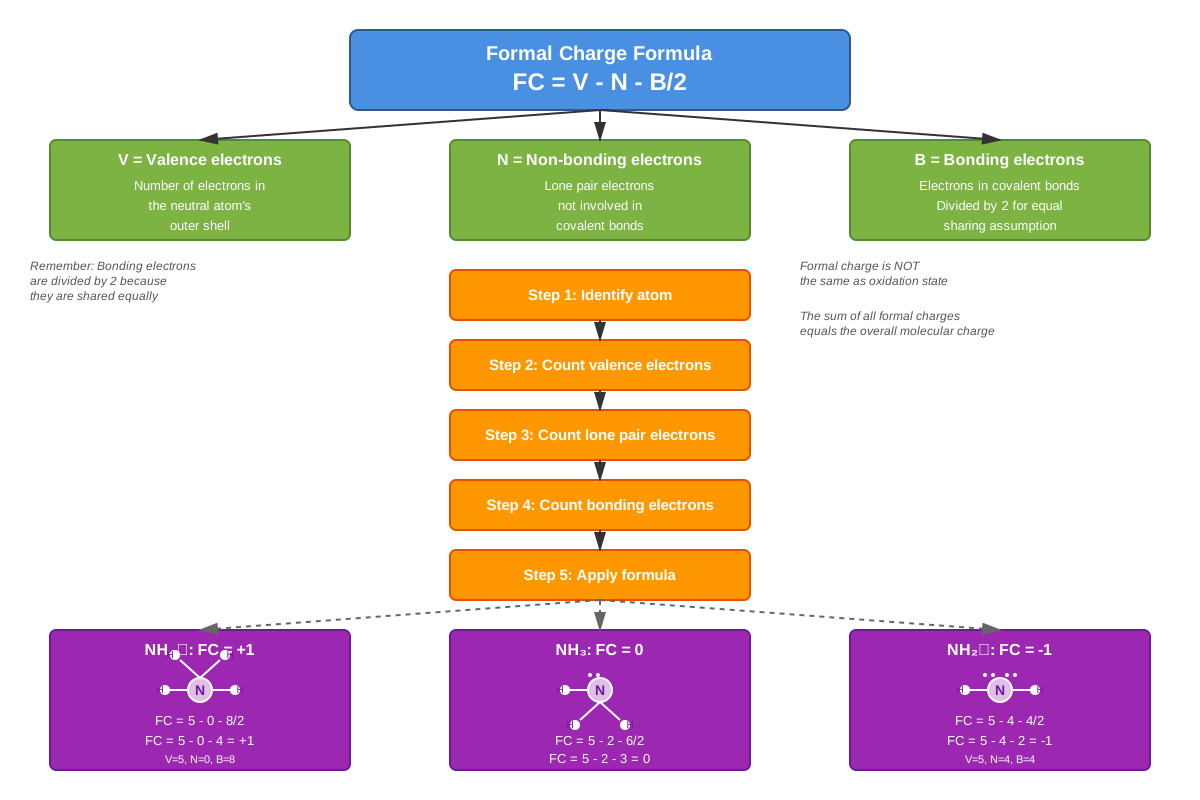
Formal charge is a hypothetical charge assigned to an atom in a molecule, calculated by comparing the number of valence electrons in the free atom to the number of electrons "owned" by that atom in the bonded structure. The formal charge formula is:
Formal Charge = (Valence electrons) - (Non-bonding electrons) - (1/2 × Bonding electrons)Alternatively, this can be expressed as:
Formal Charge = (Valence electrons) - (Lone pair electrons) - (Number of bonds)The second formulation is often faster for MCAT calculations because counting bonds is quicker than counting individual bonding electrons. Each single bond counts as one bond, each double bond as two bonds, and each triple bond as three bonds.
Step-by-Step Calculation Process
To calculate formal charge systematically:
- Identify the atom of interest in the Lewis structure
- Determine valence electrons for the free atom (from periodic table position)
- Count non-bonding electrons (lone pairs) on that atom in the structure
- Count bonding electrons and divide by two (or simply count bonds)
- Apply the formula and determine the charge
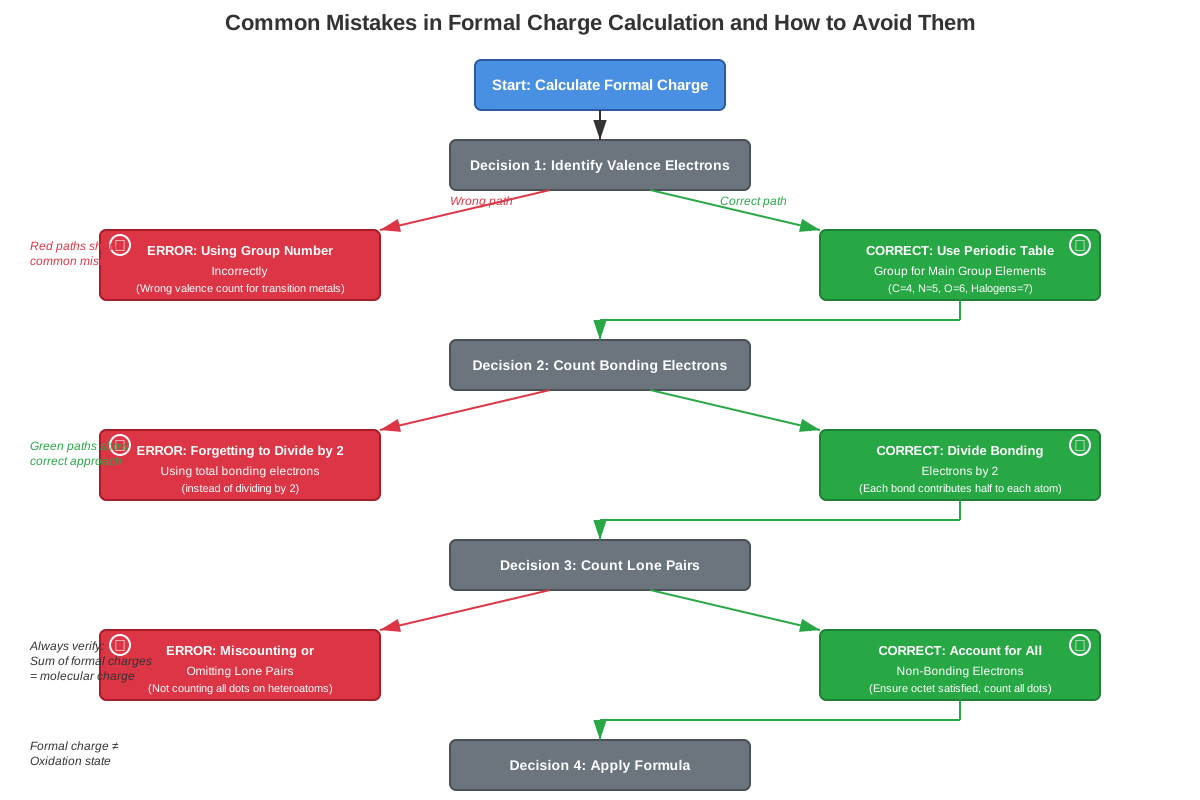
- Verify that the sum of all formal charges equals the overall molecular charge
Common Formal Charge Patterns
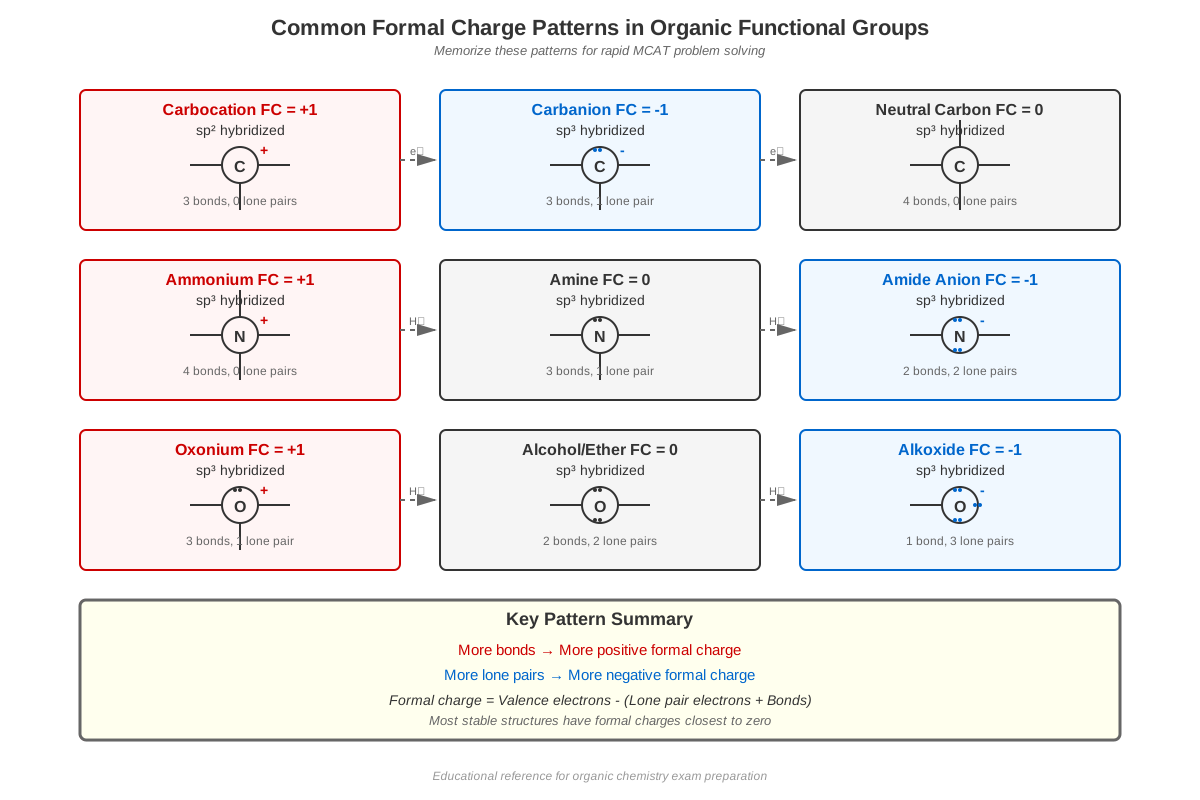
Certain formal charge patterns appear repeatedly in organic molecules and should be memorized for rapid recognition:
| Atom | Bonds | Lone Pairs | Formal Charge | Example |
|---|---|---|---|---|
| Carbon | 4 | 0 | 0 | CH₄, most organic carbons |
| Carbon | 3 | 0 | +1 | Carbocation (R₃C⁺) |
| Carbon | 3 | 1 | -1 | Carbanion (R₃C⁻) |
| Nitrogen | 3 | 1 | 0 | Ammonia (NH₃), amines |
| Nitrogen | 4 | 0 | +1 | Ammonium (NH₄⁺), protonated amines |
| Nitrogen | 2 | 1 | 0 | Imines (C=N-R) |
| Oxygen | 2 | 2 | 0 | Water (H₂O), alcohols, ethers |
| Oxygen | 3 | 1 | +1 | Protonated alcohols (R-OH₂⁺) |
| Oxygen | 1 | 3 | -1 | Alkoxide ions (RO⁻), hydroxide |
| Oxygen | 1 | 2 | 0 | Carbonyl oxygen (C=O) |
Formal Charge and Molecular Stability
Formal charge distributions directly correlate with molecular stability. Several principles guide stability assessment:
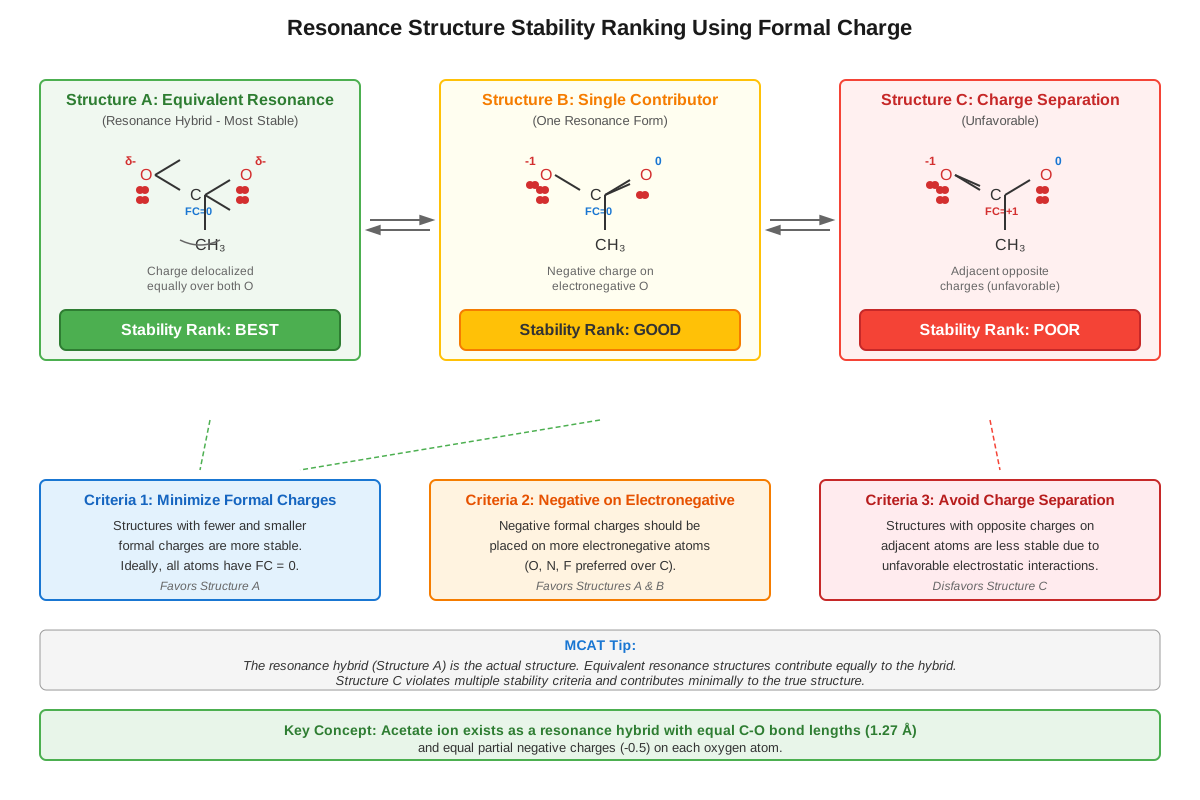
Principle 1: Minimize formal charges - Structures with fewer formal charges are generally more stable than those with more formal charges. A structure where all atoms have formal charges of zero is typically most stable.
Principle 2: Minimize charge separation - When formal charges must exist, structures with smaller separation between opposite charges are more stable. Adjacent opposite charges are more stable than distant ones.
Principle 3: Match formal charge with electronegativity - Negative formal charges should reside on more electronegative atoms, while positive formal charges should reside on less electronegative atoms. A structure with negative charge on oxygen is more stable than one with negative charge on carbon.
Principle 4: Avoid like charges on adjacent atoms - Structures with positive charges on adjacent atoms or negative charges on adjacent atoms are highly unstable due to electrostatic repulsion.
Formal Charge in Resonance Structures
Resonance structures are alternative Lewis structures for the same molecule that differ only in electron placement, not atom positions. Formal charge analysis is the primary tool for ranking resonance contributors:
The major resonance contributor (most important structure) typically has:
- The fewest formal charges
- Negative formal charges on the most electronegative atoms
- Positive formal charges on the least electronegative atoms
- Minimal charge separation
Minor resonance contributors may have:
- More formal charges
- Charge separation
- Unfavorable formal charge placement
For example, in the acetate ion (CH₃COO⁻), two resonance structures exist with the negative charge on different oxygen atoms. Both are equivalent and contribute equally because both have the same formal charge distribution. However, a hypothetical structure with negative charge on carbon would be a negligible contributor due to unfavorable formal charge placement.
Formal Charge and Reactivity
Formal charge indicates reactive sites within molecules:
Atoms with positive formal charge are electron-deficient and act as electrophiles (electron-seeking species). They are susceptible to attack by nucleophiles. Examples include carbocations, protonated carbonyl groups, and quaternary ammonium ions.
Atoms with negative formal charge are electron-rich and act as nucleophiles (nucleus-seeking species). They readily donate electrons to electrophiles. Examples include carbanions, alkoxide ions, and deprotonated amines.
Atoms with zero formal charge may still be reactive depending on their electronegativity and bonding environment, but formal charge provides the first-order prediction of reactivity.
Formal Charge vs. Oxidation State
Students must distinguish between formal charge and oxidation state, as these are different electron-accounting systems:
Formal charge assumes equal sharing of bonding electrons between atoms, regardless of electronegativity differences. It is used primarily in organic chemistry to assess structure and reactivity.
Oxidation state assigns bonding electrons to the more electronegative atom in each bond. It is used primarily in inorganic chemistry and redox reactions.
The same atom can have different formal charges and oxidation states. For example, in carbon monoxide (C≡O), carbon has a formal charge of -1 but an oxidation state of +2.
Concept Relationships
Formal charge calculations build directly on Lewis structure drawing skills, as accurate formal charge determination requires correct representation of bonds and lone pairs. The concept flows naturally into resonance theory, where formal charge becomes the primary criterion for evaluating which resonance structures contribute most significantly to the actual molecular structure. This relationship can be mapped as: Lewis Structures → Formal Charge Calculation → Resonance Structure Ranking → Stability Prediction.
Formal charge connects intimately with electronegativity concepts from general chemistry. The principle that negative formal charges should reside on electronegative atoms reflects the same underlying physics that explains polar covalent bonds. This relationship extends to acid-base chemistry, where formal charge helps predict pKa values and protonation states. Molecules with negative formal charges are more basic (proton acceptors), while those with positive formal charges are more acidic (proton donors).
The concept also bridges to reaction mechanisms in organic chemistry. Understanding formal charge distribution allows prediction of nucleophilic and electrophilic sites, which determines where reactions will occur. This flows into arrow-pushing mechanisms, where curved arrows show electron movement from electron-rich (often negatively charged) to electron-deficient (often positively charged) sites: Formal Charge Analysis → Reactive Site Identification → Mechanism Prediction → Product Formation.
Finally, formal charge relates to molecular geometry through VSEPR theory. The number of bonds and lone pairs used in formal charge calculations also determines molecular shape, creating a connection between electronic structure and three-dimensional geometry.
High-Yield Facts
⭐ The formal charge formula: FC = Valence electrons - Lone pair electrons - Number of bonds (fastest calculation method for MCAT)
⭐ Neutral carbon has four bonds and no lone pairs; any deviation creates formal charge
⭐ Neutral nitrogen has three bonds and one lone pair; four bonds creates +1 charge
⭐ Neutral oxygen has two bonds and two lone pairs; one bond with three lone pairs creates -1 charge
⭐ The most stable resonance structure has the fewest formal charges and places negative charges on electronegative atoms
- The sum of all formal charges in a molecule equals the overall molecular charge
- Formal charge is a bookkeeping tool, not the actual charge distribution (which is better represented by partial charges δ+ and δ-)
- Carbocations (C with +1 formal charge) are key intermediates in many organic reactions including SN1 and E1 mechanisms
- Carbanions (C with -1 formal charge) are strong bases and nucleophiles, often formed by deprotonation of weak C-H bonds
- Protonated heteroatoms (N, O) carry positive formal charges and are excellent leaving groups in substitution reactions
- In resonance structures with equivalent formal charge distributions, all contributors are equally important (e.g., carboxylate ions, benzene)
- Formal charge helps identify the most acidic proton: removing it should create the most stable anion (negative charge on most electronegative atom)
Quick check — test yourself on Formal charge in organic molecules so far.
Try Flashcards →Common Misconceptions
Misconception: Formal charge represents the actual charge on an atom in a molecule.
Correction: Formal charge is a theoretical construct for electron bookkeeping that assumes equal sharing of bonding electrons. Actual charge distribution is better represented by partial charges (δ+ and δ-) determined by electronegativity differences. Formal charge is a useful approximation for predicting reactivity and stability, not a measurement of actual electron density.
Misconception: All resonance structures contribute equally to the actual molecular structure.
Correction: Resonance structures contribute in proportion to their stability, which is assessed primarily through formal charge analysis. Major contributors have minimal formal charges and favorable charge placement, while minor contributors may have extensive formal charges or unfavorable distributions. Some resonance structures are so unstable they contribute negligibly.
Misconception: An atom with zero formal charge has no partial charge or reactivity.
Correction: Formal charge and partial charge are different concepts. An atom can have zero formal charge but still possess significant partial charge due to electronegativity differences. For example, the oxygen in water has zero formal charge but carries substantial partial negative charge (δ-), making it nucleophilic.
Misconception: Formal charge calculations can be skipped if the Lewis structure "looks right."
Correction: Many incorrect Lewis structures appear reasonable at first glance but violate formal charge principles. Systematic formal charge calculation is essential for verifying structure correctness, especially for molecules with multiple heteroatoms or unusual bonding patterns. On the MCAT, wrong answer choices often contain structures with unfavorable formal charge distributions.
Misconception: Carbon can never have a formal charge in stable organic molecules.
Correction: While neutral carbon (four bonds, no lone pairs) is most common, charged carbon species are crucial intermediates and products in organic chemistry. Carbocations appear in SN1 and E1 mechanisms, carbanions in organometallic chemistry and enolate formation, and some stable molecules contain charged carbon (e.g., isocyanides, carbon monoxide).
Misconception: The structure with the most bonds is always the most stable resonance contributor.
Correction: While multiple bonds often indicate stability, formal charge distribution is the primary stability criterion. A structure with fewer bonds but better formal charge distribution (charges on appropriate atoms, minimal separation) is more stable than one with more bonds but unfavorable charges. Always calculate formal charges rather than simply counting bonds.
Worked Examples
Example 1: Comparing Resonance Structures of the Nitrate Ion
Problem: The nitrate ion (NO₃⁻) can be drawn with three different resonance structures. Draw these structures, calculate formal charges, and determine their relative contributions.
Solution:
Step 1: Draw the three resonance structures. Each has nitrogen as the central atom bonded to three oxygen atoms, with one N=O double bond and two N-O single bonds. The double bond position varies among the three structures.
Step 2: Calculate formal charges for Structure 1 (N=O double bond to oxygen A):
For nitrogen:
- Valence electrons: 5
- Lone pairs: 0
- Bonds: 4 (one double, two single)
- FC = 5 - 0 - 4 = +1
For oxygen A (double bonded):
- Valence electrons: 6
- Lone pairs: 4 electrons (2 pairs)
- Bonds: 2 (double bond)
- FC = 6 - 4 - 2 = 0
For oxygen B (single bonded):
- Valence electrons: 6
- Lone pairs: 6 electrons (3 pairs)
- Bonds: 1 (single bond)
- FC = 6 - 6 - 1 = -1
For oxygen C (single bonded):
- Same as oxygen B: FC = -1
Step 3: Verify that formal charges sum to overall charge: (+1) + (0) + (-1) + (-1) = -1 ✓
Step 4: Analyze the other two structures. By symmetry, they have identical formal charge distributions, just with the double bond to different oxygen atoms.
Step 5: Evaluate stability. All three structures have:
- Total of three formal charges (one +1, one 0, two -1)
- Positive charge on nitrogen (less electronegative)
- Negative charges on oxygen (more electronegative)
- Equivalent formal charge distributions
Conclusion: All three resonance structures are equivalent and contribute equally to the actual structure of the nitrate ion. The actual structure has all three N-O bonds equivalent (bond order 1.33) with the negative charge delocalized equally over all three oxygen atoms. This equal contribution occurs because all three structures have identical and favorable formal charge distributions.
Example 2: Identifying the Most Acidic Proton
Problem: Consider acetic acid (CH₃COOH). Explain why the hydroxyl proton is more acidic than the methyl protons using formal charge analysis.
Solution:
Step 1: Draw the conjugate bases formed by removing each type of proton.
Removing a methyl proton creates: CH₂⁻-COOH (carbanion)
Removing the hydroxyl proton creates: CH₃-COO⁻ (carboxylate)
Step 2: Calculate formal charges in the carbanion structure (CH₂⁻-COOH):
For the negatively charged carbon:
- Valence electrons: 4
- Lone pairs: 2 electrons (1 pair)
- Bonds: 3
- FC = 4 - 2 - 3 = -1 ✓
This structure has a negative formal charge on carbon, which is not very electronegative.
Step 3: Calculate formal charges in the carboxylate structure (CH₃-COO⁻). This structure has two major resonance forms with the negative charge on different oxygen atoms.
For each oxygen in the resonance structures:
- One oxygen: FC = 6 - 6 - 1 = -1
- Other oxygen: FC = 6 - 4 - 2 = 0
Step 4: Compare stability of conjugate bases:
The carbanion (CH₂⁻-COOH) has:
- Negative charge on carbon (electronegativity 2.5)
- No resonance stabilization
- High energy, unstable
The carboxylate (CH₃-COO⁻) has:
- Negative charge on oxygen (electronegativity 3.5)
- Resonance stabilization (charge delocalized over two oxygens)
- Lower energy, more stable
Step 5: Apply the principle that stronger acids form more stable conjugate bases.
Conclusion: The hydroxyl proton is much more acidic (pKa ≈ 4.8) than the methyl protons (pKa > 40) because removing it creates a stable carboxylate ion with negative formal charge on electronegative oxygen atoms and resonance stabilization. Removing a methyl proton creates an unstable carbanion with negative charge on less electronegative carbon. Formal charge analysis correctly predicts that the O-H proton is approximately 10³⁵ times more acidic than the C-H protons.
Exam Strategy
When approaching MCAT questions involving formal charge, follow this systematic approach:
Step 1: Quickly assess whether formal charge is relevant. Trigger words include "most stable," "major contributor," "resonance," "reactive site," "nucleophilic," "electrophilic," and "acidic proton." If comparing structures or predicting reactivity, formal charge analysis is likely needed.
Step 2: Use the fast formula. Calculate FC = Valence - Lone pairs - Bonds rather than the longer version with bonding electrons. This saves 5-10 seconds per atom. For MCAT purposes, you should be able to calculate formal charge for any atom in under 10 seconds.
Step 3: Look for patterns before calculating. Memorize the high-yield formal charge patterns (neutral carbon = 4 bonds, neutral nitrogen = 3 bonds + 1 lone pair, etc.). Often you can identify formal charges by pattern recognition without explicit calculation.
Step 4: Use process of elimination. Wrong answer choices often contain:
- Structures with unfavorable formal charge distributions (negative on carbon instead of oxygen)
- Resonance structures claimed to be major contributors despite having more formal charges
- Structures where formal charges don't sum to the correct overall charge
- Atoms that violate octet rule without appropriate formal charges
Step 5: Check your work with the sum rule. The sum of all formal charges must equal the overall molecular charge. If it doesn't, you've made an error in structure or calculation.
Time allocation: Don't spend more than 30 seconds on formal charge analysis for any single question. If a problem requires comparing multiple resonance structures, quickly calculate formal charges for heteroatoms (N, O) only, as these are most likely to carry charges and determine stability.
Red flag phrases: "All resonance structures contribute equally" is usually wrong unless the structures are truly equivalent by symmetry. "The structure with the most bonds" is not always the most stable—formal charge distribution matters more.
Memory Techniques
"VLON" mnemonic for formal charge formula: Valence minus Lone pairs minus bONds (sounds like "violin")
"NEWS" for common neutral atoms:
- Nitrogen: Eight electrons total (3 bonds + 1 lone pair)
- Water-like oxygen: Eight electrons total (2 bonds + 2 lone pairs)
- Saturated carbon: Eight electrons total (4 bonds + 0 lone pairs)
"FENCE" for formal charge stability principles:
- Fewer formal charges = more stable
- Electronegative atoms get negative charges
- Negative and positive charges should be Close together (minimize separation)
- Equal charges repel (avoid like charges on adjacent atoms)
Visualization strategy: Picture formal charges as "electron debt" (positive) or "electron surplus" (negative). An atom with positive formal charge "owes" electrons and wants to gain them (electrophile). An atom with negative formal charge has "extra" electrons and wants to donate them (nucleophile).
"4-3-2-1" for carbon, nitrogen, oxygen formal charges:
- Carbon: 4 bonds = neutral, 3 bonds = charged
- Nitrogen: 3 bonds (with lone pair) = neutral, 4 or 2 bonds = charged
- Oxygen: 2 bonds (with 2 lone pairs) = neutral, 3 or 1 bonds = charged
Summary
Formal charge in organic molecules is a systematic electron-accounting method that assigns hypothetical charges to individual atoms based on the assumption of equal electron sharing in covalent bonds. The formula FC = Valence electrons - Lone pair electrons - Number of bonds enables rapid calculation and is essential for evaluating molecular stability, ranking resonance structures, and predicting reactive sites. Stable structures minimize formal charges, place negative charges on electronegative atoms, and minimize charge separation. Formal charge analysis is the primary tool for determining major resonance contributors and predicting where nucleophiles and electrophiles will react. This concept appears frequently on the MCAT in questions about resonance, acid-base chemistry, and reaction mechanisms. Mastery requires memorizing common formal charge patterns for carbon, nitrogen, and oxygen, understanding the relationship between formal charge and molecular stability, and practicing rapid calculation to enable efficient problem-solving under timed conditions.
Key Takeaways
- Formal charge is calculated using FC = Valence electrons - Lone pairs - Bonds, providing a rapid assessment of electron distribution
- Neutral carbon has 4 bonds, neutral nitrogen has 3 bonds + 1 lone pair, and neutral oxygen has 2 bonds + 2 lone pairs
- The most stable resonance structures have the fewest formal charges with negative charges on electronegative atoms
- Atoms with positive formal charge are electrophilic (electron-seeking), while those with negative formal charge are nucleophilic (electron-donating)
- Formal charge analysis predicts the most acidic protons (removal creates stable anions with negative charge on electronegative atoms)
- The sum of all formal charges must equal the overall molecular charge—use this as a verification check
- Pattern recognition of common formal charge distributions enables faster problem-solving than calculating from scratch every time
Related Topics
Resonance Theory and Electron Delocalization: Formal charge mastery enables deeper understanding of how resonance structures combine to represent actual molecular structure, including resonance hybrids and the concept of electron delocalization in conjugated systems and aromatic compounds.
Acid-Base Chemistry in Organic Molecules: Building on formal charge analysis, students can predict pKa trends, identify acidic and basic sites, and understand how molecular structure affects acid-base properties—critical for amino acid chemistry and buffer systems.
Reaction Mechanisms and Arrow Pushing: Formal charge identification of nucleophilic and electrophilic sites provides the foundation for understanding curved-arrow mechanisms in substitution, elimination, addition, and rearrangement reactions.
Molecular Orbital Theory: Advanced treatment of bonding that explains why formal charge is an approximation and how actual electron density differs from formal charge predictions, particularly in molecules with significant electronegativity differences.
Carbonyl Chemistry: Formal charge analysis of carbonyl compounds and their derivatives (carboxylic acids, esters, amides) explains reactivity patterns, acidity trends, and the stability of tetrahedral intermediates.
Practice CTA
Now that you've mastered the core concepts of formal charge in organic molecules, it's time to solidify your understanding through active practice. Attempt the practice questions to test your ability to calculate formal charges rapidly, rank resonance structures, and predict reactive sites. Use the flashcards to drill the high-yield formal charge patterns until they become automatic. Remember, formal charge analysis is a skill that improves dramatically with practice—the difference between struggling through calculations and instantly recognizing patterns comes from repetition. Your ability to quickly assess formal charge distributions will give you a significant advantage on MCAT Organic Chemistry questions, enabling you to eliminate wrong answers and identify correct mechanisms efficiently. Start practicing now to build the speed and accuracy you need for test day success!
Sign up free to keep reading
Create a free AnvayaPrep account to finish this MCAT guide on Formal charge in organic molecules — plus flashcards and practice questions.