Overview
Nucleophiles represent one of the most fundamental concepts in Organic Chemistry and are absolutely essential for understanding reaction mechanisms tested on the MCAT. A nucleophile, derived from the Greek words meaning "nucleus-loving," is a chemical species that donates an electron pair to form a chemical bond in a reaction. Understanding nucleophiles is critical because they participate in the majority of organic reactions, including substitution, addition, and elimination reactions that appear frequently on the MCAT. Mastery of nucleophilic behavior allows students to predict reaction outcomes, understand biological processes, and solve complex mechanism-based questions efficiently.
The concept of nucleophiles is deeply rooted in Structure and Bonding principles. The nucleophilicity of a species depends on factors including charge distribution, electronegativity, polarizability, steric hindrance, and solvent effects. These structural features determine how readily a molecule or ion will donate its electron pair to an electrophile (electron-deficient species). On the MCAT, questions about Nucleophiles Organic Chemistry often require students to compare relative nucleophilicity, predict reaction products, or identify the nucleophile in a given mechanism.
For Nucleophiles MCAT preparation, students must understand that this topic bridges multiple areas of organic chemistry and biochemistry. Nucleophilic reactions are the foundation of enzyme mechanisms, amino acid chemistry, and metabolic pathways. The ability to quickly identify nucleophiles and predict their reactivity patterns is a high-yield skill that appears in both discrete questions and passage-based problems, making this a medium-importance topic that deserves focused attention during preparation.
Learning Objectives
- [ ] Define Nucleophiles using accurate Organic Chemistry terminology
- [ ] Explain why Nucleophiles matters for the MCAT
- [ ] Apply Nucleophiles to exam-style questions
- [ ] Identify common mistakes related to Nucleophiles
- [ ] Connect Nucleophiles to related Organic Chemistry concepts
- [ ] Compare and rank the relative nucleophilicity of common species in different solvents
- [ ] Predict the nucleophile in a given reaction mechanism based on structural features
- [ ] Distinguish between nucleophilicity and basicity and explain when each property dominates
Prerequisites
- Lewis structures and formal charge: Essential for identifying lone pairs and negative charges that indicate nucleophilic sites
- Electronegativity trends: Necessary to understand how electron density distribution affects nucleophilic character
- Acid-base chemistry: Required because nucleophilicity and basicity are related but distinct properties
- Molecular orbital theory basics: Helps explain why certain orbitals are better electron donors
- Periodic trends: Critical for predicting relative nucleophilicity across periods and groups
- Resonance structures: Important for understanding how electron delocalization affects nucleophilic strength
Why This Topic Matters
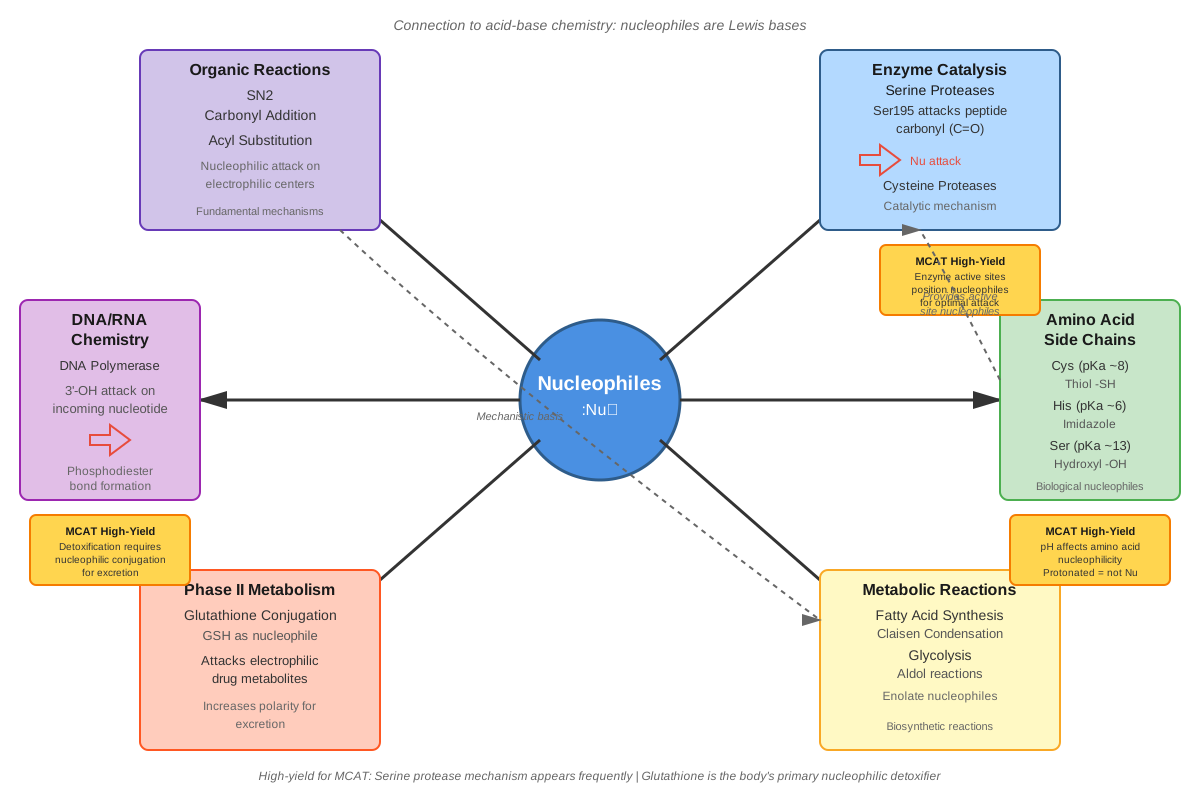
Nucleophiles are clinically and biochemically significant because they drive the majority of reactions in living systems. Enzyme active sites frequently contain nucleophilic amino acid residues (serine, cysteine, histidine) that attack electrophilic substrates. Drug metabolism in the liver involves nucleophilic attack by glutathione on electrophilic drug metabolites. DNA replication and repair mechanisms rely on nucleophilic attack by hydroxyl groups. Understanding nucleophiles provides insight into how medications work, how toxins damage cells, and how the body synthesizes essential biomolecules.
On the MCAT, nucleophile-related questions appear with moderate frequency across both the Chemical and Physical Foundations of Biological Systems section and the Biological and Biochemical Foundations of Living Systems section. Approximately 3-5 questions per exam directly test nucleophile concepts, while many additional questions require nucleophile knowledge as background understanding. Questions typically appear in three formats: discrete questions asking students to rank nucleophilicity, passage-based questions describing reaction mechanisms where students must identify the nucleophile, and questions requiring prediction of reaction products based on nucleophilic attack.
Common exam scenarios include: comparing nucleophilicity in protic versus aprotic solvents, identifying the nucleophile in enzyme mechanisms (especially serine proteases), predicting SN1 versus SN2 reaction outcomes based on nucleophile strength, analyzing carbonyl addition reactions, and understanding nucleophilic aromatic substitution. The MCAT particularly favors questions that integrate nucleophile concepts with biological systems, such as asking how a specific amino acid residue acts as a nucleophile in a catalytic mechanism.
Core Concepts
Definition and Fundamental Properties
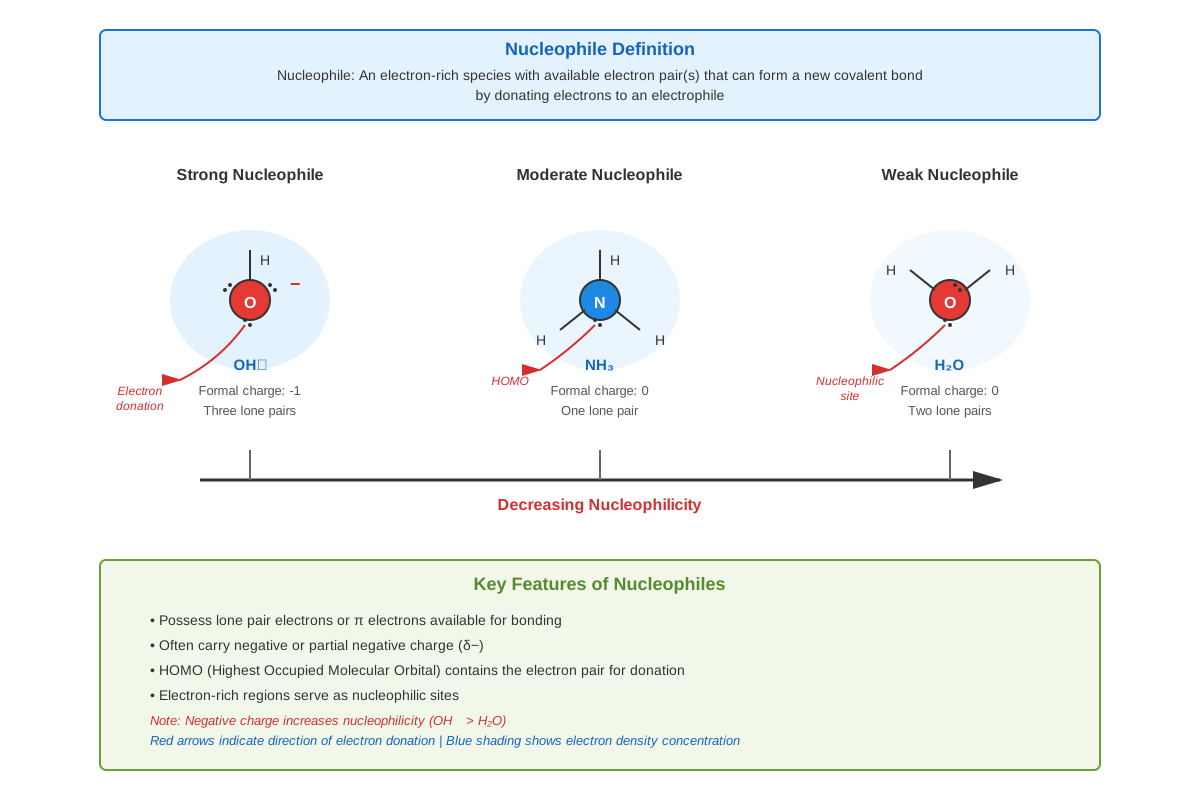
A nucleophile is a chemical species that possesses a pair of electrons available for donation to form a new covalent bond with an electron-deficient center (electrophile). The term "nucleophile" literally means "nucleus-loving" because these species are attracted to positive or partially positive centers. Nucleophiles can be negatively charged ions (anions) or neutral molecules with lone pairs of electrons. The defining characteristic is the presence of a high-energy, accessible electron pair in a molecular orbital that can overlap with an empty or partially empty orbital on an electrophile.
The strength of a nucleophile—its nucleophilicity—refers to its reactivity in forming new bonds, specifically its rate of reaction with a standard electrophile. This is a kinetic property, measuring how fast the nucleophile reacts. Common nucleophiles include hydroxide ion (OH⁻), alkoxide ions (RO⁻), halide ions (Cl⁻, Br⁻, I⁻), ammonia (NH₃), amines (RNH₂), water (H₂O), alcohols (ROH), thiols (RSH), and carbanions (R⁻).
Structural Features of Nucleophiles
Several structural features determine nucleophilic character:
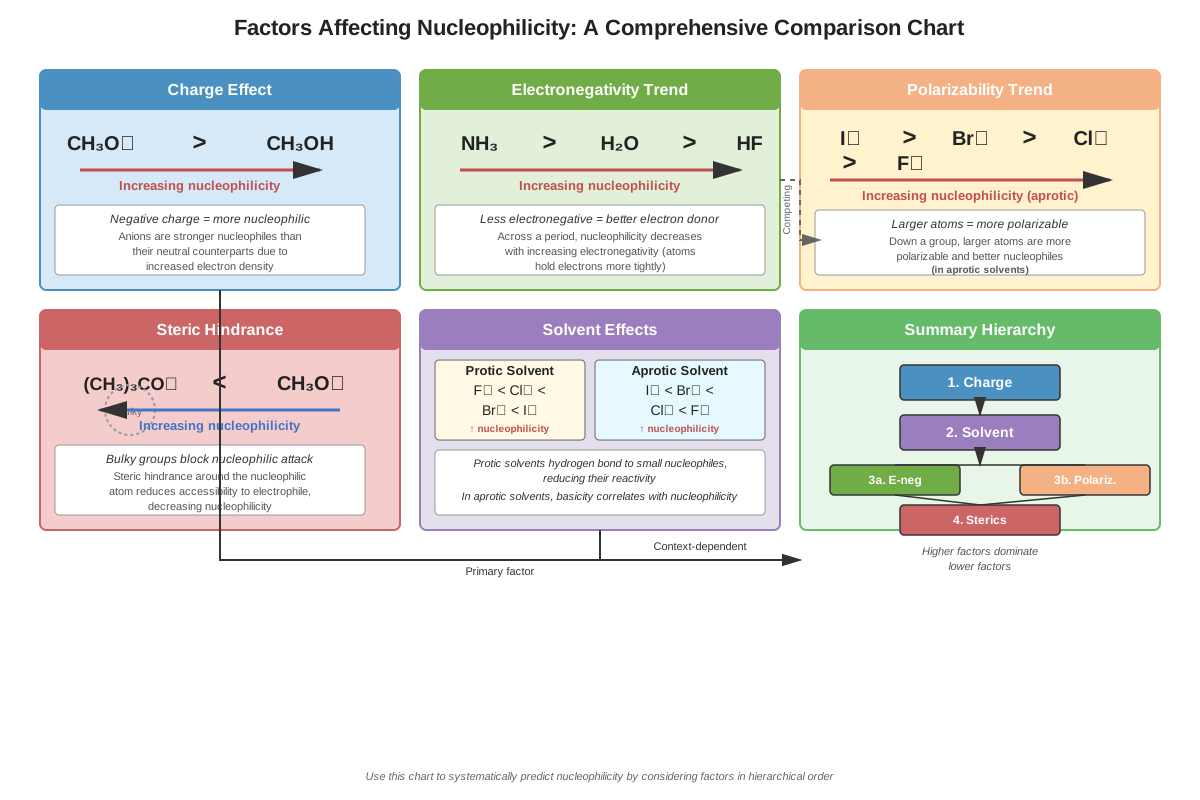
- Charge: Negatively charged species are generally more nucleophilic than their neutral counterparts (e.g., OH⁻ > H₂O, NH₂⁻ > NH₃)
- Electronegativity: Less electronegative atoms hold electrons less tightly and donate them more readily
- Polarizability: Larger atoms with more diffuse electron clouds can more easily distort their electron density toward an electrophile
- Steric accessibility: Bulky groups surrounding the nucleophilic atom hinder approach to the electrophile
- Resonance stabilization: Delocalization of the electron pair reduces nucleophilicity
Nucleophilicity Trends Across the Periodic Table
Understanding periodic trends in nucleophilicity is essential for MCAT success:
Within a period (left to right): Nucleophilicity generally decreases as electronegativity increases. For example, in the series:
- R⁻ > RNH⁻ > RO⁻ > F⁻
The carbon anion is the strongest nucleophile because carbon is the least electronegative and holds its electrons least tightly.
Within a group (top to bottom): The trend depends critically on the solvent:
| Solvent Type | Nucleophilicity Trend | Example |
|---|---|---|
| Aprotic (DMSO, DMF, acetone) | Decreases down the group | F⁻ > Cl⁻ > Br⁻ > I⁻ |
| Protic (H₂O, ROH) | Increases down the group | I⁻ > Br⁻ > Cl⁻ > F⁻ |
This solvent-dependent reversal is one of the most tested concepts on the MCAT.
Solvent Effects on Nucleophilicity
Protic solvents (water, alcohols) contain hydrogen atoms bonded to electronegative atoms and can form hydrogen bonds. In protic solvents, small nucleophiles like fluoride become heavily solvated (surrounded by solvent molecules), which decreases their nucleophilicity by creating a "shell" that must be removed before reaction. Larger nucleophiles like iodide are less solvated because their charge is more diffuse, making them more nucleophilic in protic solvents despite being less basic.
Aprotic solvents (DMSO, DMF, acetonitrile, acetone) cannot form hydrogen bonds with anions. In these solvents, nucleophiles are "naked" and their intrinsic reactivity dominates. Smaller, more basic nucleophiles are more reactive because they hold their electrons in tighter, higher-energy orbitals.
MCAT Exam Tip: When comparing nucleophilicity, always check whether the solvent is protic or aprotic. This single factor can reverse the expected order.
Nucleophilicity versus Basicity
While related, nucleophilicity and basicity are distinct properties:
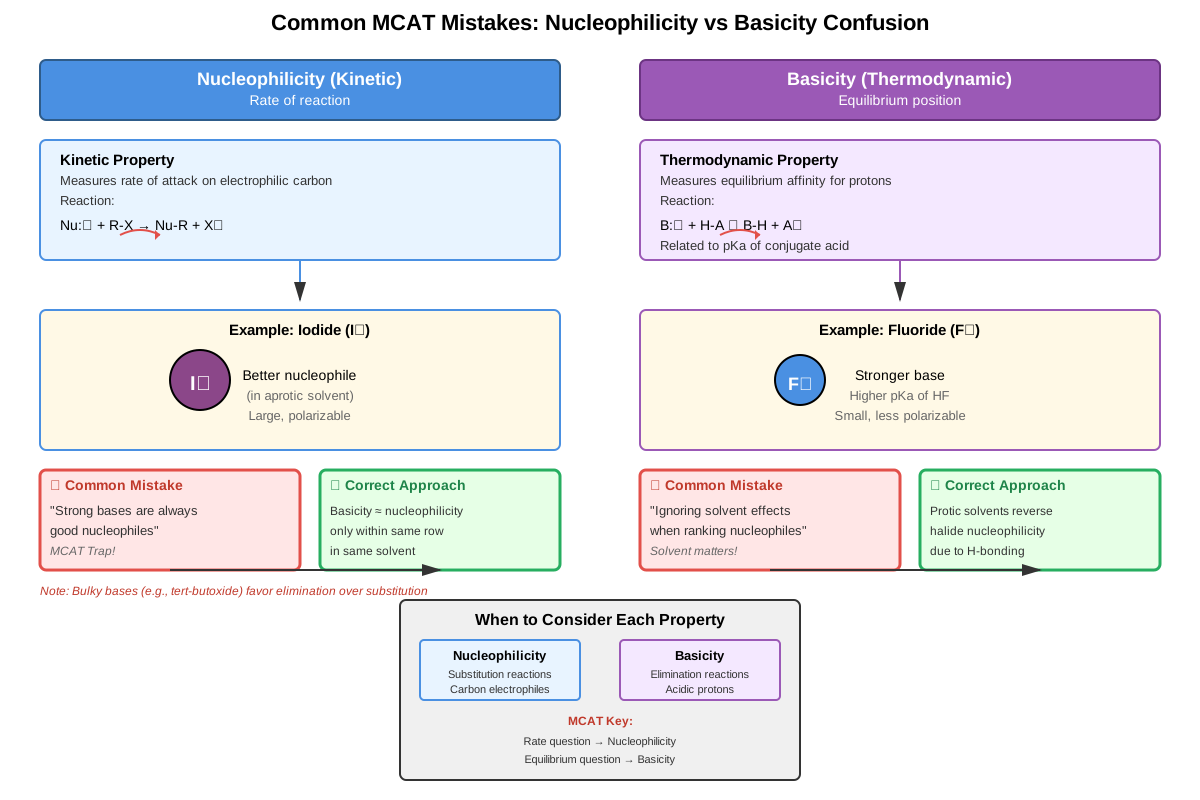
- Basicity is a thermodynamic property measuring the equilibrium position of proton acceptance (related to pKa)
- Nucleophilicity is a kinetic property measuring the rate of attack on an electrophilic carbon or other atom
Key differences:
| Property | Basicity | Nucleophilicity |
|---|---|---|
| Measures | Equilibrium (thermodynamic) | Rate (kinetic) |
| Reacts with | Protons (H⁺) | Electrophilic centers (usually carbon) |
| Steric effects | Minimal | Significant |
| Solvent effects | Less pronounced | Highly significant |
For example, tert-butoxide (t-BuO⁻) is a strong base but a poor nucleophile due to steric hindrance. Iodide (I⁻) is a weak base but an excellent nucleophile in protic solvents due to high polarizability.
Common Nucleophiles and Their Relative Strengths
Understanding the relative nucleophilicity of common species is essential:
Strong nucleophiles (typically charged):
- Hydride (H⁻) from LiAlH₄ or NaBH₄
- Carbanions (R⁻) from Grignard reagents or organolithium compounds
- Alkoxide ions (RO⁻)
- Hydroxide (OH⁻)
- Cyanide (CN⁻)
- Thiolate (RS⁻)
Moderate nucleophiles:
- Bromide (Br⁻) and iodide (I⁻) in protic solvents
- Ammonia (NH₃)
- Primary and secondary amines (RNH₂, R₂NH)
- Phosphines (PR₃)
Weak nucleophiles (typically neutral):
- Water (H₂O)
- Alcohols (ROH)
- Carboxylic acids (RCOOH)
Very weak or non-nucleophilic:
- Fluoride (F⁻) in protic solvents
- Resonance-stabilized anions (acetate, nitrate)
- Bulky bases (t-BuO⁻ for nucleophilic purposes)
Ambident Nucleophiles
Some nucleophiles have two or more atoms that can donate electrons, called ambident nucleophiles. The site of attack depends on reaction conditions:
- Enolate ions: Can attack through oxygen (O-attack, kinetic product) or carbon (C-attack, thermodynamic product)
- Cyanide (CN⁻): Can attack through carbon (typical) or nitrogen (rare)
- Thiocyanate (SCN⁻): Can attack through sulfur or nitrogen
The MCAT may test understanding of which site attacks under specific conditions, typically favoring the less hindered, more nucleophilic atom.
Concept Relationships
The concept of nucleophiles is central to understanding organic reaction mechanisms. Structure and Bonding principles determine which atoms in a molecule possess nucleophilic character → this nucleophilicity determines participation in substitution reactions (SN1 and SN2) → the strength of the nucleophile influences whether substitution or elimination reactions (E1 and E2) predominate → nucleophilic attack on carbonyl groups leads to addition and substitution reactions → these mechanisms underlie biochemical transformations including enzyme catalysis.
Nucleophilicity connects directly to acid-base chemistry because both involve electron pair donation, though to different acceptors. The relationship between pKa and nucleophilicity helps predict reaction outcomes. Leaving group ability is the inverse of nucleophilicity—good leaving groups are weak nucleophiles (stable anions).
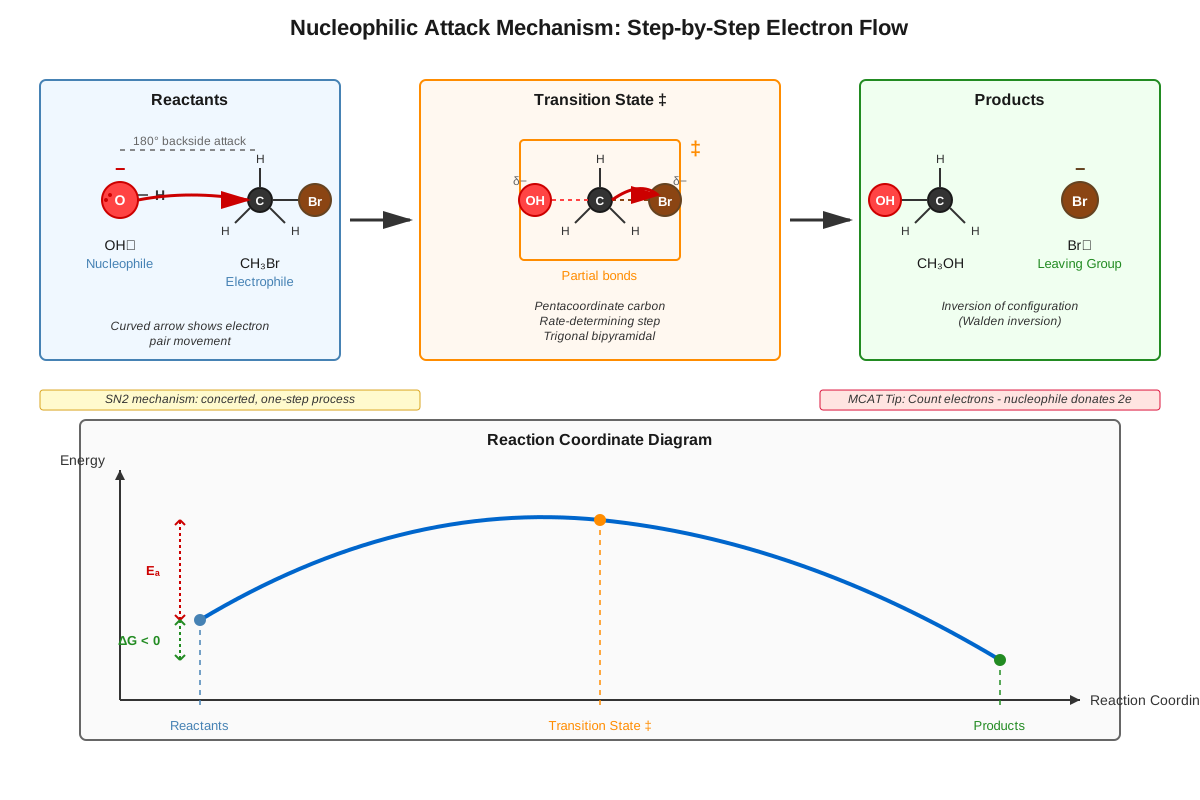
The concept also links to stereochemistry because nucleophilic attack in SN2 reactions causes inversion of configuration, while SN1 reactions lead to racemization. Understanding solvent effects on nucleophilicity is essential for predicting reaction rates and mechanisms. Finally, nucleophile concepts extend to organometallic chemistry where carbon nucleophiles (Grignard reagents, organolithium compounds) attack electrophilic carbonyls.
Relationship map:
Electronic structure → Nucleophilicity → Reaction mechanism (SN1/SN2/addition) → Product stereochemistry → Biological function
High-Yield Facts
⭐ Nucleophilicity increases down a group in protic solvents (I⁻ > Br⁻ > Cl⁻ > F⁻) due to decreased solvation of larger anions
⭐ Nucleophilicity decreases down a group in aprotic solvents (F⁻ > Cl⁻ > Br⁻ > I⁻) because basicity correlates with nucleophilicity when solvation is minimal
⭐ Charged nucleophiles are stronger than their neutral counterparts (OH⁻ >> H₂O, RO⁻ >> ROH)
⭐ Nucleophilicity and basicity are related but distinct—basicity is thermodynamic (equilibrium), nucleophilicity is kinetic (rate)
⭐ Steric hindrance decreases nucleophilicity more than basicity—bulky bases like tert-butoxide favor elimination over substitution
- Sulfur nucleophiles (RS⁻, RSH) are more nucleophilic than oxygen analogs (RO⁻, ROH) due to greater polarizability
- Resonance-stabilized anions (acetate, phenoxide) are weak nucleophiles because electron delocalization reduces availability
- Primary amines are better nucleophiles than ammonia, but tertiary amines face steric hindrance
- Carbon nucleophiles (Grignard reagents, enolates) are among the strongest nucleophiles and react irreversibly
- Protic solvents (water, alcohols) decrease nucleophilicity through hydrogen bonding and solvation
- The nucleophile in SN2 reactions attacks from the backside (180° from the leaving group), causing inversion
- Weak nucleophiles favor SN1 mechanisms where carbocation formation is rate-determining
- Azide (N₃⁻) is an excellent nucleophile used in organic synthesis and bioconjugation
- Cyanide (CN⁻) adds a carbon atom and is useful for chain extension reactions
- Phosphorus nucleophiles (PR₃) are soft nucleophiles that preferentially attack soft electrophiles
Quick check — test yourself on Nucleophiles so far.
Try Flashcards →Common Misconceptions
Misconception: Stronger bases are always better nucleophiles.
Correction: While basicity and nucleophilicity often correlate, they measure different properties. Basicity is thermodynamic (equilibrium with protons), while nucleophilicity is kinetic (rate of attack on carbon). Steric hindrance and solvent effects can cause strong bases to be poor nucleophiles. For example, tert-butoxide is a strong base (high pKa of conjugate acid) but a poor nucleophile due to steric bulk.
Misconception: Fluoride is always the best nucleophile among halides because it's the most electronegative.
Correction: Fluoride is actually the worst nucleophile among halides in protic solvents (the most common MCAT scenario). Its small size leads to extensive solvation, creating a barrier to reaction. In protic solvents: I⁻ > Br⁻ > Cl⁻ > F⁻. Only in aprotic solvents does the trend reverse.
Misconception: All negatively charged species are strong nucleophiles.
Correction: Charge is only one factor. Resonance-stabilized anions like acetate (CH₃COO⁻) or nitrate (NO₃⁻) are weak nucleophiles because their electrons are delocalized and less available for donation. Similarly, very small anions in protic solvents are heavily solvated and less nucleophilic than expected.
Misconception: Nucleophiles only attack carbon atoms.
Correction: While carbon electrophiles are common, nucleophiles can attack other electrophilic centers including phosphorus (in ATP), sulfur (in sulfonyl chlorides), and even hydrogen (in acid-base reactions). The MCAT may test nucleophilic attack on carbonyl carbons, acyl carbons, or phosphate groups in biological molecules.
Misconception: The nucleophile in a reaction is always negatively charged.
Correction: Many important nucleophiles are neutral molecules with lone pairs, including water, alcohols, ammonia, and amines. These neutral nucleophiles are weaker than their anionic counterparts but are biologically relevant because they exist at physiological pH. For example, the hydroxyl group of serine acts as a nucleophile in many enzyme mechanisms despite being neutral.
Misconception: Larger atoms are always better nucleophiles.
Correction: Size affects nucleophilicity differently depending on solvent. In aprotic solvents, smaller atoms are better nucleophiles because they're more basic. The "larger is better" rule only applies in protic solvents where solvation effects dominate. Students must always consider the reaction medium.
Worked Examples
Example 1: Ranking Nucleophilicity in Different Solvents
Question: Rank the following species in order of decreasing nucleophilicity in (a) water and (b) DMSO (an aprotic solvent): CH₃O⁻, CH₃OH, Cl⁻, I⁻
Solution:
First, identify the key factors:
- Two charged species (CH₃O⁻, Cl⁻, I⁻) and one neutral (CH₃OH)
- Need to consider both charge and periodic trends
- Solvent effect is critical
(a) In water (protic solvent):
Step 1: Charged species are more nucleophilic than neutral species
- CH₃O⁻, Cl⁻, I⁻ > CH₃OH
Step 2: Among charged species, compare CH₃O⁻ versus halides
- Oxygen is less electronegative than fluorine but more than carbon
- CH₃O⁻ is a strong nucleophile (alkoxide)
Step 3: Among halides in protic solvent, larger is better
- I⁻ > Cl⁻ (due to less solvation of larger I⁻)
Step 4: Compare alkoxide to iodide
- Alkoxides are generally stronger nucleophiles than halides
- CH₃O⁻ > I⁻
Final order in water: CH₃O⁻ > I⁻ > Cl⁻ > CH₃OH
(b) In DMSO (aprotic solvent):
Step 1: Charged species still more nucleophilic than neutral
- CH₃O⁻, Cl⁻, I⁻ > CH₃OH
Step 2: In aprotic solvent, basicity correlates with nucleophilicity
- More basic = more nucleophilic when no solvation effects
Step 3: Compare basicities (related to pKa of conjugate acids)
- CH₃OH₂⁺ has pKa ≈ -2 (CH₃O⁻ is very basic)
- HCl has pKa ≈ -7 (Cl⁻ is weakly basic)
- HI has pKa ≈ -10 (I⁻ is very weakly basic)
Step 4: Order by basicity
- CH₃O⁻ > Cl⁻ > I⁻
Final order in DMSO: CH₃O⁻ > Cl⁻ > I⁻ > CH₃OH
Key takeaway: The halide order reverses between protic and aprotic solvents—this is a high-yield MCAT concept.
Example 2: Identifying the Nucleophile in an Enzyme Mechanism
Question: In the mechanism of chymotrypsin (a serine protease), a serine residue attacks the carbonyl carbon of a peptide bond. The serine hydroxyl group has a pKa of approximately 13, and the reaction occurs at pH 7. Explain how serine can act as a nucleophile under these conditions and identify what makes this possible.
Solution:
Step 1: Analyze the protonation state
- At pH 7, serine's hydroxyl (pKa ≈ 13) is predominantly protonated (neutral)
- Neutral ROH is a weak nucleophile
- Yet the reaction proceeds efficiently
Step 2: Consider the enzyme environment
- Enzymes create specialized microenvironments
- Nearby histidine residue acts as a general base
- Histidine (pKa ≈ 6) can accept a proton at pH 7
Step 3: Explain the mechanism
- Histidine abstracts the proton from serine's hydroxyl
- This generates RO⁻ (alkoxide) in situ
- The alkoxide is a strong nucleophile
- The negatively charged oxygen attacks the carbonyl carbon
Step 4: Identify the actual nucleophile
- The nucleophile is the serine alkoxide (Ser-O⁻)
- It's generated transiently through acid-base catalysis
- The histidine-serine pair is called a "catalytic dyad"
Step 5: Explain why this matters for the MCAT
- Demonstrates that neutral species can become nucleophilic through deprotonation
- Shows how enzymes use acid-base chemistry to enhance nucleophilicity
- Illustrates the connection between pKa, pH, and reactivity
Answer: The nucleophile is the serine alkoxide (Ser-O⁻), generated when histidine acts as a general base to deprotonate the serine hydroxyl. This converts a weak neutral nucleophile (Ser-OH) into a strong anionic nucleophile (Ser-O⁻), enabling attack on the peptide carbonyl. This mechanism demonstrates how enzymes manipulate nucleophilicity through acid-base catalysis.
Key takeaway: On the MCAT, enzyme mechanisms often involve converting weak nucleophiles to strong ones through proton transfer. Always look for nearby basic residues (histidine, aspartate, glutamate) that might activate nucleophiles.
Exam Strategy
When approaching MCAT questions about nucleophiles, follow this systematic strategy:
Step 1: Identify the question type
- Ranking nucleophilicity: Look for solvent information immediately
- Mechanism identification: Find the electron-rich species
- Product prediction: Identify both nucleophile and electrophile
Step 2: Check for trigger words
- "Protic solvent," "water," "alcohol" → larger atoms are more nucleophilic
- "Aprotic solvent," "DMSO," "DMF" → smaller, more basic atoms are more nucleophilic
- "Strong base" → might be a poor nucleophile if bulky
- "Enzyme active site" → look for serine, cysteine, or histidine as nucleophiles
Step 3: Apply the decision tree
- Is the species charged or neutral? (Charged > neutral)
- What is the solvent? (Determines periodic trend)
- Is there steric hindrance? (Reduces nucleophilicity)
- Is there resonance stabilization? (Reduces nucleophilicity)
Step 4: Use process of elimination
- Eliminate options with reversed periodic trends for the given solvent
- Eliminate options that rank neutral species above charged analogs
- Eliminate options that ignore steric effects
- Eliminate options that place resonance-stabilized anions as strong nucleophiles
Time allocation: Spend 30-45 seconds identifying the solvent and key structural features, then 30-45 seconds applying trends. Don't spend more than 90 seconds on nucleophilicity ranking questions.
High-Yield Exam Tip: If a question doesn't specify the solvent, assume a protic solvent (water or alcohol) because these are more common in biological systems and MCAT passages.
Common trap answers:
- Ranking halides in protic solvent as F⁻ > Cl⁻ > Br⁻ > I⁻ (backwards)
- Claiming tert-butoxide is a strong nucleophile (it's a strong base but poor nucleophile)
- Stating that acetate is a strong nucleophile (it's resonance-stabilized and weak)
- Ignoring solvent effects entirely
Memory Techniques
Mnemonic for halide nucleophilicity in protic solvents: "I Brought Cats For Protic" (I⁻ > Br⁻ > Cl⁻ > F⁻ in Protic solvents)
Mnemonic for aprotic solvents: Reverse it! "For Aprotic, Flip" (F⁻ > Cl⁻ > Br⁻ > I⁻ in Aprotic solvents)
Acronym for factors affecting nucleophilicity: SPECS
- Solvent (protic vs. aprotic)
- Polarizability (larger atoms more polarizable)
- Electronegativity (less electronegative = more nucleophilic)
- Charge (negative > neutral)
- Sterics (less hindered = more nucleophilic)
Visualization for nucleophile vs. base: Picture a nucleophile as an "arrow shooter" aiming at carbon targets (kinetic, fast), while a base is a "proton magnet" that holds onto H⁺ (thermodynamic, equilibrium). This helps distinguish their different roles.
Memory aid for enzyme nucleophiles: "Serine Cuts Hard" (Serine, Cysteine, and Histidine are the three main nucleophilic amino acids in enzyme active sites)
Rhyme for resonance effect: "When electrons can roam, nucleophiles stay home" (resonance-stabilized species are poor nucleophiles)
Visual pattern: Draw a simple periodic table and mark the nucleophilicity trends with arrows:
- Across a period: ← (decreases left to right)
- Down a group in protic: ↓ (increases going down)
- Down a group in aprotic: ↑ (decreases going down)
Summary
Nucleophiles are electron-rich species that donate electron pairs to form new bonds with electrophiles, representing a cornerstone concept in organic chemistry and biochemistry. The strength of a nucleophile—its nucleophilicity—depends on multiple factors including charge, electronegativity, polarizability, steric accessibility, and critically, the solvent environment. In protic solvents like water, larger atoms are more nucleophilic due to reduced solvation (I⁻ > Br⁻ > Cl⁻ > F⁻), while in aprotic solvents, smaller, more basic atoms dominate (F⁻ > Cl⁻ > Br⁻ > I⁻). Charged species are invariably more nucleophilic than their neutral counterparts, but resonance stabilization and steric hindrance can dramatically reduce nucleophilicity. Understanding the distinction between nucleophilicity (kinetic, rate-based) and basicity (thermodynamic, equilibrium-based) is essential for predicting reaction outcomes. On the MCAT, nucleophile concepts appear in substitution and elimination reactions, carbonyl chemistry, and enzyme mechanisms, making this a medium-yield topic that connects structure, reactivity, and biological function.
Key Takeaways
- Nucleophilicity is solvent-dependent: Halide nucleophilicity order reverses between protic (I⁻ > Br⁻ > Cl⁻ > F⁻) and aprotic (F⁻ > Cl⁻ > Br⁻ > I⁻) solvents
- Charge matters most: Anionic species are significantly more nucleophilic than their neutral analogs (OH⁻ >> H₂O)
- Nucleophilicity ≠ basicity: These are related but distinct properties—basicity is thermodynamic, nucleophilicity is kinetic
- Steric hindrance reduces nucleophilicity: Bulky groups around the nucleophilic atom decrease reactivity more than they decrease basicity
- Resonance stabilization weakens nucleophiles: Electron delocalization makes the electron pair less available for donation
- Biological nucleophiles: Serine, cysteine, and histidine are the primary nucleophilic amino acids in enzyme active sites
- Polarizability increases nucleophilicity: Larger atoms with diffuse electron clouds (S, I) are more nucleophilic than smaller analogs (O, F) in protic solvents
Related Topics
SN1 and SN2 Reactions: Understanding nucleophile strength is essential for predicting whether substitution reactions proceed through unimolecular (SN1) or bimolecular (SN2) mechanisms. Strong nucleophiles favor SN2, while weak nucleophiles allow SN1 pathways.
Elimination Reactions (E1 and E2): The competition between substitution and elimination depends on nucleophile strength and basicity. Strong, bulky bases favor elimination over substitution.
Carbonyl Chemistry: Nucleophilic addition and nucleophilic acyl substitution reactions are fundamental transformations where nucleophiles attack carbonyl carbons. This includes reactions of aldehydes, ketones, carboxylic acids, and derivatives.
Leaving Groups: The inverse of nucleophilicity—good leaving groups are weak nucleophiles (stable anions). Understanding this relationship helps predict reaction feasibility.
Enzyme Mechanisms: Serine proteases, cysteine proteases, and other enzymes use amino acid nucleophiles to catalyze reactions. Mastering nucleophile concepts enables understanding of biological catalysis.
Organometallic Chemistry: Grignard reagents and organolithium compounds are powerful carbon nucleophiles used in synthesis. These extend nucleophile concepts to carbon-carbon bond formation.
Practice CTA
Now that you've mastered the core concepts of nucleophiles, it's time to reinforce your understanding through active practice. Attempt the practice questions and flashcards associated with this topic to test your ability to rank nucleophilicity, identify nucleophiles in mechanisms, and apply these concepts to MCAT-style passages. Remember, understanding nucleophiles unlocks your ability to predict and explain the vast majority of organic reactions—this knowledge will serve you throughout your MCAT preparation and beyond. Focus especially on solvent-dependent trends and the distinction between nucleophilicity and basicity, as these are high-yield concepts that appear repeatedly on the exam. You've got this!
Sign up free to keep reading
Create a free AnvayaPrep account to finish this MCAT guide on Nucleophiles — plus flashcards and practice questions.