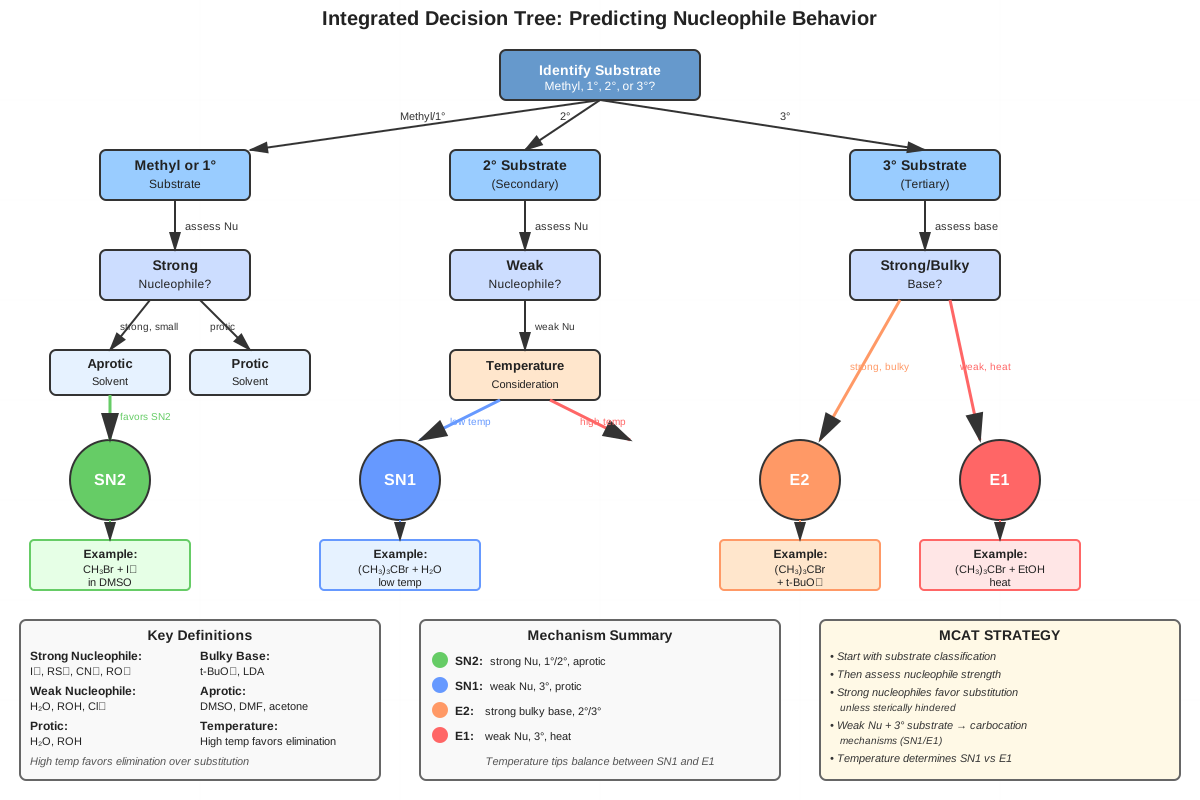
Overview
Nucleophile strength is a fundamental concept in Organic Chemistry that determines how readily a nucleophile will donate its electron pair to form a new chemical bond with an electrophile. Understanding nucleophile strength is critical for predicting reaction outcomes in substitution and elimination reactions, two of the most important reaction classes tested on the MCAT. A nucleophile (literally "nucleus-loving") is a species with a lone pair of electrons or a π bond that seeks out positively charged or electron-deficient centers. The strength of a nucleophile directly influences reaction rates, mechanism pathways (SN1 vs. SN2 vs. E1 vs. E2), and product distributions in organic transformations.
For the MCAT, mastering nucleophile strength Organic Chemistry principles enables students to predict which species will react fastest in a given environment, distinguish between competing reaction mechanisms, and solve complex passage-based questions that integrate multiple organic chemistry concepts. The MCAT frequently tests nucleophile strength through discrete questions asking students to rank nucleophiles or through passage-based scenarios involving biological molecules like amino acids, nucleotides, or enzyme mechanisms where nucleophilic attack is central to function.
The concept of nucleophile strength MCAT questions connects intimately with acid-base chemistry, electronegativity trends, solvent effects, steric hindrance, and resonance stabilization. Unlike basicity (a thermodynamic property measuring equilibrium affinity for protons), nucleophilicity is a kinetic property measuring the rate at which a species attacks an electrophilic center. This distinction, though subtle, is crucial for MCAT success and frequently appears as a source of confusion that separates high-scoring students from those who struggle with organic chemistry passages.
Learning Objectives
- [ ] Define nucleophile strength using accurate Organic Chemistry terminology
- [ ] Explain why nucleophile strength matters for the MCAT
- [ ] Apply nucleophile strength to exam-style questions
- [ ] Identify common mistakes related to nucleophile strength
- [ ] Connect nucleophile strength to related Organic Chemistry concepts
- [ ] Rank nucleophiles in both protic and aprotic solvents based on periodic trends
- [ ] Distinguish between nucleophilicity and basicity in mechanistic contexts
- [ ] Predict how steric hindrance affects nucleophile strength in SN2 reactions
Prerequisites
- Electronegativity and periodic trends: Understanding how electronegativity varies across periods and down groups is essential for predicting nucleophile strength based on atomic properties
- Acid-base chemistry and pKa values: Nucleophilicity relates to basicity, and knowing conjugate acid-base relationships helps predict nucleophilic behavior
- Lewis structures and formal charges: Identifying lone pairs and electron-rich centers requires facility with drawing accurate Lewis structures
- Solvent properties (polar protic vs. polar aprotic): Solvent effects dramatically alter nucleophile strength rankings, making this background knowledge critical
- Basic organic functional groups: Recognizing alcohols, amines, halides, and other common nucleophiles is necessary for applying nucleophile strength principles
Why This Topic Matters
Nucleophile strength appears in approximately 15-20% of MCAT Organic Chemistry questions, either directly or as a component of more complex substitution and elimination problems. The MCAT Chemical and Physical Foundations of Biological Systems section frequently embeds nucleophile strength concepts within biochemical passages describing enzyme mechanisms, where amino acid side chains act as nucleophiles attacking carbonyl carbons in peptide bond formation or ester hydrolysis.
In clinical and research contexts, nucleophilic reactions underpin drug metabolism (Phase II conjugation reactions), DNA alkylation by chemotherapeutic agents, and the mechanism of action for many enzyme inhibitors. Understanding which biological nucleophiles (cysteine thiols, serine hydroxyls, lysine amines) will react fastest with electrophilic drugs or toxins has direct implications for pharmacology and toxicology.
On the MCAT, nucleophile strength questions typically appear as:
- Discrete questions asking students to rank nucleophiles in order of reactivity
- Passage-based mechanism questions requiring identification of the nucleophile in a multi-step synthesis
- Experimental design passages where solvent choice affects reaction rates through nucleophile strength modulation
- Biochemistry integration questions involving enzyme active sites where specific amino acids function as nucleophiles
Core Concepts
Definition of Nucleophile Strength
Nucleophile strength (or nucleophilicity) is a kinetic measure of how rapidly a nucleophile will donate its electron pair to an electrophilic center, typically measured by the rate constant of an SN2 reaction with a standard electrophile like methyl iodide. A strong nucleophile reacts quickly, while a weak nucleophile reacts slowly or not at all under the same conditions. This property is fundamentally different from basicity, which measures the thermodynamic stability of a species after it has accepted a proton (equilibrium property).
The key distinction: nucleophilicity measures reaction rate (kinetics), while basicity measures equilibrium position (thermodynamics). A species can be a strong nucleophile but weak base, or vice versa, depending on the reaction conditions and molecular structure.
Factors Affecting Nucleophile Strength
Charge
Negatively charged species are generally stronger nucleophiles than their neutral counterparts because the negative charge represents an excess of electron density seeking a positive center. For example:
- HO⁻ (hydroxide) is a much stronger nucleophile than H₂O (water)
- RO⁻ (alkoxide) is stronger than ROH (alcohol)
- NH₂⁻ (amide) is stronger than NH₃ (ammonia)
This trend holds across all solvent systems and represents the most reliable predictor of nucleophile strength.
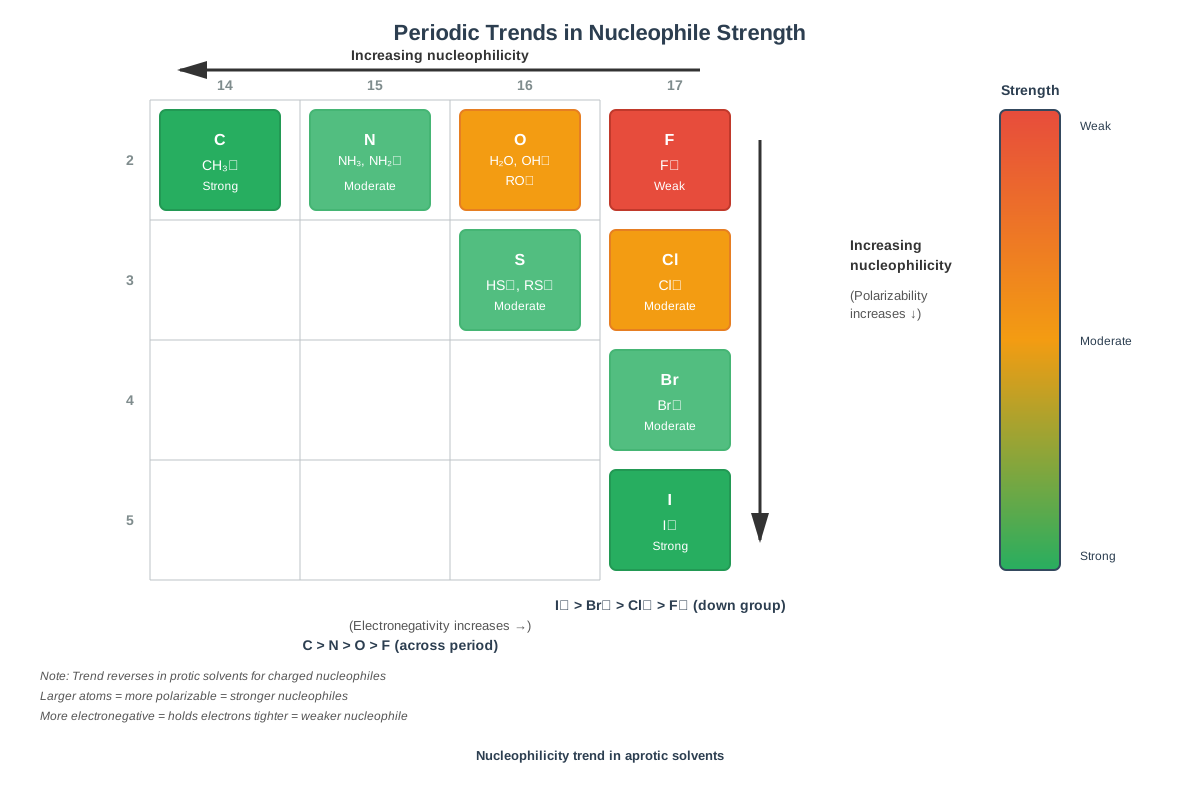
Electronegativity (Across a Period)
When comparing nucleophiles in the same row of the periodic table, electronegativity inversely correlates with nucleophile strength. Less electronegative atoms hold their electrons more loosely and donate them more readily:
Nucleophile strength across Period 2: C > N > O > F
For example, carbanions (R₃C⁻) are stronger nucleophiles than amines (R₃N), which are stronger than alkoxides (RO⁻), which are stronger than fluoride (F⁻). This trend reflects the decreasing willingness to share electron density as electronegativity increases.
Polarizability (Down a Group)
Polarizability describes how easily an atom's electron cloud can be distorted. Larger atoms with more electron shells are more polarizable because their valence electrons are farther from the nucleus and less tightly held. In polar aprotic solvents (like DMSO, DMF, acetone, or acetonitrile), nucleophile strength increases down a group:
Nucleophile strength down Group 17 (in aprotic solvents): I⁻ > Br⁻ > Cl⁻ > F⁻
This trend reverses in polar protic solvents (discussed below), making solvent effects crucial for MCAT questions.
Solvent Effects: The Critical Variable
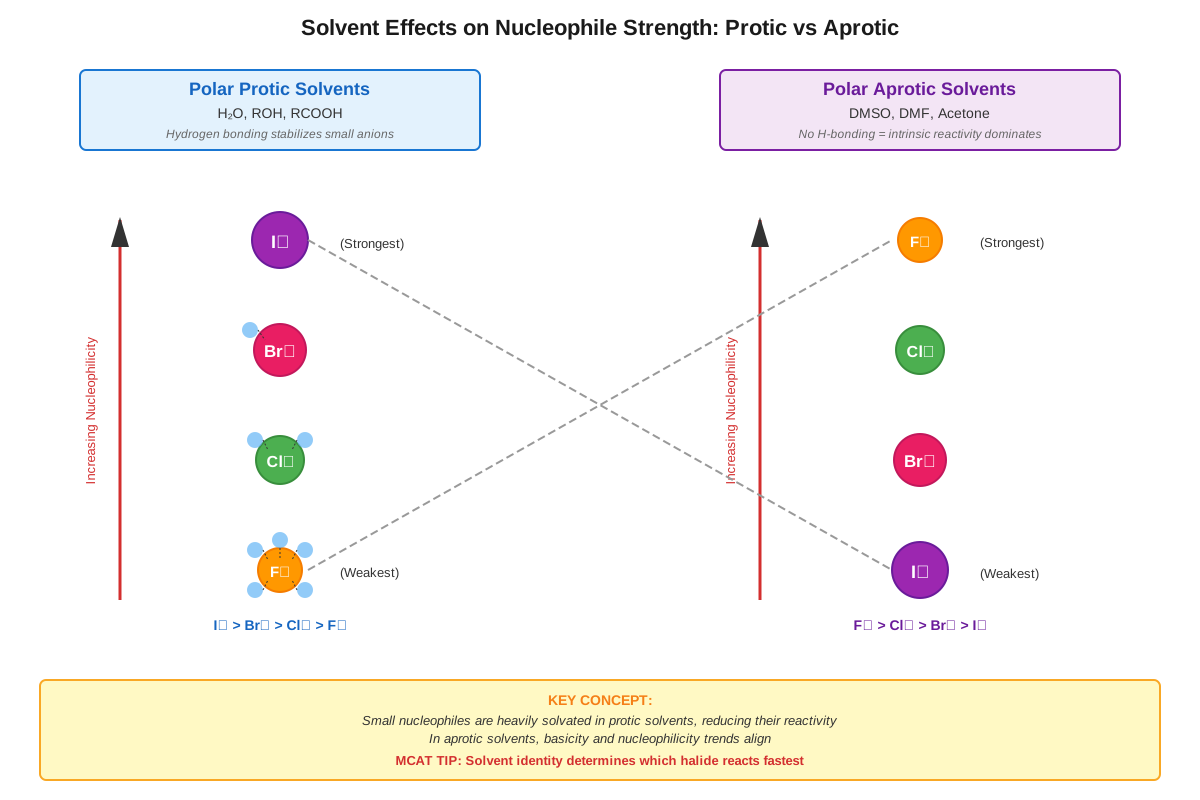
The solvent environment dramatically affects nucleophile strength rankings, and this is a high-yield MCAT concept:
In polar protic solvents (water, alcohols, carboxylic acids—solvents with O-H or N-H bonds):
- Small, highly charged nucleophiles become extensively solvated through hydrogen bonding
- This solvation shell must be disrupted before nucleophilic attack can occur
- Larger, more polarizable nucleophiles are less solvated and therefore more reactive
- Result: Nucleophile strength increases down a group (I⁻ > Br⁻ > Cl⁻ > F⁻)
In polar aprotic solvents (DMSO, DMF, acetone, acetonitrile—polar but lacking H-bond donors):
- Nucleophiles are not extensively solvated
- Intrinsic nucleophilicity based on charge density dominates
- Smaller, more basic nucleophiles are stronger
- Result: Nucleophile strength follows basicity trends (F⁻ > Cl⁻ > Br⁻ > I⁻)
| Solvent Type | Examples | Halide Nucleophile Strength Order |
|---|---|---|
| Polar Protic | H₂O, CH₃OH, RCOOH | I⁻ > Br⁻ > Cl⁻ > F⁻ |
| Polar Aprotic | DMSO, DMF, acetone | F⁻ > Cl⁻ > Br⁻ > I⁻ |
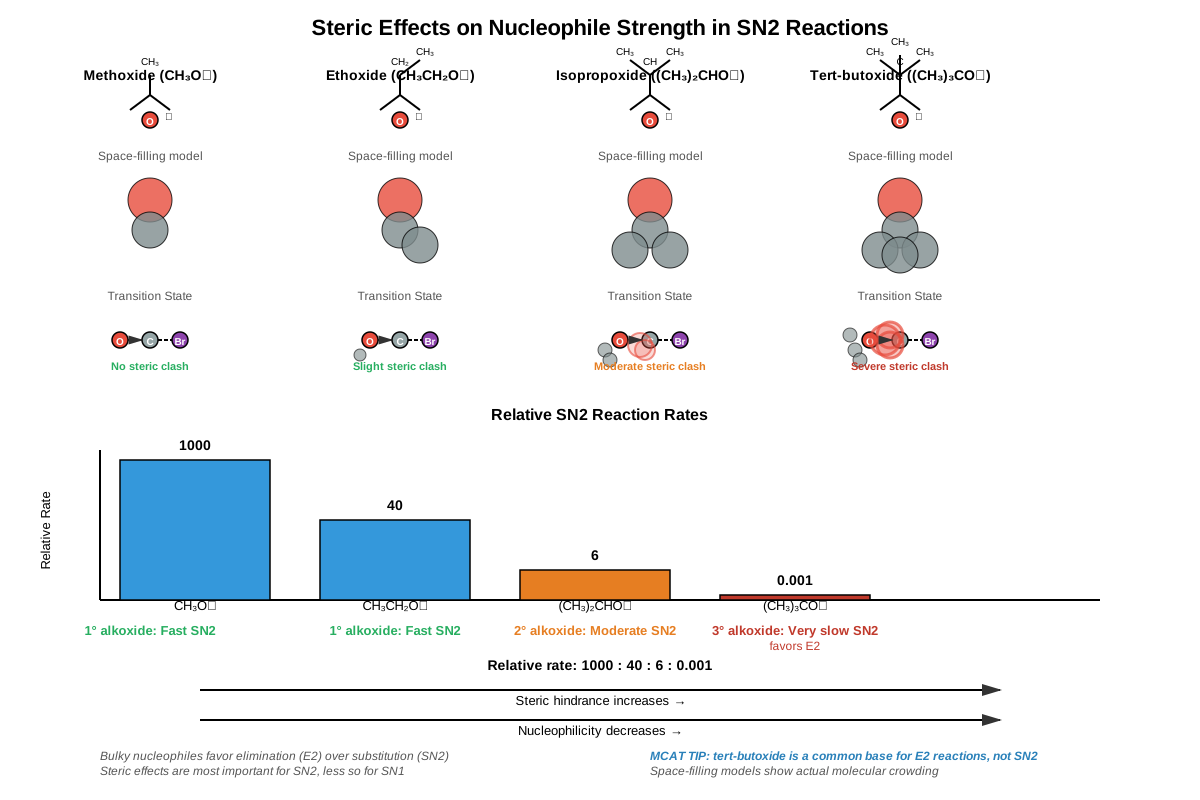
Steric Hindrance
Bulky nucleophiles have reduced nucleophile strength in SN2 reactions because they cannot easily approach the backside of the electrophilic carbon. This effect is particularly important when comparing nucleophiles with the same nucleophilic atom:
- CH₃O⁻ (methoxide) > (CH₃)₃CO⁻ (tert-butoxide) in SN2 reactions
- Primary amines > secondary amines > tertiary amines as nucleophiles
However, steric hindrance does not significantly affect SN1 reactions, where the nucleophile attacks a planar carbocation intermediate rather than performing backside attack.
Resonance Stabilization
Nucleophiles whose lone pairs are delocalized through resonance are weaker because their electron density is less available for donation. Compare:
- CH₃O⁻ (methoxide, strong nucleophile) vs. CH₃COO⁻ (acetate, weak nucleophile)
- The acetate anion has its negative charge delocalized over two oxygen atoms, making it less nucleophilic despite being a similar base strength
This principle explains why carboxylate anions (RCOO⁻) are poor nucleophiles despite being negatively charged, and why phenoxide (C₆H₅O⁻) is less nucleophilic than alkoxides.
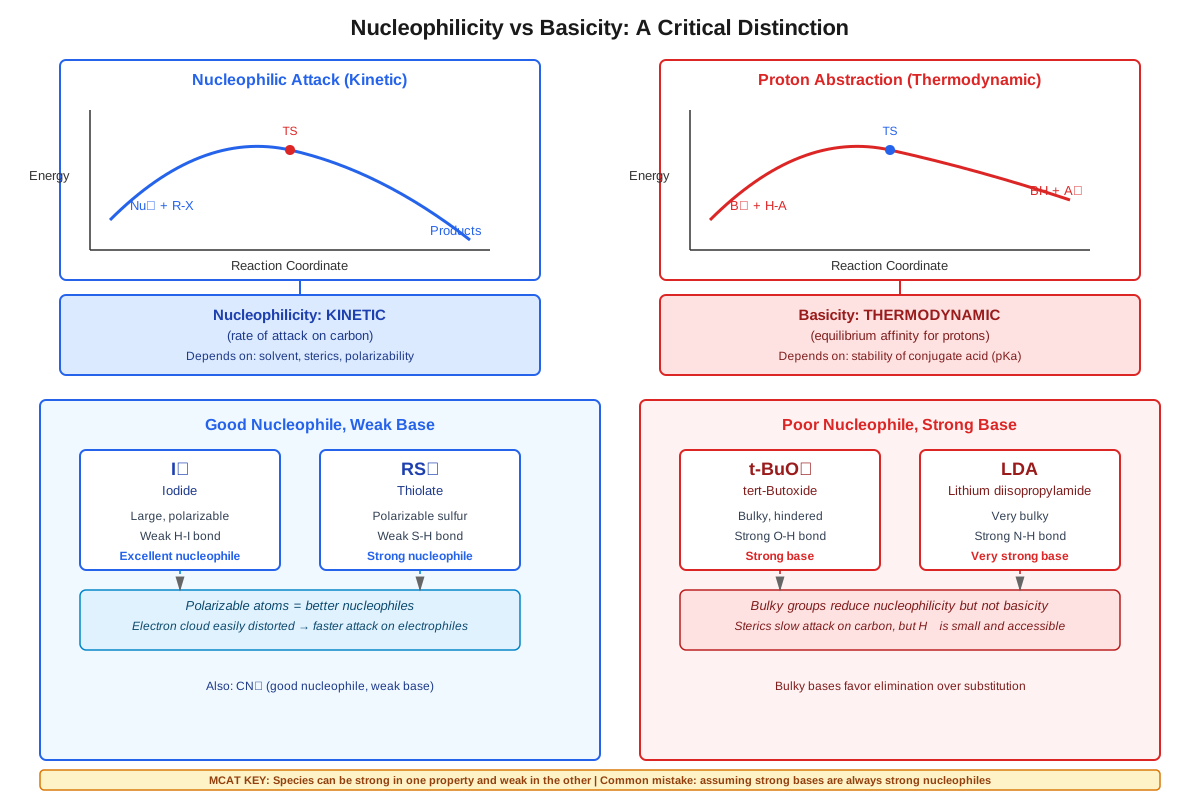
Nucleophilicity vs. Basicity
This distinction is critical for MCAT success and frequently tested:
Basicity (thermodynamic):
- Measures equilibrium affinity for protons (H⁺)
- Relates to pKa of conjugate acid
- Determined by stability of species after protonation
Nucleophilicity (kinetic):
- Measures rate of attack on electrophilic carbon (or other electrophiles)
- Affected by steric factors, solvent, and polarizability
- Determined by transition state energy
Key example: In polar protic solvents, iodide (I⁻) is a strong nucleophile but weak base, while fluoride (F⁻) is a weak nucleophile but strong base. This occurs because:
- Basicity follows electronegativity: F⁻ holds protons most tightly (strongest base)
- Nucleophilicity in protic solvents follows polarizability: I⁻ is least solvated (strongest nucleophile)
Common Nucleophiles by Functional Group
Understanding the relative nucleophile strength of common organic functional groups is essential:
Strong nucleophiles (typically charged):
- Hydride (H⁻) from LiAlH₄ or NaBH₄
- Carbanions (R⁻) from organolithium or Grignard reagents
- Alkoxides (RO⁻)
- Hydroxide (HO⁻)
- Amide ions (R₂N⁻)
Moderate nucleophiles (neutral with available lone pairs):
- Amines (R₃N, R₂NH, RNH₂)
- Phosphines (R₃P)
- Thiols (RSH) and thiolates (RS⁻)
- Alcohols (ROH)
- Water (H₂O)
Weak nucleophiles:
- Carboxylate anions (RCOO⁻) - resonance stabilized
- Carboxylic acids (RCOOH)
- Weak bases like Cl⁻ in protic solvents
Concept Relationships
Nucleophile strength serves as a central organizing principle connecting multiple organic chemistry concepts. The relationship map flows as follows:
Periodic trends and electronegativity → determine intrinsic electron-donating ability → affects nucleophile strength → influences reaction mechanism selection (SN1 vs. SN2 vs. E1 vs. E2) → determines product distribution in substitution and elimination reactions
Acid-base chemistry ↔ nucleophilicity: While related, these properties diverge based on solvent effects and steric factors. Strong bases are often (but not always) strong nucleophiles.
Solvent properties → modulate nucleophile strength through solvation effects → alter reaction rates → affect mechanism preference
Steric hindrance → reduces nucleophile strength in SN2 reactions → favors elimination over substitution → leads to E2 products with bulky bases
Resonance stabilization → decreases nucleophile strength → makes species better leaving groups → influences reaction reversibility
Understanding these connections allows students to predict reaction outcomes without memorizing isolated facts. For example, knowing that tert-butoxide is both bulky (weak nucleophile) and strongly basic predicts that it will favor E2 elimination over SN2 substitution when reacting with alkyl halides.
Quick check — test yourself on Nucleophile strength so far.
Try Flashcards →High-Yield Facts
⭐ Nucleophilicity is a kinetic property (rate), while basicity is a thermodynamic property (equilibrium)
⭐ In polar protic solvents, nucleophile strength increases down a group: I⁻ > Br⁻ > Cl⁻ > F⁻
⭐ In polar aprotic solvents, nucleophile strength follows basicity: F⁻ > Cl⁻ > Br⁻ > I⁻
⭐ Negatively charged species are always stronger nucleophiles than their neutral conjugate acids
⭐ Across a period, nucleophile strength decreases with increasing electronegativity: C > N > O > F
- Steric hindrance significantly reduces nucleophile strength in SN2 reactions but not in SN1 reactions
- Resonance delocalization of lone pairs decreases nucleophile strength (acetate is a weak nucleophile despite negative charge)
- Polarizability (size) is the dominant factor determining nucleophile strength in protic solvents
- Strong nucleophiles favor SN2 mechanisms, while weak nucleophiles are compatible with SN1 mechanisms
- Thiols (RSH) and thiolates (RS⁻) are excellent nucleophiles due to sulfur's high polarizability
- Bulky strong bases like tert-butoxide favor elimination (E2) over substitution due to steric effects
- Water and alcohols are weak nucleophiles but can participate in SN1 reactions with stable carbocations
Common Misconceptions
Misconception: Strong bases are always strong nucleophiles.
Correction: While basicity and nucleophilicity often correlate, they can diverge significantly. In polar protic solvents, fluoride is a strong base but weak nucleophile due to extensive solvation, while iodide is a weak base but strong nucleophile due to high polarizability and minimal solvation.
Misconception: Nucleophile strength rankings are universal across all conditions.
Correction: Solvent effects dramatically alter nucleophile strength rankings. The halide nucleophile order completely reverses between protic and aprotic solvents. Always consider the reaction medium when ranking nucleophiles.
Misconception: Larger atoms are always better nucleophiles.
Correction: Size (polarizability) only dominates nucleophile strength in polar protic solvents where differential solvation occurs. In aprotic solvents, smaller atoms with higher charge density are stronger nucleophiles.
Misconception: Carboxylate anions (RCOO⁻) are strong nucleophiles because they're negatively charged.
Correction: Despite bearing a negative charge, carboxylates are weak nucleophiles because resonance delocalizes the negative charge over two oxygen atoms, reducing electron availability for donation. This makes them excellent leaving groups but poor nucleophiles.
Misconception: Nucleophile strength doesn't affect mechanism selection.
Correction: Nucleophile strength is a primary factor determining whether SN1 or SN2 mechanisms operate. Strong nucleophiles favor SN2 (bimolecular, rate depends on nucleophile concentration), while weak nucleophiles are compatible with SN1 (unimolecular, rate independent of nucleophile).
Misconception: Ammonia (NH₃) and amines are weak nucleophiles.
Correction: Neutral amines are actually moderate to good nucleophiles due to nitrogen's relatively low electronegativity and available lone pair. They readily participate in SN2 reactions, forming quaternary ammonium salts.
Worked Examples
Example 1: Ranking Nucleophiles in Different Solvents
Question: Rank the following species in order of decreasing nucleophile strength in (a) water and (b) DMSO: F⁻, Cl⁻, Br⁻, I⁻
Solution:
(a) In water (polar protic solvent):
Step 1: Identify the solvent type. Water is polar protic (contains O-H bonds capable of hydrogen bonding).
Step 2: Recall that in protic solvents, small nucleophiles are extensively solvated through hydrogen bonding, which decreases their nucleophilicity.
Step 3: Apply the polarizability trend. Larger, more polarizable atoms are less solvated and therefore more nucleophilic in protic solvents.
Step 4: Rank from most to least nucleophilic: I⁻ > Br⁻ > Cl⁻ > F⁻
Reasoning: Iodide is the largest halide with the most diffuse electron cloud. It experiences minimal solvation in water and can easily approach electrophiles. Fluoride, despite being the strongest base, is so heavily solvated by water molecules that its nucleophilicity is severely diminished.
(b) In DMSO (polar aprotic solvent):
Step 1: Identify the solvent type. DMSO is polar aprotic (polar but lacks H-bond donors).
Step 2: Recognize that without extensive solvation, intrinsic nucleophilicity based on charge density dominates.
Step 3: Apply the electronegativity/basicity trend. Smaller, less electronegative atoms hold their electrons less tightly and are more nucleophilic when not solvated.
Step 4: Rank from most to least nucleophilic: F⁻ > Cl⁻ > Br⁻ > I⁻
Reasoning: In aprotic solvents, the nucleophilicity order follows basicity. Fluoride has the highest charge density and most available electron density for donation when not encumbered by a solvation shell.
Key Takeaway: This example demonstrates the critical importance of solvent effects—the ranking completely reverses between protic and aprotic solvents.
Example 2: Predicting Reaction Outcomes Based on Nucleophile Strength
Question: Predict the major product when 2-bromopropane reacts with (a) sodium methoxide (NaOCH₃) in methanol and (b) sodium methoxide in DMSO.
Solution:
(a) NaOCH₃ in methanol:
Step 1: Identify the substrate. 2-bromopropane is a secondary alkyl halide.
Step 2: Identify the nucleophile/base. Methoxide (CH₃O⁻) is both a strong base and potentially strong nucleophile.
Step 3: Consider the solvent. Methanol is polar protic, which moderately solvates the methoxide ion.
Step 4: Evaluate steric factors. Methoxide is relatively small and unhindered.
Step 5: Predict mechanism. With a secondary substrate, both SN2 and E2 are possible. The small, moderately strong nucleophile in protic solvent will favor SN2 substitution as the major pathway, though some E2 elimination will occur.
Major product: 2-methoxypropane (CH₃CH(OCH₃)CH₃)
Minor product: Propene (CH₃CH=CH₂)
(b) NaOCH₃ in DMSO:
Step 1-2: Same substrate and nucleophile/base as above.
Step 3: Consider the solvent. DMSO is polar aprotic, which does not solvate the methoxide ion. This makes methoxide a much stronger nucleophile in DMSO than in methanol.
Step 4: Predict mechanism. The enhanced nucleophilicity in aprotic solvent strongly favors SN2 substitution over elimination.
Major product: 2-methoxypropane (CH₃CH(OCH₃)CH₃) in higher yield than in methanol
Key Takeaway: The same nucleophile shows enhanced nucleophile strength in aprotic solvents, leading to cleaner SN2 reactions with less elimination side product. This principle is widely exploited in organic synthesis.
Exam Strategy
When approaching MCAT questions on nucleophile strength:
1. Immediately identify the solvent: Look for keywords like "aqueous," "water," "methanol," or "ethanol" (protic) versus "DMSO," "DMF," "acetone," or "acetonitrile" (aprotic). The solvent determines which ranking rules apply.
2. Watch for trigger phrases:
- "Rank in order of nucleophilicity" → Apply systematic comparison using charge, electronegativity, polarizability, and solvent
- "Fastest reaction" → Strongest nucleophile will react fastest in SN2
- "Predominant mechanism" → Nucleophile strength helps distinguish SN1 vs. SN2
- "Better leaving group" → Weak nucleophiles are good leaving groups (inverse relationship)
3. Use process of elimination:
- Eliminate options that violate the charge rule (neutral over anion)
- Eliminate options that ignore solvent effects
- Eliminate options that confuse basicity with nucleophilicity
4. Time allocation: Nucleophile strength questions are typically quick (60-90 seconds) if you know the rules. Don't overthink—apply the systematic approach:
1. Check charge (anion > neutral)
2. Check solvent (protic vs. aprotic)
3. Apply periodic trends
4. Consider sterics if comparing similar nucleophiles
5. Common question formats:
- Ranking questions: Present 3-4 nucleophiles to order
- Mechanism prediction: Require identifying which nucleophile will react or which mechanism will operate
- Experimental design: Ask why a particular solvent was chosen for a reaction
- Passage integration: Embed nucleophile strength in enzyme mechanism or synthesis passages
Exam Tip: If a question asks about nucleophile strength without specifying solvent, assume polar protic (aqueous) conditions unless the context suggests otherwise. The MCAT defaults to biologically relevant conditions.
Memory Techniques
Mnemonic for solvent effects on halide nucleophilicity:
"Protic Prefers Portly" (Protic solvents favor larger/more polarizable nucleophiles)
- In protic solvents: Iodide Before Chloride Before Fluoride
- Remember: I Bring Cool Beverages Frequently → I > Br > Cl > F
Mnemonic for electronegativity and nucleophile strength across a period:
"Can't Nobody Out-Fox" → C > N > O > F (decreasing nucleophile strength)
Visualization strategy for solvent effects:
Picture fluoride as a small, highly charged ion surrounded by a thick "coat" of water molecules (hydrogen bonding). This coat must be removed before fluoride can attack, slowing it down. Iodide is large and wears only a thin coat, allowing it to move quickly toward electrophiles.
Acronym for factors affecting nucleophile strength:
CEPS:
- Charge (anion > neutral)
- Electronegativity (lower = stronger, across period)
- Polarizability (higher = stronger in protic solvents)
- Solvent (protic vs. aprotic determines trends)
Memory aid for nucleophilicity vs. basicity:
"Nucleophilicity is about Need for speed (kinetics)"
"Basicity is about Balance at equilibrium (thermodynamics)"
Summary
Nucleophile strength is a kinetic property measuring how rapidly a species donates its electron pair to an electrophilic center, fundamentally distinct from basicity (a thermodynamic equilibrium property). The primary factors determining nucleophile strength are charge (anions stronger than neutrals), electronegativity (decreasing across a period increases strength), polarizability (increasing down a group increases strength in protic solvents), and critically, solvent effects. In polar protic solvents, extensive solvation of small nucleophiles reverses the expected trend, making larger, more polarizable species like iodide stronger nucleophiles than fluoride. In polar aprotic solvents, intrinsic charge density dominates, and the trend follows basicity. Steric hindrance reduces nucleophile strength in SN2 reactions, while resonance delocalization weakens nucleophilicity by reducing electron availability. Mastering these principles enables prediction of reaction mechanisms, rates, and product distributions in substitution and elimination reactions—skills essential for MCAT success in organic chemistry.
Key Takeaways
- Nucleophilicity measures reaction rate (kinetics), while basicity measures equilibrium position (thermodynamics)—they are related but distinct properties
- Solvent effects are critical: halide nucleophile strength order reverses completely between protic (I⁻ > Br⁻ > Cl⁻ > F⁻) and aprotic (F⁻ > Cl⁻ > Br⁻ > I⁻) solvents
- Negatively charged species are always stronger nucleophiles than their neutral conjugate acids
- Across a period, nucleophile strength decreases with increasing electronegativity (C > N > O > F)
- Resonance delocalization and steric hindrance both reduce nucleophile strength
- Strong nucleophiles favor SN2 mechanisms, while weak nucleophiles are compatible with SN1 mechanisms
- Understanding nucleophile strength enables prediction of reaction outcomes in substitution, elimination, and biochemical mechanisms
Related Topics
Leaving Group Ability: The inverse of nucleophile strength—weak nucleophiles make good leaving groups. Understanding this relationship is essential for predicting reaction feasibility and reversibility.
SN1 and SN2 Mechanisms: Nucleophile strength is a primary factor determining which substitution mechanism operates. Strong nucleophiles favor SN2, while weak nucleophiles are compatible with SN1.
E1 and E2 Mechanisms: Bulky strong bases (weak nucleophiles due to sterics) favor elimination over substitution, making nucleophile strength central to predicting elimination reactions.
Acid-Base Chemistry: The relationship between basicity and nucleophilicity requires deep understanding of pKa values, conjugate acid-base pairs, and thermodynamic stability.
Solvent Effects in Organic Reactions: Expanding knowledge of how protic and aprotic solvents affect reaction rates, mechanisms, and selectivity beyond just nucleophile strength.
Carbonyl Chemistry: Nucleophilic addition and acyl substitution reactions depend on nucleophile strength to predict reaction rates and product distributions with aldehydes, ketones, esters, and amides.
Practice CTA
Now that you've mastered the core concepts of nucleophile strength, it's time to reinforce your understanding through active practice. Attempt the practice questions and flashcards associated with this topic to test your ability to rank nucleophiles, predict reaction outcomes, and apply solvent effects. Remember, the difference between knowing these concepts and scoring points on the MCAT lies in repeated application under exam conditions. Challenge yourself to explain why each answer is correct and why the distractors are wrong—this metacognitive approach will cement your mastery and boost your confidence for test day. You've got this!
Sign up free to keep reading
Create a free AnvayaPrep account to finish this MCAT guide on Nucleophile strength — plus flashcards and practice questions.