Overview
Solvent effects represent one of the most critical yet frequently underestimated concepts in Organic Chemistry for the MCAT. Understanding how solvents influence reaction mechanisms, particularly in substitution and elimination reactions, is essential for predicting reaction outcomes and answering mechanism-based questions correctly. Solvents are not merely passive media in which reactions occur; they actively participate by stabilizing or destabilizing charged intermediates, transition states, and reactants, thereby dramatically affecting reaction rates, pathways, and product distributions.
The role of solvents becomes especially important when distinguishing between SN1, SN2, E1, and E2 mechanisms. Solvent effects MCAT questions typically require students to predict which mechanism will predominate under specific conditions, and solvent polarity is often the deciding factor. Polar protic solvents favor certain mechanisms by stabilizing carbocations and leaving groups through hydrogen bonding, while polar aprotic solvents enhance nucleophilicity and favor different pathways. This knowledge directly impacts your ability to solve complex reaction prediction problems that appear regularly on the exam.
Within the broader context of Organic Chemistry, solvent effects connect intimately with concepts of nucleophilicity, leaving group ability, carbocation stability, and reaction kinetics. Mastering this topic enables students to understand why seemingly similar reactions can produce vastly different outcomes simply by changing the solvent system. This understanding is not only crucial for the Chemical and Physical Foundations section but also appears in biochemical contexts where aqueous environments influence biomolecular reactions.
Learning Objectives
- [ ] Define solvent effects using accurate Organic Chemistry terminology
- [ ] Explain why solvent effects matters for the MCAT
- [ ] Apply solvent effects to exam-style questions
- [ ] Identify common mistakes related to solvent effects
- [ ] Connect solvent effects to related Organic Chemistry concepts
- [ ] Distinguish between polar protic and polar aprotic solvents and predict their influence on reaction mechanisms
- [ ] Predict how solvent choice affects nucleophilicity and leaving group ability
- [ ] Analyze reaction conditions to determine which substitution or elimination mechanism will predominate based on solvent properties
Prerequisites
- Basic understanding of SN1, SN2, E1, and E2 mechanisms: Essential for understanding how solvents differentially affect each mechanism type
- Concept of polarity and electronegativity: Required to understand solvent classification and interactions with charged species
- Hydrogen bonding fundamentals: Necessary to comprehend how protic solvents stabilize ions through solvation
- Nucleophilicity and basicity principles: Needed to understand how solvents modulate nucleophile strength
- Carbocation stability: Important for understanding how solvents stabilize charged intermediates in unimolecular mechanisms
Why This Topic Matters
Understanding solvent effects has significant real-world applications in pharmaceutical chemistry and drug design. The solubility and reactivity of drug molecules in biological systems (which are predominantly aqueous, polar protic environments) directly influence drug efficacy, metabolism, and delivery. Chemists must consider solvent effects when designing synthetic routes for pharmaceutical compounds, as reaction yields and selectivity depend heavily on solvent choice.
On the MCAT, solvent effects Organic Chemistry questions appear with moderate frequency, typically 2-4 questions per exam either as discrete items or embedded within passage-based questions. These questions most commonly appear in formats that require students to: (1) predict which mechanism will occur given specific reaction conditions, (2) explain why a particular product predominates, or (3) rank nucleophiles in different solvent systems. Approximately 60% of substitution and elimination questions on recent MCAT exams incorporate solvent considerations as a key variable.
In MCAT passages, solvent effects commonly appear in experimental contexts where researchers modify reaction conditions to optimize yields. Students might encounter data tables showing reaction rates in different solvents, or passages describing synthetic strategies where solvent choice is justified. The ability to quickly identify solvent type and predict its mechanistic consequences is a high-yield skill that separates top-scoring students from average performers.
Core Concepts
Classification of Solvents
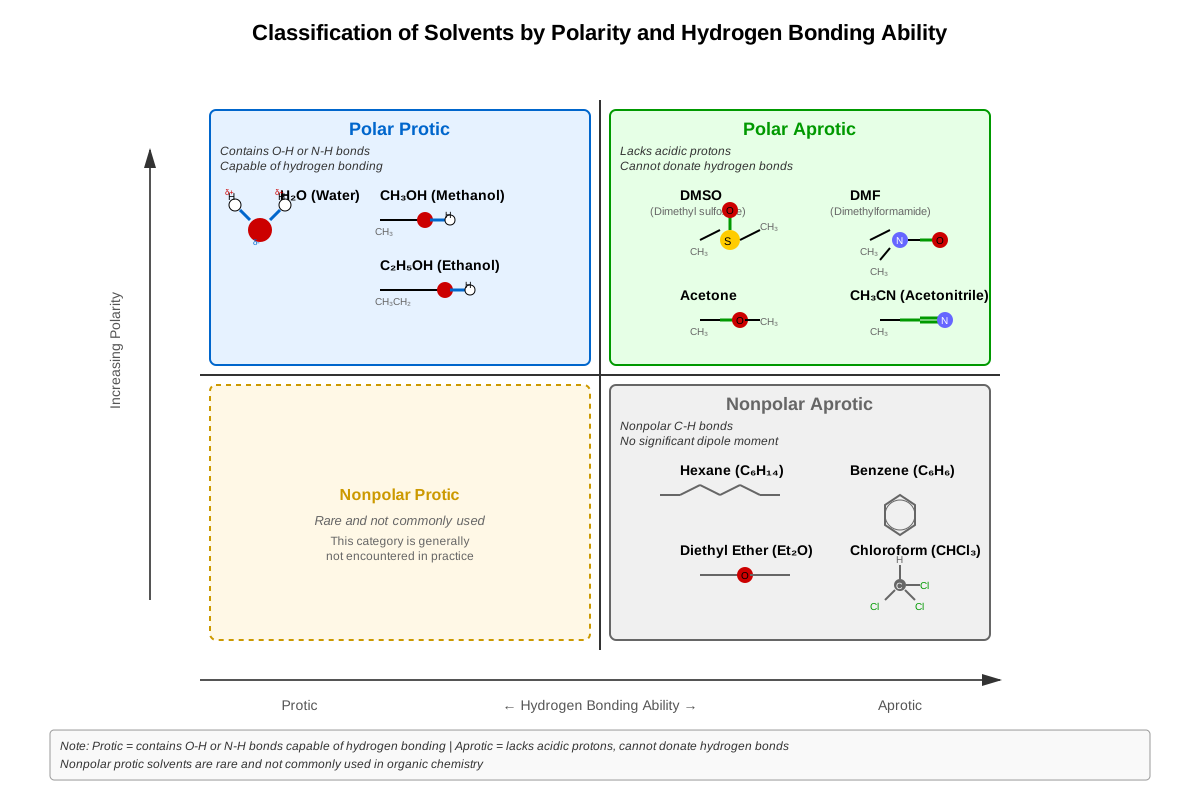
Solvents are classified based on two key properties: polarity and the presence of hydrogen bond donors. This classification system is fundamental to predicting solvent effects on reaction mechanisms.
Polar protic solvents contain both significant polarity and hydrogen atoms bonded to electronegative atoms (O, N, or F) that can participate in hydrogen bonding. Common examples include water (H₂O), methanol (CH₃OH), ethanol (CH₃CH₂OH), and acetic acid (CH₃COOH). These solvents can both donate and accept hydrogen bonds, making them excellent at solvating both cations and anions through ion-dipole interactions and hydrogen bonding.
Polar aprotic solvents possess significant polarity but lack hydrogen atoms bonded to highly electronegative atoms, preventing them from donating hydrogen bonds. Key examples include dimethyl sulfoxide (DMSO), acetone (CH₃COCH₃), dimethylformamide (DMF), and acetonitrile (CH₃CN). These solvents can accept hydrogen bonds and solvate cations effectively but cannot solvate anions through hydrogen bonding.
Nonpolar solvents lack significant polarity and include hydrocarbons like hexane, benzene, and toluene. These solvents do not significantly stabilize charged species and are rarely used for ionic substitution or elimination reactions.
| Solvent Type | Examples | H-Bond Donor? | H-Bond Acceptor? | Effect on Nucleophilicity |
|---|---|---|---|---|
| Polar Protic | H₂O, ROH, RCOOH | Yes | Yes | Decreases (solvates anions) |
| Polar Aprotic | DMSO, DMF, Acetone | No | Yes | Increases (anions unsolvated) |
| Nonpolar | Hexane, Benzene | No | No | Not applicable (ionic species insoluble) |
Solvent Effects on SN2 Mechanisms
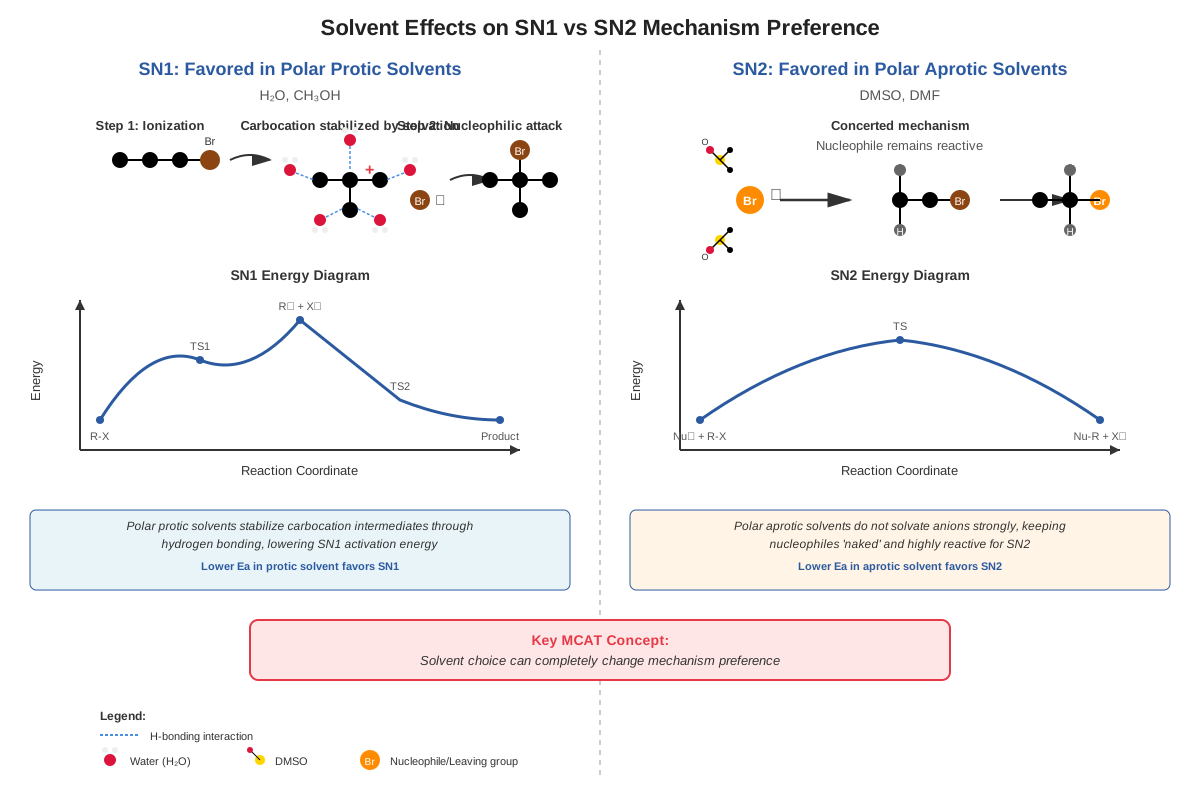
The SN2 mechanism (substitution, nucleophilic, bimolecular) proceeds through a single concerted step with a pentacoordinate transition state. The reaction rate depends on both nucleophile and substrate concentrations, and solvent choice dramatically affects the reaction rate by modulating nucleophile strength.
In polar aprotic solvents, nucleophilicity is significantly enhanced. Since these solvents cannot donate hydrogen bonds, anionic nucleophiles remain relatively "naked" or poorly solvated. The negative charge is concentrated, making the nucleophile more reactive and aggressive. For example, chloride ion (Cl⁻) is approximately 1 million times more nucleophilic in DMSO than in methanol. This dramatic enhancement makes polar aprotic solvents the preferred choice for SN2 reactions.
In polar protic solvents, nucleophilicity is substantially diminished. These solvents form extensive hydrogen bonding networks around anionic nucleophiles, creating a "solvent cage" that must be disrupted before the nucleophile can attack the electrophilic carbon. This solvation shell effectively shields the nucleophile's negative charge, reducing its reactivity. Consequently, SN2 reactions proceed much more slowly in protic solvents, and alternative mechanisms may become competitive.
The relationship between nucleophilicity and solvent can be summarized: Nucleophilicity in aprotic solvents > Nucleophilicity in protic solvents for the same nucleophile.
Solvent Effects on SN1 Mechanisms
The SN1 mechanism (substitution, nucleophilic, unimolecular) proceeds through a two-step process involving carbocation formation followed by nucleophilic attack. The rate-determining step is carbocation formation, making the reaction rate dependent only on substrate concentration. Solvent effects on SN1 reactions operate through a completely different principle than for SN2.
Polar protic solvents strongly favor SN1 mechanisms because they excel at stabilizing both the carbocation intermediate and the leaving group. As the leaving group departs, it develops a full negative charge that requires stabilization. Protic solvents surround the leaving group with hydrogen bond donors, dramatically lowering the activation energy for the ionization step. Simultaneously, the developing carbocation is stabilized by the solvent's partial negative charges (from oxygen or nitrogen atoms) through ion-dipole interactions.
The ionization step in SN1 mechanisms involves charge separation: a neutral molecule becomes a cation and an anion. This charge separation is energetically unfavorable in low-polarity environments but becomes favorable in highly polar solvents that can stabilize both charged species. Water and alcohols, with their high dielectric constants and hydrogen bonding capabilities, provide optimal conditions for SN1 reactions.
Polar aprotic solvents do not favor SN1 mechanisms as effectively because they cannot stabilize the leaving group through hydrogen bonding. While they can stabilize the carbocation to some degree, the inability to solvate the leaving group makes the ionization step energetically unfavorable.
Solvent Effects on Elimination Reactions
E2 mechanisms (elimination, bimolecular) involve concerted removal of a proton by a base and departure of a leaving group, forming a double bond. Like SN2, E2 reactions are bimolecular and depend on both base and substrate concentrations. Solvent effects on E2 reactions parallel those for SN2: polar aprotic solvents enhance base strength by leaving bases poorly solvated and more reactive. However, E2 reactions can also proceed reasonably well in protic solvents when strong, bulky bases are used.
E1 mechanisms (elimination, unimolecular) proceed through carbocation intermediates, identical to the first step of SN1. Therefore, polar protic solvents favor E1 mechanisms for the same reasons they favor SN1: excellent stabilization of carbocations and leaving groups. E1 and SN1 mechanisms are competing pathways that often occur simultaneously under the same conditions, with product ratios determined by temperature, base strength, and substrate structure.
The Ionizing Power and Nucleophilicity Relationship
A critical concept for the MCAT is understanding that ionizing power (ability to stabilize charged species and promote ionization) and nucleophilicity enhancement are inversely related across solvent types. Polar protic solvents have high ionizing power but decrease nucleophilicity. Polar aprotic solvents have moderate ionizing power but maximize nucleophilicity.
This inverse relationship explains why:
- SN1 and E1 (which require ionization) favor protic solvents
- SN2 (which requires strong nucleophiles) favors aprotic solvents
- E2 can occur in either but is enhanced in aprotic solvents with strong bases
Solvent Effects on Nucleophilicity Trends
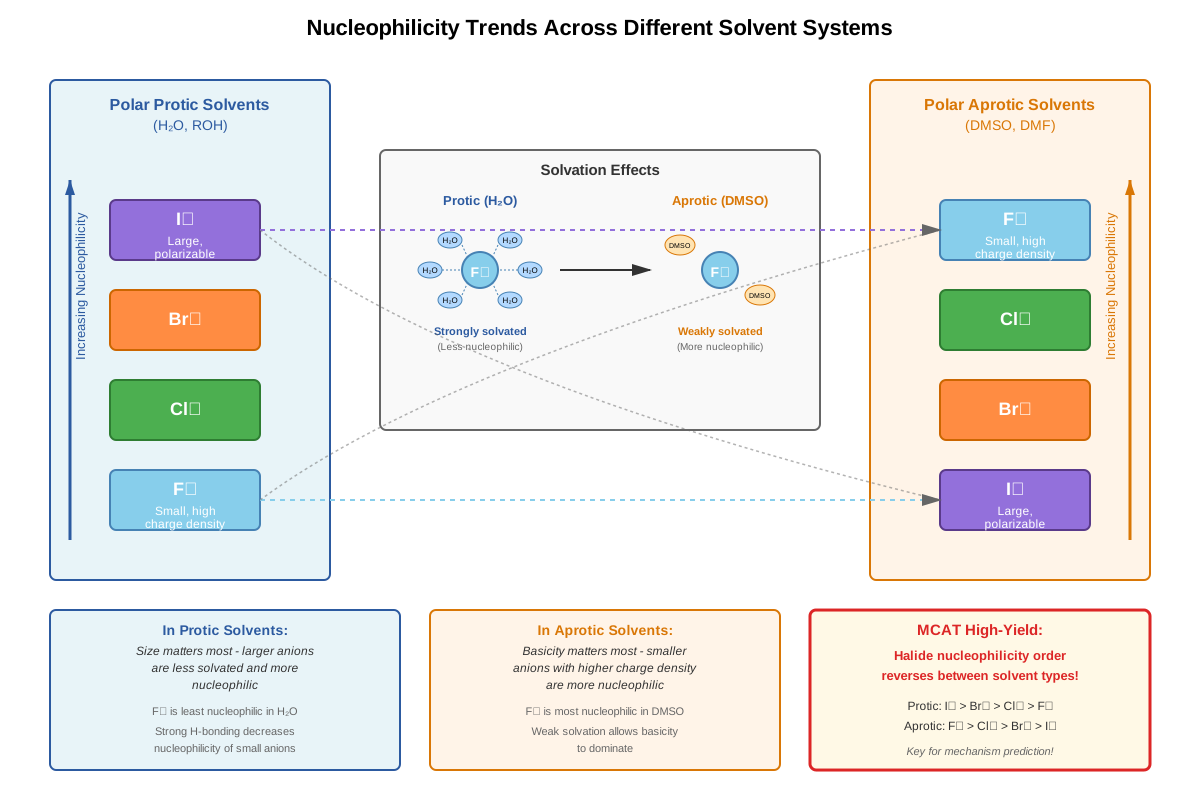
In polar aprotic solvents, nucleophilicity follows basicity trends and correlates with position in the periodic table. Smaller, more basic anions are more nucleophilic: F⁻ > Cl⁻ > Br⁻ > I⁻ (down a group, nucleophilicity decreases as basicity decreases).
In polar protic solvents, this trend reverses: I⁻ > Br⁻ > Cl⁻ > F⁻. This reversal occurs because smaller anions are more heavily solvated by hydrogen bonding. Fluoride, being the smallest and most electronegative, forms the strongest hydrogen bonds with protic solvents and is therefore the most heavily solvated and least nucleophilic. Iodide, being large and polarizable with diffuse charge, is poorly solvated and remains relatively "naked" and nucleophilic even in protic solvents.
Concept Relationships
The concepts within solvent effects form an interconnected network centered on the principle that solvent-solute interactions determine reaction pathways. Solvent classification (protic vs. aprotic) → determines solvation patterns → which affects nucleophilicity and ionization → which determines mechanism preference (SN1 vs. SN2 vs. E1 vs. E2).
Solvent effects connect directly to prerequisite knowledge of mechanism types. Understanding that SN1/E1 are unimolecular with carbocation intermediates explains why these mechanisms require solvents with high ionizing power. Conversely, knowing that SN2/E2 are bimolecular and depend on nucleophile/base strength explains why these mechanisms benefit from aprotic solvents that enhance nucleophilicity.
The relationship to carbocation stability is crucial: more stable carbocations (3° > 2° > 1°) form more readily, but even stable carbocations require solvent stabilization to make SN1/E1 mechanisms kinetically favorable. This creates a synergistic relationship where substrate structure and solvent properties together determine mechanism.
Solvent effects also connect to leaving group ability. Good leaving groups (weak bases like I⁻, Br⁻, tosylate) benefit from protic solvent stabilization after departure, further accelerating SN1/E1 mechanisms. Poor leaving groups may not depart even in protic solvents, making substitution/elimination impossible regardless of other conditions.
The concept extends to reaction kinetics: solvent effects alter activation energies for different pathways, changing not just which mechanism occurs but also the overall reaction rate. This connects to broader physical chemistry principles of transition state theory and thermodynamic vs. kinetic control.
Quick check — test yourself on Solvent effects so far.
Try Flashcards →High-Yield Facts
⭐ Polar aprotic solvents (DMSO, DMF, acetone) dramatically increase nucleophilicity and favor SN2 mechanisms
⭐ Polar protic solvents (water, alcohols) stabilize carbocations and leaving groups, favoring SN1 and E1 mechanisms
⭐ In protic solvents, nucleophilicity order reverses: I⁻ > Br⁻ > Cl⁻ > F⁻ (opposite of basicity)
⭐ In aprotic solvents, nucleophilicity follows basicity: F⁻ > Cl⁻ > Br⁻ > I⁻
⭐ Protic solvents decrease nucleophilicity by forming hydrogen bonds with anionic nucleophiles, creating a solvation shell
- Polar aprotic solvents can solvate cations but not anions effectively, leaving nucleophiles reactive
- SN2 reactions are typically 10³-10⁶ times faster in aprotic solvents compared to protic solvents
- The dielectric constant measures solvent polarity but does not distinguish between protic and aprotic character
- Mixed solvent systems (e.g., water/acetone) show intermediate properties and can fine-tune reaction selectivity
- Temperature increases favor elimination over substitution by providing energy to overcome higher activation barriers for E1/E2
Common Misconceptions
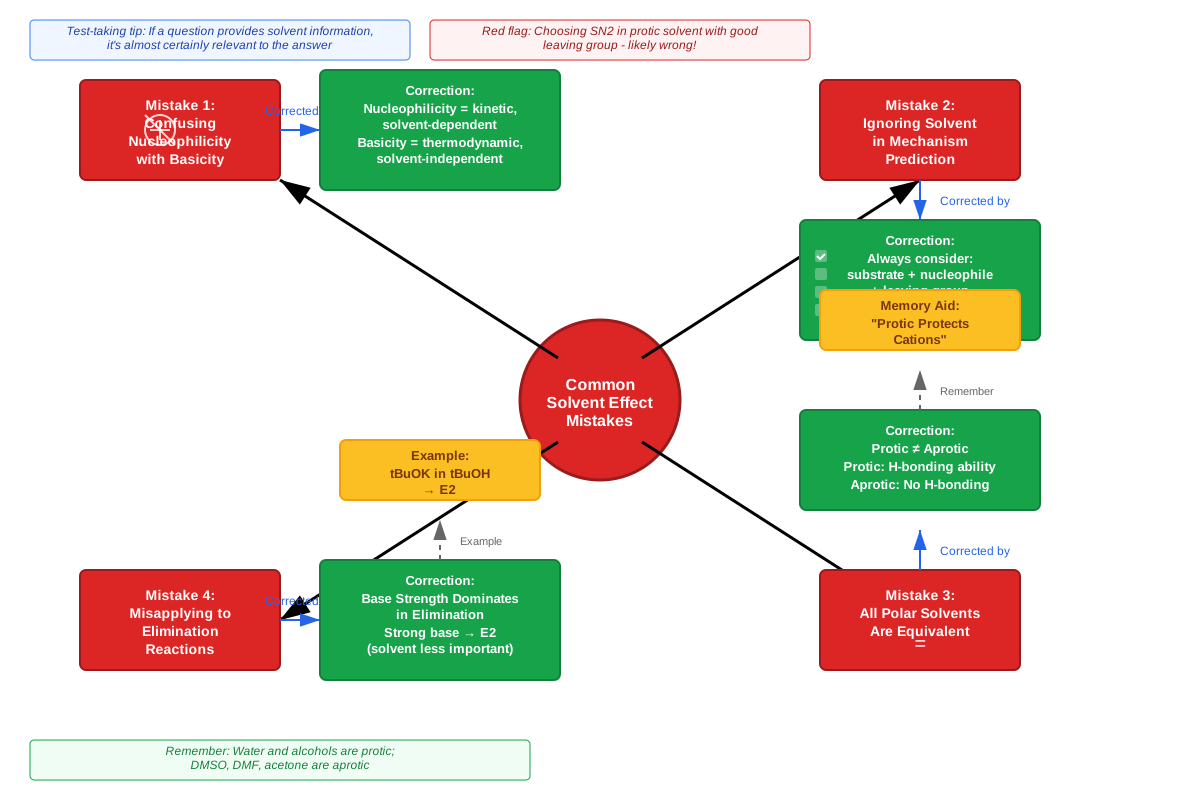
Misconception: All polar solvents have the same effect on reaction mechanisms.
Correction: Polar solvents must be subdivided into protic and aprotic categories, which have opposite effects on nucleophilicity. Polar protic solvents decrease nucleophilicity through hydrogen bonding, while polar aprotic solvents enhance it by leaving nucleophiles poorly solvated.
Misconception: Protic solvents always slow down reactions.
Correction: Protic solvents slow SN2 reactions by decreasing nucleophilicity, but they accelerate SN1 and E1 reactions by stabilizing carbocation intermediates and leaving groups. The effect depends on the mechanism.
Misconception: Nucleophilicity and basicity are always the same.
Correction: While related, nucleophilicity and basicity diverge significantly in protic solvents. In protic media, larger, less basic anions (like I⁻) can be more nucleophilic than smaller, more basic ones (like F⁻) due to differential solvation effects.
Misconception: Aprotic solvents cannot dissolve ionic compounds.
Correction: Polar aprotic solvents effectively dissolve many ionic compounds by solvating the cations through ion-dipole interactions. They simply cannot solvate anions through hydrogen bonding, which is why anions remain highly reactive.
Misconception: Solvent effects only matter for substitution reactions, not elimination.
Correction: Solvent effects are equally important for elimination reactions. E2 reactions benefit from aprotic solvents that enhance base strength, while E1 reactions require protic solvents to stabilize carbocation intermediates, just like their substitution counterparts.
Misconception: Water is always the best solvent for SN1 reactions.
Correction: While water is an excellent polar protic solvent that strongly favors SN1, other protic solvents like methanol or ethanol can be preferable when substrate solubility is limited or when less ionizing power is desired to control reaction selectivity.
Worked Examples
Example 1: Predicting Mechanism Based on Solvent
Question: A student performs a reaction between 2-bromo-2-methylpropane (tert-butyl bromide) and sodium ethoxide (NaOEt) under two different conditions: (A) in ethanol and (B) in DMSO. Predict the major mechanism and explain the reasoning for each condition.
Solution:
Step 1: Analyze the substrate
2-bromo-2-methylpropane is a tertiary alkyl halide. Tertiary substrates cannot undergo SN2 due to steric hindrance but readily form stable tertiary carbocations for SN1/E1 mechanisms.
Step 2: Analyze the nucleophile/base
Ethoxide (EtO⁻) is both a moderate nucleophile and a strong base. Its behavior will depend heavily on the solvent environment.
Step 3: Analyze Condition A (ethanol)
Ethanol is a polar protic solvent. It will:
- Stabilize any carbocation intermediate that forms
- Stabilize the bromide leaving group through hydrogen bonding
- Decrease the nucleophilicity of ethoxide through solvation
- Favor unimolecular mechanisms (SN1/E1)
Since the substrate is tertiary and the solvent favors ionization, the mechanism will be primarily E1 with some SN1. E1 will predominate over SN1 because ethoxide, despite being solvated, retains significant basicity and can abstract protons from the carbocation. The protic solvent provides the ionizing power needed for carbocation formation.
Step 4: Analyze Condition B (DMSO)
DMSO is a polar aprotic solvent. It will:
- Not effectively stabilize carbocations (moderate ionizing power)
- Dramatically enhance the nucleophilicity and basicity of ethoxide
- Disfavor carbocation formation
- Favor bimolecular mechanisms when possible
However, the tertiary substrate cannot undergo SN2 due to steric hindrance. The enhanced basicity of ethoxide in DMSO will favor E2 mechanism. The strong, poorly solvated base will abstract a β-proton in a concerted mechanism with bromide departure, forming an alkene without carbocation formation.
Answer: Condition A (ethanol) → E1 (major) and SN1 (minor); Condition B (DMSO) → E2 exclusively
Example 2: Ranking Nucleophilicity in Different Solvents
Question: Rank the following nucleophiles in order of decreasing nucleophilicity: F⁻, Cl⁻, Br⁻, I⁻ in (A) methanol and (B) acetone. Explain the reasoning.
Solution:
Step 1: Identify solvent types
- Methanol (CH₃OH) is a polar protic solvent (contains O-H bonds)
- Acetone (CH₃COCH₃) is a polar aprotic solvent (no H bonded to O)
Step 2: Apply principles for protic solvents (methanol)
In polar protic solvents, smaller anions are more heavily solvated through hydrogen bonding. The solvation energy required to "desolvate" the nucleophile before attack becomes the dominant factor affecting nucleophilicity.
- Fluoride (F⁻): smallest, highest charge density, most heavily solvated, least nucleophilic
- Chloride (Cl⁻): intermediate size, moderately solvated
- Bromide (Br⁻): larger, less solvated
- Iodide (I⁻): largest, most polarizable, least solvated, most nucleophilic
The trend follows atomic size down the group, opposite to basicity.
Answer for (A): I⁻ > Br⁻ > Cl⁻ > F⁻
Step 3: Apply principles for aprotic solvents (acetone)
In polar aprotic solvents, anions are poorly solvated and remain "naked." Nucleophilicity correlates with basicity, which follows electronegativity trends.
- Fluoride (F⁻): most basic (strongest conjugate base of weakest acid HF), most nucleophilic
- Chloride (Cl⁻): less basic than F⁻
- Bromide (Br⁻): less basic than Cl⁻
- Iodide (I⁻): least basic (conjugate base of strong acid HI), least nucleophilic
The trend follows basicity, which is inversely related to the stability of the anion.
Answer for (B): F⁻ > Cl⁻ > Br⁻ > I⁻
Step 4: Explain the reversal
The complete reversal of nucleophilicity order between protic and aprotic solvents is a high-yield MCAT concept. In protic solvents, solvation effects dominate; in aprotic solvents, intrinsic basicity dominates. This demonstrates that nucleophilicity is not an inherent property but depends on the reaction environment.
Exam Strategy
When approaching MCAT questions on solvent effects, immediately identify the solvent type mentioned in the question stem or passage. Look for trigger words: "water," "methanol," "ethanol," or "aqueous" indicate protic solvents; "DMSO," "DMF," "acetone," or "acetonitrile" indicate aprotic solvents. This single piece of information often determines the correct answer.
Use a systematic decision tree approach:
- Identify substrate type (1°, 2°, 3°, methyl)
- Identify nucleophile/base strength
- Identify solvent type (protic vs. aprotic)
- Apply mechanism rules based on these three factors
For process-of-elimination, remember that certain combinations are highly unfavorable:
- Eliminate SN2 for tertiary substrates regardless of solvent
- Eliminate SN1/E1 for primary substrates unless extremely good leaving groups
- Eliminate SN1/E1 in aprotic solvents unless specifically stated otherwise
- Eliminate SN2 in protic solvents with poor nucleophiles
Watch for questions that ask about reaction rate rather than mechanism. Solvent effects dramatically affect rates: changing from protic to aprotic can increase SN2 rates by factors of 10³-10⁶. If a question provides rate data in different solvents, use this to identify mechanism type.
Time allocation: Solvent effect questions typically require 60-90 seconds. Spend 20 seconds identifying substrate, nucleophile, and solvent; 30 seconds applying mechanism rules; and 20 seconds confirming your answer against other options. Do not overthink—these questions test pattern recognition more than complex reasoning.
Common distractor patterns include:
- Mixing up protic and aprotic solvent effects
- Confusing nucleophilicity trends in different solvents
- Assuming all polar solvents behave identically
- Forgetting that substrate structure can override solvent preferences
Memory Techniques
Mnemonic for Polar Aprotic Solvents: "Don't Make Any Fuss" = DMSO, DMF, Acetone, Acetonitrile (sounds like "fuss")
Mnemonic for Protic Solvent Effects: "Protic Promotes Positive" (Protic solvents promote positive charge formation = carbocations = SN1/E1)
Mnemonic for Nucleophilicity in Protic Solvents: "Big Bullies Win In Prison" = Bigger nucleophiles (I⁻, Br⁻) win (are more nucleophilic) in protic solvents
Visualization Strategy: Picture protic solvents as "sticky" with hydrogen bonds forming a cage around nucleophiles, slowing them down. Picture aprotic solvents as "slippery" where nucleophiles remain free and aggressive.
Acronym for SN2 Optimization: "PANS" = Polar Aprotic, Nucleophile enhanced, SN2 favored
Conceptual Memory Aid: "Opposite effects" - Protic and aprotic solvents have opposite effects on nucleophilicity; nucleophilicity trends in protic vs. aprotic solvents are opposite; SN1 and SN2 have opposite solvent preferences.
Summary
Solvent effects represent a critical determinant of reaction pathways in substitution and elimination chemistry. The fundamental principle is that solvents actively participate in reactions by stabilizing or destabilizing charged species through solvation. Polar protic solvents (water, alcohols) contain hydrogen bond donors that stabilize both carbocations and leaving groups, making them ideal for SN1 and E1 mechanisms but detrimental for SN2 by decreasing nucleophilicity through extensive solvation. Polar aprotic solvents (DMSO, DMF, acetone) lack hydrogen bond donors, leaving nucleophiles poorly solvated and highly reactive, dramatically favoring SN2 mechanisms. The nucleophilicity order reverses between solvent types: in protic solvents, larger halides (I⁻) are more nucleophilic due to weaker solvation, while in aprotic solvents, smaller halides (F⁻) are more nucleophilic due to greater basicity. For MCAT success, students must rapidly identify solvent type and apply the appropriate mechanistic preferences, recognizing that solvent choice often determines which of several competing mechanisms will predominate.
Key Takeaways
- Polar protic solvents (H₂O, ROH) favor SN1/E1 by stabilizing carbocations and leaving groups; polar aprotic solvents (DMSO, DMF) favor SN2/E2 by enhancing nucleophilicity
- Protic solvents decrease nucleophilicity through hydrogen bonding solvation shells around anions
- Nucleophilicity order reverses between protic (I⁻ > Br⁻ > Cl⁻ > F⁻) and aprotic (F⁻ > Cl⁻ > Br⁻ > I⁻) solvents
- SN2 reactions can be 10³-10⁶ times faster in aprotic versus protic solvents
- Solvent effects work synergistically with substrate structure and nucleophile strength to determine mechanism
- Identifying solvent type (protic vs. aprotic) is often the key to answering MCAT mechanism questions correctly
- The ability to stabilize charged intermediates (ionizing power) and enhance nucleophilicity are inversely related across solvent types
Related Topics
Nucleophilicity vs. Basicity: Understanding the distinction between these related concepts deepens comprehension of why solvent effects alter nucleophilicity more dramatically than basicity. Mastering solvent effects provides the foundation for understanding this nuanced relationship.
Carbocation Rearrangements: Since protic solvents favor carbocation formation, understanding rearrangements (hydride and methyl shifts) becomes essential for predicting SN1/E1 products in these solvents.
Stereochemistry of Substitution Reactions: Solvent effects determine mechanism, which in turn determines stereochemical outcomes (inversion for SN2, racemization for SN1). This topic builds directly on solvent effect principles.
Reaction Kinetics and Rate Laws: Solvent effects alter activation energies and reaction rates, connecting to broader physical chemistry concepts of how environmental factors influence kinetics.
Leaving Group Ability: The stabilization of leaving groups by protic solvents connects to understanding what makes good leaving groups and how solvent can compensate for moderate leaving groups in SN1/E1 reactions.
Practice CTA
Now that you have mastered the core concepts of solvent effects, it is time to solidify your understanding through active practice. Attempt the practice questions and flashcards associated with this topic, focusing on rapidly identifying solvent types and predicting mechanistic outcomes. Challenge yourself to explain the reasoning behind each answer, connecting back to the principles of solvation and nucleophilicity. Remember, the difference between knowing these concepts and applying them under timed exam conditions comes from deliberate practice. Your ability to quickly recognize solvent effects and their mechanistic implications will directly translate to points on test day. You have the knowledge—now build the skill through repetition and application!
Sign up free to keep reading
Create a free AnvayaPrep account to finish this MCAT guide on Solvent effects — plus flashcards and practice questions.