Overview
SN1 reactions represent one of the fundamental mechanistic pathways in Organic Chemistry through which nucleophilic substitution occurs at saturated carbon centers. The designation "SN1" stands for Substitution Nucleophilic Unimolecular, reflecting the reaction's defining characteristic: a rate-determining step that depends on the concentration of only one species—the substrate. This contrasts sharply with the bimolecular SN2 mechanism, making the distinction between these pathways a high-yield topic for the MCAT.
Understanding SN1 reactions is essential for MCAT success because these reactions appear frequently in both discrete questions and passage-based scenarios within the Chemical and Physical Foundations of Biological Systems section. The MCAT tests not merely rote memorization of reaction conditions but rather the ability to predict reaction outcomes based on substrate structure, leaving group quality, solvent properties, and nucleophile characteristics. Questions often require students to distinguish between SN1, SN2, E1, and E2 mechanisms—a critical skill that separates high-scoring test-takers from average performers.
Within the broader context of Organic Chemistry, SN1 reactions connect intimately to carbocation chemistry, stereochemistry, solvent effects, and reaction kinetics. Mastery of this mechanism provides the foundation for understanding elimination reactions (particularly E1), rearrangement reactions, and the behavior of biological molecules containing leaving groups. The principles governing SN1 reactivity extend beyond synthetic chemistry into biochemical contexts, including enzyme mechanisms and drug metabolism pathways that may appear in MCAT passages.
Learning Objectives
- [ ] Define SN1 reactions using accurate Organic Chemistry terminology
- [ ] Explain why SN1 reactions matter for the MCAT
- [ ] Apply SN1 reactions to exam-style questions
- [ ] Identify common mistakes related to SN1 reactions
- [ ] Connect SN1 reactions to related Organic Chemistry concepts
- [ ] Predict the rate law and rate-determining step for SN1 reactions from substrate structure
- [ ] Analyze stereochemical outcomes of SN1 reactions and explain racemization patterns
- [ ] Evaluate competing reaction pathways (SN1 vs. SN2 vs. E1 vs. E2) based on reaction conditions
Prerequisites
- Carbocation stability and structure: SN1 reactions proceed through carbocation intermediates, requiring understanding of hyperconjugation, inductive effects, and resonance stabilization
- Leaving group concepts: The ability of a group to depart with an electron pair determines whether SN1 reactions can occur
- Basic stereochemistry: Understanding R/S nomenclature and three-dimensional molecular structure is essential for predicting stereochemical outcomes
- Reaction kinetics fundamentals: Knowledge of rate laws, rate-determining steps, and reaction coordinate diagrams enables mechanistic analysis
- Solvent polarity: Polar protic vs. polar aprotic solvent effects directly influence SN1 reaction rates
Why This Topic Matters
SN1 reactions appear in approximately 3-5 questions per MCAT exam, either as discrete items or embedded within passage-based scenarios. The MCAT frequently presents experimental data showing reaction rates under varying conditions and asks students to deduce the mechanism. Additionally, passages may describe pharmaceutical synthesis routes or biological transformations where nucleophilic substitution occurs, requiring mechanistic insight to answer associated questions correctly.
From a real-world perspective, SN1-type mechanisms operate in numerous biological processes. The hydrolysis of tert-butyl chloride in aqueous solution—a classic SN1 reaction—models how certain prodrugs are activated in physiological environments. Enzyme-catalyzed substitution reactions in metabolic pathways often proceed through carbocation-like transition states stabilized by the enzyme active site. Understanding SN1 chemistry provides insight into how cells process xenobiotics, how certain antibiotics function, and how DNA alkylating agents cause mutations.
Common MCAT question formats include: (1) identifying which substrate undergoes fastest SN1 reaction among structural isomers, (2) predicting stereochemical outcomes from chiral starting materials, (3) explaining why certain conditions favor SN1 over competing mechanisms, and (4) interpreting kinetic data to distinguish unimolecular from bimolecular processes. Passages may present reaction rate tables, stereochemical analysis, or solvent effect studies that require application of SN1 principles.
Core Concepts
Definition and Mechanism
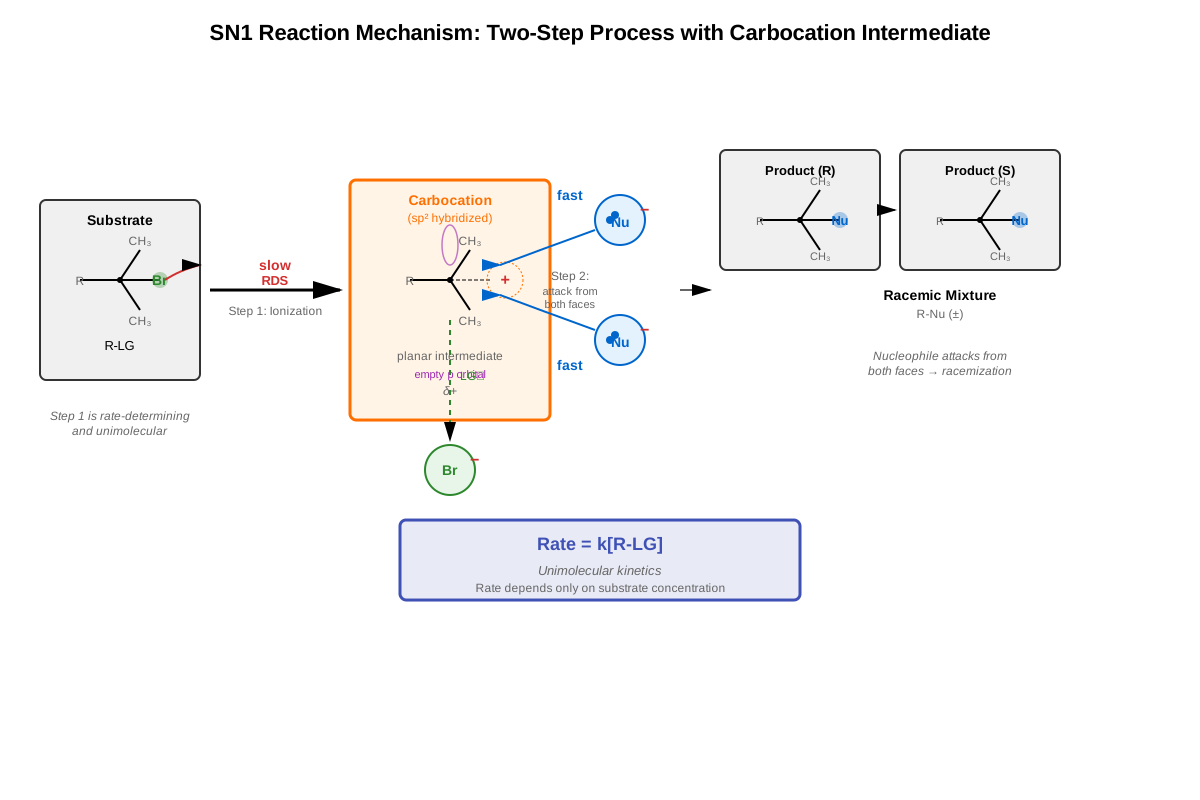
An SN1 reaction is a two-step nucleophilic substitution mechanism in which the rate-determining step involves only the substrate molecule. The "1" in SN1 indicates this unimolecular character. The general mechanism proceeds as follows:
Step 1 (Rate-Determining): The substrate undergoes heterolytic cleavage of the carbon-leaving group bond, forming a carbocation intermediate and a leaving group. This step is slow and determines the overall reaction rate.
Step 2 (Fast): A nucleophile rapidly attacks the carbocation from either face, forming the substitution product.
The rate law for an SN1 reaction is: Rate = k[substrate], demonstrating first-order kinetics. Notably, the nucleophile concentration does not appear in the rate expression because nucleophilic attack occurs after the rate-determining step.
Carbocation Intermediate
The formation of a carbocation intermediate distinguishes SN1 from SN2 mechanisms and dictates substrate reactivity patterns. Carbocations are sp² hybridized with trigonal planar geometry and an empty p orbital perpendicular to the molecular plane. Their stability follows the order:
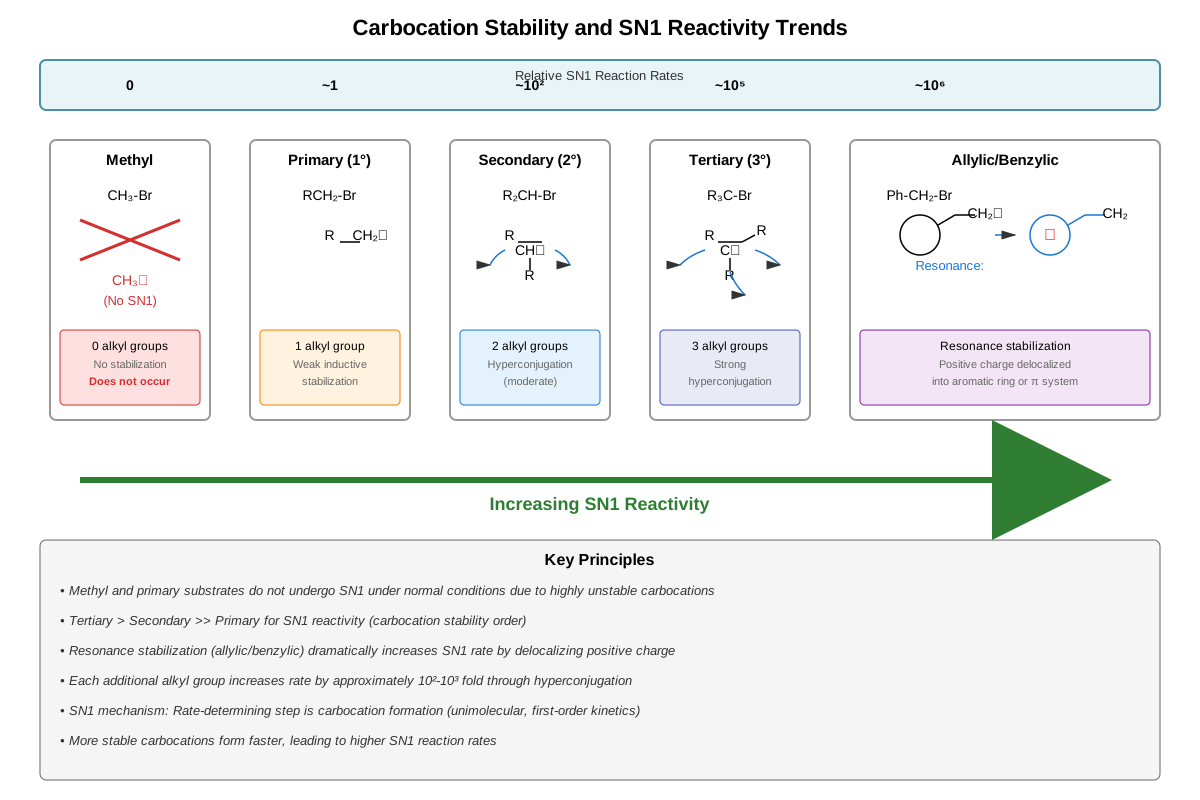
Tertiary (3°) > Secondary (2°) > Primary (1°) > Methyl
This stability hierarchy arises from:
- Hyperconjugation: Adjacent C-H or C-C σ bonds donate electron density into the empty p orbital
- Inductive effects: Alkyl groups are electron-donating relative to hydrogen
- Resonance stabilization: When applicable (e.g., allylic or benzylic carbocations), resonance dramatically increases stability
MCAT Exam Tip: Tertiary substrates strongly favor SN1 mechanisms, while primary substrates rarely undergo SN1 reactions under normal conditions. Secondary substrates represent borderline cases where reaction conditions determine the mechanism.
Stereochemistry
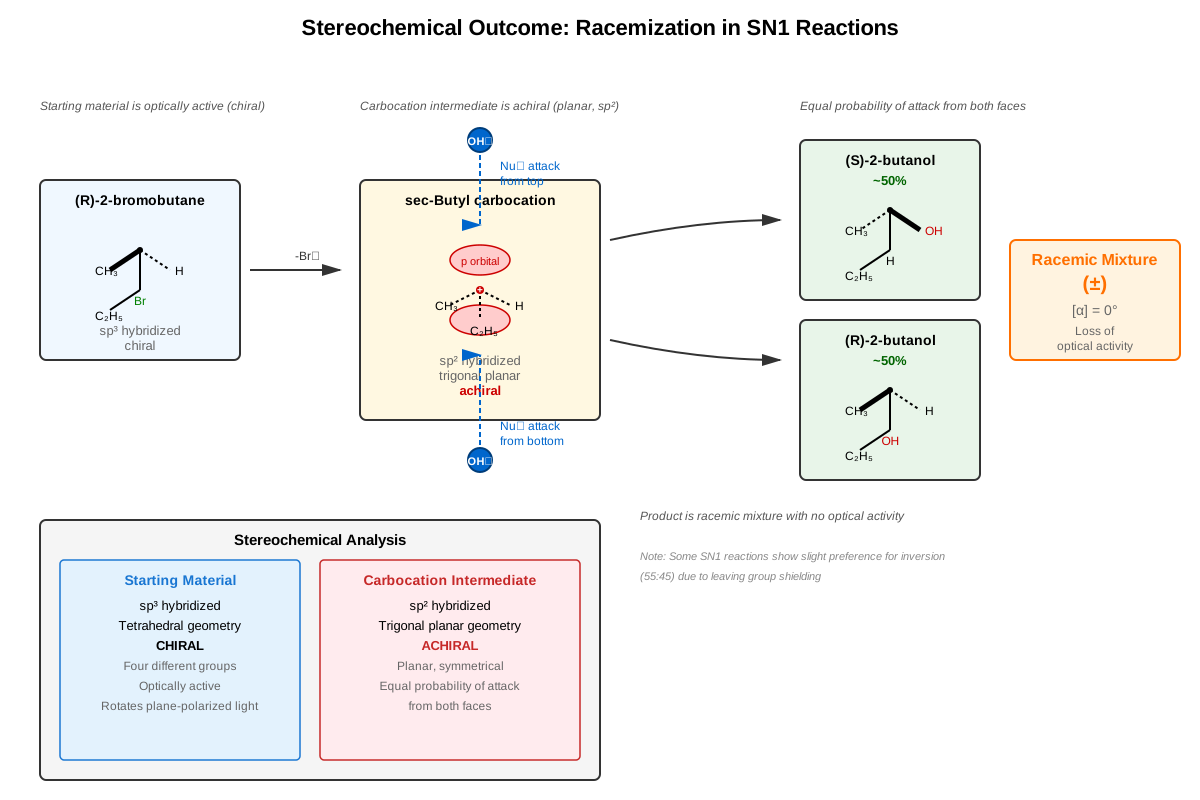
Because the carbocation intermediate is planar (sp² hybridized), nucleophilic attack can occur from either face with approximately equal probability. When the reaction occurs at a stereogenic center, this leads to racemization—formation of a racemic mixture (50:50 mixture of enantiomers).
In practice, slight deviations from perfect racemization often occur due to:
- Ion pairing: The leaving group may remain loosely associated with the carbocation, partially blocking one face
- Solvent effects: Solvent molecules may preferentially shield one face
The MCAT expects students to recognize that SN1 reactions at chiral centers produce racemic or nearly racemic products, contrasting with SN2 reactions that produce complete inversion of configuration.
Substrate Structure Requirements
Ideal SN1 substrates possess:
- Highly substituted carbon: Tertiary > secondary >> primary (primary substrates essentially never undergo SN1)
- Good leaving group: Weak bases make good leaving groups (I⁻ > Br⁻ > Cl⁻ > F⁻; H₂O > ROH)
- Carbocation-stabilizing features: Resonance (allylic, benzylic) or adjacent heteroatoms with lone pairs
| Substrate Type | SN1 Reactivity | Reason |
|---|---|---|
| Tertiary alkyl halides | Excellent | Stable 3° carbocation |
| Allylic/benzylic halides | Excellent | Resonance-stabilized carbocation |
| Secondary alkyl halides | Moderate | Moderately stable 2° carbocation |
| Primary alkyl halides | Very poor | Unstable 1° carbocation |
| Methyl halides | None | Extremely unstable methyl carbocation |
Solvent Effects
Polar protic solvents dramatically accelerate SN1 reactions through two mechanisms:
- Stabilization of the carbocation intermediate: Polar solvents with high dielectric constants stabilize charged species through electrostatic interactions
- Stabilization of the leaving group: Protic solvents (those with O-H or N-H bonds) form hydrogen bonds with anionic leaving groups, facilitating their departure
Common polar protic solvents include water, alcohols (methanol, ethanol), and carboxylic acids. These solvents lower the activation energy for carbocation formation, increasing reaction rates by factors of 10³ to 10⁶ compared to nonpolar solvents.
In contrast, polar aprotic solvents (DMSO, DMF, acetone) do not significantly accelerate SN1 reactions because they cannot hydrogen bond with leaving groups, though they still provide some carbocation stabilization through dipole interactions.
Nucleophile Characteristics
Unlike SN2 reactions where strong nucleophiles are required, SN1 reactions proceed readily with weak nucleophiles because nucleophilic attack occurs after the rate-determining step. Common nucleophiles in SN1 reactions include:
- Water (H₂O) - produces alcohols
- Alcohols (ROH) - produces ethers
- Carboxylate ions (RCO₂⁻) - produces esters
- Halide ions (Cl⁻, Br⁻, I⁻) - produces alkyl halides
The nucleophile's strength affects product distribution when multiple nucleophiles are present but does not influence the overall reaction rate.
Carbocation Rearrangements
A critical complication in SN1 reactions is carbocation rearrangement. If the initially formed carbocation can rearrange to a more stable carbocation through hydride shift (H⁻ migration) or alkyl shift (R⁻ migration), rearrangement will occur before nucleophilic attack.
For example, a secondary carbocation adjacent to a tertiary carbon will undergo alkyl shift to form the more stable tertiary carbocation. This produces unexpected "rearranged" products that students must anticipate.
High-Yield MCAT Concept: Always check for possible carbocation rearrangements in SN1 mechanisms. The MCAT loves testing whether students recognize rearranged products.
Competing Elimination Reactions
Under SN1 conditions, E1 elimination competes directly with substitution because both mechanisms share the same rate-determining step (carbocation formation). The carbocation intermediate can either:
- Accept a nucleophile (SN1 pathway) → substitution product
- Lose a proton from an adjacent carbon (E1 pathway) → alkene product
Higher temperatures favor elimination over substitution due to the greater entropy change associated with forming two product molecules from one reactant. Bulky nucleophiles/bases also favor elimination because they more readily abstract protons than attack the carbocation carbon.
Concept Relationships
The core concepts within SN1 reactions form an interconnected network where substrate structure determines mechanism feasibility, which in turn dictates stereochemical outcomes and competing pathways. The relationship flows as follows:
Substrate structure → Carbocation stability → Mechanism viability → Stereochemical outcome
Specifically, tertiary or resonance-stabilized substrates form stable carbocations, enabling the SN1 mechanism, which produces racemization at stereocenters. Simultaneously, the carbocation intermediate creates a branch point:
Carbocation intermediate → Nucleophilic attack (SN1) OR Proton loss (E1) OR Rearrangement
Solvent effects modulate this entire pathway by stabilizing both the carbocation and leaving group, thereby lowering the activation energy for the rate-determining step. This connects to prerequisite knowledge of solvent polarity and intermolecular forces.
The distinction between SN1 and SN2 mechanisms relates directly to steric effects (prerequisite topic): bulky substituents that hinder backside attack in SN2 reactions actually promote SN1 by stabilizing carbocations through hyperconjugation. This inverse relationship between steric hindrance and mechanism preference is a high-yield MCAT concept.
Furthermore, leaving group ability (prerequisite) directly impacts both SN1 and SN2 reactions, but the effect is more pronounced in SN1 because leaving group departure constitutes the entire rate-determining step. This connects to acid-base chemistry: the best leaving groups are the weakest bases (conjugate bases of strong acids).
Quick check — test yourself on SN1 reactions so far.
Try Flashcards →High-Yield Facts
⭐ SN1 reactions follow first-order kinetics with rate law: Rate = k[substrate]
⭐ Tertiary substrates strongly favor SN1; primary substrates essentially never undergo SN1
⭐ SN1 reactions at chiral centers produce racemic or nearly racemic mixtures
⭐ Polar protic solvents (water, alcohols) dramatically accelerate SN1 reactions
⭐ Carbocation rearrangements via hydride or alkyl shifts occur when a more stable carbocation can form
- The carbocation intermediate in SN1 is sp² hybridized with trigonal planar geometry
- Allylic and benzylic substrates undergo rapid SN1 reactions due to resonance stabilization
- E1 elimination competes with SN1 substitution, sharing the same rate-determining step
- Nucleophile strength does not affect SN1 reaction rate (only product distribution)
- Good leaving groups are weak bases: I⁻ > Br⁻ > Cl⁻ >> F⁻
- Temperature increase favors E1 over SN1 due to entropy considerations
- Secondary substrates represent borderline cases where conditions determine SN1 vs. SN2
- The rate-determining step is carbocation formation (heterolytic bond cleavage)
- Ion pairing between carbocation and leaving group can cause slight deviations from perfect racemization
- Carbocation stability order: resonance-stabilized > 3° > 2° > 1° > methyl
Common Misconceptions
Misconception: SN1 reactions always produce perfectly racemic mixtures (exactly 50:50 enantiomers).
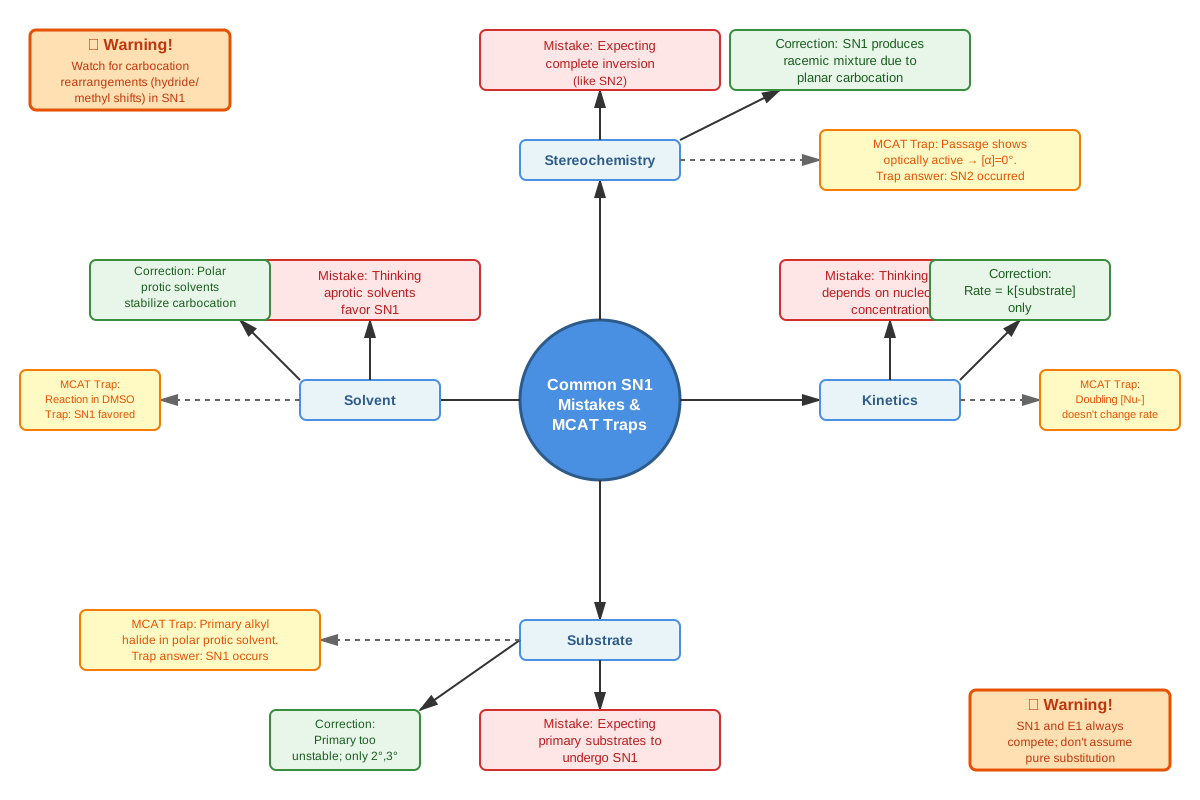
Correction: While SN1 reactions produce racemization, ion pairing and solvent effects often cause slight deviations from perfect 50:50 ratios. The MCAT may present data showing 60:40 or 55:45 ratios, which still indicates an SN1 mechanism rather than pure SN2 (which gives 100% inversion).
Misconception: Strong nucleophiles are required for SN1 reactions.
Correction: Because nucleophilic attack occurs after the rate-determining step, even weak nucleophiles like water or alcohols readily participate in SN1 reactions. Strong nucleophiles actually favor competing SN2 mechanisms with less substituted substrates.
Misconception: Primary alkyl halides can undergo SN1 reactions if the nucleophile is very weak.
Correction: Primary carbocations are so unstable (lacking sufficient hyperconjugation) that they essentially never form under normal conditions, regardless of nucleophile strength. Primary substrates undergo SN2, not SN1.
Misconception: The leaving group departs completely and diffuses away before nucleophilic attack.
Correction: The leaving group often remains loosely associated with the carbocation as an ion pair, which can influence stereochemical outcomes and explain why racemization is sometimes incomplete.
Misconception: Increasing nucleophile concentration will speed up an SN1 reaction.
Correction: Because the rate law is Rate = k[substrate], nucleophile concentration has zero effect on reaction rate. This is a key experimental distinction used to identify SN1 mechanisms on the MCAT.
Misconception: All secondary substrates undergo SN1 reactions.
Correction: Secondary substrates are borderline cases. Under conditions favoring SN1 (polar protic solvent, weak nucleophile, heat), they may proceed via SN1, but under SN2-favoring conditions (polar aprotic solvent, strong nucleophile), they follow SN2. The MCAT tests the ability to predict mechanism based on complete reaction conditions.
Misconception: SN1 and E1 are completely separate, unrelated mechanisms.
Correction: SN1 and E1 share the identical rate-determining step (carbocation formation) and compete directly. Both produce the same carbocation intermediate, which then either accepts a nucleophile (SN1) or loses a proton (E1). Understanding this competition is essential for predicting product mixtures.
Worked Examples
Example 1: Mechanism Identification from Kinetic Data
Question: A researcher studies the reaction of 2-bromo-2-methylpropane with water. Experiment 1 uses 0.1 M substrate and measures an initial rate of 2.0 × 10⁻⁴ M/s. Experiment 2 doubles the substrate concentration to 0.2 M and measures an initial rate of 4.0 × 10⁻⁴ M/s. Experiment 3 uses 0.1 M substrate but adds excess sodium hydroxide (strong nucleophile), yet the rate remains 2.0 × 10⁻⁴ M/s. What mechanism is operating?
Solution:
Step 1: Analyze the substrate structure. 2-bromo-2-methylpropane is tert-butyl bromide, a tertiary alkyl halide. This structure strongly favors SN1 due to the stable tertiary carbocation that can form.
Step 2: Examine the rate dependence on substrate concentration. When substrate concentration doubles (0.1 M → 0.2 M), the rate doubles (2.0 × 10⁻⁴ → 4.0 × 10⁻⁴ M/s). This indicates first-order dependence on substrate: Rate ∝ [substrate]¹.
Step 3: Examine the rate dependence on nucleophile concentration. Adding excess strong nucleophile (OH⁻) does not change the reaction rate. This indicates zero-order dependence on nucleophile: Rate ∝ [nucleophile]⁰.
Step 4: Combine observations. The rate law is Rate = k[substrate]¹[nucleophile]⁰ = k[substrate], which is the defining characteristic of an SN1 mechanism.
Conclusion: This reaction proceeds via SN1 mechanism. The tertiary substrate forms a stable carbocation in the rate-determining step, and nucleophilic attack occurs afterward (explaining why nucleophile concentration doesn't affect rate).
Learning Objective Connection: This example demonstrates application of SN1 reactions to exam-style questions by using kinetic data to identify mechanism—a common MCAT question format.
Example 2: Stereochemical Outcome Prediction
Question: (R)-3-bromo-3-methylhexane is dissolved in aqueous ethanol (a polar protic solvent) and allowed to react at room temperature. The product is analyzed by polarimetry and found to rotate plane-polarized light only weakly, nearly zero. Additionally, when the reaction rate is measured with varying ethanol concentrations, no rate change is observed. What product(s) formed, and what is the stereochemical outcome?
Solution:
Step 1: Identify the substrate characteristics. 3-bromo-3-methylhexane has the bromine on a tertiary carbon (C3 is bonded to three other carbons plus the methyl group). This tertiary substrate strongly favors SN1.
Step 2: Confirm mechanism from experimental data. The rate independence from nucleophile (ethanol) concentration confirms SN1 mechanism (Rate = k[substrate]).
Step 3: Predict the stereochemical outcome. The starting material is (R)-configured at C3. In an SN1 reaction, the C-Br bond breaks to form a planar, sp² carbocation intermediate. This carbocation has no chirality—it's achiral.
Step 4: Analyze nucleophilic attack. Ethanol (the nucleophile/solvent) can attack the carbocation from either face with approximately equal probability, producing both (R) and (S) products in roughly equal amounts.
Step 5: Interpret the polarimetry result. A racemic mixture (50% R, 50% S) produces zero net rotation of plane-polarized light because the equal and opposite rotations cancel. The "nearly zero" rotation observed (rather than exactly zero) likely reflects slight ion pairing effects causing minor deviation from perfect 50:50 ratio.
Products: A racemic (or nearly racemic) mixture of (R)-3-ethoxy-3-methylhexane and (S)-3-ethoxy-3-methylhexane.
Stereochemical outcome: Racemization at the stereogenic center.
Learning Objective Connection: This example connects SN1 reactions to stereochemistry concepts and demonstrates how to predict stereochemical outcomes—a high-yield MCAT skill.
Exam Strategy
When approaching SN1 reactions questions on the MCAT, employ this systematic strategy:
Step 1: Identify trigger words and phrases
- "First-order kinetics" or "rate depends only on substrate concentration" → strongly suggests SN1
- "Tertiary substrate," "benzylic," or "allylic" → SN1-favorable substrates
- "Polar protic solvent," "aqueous," "in ethanol" → SN1-favorable conditions
- "Racemic mixture" or "loss of optical activity" → indicates SN1 occurred at chiral center
- "Rearranged product" → carbocation rearrangement during SN1
Step 2: Evaluate substrate structure first
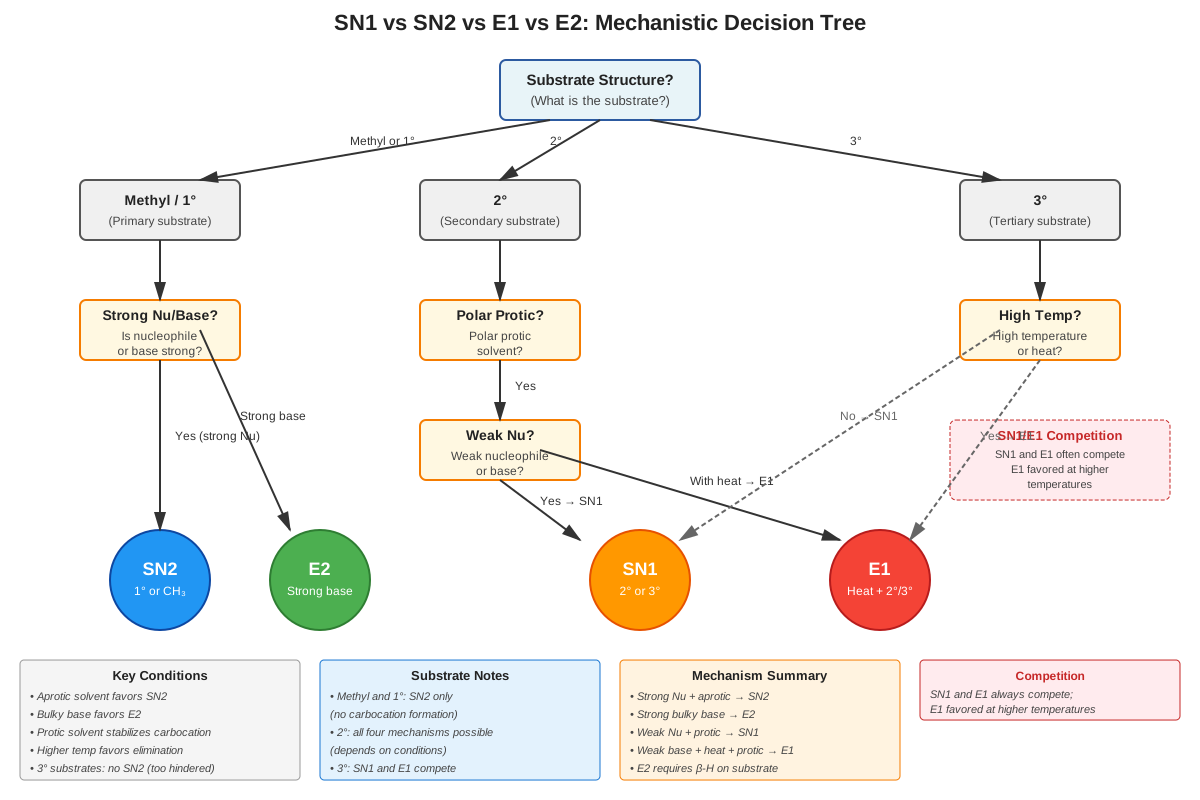
The substrate structure is the single most important factor. Use this decision tree:
- Methyl or primary → SN1 essentially impossible (eliminate SN1 answer choices)
- Secondary → borderline; examine other conditions carefully
- Tertiary, allylic, or benzylic → SN1 highly favorable
Step 3: Check for competing mechanisms
Remember that SN1 rarely occurs in isolation:
- E1 always competes (same rate-determining step)
- Higher temperature → more E1 relative to SN1
- Bulky nucleophile/base → more E1 relative to SN1
Step 4: Process of elimination tips
- If a question asks about rate dependence and an answer choice mentions nucleophile concentration affecting rate, eliminate it for SN1
- If stereochemistry is discussed and an answer states "complete inversion," eliminate it (that's SN2)
- If the substrate is primary and an answer suggests SN1, eliminate it immediately
Step 5: Time allocation
For discrete questions on mechanism identification: 60-90 seconds
For passage-based questions requiring data interpretation: 90-120 seconds
Don't spend excessive time drawing detailed mechanisms unless specifically asked—focus on the rate-determining step and key characteristics
High-Yield Exam Tip: When a question presents kinetic data (rate vs. concentration tables), immediately look at how rate changes with substrate and nucleophile concentration. This is the fastest way to distinguish SN1 from SN2.
Memory Techniques
Mnemonic for SN1 substrate preference: "Taller Structures Stand Alone"
- Tertiary substrates
- Stand (undergo SN1)
- Alone (unimolecular mechanism)
Mnemonic for carbocation stability: "Really Tall Secondary People"
- Resonance-stabilized (most stable)
- Tertiary
- Secondary
- Primary (least stable, essentially doesn't form)
Visualization for racemization: Picture the carbocation as a flat platform (sp² hybridization) with the nucleophile as a ball that can land on either the top or bottom face with equal probability. This mental image reinforces why racemic mixtures form.
Acronym for SN1-favorable conditions: "PAWS"
- Polar protic solvent
- Alkyl groups (tertiary, allylic, benzylic)
- Weak nucleophile (acceptable)
- Stable carbocation intermediate
Memory aid for rate law: "SN1 = 1 species in rate law" (only substrate concentration appears)
Rearrangement reminder: "Carbocations are restless—they'll rearrange if they can become more stable." Always check adjacent carbons for possible hydride or alkyl shifts.
Summary
SN1 reactions represent unimolecular nucleophilic substitution mechanisms proceeding through carbocation intermediates. The rate-determining step involves only substrate ionization (Rate = k[substrate]), making these reactions first-order and independent of nucleophile concentration. Tertiary, allylic, and benzylic substrates undergo SN1 readily due to stable carbocation formation, while primary substrates essentially never follow this pathway. Polar protic solvents dramatically accelerate SN1 by stabilizing both carbocations and leaving groups. The planar carbocation intermediate leads to racemization at stereocenters, contrasting with SN2's inversion. Carbocation rearrangements via hydride or alkyl shifts occur when more stable carbocations can form, producing unexpected products. E1 elimination competes directly with SN1, sharing the same rate-determining step, with higher temperatures and bulkier bases favoring elimination. MCAT success requires recognizing SN1 from kinetic data, predicting stereochemical outcomes, identifying favorable substrates and conditions, and distinguishing SN1 from competing SN2 and E1 mechanisms.
Key Takeaways
- SN1 reactions follow first-order kinetics (Rate = k[substrate]) with the rate-determining step being carbocation formation
- Tertiary, allylic, and benzylic substrates strongly favor SN1; primary substrates do not undergo SN1 under normal conditions
- Racemization occurs at chiral centers because the planar carbocation intermediate allows nucleophilic attack from either face
- Polar protic solvents (water, alcohols) accelerate SN1 by stabilizing carbocations and leaving groups through solvation
- Carbocation rearrangements must always be considered—hydride and alkyl shifts occur when more stable carbocations can form
- E1 elimination competes with SN1 substitution, both sharing carbocation formation as the rate-determining step
- Nucleophile strength does not affect SN1 rate, only product distribution when multiple nucleophiles are present
Related Topics
SN2 Reactions: Understanding the bimolecular alternative to SN1 is essential for mechanism comparison. SN2 features backside attack, inversion of configuration, and second-order kinetics—contrasting sharply with SN1 characteristics.
E1 Elimination Reactions: E1 mechanisms share the carbocation-forming rate-determining step with SN1, making them direct competitors. Mastering E1 enables prediction of product mixtures under various conditions.
E2 Elimination Reactions: The bimolecular elimination pathway competes with SN2 (not SN1) and requires understanding of anti-periplanar geometry and Zaitsev's rule.
Carbocation Chemistry: Deep understanding of carbocation stability, resonance, hyperconjugation, and rearrangements underpins both SN1 and E1 mechanisms.
Solvent Effects in Organic Reactions: Comprehensive knowledge of how polar protic vs. polar aprotic solvents influence reaction mechanisms extends beyond substitution to many organic transformations.
Stereochemistry and Optical Activity: SN1's racemization connects to broader stereochemical concepts including enantiomeric excess, specific rotation, and chiral resolution.
Practice CTA
Now that you've mastered the core concepts of SN1 reactions, it's time to solidify your understanding through active practice. Attempt the practice questions and flashcards associated with this topic to test your ability to identify mechanisms from experimental data, predict stereochemical outcomes, and distinguish SN1 from competing pathways. Remember: the MCAT rewards not just knowledge but the ability to apply concepts under time pressure. Each practice question you complete builds the pattern recognition and analytical skills that translate directly to test-day success. You've built a strong foundation—now reinforce it through deliberate practice!
Sign up free to keep reading
Create a free AnvayaPrep account to finish this MCAT guide on SN1 reactions — plus flashcards and practice questions.