Overview
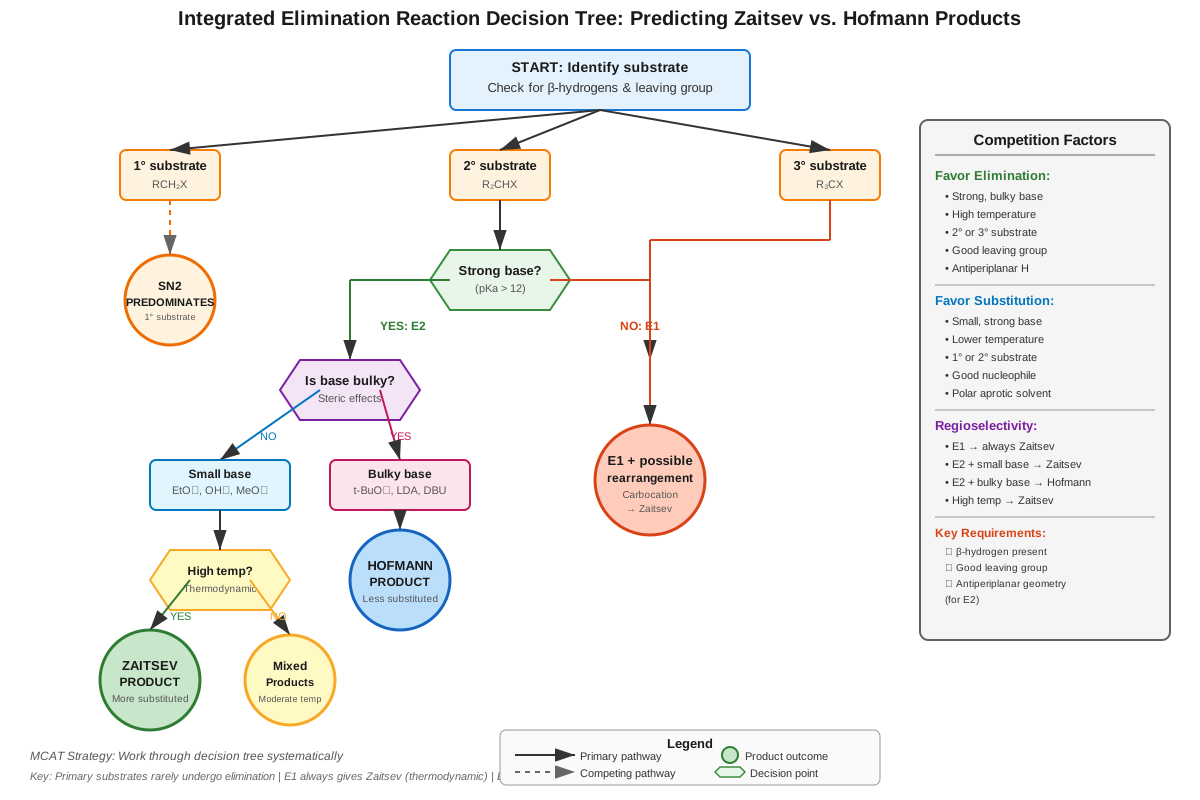
The Zaitsev product (also spelled Saytzeff or Saytsev) represents one of the most fundamental concepts in Organic Chemistry and is a critical topic within the Substitution and Elimination unit of the MCAT curriculum. Named after Russian chemist Alexander Zaitsev, this principle predicts the major product formed during elimination reactions by identifying which alkene will be most thermodynamically stable. When a substrate undergoes an elimination reaction—particularly E1 or E2 mechanisms—multiple alkene products are often possible depending on which β-hydrogen is removed. Zaitsev's rule states that the major product will be the most substituted (and therefore most stable) alkene, where "most substituted" refers to the alkene carbon atoms having the greatest number of alkyl groups attached.
Understanding the Zaitsev product is essential for the MCAT because elimination reactions appear frequently in both discrete questions and passage-based problems within the Chemical and Physical Foundations of Biological Systems section. The MCAT tests not only the ability to predict major products but also requires students to understand the underlying thermodynamic principles that govern product distribution. This topic bridges multiple areas of Organic Chemistry, including carbocation stability, hyperconjugation, steric effects, and reaction mechanisms. Students must be able to quickly identify which elimination product will predominate under standard conditions and recognize when exceptions to Zaitsev's rule occur.
The Zaitsev product MCAT questions often integrate this concept with broader reaction schemes, requiring students to trace multi-step syntheses or predict product ratios. This topic connects intimately with E1 and E2 mechanisms, carbocation rearrangements, and competing substitution reactions. Mastery of Zaitsev's rule enables students to approach complex reaction prediction problems systematically and confidently, making it a high-yield topic that appears across multiple question formats on test day.
Learning Objectives
- [ ] Define Zaitsev product using accurate Organic Chemistry terminology
- [ ] Explain why Zaitsev product matters for the MCAT
- [ ] Apply Zaitsev product to exam-style questions
- [ ] Identify common mistakes related to Zaitsev product
- [ ] Connect Zaitsev product to related Organic Chemistry concepts
- [ ] Predict the major and minor products of elimination reactions using Zaitsev's rule
- [ ] Distinguish between conditions that favor Zaitsev versus Hofmann products
- [ ] Evaluate the thermodynamic stability of different alkene isomers based on substitution patterns
- [ ] Analyze reaction conditions to determine when exceptions to Zaitsev's rule apply
Prerequisites
- Alkene structure and nomenclature: Understanding double bond geometry and carbon substitution patterns is essential for identifying which product is most substituted
- E1 and E2 elimination mechanisms: Zaitsev's rule applies primarily to these elimination pathways, so familiarity with their mechanistic details is required
- Carbocation stability: The relative stability of carbocations (tertiary > secondary > primary) parallels alkene stability principles
- Acid-base chemistry: Elimination reactions involve proton abstraction by bases, requiring understanding of base strength and β-hydrogen acidity
- Conformational analysis: E2 reactions require antiperiplanar geometry, which affects which β-hydrogens are available for elimination
Why This Topic Matters
The Zaitsev product concept appears regularly on the MCAT, with elimination reactions featured in approximately 2-4 questions per exam administration. These questions may appear as discrete items testing direct application of Zaitsev's rule or embedded within passage-based problems involving multi-step organic syntheses, pharmaceutical modifications, or biochemical pathway analogs. The MCAT frequently tests this concept by presenting a substrate with multiple β-hydrogens and asking students to identify the major elimination product, or by providing reaction conditions and requiring students to predict product distributions.
From a real-world perspective, understanding Zaitsev selectivity is crucial in pharmaceutical chemistry and drug metabolism. Many medications undergo elimination reactions during hepatic metabolism, and predicting which metabolites form helps pharmaceutical scientists understand drug clearance pathways and potential toxic byproducts. For example, when designing prodrugs that must undergo elimination to become active, chemists deliberately engineer substrates to favor specific Zaitsev products. Additionally, the synthesis of complex natural products often requires controlling elimination selectivity to build the correct alkene geometry and substitution pattern.
On the MCAT, Zaitsev product questions commonly appear in passages discussing synthetic routes to biologically active compounds, steroid hormone modifications, or metabolic transformations of xenobiotics. The exam may present experimental data showing product ratios and ask students to explain why one product predominates, or provide a reaction scheme and require identification of the major product structure. Understanding when Zaitsev's rule applies versus when exceptions occur (such as with bulky bases or specific leaving groups) distinguishes high-scoring students from those with superficial knowledge.
Core Concepts
Definition and Fundamental Principle
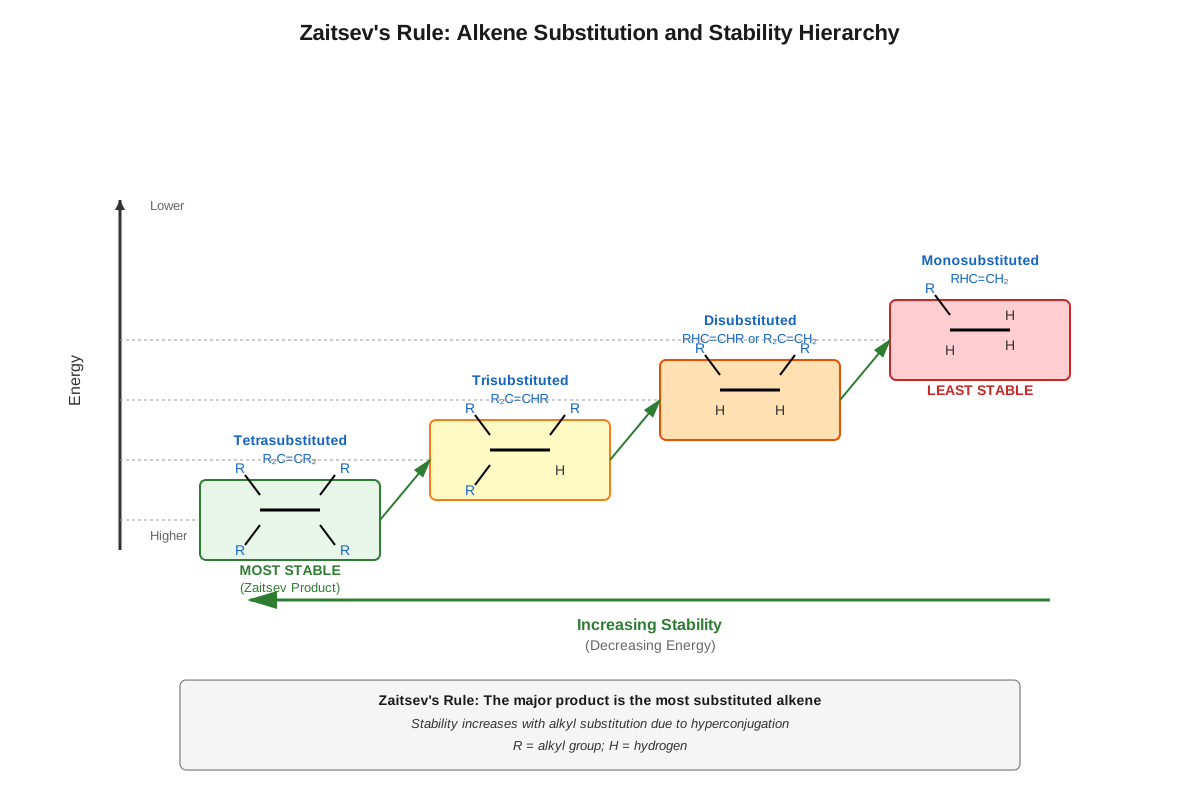
The Zaitsev product is the most substituted alkene formed as the major product in an elimination reaction. Zaitsev's rule (also called the Saytzeff rule) states that in elimination reactions, the major product will be the alkene with the greatest number of alkyl substituents attached to the double bond carbons. This occurs because more highly substituted alkenes are thermodynamically more stable than less substituted ones. The stability order follows: tetrasubstituted > trisubstituted > disubstituted > monosubstituted > unsubstituted (ethylene).
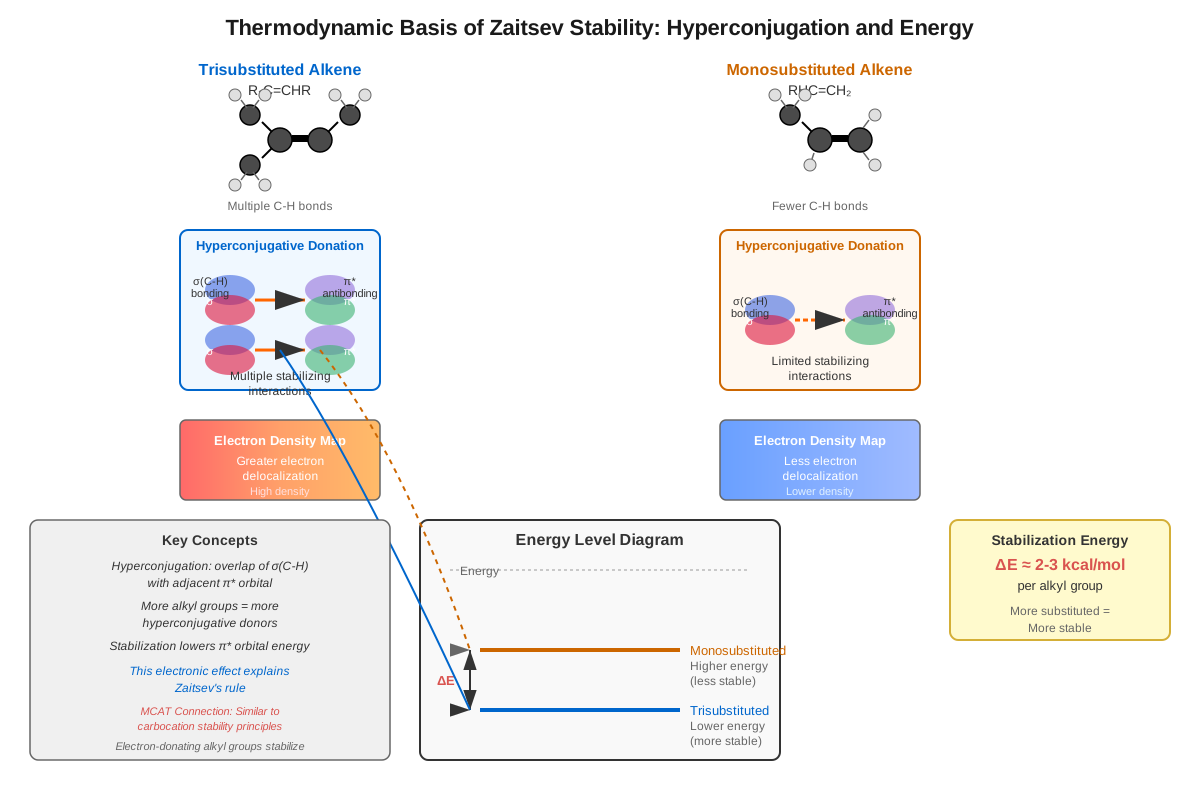
The thermodynamic basis for this stability difference involves hyperconjugation and inductive effects. Alkyl groups are electron-donating through both sigma bond overlap (hyperconjugation) and inductive effects, which stabilizes the π system of the alkene. Each additional alkyl substituent provides more electron density to the double bond, lowering the overall energy of the molecule. This stabilization typically amounts to 2-3 kcal/mol per additional alkyl group, making the energy difference significant enough to strongly favor the more substituted product.
Mechanism and Product Formation
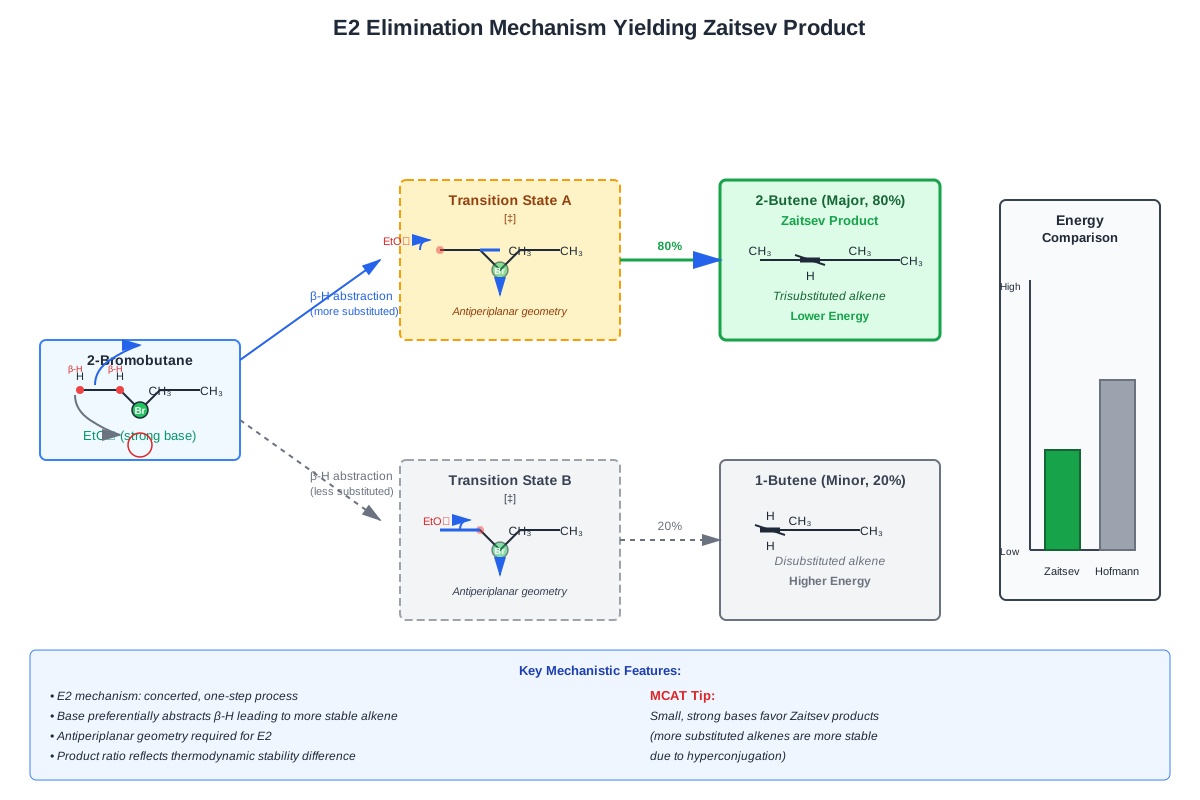
In E2 elimination reactions, the base abstracts a β-hydrogen while the leaving group departs simultaneously in a concerted mechanism. When multiple β-hydrogens are available, the base can abstract any of them, potentially leading to different alkene products. Under standard E2 conditions with small, strong bases (like hydroxide or ethoxide), the reaction preferentially removes the β-hydrogen that leads to the more substituted alkene—the Zaitsev product. This occurs because the transition state for forming the more substituted alkene is lower in energy, partially reflecting the greater stability of the final product.
In E1 elimination reactions, the mechanism proceeds through a carbocation intermediate. After the leaving group departs, any β-hydrogen can be removed by base or solvent. The product distribution in E1 reactions typically shows even stronger Zaitsev selectivity than E2 reactions because the transition state for proton removal more closely resembles the alkene product (Hammond postulate). The more stable alkene product has a lower-energy transition state for its formation, leading to faster formation and higher product ratios favoring the Zaitsev product.
Substitution Patterns and Stability
Understanding alkene substitution patterns is critical for predicting Zaitsev products:
| Alkene Type | Number of Alkyl Groups on C=C | Relative Stability | Example |
|---|---|---|---|
| Unsubstituted | 0 | Least stable | H₂C=CH₂ |
| Monosubstituted | 1 | Low stability | RCH=CH₂ |
| Disubstituted | 2 | Moderate stability | R₂C=CH₂ or RCH=CHR |
| Trisubstituted | 3 | High stability | R₂C=CHR |
| Tetrasubstituted | 4 | Highest stability | R₂C=CR₂ |
When analyzing a substrate for potential elimination products, follow these steps:
- Identify all β-carbons (carbons adjacent to the carbon bearing the leaving group)
- Determine which β-carbons have at least one hydrogen atom
- Draw the alkene that would result from removing each possible β-hydrogen
- Count the total number of alkyl substituents on each potential alkene
- The alkene with the most substituents is the Zaitsev product
Exceptions to Zaitsev's Rule: Hofmann Products
While Zaitsev products predominate under most conditions, certain situations favor the Hofmann product—the least substituted alkene. This anti-Zaitsev selectivity occurs when:
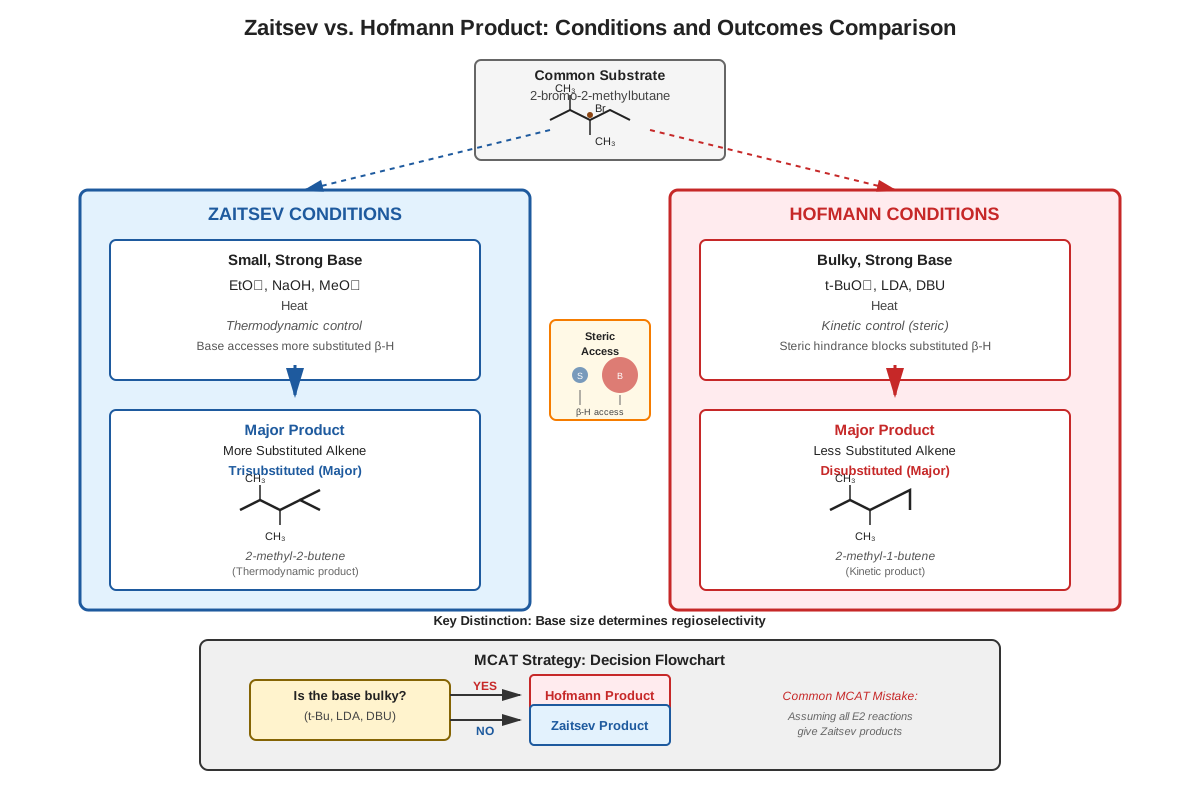
Bulky bases are used: Sterically hindered bases like tert-butoxide, DBU (1,8-diazabicyclo[5.4.0]undec-7-ene), or LDA (lithium diisopropylamide) cannot easily access the more hindered β-hydrogens that lead to the more substituted alkene. Instead, these bases preferentially abstract the most accessible (least hindered) β-hydrogen, producing the less substituted Hofmann product.
Charged leaving groups: When the leaving group is positively charged (such as in quaternary ammonium salts or sulfonium salts), the substrate has significant positive character. This makes the β-hydrogens more acidic, and the reaction becomes more E1cb-like (elimination, unimolecular, conjugate base mechanism). In E1cb-like reactions, the reaction is more sensitive to β-hydrogen acidity than to product stability, favoring removal of the most acidic hydrogen, which is typically on the least substituted carbon.
Poor leaving groups: Substrates with poor leaving groups (like fluoride) may require strongly basic conditions that favor kinetic (Hofmann) over thermodynamic (Zaitsev) control.
Stereochemistry Considerations
For E2 eliminations, the requirement for antiperiplanar geometry (the β-hydrogen and leaving group must be 180° apart) can override Zaitsev selectivity. If the most substituted alkene would require elimination from a conformation where the β-hydrogen and leaving group cannot achieve antiperiplanar alignment, a less substituted product may form instead. This is particularly important in cyclic systems where conformational constraints limit which β-hydrogens are properly aligned for elimination.
In cyclohexane derivatives, the leaving group must be axial for E2 elimination to occur efficiently. If the more substituted alkene would require elimination of an equatorial hydrogen, the reaction may instead eliminate an axial hydrogen leading to a less substituted product, even though this violates Zaitsev's rule.
Concept Relationships
The Zaitsev product concept sits at the intersection of multiple fundamental organic chemistry principles. Thermodynamic stability of alkenes directly determines which product predominates → this stability derives from hyperconjugation and inductive effects → these electronic effects parallel carbocation stability principles (tertiary > secondary > primary). Understanding that more substituted carbocations are more stable helps students remember that more substituted alkenes are also more stable.
The E1 and E2 mechanisms provide the mechanistic framework → these mechanisms compete with SN1 and SN2 substitution reactions → reaction conditions (base strength, temperature, solvent) determine whether elimination or substitution predominates. Once elimination is favored, Zaitsev's rule predicts the major product.
Steric effects create exceptions to Zaitsev's rule → bulky bases favor Hofmann products → this connects to kinetic versus thermodynamic control concepts. Zaitsev products represent thermodynamic control (most stable product), while Hofmann products often represent kinetic control (fastest-forming product when sterics dominate).
The antiperiplanar requirement for E2 reactions → connects to conformational analysis → influences product distribution in cyclic systems → demonstrates how stereochemistry can override thermodynamic preferences. This relationship shows that multiple factors must be considered simultaneously when predicting elimination products.
Quick check — test yourself on Zaitsev product so far.
Try Flashcards →High-Yield Facts
⭐ The Zaitsev product is the most substituted alkene formed in an elimination reaction, and it is the major product under standard conditions with small bases.
⭐ Alkene stability order: tetrasubstituted > trisubstituted > disubstituted > monosubstituted, with approximately 2-3 kcal/mol stabilization per additional alkyl group.
⭐ E1 reactions typically show stronger Zaitsev selectivity than E2 reactions because the transition state more closely resembles the product.
⭐ Bulky bases (tert-butoxide, LDA) favor Hofmann products (least substituted alkene) due to steric hindrance preventing access to more hindered β-hydrogens.
⭐ E2 eliminations require antiperiplanar geometry (β-H and leaving group 180° apart), which can override Zaitsev selectivity in conformationally constrained systems.
- Hyperconjugation and inductive electron donation from alkyl groups stabilize the π system of more substituted alkenes
- Quaternary ammonium salts and sulfonium salts often give Hofmann products due to increased β-hydrogen acidity
- In cyclohexane rings, the leaving group must be axial for efficient E2 elimination
- Heat generally favors elimination over substitution, and elimination typically follows Zaitsev's rule
- The Hammond postulate explains why more stable products form faster in E1 reactions: the transition state resembles the product
Common Misconceptions
Misconception: Zaitsev's rule applies to all elimination reactions regardless of conditions.
Correction: Zaitsev's rule predicts the major product under standard conditions with small, unhindered bases. Bulky bases, charged leaving groups, and conformational constraints can lead to Hofmann products or other non-Zaitsev outcomes.
Misconception: The Zaitsev product is always the only product formed in elimination reactions.
Correction: Elimination reactions typically produce a mixture of products, with the Zaitsev product being the major component. Minor products (including Hofmann products) are usually present, and the product ratio depends on the energy difference between possible products and reaction conditions.
Misconception: More substituted alkenes are more stable solely because they are "bigger" or have more atoms.
Correction: Alkene stability increases with substitution due to electronic effects—specifically hyperconjugation and inductive electron donation from alkyl groups that stabilize the π bond. The number of atoms is irrelevant; the number of alkyl substituents on the double bond carbons is what matters.
Misconception: In E2 reactions, the base always removes the most acidic β-hydrogen.
Correction: Under standard E2 conditions with small bases, the major product is determined by product stability (Zaitsev), not β-hydrogen acidity. Only with very strong, bulky bases or in E1cb-like mechanisms does β-hydrogen acidity become the dominant factor, leading to Hofmann products.
Misconception: Zaitsev's rule and Markovnikov's rule are the same thing.
Correction: These are distinct rules for different reaction types. Markovnikov's rule predicts regioselectivity in addition reactions (the electrophile adds to the less substituted carbon), while Zaitsev's rule predicts regioselectivity in elimination reactions (the more substituted alkene forms). They are conceptually related through carbocation stability but apply to opposite reaction types.
Misconception: The Zaitsev product always has the highest boiling point or is always the trans isomer.
Correction: Zaitsev's rule only predicts which regioisomer (substitution pattern) will predominate, not stereochemistry or physical properties. A Zaitsev product could be cis or trans depending on the substrate structure, and physical properties depend on multiple factors beyond substitution pattern.
Worked Examples
Example 1: Predicting the Major Elimination Product
Problem: 2-bromobutane is treated with sodium ethoxide (NaOEt) in ethanol at elevated temperature. Draw the major product and explain why it forms preferentially.
Solution:
Step 1: Identify the substrate structure and leaving group.
2-bromobutane: CH₃-CHBr-CH₂-CH₃ (bromine on C2 is the leaving group)
Step 2: Identify all β-carbons (carbons adjacent to C2).
- C1 (CH₃ group) is one β-carbon
- C3 (CH₂) is another β-carbon
Step 3: Determine possible elimination products.
- Removing a β-hydrogen from C1 gives: CH₂=CH-CH₂-CH₃ (1-butene, monosubstituted)
- Removing a β-hydrogen from C3 gives: CH₃-CH=CH-CH₃ (2-butene, disubstituted)
Step 4: Apply Zaitsev's rule.
2-butene is disubstituted (two alkyl groups on the double bond carbons), while 1-butene is monosubstituted (one alkyl group on the double bond carbons). The disubstituted alkene is more stable.
Step 5: Consider reaction conditions.
Sodium ethoxide is a small, strong base that favors E2 elimination under these conditions. Small bases favor Zaitsev products.
Answer: The major product is 2-butene (CH₃-CH=CH-CH₃). This disubstituted alkene is thermodynamically more stable than 1-butene due to greater hyperconjugation and inductive stabilization. Under standard E2 conditions with ethoxide, the reaction follows Zaitsev's rule, producing the more substituted alkene as the major product. (Note: 2-butene will form as a mixture of cis and trans isomers, with trans predominating due to lower steric strain.)
Example 2: Recognizing an Exception to Zaitsev's Rule
Problem: 2-bromo-2-methylbutane is treated with potassium tert-butoxide in tert-butanol. The major product is 2-methyl-1-butene rather than 2-methyl-2-butene. Explain this observation.
Solution:
Step 1: Draw the substrate structure.
2-bromo-2-methylbutane: CH₃-CBr(CH₃)-CH₂-CH₃ (tertiary bromide)
Step 2: Identify possible elimination products.
- Removing β-H from the CH₃ group on C1: CH₂=C(CH₃)-CH₂-CH₃ (2-methyl-1-butene, disubstituted)
- Removing β-H from C3: CH₃-C(CH₃)=CH-CH₃ (2-methyl-2-butene, trisubstituted)
Step 3: Predict the Zaitsev product.
2-methyl-2-butene is trisubstituted and should be the Zaitsev product (more stable than the disubstituted 2-methyl-1-butene).
Step 4: Analyze the actual conditions.
Potassium tert-butoxide is a very bulky, strong base. The tert-butyl group creates significant steric hindrance.
Step 5: Explain the exception.
The β-hydrogens on C3 that would lead to the trisubstituted (Zaitsev) product are more sterically hindered because C2 is a quaternary carbon with two methyl groups. The bulky tert-butoxide base cannot easily access these hindered hydrogens. Instead, it preferentially abstracts the more accessible β-hydrogens from the less hindered methyl group on C1, leading to the less substituted Hofmann product (2-methyl-1-butene).
Answer: The major product is 2-methyl-1-butene (the Hofmann product) because the bulky tert-butoxide base cannot easily access the more hindered β-hydrogens that would lead to the more substituted Zaitsev product. This demonstrates that steric effects can override thermodynamic stability preferences, and bulky bases favor Hofmann elimination, producing the least substituted alkene.
Exam Strategy
When approaching MCAT questions involving elimination reactions and Zaitsev products, use this systematic approach:
Step 1: Identify the reaction type. Look for trigger words like "elimination," "dehydrohalogenation," or conditions suggesting elimination (strong base, heat, poor nucleophile). Confirm that elimination is favored over substitution by checking for a strong base, elevated temperature, or a sterically hindered substrate.
Step 2: Draw all possible alkene products. Systematically identify each β-carbon and draw the alkene that would result from removing a hydrogen from each position. This prevents missing possible products.
Step 3: Count substituents on each alkene. For each possible product, count the total number of alkyl groups (not hydrogens) attached to the two carbons of the double bond. The product with the most alkyl substituents is the Zaitsev product.
Step 4: Check for exceptions. Scan the reaction conditions for bulky bases (tert-butoxide, LDA, DBU), charged leaving groups (quaternary ammonium), or cyclic systems where conformational constraints apply. These signal potential Hofmann products or other exceptions.
Step 5: Consider stereochemistry if relevant. For E2 reactions in cyclic systems, verify that the β-hydrogen and leaving group can achieve antiperiplanar geometry. If not, the predicted Zaitsev product may not form.
Exam Tip: If a question asks for the "major product" of an elimination reaction without specifying unusual conditions, default to the Zaitsev product. The MCAT will explicitly provide bulky bases or other unusual conditions if they want you to predict a Hofmann product.
Time-saving trigger words:
- "Strong base" + "heat" = elimination likely, expect Zaitsev product
- "tert-butoxide" or "LDA" = bulky base, expect Hofmann product
- "Quaternary ammonium" = charged leaving group, expect Hofmann product
- "Most stable alkene" = asking for Zaitsev product directly
- "Least substituted alkene" = asking for Hofmann product
Process of elimination strategy: If answer choices show different alkene isomers, quickly count substituents on each. Eliminate choices showing less substituted alkenes unless the question stem indicates bulky bases or other exceptions. If two choices show the same substitution pattern but different stereochemistry (cis vs. trans), remember that trans is usually more stable and more abundant, but this is a separate consideration from Zaitsev's rule.
Memory Techniques
"Z is for Zaitsev, Z is for Zubstituted": Remember that Zaitsev products are the most substituted (the Z sound helps link the concepts). The more alkyl groups, the more Zaitsev.
"Big Base, Little Alkene": Bulky bases produce the smallest (least substituted) alkene—the Hofmann product. This mnemonic captures the inverse relationship between base size and product substitution.
Counting mnemonic: "T-T-D-M-U" (Tetra-Tri-Di-Mono-Unsubstituted): Visualize this as a descending staircase of stability. The product highest on the stairs (most substituted) is the Zaitsev product.
"Zaitsev Zips to Ztability": The Zaitsev product is the thermodynamically most stable product. This alliterative phrase links the name to the underlying principle.
Hand visualization: Hold up your hand with fingers spread. Each finger represents an alkyl substituent on the alkene. More fingers up = more substituted = more stable = Zaitsev product. When you see a bulky base, make a fist (can't reach the fingers) = Hofmann product.
"Anti-Parallel Parking": For E2 stereochemistry, visualize parallel parking a car—you need the right alignment (antiperiplanar) to successfully complete the maneuver (elimination). If the geometry is wrong, you can't park (can't eliminate that hydrogen).
Summary
The Zaitsev product represents the most substituted and thermodynamically most stable alkene formed as the major product in elimination reactions under standard conditions. This fundamental principle in organic chemistry predicts that when multiple β-hydrogens are available for elimination, the reaction will preferentially form the alkene with the greatest number of alkyl substituents on the double bond carbons. The stability of more substituted alkenes arises from hyperconjugation and inductive electron donation from alkyl groups, which stabilizes the π system. While Zaitsev's rule applies broadly to E1 and E2 eliminations with small bases, important exceptions occur with bulky bases (which favor Hofmann products), charged leaving groups, and conformationally constrained systems where antiperiplanar geometry requirements override thermodynamic preferences. For MCAT success, students must rapidly identify possible elimination products, count substituents to determine the Zaitsev product, recognize conditions that lead to exceptions, and understand the thermodynamic basis for alkene stability differences.
Key Takeaways
- The Zaitsev product is the most substituted alkene (most alkyl groups on C=C carbons) and forms as the major product under standard elimination conditions
- Alkene stability increases with substitution: tetrasubstituted > trisubstituted > disubstituted > monosubstituted, due to hyperconjugation and inductive effects
- E1 reactions show stronger Zaitsev selectivity than E2 reactions because the transition state more closely resembles the product
- Bulky bases (tert-butoxide, LDA) produce Hofmann products (least substituted alkene) due to steric hindrance preventing access to more hindered β-hydrogens
- E2 eliminations require antiperiplanar geometry, which can override Zaitsev selectivity in cyclic systems where conformational constraints limit which β-hydrogens are properly aligned
- Charged leaving groups (quaternary ammonium, sulfonium) often favor Hofmann products due to increased β-hydrogen acidity
- To predict elimination products: identify all β-carbons, draw possible alkenes, count substituents, and check for exceptions based on reaction conditions
Related Topics
Hofmann Elimination: The complementary concept to Zaitsev's rule, focusing on conditions and mechanisms that favor the least substituted alkene product. Mastering Zaitsev products provides the foundation for understanding when and why Hofmann products form.
E1 and E2 Mechanisms: Detailed mechanistic understanding of elimination reactions, including transition states, stereochemistry, and kinetics. Zaitsev's rule applies to these mechanisms, so deeper mechanistic knowledge enhances product prediction accuracy.
Alkene Stability and Heats of Hydrogenation: Quantitative thermodynamic data supporting the relative stability of differently substituted alkenes. This topic provides experimental evidence for the principles underlying Zaitsev's rule.
Carbocation Rearrangements: In E1 reactions, carbocation intermediates may rearrange before elimination occurs, potentially changing which Zaitsev product forms. Understanding rearrangements is essential for predicting products in complex substrates.
Stereochemistry of Elimination Reactions: Detailed analysis of syn vs. anti elimination, E/Z nomenclature, and stereochemical outcomes. While Zaitsev's rule predicts regiochemistry, stereochemistry determines the exact three-dimensional structure of the product.
Practice CTA
Now that you've mastered the core concepts of Zaitsev products and elimination reactions, it's time to reinforce your understanding through active practice. Challenge yourself with practice questions that require you to predict major products, identify exceptions to Zaitsev's rule, and analyze reaction conditions. Use flashcards to drill the alkene stability order and conditions favoring Zaitsev versus Hofmann products. Remember, the difference between knowing these concepts passively and applying them rapidly under exam pressure comes from repeated, deliberate practice. You've built the foundation—now strengthen it through application. Your ability to quickly and accurately predict elimination products will serve you well not only on discrete questions but also in complex passage-based scenarios where elimination reactions appear as part of multi-step syntheses. Keep pushing forward!
Sign up free to keep reading
Create a free AnvayaPrep account to finish this MCAT guide on Zaitsev product — plus flashcards and practice questions.