Overview
Atomic spectra represent one of the most elegant experimental confirmations of quantum mechanics and the discrete nature of atomic energy levels. When atoms absorb or emit electromagnetic radiation, they do so only at specific wavelengths that correspond to transitions between quantized energy states. This phenomenon produces characteristic patterns of spectral lines—unique "fingerprints" for each element—that have revolutionized fields from astronomy to analytical chemistry. Understanding atomic spectra requires synthesizing concepts from classical electromagnetism, quantum mechanics, and atomic structure, making it a conceptually rich topic that bridges multiple domains of Physics.
For the MCAT, atomic spectra serves as a critical application of quantum theory and energy quantization. The exam frequently tests students' ability to interpret emission and absorption spectra, calculate photon energies associated with electronic transitions, and connect spectroscopic observations to underlying atomic structure. Questions may appear as standalone discrete items or embedded within passages discussing analytical techniques, stellar composition, or the historical development of quantum theory. The topic integrates seamlessly with other areas of Atomic and Nuclear Physics, including the Bohr model, photoelectric effect, and nuclear decay processes.
Mastery of atomic spectra Physics provides essential conceptual tools for understanding how matter interacts with light at the quantum level. This knowledge extends beyond the physics section, connecting to general chemistry topics such as electron configuration, periodic trends, and molecular spectroscopy. The mathematical framework developed here—particularly the relationship between energy differences and photon wavelengths—recurs throughout MCAT science sections and represents a high-yield investment of study time.
Learning Objectives
- [ ] Define Atomic spectra using accurate Physics terminology
- [ ] Explain why Atomic spectra matters for the MCAT
- [ ] Apply Atomic spectra to exam-style questions
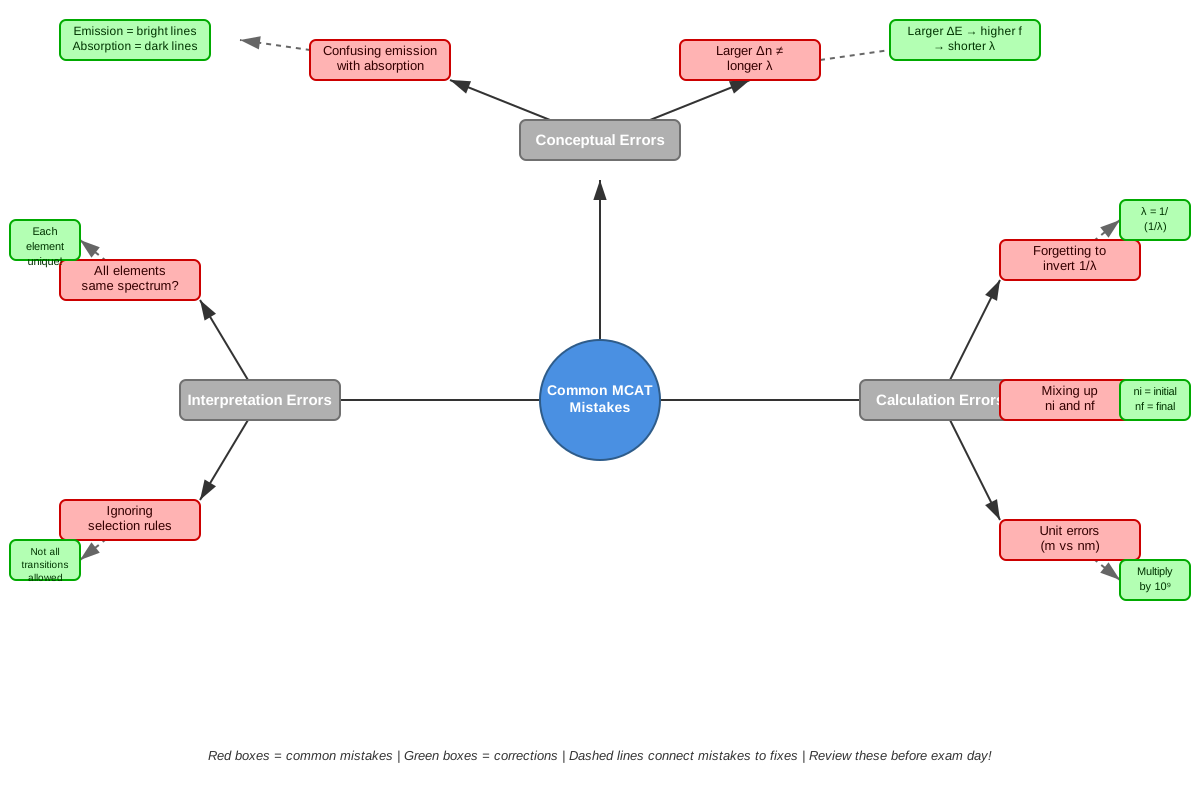
- [ ] Identify common mistakes related to Atomic spectra
- [ ] Connect Atomic spectra to related Physics concepts
- [ ] Calculate photon wavelengths and frequencies for electronic transitions using the Rydberg equation
- [ ] Distinguish between emission and absorption spectra and predict their appearance for given atomic transitions
- [ ] Relate spectral line patterns to energy level diagrams and quantum numbers
Prerequisites
- Electromagnetic spectrum and wave properties: Understanding wavelength, frequency, and the relationship c = λν is essential for calculating photon energies and interpreting spectral positions
- Energy quantization and photons: The concept that light exists in discrete packets (photons) with energy E = hf forms the foundation for understanding why spectra show discrete lines rather than continuous distributions
- Bohr model of the hydrogen atom: Knowledge of quantized electron orbits and energy levels provides the structural framework for predicting and explaining spectral transitions
- Conservation of energy: Recognizing that energy absorbed or emitted during transitions must equal the difference between initial and final states is fundamental to all spectroscopic calculations
- Basic atomic structure: Familiarity with electrons, protons, nuclei, and the concept of electron shells enables understanding of what physically changes during spectral transitions
Why This Topic Matters
Atomic spectra represents a cornerstone of modern physics and chemistry, with profound implications for both scientific understanding and practical applications. Spectroscopy—the study of how matter interacts with electromagnetic radiation—underpins analytical techniques used throughout medicine, including atomic absorption spectroscopy for detecting toxic metals in biological samples, flame photometry for measuring electrolyte concentrations, and fluorescence spectroscopy for imaging cellular processes. The same principles that explain hydrogen's spectral lines also govern the function of lasers, LED lighting, and fluorescent markers used in diagnostic procedures.
On the MCAT, atomic spectra MCAT questions appear with moderate frequency, typically 1-3 questions per exam. These questions most commonly test:
- Calculation of photon energy, wavelength, or frequency for specific transitions
- Interpretation of emission or absorption spectra diagrams
- Application of the Rydberg equation to hydrogen-like atoms
- Conceptual understanding of why spectra are discrete rather than continuous
- Connection between spectral observations and quantum mechanical principles
The topic frequently appears in passages discussing analytical chemistry techniques, astronomical observations (stellar composition determined through spectroscopy), or historical experiments that established quantum theory. Discrete questions often present energy level diagrams and ask students to predict spectral line positions or identify which transitions produce visible light. The integration of mathematical calculation with conceptual reasoning makes this a particularly effective topic for discriminating between high-scoring and average-performing test-takers.
Core Concepts
Definition and Nature of Atomic Spectra
Atomic spectra are the characteristic patterns of electromagnetic radiation absorbed or emitted by atoms when electrons transition between discrete energy levels. Unlike continuous spectra produced by incandescent solids (which emit all wavelengths within a range), atomic spectra consist of discrete lines at specific wavelengths, reflecting the quantized nature of atomic energy states. Each element produces a unique spectral pattern—a "fingerprint" that enables identification and quantification of substances.
The discrete nature of atomic spectra provided crucial early evidence for quantum mechanics. Classical physics predicted that electrons orbiting nuclei should emit radiation continuously across all wavelengths as they spiral inward, but experimental observations showed only specific wavelengths appeared. This discrepancy was resolved by recognizing that electrons occupy quantized energy states and can only transition between these allowed levels.
Emission vs. Absorption Spectra
Two complementary types of atomic spectra exist, each revealing the same underlying energy level structure:
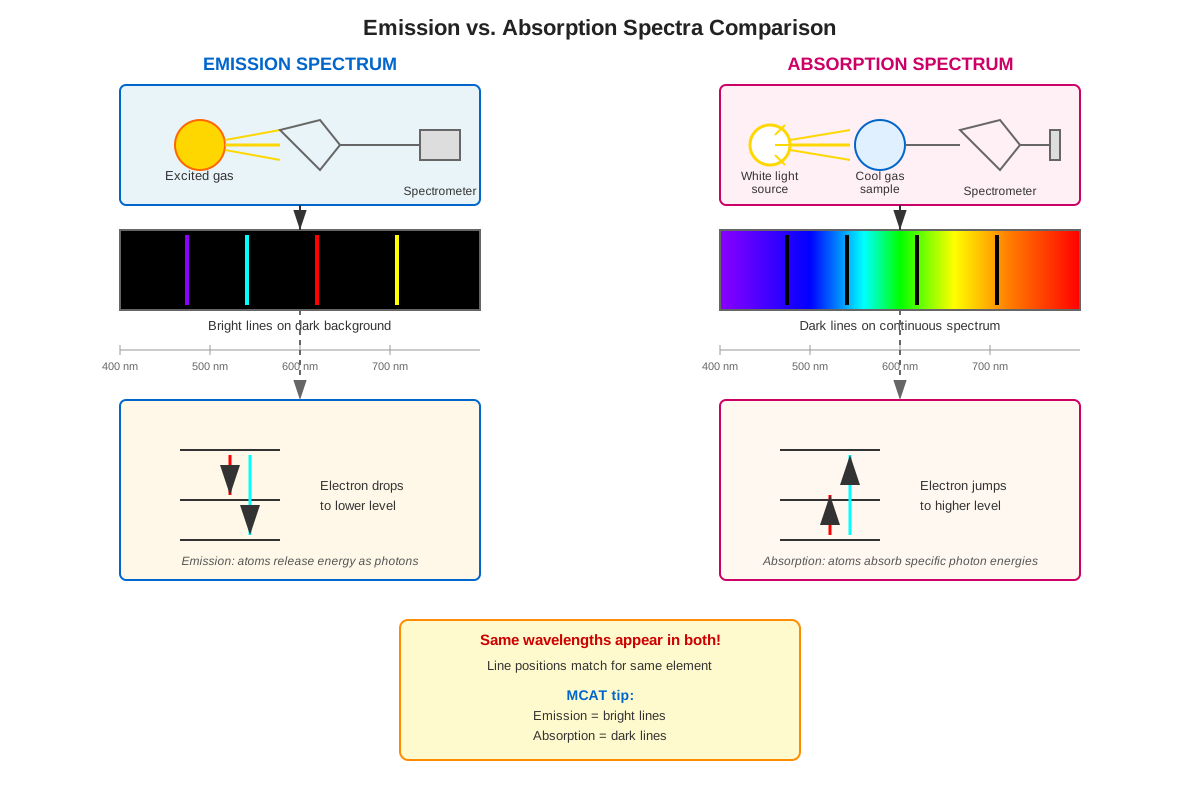
Emission spectra occur when excited atoms release energy as photons while electrons transition from higher to lower energy levels. To produce an emission spectrum, atoms are first energized (through heating, electrical discharge, or photon absorption), promoting electrons to excited states. As electrons spontaneously return to lower energy levels, they emit photons with energies exactly matching the energy differences between levels. When this emitted light passes through a prism or diffraction grating, it produces bright colored lines on a dark background, with each line corresponding to a specific electronic transition.
Absorption spectra form when ground-state atoms absorb photons of specific energies, promoting electrons to higher energy levels. White light (containing all visible wavelengths) passes through a cool gas of atoms. The atoms selectively absorb photons whose energies exactly match allowed transitions, removing these wavelengths from the transmitted light. The resulting spectrum shows dark lines (missing wavelengths) on a bright continuous background. Critically, the dark lines in an absorption spectrum appear at exactly the same wavelengths as the bright lines in that element's emission spectrum.
| Feature | Emission Spectrum | Absorption Spectrum |
|---|---|---|
| Appearance | Bright lines on dark background | Dark lines on bright background |
| Atomic state | Excited atoms returning to lower states | Ground-state atoms being excited |
| Energy flow | Atoms release energy as photons | Atoms absorb energy from photons |
| Production method | Heat, electrical discharge, or bombardment | White light passed through cool gas |
| Line positions | Same wavelengths as absorption spectrum | Same wavelengths as emission spectrum |
Energy Levels and Electronic Transitions
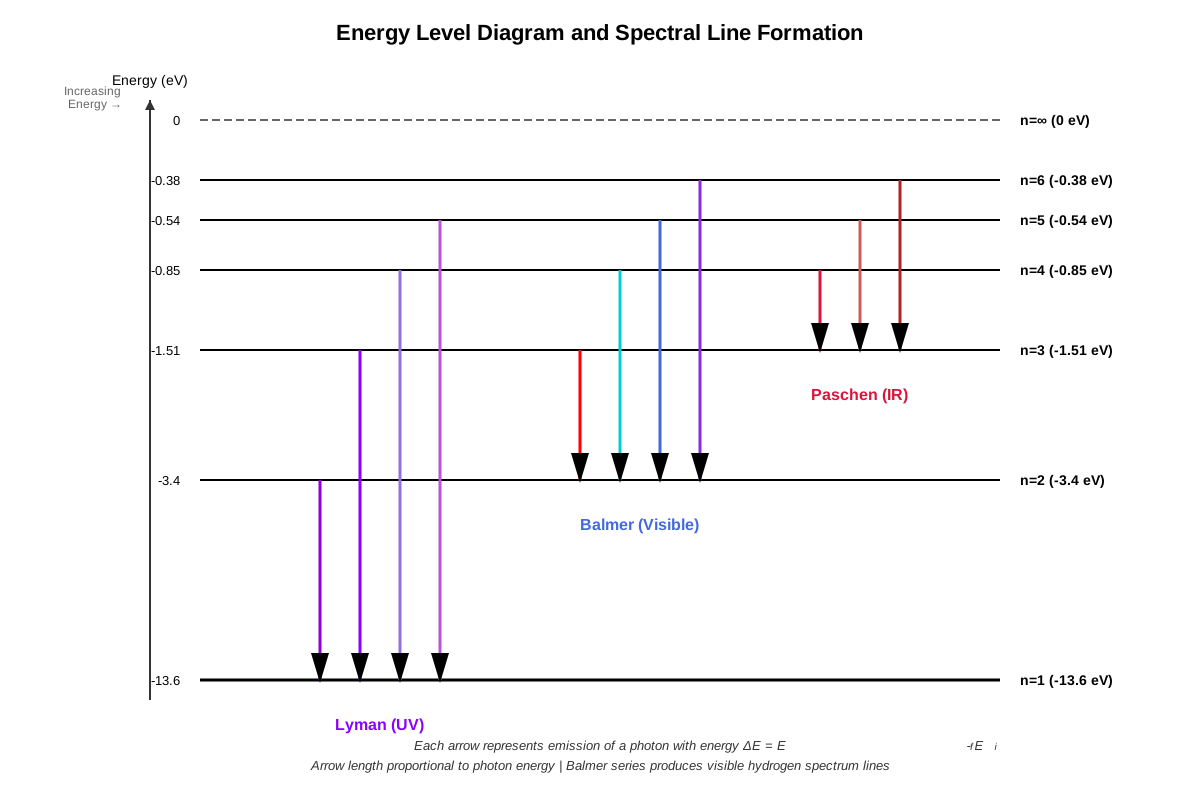
Electrons in atoms occupy discrete energy levels characterized by quantum numbers. For hydrogen and hydrogen-like ions (single-electron systems), these energy levels are given by:
E_n = -13.6 eV × (Z²/n²)where n is the principal quantum number (1, 2, 3, ...), Z is the atomic number, and 13.6 eV is the ionization energy of hydrogen. The negative sign indicates that electrons are bound to the nucleus; zero energy corresponds to a free electron infinitely far from the nucleus.
When an electron transitions between levels, the energy difference appears as a photon:
ΔE = E_final - E_initial = hf = hc/λwhere h is Planck's constant (6.626 × 10⁻³⁴ J·s), f is photon frequency, c is the speed of light (3.00 × 10⁸ m/s), and λ is wavelength. For emission (electron dropping to lower level), ΔE is negative, and the atom releases a photon. For absorption (electron rising to higher level), ΔE is positive, and the atom absorbs a photon.
The Rydberg Equation
The Rydberg equation quantitatively predicts wavelengths of spectral lines for hydrogen:
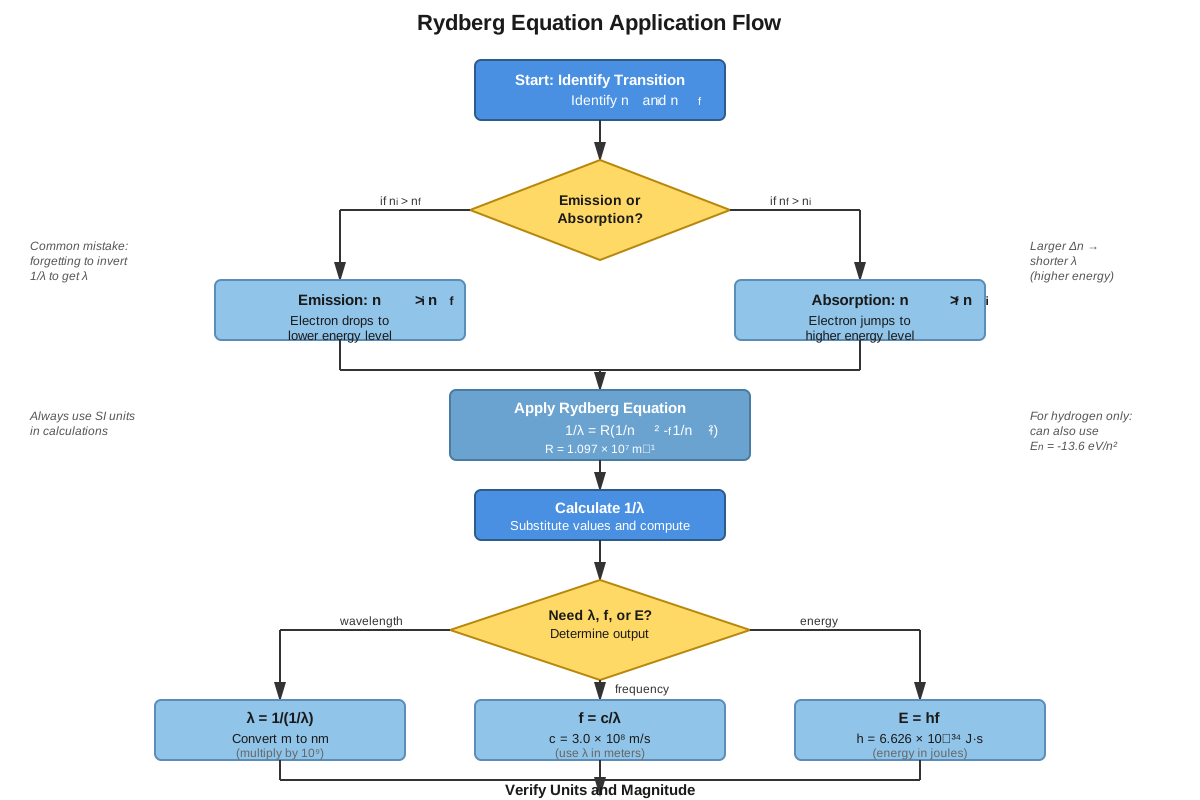
1/λ = R_H × (1/n_f² - 1/n_i²)where R_H is the Rydberg constant (1.097 × 10⁷ m⁻¹), n_f is the final energy level, and n_i is the initial energy level. For emission spectra, n_i > n_f (electron drops down); for absorption, n_i < n_f (electron jumps up).
This equation reveals that spectral lines cluster into series based on the final energy level:
- Lyman series (n_f = 1): Transitions to ground state; all lines in ultraviolet region
- Balmer series (n_f = 2): Transitions to first excited state; visible and near-UV lines
- Paschen series (n_f = 3): Transitions to second excited state; infrared lines
- Brackett and Pfund series (n_f = 4, 5): Higher transitions; far infrared
The Balmer series is particularly important for MCAT questions because it produces visible light. The first four Balmer lines (n = 3→2, 4→2, 5→2, 6→2) appear as red, cyan, blue, and violet lines respectively.
Line Intensity and Selection Rules
Not all theoretically possible transitions occur with equal probability. Selection rules derived from quantum mechanics determine which transitions are "allowed" (high probability, producing intense spectral lines) versus "forbidden" (low probability, producing weak or absent lines). For single-electron atoms, the primary selection rule requires that the orbital angular momentum quantum number (ℓ) changes by ±1 during a transition (Δℓ = ±1).
Line intensity also depends on:
- Population of the initial state (more atoms in initial level → more intense line)
- Transition probability (some allowed transitions are more probable than others)
- Temperature (affects population distribution across energy levels)
Multi-Electron Atoms and Spectral Complexity
While hydrogen produces relatively simple spectra due to having only one electron, multi-electron atoms exhibit far more complex patterns. Electron-electron repulsion and shielding effects cause energy levels to split based on orbital angular momentum (s, p, d, f subshells have different energies for the same n value). This produces many more possible transitions and correspondingly more spectral lines.
Despite this complexity, each element still produces a unique, reproducible spectral pattern. Sodium, for example, is famous for its bright yellow doublet (two closely spaced lines at 589.0 and 589.6 nm) arising from transitions involving the single valence electron. This characteristic emission makes sodium vapor lamps efficient for street lighting.
Continuous, Emission, and Absorption Spectra Comparison
Understanding the three types of spectra and their production mechanisms is essential:
Continuous spectra contain all wavelengths within a range without gaps. Hot, dense objects (incandescent solids, liquids, or high-pressure gases) produce continuous spectra. The sun's interior and incandescent light bulbs are common examples.
Line emission spectra show discrete bright lines. Low-pressure gases excited by heat or electrical discharge produce these spectra. Neon signs and gas discharge tubes demonstrate this phenomenon.
Line absorption spectra display discrete dark lines superimposed on a continuous background. These form when continuous-spectrum light passes through a cooler, low-pressure gas. Stellar spectra exemplify this: the hot stellar interior produces continuous radiation, but cooler outer atmospheric gases absorb specific wavelengths, creating dark Fraunhofer lines that reveal stellar composition.
Concept Relationships
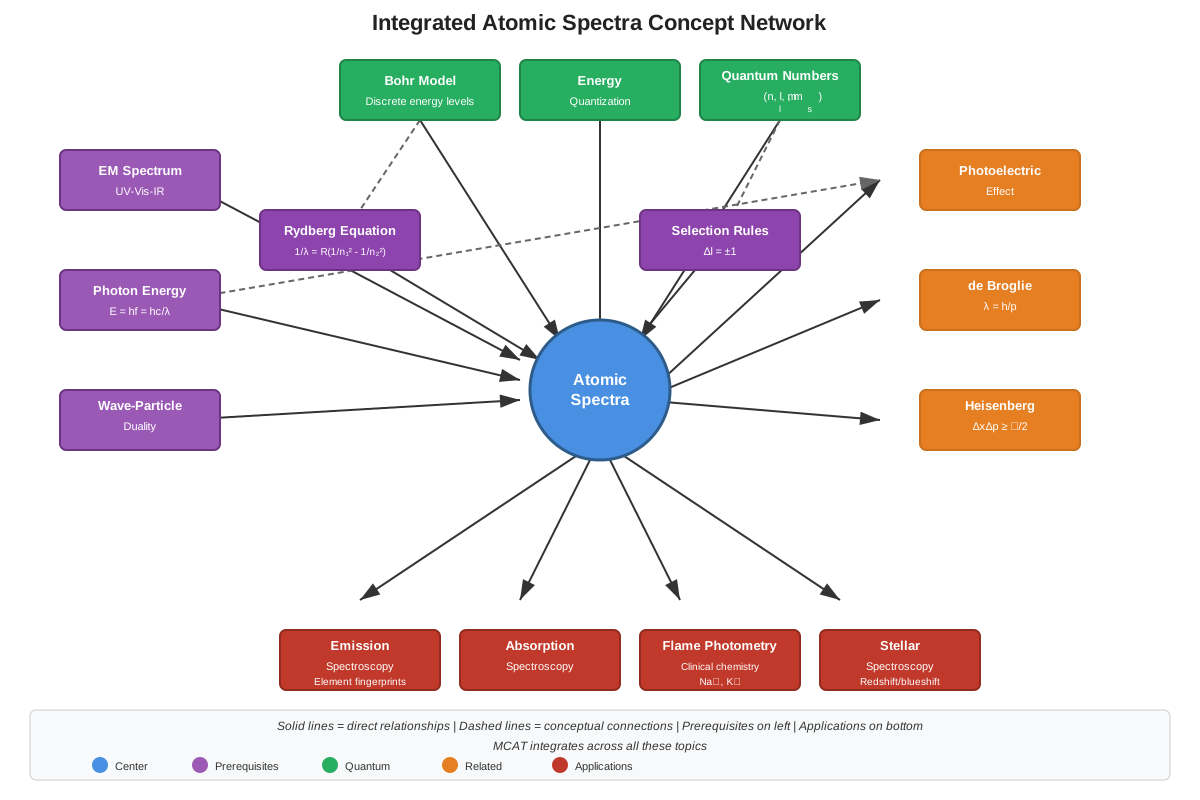
The concepts within atomic spectra form an interconnected logical framework. Energy quantization serves as the foundation, establishing that electrons can only occupy discrete energy levels. This quantization directly causes the discrete nature of spectral lines—since only specific energy differences exist between levels, only photons with corresponding energies can be absorbed or emitted. The Rydberg equation mathematically expresses these allowed transitions for hydrogen, connecting quantum numbers to observable wavelengths.
Emission and absorption spectra represent complementary manifestations of the same underlying energy level structure. Both arise from electronic transitions, but emission involves downward transitions (energy release) while absorption involves upward transitions (energy uptake). The line series (Lyman, Balmer, Paschen) organize transitions by final energy level, with each series occupying a distinct spectral region.
Connections to prerequisite topics are extensive. The Bohr model provides the structural framework for understanding energy levels and the physical meaning of quantum numbers. Photon energy relationships (E = hf = hc/λ) enable conversion between energy differences and spectral wavelengths. Conservation of energy ensures that photon energy exactly matches the energy difference between initial and final states.
Looking forward, atomic spectra connects to numerous advanced topics. Molecular spectroscopy extends these principles to molecules, where vibrational and rotational energy levels add complexity. Laser physics exploits stimulated emission between specific energy levels to produce coherent light. Quantum mechanics provides the rigorous mathematical framework explaining selection rules and transition probabilities. Analytical chemistry applies spectroscopic principles to identify and quantify substances.
The conceptual flow can be mapped as:
Energy Quantization → Discrete Energy Levels → Electronic Transitions → Photon Emission/Absorption → Spectral Lines → Rydberg Equation → Spectral Series → Element Identification
Quick check — test yourself on Atomic spectra so far.
Try Flashcards →High-Yield Facts
⭐ Atomic spectra consist of discrete lines at specific wavelengths because electrons occupy quantized energy levels and can only transition between allowed states
⭐ The Rydberg equation (1/λ = R_H × (1/n_f² - 1/n_i²)) calculates wavelengths for hydrogen spectral lines, with R_H = 1.097 × 10⁷ m⁻¹
⭐ Emission spectra show bright lines on dark backgrounds (excited atoms releasing energy); absorption spectra show dark lines on bright backgrounds (ground-state atoms absorbing energy)
⭐ The Balmer series (n_f = 2) produces visible light; Lyman series (n_f = 1) produces UV; Paschen series (n_f = 3) produces IR
⭐ Each element produces a unique spectral pattern that serves as a "fingerprint" for identification
- Energy of a photon emitted or absorbed equals the difference between initial and final energy levels: ΔE = |E_final - E_initial| = hf = hc/λ
- For hydrogen, energy levels are given by E_n = -13.6 eV/n², with more negative values indicating stronger binding
- Spectral lines within a series converge toward a series limit as n_i approaches infinity (ionization)
- The longest wavelength (lowest energy) line in any series corresponds to the smallest energy gap (consecutive levels)
- The shortest wavelength (highest energy) line in any series corresponds to transitions from n = ∞ (series limit)
- Multi-electron atoms produce more complex spectra due to electron-electron interactions and orbital splitting
- Absorption spectra require ground-state or low-energy atoms; emission spectra require pre-excited atoms
- The same wavelengths appear as bright lines in emission and dark lines in absorption for a given element
- Spectral line intensity depends on transition probability, population of initial state, and temperature
- Continuous spectra arise from dense matter (solids, liquids, high-pressure gases); line spectra arise from low-pressure gases
Common Misconceptions
Misconception: Electrons physically orbit the nucleus like planets orbit the sun, and spectral lines represent the electron changing orbital radius.
Correction: Electrons exist in quantum states described by probability distributions (orbitals), not classical orbits. Spectral lines represent transitions between discrete energy states, not changes in orbital radius. The Bohr model's circular orbits are a simplified visualization; actual electron behavior follows quantum mechanical wave functions.
Misconception: Atoms continuously emit radiation at all wavelengths when excited.
Correction: Excited atoms emit photons only at specific wavelengths corresponding to allowed transitions between quantized energy levels. The discrete nature of spectral lines directly contradicts continuous emission and provided key evidence for quantum mechanics. An excited atom emits a photon only when an electron transitions to a lower energy level.
Misconception: Absorption and emission spectra for an element show different wavelengths.
Correction: Absorption and emission spectra for the same element show lines at identical wavelengths because both arise from the same energy level structure. The difference lies in appearance (bright vs. dark lines) and production method, not wavelength positions. The complementary nature of these spectra reflects energy conservation and the reversibility of electronic transitions.
Misconception: Higher energy levels are farther apart in energy than lower levels.
Correction: Energy levels converge as n increases—the energy difference between consecutive levels decreases for higher n values. For hydrogen, E_n = -13.6 eV/n², so the gap between n=1 and n=2 (10.2 eV) is much larger than between n=5 and n=6 (0.166 eV). This convergence explains why spectral series have a series limit and why higher-n transitions produce longer wavelengths (lower energies).
Misconception: The Rydberg equation applies to all atoms equally.
Correction: The standard Rydberg equation applies only to hydrogen and hydrogen-like ions (single-electron systems like He⁺, Li²⁺). For hydrogen-like ions, the equation must be modified to include Z² (atomic number squared). Multi-electron atoms require more complex treatments due to electron-electron repulsion and shielding effects, though modified Rydberg-type equations can approximate some transitions.
Misconception: All electronic transitions produce visible light.
Correction: Only transitions with energy differences corresponding to visible photon energies (roughly 1.8-3.1 eV, or 400-700 nm wavelengths) produce visible light. Many transitions produce UV radiation (higher energy) or infrared radiation (lower energy). For hydrogen, only the Balmer series (n_f = 2) includes visible lines; Lyman series is UV, and Paschen/Brackett/Pfund series are IR.
Misconception: Spectral lines have zero width and appear at exactly one wavelength.
Correction: Real spectral lines have finite width due to several factors: natural line broadening (Heisenberg uncertainty principle), Doppler broadening (thermal motion of atoms), pressure broadening (collisions between atoms), and instrumental resolution. However, for MCAT purposes, lines are typically treated as occurring at discrete wavelengths, with line width effects being negligible for problem-solving.
Worked Examples
Example 1: Calculating Wavelength of a Hydrogen Transition
Problem: An electron in a hydrogen atom transitions from n = 4 to n = 2. Calculate the wavelength of the emitted photon and determine whether it falls in the visible spectrum.
Solution:
Step 1: Identify the type of transition and series.
Since n_f = 2, this is a Balmer series transition. The electron drops from a higher to lower level, so this is emission.
Step 2: Apply the Rydberg equation.
1/λ = R_H × (1/n_f² - 1/n_i²)
1/λ = (1.097 × 10⁷ m⁻¹) × (1/2² - 1/4²)
1/λ = (1.097 × 10⁷ m⁻¹) × (1/4 - 1/16)
1/λ = (1.097 × 10⁷ m⁻¹) × (4/16 - 1/16)
1/λ = (1.097 × 10⁷ m⁻¹) × (3/16)
1/λ = 2.057 × 10⁶ m⁻¹
Step 3: Solve for wavelength.
λ = 1/(2.057 × 10⁶ m⁻¹) = 4.86 × 10⁻⁷ m = 486 nmStep 4: Determine spectral region.
The visible spectrum ranges from approximately 400-700 nm. At 486 nm, this photon falls in the visible range, appearing as cyan/blue-green light. This is the second line of the Balmer series (H-β line).
Key Connections: This problem integrates the Rydberg equation, understanding of spectral series, and knowledge of the electromagnetic spectrum. The Balmer series produces visible light because the energy gaps for n_f = 2 transitions correspond to visible photon energies.
Example 2: Energy Level Diagram and Multiple Transitions
Problem: Consider a hydrogen atom with energy levels E₁ = -13.6 eV, E₂ = -3.4 eV, E₃ = -1.51 eV, and E₄ = -0.85 eV.
(a) Which transition produces the highest energy photon?
(b) Calculate the energy of a photon emitted during the n = 3 to n = 1 transition.
(c) If an electron in the ground state absorbs a 12.1 eV photon, what final state does it reach?
Solution:
(a) The highest energy photon comes from the largest energy difference. Examining all possible downward transitions:
- n=4→1: ΔE = -0.85 - (-13.6) = 12.75 eV
- n=4→2: ΔE = -0.85 - (-3.4) = 2.55 eV
- n=4→3: ΔE = -0.85 - (-1.51) = 0.66 eV
- n=3→1: ΔE = -1.51 - (-13.6) = 12.09 eV
- n=3→2: ΔE = -1.51 - (-3.4) = 1.89 eV
- n=2→1: ΔE = -3.4 - (-13.6) = 10.2 eV
The n=4→1 transition produces the highest energy photon (12.75 eV). This makes physical sense: the largest energy gap exists between the highest and lowest levels shown.
(b) For n=3→1 transition:
ΔE = E₁ - E₃ = -13.6 eV - (-1.51 eV) = 12.09 eVThe emitted photon has energy 12.09 eV. This is a Lyman series transition (n_f = 1), producing UV radiation.
(c) For absorption from ground state (n=1):
E_final = E_initial + E_photon
E_final = -13.6 eV + 12.1 eV = -1.5 eV
Comparing to given energy levels, E₃ = -1.51 eV ≈ -1.5 eV, so the electron reaches n = 3.
Alternative approach for part (c): Check which transition from n=1 requires 12.1 eV:
- n=1→2: requires 10.2 eV (too small)
- n=1→3: requires 12.09 eV ≈ 12.1 eV (matches!)
- n=1→4: requires 12.75 eV (too large)
Key Connections: This problem emphasizes that photon energy equals the magnitude of the energy level difference, demonstrates how to use energy level diagrams, and reinforces that absorption requires photon energy exactly matching an allowed transition. The problem also illustrates that Lyman series transitions (to n=1) involve the largest energy changes.
Exam Strategy
When approaching atomic spectra MCAT questions, begin by identifying whether the question involves emission or absorption. Look for trigger words: "excited atoms," "discharge tube," or "heated gas" suggest emission; "white light passing through," "cool gas," or "dark lines" suggest absorption. This distinction immediately narrows the conceptual framework.
For calculation problems, write down the Rydberg equation and relevant constants immediately. The MCAT provides R_H = 1.097 × 10⁷ m⁻¹, h = 6.626 × 10⁻³⁴ J·s, and c = 3.00 × 10⁸ m/s. Identify n_initial and n_final carefully—the larger n value is always the higher energy level (less negative). Remember that for emission, electrons drop down (n_i > n_f), while for absorption, electrons jump up (n_i < n_f).
Process-of-elimination strategies are particularly effective for spectral series questions. If asked which transition produces visible light, immediately eliminate any transition with n_f = 1 (Lyman, UV) or n_f ≥ 3 (Paschen and higher, IR). Only Balmer series (n_f = 2) produces visible light. Similarly, if asked for the highest energy transition, look for the largest energy gap, which typically involves the ground state (n=1).
For questions presenting energy level diagrams, sketch quick arrows representing transitions. Upward arrows represent absorption (energy input required), downward arrows represent emission (energy released). The arrow length qualitatively represents photon energy—longer arrows mean higher energy photons and shorter wavelengths.
Time management is crucial. Straightforward Rydberg equation calculations should take 60-90 seconds. If a calculation becomes complex, check whether the question can be answered conceptually or through estimation. For example, if asked whether a transition produces UV, visible, or IR light, you might estimate the energy difference and compare to the visible range (roughly 2-3 eV) rather than calculating the exact wavelength.
Watch for questions that test conceptual understanding rather than calculation. Common conceptual questions include:
- Why are spectral lines discrete rather than continuous? (energy quantization)
- Why does each element have a unique spectrum? (unique energy level structure)
- How do emission and absorption spectra relate? (complementary; same wavelengths)
- What produces continuous vs. line spectra? (dense matter vs. low-pressure gas)
Finally, be prepared for passage-based questions that apply spectroscopic principles to unfamiliar contexts. The passage might discuss stellar spectroscopy, analytical chemistry techniques, or laser physics. Extract the relevant energy level information or transition data from the passage, then apply standard atomic spectra principles. The underlying physics remains the same even when the context is novel.
Memory Techniques
LEAP mnemonic for spectral series (in order of increasing n_f and wavelength):
- Lyman (n_f = 1): UV
- Emission visible: Balmer (n_f = 2)
- All others infrared
- Paschen (n_f = 3): IR
"Bright Excited, Dark Absorbed" reminds you that emission spectra show bright lines (excited atoms releasing energy) while absorption spectra show dark lines (ground-state atoms absorbing energy).
"Energy Equals Height Frequency" (E = hf) can be remembered as "Einstein's Helpful Formula" for connecting photon energy to frequency.
Rydberg equation memory aid: "One over wavelength equals Rydberg times (one over final squared minus one over initial squared)" can be remembered as "Wavelength Reciprocal Final Initial" (WRFI).
Visualization strategy for energy levels: Picture energy levels as rungs on a ladder that get closer together as you climb higher. The ground state (n=1) is the basement, far below the first floor (n=2). Higher floors (n=3, 4, 5...) are increasingly close together. Transitions between distant floors (large n difference) release more energy (shorter wavelength photons) than transitions between adjacent floors.
"UV Below, IR Above, Visible in the Middle" helps remember spectral regions: Lyman series (n_f = 1) is below visible (UV), Paschen and higher (n_f ≥ 3) are above visible (IR), and Balmer (n_f = 2) includes visible wavelengths.
Acronym for factors affecting line intensity: PPT
- Population of initial state
- Probability of transition
- Temperature
Summary
Atomic spectra arise from electronic transitions between quantized energy levels in atoms, producing discrete spectral lines at characteristic wavelengths unique to each element. Emission spectra display bright lines when excited atoms release energy as photons during downward transitions, while absorption spectra show dark lines when ground-state atoms absorb specific wavelengths during upward transitions. The Rydberg equation (1/λ = R_H × (1/n_f² - 1/n_i²)) quantitatively predicts hydrogen spectral line wavelengths, with different spectral series (Lyman, Balmer, Paschen) corresponding to transitions ending at different final energy levels. The Balmer series (n_f = 2) produces visible light, Lyman series (n_f = 1) produces UV, and higher series produce IR radiation. Photon energy equals the energy difference between levels (ΔE = hf = hc/λ), connecting quantum mechanical energy states to observable electromagnetic radiation. Understanding atomic spectra requires integrating energy quantization, photon properties, and the Bohr model, while providing essential tools for interpreting spectroscopic data and solving MCAT problems involving electronic transitions and light-matter interactions.
Key Takeaways
- Atomic spectra consist of discrete lines because electrons occupy quantized energy levels and can only transition between specific allowed states
- Emission spectra (bright lines) and absorption spectra (dark lines) show the same wavelengths for a given element, reflecting the same underlying energy level structure
- The Rydberg equation calculates hydrogen spectral wavelengths: 1/λ = R_H × (1/n_f² - 1/n_i²), with different series (Lyman, Balmer, Paschen) corresponding to different final levels
- Only the Balmer series (n_f = 2) produces visible light; Lyman series is UV, and Paschen and higher series are IR
- Photon energy equals the energy difference between initial and final states: ΔE = |E_final - E_initial| = hf = hc/λ
- Each element produces a unique spectral pattern serving as a "fingerprint" for identification in analytical and astronomical applications
- Energy levels converge at higher n values, meaning transitions between high-n levels produce lower energy (longer wavelength) photons than transitions involving low-n levels
Related Topics
Photoelectric Effect: Understanding how photons interact with matter to eject electrons builds on the photon energy concepts (E = hf) central to atomic spectra and reinforces quantum mechanical principles.
Bohr Model and Quantum Numbers: Deeper exploration of the quantum mechanical framework underlying energy quantization explains why energy levels have the specific values used in spectral calculations.
Molecular Spectroscopy: Extending atomic spectra principles to molecules introduces vibrational and rotational energy levels, creating more complex spectra used in organic chemistry structure determination.
Laser Physics: Lasers exploit stimulated emission between specific atomic or molecular energy levels, directly applying atomic spectra principles to produce coherent, monochromatic light.
Stellar Spectroscopy and Astronomical Applications: Analyzing stellar spectra reveals chemical composition, temperature, velocity, and other properties of distant stars, demonstrating real-world applications of atomic spectra.
Analytical Chemistry Techniques: Atomic absorption spectroscopy, flame photometry, and fluorescence spectroscopy apply atomic spectra principles to quantify elements in biological and environmental samples.
Practice CTA
Now that you've mastered the core concepts of atomic spectra, reinforce your understanding by working through practice questions and flashcards. Focus on problems requiring Rydberg equation calculations, interpretation of energy level diagrams, and distinguishing between emission and absorption spectra. Challenge yourself with passage-based questions that apply these principles to unfamiliar contexts—this mirrors the MCAT's emphasis on applying foundational knowledge to novel situations. Remember, spectroscopy questions reward both computational accuracy and conceptual clarity, so practice both calculation speed and qualitative reasoning. You've built a strong foundation in this high-yield topic; consistent practice will transform this knowledge into test-day confidence and points!
Sign up free to keep reading
Create a free AnvayaPrep account to finish this MCAT guide on Atomic spectra — plus flashcards and practice questions.