Overview
The Bohr model represents a pivotal conceptual bridge between classical physics and quantum mechanics, describing the structure of the hydrogen atom through quantized electron orbits. Developed by Niels Bohr in 1913, this model successfully explained the discrete line spectrum of hydrogen and introduced the revolutionary concept that electrons occupy specific energy levels rather than existing at arbitrary distances from the nucleus. While modern quantum mechanics has superseded the Bohr model with more sophisticated wave-mechanical descriptions, the Bohr framework remains essential for MCAT preparation because it provides an intuitive, calculable approach to understanding atomic structure, energy transitions, and spectroscopy.
For the MCAT, the Bohr model serves as the primary framework for solving quantitative problems involving atomic energy levels, photon emission and absorption, and the electromagnetic spectrum. The MCAT frequently tests students' ability to calculate energy differences between electron shells, determine wavelengths of emitted photons, and understand the relationship between atomic structure and spectroscopic observations. This topic appears in both passage-based and discrete questions within the Chemical and Physical Foundations section, often integrated with concepts from general chemistry and electromagnetic radiation.
Understanding the Bohr model is fundamental to grasping broader concepts in Atomic and Nuclear Physics and connects directly to topics such as electromagnetic radiation, quantum mechanics, electron configuration, and spectroscopy. The model's quantization principles extend beyond hydrogen to inform our understanding of multi-electron atoms, periodic trends, and the photoelectric effect. Mastery of Bohr model Physics provides the conceptual foundation necessary for interpreting experimental data involving atomic spectra and energy transitions, skills that are regularly assessed on the MCAT through data interpretation and calculation-based questions.
Learning Objectives
- [ ] Define Bohr model using accurate Physics terminology
- [ ] Explain why Bohr model matters for the MCAT
- [ ] Apply Bohr model to exam-style questions
- [ ] Identify common mistakes related to Bohr model
- [ ] Connect Bohr model to related Physics concepts
- [ ] Calculate energy levels for hydrogen-like atoms using the Bohr equation
- [ ] Determine wavelengths and frequencies of photons emitted during electron transitions
- [ ] Distinguish between absorption and emission spectra using Bohr model principles
- [ ] Apply the Rydberg equation to predict spectral line positions
Prerequisites
- Basic atomic structure: Understanding protons, neutrons, and electrons is essential for comprehending how the Bohr model organizes electrons around the nucleus
- Electromagnetic radiation fundamentals: Knowledge of wavelength, frequency, and the relationship c = λν enables calculation of photon properties during electron transitions
- Energy conservation principles: The Bohr model relies on energy conservation when electrons transition between quantized states
- Coulombic interactions: Understanding electrostatic attraction between opposite charges explains why electrons remain bound to the nucleus
- Basic algebra and equation manipulation: Solving Bohr model problems requires rearranging equations and working with exponential relationships
Why This Topic Matters
The Bohr model MCAT content appears with moderate frequency across multiple question types, making it a reliable source of points for well-prepared students. Approximately 2-4 questions per exam directly or indirectly test Bohr model concepts, typically appearing in passages about spectroscopy, atomic structure, or quantum phenomena. These questions often require both conceptual understanding and quantitative problem-solving skills, making thorough preparation essential for maximizing performance.
Clinically and technologically, the principles underlying the Bohr model enable numerous diagnostic and therapeutic applications. Atomic emission spectroscopy identifies elements in biological samples, flame photometry measures electrolyte concentrations in blood, and laser technology (based on controlled electron transitions) powers surgical instruments and diagnostic devices. Understanding how atoms absorb and emit specific wavelengths of light explains the mechanism of phototherapy for neonatal jaundice and the selective absorption of laser energy by different tissue types during medical procedures.
On the MCAT, Bohr model content typically appears in passages describing experimental spectroscopy data, astronomical observations of stellar composition, or quantum mechanical phenomena. Questions may present emission spectra and ask students to identify transitions, provide energy level diagrams requiring calculation of photon wavelengths, or test conceptual understanding of why only certain wavelengths appear in atomic spectra. The integration of Physics calculations with chemical reasoning makes this topic particularly valuable for demonstrating scientific reasoning skills across disciplines.
Core Concepts
Fundamental Postulates of the Bohr Model
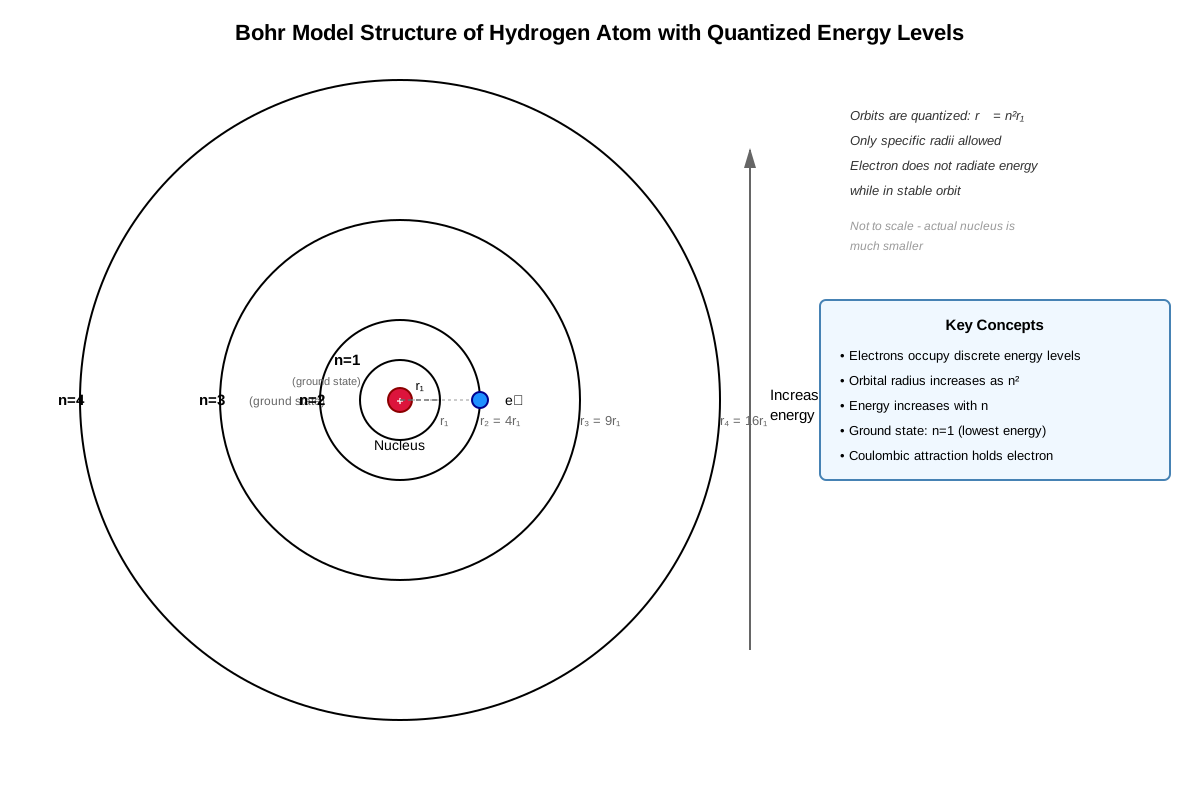
The Bohr model rests on several revolutionary postulates that departed from classical physics. First, electrons orbit the nucleus in specific, quantized circular paths called stationary states or energy levels, designated by the principal quantum number n (where n = 1, 2, 3, ...). Unlike classical orbiting charges that would continuously radiate energy and spiral into the nucleus, electrons in these stationary states do not emit radiation and remain stable indefinitely.
Second, electrons can only transition between these discrete energy levels by absorbing or emitting a photon whose energy exactly equals the energy difference between the initial and final states. This quantization of energy explains why atomic spectra consist of discrete lines rather than continuous bands. The energy of the photon involved in a transition follows the relationship:
ΔE = E_final - E_initial = hf = hc/λwhere h is Planck's constant (6.626 × 10⁻³⁴ J·s), f is frequency, c is the speed of light (3.0 × 10⁸ m/s), and λ is wavelength.
Third, the angular momentum of an electron in a permitted orbit is quantized according to:
L = mvr = nℏ = n(h/2π)where m is electron mass, v is orbital velocity, r is orbital radius, and ℏ (h-bar) represents the reduced Planck constant. This quantization condition determines which orbits are permitted.
Energy Levels and the Bohr Equation
The energy of an electron in the nth energy level of a hydrogen atom (or hydrogen-like ion) is given by the Bohr equation:
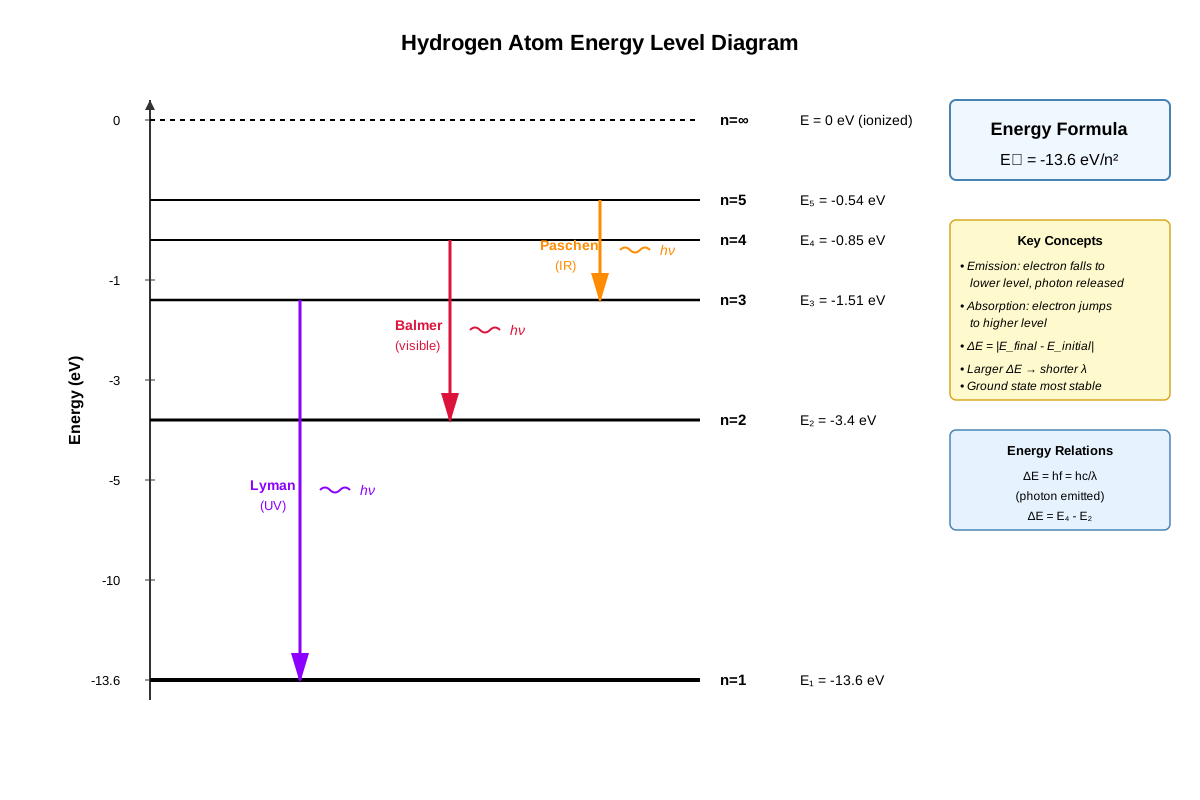
E_n = -13.6 eV × (Z²/n²)where Z is the atomic number (nuclear charge) and n is the principal quantum number. For hydrogen, Z = 1, simplifying to E_n = -13.6 eV/n². The negative sign indicates that the electron is bound to the nucleus; energy must be added to remove the electron completely (ionization).
Several critical insights emerge from this equation:
- Energy levels become closer together as n increases (the energy difference between successive levels decreases)
- The ground state (n = 1) has the lowest (most negative) energy: E₁ = -13.6 eV for hydrogen
- As n approaches infinity, energy approaches zero, representing a free electron
- For hydrogen-like ions (He⁺, Li²⁺, etc.), energies scale with Z², making transitions more energetic for higher atomic numbers
Electron Transitions and Spectral Series
When an electron transitions from a higher energy level (n_initial) to a lower level (n_final), it emits a photon. Conversely, absorption of a photon with appropriate energy promotes an electron to a higher level. The energy of the emitted or absorbed photon equals the difference between energy levels:
ΔE = E_final - E_initial = -13.6 eV × Z² × (1/n_final² - 1/n_initial²)For emission (electron dropping to lower level), ΔE is negative, and we typically report the photon energy as |ΔE|. For absorption, ΔE is positive.
The hydrogen spectrum contains several named spectral series, each corresponding to transitions ending at a specific final level:
| Series Name | Final Level (n_final) | Initial Levels | Spectral Region |
|---|---|---|---|
| Lyman | 1 | 2, 3, 4, ... | Ultraviolet |
| Balmer | 2 | 3, 4, 5, ... | Visible |
| Paschen | 3 | 4, 5, 6, ... | Infrared |
| Brackett | 4 | 5, 6, 7, ... | Infrared |
| Pfund | 5 | 6, 7, 8, ... | Infrared |
The Balmer series is particularly important for the MCAT because it produces visible light, making it experimentally accessible and frequently referenced in passages.
The Rydberg Equation
The Rydberg equation provides an alternative formulation for calculating the wavelength of emitted photons:
1/λ = R_H × Z² × (1/n_final² - 1/n_initial²)where R_H is the Rydberg constant (1.097 × 10⁷ m⁻¹ for hydrogen). This equation directly relates the wavelength of spectral lines to the quantum numbers of the transition, making it particularly useful for spectroscopy problems on the MCAT.
For emission spectra, n_initial > n_final, making the term in parentheses positive. For absorption, the reverse is true. The Rydberg equation elegantly explains why atomic spectra consist of discrete lines: only specific combinations of n_initial and n_final are possible, producing only specific wavelengths.
Orbital Radii and the Bohr Radius
The radius of the nth orbital in the Bohr model is given by:
r_n = n² × a₀ / Zwhere a₀ is the Bohr radius (0.529 Å or 5.29 × 10⁻¹¹ m), representing the radius of the ground state hydrogen atom. This relationship shows that orbital radii increase with the square of the principal quantum number, meaning higher energy levels are progressively farther from the nucleus and more diffuse.
Limitations of the Bohr Model
While revolutionary for its time, the Bohr model has significant limitations that students should recognize for the MCAT:
- Accuracy limited to hydrogen-like systems: The model accurately predicts spectra only for single-electron species (H, He⁺, Li²⁺)
- No explanation of fine structure: Cannot account for splitting of spectral lines in magnetic fields (Zeeman effect) or subtle line splitting (fine structure)
- Violates Heisenberg uncertainty principle: Specifying exact orbits with defined position and momentum contradicts quantum mechanics
- Cannot predict relative intensities: The model doesn't explain why some spectral lines are brighter than others
- Incompatible with wave nature of electrons: Treats electrons as particles rather than wave-particle entities
Despite these limitations, the Bohr model remains the primary framework for MCAT questions because it provides calculable, intuitive results for the most commonly tested scenarios.
Concept Relationships
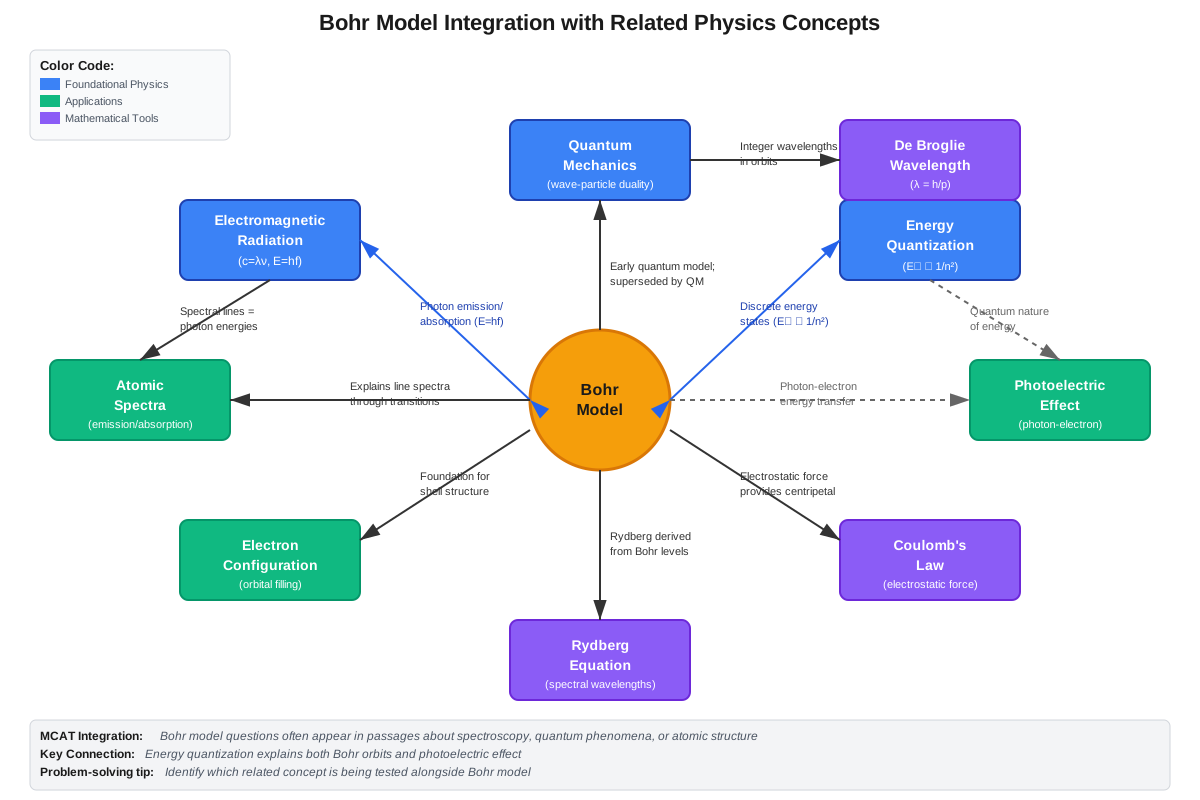
The Bohr model integrates multiple foundational physics concepts into a unified framework for understanding atomic structure. Quantization of energy serves as the central organizing principle, explaining why electrons occupy discrete energy levels rather than a continuum of possible states. This quantization directly leads to the discrete line spectra observed experimentally, creating a testable prediction that validates the model.
Electromagnetic radiation connects intimately with the Bohr model through photon emission and absorption. When electrons transition between energy levels, the energy conservation principle requires that the energy difference exactly equals the photon energy (E = hf), linking atomic structure to observable light. This relationship extends to spectroscopy, where measuring wavelengths allows determination of energy level spacing.
The Bohr model builds upon Coulombic attraction between the positive nucleus and negative electrons, with this electrostatic force providing the centripetal force for circular orbits. The balance between attractive force and orbital motion determines the quantized orbital radii, which scale with n².
Conceptually, the Bohr model represents a transitional framework between classical mechanics (circular orbits, defined trajectories) and quantum mechanics (quantized states, discrete energy levels). Understanding this historical progression helps students recognize when to apply Bohr model approximations versus more sophisticated quantum mechanical treatments.
The relationship map flows as: Quantization postulate → Discrete energy levels → Specific photon energies during transitions → Line spectra → Spectroscopic identification. Simultaneously, Coulombic force + Quantized angular momentum → Specific orbital radii → Energy level spacing. These parallel pathways converge in the Bohr equation, which quantitatively predicts all observable spectroscopic phenomena for hydrogen-like atoms.
Quick check — test yourself on Bohr model so far.
Try Flashcards →High-Yield Facts
⭐ The ground state energy of hydrogen is -13.6 eV, and all other energy levels are calculated as E_n = -13.6 eV/n²
⭐ Energy levels become closer together as n increases, meaning transitions between high-n levels produce lower-energy (longer-wavelength) photons
⭐ The Balmer series (transitions to n = 2) produces visible light, while Lyman series (to n = 1) produces UV and Paschen series (to n = 3) produces IR
⭐ Photon energy equals the energy difference between levels: ΔE = hf = hc/λ, allowing calculation of wavelength from energy transitions
⭐ The Bohr model accurately describes only hydrogen-like (single-electron) species, including H, He⁺, Li²⁺, etc.
- The Bohr radius (a₀ = 0.529 Å) represents the ground state orbital radius of hydrogen
- Orbital radius increases with n² and decreases with atomic number Z: r_n = n²a₀/Z
- Ionization energy is the energy required to remove an electron completely (move from n to n = ∞)
- For hydrogen-like ions, all energies scale with Z²: E_n = -13.6 eV × Z²/n²
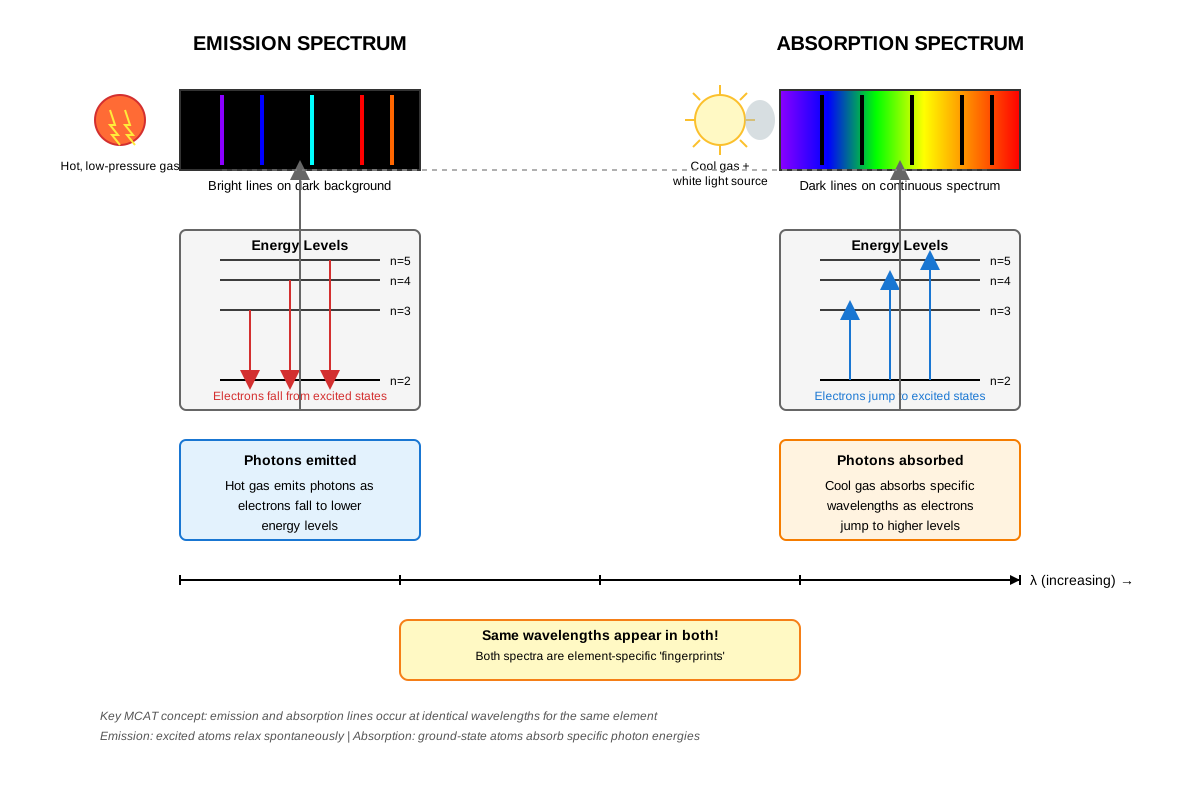
- Absorption spectra show dark lines on a continuous background (missing wavelengths absorbed by atoms), while emission spectra show bright lines on a dark background
- The Rydberg constant (R_H = 1.097 × 10⁷ m⁻¹) appears in the equation 1/λ = R_H(1/n_final² - 1/n_initial²)
- Electrons in higher energy levels are less tightly bound and easier to remove (lower ionization energy)
Common Misconceptions
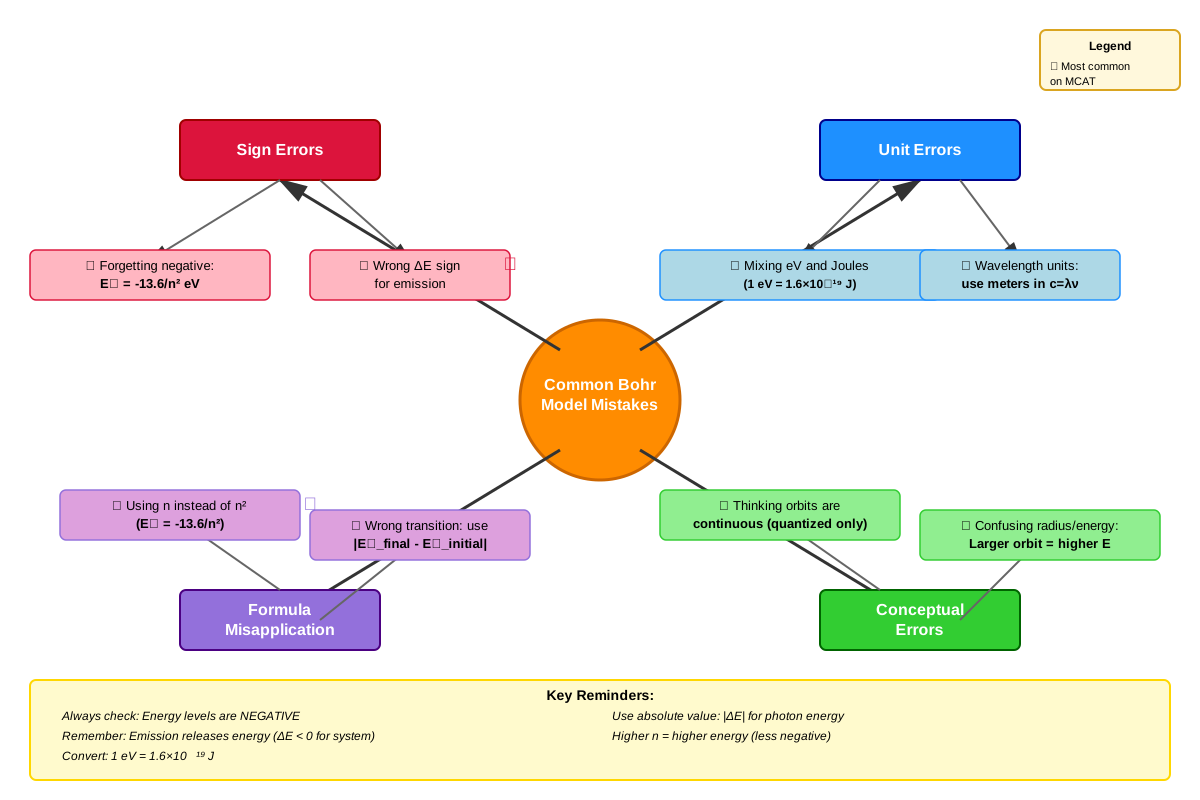
Misconception: Electrons physically orbit the nucleus like planets orbit the sun in the Bohr model.
Correction: While the Bohr model uses circular orbit language for calculation purposes, modern quantum mechanics shows electrons exist as probability clouds (orbitals) rather than following defined paths. The MCAT uses Bohr model calculations but students should recognize this is a simplified approximation.
Misconception: Any photon can be absorbed by an atom as long as it has sufficient energy.
Correction: Atoms only absorb photons whose energy exactly matches the difference between two allowed energy levels. A photon with energy between two transition energies will not be absorbed, even if it has "enough" energy. This selectivity creates the discrete absorption spectrum.
Misconception: Higher energy levels have more negative energy values.
Correction: Higher energy levels have less negative (closer to zero) energy values. The ground state (n = 1) has the most negative energy (-13.6 eV for hydrogen), while excited states have progressively less negative energies. Zero energy represents a free electron.
Misconception: The Bohr model works equally well for all atoms.
Correction: The Bohr model accurately predicts spectra only for hydrogen-like (single-electron) systems. Multi-electron atoms experience electron-electron repulsion and shielding effects that the simple Bohr model cannot account for, though the Z² scaling applies to hydrogen-like ions.
Misconception: Larger orbital radii correspond to lower energy levels.
Correction: Larger orbital radii correspond to higher (less negative) energy levels. As n increases, both the orbital radius (r_n ∝ n²) and the energy (E_n ∝ 1/n²) increase, meaning electrons farther from the nucleus have higher energy and are less tightly bound.
Misconception: The energy of an emitted photon is always positive.
Correction: When calculating ΔE = E_final - E_initial for emission, the result is negative because the electron moves to a lower energy state. The photon energy itself is positive (|ΔE|), but the sign convention in the calculation indicates energy is released by the atom.
Worked Examples
Example 1: Calculating Photon Wavelength from Electron Transition
Question: An electron in a hydrogen atom transitions from n = 4 to n = 2. Calculate the wavelength of the emitted photon and identify which spectral series this belongs to.
Solution:
Step 1: Calculate the energy of each level using E_n = -13.6 eV/n²
For n = 4: E₄ = -13.6 eV / 16 = -0.85 eV
For n = 2: E₂ = -13.6 eV / 4 = -3.4 eV
Step 2: Calculate the energy difference
ΔE = E_final - E_initial = E₂ - E₄ = -3.4 eV - (-0.85 eV) = -2.55 eV
The negative sign indicates energy is released (emission). The photon energy is |ΔE| = 2.55 eV.
Step 3: Convert eV to joules (1 eV = 1.6 × 10⁻¹⁹ J)
E_photon = 2.55 eV × 1.6 × 10⁻¹⁹ J/eV = 4.08 × 10⁻¹⁹ J
Step 4: Calculate wavelength using E = hc/λ, rearranged to λ = hc/E
λ = (6.626 × 10⁻³⁴ J·s)(3.0 × 10⁸ m/s) / (4.08 × 10⁻¹⁹ J)
λ = 1.988 × 10⁻²⁵ / 4.08 × 10⁻¹⁹ = 4.87 × 10⁻⁷ m = 487 nm
Step 5: Identify the series
Since the transition ends at n = 2, this belongs to the Balmer series. The wavelength of 487 nm falls in the visible range (blue-green light), confirming this assignment.
Key takeaway: This problem integrates the Bohr equation with electromagnetic radiation principles, demonstrating the connection between atomic structure and observable light—a common MCAT question type.
Example 2: Comparing Hydrogen-Like Ions
Question: Compare the energy required to excite an electron from n = 1 to n = 3 in hydrogen (H) versus singly-ionized helium (He⁺). Which requires more energy and by what factor?
Solution:
Step 1: Recognize that He⁺ is a hydrogen-like ion with Z = 2
Step 2: Calculate the transition energy for hydrogen (Z = 1)
ΔE_H = E₃ - E₁ = -13.6 eV(1/9 - 1/1) = -13.6 eV(-8/9) = 12.09 eV
Step 3: Calculate the transition energy for He⁺ (Z = 2)
For hydrogen-like ions, energies scale with Z²:
ΔE_He⁺ = -13.6 eV × Z²(1/n_final² - 1/n_initial²)
ΔE_He⁺ = -13.6 eV × 4(1/9 - 1/1) = -13.6 eV × 4 × (-8/9) = 48.36 eV
Step 4: Compare the energies
The ratio is: ΔE_He⁺ / ΔE_H = 48.36 / 12.09 = 4
Answer: He⁺ requires 4 times more energy than hydrogen for the same transition (n = 1 to n = 3). This factor of 4 equals Z² (2² = 4), demonstrating that hydrogen-like ions with higher nuclear charge have more tightly bound electrons and larger energy gaps between levels.
Key takeaway: Understanding the Z² scaling allows quick comparison of hydrogen-like species without recalculating from scratch—a valuable time-saving strategy for the MCAT.
Exam Strategy
When approaching Bohr model MCAT questions, first identify whether the question asks for conceptual understanding or quantitative calculation. Conceptual questions often test understanding of energy level spacing, spectral series, or the relationship between wavelength and energy. Quantitative questions typically require using the Bohr equation, Rydberg equation, or E = hf relationships.
Trigger words and phrases to watch for include:
- "Spectral line" or "emission spectrum" → indicates electron transitions and photon emission
- "Hydrogen-like ion" → signals need to use Z² scaling in the Bohr equation
- "Ground state" → refers to n = 1, the lowest energy level
- "Ionization energy" → energy to move electron from current level to n = ∞
- "Balmer series" → transitions ending at n = 2, producing visible light
- "Wavelength of emitted light" → requires calculating ΔE then using λ = hc/E
For process-of-elimination strategies, remember:
- Eliminate answers with positive energy values for bound electrons (all bound state energies are negative)
- Eliminate wavelengths that don't match the spectral region mentioned (UV < 400 nm, visible 400-700 nm, IR > 700 nm)
- For comparison questions, eliminate options that don't follow Z² scaling for hydrogen-like ions
- If a question asks about multi-electron atoms, eliminate answers that assume perfect Bohr model accuracy
Time allocation: Most Bohr model calculations can be completed in 60-90 seconds if you're comfortable with the equations. If a calculation seems to require more than 2 minutes, check whether you can estimate or use proportional reasoning instead of exact calculation. For example, if comparing two transitions, you might calculate the ratio rather than absolute values.
Exam Tip: Memorize E₁ = -13.6 eV for hydrogen and the Bohr equation E_n = -13.6 eV × Z²/n². These two facts enable solving most quantitative Bohr model problems on the MCAT.
Memory Techniques
Mnemonic for spectral series (in order of increasing final n value):
"Lazy Beavers Prefer Building Ponds"
- Lazy = Lyman (n_final = 1)
- Beavers = Balmer (n_final = 2)
- Prefer = Paschen (n_final = 3)
- Building = Brackett (n_final = 4)
- Ponds = Pfund (n_final = 5)
Visualization for energy levels: Picture a ladder where the rungs get progressively closer together as you climb higher. The bottom rung (n = 1) is far from the second rung, but the top rungs are very close together. This represents how energy level spacing decreases as n increases.
Acronym for key constants:
"HP Rocks" = H (Planck's constant, h = 6.626 × 10⁻³⁴ J·s), P (speed of light, c = 3.0 × 10⁸ m/s), R (Rydberg constant, R_H = 1.097 × 10⁷ m⁻¹)
Memory aid for negative energy: Think "Negative means Not free" - bound electrons have negative energy, and only free electrons (n = ∞) have zero energy. More negative = more tightly bound.
Relationship reminder: "Big n, Big r, Big E" - as the principal quantum number (n) increases, both the orbital radius (r) and energy (E) increase (energy becomes less negative, approaching zero).
Summary
The Bohr model provides a quantized framework for understanding atomic structure, particularly for hydrogen and hydrogen-like ions. Electrons occupy discrete energy levels characterized by the principal quantum number n, with energies given by E_n = -13.6 eV × Z²/n². Transitions between these levels involve absorption or emission of photons whose energy exactly matches the energy difference between levels, explaining the discrete line spectra observed experimentally. The model successfully predicts the wavelengths of spectral lines through the Rydberg equation and organizes hydrogen's spectrum into series (Lyman, Balmer, Paschen) based on the final energy level of transitions. While limited to single-electron systems and superseded by quantum mechanics, the Bohr model remains essential for MCAT preparation because it provides calculable predictions for spectroscopy problems and introduces fundamental concepts of energy quantization. Students must be able to calculate energy levels, determine photon wavelengths from transitions, apply Z² scaling to hydrogen-like ions, and recognize the relationship between energy level spacing and spectral line positions to successfully answer MCAT questions on this topic.
Key Takeaways
- The Bohr model describes electrons in quantized energy levels with E_n = -13.6 eV × Z²/n², where more negative values indicate more tightly bound electrons
- Photon emission occurs when electrons drop to lower energy levels, with photon energy equal to the energy difference: ΔE = hf = hc/λ
- The Balmer series (transitions to n = 2) produces visible light and is the most commonly referenced series on the MCAT
- Energy levels become progressively closer together as n increases, meaning high-n transitions produce lower-energy photons
- The Bohr model accurately describes only hydrogen-like (single-electron) species, with energies scaling by Z² for ions
- Understanding the relationship between energy transitions and spectral lines enables interpretation of emission and absorption spectra
- Mastery of the Bohr equation and E = hf relationship allows calculation of wavelengths, frequencies, and energies for atomic transitions
Related Topics
Quantum Mechanics and Wave Functions: The Bohr model's limitations led to development of quantum mechanics, which describes electrons as wave functions rather than particles in defined orbits. Understanding this progression helps contextualize when to apply Bohr approximations versus more sophisticated quantum treatments.
Electron Configuration and Periodic Trends: While the Bohr model applies strictly to hydrogen-like atoms, its energy level concept extends to multi-electron atoms through electron configuration, explaining periodic trends in ionization energy and atomic radius.
Photoelectric Effect: Both the photoelectric effect and Bohr model demonstrate energy quantization, with the photoelectric effect showing that light behaves as quantized photons—the same photons involved in Bohr model transitions.
Spectroscopy and Analytical Techniques: Mastering the Bohr model enables understanding of atomic absorption and emission spectroscopy, techniques used in clinical chemistry and research to identify elements and measure concentrations.
Nuclear Physics and Binding Energy: The concept of negative binding energy in the Bohr model parallels nuclear binding energy, where bound nucleons have lower energy than separated particles.
Practice CTA
Now that you've mastered the core concepts of the Bohr model, it's time to reinforce your understanding through active practice. Attempt the practice questions to test your ability to apply the Bohr equation, calculate photon wavelengths, and interpret spectroscopic data. Use the flashcards to drill key facts like the ground state energy of hydrogen, spectral series, and the relationship between energy levels and orbital radii. Remember, the MCAT rewards not just knowledge but the ability to apply concepts quickly and accurately under time pressure—practice is what builds that skill. You've got this!
Sign up free to keep reading
Create a free AnvayaPrep account to finish this MCAT guide on Bohr model — plus flashcards and practice questions.