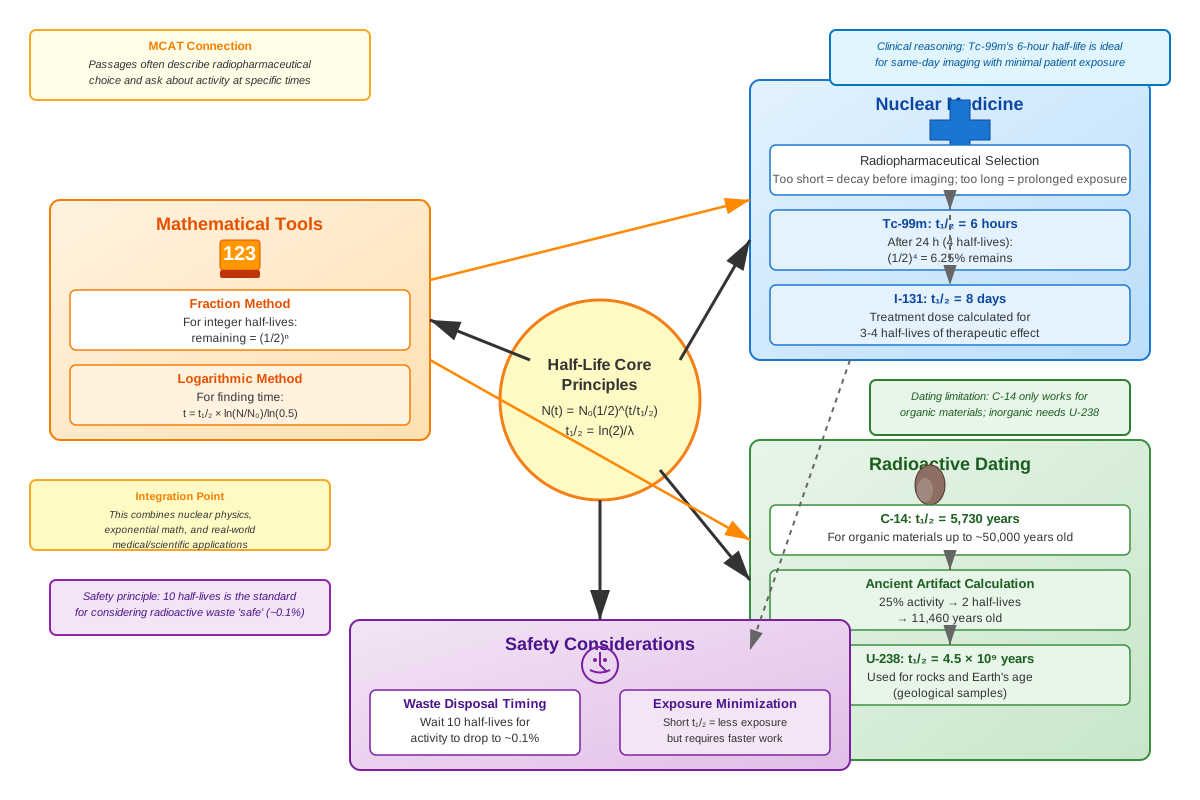
Overview
Half-life is a fundamental concept in Atomic and Nuclear Physics that describes the time required for half of a radioactive sample to undergo decay. This exponential decay process is central to understanding nuclear reactions, radioactive dating, medical imaging techniques, and radiation safety—all topics that appear regularly on the MCAT. The concept of half-life extends beyond simple memorization of a definition; it requires students to apply exponential decay mathematics, interpret graphs, and solve multi-step quantitative problems under time pressure.
For the MCAT, half-life represents a high-yield intersection of Physics principles, mathematical reasoning, and real-world applications. Questions may appear as standalone calculations in the Chemical and Physical Foundations section, or embedded within passage-based questions discussing radiopharmaceuticals, carbon dating, or nuclear medicine. Understanding half-life enables students to predict the remaining quantity of a radioactive substance after any time interval, calculate decay constants, and interpret decay curves—skills that are directly tested on exam day.
The concept of half-life connects to broader Physics principles including exponential functions, first-order kinetics, nuclear stability, and energy conservation. It shares mathematical similarities with capacitor discharge in circuits and first-order chemical kinetics, making it a conceptual bridge between different MCAT subjects. Mastery of half-life calculations and conceptual understanding provides a foundation for more advanced topics in nuclear chemistry and medical applications of radiation.
Learning Objectives
- [ ] Define half-life using accurate Physics terminology
- [ ] Explain why half-life matters for the MCAT
- [ ] Apply half-life to exam-style questions
- [ ] Identify common mistakes related to half-life
- [ ] Connect half-life to related Physics concepts
- [ ] Calculate the remaining quantity of a radioactive sample after a given number of half-lives
- [ ] Derive and apply the relationship between half-life, decay constant, and exponential decay equations
- [ ] Interpret radioactive decay curves and extract quantitative information from graphical representations
- [ ] Distinguish between half-life and mean lifetime in radioactive decay processes
Prerequisites
- Exponential functions and logarithms: Half-life calculations rely on exponential decay equations and logarithmic transformations to solve for time or remaining quantity
- Basic algebra and equation manipulation: Students must rearrange equations, solve for variables, and work with fractional exponents when calculating decay problems
- Understanding of atoms and nuclear structure: Knowledge of protons, neutrons, and nuclear stability provides context for why certain isotopes undergo radioactive decay
- First-order kinetics: The mathematical framework of half-life mirrors first-order reaction kinetics from general chemistry
- Scientific notation and unit conversions: Radioactive decay problems often involve very large or very small numbers requiring proper notation and unit management
Why This Topic Matters
Clinical and Real-World Significance
Half-life concepts are essential in nuclear medicine, where radioisotopes are used for both diagnostic imaging (PET scans, bone scans) and therapeutic interventions (radioiodine therapy for thyroid cancer, brachytherapy). Physicians must understand half-life to determine appropriate dosing schedules, minimize radiation exposure to patients and staff, and predict when radioactive materials become safe for disposal. Carbon-14 dating revolutionized archaeology and geology by enabling accurate age determination of organic materials up to 50,000 years old. In environmental science, half-life determines how long radioactive contamination persists in ecosystems following nuclear accidents or weapons testing.
MCAT Exam Statistics
Half-life questions appear in approximately 3-5% of Chemical and Physical Foundations passages and discrete questions. The MCAT tests half-life through multiple question formats: straightforward calculations asking for remaining quantity after a specified time, graph interpretation requiring students to extract half-life from decay curves, passage-based questions embedded in nuclear medicine contexts, and conceptual questions about the relationship between half-life and decay constant. Questions typically appear at medium difficulty, though they can become challenging when combined with unit conversions, multiple decay steps, or integration with biological concepts.
Common Exam Contexts
The MCAT frequently presents half-life within passages discussing: radiopharmaceutical development and dosing strategies; positron emission tomography (PET) imaging using fluorine-18 or carbon-11; radioiodine uptake studies for thyroid function assessment; carbon dating of archaeological specimens; nuclear reactor safety and waste management; radiation therapy planning; and tracer studies in metabolic research. Discrete questions often test pure calculation skills or conceptual understanding of exponential decay properties.
Core Concepts
Definition of Half-Life
Half-life (symbolized as t₁/₂) is defined as the time required for exactly one-half of the radioactive nuclei in a sample to undergo decay. This is a probabilistic process governed by quantum mechanics—individual nuclei decay randomly, but large populations exhibit predictable exponential decay patterns. The half-life is an intrinsic property of each radioactive isotope, independent of the initial quantity, physical state (solid, liquid, gas), temperature, pressure, or chemical environment. For example, carbon-14 has a half-life of 5,730 years whether it exists as pure carbon, carbon dioxide, or incorporated into organic molecules.
The constancy of half-life across different conditions makes it an ideal "nuclear clock" for dating applications and medical dosing calculations. Unlike chemical reaction rates that vary with temperature and concentration, nuclear decay rates remain constant because they depend on processes occurring within the nucleus, which are unaffected by external conditions accessible in normal environments.
Mathematical Framework of Radioactive Decay
Radioactive decay follows first-order kinetics, meaning the rate of decay is proportional to the number of radioactive nuclei present at any given time. The fundamental decay equation is:
N(t) = N₀ × e^(-λt)Where:
- N(t) = number of radioactive nuclei remaining at time t
- N₀ = initial number of radioactive nuclei at t = 0
- λ = decay constant (probability of decay per unit time)
- e = Euler's number (approximately 2.718)
- t = elapsed time
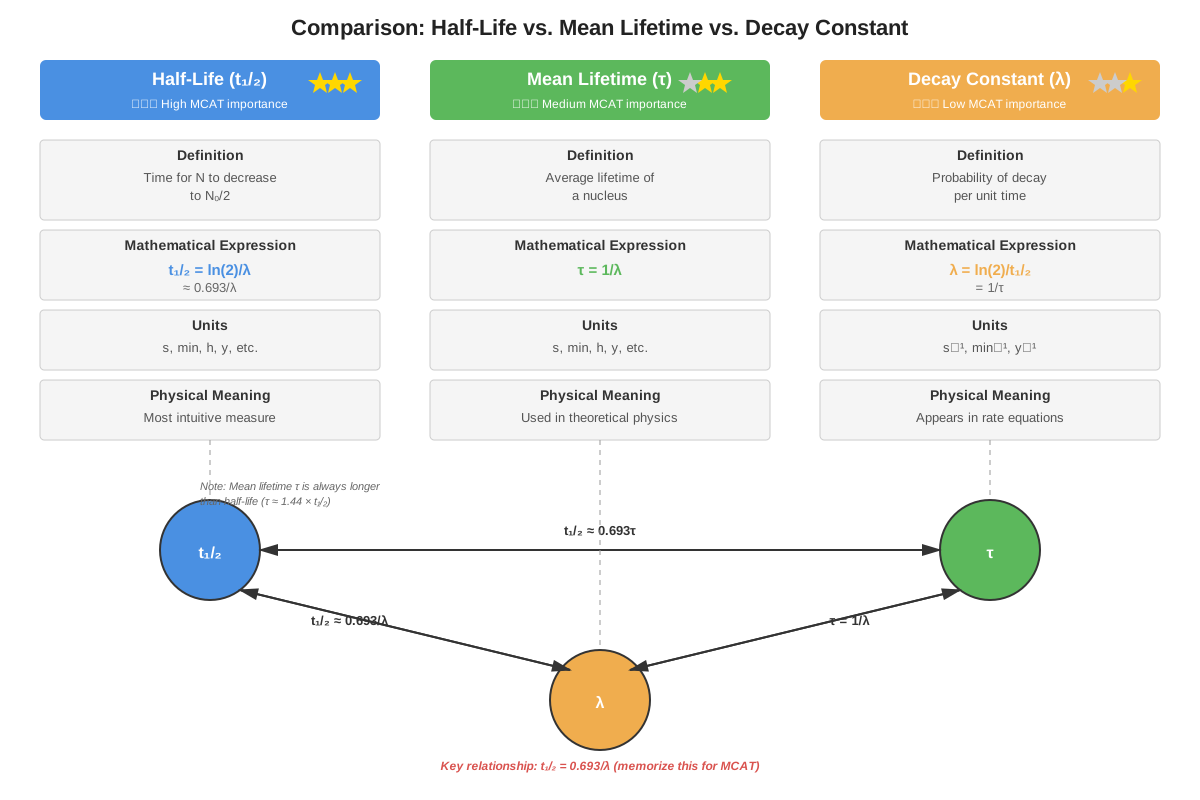
The decay constant (λ) and half-life (t₁/₂) are inversely related through the equation:
t₁/₂ = ln(2)/λ = 0.693/λThis relationship derives from setting N(t) = N₀/2 and solving for t. For MCAT purposes, students should memorize that ln(2) ≈ 0.693, as this approximation frequently appears in calculations.
Simplified Half-Life Calculation Method
For MCAT-style questions, the most practical approach uses the simplified formula:
N(t) = N₀ × (1/2)^nWhere n = number of half-lives elapsed = t/t₁/₂
This formula allows rapid calculation without requiring natural logarithms or exponential functions. Students can determine the number of half-lives by dividing the total elapsed time by the half-life, then apply successive halvings to find the remaining quantity.
Example: If a sample starts with 800 mg of a radioactive isotope with a half-life of 4 hours, how much remains after 12 hours?
- Number of half-lives: n = 12 hours / 4 hours = 3 half-lives
- Remaining amount: N = 800 mg × (1/2)³ = 800 mg × 1/8 = 100 mg
Activity and Decay Rate
Activity (A) measures the number of decay events per unit time, typically expressed in becquerels (Bq, where 1 Bq = 1 decay/second) or curies (Ci, where 1 Ci = 3.7 × 10¹⁰ Bq). Activity is directly proportional to the number of radioactive nuclei:
A(t) = λN(t) = A₀ × e^(-λt)Activity follows the same exponential decay pattern as the number of nuclei. After one half-life, both the number of radioactive atoms and the activity decrease to 50% of their initial values. This concept is crucial for medical applications where radiation dose depends on activity rather than mass of radioactive material.
Decay Curves and Graphical Interpretation
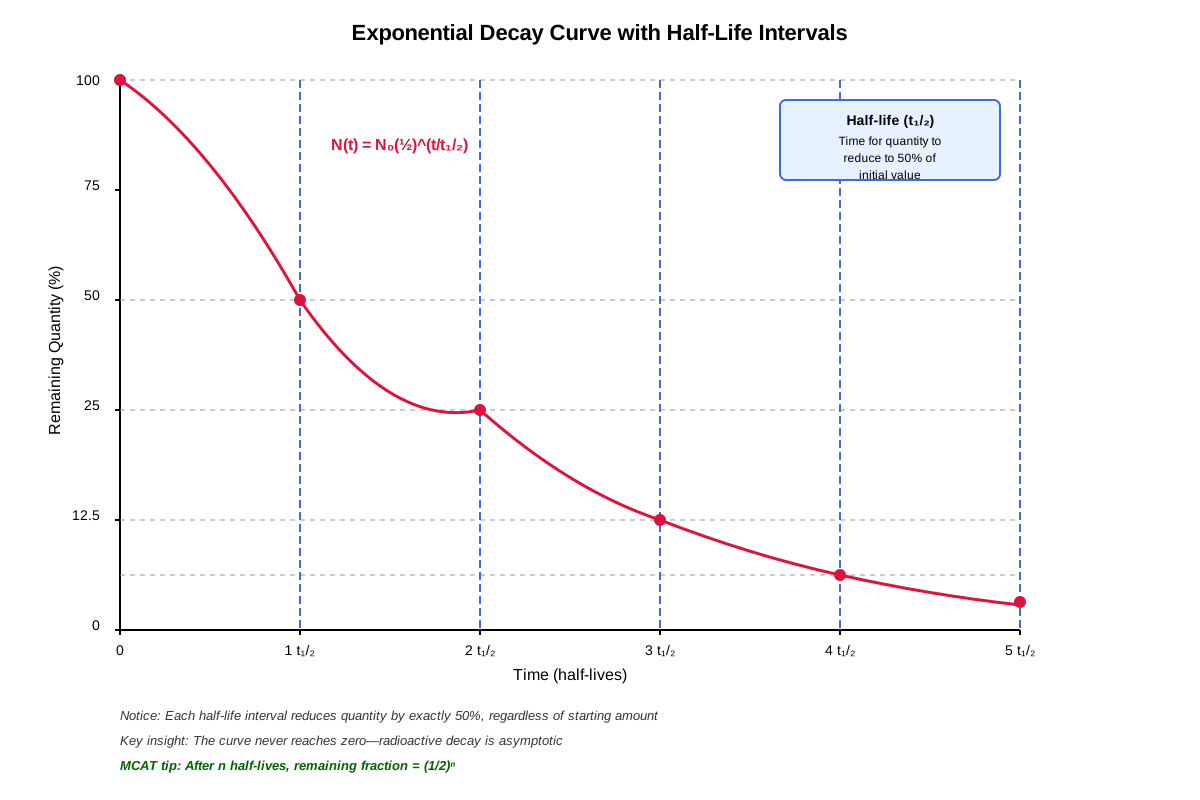
Radioactive decay produces a characteristic exponential curve when N(t) or A(t) is plotted against time. Key features include:
- Y-intercept: Represents initial quantity (N₀ or A₀)
- Exponential decrease: The curve never reaches zero but approaches it asymptotically
- Constant half-life intervals: Each successive half-life reduces the quantity by 50%, creating equal horizontal intervals between specific fractional values (1, 1/2, 1/4, 1/8, etc.)
On a semi-logarithmic plot (log scale on y-axis, linear scale on x-axis), exponential decay appears as a straight line with slope = -λ. The half-life can be read directly as the horizontal distance between any two points where the y-values differ by a factor of 2.
Comparison of Different Isotopes
| Isotope | Half-Life | Medical/Scientific Application |
|---|---|---|
| Technetium-99m | 6 hours | Most common nuclear medicine imaging agent |
| Fluorine-18 | 110 minutes | PET scanning (FDG-PET for cancer detection) |
| Iodine-131 | 8 days | Thyroid cancer treatment and imaging |
| Carbon-14 | 5,730 years | Radiocarbon dating of organic materials |
| Uranium-238 | 4.5 billion years | Geological dating, nuclear fuel |
| Polonium-214 | 164 microseconds | Intermediate in radon decay chain |
This table illustrates the enormous range of half-lives, from microseconds to billions of years, each suited to specific applications based on the required duration of radioactivity.
Effective Half-Life in Biological Systems
In medical contexts, radioactive substances are eliminated from the body through both radioactive decay and biological excretion. The effective half-life (t_eff) accounts for both processes:
1/t_eff = 1/t_physical + 1/t_biologicalWhere t_physical is the radioactive half-life and t_biological is the biological elimination half-life. The effective half-life is always shorter than either individual half-life, meaning radioactive tracers clear from the body faster than predicted by nuclear decay alone. This concept is important for radiation safety and dosing calculations in nuclear medicine.
Concept Relationships
The concept of half-life serves as a central node connecting multiple Physics and chemistry principles. Exponential decay mathematics provides the quantitative foundation → which enables half-life calculations → which apply to radioactive decay processes → which depend on nuclear instability → which relates to nuclear binding energy and the balance of nuclear forces.
Half-life connects to first-order kinetics in chemistry, where reaction rates depend on reactant concentration to the first power. The mathematical treatment is identical, making half-life a bridge between nuclear physics and chemical kinetics. Both processes exhibit constant half-lives independent of initial quantity.
The relationship between decay constant and half-life (λ = 0.693/t₁/₂) links probabilistic quantum mechanical processes to macroscopic observable quantities. This connection illustrates how statistical behavior of large populations emerges from random individual events—a fundamental principle in quantum mechanics and statistical physics.
Activity measurements connect half-life to practical radiation detection and safety protocols. Understanding how activity decreases with the same half-life as the number of nuclei enables calculation of radiation exposure over time, crucial for medical dosing and occupational safety.
In biological systems, the concept extends to effective half-life, integrating nuclear physics with pharmacokinetics and physiology. This demonstrates how physical principles must be modified when applied to living systems that actively eliminate substances.
High-Yield Facts
⭐ Half-life is constant for a given isotope and independent of initial quantity, temperature, pressure, or chemical form
⭐ After n half-lives, the remaining fraction is (1/2)ⁿ, and the fraction decayed is 1 - (1/2)ⁿ
⭐ The relationship between half-life and decay constant is t₁/₂ = 0.693/λ
⭐ Activity (decay rate) decreases with the same half-life as the number of radioactive nuclei
⭐ On a semi-log plot, exponential decay appears as a straight line
- After one half-life, 50% remains; after two half-lives, 25% remains; after three half-lives, 12.5% remains
- The number of half-lives is calculated as n = (elapsed time)/(half-life)
- Technetium-99m (t₁/₂ = 6 hours) is the most commonly used medical radioisotope
- Carbon-14 dating is effective for materials up to approximately 50,000 years old (about 8-9 half-lives)
- Effective half-life in biological systems is always shorter than the physical half-life alone
- A sample never completely decays to zero—it approaches zero asymptotically
- Units of activity: 1 Curie (Ci) = 3.7 × 10¹⁰ Becquerels (Bq) = 3.7 × 10¹⁰ decays/second
Quick check — test yourself on Half life so far.
Try Flashcards →Common Misconceptions
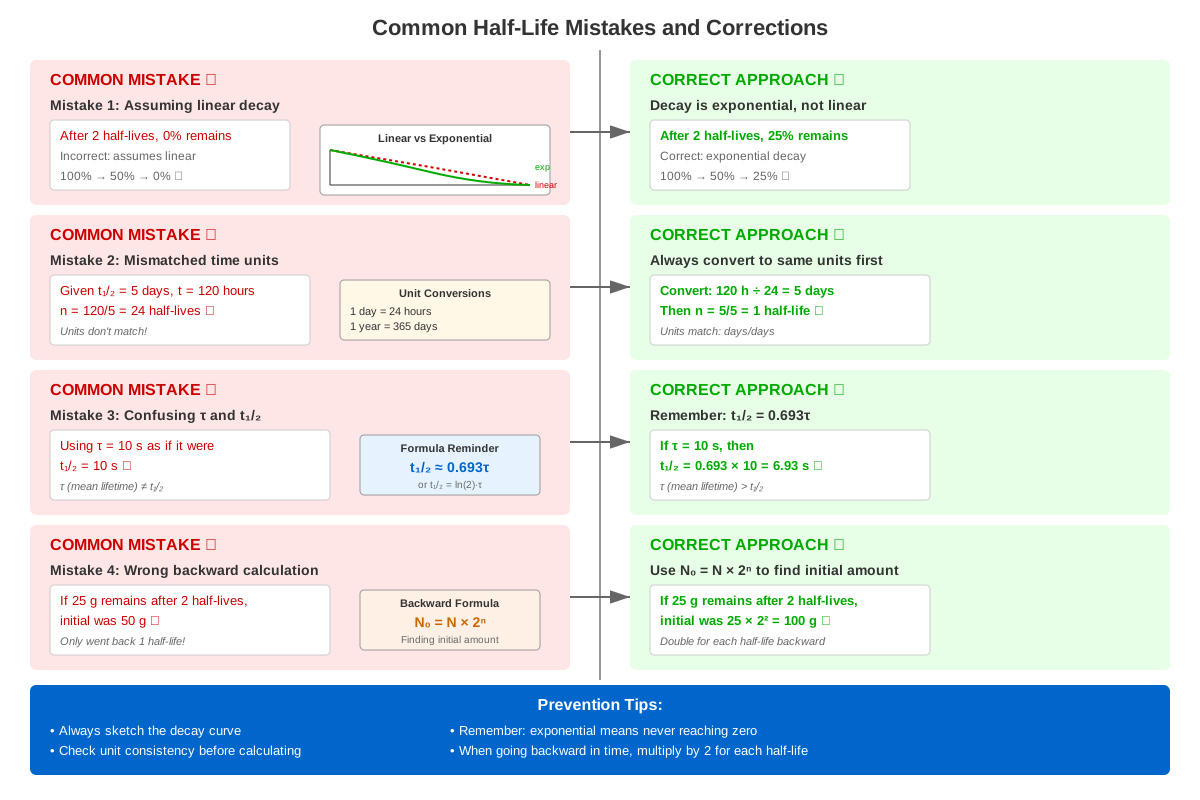
Misconception: Half-life means the time for all radioactive material to decay completely.
Correction: Half-life is the time for exactly half (50%) of the radioactive nuclei to decay. After one half-life, 50% remains; after two half-lives, 25% remains; the sample never reaches zero but approaches it asymptotically through successive halvings.
Misconception: After two half-lives, none of the original radioactive material remains.
Correction: After two half-lives, 25% (one-quarter) of the original radioactive nuclei remain. Each half-life reduces the quantity by half, not to zero: 100% → 50% → 25% → 12.5%, and so on.
Misconception: Half-life changes with temperature or chemical reactions, similar to chemical reaction rates.
Correction: Half-life is a nuclear property determined by forces within the nucleus and is completely independent of external conditions like temperature, pressure, or chemical environment. Nuclear processes are unaffected by conditions that influence chemical reactions because nuclear binding energies (MeV scale) vastly exceed chemical bond energies (eV scale).
Misconception: If a sample has decayed to 25% of its original amount, one half-life has elapsed.
Correction: If 25% remains, two half-lives have elapsed (100% → 50% → 25%). Students often confuse "25% remaining" with "25% decayed." Always identify whether the problem states remaining amount or decayed amount.
Misconception: Longer half-life means more dangerous radiation.
Correction: Danger depends on activity (decay rate), not half-life alone. Isotopes with shorter half-lives have higher activity per unit mass, producing more radiation in a given time period. Very long half-lives mean low activity but persistent contamination. Very short half-lives mean intense radiation but rapid clearance. The relationship is inverse: activity is proportional to 1/t₁/₂ for equal numbers of atoms.
Misconception: The decay constant λ and half-life t₁/₂ are directly proportional.
Correction: They are inversely proportional: λ = 0.693/t₁/₂. A larger decay constant means faster decay and shorter half-life. Students sometimes incorrectly assume that larger λ means longer half-life.
Misconception: Effective half-life in biological systems is longer than physical half-life.
Correction: Effective half-life is always shorter than both physical and biological half-lives because both decay and excretion work together to eliminate the radioactive substance. The formula 1/t_eff = 1/t_physical + 1/t_biological ensures t_eff < t_physical and t_eff < t_biological.
Worked Examples
Example 1: Multi-Step Half-Life Calculation
Problem: A hospital receives a 400 mCi sample of Technetium-99m (t₁/₂ = 6 hours) at 8:00 AM. A patient is scheduled for a bone scan requiring 20 mCi at 2:00 PM the same day. Will sufficient activity remain for the procedure?
Solution:
Step 1: Calculate elapsed time
- From 8:00 AM to 2:00 PM = 6 hours
Step 2: Determine number of half-lives
- n = elapsed time / half-life = 6 hours / 6 hours = 1 half-life
Step 3: Calculate remaining activity
- A(t) = A₀ × (1/2)ⁿ
- A(t) = 400 mCi × (1/2)¹
- A(t) = 400 mCi × 0.5 = 200 mCi
Step 4: Compare to required dose
- 200 mCi remaining > 20 mCi required ✓
Answer: Yes, 200 mCi will remain, which is sufficient for the 20 mCi procedure with substantial excess.
Key Learning Points: This problem integrates time calculation, half-life application, and practical medical context. Notice that one complete half-life elapsed, making the calculation straightforward. Always identify the number of half-lives first, as this simplifies the mathematics considerably.
Example 2: Working Backward from Remaining Fraction
Problem: An archaeological sample contains 12.5% of its original Carbon-14 content. Given that Carbon-14 has a half-life of 5,730 years, approximately how old is the sample?
Solution:
Step 1: Identify the remaining fraction
- 12.5% = 0.125 = 1/8
Step 2: Express as a power of 1/2
- 1/8 = (1/2)³
- Therefore, 3 half-lives have elapsed
Step 3: Calculate total elapsed time
- Total time = n × t₁/₂
- Total time = 3 × 5,730 years
- Total time = 17,190 years
Answer: The sample is approximately 17,200 years old (rounding to appropriate significant figures).
Alternative Approach Using Logarithms (for non-integer half-lives):
If the remaining fraction doesn't equal a simple power of 1/2, use:
n = log(N/N₀) / log(1/2) = -log(N/N₀) / log(2)For this problem:
- n = -log(0.125) / log(2) = -(-0.903) / 0.301 = 3.0 half-lives
Key Learning Points: This problem requires recognizing that 12.5% = 1/8 = (1/2)³. Creating a mental reference table helps: 50% = 1 half-life, 25% = 2 half-lives, 12.5% = 3 half-lives, 6.25% = 4 half-lives. The MCAT typically uses values that result in integer or simple fractional numbers of half-lives to avoid requiring calculators.
Example 3: Activity and Decay Constant
Problem: A radioactive sample has an initial activity of 8.0 × 10⁴ Bq and a half-life of 2.0 hours. (a) What is the decay constant? (b) What will be the activity after 5.0 hours?
Solution:
Part (a): Calculate decay constant
Step 1: Use the relationship between λ and t₁/₂
λ = 0.693 / t₁/₂Step 2: Convert half-life to seconds (SI units)
- t₁/₂ = 2.0 hours × 3600 s/hour = 7200 s
Step 3: Calculate λ
- λ = 0.693 / 7200 s = 9.6 × 10⁻⁵ s⁻¹
Part (b): Calculate activity after 5.0 hours
Step 1: Determine number of half-lives
- n = 5.0 hours / 2.0 hours = 2.5 half-lives
Step 2: Calculate remaining activity
- A(t) = A₀ × (1/2)ⁿ
- A(t) = 8.0 × 10⁴ Bq × (1/2)^2.5
- A(t) = 8.0 × 10⁴ Bq × (1/2)² × (1/2)^0.5
- A(t) = 8.0 × 10⁴ Bq × 0.25 × 0.707
- A(t) = 8.0 × 10⁴ Bq × 0.177
- A(t) ≈ 1.4 × 10⁴ Bq
Answers: (a) λ = 9.6 × 10⁻⁵ s⁻¹; (b) Activity after 5.0 hours ≈ 1.4 × 10⁴ Bq
Key Learning Points: This problem demonstrates unit conversion (hours to seconds), calculation of decay constant, and handling non-integer half-lives. For (1/2)^0.5, remember that this equals 1/√2 ≈ 0.707. The MCAT may provide this value or expect students to recognize that 2.5 half-lives = 2 half-lives + 0.5 half-life, allowing step-wise calculation.
Exam Strategy
Question Recognition and Approach
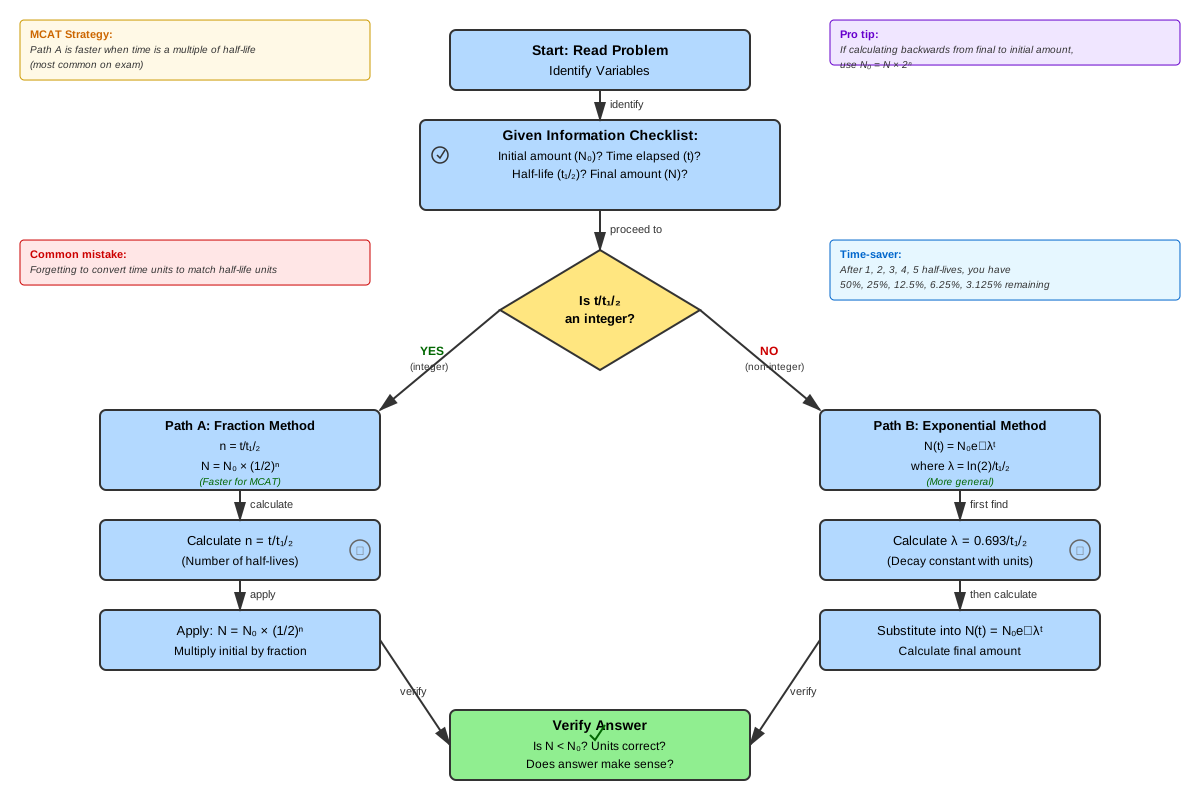
When encountering half-life questions on the MCAT, first identify the question type:
- Direct calculation: Given initial amount, half-life, and time → find remaining amount
- Reverse calculation: Given remaining fraction and half-life → find elapsed time
- Graph interpretation: Extract half-life from decay curve or predict values
- Conceptual understanding: Test knowledge of half-life properties without calculation
- Integrated passage: Half-life embedded in medical or research context
Trigger Words and Phrases
Watch for these key phrases that signal half-life questions:
- "Radioactive decay," "nuclear decay," "disintegration"
- "Activity," "decay rate," "counts per minute"
- "Radioisotope," "radiotracer," "radiolabeled"
- "Time required for half," "50% remaining"
- Specific isotope names (Tc-99m, I-131, C-14, F-18)
- "Exponential decay," "first-order kinetics"
Systematic Problem-Solving Process
Step 1: Extract given information
- Initial quantity (N₀ or A₀)
- Half-life (t₁/₂)
- Elapsed time (t) or remaining fraction
Step 2: Calculate number of half-lives
- n = t / t₁/₂
- Or determine n from remaining fraction: if 25% remains, n = 2
Step 3: Apply the simplified formula
- N(t) = N₀ × (1/2)ⁿ
- Avoid exponential equations unless necessary
Step 4: Check answer reasonableness
- After each half-life, quantity should halve
- Remaining amount must be less than initial amount
- Time cannot be negative
Process of Elimination Tips
When unsure of the correct answer:
- Eliminate answers where remaining amount exceeds initial amount (physically impossible)
- Eliminate answers suggesting complete decay unless many half-lives have passed (>10)
- Check dimensional analysis: ensure units match (if given in mg, answer should be in mg)
- Use benchmark values: after 1 half-life → 50%, after 2 → 25%, after 3 → 12.5%
- For graph questions: the half-life is constant, so equal time intervals should show equal fractional decreases
Time Management
Half-life calculations should take 45-90 seconds for straightforward problems. If a calculation becomes complex:
- Simplify: Look for integer or simple fractional half-lives
- Estimate: Use powers of 2 (2, 4, 8, 16, 32) for quick mental math
- Skip and return: If stuck on logarithmic calculations, mark and return after completing easier questions
Exam Tip: Create a quick reference table before starting calculations: 1 half-life = 50%, 2 = 25%, 3 = 12.5%, 4 = 6.25%. This saves time and reduces errors during the exam.
Memory Techniques
The "Halving Cascade" Mnemonic
Remember the sequence: "Half, Quarter, Eighth, Sixteenth" (HQES)
- 1 half-life → Half (50%)
- 2 half-lives → Quarter (25%)
- 3 half-lives → Eighth (12.5%)
- 4 half-lives → Sixteenth (6.25%)
The "0.693 Rule" Memory Aid
"Lucky 693" - Remember that ln(2) ≈ 0.693, which connects half-life and decay constant:
- t₁/₂ = 0.693 / λ
- Think: "To find half-life, divide lucky 693 by lambda"
Medical Isotope Memory Device
"Tech Fixes Bones In 6, Iodine Treats Thyroids In 8"
- Tech(netium-99m) → bone scans → 6 hours half-life
- Iodine-131 → thyroid treatment → 8 days half-life
Visualization Strategy: The Cookie Jar Method
Visualize a jar of cookies being eaten where exactly half disappear at regular intervals:
- Start: 16 cookies (N₀)
- After 1 period: 8 cookies (1 half-life)
- After 2 periods: 4 cookies (2 half-lives)
- After 3 periods: 2 cookies (3 half-lives)
- After 4 periods: 1 cookie (4 half-lives)
This concrete visualization helps internalize exponential decay and prevents the misconception that everything disappears after two half-lives.
Formula Organization Acronym: "HAND"
Half-life formula: t₁/₂ = 0.693/λ
Amount remaining: N(t) = N₀(1/2)ⁿ
Number of half-lives: n = t/t₁/₂
Decay constant relationship: λ = 0.693/t₁/₂
Summary
Half-life is the time required for exactly half of a radioactive sample to decay, representing a fundamental property of each radioactive isotope that remains constant regardless of external conditions. The mathematical framework involves exponential decay described by N(t) = N₀(1/2)ⁿ, where n represents the number of half-lives elapsed. This simplified approach allows rapid calculation without requiring complex exponential functions, making it ideal for MCAT problem-solving. The decay constant (λ) relates to half-life through t₁/₂ = 0.693/λ, connecting probabilistic quantum processes to measurable quantities. Activity (decay rate) decreases with the same half-life as the number of radioactive nuclei, crucial for medical dosing and radiation safety. On the MCAT, half-life appears in calculations, graph interpretation, and passage-based questions involving nuclear medicine, radiocarbon dating, and radiation safety. Common pitfalls include confusing remaining fraction with decayed fraction, assuming complete decay after two half-lives, and incorrectly believing that half-life varies with external conditions. Mastery requires understanding both the conceptual foundation and computational techniques, including recognition of benchmark values (50%, 25%, 12.5%) and systematic problem-solving approaches that prioritize efficiency and accuracy.
Key Takeaways
- Half-life (t₁/₂) is the constant time for half of a radioactive sample to decay, independent of initial quantity and external conditions
- The simplified calculation formula N(t) = N₀(1/2)ⁿ, where n = t/t₁/₂, enables rapid problem-solving without calculators
- After n half-lives, the remaining fraction is (1/2)ⁿ: 1 → 50%, 2 → 25%, 3 → 12.5%, 4 → 6.25%
- The decay constant and half-life are inversely related: λ = 0.693/t₁/₂
- Activity (decay rate) follows the same exponential decay pattern as the number of radioactive nuclei
- Common MCAT isotopes include Tc-99m (6 hours), I-131 (8 days), and C-14 (5,730 years)
- Effective half-life in biological systems is always shorter than physical half-life alone due to combined decay and excretion
Related Topics
Radioactive Decay Modes (Alpha, Beta, Gamma): Understanding the specific types of nuclear decay processes that occur during radioactive transformation, including particle emission and energy release. Mastering half-life provides the temporal framework for these decay processes.
Nuclear Binding Energy and Mass Defect: The energy considerations that determine nuclear stability and why certain isotopes undergo radioactive decay. Half-life quantifies the rate at which unstable nuclei seek stability.
Exponential Functions in Physics: Mathematical treatment of exponential growth and decay appears throughout physics (RC circuits, damped oscillations) and chemistry (first-order kinetics). Half-life mastery strengthens general exponential reasoning skills.
Medical Imaging Techniques: PET scans, SPECT imaging, and other nuclear medicine modalities rely on radioactive tracers with appropriate half-lives. Understanding half-life enables evaluation of imaging protocols and radiation safety.
Pharmacokinetics and Drug Half-Life: The biological half-life concept extends to drug metabolism and elimination, creating connections between physics and biochemistry tested on the MCAT.
Practice CTA
Now that you've mastered the core concepts of half-life, it's time to solidify your understanding through active practice. Attempt the practice questions and flashcards to test your ability to apply these principles under exam-like conditions. Focus on both computational accuracy and conceptual understanding—the MCAT rewards students who can rapidly identify question types and execute efficient solution strategies. Remember that half-life questions are highly predictable in structure, making them excellent opportunities to gain confident, quick points on test day. Each practice problem you complete strengthens your pattern recognition and builds the automaticity needed for peak performance. You've built a strong foundation—now transform that knowledge into exam success through deliberate practice!
Sign up free to keep reading
Create a free AnvayaPrep account to finish this MCAT guide on Half life — plus flashcards and practice questions.