Overview
Nuclear binding energy is a fundamental concept in Atomic and Nuclear Physics that explains the stability of atomic nuclei and the enormous energy changes involved in nuclear reactions. This topic represents the intersection of Einstein's mass-energy equivalence principle and the strong nuclear force, making it essential for understanding both nuclear stability and the energy released in fission and fusion processes. On the MCAT, nuclear binding energy appears regularly in passages involving nuclear medicine, radioactive decay, energy production, and fundamental particle physics.
Understanding nuclear binding energy requires mastering the relationship between mass defect and energy, recognizing binding energy per nucleon trends across the periodic table, and applying these concepts to predict nuclear stability and reaction energetics. The MCAT frequently tests this topic through calculation-based questions, graph interpretation, and conceptual questions about nuclear processes. Students must be comfortable converting between mass units and energy units, interpreting binding energy curves, and explaining why certain nuclear reactions release energy while others require energy input.
This topic connects directly to other Physics concepts including conservation of energy, Einstein's special relativity, electrostatic forces, and the fundamental forces of nature. It also bridges to chemistry concepts such as periodic trends and reaction energetics, making it a high-yield interdisciplinary topic that exemplifies the integrative nature of MCAT questions.
Learning Objectives
- [ ] Define Nuclear binding energy using accurate Physics terminology
- [ ] Explain why Nuclear binding energy matters for the MCAT
- [ ] Apply Nuclear binding energy to exam-style questions
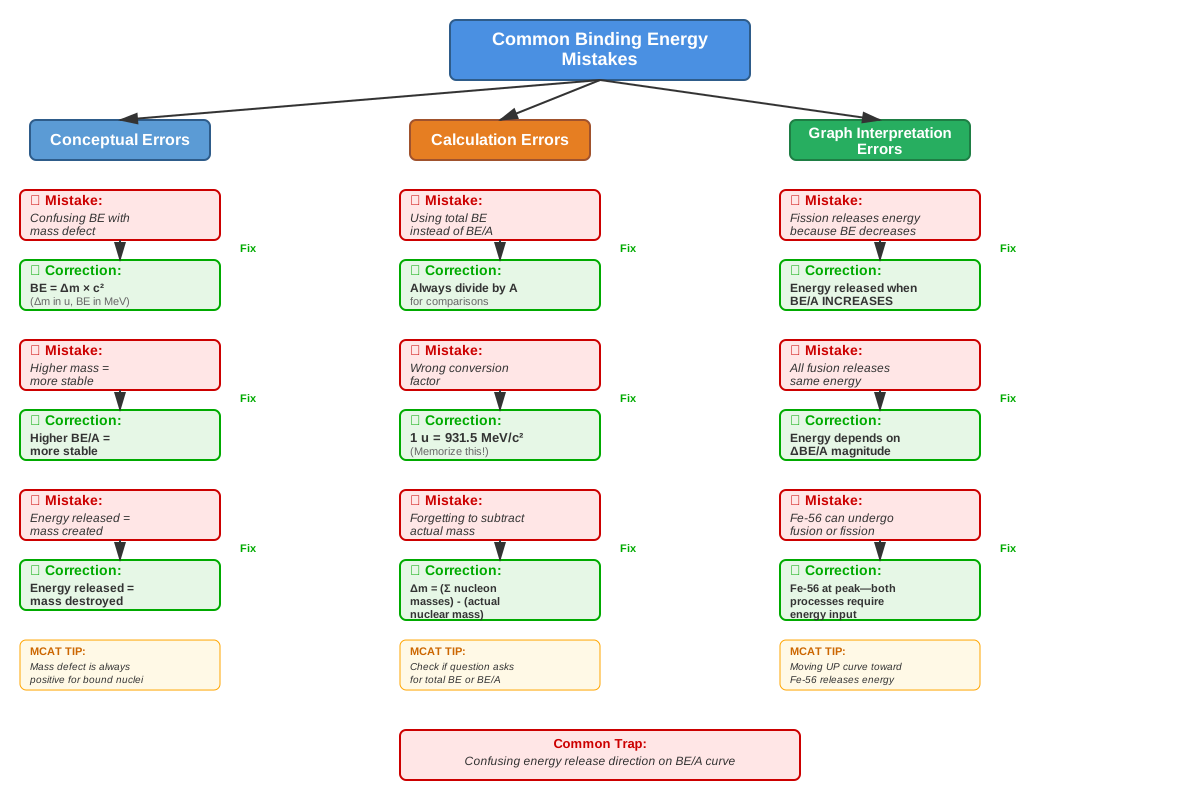
- [ ] Identify common mistakes related to Nuclear binding energy
- [ ] Connect Nuclear binding energy to related Physics concepts
- [ ] Calculate mass defect and convert it to binding energy using E=mc²
- [ ] Interpret binding energy per nucleon curves and predict nuclear stability
- [ ] Determine whether nuclear reactions are exothermic or endothermic based on binding energy changes
- [ ] Compare the energy yields of fission, fusion, and chemical reactions
Prerequisites
- Mass-energy equivalence (E=mc²): Essential for converting mass defect into binding energy and understanding the energy scale of nuclear processes
- Atomic structure (protons, neutrons, electrons): Required to understand nuclear composition and calculate mass defect
- Conservation of energy: Fundamental principle underlying all binding energy calculations and nuclear reaction energetics
- Scientific notation and unit conversions: Necessary for handling the extremely large and small numbers common in nuclear physics calculations
- Basic understanding of forces: Helps contextualize why the strong nuclear force creates binding energy by overcoming electrostatic repulsion
Why This Topic Matters
Nuclear binding energy has profound real-world applications that make it clinically and technologically relevant. Nuclear medicine relies on radioactive isotopes whose decay patterns depend on nuclear stability, which is directly determined by binding energy. PET scans use positron-emitting isotopes, radiation therapy targets tumors with high-energy particles from nuclear reactions, and radioactive tracers help diagnose various conditions—all applications rooted in nuclear binding energy principles.
On the MCAT, nuclear binding energy appears in approximately 2-4% of Physics questions, typically in the Atomic and Nuclear Physics subsection. Questions may appear as standalone discrete items but more commonly emerge in passages discussing nuclear power, medical imaging, radioactive dating, or fundamental physics research. The MCAT particularly favors questions that require interpreting binding energy per nucleon graphs, calculating energy released in nuclear reactions, and comparing nuclear versus chemical energy scales.
Common question formats include: (1) calculation problems requiring mass-to-energy conversions, (2) graph interpretation questions asking students to identify the most stable nuclei or predict reaction spontaneity, (3) conceptual questions about why fusion powers stars or why fission is used in nuclear reactors, and (4) passage-based questions integrating nuclear binding energy with medical applications or energy production. The interdisciplinary nature of this topic means it can appear in passages that seem primarily focused on chemistry, biology, or even social sciences discussing energy policy.
Core Concepts
Definition of Nuclear Binding Energy
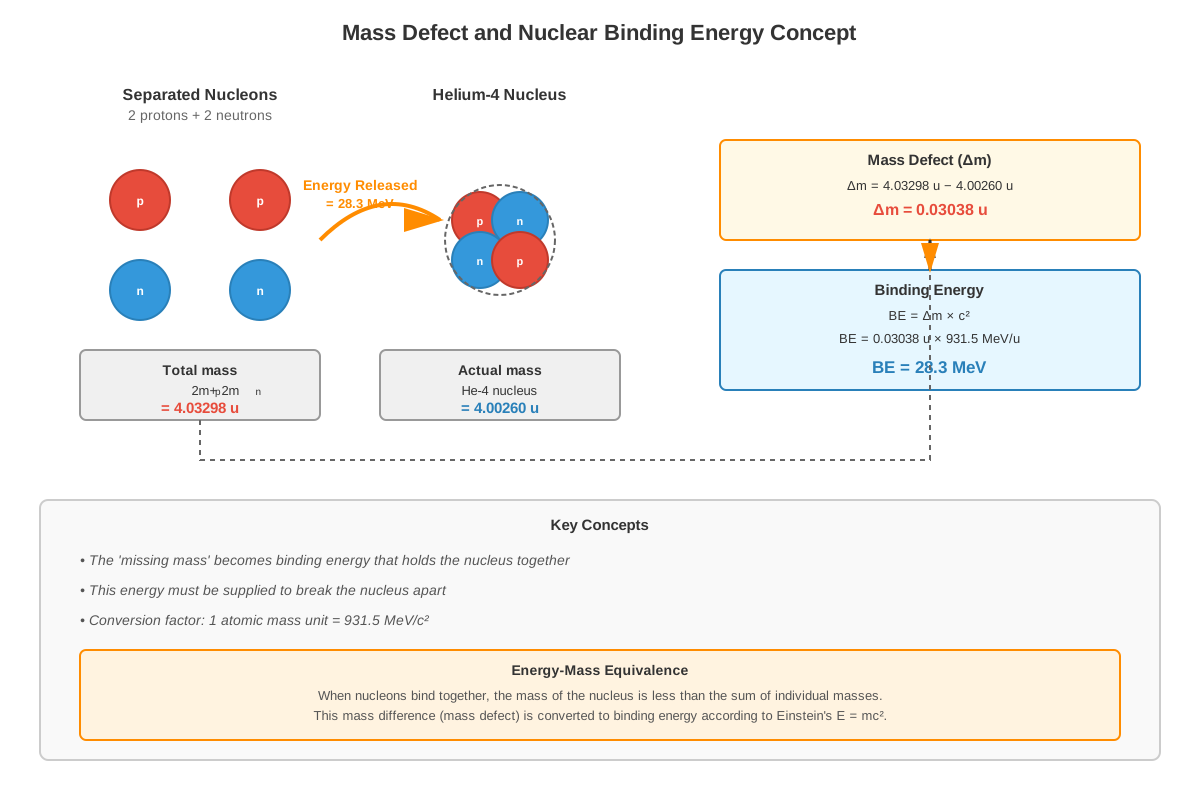
Nuclear binding energy is the energy required to completely disassemble a nucleus into its constituent protons and neutrons, separating them to infinite distance. Equivalently, it represents the energy released when individual nucleons (protons and neutrons) come together to form a nucleus. This energy arises from the strong nuclear force, one of the four fundamental forces of nature, which overcomes the electrostatic repulsion between positively charged protons and binds nucleons together.
The existence of binding energy reflects a fundamental principle: the mass of an intact nucleus is always less than the sum of the masses of its separated constituent nucleons. This "missing mass" is called the mass defect (Δm), and it has been converted into binding energy according to Einstein's mass-energy equivalence relationship.
Mass Defect and E=mc²
The mass defect is calculated by subtracting the actual nuclear mass from the sum of the individual nucleon masses:
Δm = (Z × m_proton + N × m_neutron) - m_nucleusWhere:
- Z = number of protons (atomic number)
- N = number of neutrons
- m_proton = mass of a single proton (1.007276 u)
- m_neutron = mass of a single neutron (1.008665 u)
- m_nucleus = actual measured mass of the nucleus
- u = unified atomic mass unit (1 u = 1.66054 × 10⁻²⁷ kg)
The binding energy (BE) is then calculated using Einstein's equation:
BE = Δm × c²Where c = speed of light (3.00 × 10⁸ m/s)
For MCAT purposes, a crucial conversion factor is:
1 u = 931.5 MeV/c²
This allows direct conversion: if Δm is expressed in atomic mass units (u), then:
BE (MeV) = Δm (u) × 931.5 MeV/uBinding Energy Per Nucleon
While total binding energy increases with atomic mass, binding energy per nucleon (BE/A, where A is the mass number) provides a better measure of nuclear stability. This quantity represents the average energy required to remove one nucleon from the nucleus.
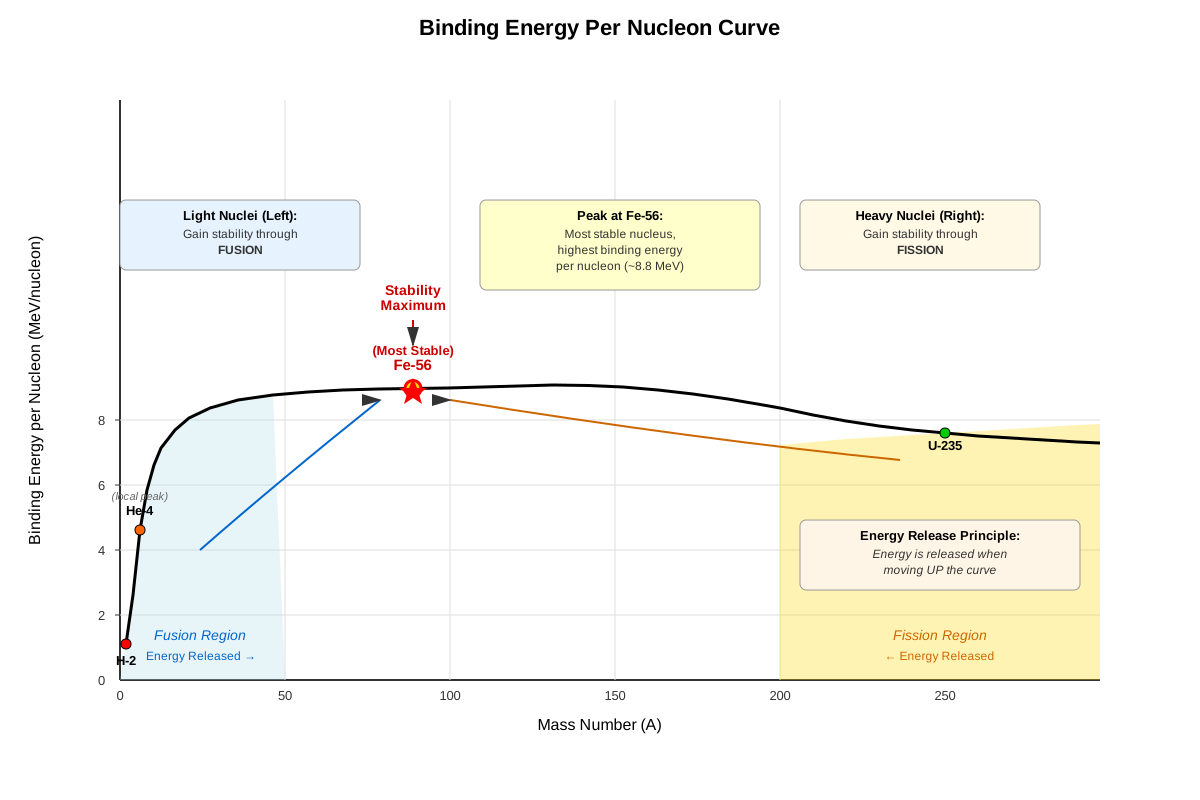
The binding energy per nucleon varies systematically across the periodic table, creating a characteristic curve with several important features:
| Region | Approximate BE/A | Examples | Characteristics |
|---|---|---|---|
| Light nuclei (A < 20) | 1-7 MeV | H, He, Li | Generally low; exceptions include He-4 |
| Intermediate nuclei (20 < A < 100) | 8-8.8 MeV | Fe, Ni, Co | Maximum stability; peak around Fe-56 |
| Heavy nuclei (A > 100) | 7.5-8 MeV | U, Pu, Th | Gradually decreasing stability |
Iron-56 (⁵⁶Fe) has the highest binding energy per nucleon (~8.8 MeV), making it the most stable nucleus. This fact has profound implications for stellar nucleosynthesis and nuclear reaction energetics.
Nuclear Stability and the Binding Energy Curve
The binding energy per nucleon curve reveals why certain nuclear processes release energy:
- Fusion (combining light nuclei): Moving up the left side of the curve increases BE/A, releasing energy. This powers stars and hydrogen bombs.
- Fission (splitting heavy nuclei): Moving down the right side of the curve increases BE/A, releasing energy. This powers nuclear reactors and atomic bombs.
- Nuclei near iron: Cannot release energy through either fusion or fission since they're already at the stability peak.
The curve's shape results from competing factors:
- Strong nuclear force: Short-range attractive force between all nucleons; increases binding energy
- Electrostatic repulsion: Long-range repulsive force between protons; decreases binding energy in heavy nuclei
- Surface effects: Nucleons on the nuclear surface are less tightly bound
- Pairing effects: Even numbers of protons or neutrons increase stability
Energy Released in Nuclear Reactions
For any nuclear reaction, the energy released (Q-value) equals the change in total binding energy:
Q = BE_products - BE_reactantsIf Q > 0, the reaction is exothermic (releases energy)
If Q < 0, the reaction is endothermic (requires energy input)
Alternatively, Q can be calculated from mass changes:
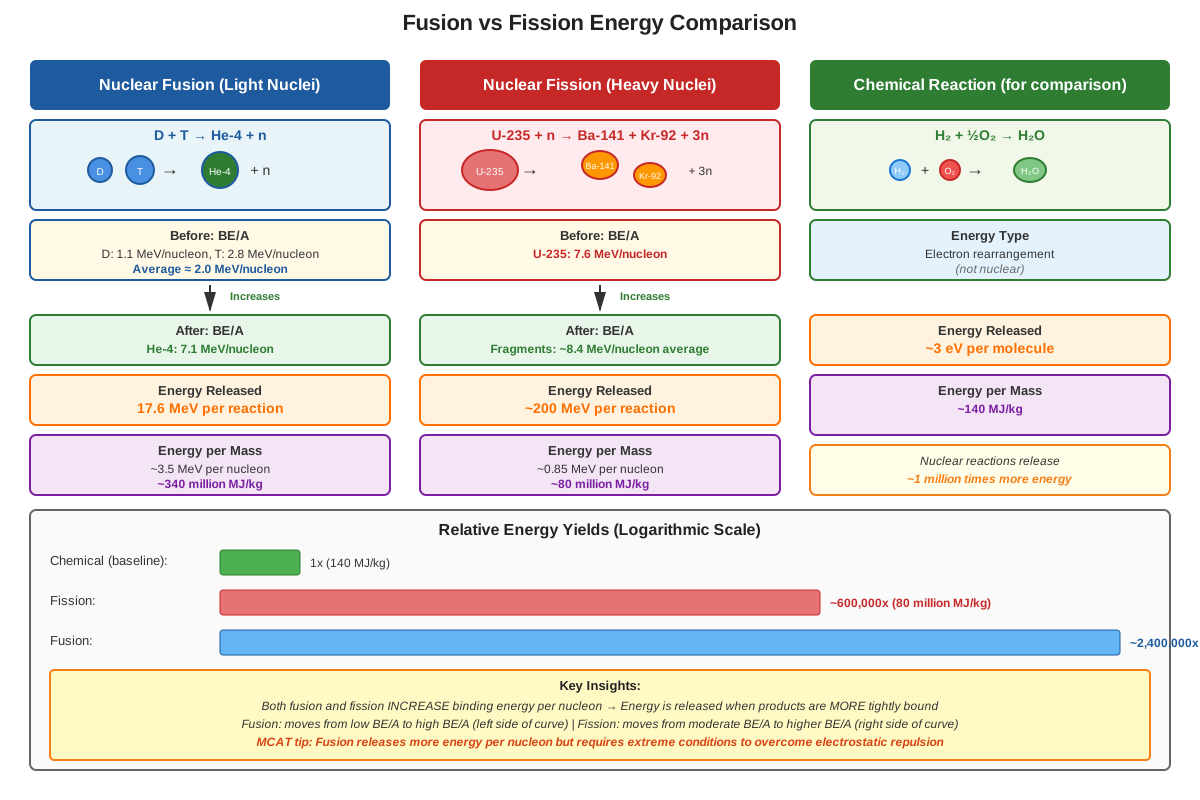
Q = (m_reactants - m_products) × c²The energy scale of nuclear reactions dwarfs chemical reactions. Nuclear reactions typically release millions of electron volts (MeV) per reaction, while chemical reactions release only a few electron volts (eV). This million-fold difference explains why nuclear fuels are so energy-dense.
Fusion Reactions
Nuclear fusion combines light nuclei to form heavier ones. The most important fusion reactions for the MCAT involve hydrogen isotopes:
Deuterium-Tritium fusion (most easily achieved):
²H + ³H → ⁴He + n + 17.6 MeV
Proton-proton chain (powers the Sun):
Multiple steps ultimately converting 4 ¹H → ⁴He + 2e⁺ + 2ν + 26.7 MeV
Fusion requires extremely high temperatures (millions of degrees) to overcome electrostatic repulsion between positively charged nuclei. This is why fusion occurs naturally only in stellar cores and requires sophisticated confinement in terrestrial reactors.
Fission Reactions
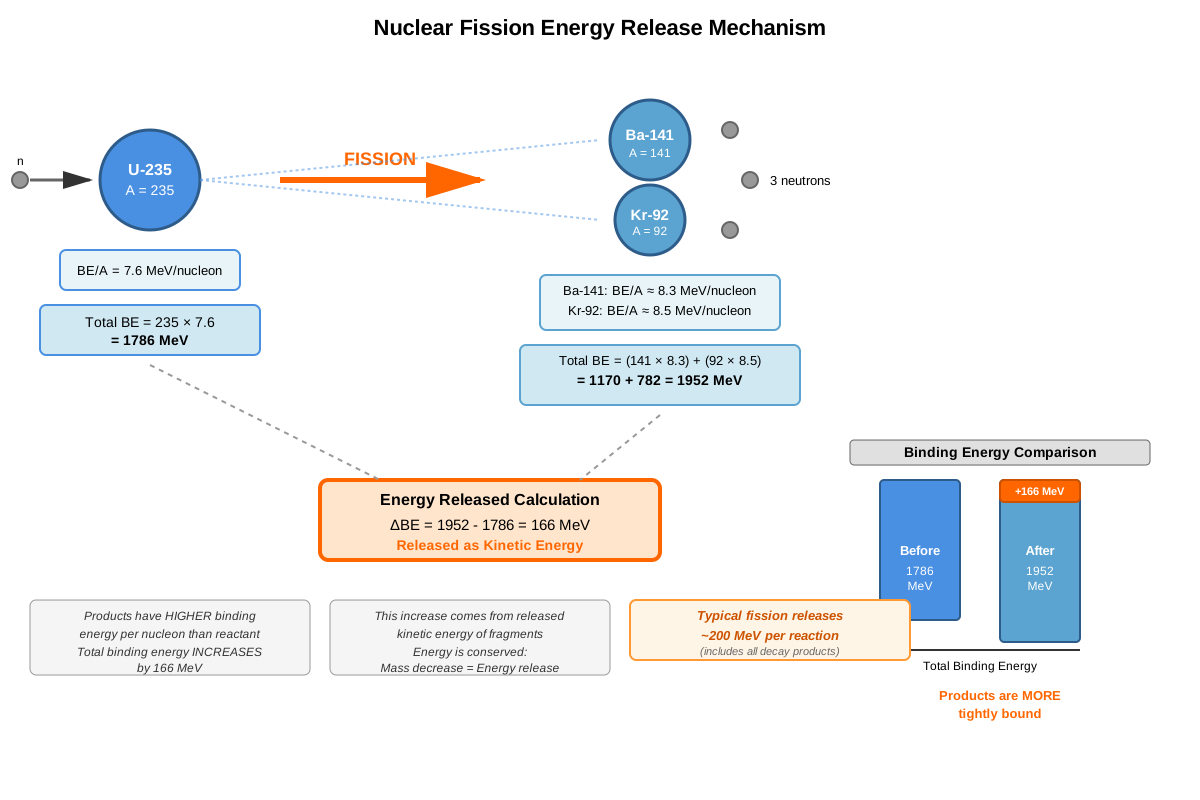
Nuclear fission splits heavy nuclei into lighter fragments. The most common fission reaction for MCAT purposes:
²³⁵U + n → ⁹²Kr + ¹⁴¹Ba + 3n + ~200 MeV
Key features of fission:
- Initiated by neutron absorption
- Produces multiple neutrons (enabling chain reactions)
- Releases ~200 MeV per fission event
- Products are typically radioactive (nuclear waste issue)
- Occurs spontaneously in very heavy elements but requires neutron bombardment for U-235
Concept Relationships
The concepts within Nuclear binding energy Physics form an interconnected framework. The mass defect serves as the foundation, representing the measurable difference between separated and bound nucleons. This mass defect directly converts to binding energy through E=mc², establishing the quantitative relationship between mass and energy that underlies all nuclear energetics.
Binding energy per nucleon emerges from total binding energy by normalization, providing the stability metric that explains the binding energy curve. This curve, in turn, predicts which nuclear processes release energy: fusion for light nuclei moving toward iron, and fission for heavy nuclei moving toward iron. Both processes increase the average binding energy per nucleon, releasing the difference as kinetic energy.
The relationship map flows as follows:
Strong nuclear force → overcomes electrostatic repulsion → creates mass defect → converts via E=mc² → produces binding energy → normalized by nucleon count → yields binding energy per nucleon → plotted across elements → creates binding energy curve → predicts energy release in fusion (light nuclei) and fission (heavy nuclei) → explains nuclear stability and reaction energetics
This topic connects to prerequisite knowledge of atomic structure (provides nucleon counts for calculations), E=mc² (enables mass-energy conversions), and conservation of energy (ensures energy accounting in reactions). It extends forward to radioactive decay (unstable nuclei seek higher binding energy states), nuclear medicine applications (isotope selection based on stability), and stellar evolution (fusion processes in stars).
High-Yield Facts
⭐ Iron-56 has the highest binding energy per nucleon (~8.8 MeV), making it the most stable nucleus
⭐ Nuclear binding energy is calculated using BE = Δm × c², where Δm is the mass defect
⭐ The conversion factor 1 u = 931.5 MeV/c² allows direct calculation of binding energy from mass defect in atomic mass units
⭐ Fusion releases energy for nuclei lighter than iron; fission releases energy for nuclei heavier than iron
⭐ Nuclear reactions release approximately one million times more energy per reaction than chemical reactions
- The mass of a nucleus is always less than the sum of its constituent nucleons' masses due to binding energy
- Binding energy per nucleon generally increases from hydrogen to iron, then gradually decreases for heavier elements
- Helium-4 shows anomalously high binding energy per nucleon for its mass, making it particularly stable
- The strong nuclear force is short-range (~10⁻¹⁵ m), while electrostatic repulsion is long-range, explaining why heavy nuclei are less stable
- Exothermic nuclear reactions have products with greater total binding energy than reactants
- The Sun's energy comes from fusion reactions converting hydrogen to helium, releasing ~26.7 MeV per helium nucleus formed
- Nuclear fission of U-235 releases approximately 200 MeV per fission event, with energy distributed among fission fragments, neutrons, and gamma rays
Quick check — test yourself on Nuclear binding energy so far.
Try Flashcards →Common Misconceptions
Misconception: Binding energy is the energy stored in the nucleus that can be released.
Correction: Binding energy is the energy that would be required to disassemble the nucleus. A higher binding energy means a more stable nucleus that is harder to break apart. Energy is released in nuclear reactions when the products have higher total binding energy than the reactants, not by "releasing" the binding energy itself.
Misconception: The mass defect represents mass that disappeared or was destroyed.
Correction: Mass is not destroyed; it is converted to energy according to E=mc². The "missing" mass exists as binding energy holding the nucleus together. This energy has mass equivalence, and if the nucleus were disassembled, that energy would need to be supplied, and the separated nucleons would have greater total mass.
Misconception: Higher binding energy per nucleon means the nucleus is less stable and easier to break apart.
Correction: Higher binding energy per nucleon indicates greater stability. It means more energy is required to remove each nucleon from the nucleus. Iron-56, with the highest BE/A, is the most stable nucleus, not the least stable.
Misconception: Fusion and fission both work for all nuclei to release energy.
Correction: Fusion releases energy only for nuclei lighter than iron (moving up the left side of the BE/A curve), while fission releases energy only for nuclei heavier than iron (moving down the right side). Nuclei near iron cannot release energy through either process because they're already at maximum stability.
Misconception: The energy released in nuclear reactions comes from converting matter to energy, destroying mass.
Correction: The energy comes from the difference in binding energy between reactants and products. When products are more tightly bound, the excess binding energy is released as kinetic energy. The total mass-energy is conserved; the products have slightly less mass because they have higher binding energy (which has negative mass equivalence in the bound state).
Misconception: Nuclear binding energy and electron binding energy are the same phenomenon.
Correction: Nuclear binding energy (MeV scale) results from the strong nuclear force holding nucleons together in the nucleus. Electron binding energy (eV scale) results from electromagnetic attraction between electrons and the nucleus. They differ by a factor of about one million in magnitude and involve completely different forces.
Worked Examples
Example 1: Calculating Binding Energy of Helium-4
Question: Calculate the binding energy of a helium-4 nucleus (⁴He) given the following masses:
- Proton mass: 1.007276 u
- Neutron mass: 1.008665 u
- Helium-4 nucleus mass: 4.001506 u
- Conversion factor: 1 u = 931.5 MeV/c²
Solution:
Step 1: Identify the nuclear composition
Helium-4 has Z = 2 protons and N = 2 neutrons (A = 4)
Step 2: Calculate the total mass of separated nucleons
Mass of separated nucleons = (2 × 1.007276 u) + (2 × 1.008665 u)
= 2.014552 u + 2.017330 u
= 4.031882 u
Step 3: Calculate the mass defect
Δm = mass of separated nucleons - mass of nucleus
Δm = 4.031882 u - 4.001506 u
Δm = 0.030376 u
Step 4: Convert mass defect to binding energy
BE = Δm × 931.5 MeV/u
BE = 0.030376 u × 931.5 MeV/u
BE = 28.3 MeV
Step 5: Calculate binding energy per nucleon
BE/A = 28.3 MeV / 4 nucleons
BE/A = 7.08 MeV per nucleon
Interpretation: Helium-4 has a relatively high binding energy per nucleon for such a light element, explaining its exceptional stability. This connects to Learning Objective: Apply Nuclear binding energy to exam-style questions.
Example 2: Determining Energy Release in a Fusion Reaction
Question: Consider the deuterium-tritium fusion reaction:
²H + ³H → ⁴He + n
Given binding energies:
- ²H: 2.22 MeV total
- ³H: 8.48 MeV total
- ⁴He: 28.3 MeV total
- Neutron: 0 MeV (free particle)
Calculate the energy released in this reaction and explain why this reaction powers fusion reactors.
Solution:
Step 1: Calculate total binding energy of reactants
BE_reactants = BE(²H) + BE(³H)
BE_reactants = 2.22 MeV + 8.48 MeV = 10.70 MeV
Step 2: Calculate total binding energy of products
BE_products = BE(⁴He) + BE(n)
BE_products = 28.3 MeV + 0 MeV = 28.3 MeV
Step 3: Calculate energy released (Q-value)
Q = BE_products - BE_reactants
Q = 28.3 MeV - 10.70 MeV
Q = 17.6 MeV
Step 4: Interpret the result
Since Q > 0, this reaction is exothermic and releases 17.6 MeV of energy. This energy appears as kinetic energy of the helium nucleus and neutron.
Step 5: Explain significance for fusion reactors
This reaction releases 17.6 MeV per fusion event. For comparison:
- Burning one carbon atom releases ~4 eV
- This fusion reaction releases ~4 million times more energy per reaction
- The deuterium-tritium reaction has the largest cross-section (highest probability) at achievable temperatures (~100 million K), making it the most practical fusion reaction for terrestrial reactors
The products (helium-4 and neutron) have higher total binding energy than the reactants, meaning they are more tightly bound. The "extra" binding energy is released as kinetic energy. This exemplifies the principle that fusion of light nuclei releases energy by moving toward the iron-56 stability peak on the binding energy curve.
Connection to Learning Objectives: This problem demonstrates applying nuclear binding energy to exam-style questions, connecting to related physics concepts (energy conservation), and explaining why nuclear binding energy matters (practical fusion energy applications).
Exam Strategy
When approaching Nuclear binding energy MCAT questions, begin by identifying the question type: calculation, graph interpretation, or conceptual. For calculation questions, immediately note whether you're given masses (requiring mass defect calculation) or binding energies (requiring direct comparison). Write down the relevant equation before attempting calculations to avoid algebraic errors under time pressure.
Exam Tip: If a question provides atomic masses rather than nuclear masses, remember that atomic mass includes electrons. For high-precision calculations, subtract electron masses, but for MCAT-level problems, this correction is usually negligible and can be ignored unless specifically mentioned.
Trigger words and phrases to watch for:
- "Most stable nucleus" → Look for highest BE/A (iron-56)
- "Energy released" → Calculate Q = BE_products - BE_reactants
- "Mass defect" → Signals a calculation using Δm and E=mc²
- "Fusion" or "fission" → Determine position relative to iron on BE/A curve
- "Binding energy per nucleon" → Requires normalization by mass number A
Process of elimination strategies:
- For stability questions, eliminate any answer suggesting nuclei far from iron-56 are most stable
- For energy release questions, eliminate answers that violate energy conservation or give energies in the wrong scale (eV vs MeV)
- For fusion/fission questions, eliminate answers that suggest energy release for reactions moving away from iron-56 on the stability curve
- For calculation questions, eliminate answers that differ by orders of magnitude from your estimate
Time allocation: Straightforward binding energy calculations should take 60-90 seconds. Graph interpretation questions typically require 45-60 seconds. Passage-based questions integrating nuclear binding energy with other concepts may require 90-120 seconds. If a calculation becomes algebraically complex, consider whether the question is asking for a qualitative comparison rather than a precise numerical answer.
Common question patterns:
- Comparing energy yields of nuclear vs. chemical reactions (expect ~10⁶ ratio)
- Identifying which nuclear reaction releases more energy based on position on BE/A curve
- Calculating mass defect from given masses and converting to energy
- Explaining why certain isotopes are used in medical applications based on stability
Memory Techniques
Mnemonic for binding energy calculation steps: "SCAM"
- Separate nucleons (calculate total mass)
- Compare to nucleus (find mass defect)
- Apply E=mc² (convert to energy)
- Multiply by 931.5 (if using atomic mass units)
Visualization for the binding energy curve: Picture a valley with iron at the bottom. Light nuclei (hydrogen, helium) are on the left slope, heavy nuclei (uranium, plutonium) are on the right slope. Rolling down either slope releases energy—fusion pushes light nuclei down the left slope, fission pushes heavy nuclei down the right slope. Iron sits at the bottom and can't roll anywhere to release energy.
Acronym for fusion fuel: "DT Fusion"
- Deuterium
- Tritium
- Fusion (easiest to achieve, releases 17.6 MeV)
Memory aid for conversion factor: "Nine-Three-One point Five" (931.5 MeV/u) can be remembered as "nine thirty-one and a half" like a time (9:31:30). This unusual time helps the number stick.
Conceptual anchor: "Binding energy is like debt"—the more binding energy a nucleus has, the more energy you'd need to "pay" to break it apart. A nucleus with high binding energy is like being deeply in debt (stable, hard to break), while low binding energy is like having little debt (unstable, easy to break). This reverses the intuitive misconception that high binding energy means easy to break.
Summary
Nuclear binding energy represents the energy required to disassemble a nucleus into separated protons and neutrons, arising from the strong nuclear force that overcomes electrostatic repulsion. The mass defect—the difference between the mass of separated nucleons and the intact nucleus—converts to binding energy via E=mc², with the key conversion factor 1 u = 931.5 MeV/c². Binding energy per nucleon provides the best stability metric, reaching maximum at iron-56 (~8.8 MeV per nucleon). The characteristic binding energy curve explains why fusion releases energy for light nuclei (moving toward iron) and fission releases energy for heavy nuclei (also moving toward iron). Nuclear reactions release approximately one million times more energy than chemical reactions, making them relevant for power generation, stellar processes, and medical applications. MCAT questions test calculation skills (mass defect to binding energy), graph interpretation (stability predictions from BE/A curves), and conceptual understanding (why specific reactions release energy). Mastering this topic requires comfort with unit conversions, energy conservation principles, and the relationship between nuclear stability and binding energy.
Key Takeaways
- Nuclear binding energy is the energy required to disassemble a nucleus; higher binding energy indicates greater stability
- Mass defect (Δm) converts to binding energy using BE = Δm × c², with 1 u = 931.5 MeV/c² for MCAT calculations
- Iron-56 has the highest binding energy per nucleon (~8.8 MeV), making it the most stable nucleus
- Fusion releases energy for nuclei lighter than iron; fission releases energy for nuclei heavier than iron
- Nuclear reactions release ~10⁶ times more energy than chemical reactions due to the strong nuclear force
- Energy released in nuclear reactions equals the increase in total binding energy: Q = BE_products - BE_reactants
- The binding energy per nucleon curve predicts nuclear stability and explains stellar nucleosynthesis and nuclear power
Related Topics
Radioactive Decay: Nuclear binding energy determines which nuclei are unstable and will undergo radioactive decay. Unstable nuclei decay to achieve configurations with higher binding energy per nucleon, releasing energy in the process. Understanding binding energy curves helps predict decay modes and daughter products.
Mass-Energy Equivalence (E=mc²): This fundamental principle from special relativity underlies all binding energy calculations. Mastering nuclear binding energy deepens understanding of how mass and energy are interconvertible and why the speed of light squared creates such enormous energy yields from small mass changes.
Nuclear Medicine Applications: PET scans, radiation therapy, and radioactive tracers all depend on isotope selection based on nuclear stability and decay properties. Binding energy concepts explain why certain isotopes are preferred for medical applications and how they release energy for imaging or treatment.
Stellar Nucleosynthesis: The life cycle of stars—from hydrogen fusion in main sequence stars to supernova nucleosynthesis—is entirely governed by binding energy principles. Understanding why fusion proceeds up to iron and why heavier elements require supernova conditions connects nuclear physics to astrophysics.
Nuclear Power and Weapons: Both fission reactors and fusion research depend on binding energy principles. Understanding chain reactions, critical mass, and energy yields requires mastery of binding energy calculations and stability predictions.
Practice CTA
Now that you've mastered the core concepts of Nuclear binding energy, it's time to solidify your understanding through active practice. Attempt the practice questions and flashcards associated with this topic to test your ability to calculate mass defects, interpret binding energy curves, and predict nuclear reaction energetics. Focus especially on questions that integrate multiple concepts—these mirror the interdisciplinary nature of actual MCAT passages. Remember, nuclear binding energy is a high-yield topic that appears regularly on the exam, and your investment in mastering these calculations and concepts will pay dividends on test day. Challenge yourself with timed practice to build both accuracy and speed, and review any mistakes to identify gaps in understanding. You've got this!
Sign up free to keep reading
Create a free AnvayaPrep account to finish this MCAT guide on Nuclear binding energy — plus flashcards and practice questions.