Overview
Radioactive decay is a spontaneous nuclear process in which unstable atomic nuclei lose energy by emitting radiation in the form of particles or electromagnetic waves. This fundamental concept in Atomic and Nuclear Physics represents one of the most clinically relevant topics in Physics for the MCAT, bridging theoretical nuclear science with practical medical applications. Understanding radioactive decay is essential for interpreting diagnostic imaging techniques, radiation therapy protocols, and radioisotope dating methods that appear frequently in both the Chemical and Physical Foundations of Biological Systems section and interdisciplinary passages.
The MCAT tests radioactive decay through quantitative problems involving half-life calculations, qualitative questions about decay mechanisms, and passage-based questions that integrate nuclear physics with biochemistry or medical applications. Students must master the mathematical relationships governing decay rates, recognize different types of radioactive emissions, and understand how nuclear stability influences decay pathways. This topic connects directly to atomic structure, energy conservation, and exponential functions—mathematical tools that appear throughout the physical sciences sections of the exam.
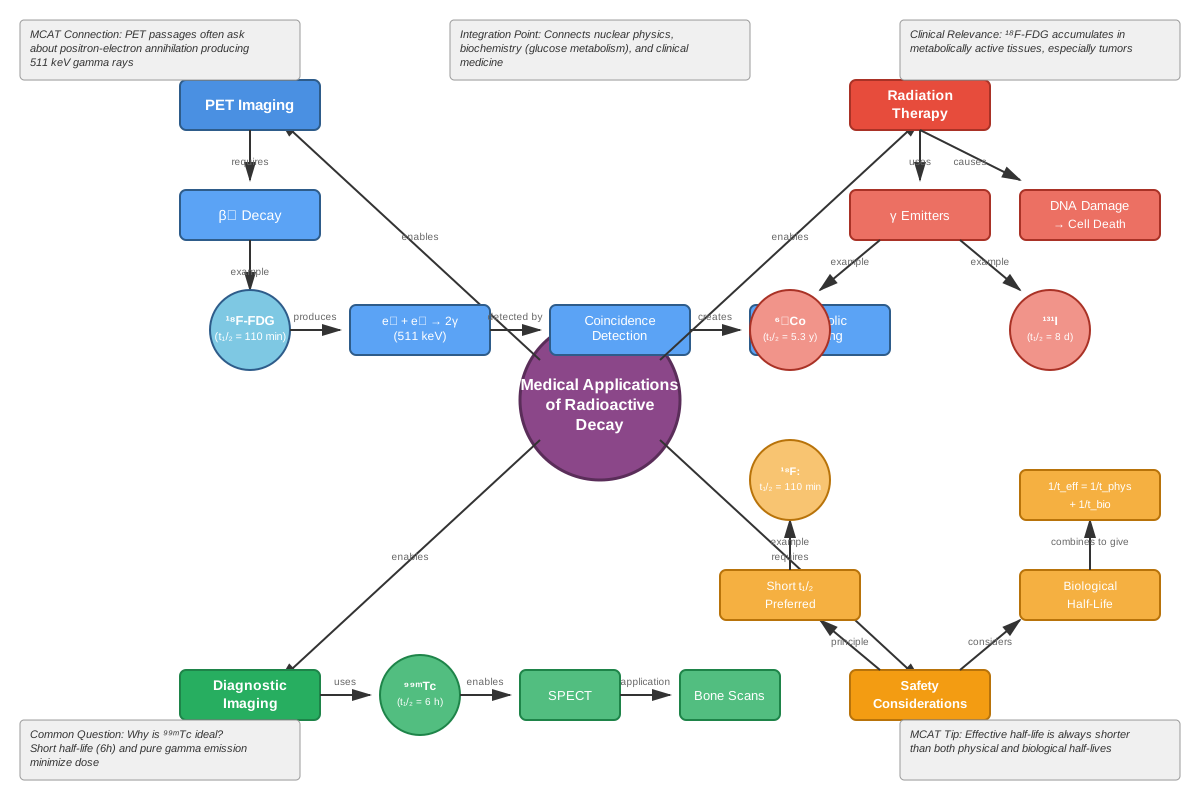
Beyond exam performance, radioactive decay knowledge provides the foundation for understanding modern medical technologies. Positron emission tomography (PET) scans rely on beta-plus decay, radiation oncology uses gamma-emitting isotopes for cancer treatment, and carbon-14 dating employs first-order decay kinetics. The MCAT frequently presents clinical vignettes requiring students to apply decay principles to real-world scenarios, making this topic both high-yield for test performance and essential for future medical practice.
Learning Objectives
- [ ] Define radioactive decay using accurate Physics terminology
- [ ] Explain why radioactive decay matters for the MCAT
- [ ] Apply radioactive decay to exam-style questions
- [ ] Identify common mistakes related to radioactive decay
- [ ] Connect radioactive decay to related Physics concepts
- [ ] Calculate the remaining quantity of a radioactive sample after a given time using half-life equations
- [ ] Distinguish between alpha, beta, and gamma decay based on particle properties and nuclear equations
- [ ] Predict nuclear stability and decay pathways using the neutron-to-proton ratio
- [ ] Interpret decay curves and determine decay constants from graphical data
Prerequisites
- Atomic structure and notation: Understanding atomic number (Z), mass number (A), and isotope notation is essential for writing and balancing nuclear equations
- Exponential functions and logarithms: Radioactive decay follows first-order kinetics requiring manipulation of exponential equations and natural logarithms
- Energy and mass equivalence (E=mc²): Nuclear reactions involve mass defects and energy release that require understanding Einstein's mass-energy relationship
- Conservation laws: Nuclear processes must conserve charge, mass number, and energy—fundamental principles from classical physics
- Basic chemistry concepts: Knowledge of the periodic table, element symbols, and chemical versus nuclear reactions provides context for nuclear transformations
Why This Topic Matters
Radioactive decay appears in approximately 2-4 questions per MCAT exam, making it a medium-yield topic that can significantly impact scores when mastered. The topic appears most frequently in discrete questions testing half-life calculations and in passage-based questions integrating nuclear medicine with physiology or biochemistry. Recent MCAT exams have featured passages on radiopharmaceuticals, carbon dating of biological specimens, and radiation safety in medical settings.
Clinically, radioactive decay underpins numerous diagnostic and therapeutic modalities. Technetium-99m, the most commonly used medical radioisotope, has a 6-hour half-life ideal for imaging procedures. Iodine-131 treats thyroid disorders through targeted beta decay. PET scans detect positron-emitting isotopes like fluorine-18 to visualize metabolic activity in tumors and brain tissue. Understanding decay kinetics allows physicians to calculate appropriate dosing intervals, minimize radiation exposure, and interpret time-sensitive imaging results.
The MCAT presents radioactive decay through multiple question formats: standalone calculations requiring half-life formulas, passage analysis of experimental radioisotope studies, and interdisciplinary questions connecting nuclear physics to biological systems. Questions often embed decay calculations within clinical scenarios, requiring students to extract relevant information from complex passages while applying mathematical relationships under time pressure. Mastery of this topic demonstrates quantitative reasoning skills and scientific literacy that medical schools value highly.
Core Concepts
Definition and Fundamental Nature of Radioactive Decay
Radioactive decay is a spontaneous, random process by which an unstable atomic nucleus loses energy through the emission of ionizing radiation. This process is fundamentally different from chemical reactions because it involves changes to the nucleus itself rather than electron rearrangements. The decay process is stochastic at the individual atom level—it is impossible to predict when a specific nucleus will decay—but becomes statistically predictable for large populations of atoms.
The driving force behind radioactive decay is nuclear instability. Nuclei exist in a delicate balance between the strong nuclear force (which binds protons and neutrons together) and electromagnetic repulsion (which pushes protons apart). When this balance is disrupted—typically due to an unfavorable neutron-to-proton ratio or excess energy—the nucleus spontaneously transforms to achieve greater stability. This transformation releases energy in accordance with Einstein's mass-energy equivalence principle, as the products have slightly less mass than the original nucleus.
Types of Radioactive Decay
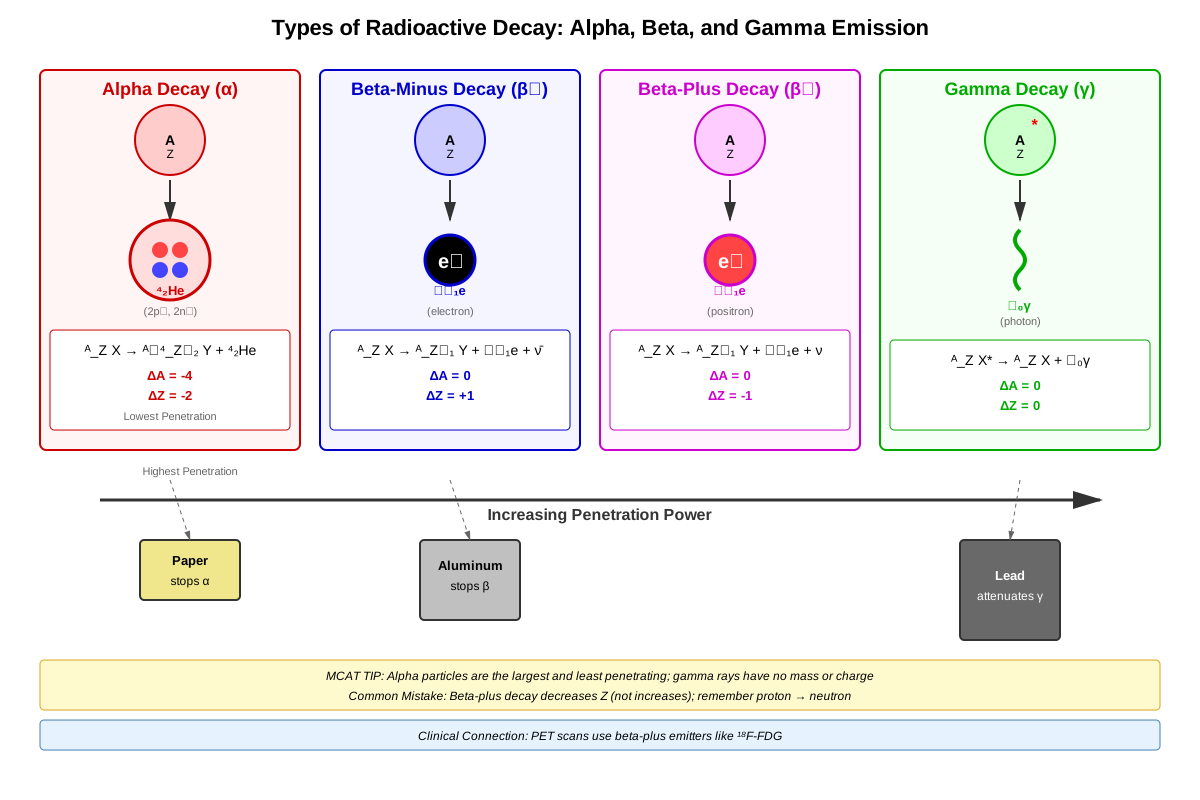
Alpha decay occurs when a nucleus emits an alpha particle (α), which consists of two protons and two neutrons—identical to a helium-4 nucleus (⁴₂He). This decay mode is common in heavy elements (Z > 82) where the nucleus is too large to remain stable. Alpha particles carry a +2 charge, have relatively high mass, and possess low penetrating power (stopped by paper or skin). The decay equation follows the pattern:
ᴬ_Z X → ᴬ⁻⁴_{Z-2} Y + ⁴₂HeFor example: ²³⁸₉₂U → ²³⁴₉₀Th + ⁴₂He
Beta-minus decay (β⁻) occurs when a neutron converts into a proton, emitting an electron and an antineutrino. This process increases the atomic number by one while maintaining the mass number. Beta-minus decay occurs in neutron-rich nuclei attempting to achieve a more favorable n/p ratio:
ᴬ_Z X → ᴬ_{Z+1} Y + ⁰₋₁e + ν̄For example: ¹⁴₆C → ¹⁴₇N + ⁰₋₁e + ν̄
Beta-plus decay (β⁺) or positron emission occurs when a proton converts into a neutron, emitting a positron (antimatter electron) and a neutrino. This decreases the atomic number by one and occurs in proton-rich nuclei:
ᴬ_Z X → ᴬ_{Z-1} Y + ⁰₊₁e + νFor example: ¹⁸₉F → ¹⁸₈O + ⁰₊₁e + ν
Gamma decay (γ) involves the emission of high-energy photons without changing the atomic or mass number. Gamma rays are electromagnetic radiation released when a nucleus transitions from an excited state to a lower energy state. Gamma emission often accompanies other decay modes as the daughter nucleus releases excess energy:
ᴬ_Z X* → ᴬ_Z X + γ| Decay Type | Particle Emitted | Change in Z | Change in A | Penetrating Power | Typical Cause |
|---|---|---|---|---|---|
| Alpha (α) | ⁴₂He nucleus | -2 | -4 | Low (paper stops) | Heavy nuclei |
| Beta-minus (β⁻) | Electron | +1 | 0 | Medium (aluminum stops) | Neutron excess |
| Beta-plus (β⁺) | Positron | -1 | 0 | Medium (annihilates quickly) | Proton excess |
| Gamma (γ) | Photon | 0 | 0 | High (lead reduces) | Nuclear de-excitation |
Decay Kinetics and Half-Life
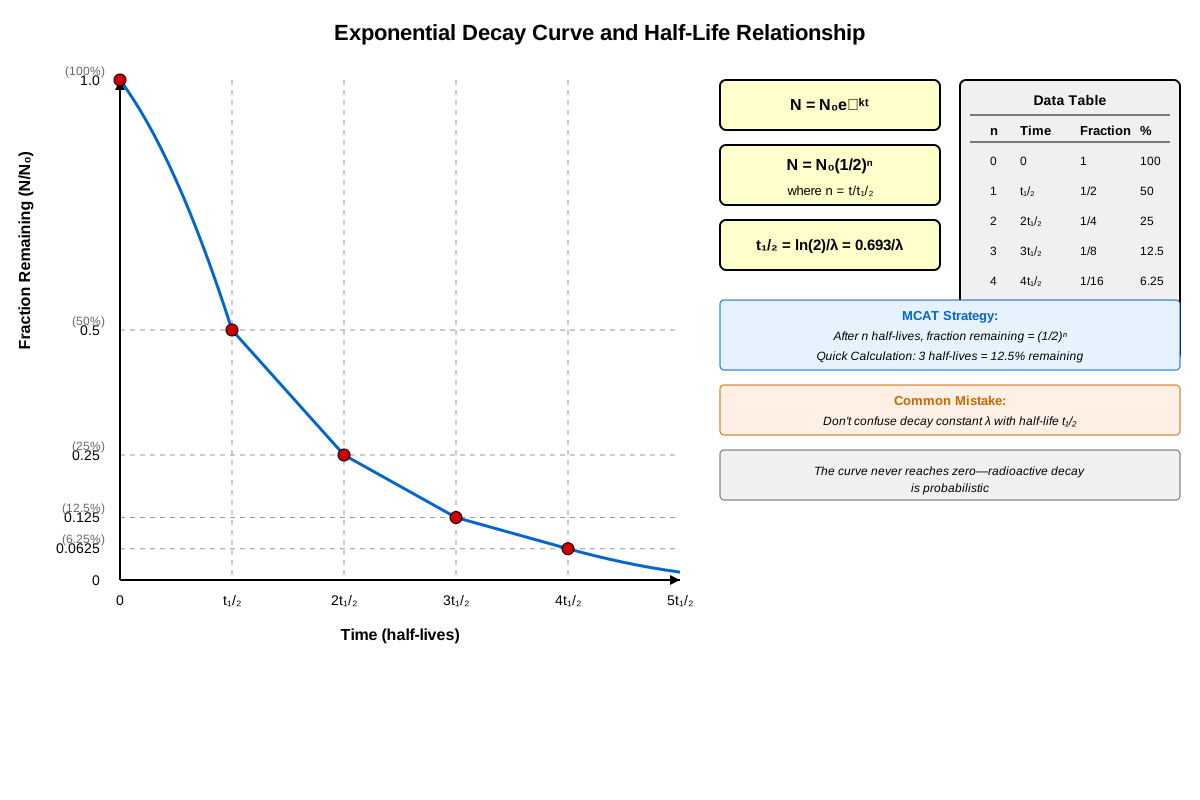
Radioactive decay follows first-order kinetics, meaning the rate of decay is proportional to the number of radioactive nuclei present. The mathematical relationship is expressed as:
N(t) = N₀e^(-λt)Where:
- N(t) = number of radioactive nuclei at time t
- N₀ = initial number of radioactive nuclei
- λ = decay constant (probability of decay per unit time)
- t = elapsed time
The half-life (t₁/₂) is the time required for half of the radioactive nuclei to decay. This is the most commonly tested parameter on the MCAT and relates to the decay constant through:
t₁/₂ = ln(2)/λ = 0.693/λAn alternative form using half-lives directly:
N(t) = N₀(1/2)^(t/t₁/₂)Or for the fraction remaining:
N(t)/N₀ = (1/2)^nWhere n = number of half-lives elapsed (n = t/t₁/₂)
The activity (A) of a radioactive sample measures the number of decays per unit time and is measured in becquerels (Bq, decays per second) or curies (Ci). Activity also follows first-order decay:
A(t) = A₀e^(-λt) = λN(t)Nuclear Stability and Decay Prediction
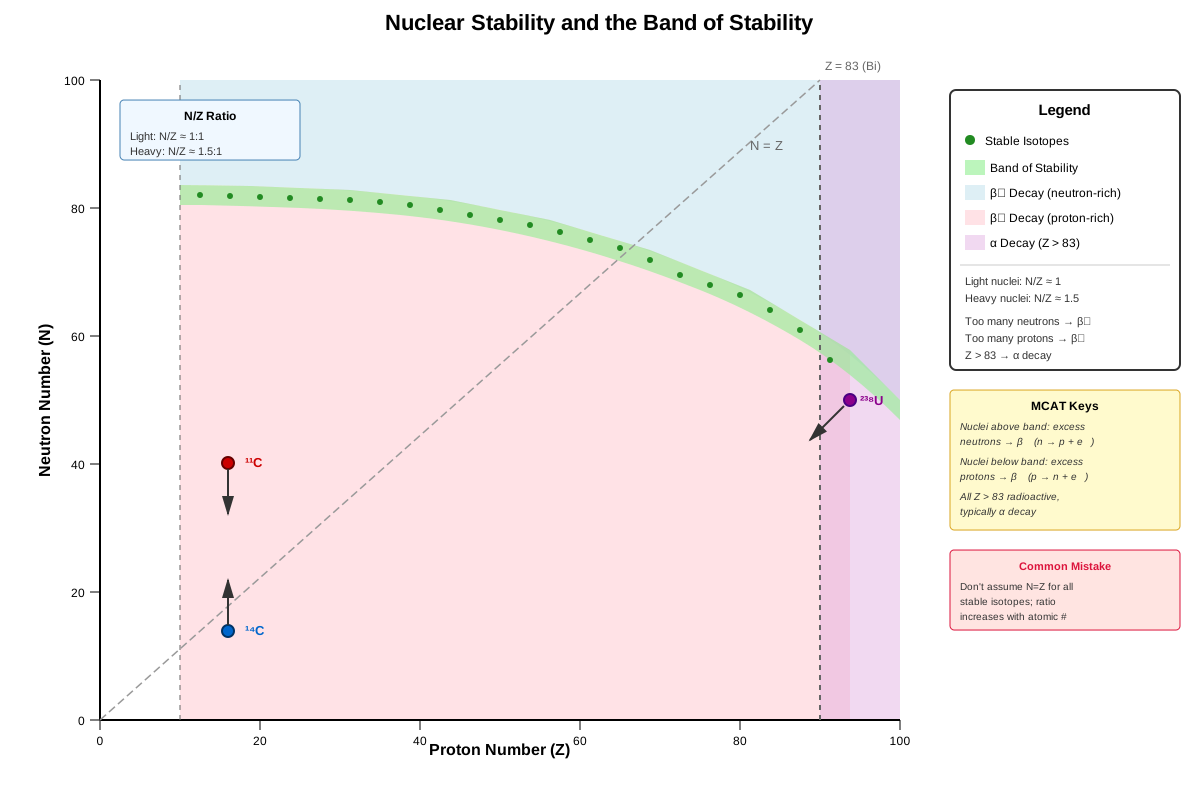
The band of stability on a graph of neutrons versus protons shows which isotopes are stable. For light elements (Z < 20), stable nuclei have approximately equal numbers of protons and neutrons (n/p ratio ≈ 1). For heavier elements, stable nuclei require progressively more neutrons than protons (n/p ratio up to 1.5) because additional neutrons provide strong force attraction without electromagnetic repulsion.
Nuclei above the band of stability are neutron-rich and typically undergo beta-minus decay to convert neutrons to protons. Nuclei below the band are proton-rich and undergo beta-plus decay or electron capture to convert protons to neutrons. Very heavy nuclei (Z > 82) are inherently unstable and undergo alpha decay to reduce their size.
Magic numbers (2, 8, 20, 28, 50, 82, 126) represent particularly stable configurations of protons or neutrons, analogous to noble gas electron configurations. Nuclei with magic numbers of protons or neutrons exhibit enhanced stability and longer half-lives.
Decay Series and Secular Equilibrium
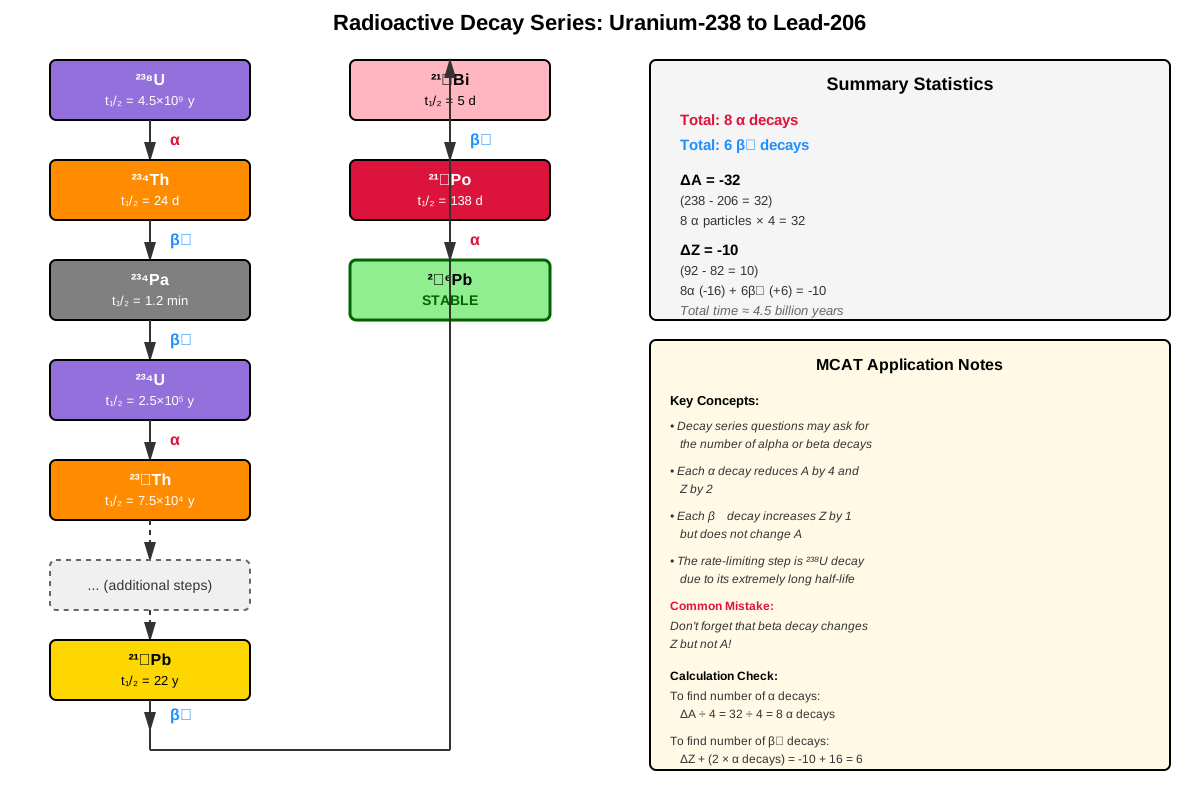
Many radioactive isotopes do not decay directly to a stable product but instead undergo a decay series of multiple transformations. The uranium-238 decay series, for example, involves 14 separate decay steps before reaching stable lead-206. In such series, intermediate products (decay daughters) accumulate and decay simultaneously.
Secular equilibrium occurs when a long-lived parent isotope produces a shorter-lived daughter. After sufficient time, the activity of the daughter equals the activity of the parent, even though their half-lives differ dramatically. This principle is exploited in medical isotope generators, such as the molybdenum-99/technetium-99m generator used in nuclear medicine.
Concept Relationships
Radioactive decay integrates multiple physics concepts into a unified framework. The nuclear instability that drives decay connects directly to atomic structure, specifically the balance of forces within the nucleus. The strong nuclear force (attractive, short-range) competes with electromagnetic repulsion (repulsive between protons), determining whether a nucleus is stable or will undergo spontaneous transformation.
The first-order kinetics of radioactive decay exemplifies exponential functions and demonstrates how microscopic random processes produce predictable macroscopic behavior. This mathematical framework connects to chemical kinetics (first-order reactions) and pharmacokinetics (drug elimination), creating interdisciplinary connections the MCAT frequently tests.
Energy conservation governs all decay processes. The mass defect (difference between parent and product masses) converts to kinetic energy of emitted particles according to E=mc². This released energy appears as the kinetic energy of alpha or beta particles and as electromagnetic energy in gamma rays, connecting nuclear physics to thermodynamics and energy transformations.
The relationship map flows as: Nuclear instability → spontaneous decay → particle/photon emission → energy release → daughter nucleus formation → potential further decay. Simultaneously, population statistics → first-order kinetics → exponential decay → half-life calculations → activity measurements.
Understanding penetrating power of different radiation types connects to electromagnetic theory (gamma rays as photons) and particle physics (alpha and beta particles as matter). This knowledge extends to radiation safety and medical applications, where tissue penetration determines both imaging capabilities and biological damage.
High-Yield Facts
⭐ Half-life is independent of the amount of substance present—whether you start with 1 gram or 1 kilogram, half will decay in the same time period
⭐ After n half-lives, the fraction remaining is (1/2)ⁿ—this allows rapid mental calculation without complex exponentials
⭐ Alpha decay decreases atomic number by 2 and mass number by 4—essential for balancing nuclear equations
⭐ Beta-minus decay increases atomic number by 1 with no change in mass number—a neutron converts to a proton
⭐ Gamma decay changes neither atomic number nor mass number—only energy state changes
- First-order decay means the rate of decay is proportional to the number of nuclei present: rate = λN
- The decay constant λ and half-life are inversely related: λ = 0.693/t₁/₂
- Activity (decays per second) decreases with the same half-life as the number of nuclei
- Nuclei with magic numbers (2, 8, 20, 28, 50, 82, 126) of protons or neutrons show enhanced stability
- Carbon-14 dating uses the 5,730-year half-life of ¹⁴C to determine the age of organic materials
- Positron emission (β⁺ decay) requires the positron to annihilate with an electron, producing two 511 keV gamma rays—the basis of PET imaging
- Alpha particles have the highest ionizing power but lowest penetrating power due to their large mass and charge
- The neutron-to-proton ratio determines decay mode: high n/p ratio → β⁻ decay; low n/p ratio → β⁺ decay or electron capture
- Secular equilibrium occurs when a long-lived parent produces a short-lived daughter, and their activities become equal
- All elements with Z > 82 (lead) have no stable isotopes and will eventually undergo radioactive decay
Quick check — test yourself on Radioactive decay so far.
Try Flashcards →Common Misconceptions
Misconception: Radioactive decay is a chemical reaction that can be influenced by temperature, pressure, or chemical environment.
Correction: Radioactive decay is a nuclear process completely independent of external conditions. Chemical reactions involve electrons; nuclear decay involves the nucleus and cannot be altered by any chemical or physical means accessible in normal environments.
Misconception: After one half-life, all of the radioactive material is gone.
Correction: After one half-life, exactly half (50%) of the original radioactive nuclei remain. After two half-lives, one-quarter (25%) remains. The substance never completely disappears but approaches zero asymptotically.
Misconception: Larger samples of radioactive material have longer half-lives than smaller samples.
Correction: Half-life is an intrinsic property of the isotope and is completely independent of sample size. A single atom of carbon-14 and a kilogram of carbon-14 both have a 5,730-year half-life. However, larger samples have higher activity (more decays per second) because they contain more atoms.
Misconception: Beta particles are electrons removed from electron shells around the nucleus.
Correction: Beta-minus particles are electrons created during the conversion of a neutron to a proton within the nucleus itself. They are not orbital electrons. The process involves the weak nuclear force and creates a new electron that did not previously exist in the atom.
Misconception: Gamma rays are the most dangerous form of radiation because they have the highest penetrating power.
Correction: While gamma rays penetrate most deeply, alpha particles cause the most biological damage per particle if they reach tissue (highest ionizing power). External alpha sources are relatively safe because skin blocks them, but internal alpha emitters (inhaled or ingested) are extremely dangerous. The danger depends on both penetrating power and ionizing power, as well as exposure route.
Misconception: The decay constant λ and half-life t₁/₂ are the same thing.
Correction: These are inversely related but distinct quantities. The decay constant (λ) represents the probability of decay per unit time and has units of time⁻¹. The half-life (t₁/₂) is the time for half the sample to decay and has units of time. They relate through t₁/₂ = 0.693/λ.
Misconception: Radioactive decay can be used to date any object.
Correction: Radiometric dating only works for materials that incorporated the radioactive isotope when they formed and have remained closed systems. Carbon-14 dating only works for organic materials up to about 50,000 years old. Different isotopes with different half-lives are used for different time scales and material types.
Worked Examples
Example 1: Half-Life Calculation with Medical Application
Problem: A hospital receives a shipment of iodine-131 (t₁/₂ = 8 days) with an activity of 400 mCi for thyroid cancer treatment. Due to scheduling issues, the treatment is delayed by 24 days. What activity remains when the patient receives treatment?
Solution:
Step 1: Determine the number of half-lives elapsed.
- Time elapsed = 24 days
- Half-life = 8 days
- Number of half-lives (n) = 24 days ÷ 8 days = 3 half-lives
Step 2: Apply the half-life formula.
- Fraction remaining = (1/2)ⁿ = (1/2)³ = 1/8
Step 3: Calculate final activity.
- Final activity = Initial activity × (1/8)
- Final activity = 400 mCi × (1/8) = 50 mCi
Answer: 50 mCi of iodine-131 remains after 24 days.
MCAT Connection: This problem demonstrates practical medical application of half-life calculations. The MCAT frequently presents scenarios requiring students to determine whether a radiopharmaceutical shipment remains viable or calculate appropriate dosing based on decay time. Notice that we used the simplified formula with half-lives rather than the exponential equation—this is faster and less error-prone under exam conditions when the time is an exact multiple of the half-life.
Example 2: Nuclear Equation Balancing and Decay Mode Identification
Problem: Phosphorus-32 is used in molecular biology research as a radioactive tracer. It undergoes radioactive decay to form sulfur-32. Write the complete nuclear equation for this decay and identify the type of decay.
Solution:
Step 1: Write what we know.
- Parent nucleus: ³²₁₅P (phosphorus-32, Z=15, A=32)
- Daughter nucleus: ³²₁₆S (sulfur-32, Z=16, A=32)
Step 2: Analyze the changes.
- Atomic number increased by 1 (15 → 16)
- Mass number unchanged (32 → 32)
- This pattern indicates beta-minus decay
Step 3: Write the complete equation.
- ³²₁₅P → ³²₁₆S + ⁰₋₁e + ν̄
Step 4: Verify conservation laws.
- Mass number: 32 = 32 + 0 ✓
- Atomic number: 15 = 16 + (-1) ✓
Answer: ³²₁₅P → ³²₁₆S + ⁰₋₁e + ν̄ (beta-minus decay)
MCAT Connection: This problem requires recognizing decay modes from changes in atomic and mass numbers. The MCAT tests this skill by providing partial nuclear equations and asking students to identify missing particles or predict decay products. Key insight: when Z increases by 1 with no change in A, beta-minus decay has occurred. The antineutrino (ν̄) is often omitted in simplified MCAT equations but should be understood as part of the complete process. This decay mode is common in neutron-rich isotopes, which phosphorus-32 is (17 neutrons, 15 protons gives n/p = 1.13, above the 1:1 ratio for light elements).
Example 3: Exponential Decay with Decay Constant
Problem: A sample of technetium-99m has a decay constant of 0.1155 hr⁻¹. If the initial activity is 800 MBq, what will the activity be after 12 hours?
Solution:
Step 1: Identify the appropriate equation.
- We have the decay constant (λ) and need to find activity after time t
- Use: A(t) = A₀e^(-λt)
Step 2: Substitute values.
- A₀ = 800 MBq
- λ = 0.1155 hr⁻¹
- t = 12 hr
- A(12) = 800 × e^(-0.1155 × 12)
Step 3: Calculate the exponent.
- Exponent = -0.1155 × 12 = -1.386
Step 4: Evaluate the exponential.
- e^(-1.386) ≈ 0.250 (or use calculator)
Step 5: Calculate final activity.
- A(12) = 800 × 0.250 = 200 MBq
Answer: The activity after 12 hours is 200 MBq.
MCAT Connection: This problem demonstrates using the exponential form of the decay equation when time is not an exact multiple of the half-life. Note that 200 MBq is exactly 1/4 of the original activity, suggesting that 12 hours represents 2 half-lives. We can verify: t₁/₂ = 0.693/λ = 0.693/0.1155 = 6 hours. Indeed, 12 hours = 2 half-lives, and (1/2)² = 1/4. This cross-check demonstrates how understanding the relationship between λ and t₁/₂ provides a quick verification method. The MCAT may provide either the decay constant or half-life, so students must be comfortable converting between them and using both forms of the equation.
Exam Strategy
When approaching radioactive decay questions on the MCAT, first identify whether the question requires qualitative understanding (decay mode, nuclear stability) or quantitative calculation (half-life, activity). Quantitative questions typically provide either the half-life or decay constant—immediately note which is given and determine if you need to convert between them using λ = 0.693/t₁/₂.
Trigger words that indicate radioactive decay questions include: "half-life," "radioactive isotope," "nuclear decay," "activity," "radiopharmaceutical," "carbon dating," "alpha/beta/gamma emission," and "nuclear medicine." Passages discussing medical imaging (PET, SPECT), radiation therapy, or archaeological dating almost certainly require decay calculations or conceptual understanding of decay processes.
For half-life calculations, determine if the time given is an exact multiple of the half-life. If yes, use the simplified formula N(t)/N₀ = (1/2)ⁿ, which is much faster than exponentials. If the time is not a clean multiple, you must use the exponential form. The MCAT often designs questions with times like "3 half-lives" or "16 days with an 8-day half-life" to reward students who recognize the shortcut.
Process of elimination strategies for decay questions:
- Eliminate answer choices that violate conservation laws (mass number and atomic number must balance in nuclear equations)
- For half-life problems, eliminate answers that show complete decay (the amount never reaches zero) or no decay
- For decay mode questions, eliminate options inconsistent with the neutron-to-proton ratio (neutron-rich → β⁻; proton-rich → β⁺)
- For penetration questions, remember the order: alpha < beta < gamma
Time allocation: Straightforward half-life calculations should take 30-45 seconds. Nuclear equation balancing should take 20-30 seconds. Passage-based questions integrating decay with other concepts may require 90-120 seconds. If a calculation becomes complex, check whether you're using the most efficient approach—often the MCAT rewards conceptual shortcuts over lengthy calculations.
Watch for unit consistency: activity may be given in Bq, Ci, mCi, or MBq. Mass may be in grams, kilograms, or moles. Time may be in seconds, minutes, hours, days, or years. Convert to consistent units before calculating. The MCAT occasionally includes wrong answers that result from unit conversion errors.
Memory Techniques
Mnemonic for decay types and their effects: "Alpha Away All" (Alpha takes away 2 from Z and 4 from A)
Mnemonic for beta decay: "Beta Bumps" (Beta-minus bumps Z up by 1; Beta-plus bumps Z down by 1)
Mnemonic for penetrating power: "Alpha Blocked by Paper, Beta Blocked by Aluminum, Gamma Goes through Lead" (APB-BAL-GGL)
Visualization for half-life: Picture a staircase descending by half at each step: 100% → 50% → 25% → 12.5% → 6.25%. Each step down represents one half-life. This visual makes it immediately clear that the substance never reaches zero and that after n steps, you're at (1/2)ⁿ of the original.
Acronym for decay constant relationship: "Lazy Turtles Hate Numbers" represents λ × t₁/₂ = 0.693 (approximately ln 2). The inverse relationship means large λ (fast decay) corresponds to small t₁/₂ (short half-life).
Memory aid for nuclear stability: "Light elements Like One-to-one" (n/p ≈ 1 for Z < 20), "Heavy elements Have More neutrons" (n/p up to 1.5 for heavy elements). Elements above the band of stability are "Neutron Naughty" and undergo β⁻ decay; below are "Proton Problematic" and undergo β⁺ decay.
Conceptual anchor for first-order kinetics: Connect radioactive decay to drug elimination (also first-order). Both follow the same mathematical pattern: the rate of decrease is proportional to the amount present. This connection helps recall the exponential equation form and reinforces that half-life is independent of initial amount.
Summary
Radioactive decay is the spontaneous transformation of unstable atomic nuclei through emission of particles or electromagnetic radiation, driven by the nucleus seeking greater stability. The MCAT tests this topic through half-life calculations, nuclear equation balancing, and clinical applications in nuclear medicine. Students must master three decay modes: alpha decay (emission of ⁴₂He, decreasing Z by 2 and A by 4), beta-minus decay (neutron to proton conversion, increasing Z by 1), and beta-plus decay (proton to neutron conversion, decreasing Z by 1), plus gamma emission (energy release without changing Z or A). The mathematical framework follows first-order kinetics with the exponential equation N(t) = N₀e^(-λt) or the half-life form N(t) = N₀(1/2)^(t/t₁/₂). Nuclear stability depends on the neutron-to-proton ratio, with deviations from the band of stability predicting decay mode. Clinical applications include PET imaging (positron emission), radiation therapy (gamma and beta emitters), and radiopharmaceutical dosing (half-life calculations). Success on MCAT questions requires recognizing when to use simplified half-life formulas versus exponential equations, balancing nuclear equations using conservation laws, and connecting nuclear physics principles to medical scenarios.
Key Takeaways
- Radioactive decay is a spontaneous nuclear process independent of external conditions, following first-order kinetics with characteristic half-lives
- After n half-lives, the fraction remaining is (1/2)ⁿ—this formula enables rapid mental calculation for MCAT questions
- Alpha decay decreases Z by 2 and A by 4; beta-minus increases Z by 1; beta-plus decreases Z by 1; gamma changes neither
- The decay constant and half-life are inversely related through λ = 0.693/t₁/₂, allowing conversion between these parameters
- Nuclear stability depends on neutron-to-proton ratio: neutron-rich nuclei undergo β⁻ decay, proton-rich undergo β⁺ decay, and very heavy nuclei undergo alpha decay
- Medical applications including PET scans, radiation therapy, and radiopharmaceutical dosing directly test radioactive decay principles on the MCAT
- Penetrating power increases (alpha < beta < gamma) while ionizing power decreases in the same order—critical for radiation safety questions
Related Topics
Nuclear binding energy and mass defect: Understanding how mass converts to energy during nuclear reactions deepens comprehension of why decay releases energy and connects to E=mc² applications throughout physics.
Exponential growth and decay in biological systems: The same mathematical framework governing radioactive decay applies to population growth, drug pharmacokinetics, and capacitor discharge, creating interdisciplinary connections the MCAT frequently exploits.
Electromagnetic spectrum and photon energy: Gamma rays represent the highest-energy portion of the electromagnetic spectrum, connecting nuclear physics to wave properties, photon energy calculations (E = hf), and electromagnetic radiation effects on biological tissue.
Atomic structure and electron configuration: While radioactive decay involves the nucleus, understanding complete atomic structure provides context for distinguishing nuclear versus chemical processes and interpreting how decay changes element identity.
Conservation laws in physics: Mass-energy conservation, charge conservation, and momentum conservation govern all nuclear processes, and mastering these principles enables prediction of decay products and verification of nuclear equations.
Practice CTA
Now that you've mastered the core concepts of radioactive decay, reinforce your understanding by working through practice questions and flashcards. Focus on problems requiring half-life calculations with non-standard time intervals, nuclear equation balancing with missing particles, and passage-based questions integrating decay principles with medical applications. The more you practice identifying trigger words and applying systematic problem-solving approaches, the more confident and efficient you'll become on test day. Remember: radioactive decay questions reward both conceptual understanding and mathematical fluency—practice both aspects to maximize your MCAT score!
Sign up free to keep reading
Create a free AnvayaPrep account to finish this MCAT guide on Radioactive decay — plus flashcards and practice questions.