Overview
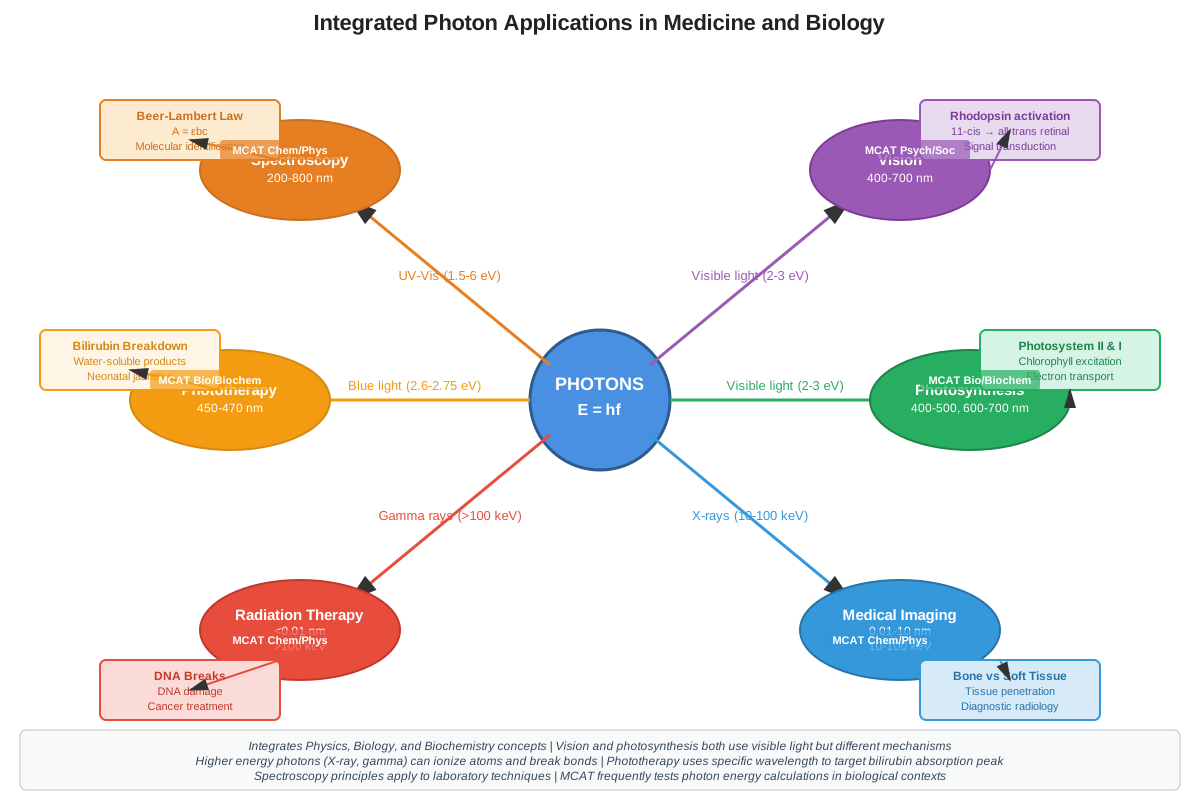
Photons represent one of the most fundamental concepts bridging classical and modern physics, serving as the quantum mechanical explanation for electromagnetic radiation. In the context of Atomic and Nuclear Physics, photons are discrete packets of electromagnetic energy that exhibit both wave-like and particle-like properties—a phenomenon central to understanding the photoelectric effect, atomic transitions, and the interaction of light with matter. For MCAT preparation, mastery of photon behavior is essential because it underlies numerous biological processes including vision, photosynthesis, medical imaging techniques, and radiation therapy.
The concept of photons revolutionized physics in the early 20th century when Einstein proposed that light consists of discrete energy quanta rather than continuous waves. This quantum perspective explains phenomena that classical wave theory cannot, such as why ultraviolet light can eject electrons from metal surfaces while intense red light cannot, regardless of intensity. Understanding Photons Physics requires integrating knowledge of electromagnetic waves, energy quantization, and the relationship between frequency, wavelength, and energy—all high-yield topics for the MCAT.
On the Photons MCAT examination, this topic appears frequently in passages involving spectroscopy, laser applications in medicine, radiation dosimetry, and the molecular basis of vision. Questions typically test the ability to calculate photon energy, relate wavelength to biological effects, and apply conservation principles to photon-matter interactions. The topic connects directly to atomic structure, electron transitions, nuclear decay processes, and even biochemical pathways involving light-dependent reactions, making it an integrative concept that spans multiple MCAT disciplines.
Learning Objectives
- [ ] Define Photons using accurate Physics terminology
- [ ] Explain why Photons matters for the MCAT
- [ ] Apply Photons to exam-style questions
- [ ] Identify common mistakes related to Photons
- [ ] Connect Photons to related Physics concepts
- [ ] Calculate photon energy, frequency, and wavelength using Planck's equation and the speed of light relationship
- [ ] Predict the biological and physical effects of photons based on their energy and wavelength
- [ ] Analyze photon-matter interactions including absorption, emission, and scattering processes
Prerequisites
- Electromagnetic waves and the electromagnetic spectrum: Understanding that light is an electromagnetic wave with characteristic frequency and wavelength is essential for grasping how photons represent quantized versions of these waves
- Wave properties (frequency, wavelength, speed): The mathematical relationships c = λν and the inverse relationship between frequency and wavelength form the foundation for photon energy calculations
- Energy units and conversions: Facility with joules, electron volts (eV), and unit conversions is necessary for solving quantitative photon problems
- Basic atomic structure: Knowledge of electron energy levels and shells provides context for understanding photon emission and absorption during atomic transitions
- Conservation of energy: This fundamental principle governs all photon-matter interactions and energy transfer processes
Why This Topic Matters
Photons are clinically relevant across multiple medical specialties and diagnostic techniques. Radiation oncology relies on high-energy photons (X-rays and gamma rays) to destroy cancer cells, while diagnostic radiology uses lower-energy X-ray photons to create images of internal structures. Phototherapy for neonatal jaundice employs blue-light photons to break down bilirubin, and laser surgery utilizes coherent photons for precise tissue ablation. Understanding photon energy and its relationship to biological effects allows physicians to select appropriate wavelengths for therapeutic interventions while minimizing collateral damage to healthy tissue.
From an MCAT perspective, photon-related questions appear in approximately 3-5% of Physics passages and discrete questions, with additional appearances in biological contexts such as photosynthesis and vision. The exam frequently tests photon energy calculations, the photoelectric effect, and the relationship between photon wavelength and penetration depth in tissue. Passages may present experimental data on spectroscopy, describe medical imaging modalities, or explore the molecular mechanisms of photoreceptors in the retina.
Common question formats include: (1) calculation-based problems requiring application of E = hf or E = hc/λ; (2) conceptual questions about why certain wavelengths produce specific biological effects; (3) graph interpretation involving absorption or emission spectra; (4) passage-based questions integrating photon physics with biochemistry or physiology. The interdisciplinary nature of photon questions makes this topic particularly high-yield, as it can appear in both Physics/Chemistry and Biological/Biochemical sections of the exam.
Core Concepts
Definition and Nature of Photons
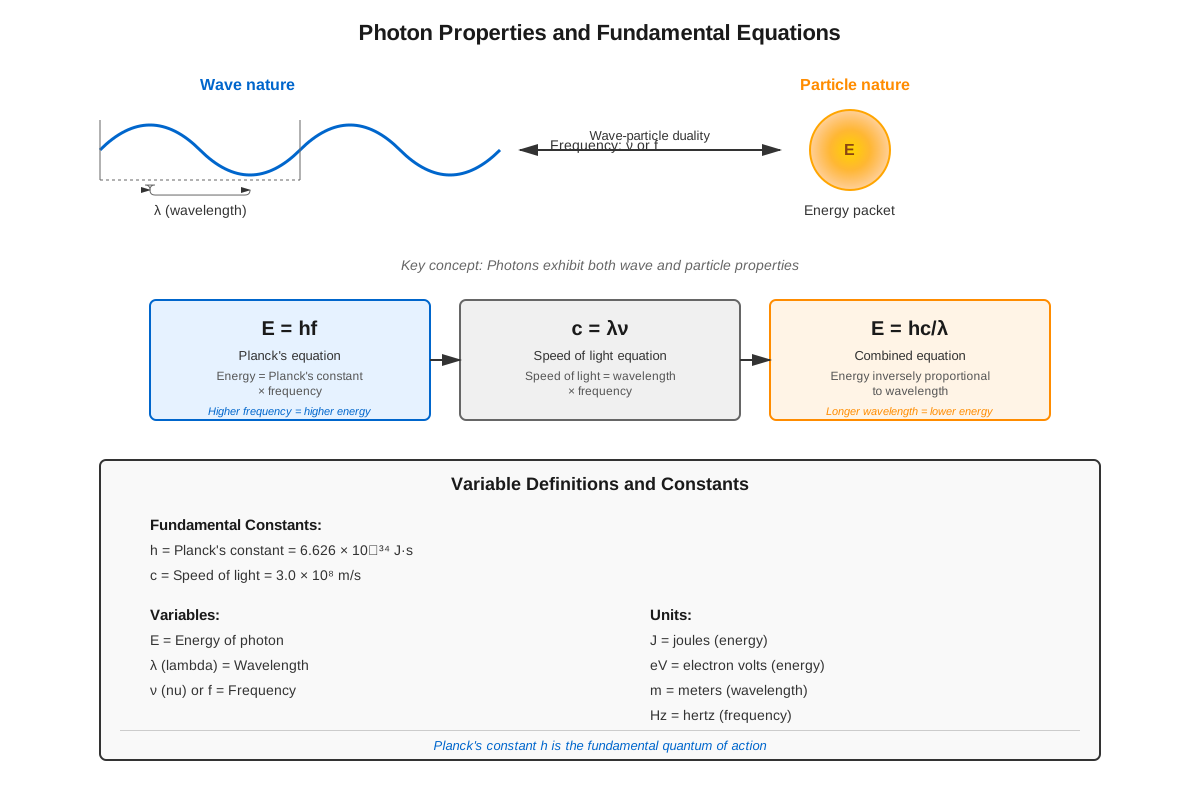
A photon is a quantum of electromagnetic radiation—the smallest discrete unit of light or other electromagnetic energy. Unlike classical waves that can have any arbitrary energy value, photons carry specific, quantized amounts of energy determined entirely by their frequency. Photons are massless particles that always travel at the speed of light in vacuum (c = 3.0 × 10⁸ m/s) and exhibit wave-particle duality, meaning they demonstrate both wave-like properties (interference, diffraction) and particle-like properties (discrete energy, momentum).
The photon concept emerged from Max Planck's work on blackbody radiation and was fully developed by Albert Einstein to explain the photoelectric effect. This particle description of light resolved contradictions that arose when classical wave theory failed to explain certain experimental observations. Each photon carries energy but has zero rest mass, and photons cannot be accelerated or decelerated—they are created and destroyed at light speed.
Planck's Equation and Photon Energy
The fundamental relationship governing photon energy is Planck's equation:
E = hfWhere:
- E = energy of the photon (joules or electron volts)
- h = Planck's constant (6.626 × 10⁻³⁴ J·s or 4.14 × 10⁻¹⁵ eV·s)
- f = frequency of the electromagnetic radiation (Hz or s⁻¹)
Since frequency and wavelength are related by the speed of light (c = λf), we can derive an alternative form:
E = hc/λWhere λ is the wavelength. This equation reveals the inverse relationship between photon energy and wavelength: shorter wavelengths correspond to higher energies, while longer wavelengths correspond to lower energies. This relationship explains why ultraviolet photons can damage DNA while infrared photons primarily cause heating—the UV photons carry sufficient energy to break chemical bonds, whereas IR photons do not.
For MCAT purposes, it's often useful to remember that photon energy is directly proportional to frequency and inversely proportional to wavelength. The constant hc ≈ 1240 eV·nm is particularly useful for quick calculations involving visible and near-visible light.
The Electromagnetic Spectrum and Photon Energy Ranges
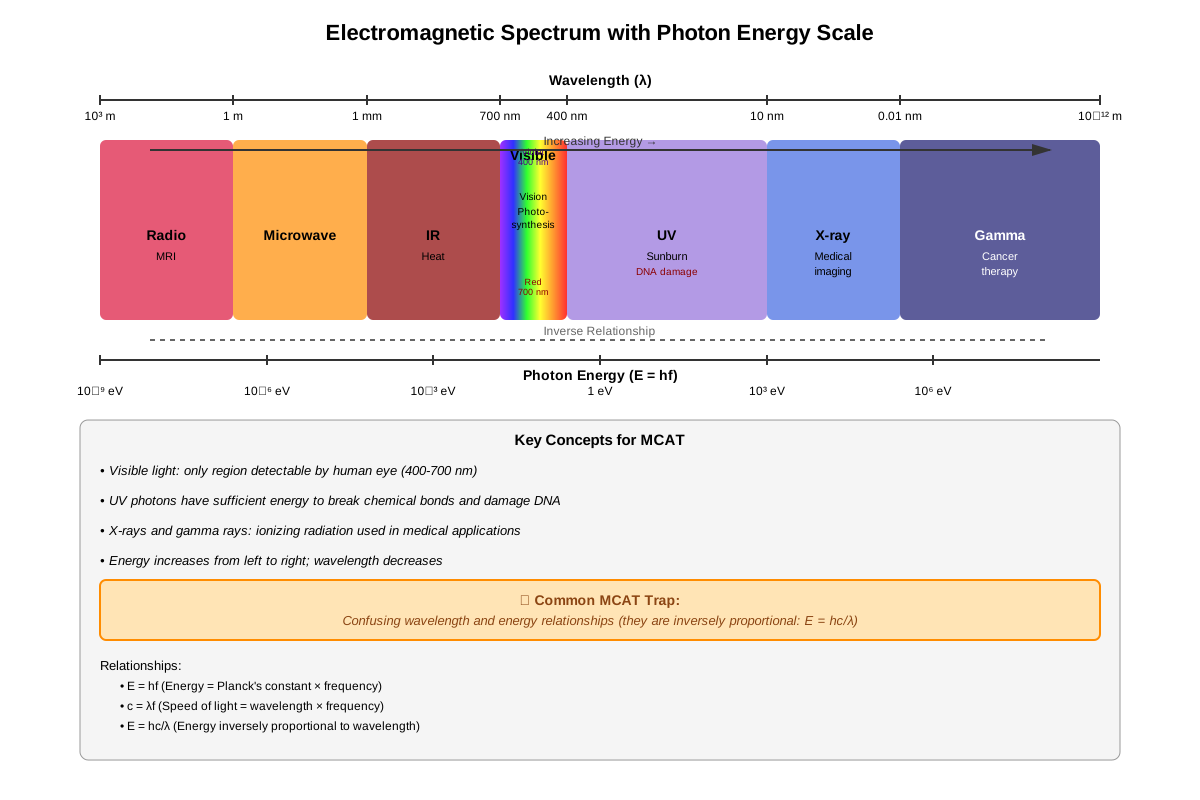
Photons span an enormous energy range across the electromagnetic spectrum, from low-energy radio wave photons to extremely high-energy gamma ray photons:
| Region | Wavelength Range | Photon Energy Range | Biological/Medical Significance |
|---|---|---|---|
| Radio waves | > 1 mm | < 1.24 × 10⁻³ eV | MRI (uses radio frequency photons) |
| Microwaves | 1 mm - 1 μm | 1.24 × 10⁻³ - 1.24 eV | Tissue heating, radar |
| Infrared | 1 μm - 700 nm | 1.24 - 1.77 eV | Thermal imaging, heating |
| Visible | 700 - 400 nm | 1.77 - 3.10 eV | Vision, photosynthesis |
| Ultraviolet | 400 - 10 nm | 3.10 - 124 eV | DNA damage, sterilization |
| X-rays | 10 - 0.01 nm | 124 eV - 124 keV | Medical imaging, radiation therapy |
| Gamma rays | < 0.01 nm | > 124 keV | Cancer treatment, nuclear medicine |
The visible spectrum, particularly relevant for biological systems, spans approximately 400 nm (violet) to 700 nm (red). Photoreceptors in the human eye contain pigments that absorb photons in this range, with different photon energies perceived as different colors. The energy of visible photons (roughly 1.8-3.1 eV) is sufficient to cause electronic transitions in organic molecules but generally insufficient to ionize atoms or break strong chemical bonds directly.
Photon Momentum
Despite having zero rest mass, photons carry momentum given by:
p = E/c = h/λThis momentum becomes significant in phenomena such as radiation pressure and Compton scattering. When photons are absorbed by or reflected from a surface, they transfer momentum, exerting a force. While this force is typically negligible in everyday situations, it becomes important in astrophysical contexts (solar sails) and in understanding photon-electron interactions.
The momentum of photons also explains why high-energy photons (X-rays and gamma rays) can eject electrons from atoms with significant kinetic energy—the photon transfers both energy and momentum to the electron during the interaction.
Photon-Matter Interactions
Photons interact with matter through several fundamental processes:
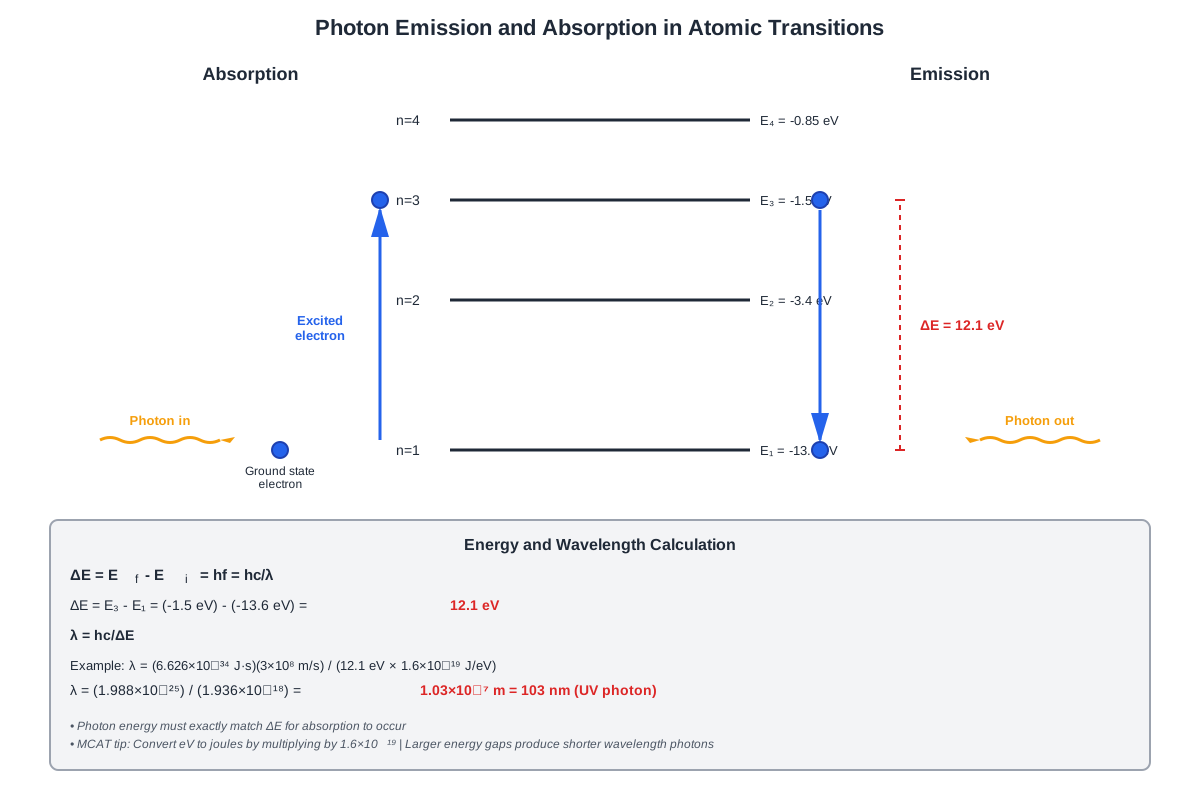
- Absorption: A photon transfers all its energy to an atom or molecule, typically promoting an electron to a higher energy state. The photon ceases to exist after absorption. This process is wavelength-specific, occurring only when the photon energy matches an allowed energy transition in the absorbing material.
- Emission: An atom or molecule in an excited state releases energy by emitting a photon as an electron transitions to a lower energy level. The photon energy equals the energy difference between the two states: E_photon = E_initial - E_final.
- Scattering: A photon interacts with matter and changes direction without being absorbed. In elastic scattering (Rayleigh scattering), the photon energy remains unchanged. In inelastic scattering (Compton scattering), the photon transfers some energy to an electron and emerges with lower energy (longer wavelength).
- Transmission: Photons pass through matter without interaction, which occurs when the material is transparent at that wavelength and the photon energy doesn't match any absorption transitions.
The probability of each interaction type depends on photon energy, the atomic number of the material, and material density. For medical imaging, these interactions determine image contrast and radiation dose.
Quantization and Atomic Transitions
The quantized nature of photons directly relates to the quantized energy levels in atoms. When an electron transitions between energy levels, the energy difference must be carried away by (emission) or supplied by (absorption) a photon with exactly that energy:
E_photon = |E_final - E_initial| = hfThis relationship produces characteristic emission spectra (bright lines at specific wavelengths) and absorption spectra (dark lines at specific wavelengths) unique to each element. Spectroscopy exploits these patterns for chemical identification, astronomical analysis, and medical diagnostics.
The discrete nature of atomic energy levels means that atoms can only absorb or emit photons of specific energies. This explains why gases appear colored—they absorb certain wavelengths while transmitting others. For example, oxygen in the atmosphere absorbs UV photons, protecting life on Earth's surface from harmful high-energy radiation.
Concept Relationships
The concept of photons serves as a bridge between classical wave physics and quantum mechanics. Electromagnetic wave theory provides the foundation for understanding photon wavelength and frequency, while quantum mechanics explains why electromagnetic energy comes in discrete packets rather than continuous waves. The relationship flows: electromagnetic waves → wave-particle duality → photons as quanta → energy quantization.
Photons connect directly to atomic structure through the mechanism of electron transitions. When electrons move between quantized energy levels, they must absorb or emit photons with energy exactly matching the transition energy. This relationship flows: quantized atomic energy levels → photon emission/absorption → spectroscopy and characteristic spectra.
The photoelectric effect demonstrates photon particle nature and connects to work function and kinetic energy concepts. The relationship is: incident photon energy → exceeds work function → electron ejection → kinetic energy of ejected electron. This connects photons to conservation of energy principles.
In biological contexts, photons link to vision (photons absorbed by retinal pigments → isomerization → neural signal), photosynthesis (photon absorption by chlorophyll → electron excitation → chemical energy storage), and DNA damage (high-energy UV photons → thymine dimer formation → mutations). These connections make photons an integrative topic spanning physics, chemistry, and biology.
Photon momentum connects to Compton scattering and radiation pressure, demonstrating that even massless particles carry momentum. This relationship extends to relativistic physics and the energy-momentum relationship E² = (pc)² + (mc²)², which for photons (m = 0) simplifies to E = pc.
Quick check — test yourself on Photons so far.
Try Flashcards →High-Yield Facts
⭐ Photon energy is directly proportional to frequency and inversely proportional to wavelength: E = hf = hc/λ
⭐ Planck's constant h = 6.626 × 10⁻³⁴ J·s (or 4.14 × 10⁻¹⁵ eV·s) is the fundamental constant relating photon energy to frequency
⭐ Higher frequency (shorter wavelength) photons carry more energy: UV photons are more energetic than visible light photons, which are more energetic than infrared photons
⭐ Photons always travel at the speed of light c = 3.0 × 10⁸ m/s in vacuum and cannot be accelerated or decelerated
⭐ The useful approximation hc ≈ 1240 eV·nm allows rapid calculation of photon energies in the visible and near-visible range
- Photons have zero rest mass but carry momentum p = h/λ = E/c
- Visible light photons have energies ranging from approximately 1.8 eV (red) to 3.1 eV (violet)
- X-ray and gamma ray photons have sufficient energy to ionize atoms and break chemical bonds, making them biologically hazardous
- Photon absorption by atoms occurs only when photon energy exactly matches an allowed energy transition
- The photoelectric effect demonstrates that light intensity affects the number of ejected electrons, while light frequency determines the maximum kinetic energy of ejected electrons
- Photons are bosons (spin-1 particles) and do not obey the Pauli exclusion principle, allowing multiple photons to occupy the same quantum state (enabling lasers)
- Compton scattering demonstrates photon particle nature through momentum transfer to electrons
Common Misconceptions
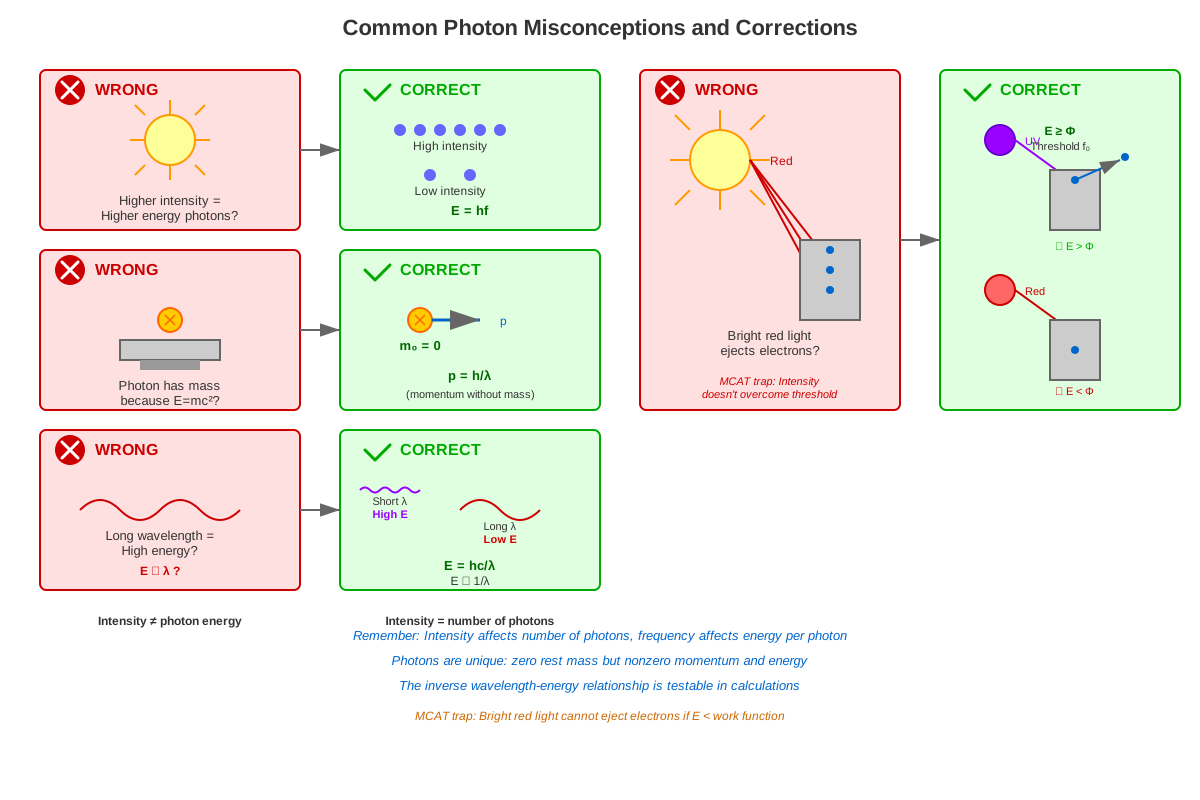
Misconception: Photons have mass because they carry energy and momentum.
Correction: Photons have zero rest mass. They carry energy and momentum because of their motion at light speed, not because of mass. The relationship E = mc² applies to rest mass energy; for photons, E = pc and p = h/λ. Photons cannot exist at rest—they are always moving at speed c.
Misconception: Higher intensity light means higher energy photons.
Correction: Intensity relates to the number of photons, not the energy per photon. Higher intensity means more photons arriving per unit time and area, but each photon's energy depends only on frequency (E = hf). Dim blue light has lower intensity than bright red light, but each blue photon carries more energy than each red photon.
Misconception: All electromagnetic radiation can be treated as either waves or particles, whichever is more convenient.
Correction: Electromagnetic radiation exhibits wave-particle duality—it has both wave and particle properties simultaneously. The photon model is necessary when energy quantization matters (photoelectric effect, atomic transitions), while the wave model is necessary for interference and diffraction. Neither model alone fully describes electromagnetic radiation.
Misconception: Photons slow down when passing through transparent materials like glass or water.
Correction: Individual photons always travel at speed c. The apparent slowing of light in materials (reduced phase velocity) results from photons being absorbed and re-emitted by atoms, creating a time delay. The photons themselves never travel slower than c between absorption and emission events.
Misconception: Photon energy can be any value, just like kinetic energy of massive particles.
Correction: For a given frequency, photon energy is fixed at E = hf. While photons of different frequencies have different energies, you cannot have a photon with arbitrary energy at a given frequency. The energy is quantized—you can have 1 photon, 2 photons, 3 photons, etc., but not 1.5 photons of a given frequency.
Misconception: Red light cannot cause the photoelectric effect because red photons are "weak."
Correction: Red photons have lower energy than blue or UV photons, but they are not "weak"—each red photon carries a specific energy determined by its frequency. Red light fails to cause photoelectric effect in certain materials because each photon's energy is below the work function threshold, not because the photons are weak. No amount of red light intensity will eject electrons if individual photon energy is insufficient.
Worked Examples
Example 1: Calculating Photon Energy and Wavelength
Problem: A photon has an energy of 2.48 eV. (a) What is its wavelength? (b) What region of the electromagnetic spectrum does it belong to? (c) Could this photon be absorbed by a hydrogen atom electron transitioning from n=1 to n=2 (energy difference = 10.2 eV)?
Solution:
(a) Using E = hc/λ, we can solve for wavelength:
λ = hc/E
We'll use the convenient form hc ≈ 1240 eV·nm:
λ = 1240 eV·nm / 2.48 eV = 500 nm
(b) A wavelength of 500 nm falls in the visible light range (400-700 nm), specifically in the green region of the spectrum.
(c) No, this photon cannot be absorbed for this transition. The photon energy (2.48 eV) is much less than the required energy difference (10.2 eV). For absorption to occur, the photon energy must exactly match the energy difference between the two levels. This photon has insufficient energy to promote the electron from n=1 to n=2.
Key Concepts Applied: This problem demonstrates the inverse relationship between energy and wavelength, the use of the convenient hc approximation, and the principle that photon absorption requires exact energy matching with atomic transition energies.
Example 2: Photoelectric Effect and Photon Energy
Problem: A metal surface has a work function of 2.3 eV. Light of wavelength 400 nm is incident on the surface. (a) Will photoelectrons be emitted? (b) If so, what is the maximum kinetic energy of the ejected electrons? (c) What is the threshold wavelength for this metal?
Solution:
(a) First, calculate the energy of 400 nm photons:
E = hc/λ = 1240 eV·nm / 400 nm = 3.1 eV
Since the photon energy (3.1 eV) exceeds the work function (2.3 eV), photoelectrons will be emitted.
(b) The maximum kinetic energy of ejected electrons is given by:
KE_max = E_photon - Φ
KE_max = 3.1 eV - 2.3 eV = 0.8 eV
(c) The threshold wavelength corresponds to photons with energy exactly equal to the work function:
E_threshold = Φ = 2.3 eV
λ_threshold = hc/E = 1240 eV·nm / 2.3 eV = 539 nm
Photons with wavelengths longer than 539 nm (lower energy) will not eject electrons from this metal, regardless of intensity.
Key Concepts Applied: This problem illustrates the photoelectric effect, the relationship between photon energy and work function, conservation of energy in photon-electron interactions, and the concept of threshold frequency/wavelength. It demonstrates why frequency (not intensity) determines whether photoelectrons are emitted.
Exam Strategy
When approaching MCAT questions on photons, first identify whether the question requires calculation or conceptual understanding. For calculation problems, immediately note what information is given (wavelength, frequency, or energy) and what is requested. Write down the relevant equations: E = hf, c = λf, and E = hc/λ. Remember that hc ≈ 1240 eV·nm is often the fastest route to answers involving visible or near-visible light.
Trigger words and phrases to watch for include: "wavelength," "frequency," "photon energy," "electromagnetic radiation," "absorption," "emission," "photoelectric effect," "work function," "threshold frequency," "spectral lines," and "quantum." When you see "intensity" or "brightness," think about the number of photons, not energy per photon. When you see "color" or specific wavelengths, immediately consider the energy implications.
For process-of-elimination strategies, remember these principles: (1) Energy and frequency are directly proportional—eliminate answers that suggest otherwise; (2) Energy and wavelength are inversely proportional—longer wavelengths mean lower energies; (3) Photon energy depends only on frequency, not intensity—eliminate answers confusing these concepts; (4) All photons travel at speed c in vacuum—eliminate answers suggesting photons can be at rest or travel at different speeds.
When passages describe experimental setups involving light and matter interactions, quickly categorize the phenomenon: Is it absorption (photon disappears, atom/molecule gains energy)? Emission (atom/molecule loses energy, photon appears)? Photoelectric effect (photon ejects electron)? Scattering (photon changes direction)? This categorization helps predict what equations and principles apply.
Time allocation: Simple photon energy calculations should take 30-45 seconds. Multi-step problems involving photoelectric effect or atomic transitions may require 60-90 seconds. Passage-based questions requiring integration of photon concepts with biological or chemical contexts may need 90-120 seconds. If a calculation becomes complex, check whether you can eliminate wrong answers conceptually without completing the math.
Memory Techniques
For Planck's constant values, remember "6-6-26" for 6.626 × 10⁻³⁴ J·s. The pattern 6-6 repeats, followed by 26. For the eV·s version, remember "4-14" (4.14 × 10⁻¹⁵ eV·s)—think "four-fourteen" as a date.
For the hc approximation, use "Twelve-Forty" → 1240 eV·nm. Visualize a clock showing 12:40 to cement this value.
For electromagnetic spectrum energy ordering, use the mnemonic "Rabbits Munch Icy Vegetables Under Xeroxed Grass" for increasing energy: Radio, Microwave, Infrared, Visible, Ultraviolet, X-ray, Gamma. Remember that energy increases as you move through this sequence.
For the relationship between wavelength and energy, visualize a seesaw: when wavelength goes up (long waves), energy goes down (low energy), and vice versa. This inverse relationship is crucial for MCAT questions.
For visible light wavelengths, remember "4-7" → visible light spans 400-700 nm. Think of a "4-7" split in cards. Within visible light, remember "ROY G. BIV" (Red, Orange, Yellow, Green, Blue, Indigo, Violet) goes from long wavelength/low energy (red) to short wavelength/high energy (violet).
For photon momentum, remember "Photons Push" → p = h/λ. Even though massless, photons carry momentum and can exert pressure.
Summary
Photons are the fundamental quanta of electromagnetic radiation, representing discrete packets of energy that exhibit both wave and particle properties. The energy of a photon is determined exclusively by its frequency through Planck's equation E = hf, establishing a direct proportionality between energy and frequency, and an inverse relationship between energy and wavelength (E = hc/λ). This quantized nature of light explains phenomena that classical wave theory cannot, including the photoelectric effect and atomic spectral lines. Photons always travel at the speed of light, carry momentum despite having zero rest mass, and interact with matter through absorption, emission, scattering, and transmission. The electromagnetic spectrum spans an enormous energy range from low-energy radio wave photons to high-energy gamma ray photons, with visible light occupying a narrow band from approximately 400-700 nm (1.8-3.1 eV). For the MCAT, understanding photon energy calculations, the relationship between wavelength and biological effects, and the mechanisms of photon-matter interactions is essential for success on questions spanning physics, chemistry, and biological sciences.
Key Takeaways
- Photons are quanta of electromagnetic radiation with energy E = hf = hc/λ, where energy is directly proportional to frequency and inversely proportional to wavelength
- Planck's constant (h = 6.626 × 10⁻³⁴ J·s) and the approximation hc ≈ 1240 eV·nm are essential for MCAT calculations
- Higher frequency photons (UV, X-ray, gamma) carry more energy and can cause ionization and molecular damage, while lower frequency photons (IR, microwave, radio) primarily cause heating
- Photons have zero rest mass but carry momentum (p = h/λ) and always travel at speed c in vacuum
- Photon-matter interactions (absorption, emission, scattering) underlie spectroscopy, medical imaging, photosynthesis, vision, and radiation therapy
- The photoelectric effect demonstrates that photon frequency (not intensity) determines whether electrons are ejected and their maximum kinetic energy
- Atomic absorption and emission of photons occur only when photon energy exactly matches allowed energy transitions between quantized levels
Related Topics
Photoelectric Effect: Building directly on photon energy concepts, this topic explores how photons interact with metal surfaces to eject electrons, demonstrating the particle nature of light and introducing the concept of work function. Mastering photons is prerequisite to understanding why threshold frequency exists and how to calculate ejected electron kinetic energy.
Atomic Structure and Electron Transitions: Photon absorption and emission drive electron transitions between energy levels in atoms. Understanding photons enables comprehension of emission spectra, absorption spectra, and spectroscopic techniques used in chemical analysis and astronomy.
Wave-Particle Duality: This broader quantum mechanical concept encompasses photons as one example of entities exhibiting both wave and particle properties. After mastering photons, students can extend these ideas to matter waves and the de Broglie wavelength.
Nuclear Decay and Gamma Emission: High-energy photons (gamma rays) are emitted during certain nuclear decay processes. Understanding photon energy and interactions is essential for comprehending radiation dosimetry and nuclear medicine applications.
Biochemistry of Vision and Photosynthesis: These biological processes depend fundamentally on photon absorption by specialized molecules (rhodopsin, chlorophyll). Mastering photon physics enables deeper understanding of how light energy is converted to chemical and neural signals.
Practice CTA
Now that you've mastered the fundamental concepts of photons, it's time to solidify your understanding through active practice. Challenge yourself with MCAT-style practice questions that test your ability to calculate photon energies, predict biological effects based on wavelength, and analyze photon-matter interactions in experimental contexts. Use flashcards to drill the key equations, constants, and relationships until they become automatic. Remember: understanding photons opens doors to comprehending atomic structure, nuclear physics, and numerous biological processes—making this topic one of the highest-yield investments of your study time. You've built a strong foundation; now apply it with confidence!
Sign up free to keep reading
Create a free AnvayaPrep account to finish this MCAT guide on Photons — plus flashcards and practice questions.