Overview
Coulomb law (also known as Coulomb's law) is one of the foundational principles in Electricity and Magnetism and represents a cornerstone concept for the MCAT Physics section. This law quantitatively describes the electrostatic force between two charged particles, establishing that the force is directly proportional to the product of the charges and inversely proportional to the square of the distance between them. Understanding Coulomb law is essential not only for solving direct calculation problems but also for grasping more complex electromagnetic phenomena that appear throughout the MCAT, including electric fields, electric potential energy, and the behavior of charged particles in biological systems.
For MCAT preparation, Coulomb law serves as the gateway to understanding how charged particles interact in biological contexts—from the behavior of ions crossing cell membranes to the structural stability of proteins and DNA. The law's mathematical form mirrors Newton's law of universal gravitation, making it an excellent example of how fundamental force laws operate in nature. This parallel also helps students develop pattern recognition skills that prove valuable when tackling analogous problems across different physics domains.
The significance of Coulomb law MCAT questions extends beyond simple plug-and-chug calculations. Test-makers frequently embed this concept within passage-based questions involving molecular interactions, experimental setups with charged particles, or physiological processes dependent on electrostatic forces. Mastery of this topic enables students to confidently approach questions about electric fields, potential energy in charge systems, and the fundamental nature of electromagnetic interactions—all of which are medium-to-high-yield topics on the exam.
Learning Objectives
- [ ] Define Coulomb law using accurate Physics terminology
- [ ] Explain why Coulomb law matters for the MCAT
- [ ] Apply Coulomb law to exam-style questions
- [ ] Identify common mistakes related to Coulomb law
- [ ] Connect Coulomb law to related Physics concepts
- [ ] Calculate electrostatic forces between multiple charged particles in various geometric configurations
- [ ] Analyze how changes in charge magnitude and separation distance affect electrostatic force
- [ ] Compare and contrast Coulomb law with Newton's law of universal gravitation to identify structural similarities
Prerequisites
- Basic algebra and mathematical manipulation: Required for rearranging Coulomb's equation and solving for unknown variables
- Understanding of vectors: Necessary because electrostatic force is a vector quantity with both magnitude and direction
- Scientific notation and unit conversions: Essential for handling the extremely large or small values typical in electrostatic calculations
- Concept of force as a vector quantity: Fundamental to understanding how multiple electrostatic forces combine through vector addition
- Basic understanding of atomic structure: Provides context for the source of electric charge (protons and electrons)
Why This Topic Matters
Coulomb law appears with moderate frequency on the MCAT, typically in 1-3 questions per exam either as direct calculations or embedded within passage-based questions. The law's importance extends far beyond these direct applications—it forms the conceptual foundation for understanding electric fields, electric potential, capacitance, and even aspects of molecular biology tested in the Biological and Biochemical Foundations section.
From a clinical and real-world perspective, electrostatic interactions govern numerous biological processes. The tertiary structure of proteins depends heavily on electrostatic attractions and repulsions between charged amino acid residues. DNA's double helix stability relies partly on electrostatic interactions between phosphate groups and surrounding ions. Cell membrane potentials, crucial for nerve impulse transmission and muscle contraction, arise from the distribution of charged ions. Understanding Coulomb law provides the quantitative framework for analyzing these phenomena.
On the MCAT, Coulomb law commonly appears in several contexts: experimental passages describing particle accelerators or mass spectrometers, questions about ion behavior in solution, problems involving charged spheres or point charges in various configurations, and conceptual questions about how force changes with distance or charge magnitude. The exam frequently tests whether students can identify inverse-square relationships, apply proportional reasoning without full calculations, and recognize when electrostatic forces dominate over other interactions.
Core Concepts
Mathematical Formulation of Coulomb Law
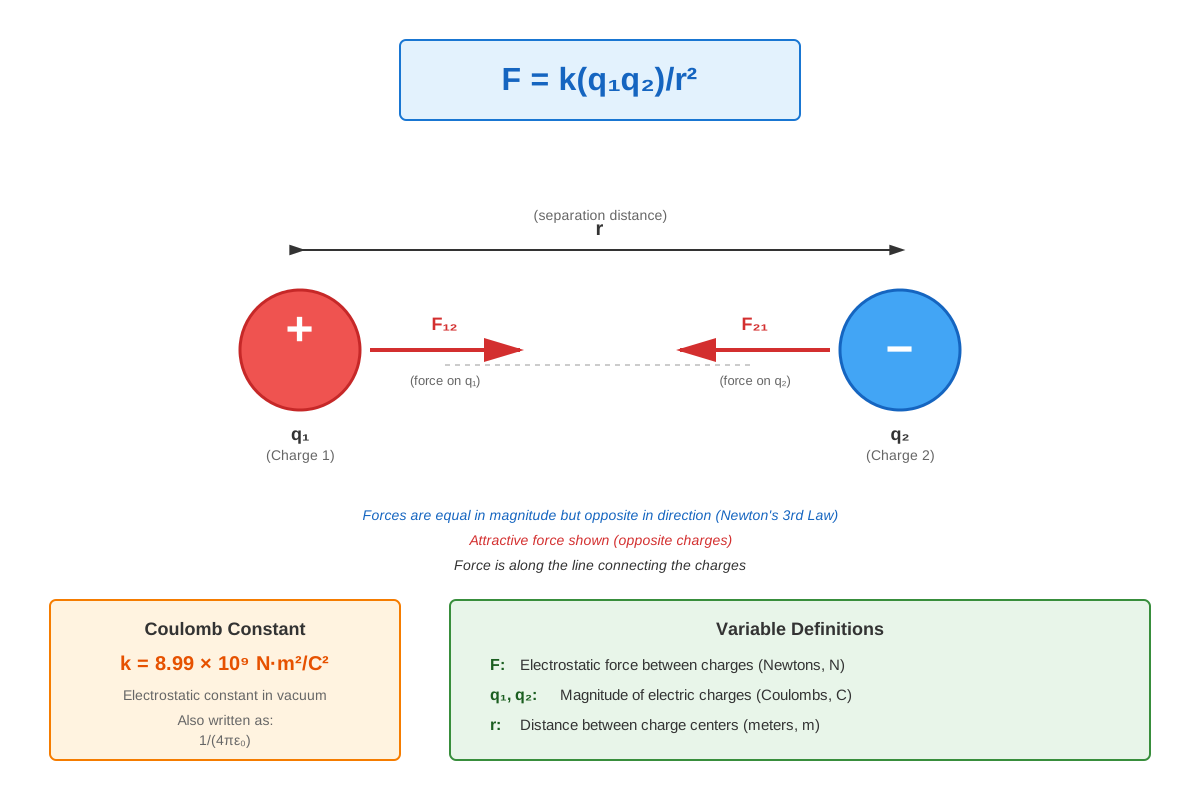
Coulomb law states that the electrostatic force between two point charges is directly proportional to the product of their charges and inversely proportional to the square of the distance between them. The mathematical expression is:
F = k × (q₁ × q₂) / r²Where:
- F = electrostatic force (measured in Newtons, N)
- k = Coulomb's constant = 8.99 × 10⁹ N·m²/C² (often approximated as 9.0 × 10⁹ for MCAT calculations)
- q₁ and q₂ = magnitudes of the two charges (measured in Coulombs, C)
- r = distance between the centers of the two charges (measured in meters, m)
The constant k can also be expressed as k = 1/(4πε₀), where ε₀ (epsilon naught) is the permittivity of free space (8.85 × 10⁻¹² C²/N·m²). While this alternative form appears in some physics contexts, the MCAT typically uses the simpler k notation.
Vector Nature of Electrostatic Force
Electrostatic force is a vector quantity, meaning it has both magnitude and direction. The direction depends on the signs of the charges involved:
- Like charges (both positive or both negative) experience repulsive forces, pushing away from each other
- Unlike charges (one positive, one negative) experience attractive forces, pulling toward each other
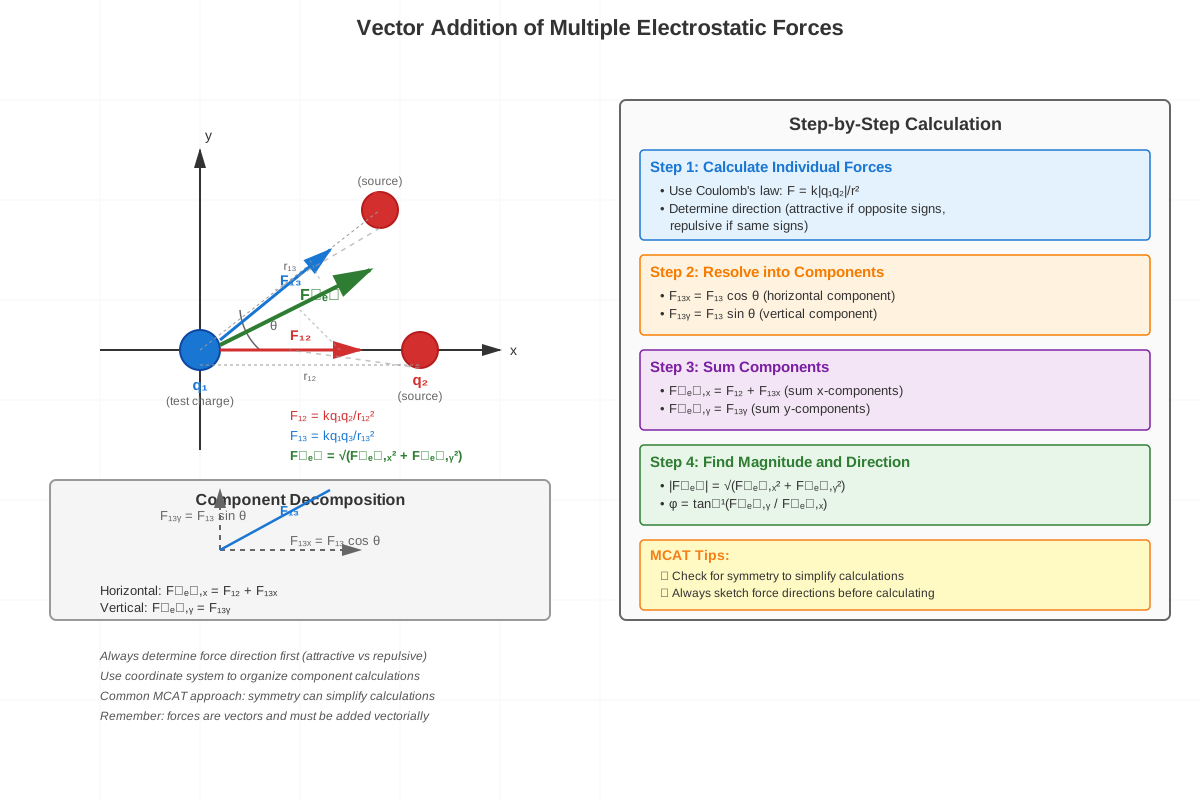
When solving problems with multiple charges, forces must be added as vectors, considering both magnitude and direction. The net force on a charge is the vector sum of all individual forces acting upon it.
The Inverse-Square Relationship
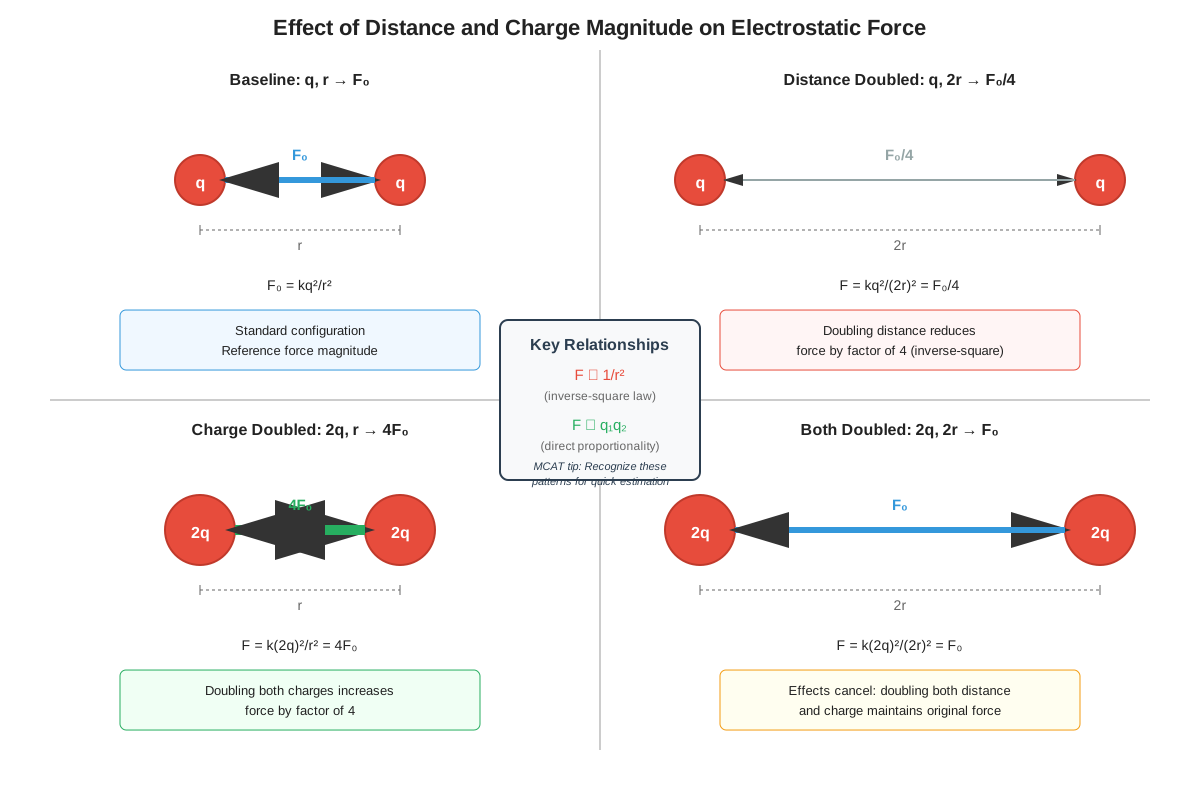
The inverse-square relationship (force proportional to 1/r²) is one of the most testable aspects of Coulomb law on the MCAT. This relationship means:
- Doubling the distance reduces the force to 1/4 of its original value
- Tripling the distance reduces the force to 1/9 of its original value
- Halving the distance increases the force by a factor of 4
This pattern appears repeatedly in MCAT questions that test proportional reasoning without requiring full calculations.
Comparison with Gravitational Force
Coulomb law exhibits remarkable structural similarity to Newton's law of universal gravitation:
| Feature | Coulomb Law | Gravitational Law |
|---|---|---|
| Formula | F = k(q₁q₂)/r² | F = G(m₁m₂)/r² |
| Constant | k = 9.0 × 10⁹ N·m²/C² | G = 6.67 × 10⁻¹¹ N·m²/kg² |
| Quantities | Electric charges | Masses |
| Force type | Can attract or repel | Always attractive |
| Relative strength | Much stronger | Much weaker |
This parallel helps students recognize that both are fundamental force laws following inverse-square relationships, though electrostatic forces are typically many orders of magnitude stronger than gravitational forces at the atomic and molecular scale.
Sign Conventions and Force Direction
The algebraic sign of charges determines force direction:
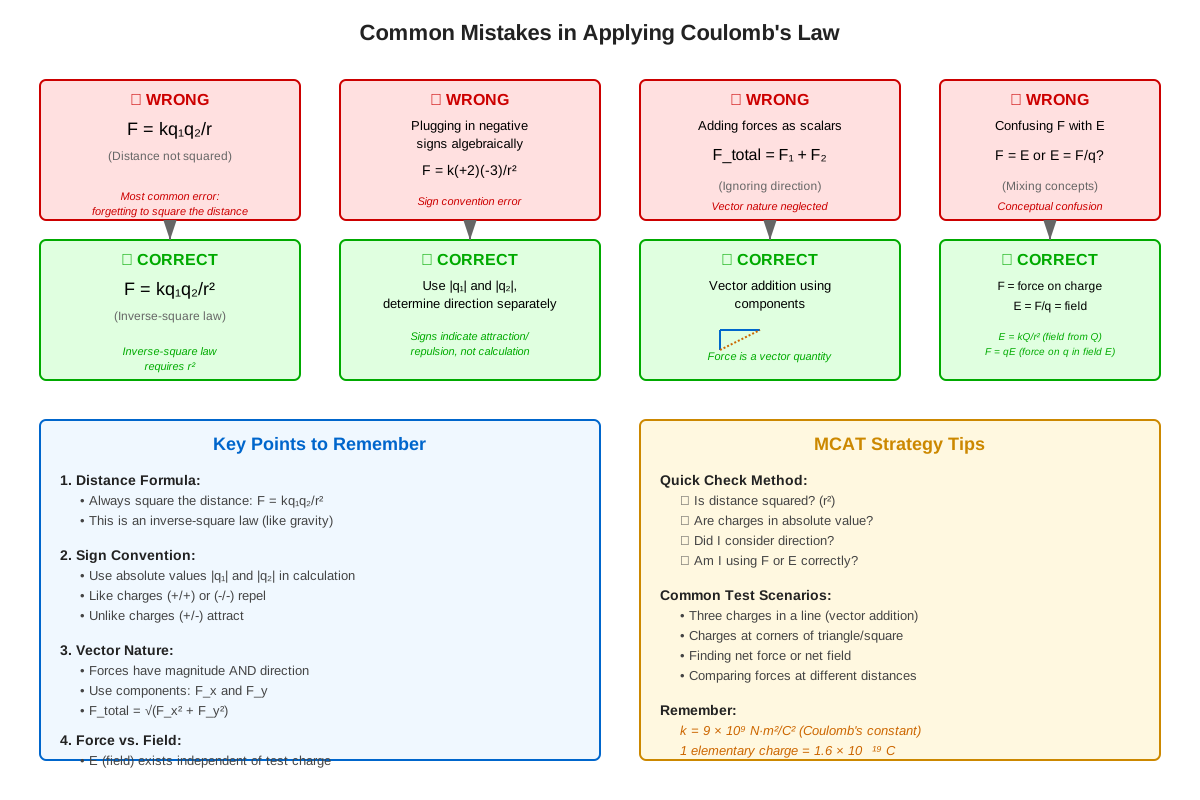
- When calculating force magnitude, use absolute values of charges
- Determine direction separately based on charge signs
- Positive force values can be assigned to repulsion, negative to attraction (or vice versa, depending on convention)
- For MCAT purposes, calculating magnitude and determining direction conceptually is often more efficient than tracking signs algebraically
Superposition Principle
When multiple charges interact, the principle of superposition applies: the net force on any charge equals the vector sum of forces from all other charges, calculated independently. Each pair interaction follows Coulomb law, and these individual forces combine vectorially.
For example, if three charges form a line, the force on the middle charge equals the vector sum of forces from the left and right charges, each calculated using Coulomb law separately.
Point Charges and Spherical Charge Distributions
Coulomb law applies exactly to point charges—idealized charges with no spatial extent. For spherically symmetric charge distributions (like uniformly charged spheres), the charge can be treated as if concentrated at the center when calculating forces on external points. This approximation simplifies many MCAT problems involving charged spheres or ions.
Units and Typical Values
Understanding typical charge magnitudes helps with MCAT problem-solving:
- Elementary charge (e) = 1.6 × 10⁻¹⁹ C (charge of one proton or electron)
- Charges in problems often appear as multiples of elementary charge
- Forces between atomic-scale charges are typically very small (piconewtons to nanonewtons)
- Macroscopic charged objects can experience much larger forces
Concept Relationships
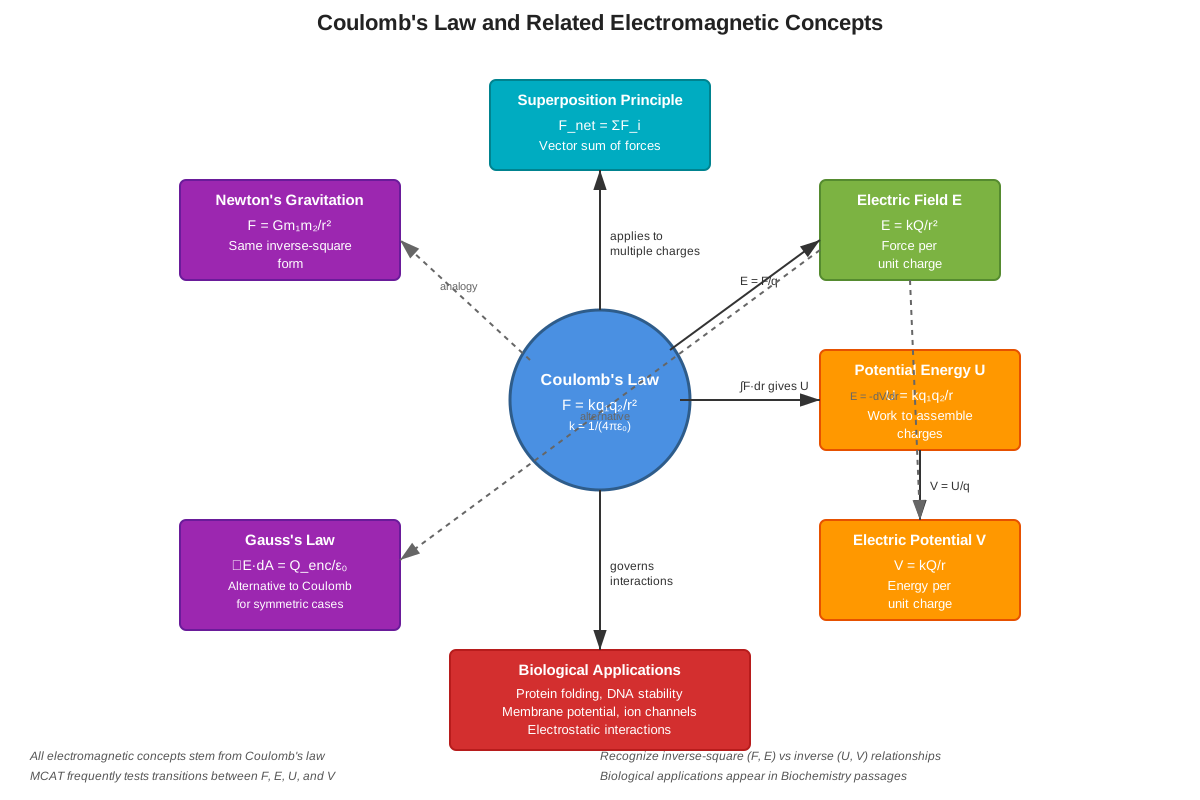
Coulomb law serves as the foundational relationship from which many other electromagnetic concepts derive. The law directly defines the electrostatic force between charges, which leads to the concept of the electric field—defined as force per unit charge. Understanding Coulomb law is prerequisite to grasping electric field calculations, as the field at any point is simply the Coulomb force that would act on a test charge placed at that location, divided by the test charge magnitude.
The relationship flows as follows: Coulomb law → Electric Force → Electric Field → Electric Potential → Electric Potential Energy. Each concept builds upon the previous one. Electric potential energy between two charges can be derived by integrating the Coulomb force over distance, yielding U = k(q₁q₂)/r. This energy relationship appears frequently in MCAT questions about work done in moving charges.
Within the topic itself, the inverse-square relationship connects to the concept of field lines and flux, explaining why electric field strength decreases with distance. The vector nature of Coulomb forces connects to the superposition principle, which extends to electric fields from multiple sources. The similarity between Coulomb law and gravitational law reinforces understanding of fundamental force laws and helps students recognize patterns across different physics domains.
Coulomb law also connects to prerequisite knowledge of vectors and forces from mechanics. The mathematical skills used to resolve forces into components and add them vectorially apply directly to electrostatic problems. The concept of equilibrium from mechanics extends to finding positions where net electrostatic force equals zero.
High-Yield Facts
⭐ Coulomb's constant k = 9.0 × 10⁹ N·m²/C² is the most commonly used value on the MCAT (exact value: 8.99 × 10⁹)
⭐ The electrostatic force follows an inverse-square law: doubling distance reduces force to 1/4
⭐ Like charges repel, unlike charges attract—this determines force direction
⭐ The elementary charge e = 1.6 × 10⁻¹⁹ C represents the smallest unit of charge in normal matter
⭐ Electrostatic forces are typically much stronger than gravitational forces at atomic scales
- The force is directly proportional to each charge: doubling one charge doubles the force
- Coulomb law applies exactly to point charges and to spherically symmetric charge distributions (when measuring from outside)
- The principle of superposition allows calculation of net force from multiple charges by vector addition
- Electrostatic force is a conservative force, meaning work done is path-independent
- In a medium other than vacuum, the force is reduced by the dielectric constant: F = k(q₁q₂)/(εᵣr²), where εᵣ is the relative permittivity
- The force acts along the line connecting the two charges (radial direction)
- Coulomb law forms the basis for understanding molecular interactions, protein folding, and membrane potentials
Quick check — test yourself on Coulomb law so far.
Try Flashcards →Common Misconceptions
Misconception: The force between charges depends on their individual magnitudes separately, so a larger charge always experiences more force.
Correction: The force magnitude is identical on both charges (Newton's third law applies). While F depends on the product q₁q₂, each charge experiences the same magnitude force, just in opposite directions.
Misconception: Coulomb's constant k has the same value in all materials and media.
Correction: The constant k = 9.0 × 10⁹ N·m²/C² applies only in vacuum (or air, as an approximation). In other media, the effective constant is reduced by the dielectric constant of the material, reducing the force between charges.
Misconception: When distance is doubled, the force is halved (linear relationship).
Correction: The relationship is inverse-square, not inverse-linear. Doubling distance reduces force to 1/4 (not 1/2), tripling distance reduces force to 1/9 (not 1/3), and so on.
Misconception: Negative charges produce negative forces, and positive charges produce positive forces.
Correction: Force magnitude is always positive (it's a magnitude). The sign of charges determines whether the force is attractive or repulsive, not whether the force value is positive or negative. Calculate magnitude using absolute values, then determine direction conceptually.
Misconception: Coulomb law only applies to stationary charges.
Correction: While Coulomb law is derived for electrostatics, it accurately describes the electric force component even for moving charges. However, moving charges also experience magnetic forces, which require additional equations. For MCAT purposes, Coulomb law applies whenever you're asked about electric force specifically.
Misconception: The force between two charges depends on the presence of other nearby charges.
Correction: Each pairwise interaction follows Coulomb law independently (superposition principle). The force between charges A and B is calculated using only their charges and separation, regardless of other charges present. Other charges contribute additional forces that sum vectorially.
Misconception: Larger objects always have larger charges.
Correction: Charge and size are independent properties. A small object can carry a large charge, and a large object can be electrically neutral. The charge depends on the excess or deficit of electrons, not on physical size.
Worked Examples
Example 1: Basic Force Calculation with Proportional Reasoning
Problem: Two point charges, q₁ = +3.0 μC and q₂ = -4.0 μC, are separated by 2.0 cm. Calculate the magnitude of the electrostatic force between them. Then determine what happens to the force if the distance is increased to 6.0 cm while charges remain constant.
Solution:
Step 1: Convert units to SI
- q₁ = +3.0 μC = 3.0 × 10⁻⁶ C
- q₂ = -4.0 μC = 4.0 × 10⁻⁶ C (use absolute value for magnitude)
- r = 2.0 cm = 0.02 m
Step 2: Apply Coulomb law
F = k(q₁q₂)/r²
F = (9.0 × 10⁹ N·m²/C²) × (3.0 × 10⁻⁶ C) × (4.0 × 10⁻⁶ C) / (0.02 m)²
F = (9.0 × 10⁹) × (12 × 10⁻¹²) / (4 × 10⁻⁴)
F = (108 × 10⁻³) / (4 × 10⁻⁴)
F = 27 × 10¹ = 270 N
Step 3: Determine direction
Since charges have opposite signs (one positive, one negative), the force is attractive.
Step 4: Analyze the distance change
New distance r' = 6.0 cm = 3 × (original distance)
Using inverse-square relationship:
- Distance increased by factor of 3
- Force decreases by factor of 3² = 9
- New force = 270 N / 9 = 30 N
Key takeaway: This problem demonstrates both direct calculation and proportional reasoning—both essential MCAT skills. The proportional reasoning approach is often faster for comparison questions.
Example 2: Vector Addition with Multiple Charges
Problem: Three charges are arranged in a line. Charge A (+2.0 μC) is at position x = 0 cm, charge B (-3.0 μC) is at x = 3.0 cm, and charge C (+4.0 μC) is at x = 6.0 cm. Calculate the net force on charge B.
Solution:
Step 1: Identify the forces acting on B
- Force from A on B (F_AB)
- Force from C on B (F_CB)
Step 2: Calculate F_AB (force from A on B)
- q_A = 2.0 × 10⁻⁶ C, q_B = 3.0 × 10⁻⁶ C
- r_AB = 3.0 cm = 0.03 m
- F_AB = (9.0 × 10⁹) × (2.0 × 10⁻⁶) × (3.0 × 10⁻⁶) / (0.03)²
- F_AB = (9.0 × 10⁹) × (6.0 × 10⁻¹²) / (9 × 10⁻⁴)
- F_AB = 54 × 10⁻³ / (9 × 10⁻⁴) = 6 × 10¹ = 60 N
Direction: A is positive, B is negative → attractive → force on B points toward A (left/negative direction)
Step 3: Calculate F_CB (force from C on B)
- q_C = 4.0 × 10⁻⁶ C, q_B = 3.0 × 10⁻⁶ C
- r_CB = 3.0 cm = 0.03 m
- F_CB = (9.0 × 10⁹) × (4.0 × 10⁻⁶) × (3.0 × 10⁻⁶) / (0.03)²
- F_CB = (9.0 × 10⁹) × (12 × 10⁻¹²) / (9 × 10⁻⁴)
- F_CB = 108 × 10⁻³ / (9 × 10⁻⁴) = 12 × 10¹ = 120 N
Direction: C is positive, B is negative → attractive → force on B points toward C (right/positive direction)
Step 4: Add forces vectorially
Define rightward as positive direction:
- F_AB = -60 N (leftward)
- F_CB = +120 N (rightward)
- F_net = -60 N + 120 N = +60 N (rightward)
Answer: The net force on charge B is 60 N directed toward charge C (rightward).
Key takeaway: This problem illustrates the superposition principle and the importance of tracking force directions. Each pairwise interaction is calculated independently, then forces are combined as vectors. This approach applies to any multi-charge configuration on the MCAT.
Exam Strategy
When approaching Coulomb law MCAT questions, first identify whether the question requires a full calculation or proportional reasoning. Many MCAT questions test conceptual understanding of how force changes with distance or charge rather than requiring numerical answers. Look for phrases like "how does the force change when..." or "compare the force in situation A to situation B"—these signal proportional reasoning opportunities.
Trigger words and phrases to watch for:
- "Point charges" → apply Coulomb law directly
- "Electrostatic force" or "electric force" → use F = kq₁q₂/r²
- "Attractive" or "repulsive" → determine charge signs
- "Net force" → apply superposition principle, vector addition required
- "Equilibrium" → net force equals zero
- "Inverse-square relationship" → focus on how force changes with distance
Process-of-elimination strategies:
- Eliminate answers that violate the inverse-square relationship (e.g., if distance doubles and an answer shows force halving)
- Rule out answers with incorrect force directions (attractive vs. repulsive based on charge signs)
- Check dimensional analysis—force must have units of Newtons
- For comparison questions, eliminate answers that don't properly account for both charge and distance changes
Time allocation advice:
- Simple Coulomb law calculations: 60-90 seconds
- Multi-charge vector addition problems: 90-120 seconds
- Conceptual/proportional reasoning questions: 30-60 seconds
For passage-based questions, scan for given values of k, charge magnitudes, and distances. The passage may provide these in various units—budget time for unit conversion. If exact calculation seems time-consuming, check whether the answer choices are far enough apart to allow estimation or proportional reasoning instead.
Quick calculation tips:
- Approximate k as 9 × 10⁹ for faster mental math
- Factor out powers of 10 early to simplify arithmetic
- For inverse-square problems, square the distance ratio first, then divide
- Remember that 1 μC = 10⁻⁶ C and 1 nC = 10⁻⁹ C
Memory Techniques
Mnemonic for Coulomb's Law formula: "Keep Quiet Quickly Right Squared" → k, q, q, r, squared → F = kqq/r²
Inverse-square visualization: Picture the force spreading out over the surface of an expanding sphere. As radius doubles, surface area increases by 4× (area = 4πr²), so force intensity decreases by 4×. This mental image reinforces why the relationship is inverse-square.
Charge sign memory: "Like charges Leave" (repel), "Opposite charges Obsess" (attract). The alliteration helps recall the relationship between charge signs and force direction.
Constant value memory: Remember k ≈ 9 × 10⁹ by thinking "nine to the ninth" (though technically it's 9 times 10 to the ninth). This approximation is sufficient for MCAT calculations.
Vector addition reminder: Use the acronym MADS for multi-charge problems:
- Magnitude: Calculate force magnitude for each pair
- Angle/direction: Determine direction for each force
- Draw: Sketch force vectors (even mentally)
- Sum: Add vectors to find net force
Comparison to gravity: Both Coulomb and gravitational laws have "two quantities multiplied, divided by distance squared"—this parallel helps recall the structure when you remember one law but temporarily forget the other.
Summary
Coulomb law quantifies the electrostatic force between charged particles, establishing that force is directly proportional to the product of charges and inversely proportional to the square of their separation distance. The mathematical relationship F = kq₁q₂/r², where k = 9.0 × 10⁹ N·m²/C², provides the foundation for understanding all electrostatic interactions tested on the MCAT. The law's inverse-square nature means that small changes in distance produce large changes in force—doubling distance reduces force to one-quarter. Like charges repel while opposite charges attract, and the force magnitude is identical on both charges regardless of their individual magnitudes. When multiple charges interact, the superposition principle applies: calculate each pairwise force independently using Coulomb law, then add all forces vectorially to find the net force. This fundamental relationship connects to broader concepts in electricity and magnetism, including electric fields, electric potential, and the behavior of charged particles in biological systems. Mastery requires both computational facility with the equation and conceptual understanding of proportional relationships, enabling efficient problem-solving through either direct calculation or proportional reasoning depending on question type.
Key Takeaways
- Coulomb law states F = kq₁q₂/r² with k = 9.0 × 10⁹ N·m²/C², describing electrostatic force between point charges
- The inverse-square relationship means doubling distance reduces force to 1/4, tripling distance reduces force to 1/9
- Like charges repel, unlike charges attract, but both charges experience equal magnitude forces (Newton's third law)
- The superposition principle allows calculation of net force from multiple charges through vector addition of individual pairwise forces
- Electrostatic forces are typically much stronger than gravitational forces at atomic and molecular scales
- Proportional reasoning often provides faster solutions than full calculations for MCAT comparison questions
- The law applies exactly to point charges and to spherically symmetric charge distributions when measured from outside the distribution
Related Topics
Electric Fields: Coulomb law provides the foundation for understanding electric fields, defined as force per unit charge. Mastering Coulomb law enables calculation of field strength and direction from point charges and charge distributions.
Electric Potential and Potential Energy: The work done by electrostatic forces (derived from Coulomb law) leads to concepts of electric potential energy (U = kq₁q₂/r) and electric potential, essential for understanding voltage and energy in circuits.
Gauss's Law: This more advanced formulation relates electric field to charge distribution and provides an alternative approach to Coulomb law for symmetric charge configurations, occasionally appearing in upper-level MCAT passages.
Capacitance: Understanding how charges interact via Coulomb law is prerequisite to analyzing charge storage in capacitors, a moderate-yield MCAT topic in circuits.
Molecular Interactions: Electrostatic forces govern ionic bonds, hydrogen bonding, and protein structure—topics that bridge physics and biochemistry on the MCAT.
Practice CTA
Now that you've mastered the core concepts of Coulomb law, reinforce your understanding by working through practice questions and flashcards. Focus on both calculation-based problems and conceptual questions about proportional relationships. Challenge yourself with multi-charge configurations requiring vector addition, and practice identifying when proportional reasoning provides a faster path to the answer than full calculation. The more you apply these concepts to varied problem types, the more automatic your problem-solving approach will become on test day. Remember: Coulomb law is not just a formula to memorize—it's a fundamental relationship that explains how the universe works at the level of charged particles. Your investment in truly understanding this concept will pay dividends across multiple MCAT topics!
Sign up free to keep reading
Create a free AnvayaPrep account to finish this MCAT guide on Coulomb law — plus flashcards and practice questions.