Overview
Electric potential is a fundamental concept in Electricity and Magnetism that describes the electric potential energy per unit charge at a specific location in an electric field. Understanding electric potential is crucial for MCAT success because it bridges the gap between abstract field concepts and practical energy considerations in biological and physical systems. While electric fields describe forces, electric potential provides an energy-based perspective that often simplifies problem-solving and connects directly to concepts students encounter in chemistry and biology, such as membrane potentials in neurons and electrochemical gradients across cell membranes.
For the MCAT, electric potential appears regularly in Physics passages involving circuits, capacitors, and electrostatic scenarios. Questions may ask students to calculate potential differences, understand the relationship between electric fields and potential, or apply conservation of energy principles to charged particles moving through potential differences. The topic integrates mathematical reasoning with conceptual understanding, making it a medium-difficulty but high-yield area for exam preparation.
Electric potential connects intimately with other core physics concepts including electric fields, work and energy, capacitance, and electric circuits. Mastering this topic enables students to approach complex multi-step problems involving charge distributions, energy storage in capacitors, and the behavior of charged particles in biological systems. The energy perspective provided by electric potential often offers more elegant solutions than force-based approaches, making it an essential tool in the MCAT problem-solving arsenal.
Learning Objectives
- [ ] Define electric potential using accurate Physics terminology
- [ ] Explain why electric potential matters for the MCAT
- [ ] Apply electric potential to exam-style questions
- [ ] Identify common mistakes related to electric potential
- [ ] Connect electric potential to related Physics concepts
- [ ] Calculate electric potential for point charges and systems of charges
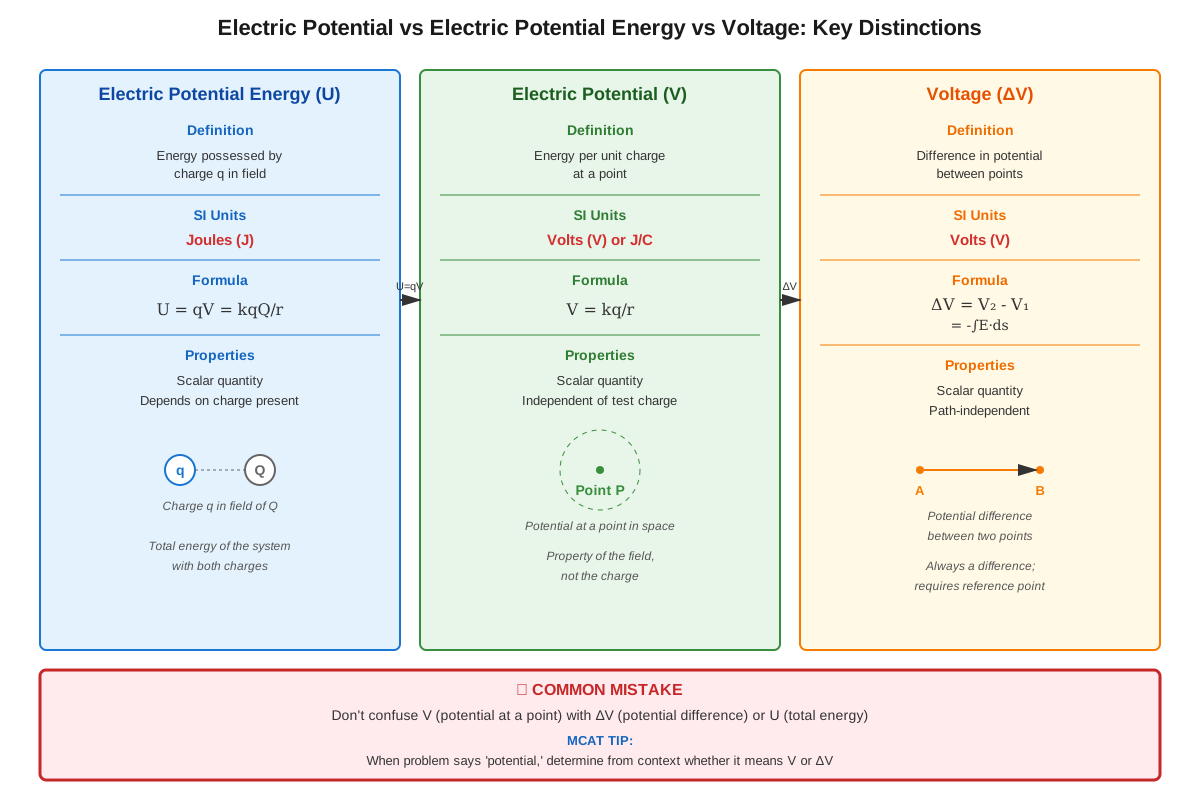
- [ ] Distinguish between electric potential, electric potential energy, and voltage
- [ ] Analyze the relationship between electric field and electric potential graphically and mathematically
- [ ] Apply conservation of energy to problems involving charged particles moving through potential differences
Prerequisites
- Electric charge and Coulomb's Law: Essential for understanding the source of electric potential and calculating potential from charge distributions
- Electric fields: Electric potential is directly related to electric field through integration and differentiation relationships
- Work and energy concepts: Electric potential is fundamentally an energy per unit charge, requiring solid understanding of work-energy principles
- Vector and scalar quantities: Distinguishing that electric field is a vector while electric potential is a scalar simplifies many calculations
- Basic calculus concepts: Understanding derivatives and integrals helps grasp the relationship between field and potential, though detailed calculus is not required for MCAT
Why This Topic Matters
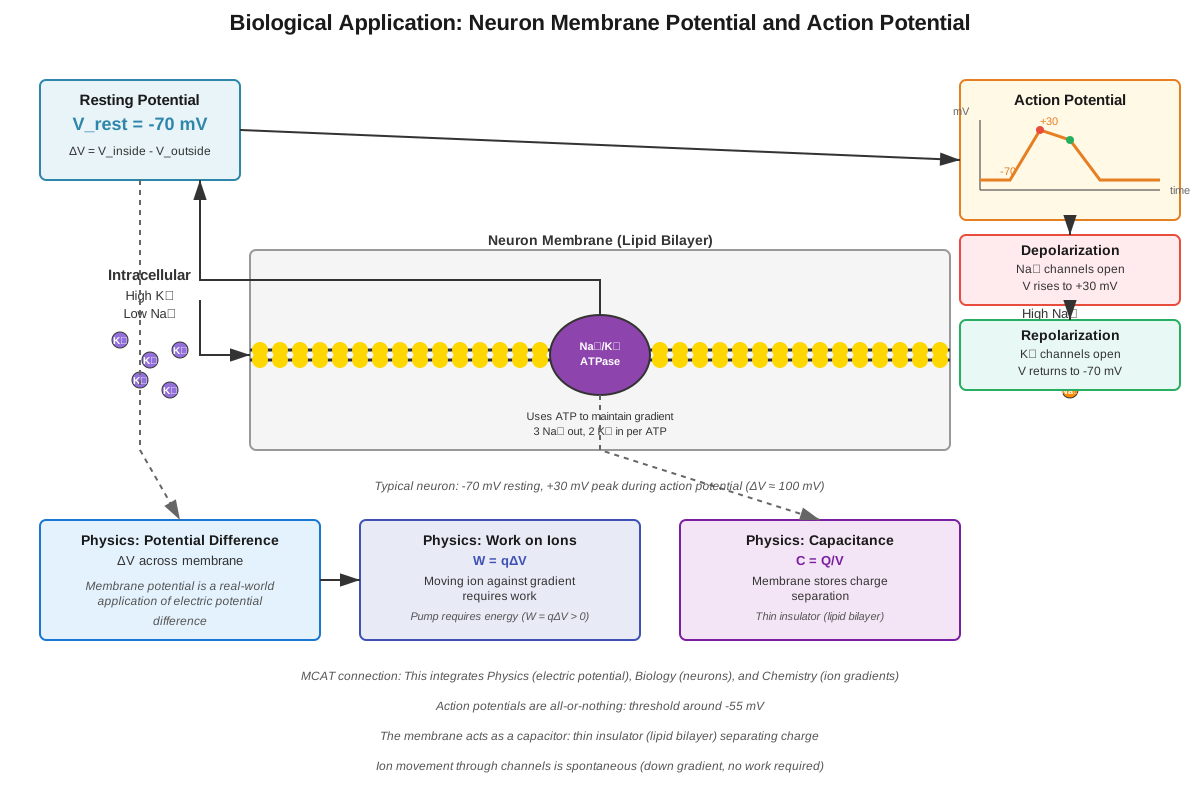
Electric potential has profound clinical and biological significance. The membrane potential of neurons, typically around -70 mV at rest, represents a real-world application of electric potential difference across a biological membrane. Action potentials, the basis of neural communication, involve rapid changes in membrane potential. Electrocardiograms (ECGs) and electroencephalograms (EEGs) measure potential differences generated by cardiac and neural tissue, respectively. Understanding electric potential provides the foundation for comprehending these vital physiological processes.
On the MCAT, electric potential appears in approximately 2-4 questions per exam, either as standalone problems or integrated into passages about circuits, capacitors, or biological systems. Questions typically test the ability to calculate potential differences, understand the relationship between potential and field, apply energy conservation to moving charges, or interpret graphs of potential versus position. The topic frequently appears in passages combining physics with biological applications, such as ion channels, membrane transport, or medical imaging technologies.
Common exam presentations include: discrete questions asking for potential at a point due to one or more charges; passage-based questions involving capacitors and energy storage; problems requiring students to determine the work done moving a charge through a potential difference; and conceptual questions about equipotential surfaces and their relationship to electric field lines. The interdisciplinary nature of electric potential makes it particularly valuable for the MCAT's integrated approach to science.
Core Concepts
Definition of Electric Potential
Electric potential (symbol: V) at a point in space is defined as the electric potential energy per unit positive test charge at that location. Mathematically:
V = U_E / qwhere V is electric potential (measured in volts, V), U_E is electric potential energy (joules, J), and q is the charge (coulombs, C). One volt equals one joule per coulomb (1 V = 1 J/C).
The electric potential Physics concept represents a scalar field—unlike the electric field vector, potential has magnitude but no direction. This scalar nature often simplifies calculations, as potentials from multiple sources can be added algebraically without vector decomposition.
Electric potential is defined relative to a reference point, typically chosen at infinity (V = 0 at r = ∞) for point charges or at ground for circuits. Only potential differences (voltage) have physical significance; the absolute value of potential at a point depends on the arbitrary choice of reference.
Electric Potential Due to Point Charges
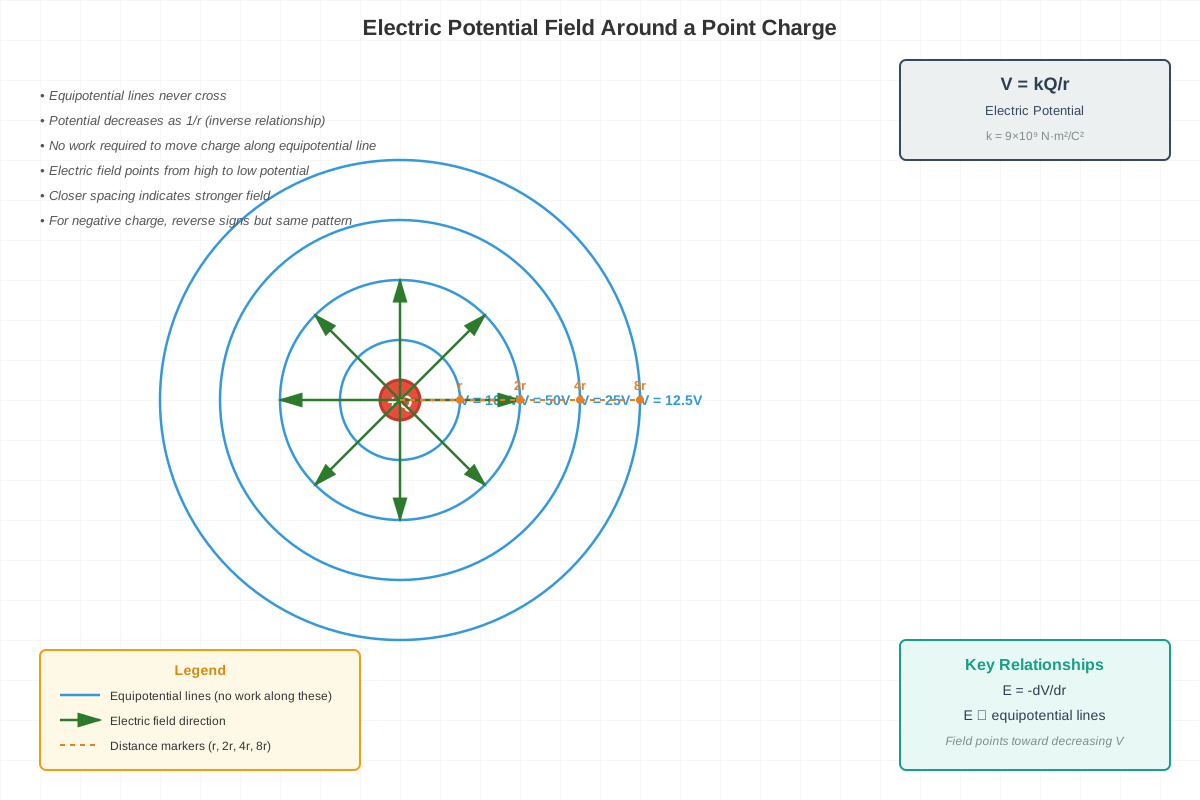
For a single point charge Q, the electric potential at distance r from the charge is:
V = kQ/rwhere k is Coulomb's constant (k ≈ 9.0 × 10⁹ N·m²/C²). This formula assumes V = 0 at infinity. Note that:
- Positive charges create positive potential in surrounding space
- Negative charges create negative potential in surrounding space
- Potential decreases with distance from a positive charge
- Potential becomes less negative (increases) with distance from a negative charge
For multiple point charges, the total electric potential at a point is the algebraic sum of potentials from each charge:
V_total = V₁ + V₂ + V₃ + ... = k(Q₁/r₁ + Q₂/r₂ + Q₃/r₃ + ...)This superposition principle for potential is simpler than vector addition required for electric fields, making potential calculations often more straightforward.
Relationship Between Electric Field and Electric Potential
Electric field and electric potential are intimately related. The electric field points in the direction of greatest potential decrease and has magnitude equal to the rate of potential change with distance:
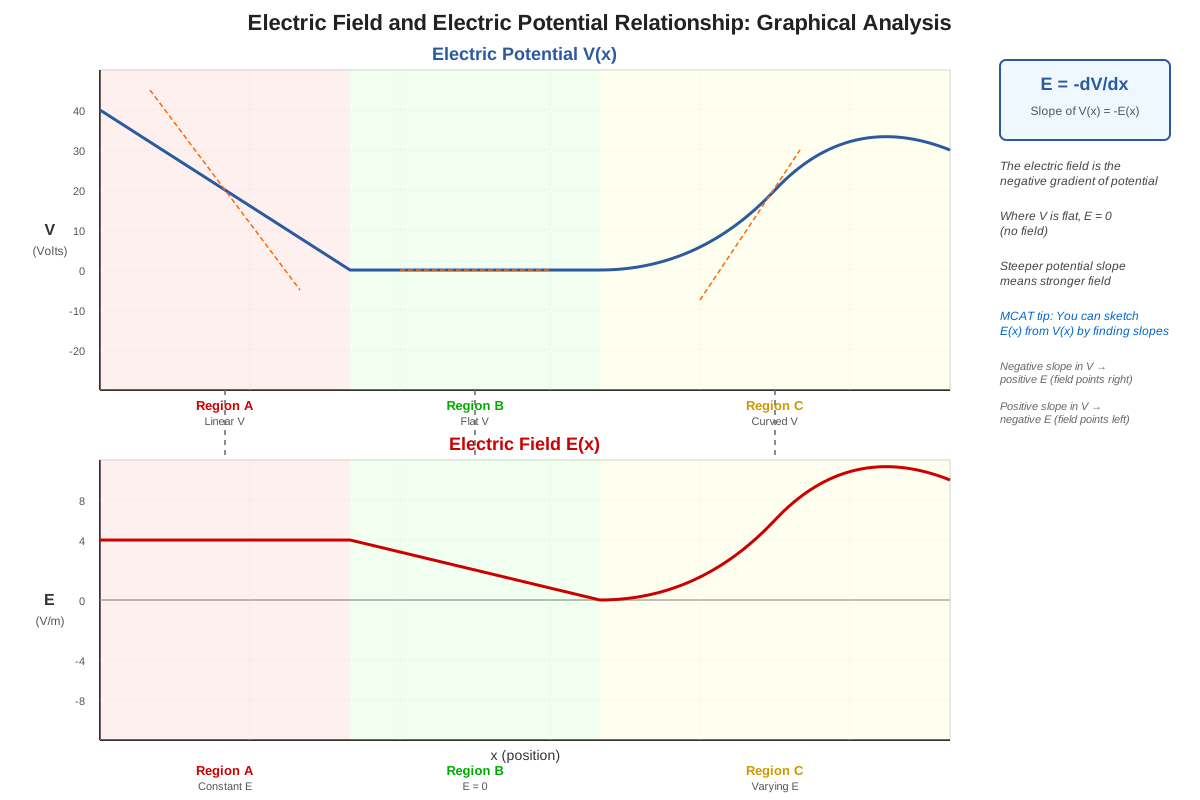
E = -dV/dxIn three dimensions, the electric field is the negative gradient of potential. For MCAT purposes, key relationships include:
- Electric field lines point from high potential to low potential
- Electric field is perpendicular to equipotential surfaces
- Where field is strong, potential changes rapidly with position
- Where field is zero, potential is constant (but not necessarily zero)
The negative sign indicates that positive charges naturally move from high to low potential (down the "potential hill"), while the electric field points in this same direction.
Equipotential Surfaces
Equipotential surfaces are imaginary surfaces where every point has the same electric potential. Key properties include:
- No work is required to move a charge along an equipotential surface
- Electric field lines are always perpendicular to equipotential surfaces
- Equipotential surfaces never intersect
- For a point charge, equipotential surfaces are concentric spheres
- Conductors in electrostatic equilibrium have surfaces that are equipotential
Understanding equipotential surfaces helps visualize electric potential distributions and simplifies problem-solving by identifying paths requiring zero work.
Electric Potential Energy and Voltage
Electric potential energy (U_E) is the energy a charge possesses due to its position in an electric field. For a charge q at a location with potential V:
U_E = qVThe potential difference or voltage (ΔV) between two points is the change in potential:
ΔV = V_B - V_A = -∫(A to B) E·dlVoltage represents the work per unit charge required to move a charge between two points. The work done by the electric field moving charge q through potential difference ΔV is:
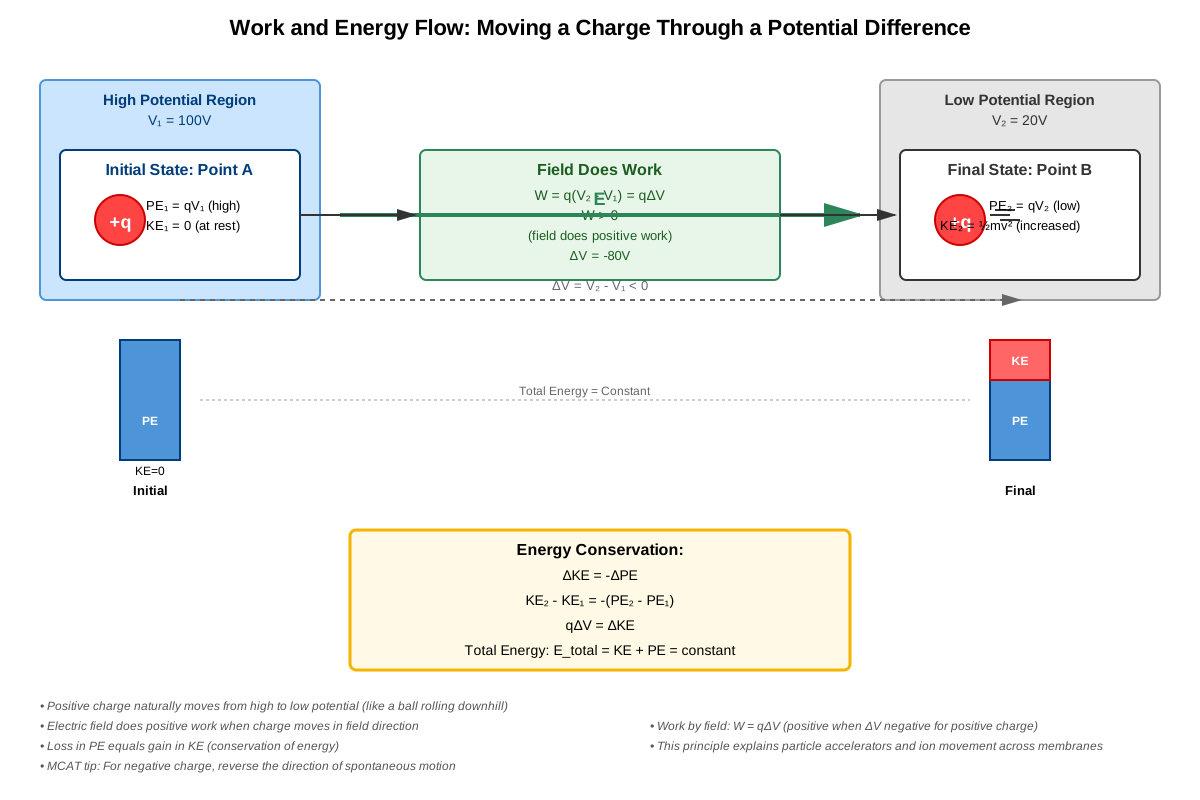
W = qΔVThis relationship is fundamental for circuit analysis and energy calculations involving moving charges.
Comparison Table: Key Quantities
| Quantity | Symbol | Units | Type | Physical Meaning |
|---|---|---|---|---|
| Electric Field | E | N/C or V/m | Vector | Force per unit charge |
| Electric Potential | V | V (volts) | Scalar | Energy per unit charge |
| Electric Potential Energy | U_E | J (joules) | Scalar | Energy of charge in field |
| Voltage (Potential Difference) | ΔV | V (volts) | Scalar | Work per unit charge between points |
| Electric Force | F | N (newtons) | Vector | Force on charge in field |
Conservation of Energy with Electric Potential
When a charged particle moves through a potential difference, conservation of energy requires:
ΔKE + ΔPE = 0or equivalently:
KE_initial + qV_initial = KE_final + qV_finalThis principle is crucial for solving problems involving charged particles accelerated through potential differences, such as in cathode ray tubes, mass spectrometers, or biological ion channels. For a particle starting from rest and accelerated through voltage ΔV:
(1/2)mv² = qΔVThis relationship allows calculation of final velocity from known charge, mass, and potential difference.
Concept Relationships
Electric potential emerges directly from the concept of electric field through integration: potential difference equals the negative line integral of the electric field. Conversely, the electric field can be found by taking the negative spatial derivative of potential. This bidirectional relationship means that knowing either quantity allows determination of the other.
Electric potential energy relates to electric potential through the charge experiencing the field: U_E = qV. This connects to the broader physics concept of potential energy in conservative force fields, with electric potential playing the role analogous to gravitational potential (mgh/m = gh) in mechanics.
The concept of voltage (potential difference) connects electric potential to practical applications in circuits. Batteries and power supplies create potential differences that drive current flow. Capacitors store energy by maintaining charge separation across a potential difference, with stored energy U = (1/2)QV = (1/2)CV².
Equipotential surfaces relate to electric field lines through perpendicularity, creating a complete geometric picture of electric field configurations. This geometric relationship extends to conductors in electrostatic equilibrium, where the surface must be equipotential and the internal field must be zero.
Relationship map:
Electric Charge → generates → Electric Field → integrates to → Electric Potential → multiplied by charge → Electric Potential Energy → conserved in → Energy Conservation Problems → applies to → Particle Motion and Circuits → connects to → Capacitance and Energy Storage
Quick check — test yourself on Electric potential so far.
Try Flashcards →High-Yield Facts
⭐ Electric potential is a scalar quantity measured in volts (V), where 1 V = 1 J/C
⭐ For a point charge Q, the electric potential at distance r is V = kQ/r, with V = 0 at infinity
⭐ Electric field points from high potential to low potential and equals the negative gradient of potential: E = -dV/dx
⭐ Work done moving charge q through potential difference ΔV is W = qΔV
⭐ Equipotential surfaces are perpendicular to electric field lines, and no work is required to move charges along them
- The potential at the surface of a conducting sphere of radius R with charge Q is V = kQ/R, and this same potential exists throughout the interior
- For multiple charges, total potential is the algebraic sum of individual potentials (superposition principle)
- A positive charge naturally moves from high to low potential, losing potential energy and gaining kinetic energy
- A negative charge naturally moves from low to high potential, also losing potential energy and gaining kinetic energy
- The potential difference between two points is independent of the path taken between them (conservative field property)
- In uniform electric field E, the potential difference over distance d is ΔV = Ed
- The electron volt (eV) is a unit of energy: 1 eV = 1.6 × 10⁻¹⁹ J, representing the energy gained by an electron moving through 1 V potential difference
Common Misconceptions
Misconception: Electric potential and electric potential energy are the same thing.
Correction: Electric potential (V) is potential energy per unit charge, measured in volts. Electric potential energy (U_E = qV) depends on both the potential and the specific charge present, measured in joules. Potential is a property of the field; potential energy is a property of a charge in that field.
Misconception: Electric potential is a vector quantity that points in the direction of the electric field.
Correction: Electric potential is a scalar quantity with magnitude only, no direction. The electric field is the vector quantity. While the field points from high to low potential, potential itself has no directional property—it simply has a value at each point in space.
Misconception: Zero electric field at a point means zero electric potential at that point.
Correction: Zero electric field means the potential is constant (not changing with position), but that constant value need not be zero. For example, inside a uniformly charged spherical shell, E = 0 everywhere, but V equals the constant surface potential, not zero.
Misconception: Positive charges always have positive potential energy, and negative charges always have negative potential energy.
Correction: The sign of potential energy depends on both the sign of the charge and the sign of the potential at its location. A positive charge at negative potential has negative potential energy (U_E = qV, where q > 0 and V < 0). A negative charge at positive potential also has negative potential energy.
Misconception: Moving a charge along an equipotential surface requires work because the charge must be moved against the electric field.
Correction: Electric field lines are perpendicular to equipotential surfaces, so moving along an equipotential surface means moving perpendicular to the field. Since work equals force times displacement in the direction of force (W = F·d·cosθ), and θ = 90° along an equipotential, no work is required (cos 90° = 0).
Misconception: The potential at the midpoint between two equal positive charges is zero because the electric fields cancel.
Correction: While the electric field vectors cancel at the midpoint (E = 0), the electric potentials add as scalars. Two positive charges each contribute positive potential, so V_midpoint = 2kQ/r, not zero. Zero field means constant potential, not necessarily zero potential.
Worked Examples
Example 1: Calculating Potential and Energy
Problem: A point charge Q₁ = +3.0 μC is located at the origin. A second point charge Q₂ = -2.0 μC is located 0.40 m away on the x-axis. (a) What is the electric potential at point P, located 0.30 m from Q₁ and 0.50 m from Q₂? (b) How much work is required to bring a +5.0 nC charge from infinity to point P?
Solution:
(a) The total potential at P is the algebraic sum of potentials from each charge:
V_P = V₁ + V₂ = kQ₁/r₁ + kQ₂/r₂Substituting values (k = 9.0 × 10⁹ N·m²/C²):
V_P = (9.0 × 10⁹)(3.0 × 10⁻⁶)/0.30 + (9.0 × 10⁹)(-2.0 × 10⁻⁶)/0.50V_P = 9.0 × 10⁴ - 3.6 × 10⁴ = 5.4 × 10⁴ V = 54 kV(b) Work required to bring a charge from infinity (where V = 0) to point P equals the change in potential energy:
W = ΔU_E = q(V_P - V_∞) = qV_PW = (5.0 × 10⁻⁹ C)(5.4 × 10⁴ V) = 2.7 × 10⁻⁴ J = 0.27 mJThe positive work indicates that external force must do work against the electric field to bring the positive charge to this location of positive potential.
Connection to learning objectives: This problem demonstrates calculating potential from multiple charges (superposition), distinguishing between potential and potential energy, and applying the relationship W = qΔV.
Example 2: Energy Conservation with Accelerated Particles
Problem: An electron (mass = 9.11 × 10⁻³¹ kg, charge = -1.6 × 10⁻¹⁹ C) is accelerated from rest through a potential difference of 1000 V. What is its final speed?
Solution:
Apply conservation of energy. Initial kinetic energy is zero (starts from rest), and we can set initial potential energy as our reference (U_i = 0):
KE_i + U_i = KE_f + U_f0 + 0 = (1/2)mv² + qΔVNote: The electron moves from low to high potential (against its natural tendency), so external work is done on it. However, we're told it's accelerated, meaning it moves from high to low potential energy. Since the electron has negative charge, it moves from low to high electric potential while moving from high to low potential energy.
Rearranging for v:
(1/2)mv² = -qΔVThe negative sign accounts for the electron's negative charge. When an electron moves through +1000 V potential difference (from 0 to +1000 V), its potential energy decreases by:
ΔU_E = qΔV = (-1.6 × 10⁻¹⁹)(1000) = -1.6 × 10⁻¹⁶ JThis lost potential energy becomes kinetic energy:
(1/2)(9.11 × 10⁻³¹)v² = 1.6 × 10⁻¹⁶v² = (2 × 1.6 × 10⁻¹⁶)/(9.11 × 10⁻³¹) = 3.51 × 10¹⁴v = 1.87 × 10⁷ m/sThis is approximately 6% the speed of light, validating our non-relativistic approach.
Connection to learning objectives: This problem applies conservation of energy to charged particle motion, correctly handles the sign conventions for negative charges, and demonstrates the practical relationship between voltage and kinetic energy gain.
Exam Strategy
When approaching MCAT questions on electric potential, first identify whether the question asks for potential (V), potential energy (U_E), or potential difference (ΔV). These are related but distinct quantities, and confusing them is a common trap.
Trigger words and phrases to watch for:
- "Voltage" or "potential difference" → calculate ΔV = V_B - V_A
- "Work required to move a charge" → use W = qΔV
- "Equipotential" → recognize that E is perpendicular and no work is needed for motion along the surface
- "Accelerated through" → apply energy conservation: qΔV = ΔKE
- "At infinity" → typically means V = 0 reference point
Process-of-elimination strategies:
- Check units: Potential must be in volts (or equivalent J/C), not joules or newtons
- Verify sign consistency: Positive charges at positive potential have positive potential energy
- Test limiting cases: As r → ∞, potential from point charge should → 0
- Use symmetry: Equal charges equidistant from a point contribute equally to potential there
- Remember scalar addition: Potentials add algebraically, not vectorially
Time allocation: For straightforward calculation problems (single charge, simple geometry), allocate 60-90 seconds. For multi-step problems involving energy conservation or multiple charges, allocate 2-3 minutes. If a problem requires complex geometry or multiple conceptual steps, consider flagging and returning if time permits.
Common question types:
- Calculation: "What is the potential at point P?" → Apply V = kQ/r or superposition
- Conceptual: "Which path requires the most work?" → Recognize work depends only on endpoints, not path
- Graphical: "Given this V vs. x graph, where is the electric field strongest?" → Look for steepest slope
- Application: "How much energy is stored in this capacitor?" → Use U = (1/2)QV
Always sketch the situation when possible, marking charges, distances, and the point of interest. For multiple charges, create a table listing each charge, its distance from the point of interest, and its contribution to total potential.
Memory Techniques
Mnemonic for potential vs. field: "Potential is Plain" (scalar), "Field has Force direction" (vector)
Voltage sign convention: "Positive charges Prefer to Plunge" (move from high to low potential naturally, like water flowing downhill)
Equipotential perpendicularity: Visualize Equipotential surfaces as Elevation contours on a topographic map—the steepest descent (electric field) is always perpendicular to the contour lines
Formula relationships acronym - VEWQ:
- V = kQ/r (potential from point charge)
- E = -dV/dx (field from potential)
- W = qΔV (work from voltage)
- Q = CV (charge on capacitor, connecting to next topic)
Energy conservation visualization: Picture electric potential as a "potential hill." Positive charges roll down the hill (high to low V), negative charges roll up the hill (low to high V), but both lose potential energy and gain kinetic energy when moving naturally.
Superposition reminder: "Potentials add like scalars, fields add like vectors" - remember that potential calculations are simpler because you just add numbers, not components.
Summary
Electric potential represents the electric potential energy per unit charge at a location in space, measured in volts (V = U_E/q). As a scalar quantity, it simplifies many calculations compared to the vector electric field, with potentials from multiple sources adding algebraically. The potential from a point charge Q at distance r is V = kQ/r, assuming zero potential at infinity. Electric field and potential are intimately related: the field points from high to low potential with magnitude equal to the potential gradient (E = -dV/dx). Equipotential surfaces, where potential is constant, are always perpendicular to field lines, and no work is required to move charges along them. The work done moving charge q through potential difference ΔV is W = qΔV, a relationship fundamental to circuit analysis and energy conservation problems. When charged particles move through potential differences, conservation of energy requires that changes in kinetic and potential energy sum to zero, enabling calculation of particle velocities and trajectories. Understanding electric potential is essential for MCAT success, appearing in questions about circuits, capacitors, particle acceleration, and biological applications like membrane potentials.
Key Takeaways
- Electric potential (V) is a scalar quantity representing energy per unit charge, measured in volts, where 1 V = 1 J/C
- For point charges, V = kQ/r; for multiple charges, potentials add algebraically through superposition
- Electric field points from high to low potential and equals the negative gradient: E = -dV/dx
- Work moving charge q through potential difference ΔV is W = qΔV, independent of path taken
- Equipotential surfaces are perpendicular to electric field lines; no work is required for motion along them
- Conservation of energy for charged particles: qΔV = ΔKE, enabling calculation of velocities after acceleration
- Distinguish carefully between potential (V), potential energy (U_E = qV), and potential difference (ΔV)
Related Topics
Capacitance and Capacitors: Electric potential difference across capacitor plates determines stored charge (Q = CV) and energy (U = ½CV²). Mastering potential enables understanding of energy storage in capacitors and their applications in circuits and defibrillators.
Electric Circuits and Kirchhoff's Laws: Voltage (potential difference) drives current flow in circuits. Kirchhoff's voltage law states that the sum of potential differences around any closed loop equals zero, directly applying electric potential concepts.
Magnetic Fields and Electromagnetic Induction: While magnetic fields don't perform work on moving charges, changing magnetic fields induce electric fields and potential differences (Faraday's law), connecting electricity and magnetism.
Membrane Potential and Action Potentials: Biological membranes maintain potential differences through ion concentration gradients. Understanding electric potential is essential for comprehending neural signaling, muscle contraction, and cellular transport mechanisms.
Electrochemistry and Galvanic Cells: Reduction potentials in electrochemistry represent electric potential differences that drive redox reactions, connecting physics concepts to chemistry and biochemistry.
Practice CTA
Now that you've mastered the core concepts of electric potential, it's time to solidify your understanding through active practice. Attempt the practice questions and flashcards to test your ability to apply these principles under exam conditions. Focus on distinguishing between potential, potential energy, and voltage; practice calculating potentials from charge distributions; and work through energy conservation problems involving moving charges. Each problem you solve strengthens your conceptual understanding and builds the pattern recognition essential for MCAT success. Remember: understanding comes from doing. Challenge yourself with progressively difficult problems, and don't hesitate to revisit this guide when you encounter difficulties. You've got this!
Sign up free to keep reading
Create a free AnvayaPrep account to finish this MCAT guide on Electric potential — plus flashcards and practice questions.