Overview
Dielectrics are insulating materials that, when placed between the plates of a capacitor, increase the capacitor's ability to store electrical charge. These materials do not conduct electricity but respond to electric fields through a process called polarization, where the internal charge distribution shifts without allowing free charge flow. Understanding dielectrics is fundamental to mastering Electricity and Magnetism concepts tested on the MCAT, particularly those involving capacitors, energy storage, and electric field behavior.
For the MCAT, dielectrics represent a medium-yield topic that frequently appears in both discrete questions and passage-based problems within the Physics section. The MCAT tests not only the mathematical relationships involving dielectric constants but also the conceptual understanding of how dielectrics affect capacitance, electric field strength, voltage, and stored energy. Questions often integrate dielectrics with biological contexts, such as cell membrane capacitance or medical imaging technologies that rely on capacitive principles.
The study of Dielectrics Physics bridges multiple foundational concepts in electricity and magnetism. Dielectrics connect directly to capacitors, electric fields, potential difference, and energy storage—all high-yield MCAT topics. Understanding how dielectric materials modify these fundamental electrical properties provides insight into more complex systems, including the electrical properties of biological membranes and the physics underlying medical diagnostic equipment. Mastery of this topic requires both quantitative problem-solving skills and qualitative reasoning about electric field interactions with matter.
Learning Objectives
- [ ] Define Dielectrics using accurate Physics terminology
- [ ] Explain why Dielectrics matters for the MCAT
- [ ] Apply Dielectrics to exam-style questions
- [ ] Identify common mistakes related to Dielectrics
- [ ] Connect Dielectrics to related Physics concepts
- [ ] Calculate the effect of dielectric insertion on capacitance, voltage, and stored energy in both isolated and battery-connected capacitors
- [ ] Explain the molecular mechanism of dielectric polarization and its effect on the internal electric field
- [ ] Predict how changes in dielectric constant affect multiple capacitor properties simultaneously
Prerequisites
- Capacitors and capacitance: Understanding the basic structure of parallel-plate capacitors and the relationship C = ε₀A/d is essential, as dielectrics modify this fundamental equation
- Electric fields: Knowledge of electric field strength, direction, and how fields exert forces on charges is necessary to understand how dielectrics reduce internal field strength
- Electric potential and voltage: Familiarity with potential difference and its relationship to electric fields (V = Ed) enables understanding of how dielectrics affect voltage across capacitor plates
- Energy storage in capacitors: Prior knowledge of the equations U = ½CV², U = ½QV, and U = ½Q²/C is required to analyze energy changes when dielectrics are inserted
- Charge conservation: Understanding that charge cannot be created or destroyed is critical for analyzing isolated versus battery-connected capacitor scenarios
Why This Topic Matters
Dielectrics have significant real-world and clinical applications that make them relevant beyond pure physics. Biological cell membranes function as capacitors with lipid bilayers serving as dielectric materials, affecting nerve signal propagation and cellular electrical properties. Medical imaging technologies, including certain types of sensors and diagnostic equipment, rely on capacitive principles involving dielectric materials. Defibrillators and other medical devices use capacitors with specific dielectric properties to store and deliver precise amounts of electrical energy.
On the MCAT, dielectrics appear in approximately 2-4% of Physics questions, making them a medium-yield topic worth dedicated study time. Questions typically fall into three categories: (1) quantitative problems requiring calculation of capacitance, voltage, or energy changes when dielectrics are inserted; (2) conceptual questions about the mechanism of dielectric polarization and field reduction; and (3) passage-based questions integrating dielectrics with biological systems or medical technology. The MCAT particularly favors questions that test understanding of the difference between isolated capacitors (constant charge) and battery-connected capacitors (constant voltage) when dielectrics are introduced.
Exam passages commonly present dielectrics in contexts such as: membrane potential and capacitance in neurons, capacitive sensors in medical monitoring devices, energy storage systems in medical equipment, or experimental setups measuring dielectric properties of biological tissues. The MCAT expects students to move fluidly between mathematical calculations and conceptual reasoning, often requiring interpretation of graphs showing relationships between dielectric constant and various capacitor properties.
Core Concepts
Definition and Basic Properties of Dielectrics
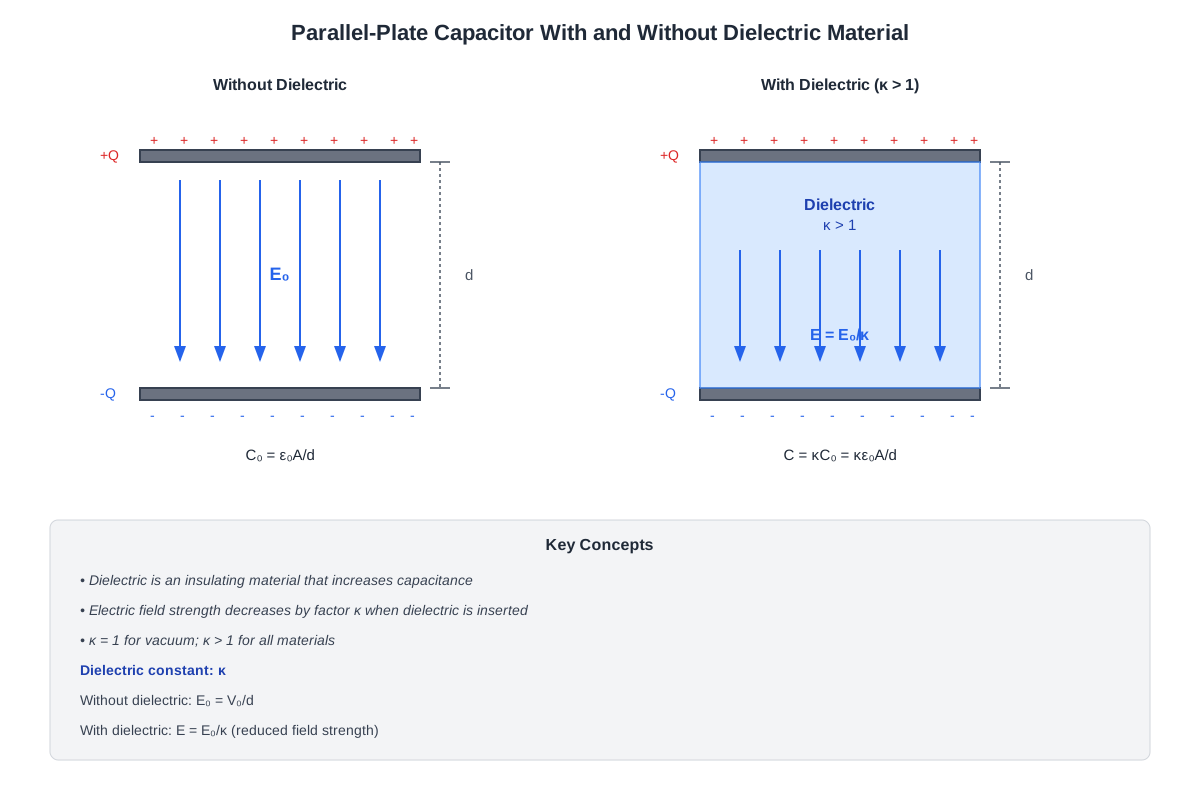
A dielectric is an electrical insulator that can be polarized by an applied electric field. Unlike conductors, dielectrics do not contain free electrons that can move throughout the material. Instead, when placed in an electric field, the bound charges within dielectric molecules shift slightly, creating microscopic electric dipoles that partially oppose the applied field. This property makes dielectrics invaluable in capacitor design and function.
The dielectric constant (also called relative permittivity), denoted by the Greek letter kappa (κ) or sometimes εᵣ, quantifies how effectively a dielectric material increases capacitance compared to vacuum. By definition, the dielectric constant of vacuum is exactly 1.0. All other materials have κ ≥ 1, with most practical dielectrics having values between 1 and 100. Common dielectric materials include air (κ ≈ 1.0006, often approximated as 1), paper (κ ≈ 3.7), glass (κ ≈ 4-10), and water (κ ≈ 80).
Mechanism of Dielectric Polarization
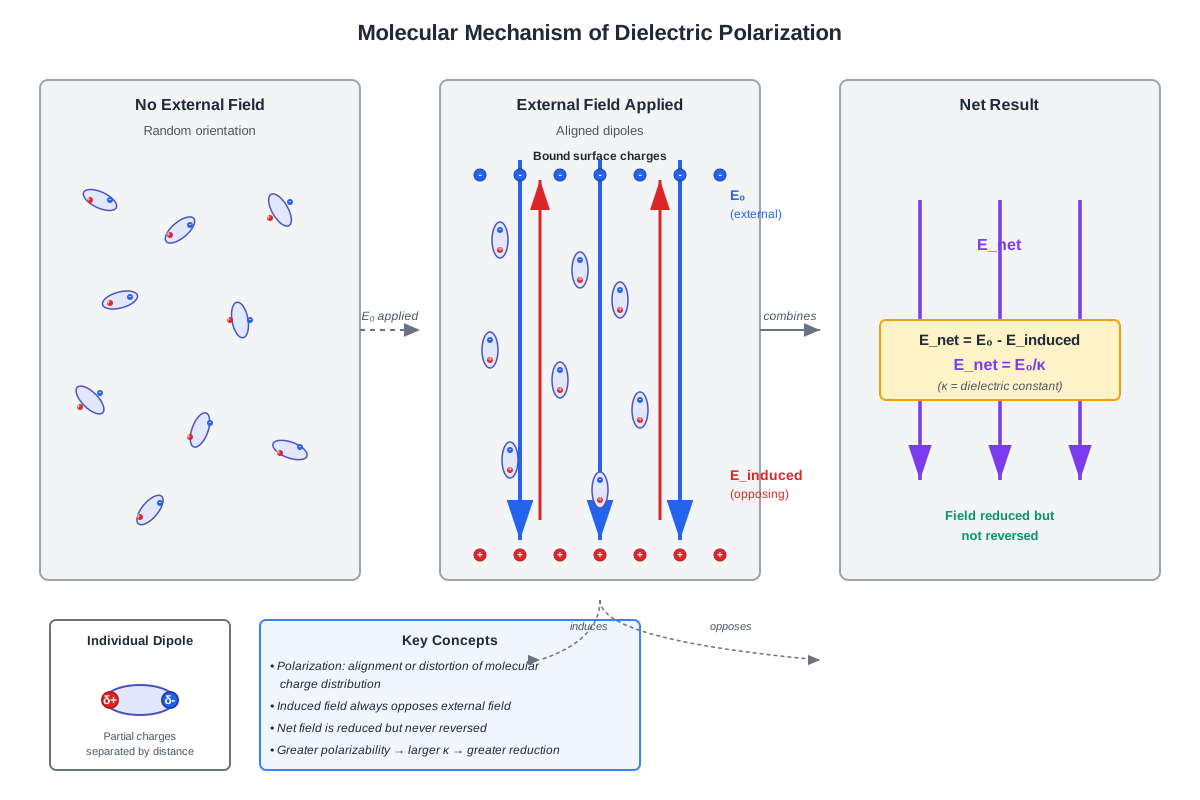
When a dielectric material is inserted between charged capacitor plates, the external electric field causes charge redistribution within the material through polarization. This occurs through three primary mechanisms:
- Electronic polarization: The electron clouds surrounding atoms shift slightly relative to the positive nuclei, creating tiny induced dipoles
- Ionic polarization: In materials with ionic bonds, positive and negative ions shift in opposite directions
- Orientation polarization: Molecules with permanent dipole moments (like water) rotate to align with the external field
The net effect of polarization is the creation of bound surface charges on the dielectric faces adjacent to the capacitor plates. These induced charges create an internal electric field (E_induced) that opposes the original external field (E_external). The resulting field inside the dielectric is:
E_total = E_external - E_induced = E_external / κThis field reduction is the fundamental reason dielectrics increase capacitance—the reduced field means less voltage is required to maintain the same charge separation, or equivalently, more charge can be stored at the same voltage.
Effect on Capacitance
The most important equation for Dielectrics MCAT problems relates the capacitance with a dielectric (C) to the capacitance without a dielectric (C₀):
C = κC₀For a parallel-plate capacitor, this becomes:
C = κε₀A/dwhere ε₀ is the permittivity of free space (8.85 × 10⁻¹² F/m), A is the plate area, and d is the separation distance. Since κ ≥ 1 for all materials, inserting a dielectric always increases capacitance. This increased capacitance means the capacitor can store more charge at the same voltage or maintain the same charge at lower voltage.
Isolated Capacitor vs. Battery-Connected Capacitor
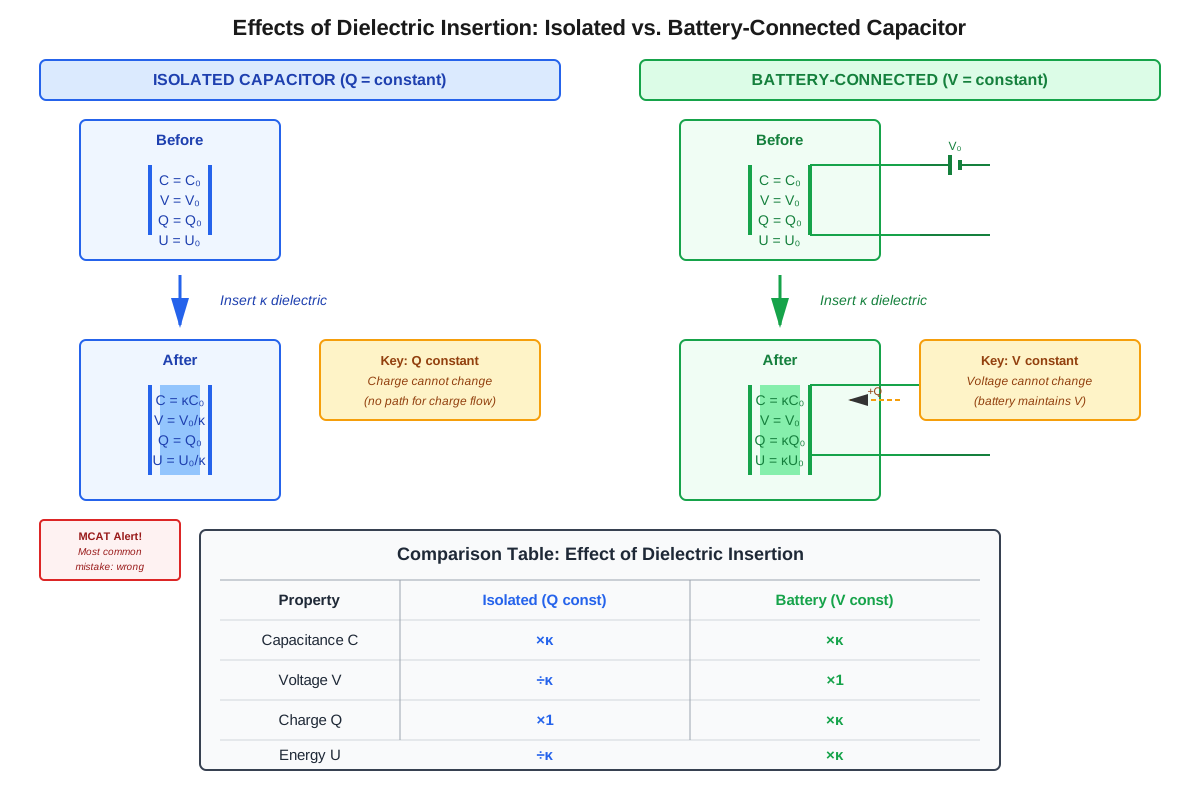
The effects of inserting a dielectric differ dramatically depending on whether the capacitor remains connected to a battery or is isolated after charging. This distinction is crucial for MCAT problem-solving:
| Property | Isolated Capacitor (Constant Q) | Battery-Connected (Constant V) |
|---|---|---|
| Charge (Q) | Remains constant | Increases by factor κ |
| Capacitance (C) | Increases by factor κ | Increases by factor κ |
| Voltage (V) | Decreases by factor κ | Remains constant |
| Electric Field (E) | Decreases by factor κ | Decreases by factor κ |
| Energy (U) | Decreases by factor κ | Increases by factor κ |
Isolated capacitor scenario: When a charged capacitor is disconnected from its battery, charge has nowhere to go (Q = constant). Inserting a dielectric increases capacitance (C → κC), so by Q = CV, voltage must decrease (V → V/κ). The stored energy U = Q²/2C decreases to U/κ because capacitance increased while charge remained constant.
Battery-connected scenario: When the capacitor remains connected to a battery, voltage is held constant by the battery (V = constant). Inserting a dielectric increases capacitance (C → κC), so by Q = CV, charge must increase (Q → κQ). The battery supplies this additional charge. The stored energy U = ½CV² increases to κU because both capacitance increased and voltage remained constant. The battery does work to supply the additional charge.
Energy Considerations and Work
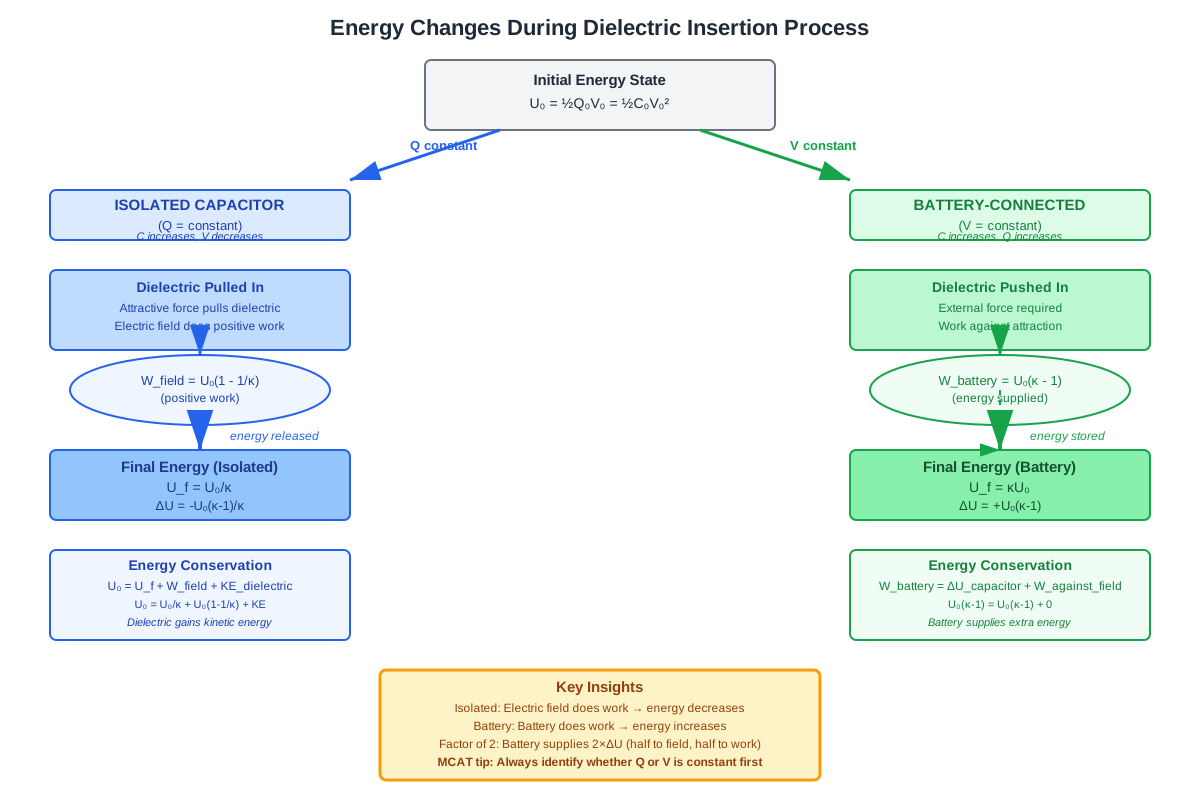
The energy stored in a capacitor can be expressed three equivalent ways:
U = ½CV² = ½QV = ½Q²/CWhen a dielectric is inserted into an isolated capacitor, the energy decreases. Where does this energy go? The dielectric is actually pulled into the capacitor by attractive forces from the electric field—the system does mechanical work on the dielectric. This is why dielectrics are spontaneously drawn into charged capacitors.
Conversely, when a dielectric is inserted into a battery-connected capacitor, energy increases. The battery must do electrical work to supply the additional charge that accumulates on the plates. The total work done by the battery (W = QΔV) exceeds the increase in stored energy; the difference accounts for the mechanical work done pulling the dielectric into the capacitor.
Dielectric Strength and Breakdown
Every dielectric material has a maximum electric field strength it can withstand before breaking down and becoming conductive. This critical value is called dielectric strength, typically measured in V/m or kV/mm. When the electric field exceeds this threshold, the material's molecular structure breaks down, free charges are created, and the material conducts electricity—often catastrophically.
For the MCAT, understanding that dielectrics allow capacitors to operate at higher voltages without breakdown is important. The reduced internal field (E → E/κ) means that for a given applied voltage, the field inside the dielectric is weaker, allowing higher voltages before reaching the breakdown threshold.
Partial Dielectric Insertion
Some MCAT problems involve dielectrics that only partially fill the space between capacitor plates. These situations can be analyzed by treating the system as capacitors in series (if the dielectric is inserted parallel to the plates) or in parallel (if inserted perpendicular to the plates). The effective capacitance depends on the geometry and the fraction of space filled by the dielectric.
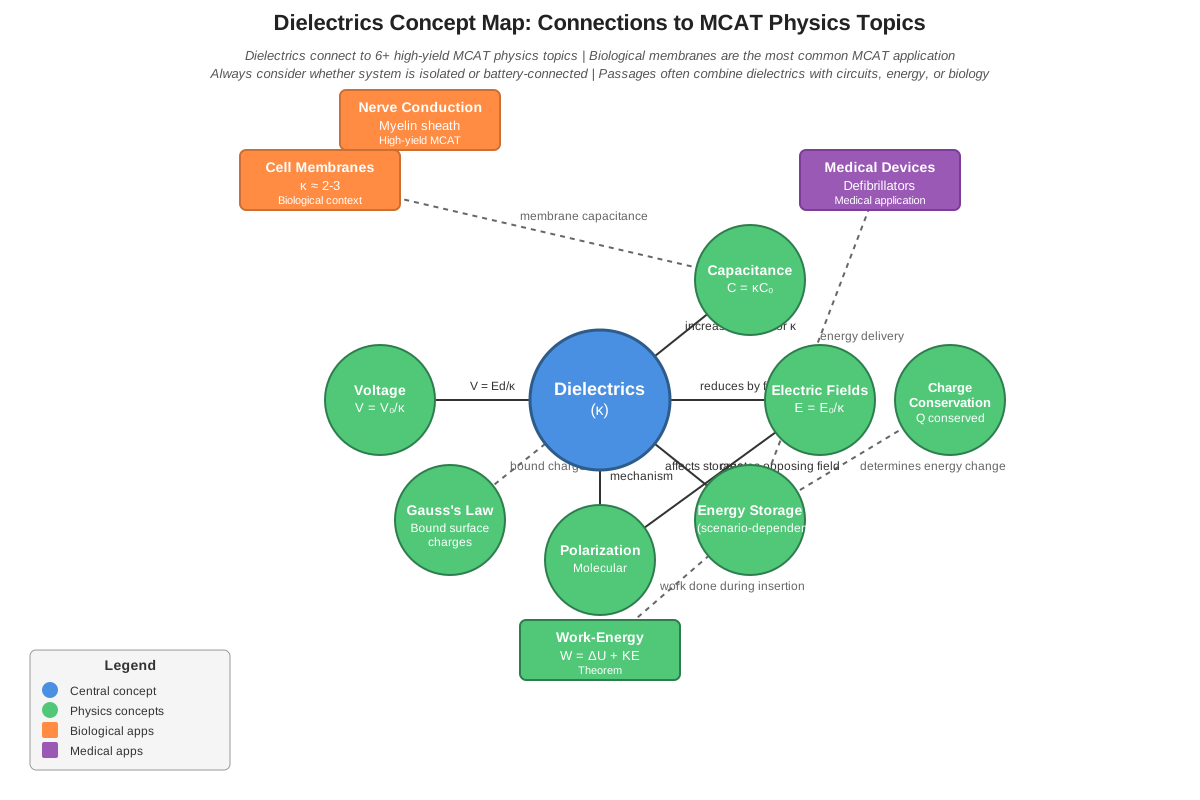
Concept Relationships
The study of dielectrics integrates multiple fundamental concepts in electricity and magnetism. At the foundation, electric fields create the forces that polarize dielectric materials. This polarization reduces the internal field strength, which directly affects voltage (since V = Ed). The modified field and voltage relationships then determine changes in capacitance (C = Q/V), which is the central quantity affected by dielectrics.
The relationship flows as: Electric Field → Polarization → Reduced Internal Field → Changed Voltage → Modified Capacitance → Altered Energy Storage
Dielectrics connect to capacitors as the primary application context—virtually all practical capacitors use dielectric materials to increase capacitance and prevent breakdown. The energy storage equations link dielectrics to work and energy concepts, particularly when analyzing whether capacitors are isolated or battery-connected. The distinction between constant charge and constant voltage scenarios connects to circuit analysis and understanding of battery behavior.
For biological applications, dielectrics connect to cell membrane structure, where lipid bilayers act as dielectric materials separating ionic solutions. This relates to bioelectricity, nerve conduction, and membrane potential—topics that may appear in MCAT passages integrating physics with biology. The dielectric properties of water (κ ≈ 80) are particularly relevant for understanding biological systems and the behavior of ions in solution.
High-Yield Facts
⭐ The dielectric constant κ is always ≥ 1, with vacuum defined as κ = 1
⭐ Inserting a dielectric always increases capacitance by the factor κ: C = κC₀
⭐ The electric field inside a dielectric is reduced by factor κ: E = E₀/κ
⭐ For an isolated capacitor, inserting a dielectric decreases voltage by factor κ and decreases energy by factor κ
⭐ For a battery-connected capacitor, inserting a dielectric increases charge by factor κ and increases energy by factor κ
- The dielectric constant of water (κ ≈ 80) is much higher than most other common materials, making it highly effective at reducing electric fields
- Dielectrics are spontaneously pulled into charged capacitors due to attractive forces from the non-uniform electric field at the edges
- The energy "lost" when inserting a dielectric into an isolated capacitor is converted to mechanical work done on the dielectric
- Dielectric breakdown occurs when the electric field exceeds the dielectric strength, causing the insulator to become conductive
- Air has κ ≈ 1.0006, so it's often treated as vacuum (κ = 1) in MCAT calculations
- The three equivalent energy formulas (U = ½CV², U = ½QV, U = Q²/2C) give different results when variables change—choose the formula with constant quantities
Quick check — test yourself on Dielectrics so far.
Try Flashcards →Common Misconceptions
Misconception: Dielectrics conduct electricity or allow charge to flow through them.
Correction: Dielectrics are insulators that do not allow free charge flow. They respond to electric fields through polarization (charge redistribution within molecules) but do not conduct current under normal operating conditions. Only when the field exceeds the dielectric strength does breakdown occur and conduction begin.
Misconception: Inserting a dielectric always increases the energy stored in a capacitor.
Correction: The effect on energy depends on whether the capacitor is isolated or connected to a battery. For an isolated capacitor (constant Q), energy decreases by factor κ. For a battery-connected capacitor (constant V), energy increases by factor κ. Students must identify which scenario applies before determining energy changes.
Misconception: The dielectric constant can be less than 1 for some materials.
Correction: By definition, κ ≥ 1 for all materials, with vacuum having κ = 1 exactly. A value less than 1 would imply the material somehow amplifies the electric field rather than reducing it, which violates the physics of polarization. Some students confuse this with other dimensionless constants that can be less than 1.
Misconception: When a dielectric is inserted, the charge on the capacitor plates changes regardless of whether it's connected to a battery.
Correction: Charge only changes if the capacitor remains connected to a battery, which can supply or remove charge. For an isolated capacitor, charge is conserved and cannot change—there's nowhere for it to go. This distinction is critical for solving problems correctly.
Misconception: The voltage across a capacitor always decreases when a dielectric is inserted.
Correction: Voltage only decreases for an isolated capacitor. When connected to a battery, the battery maintains constant voltage across the capacitor regardless of capacitance changes. The battery does work to supply additional charge that maintains this constant voltage as capacitance increases.
Misconception: Dielectric polarization means the material becomes permanently magnetized or charged.
Correction: Polarization is a temporary redistribution of bound charges within the material in response to an external field. When the external field is removed, the material returns to its unpolarized state. The material does not acquire a net charge or become permanently altered (unless breakdown occurs).
Worked Examples
Example 1: Isolated Capacitor with Dielectric Insertion
Problem: A parallel-plate capacitor with capacitance C₀ = 4.0 μF is charged to voltage V₀ = 12 V, then disconnected from the battery. A dielectric material with κ = 3.0 is then inserted between the plates. Calculate: (a) the new capacitance, (b) the new voltage, (c) the initial energy stored, and (d) the final energy stored.
Solution:
First, identify that this is an isolated capacitor scenario because it's disconnected from the battery before the dielectric is inserted. This means charge Q remains constant throughout.
(a) New capacitance: When a dielectric is inserted, capacitance increases by factor κ:
C = κC₀ = 3.0 × 4.0 μF = 12.0 μF(b) New voltage: Since Q = CV and Q is constant:
Q = C₀V₀ = CV
V = C₀V₀/C = V₀/κ = 12 V / 3.0 = 4.0 V
The voltage decreases by factor κ because the same charge is now distributed across a capacitor with higher capacitance.
(c) Initial energy: Using U = ½CV²:
U₀ = ½C₀V₀² = ½(4.0 × 10⁻⁶ F)(12 V)² = ½(4.0 × 10⁻⁶)(144) = 2.88 × 10⁻⁴ J = 288 μJ(d) Final energy: Using the same formula with new values:
U = ½CV² = ½(12.0 × 10⁻⁶ F)(4.0 V)² = ½(12.0 × 10⁻⁶)(16) = 9.6 × 10⁻⁵ J = 96 μJAlternatively, for an isolated capacitor, energy decreases by factor κ:
U = U₀/κ = 288 μJ / 3.0 = 96 μJ ✓Key insight: The energy decreased from 288 μJ to 96 μJ, a loss of 192 μJ. This energy was converted to mechanical work as the dielectric was pulled into the capacitor by attractive forces from the electric field.
Example 2: Battery-Connected Capacitor with Dielectric
Problem: A parallel-plate capacitor with plate area A = 0.02 m² and separation d = 2.0 mm is connected to a 9.0 V battery. Initially, the space between plates is air (κ ≈ 1). A dielectric sheet with κ = 5.0 is then inserted while the battery remains connected. Calculate: (a) the initial capacitance, (b) the final capacitance, (c) the initial charge, (d) the final charge, and (e) the change in stored energy. Use ε₀ = 8.85 × 10⁻¹² F/m.
Solution:
This is a battery-connected scenario, so voltage V remains constant at 9.0 V throughout.
(a) Initial capacitance (air-filled):
C₀ = ε₀A/d = (8.85 × 10⁻¹² F/m)(0.02 m²)/(2.0 × 10⁻³ m)
C₀ = (8.85 × 10⁻¹² × 0.02)/(2.0 × 10⁻³) = 8.85 × 10⁻¹¹ F = 88.5 pF
(b) Final capacitance (with dielectric):
C = κC₀ = 5.0 × 88.5 pF = 442.5 pF(c) Initial charge:
Q₀ = C₀V = (88.5 × 10⁻¹² F)(9.0 V) = 7.97 × 10⁻¹⁰ C ≈ 797 pC(d) Final charge: Since voltage is constant and capacitance increased:
Q = CV = (442.5 × 10⁻¹² F)(9.0 V) = 3.98 × 10⁻⁹ C ≈ 3,980 pCOr simply: Q = κQ₀ = 5.0 × 797 pC = 3,985 pC
(e) Change in stored energy: Using U = ½CV² (since V is constant):
U₀ = ½C₀V² = ½(88.5 × 10⁻¹² F)(9.0 V)² = 3.58 × 10⁻⁹ J
U = ½CV² = ½(442.5 × 10⁻¹² F)(9.0 V)² = 1.79 × 10⁻⁸ J
ΔU = U - U₀ = 1.79 × 10⁻⁸ - 3.58 × 10⁻⁹ = 1.43 × 10⁻⁸ J
Or using the fact that energy increases by factor κ for battery-connected capacitors:
U = κU₀ = 5.0 × 3.58 × 10⁻⁹ J = 1.79 × 10⁻⁸ J ✓Key insight: The energy increased because the battery did work to supply the additional charge. The battery supplied charge ΔQ = Q - Q₀ at voltage V, doing work W = VΔQ. Part of this work increased the stored energy, and part was converted to mechanical work pulling the dielectric into the capacitor.
Exam Strategy
When approaching MCAT questions on dielectrics, the first critical step is determining whether the capacitor is isolated (disconnected from battery, constant Q) or battery-connected (constant V). This single distinction determines how all other quantities change. Look for phrases like "disconnected from the power supply," "isolated," or "removed from the circuit" to identify constant-Q scenarios. Phrases like "remains connected," "battery maintains," or "constant voltage" indicate constant-V scenarios.
Trigger words to watch for include: "dielectric constant," "relative permittivity," "insulating material," "polarization," "breakdown," and "dielectric strength." Questions may also use specific material names (glass, paper, ceramic) and expect you to recognize these as dielectrics. Be alert for comparative language: "increases," "decreases," "remains constant," or "by what factor."
For quantitative problems, immediately write down the three energy formulas and identify which variables are constant. Use the formula containing only constant quantities to avoid errors. For example, if Q is constant (isolated capacitor), use U = Q²/2C to find energy changes. If V is constant (battery-connected), use U = ½CV². This strategy prevents the common mistake of using the wrong formula and getting incorrect results.
For conceptual questions, focus on the mechanism: dielectrics reduce the internal electric field through polarization, which is why capacitance increases. If asked to explain why a property changes, trace the causal chain: polarization → reduced field → changed voltage (or charge) → modified capacitance → altered energy. The MCAT rewards understanding of mechanisms, not just memorized formulas.
Process of elimination tips: If a question asks about energy changes and doesn't specify whether the capacitor is isolated or battery-connected, eliminate answer choices that give absolute values—the answer must depend on the scenario. If asked about capacitance changes, eliminate any choice suggesting capacitance decreases (it always increases with dielectric insertion). For field strength, eliminate choices showing field increase (it always decreases by factor κ).
Time allocation: Straightforward calculation problems should take 60-90 seconds. More complex problems involving multiple steps or scenario comparison may require 2-3 minutes. If a problem seems to require extensive calculation, look for shortcuts using proportional relationships (e.g., if κ = 4 and the question asks for the ratio of final to initial energy in an isolated capacitor, the answer is 1/4 without calculating absolute values).
Memory Techniques
Mnemonic for isolated vs. battery-connected scenarios: "I-Q-D-D, B-V-I-I"
- Isolated: Q constant, voltage Decreases, energy Decreases
- Battery: V constant, charge Increases, energy Increases
Visualization for polarization: Picture a dielectric as a collection of tiny dumbbells (representing molecules). When an external field is applied, all dumbbells rotate to align with the field, with negative ends pointing toward the positive plate and positive ends toward the negative plate. This creates an internal field pointing opposite to the external field, reducing the total field strength.
Acronym for capacitance factors: "K-A-D" reminds you that capacitance depends on:
- Kappa (dielectric constant) - directly proportional
- Area - directly proportional
- Distance - inversely proportional
Memory aid for energy formulas: Remember "Q-C-V" in a triangle:
      Q
     / \
    /   \
   C --- V
Any two vertices give you the third: Q = CV. For energy, put ½ in front and multiply any two: U = ½QV, U = ½CV², U = ½Q²/C (this last one requires flipping C to the denominator).
Conceptual anchor: "Dielectrics are like shock absorbers for electric fields"—they cushion and reduce the field strength without conducting charge, just as shock absorbers reduce force transmission without allowing direct mechanical connection.
Summary
Dielectrics are insulating materials that increase capacitance when inserted between capacitor plates by reducing the internal electric field through polarization. The dielectric constant κ quantifies this effect, with all materials having κ ≥ 1. The fundamental relationship C = κC₀ shows that capacitance always increases by factor κ. The effects on other quantities depend critically on whether the capacitor is isolated (constant charge) or battery-connected (constant voltage). For isolated capacitors, voltage and energy both decrease by factor κ, while for battery-connected capacitors, charge and energy both increase by factor κ. The electric field inside the dielectric always decreases by factor κ regardless of the scenario. Understanding these relationships requires both mathematical facility with the three equivalent energy formulas and conceptual grasp of the polarization mechanism. MCAT questions test the ability to identify scenarios, apply appropriate formulas, and reason about energy transformations when dielectrics are inserted or removed.
Key Takeaways
- Dielectrics are insulators that increase capacitance through polarization, always with κ ≥ 1 and C = κC₀
- The critical distinction is isolated capacitor (constant Q, voltage and energy decrease) versus battery-connected (constant V, charge and energy increase)
- Electric field inside a dielectric always decreases by factor κ: E = E₀/κ, regardless of whether the capacitor is isolated or connected
- Choose energy formulas based on which quantities remain constant: U = Q²/2C for constant Q, U = ½CV² for constant V
- Energy changes represent work done: mechanical work pulling the dielectric in, and electrical work by the battery supplying charge
- Water's high dielectric constant (κ ≈ 80) makes it particularly effective at reducing electric fields, relevant for biological applications
- Dielectric breakdown occurs when field strength exceeds dielectric strength, causing the insulator to conduct
Related Topics
Capacitors in Series and Parallel: Understanding how multiple capacitors combine prepares for analyzing complex circuits with dielectrics and extends the single-capacitor concepts covered here.
Electric Potential Energy: Deeper exploration of energy storage in electric fields connects to the energy changes when dielectrics are inserted and provides broader context for capacitor energy.
Gauss's Law with Dielectrics: Advanced treatment of how dielectrics modify electric field calculations using Gauss's law, extending the field reduction concepts introduced here.
Biological Membranes as Capacitors: Application of dielectric concepts to cell membrane structure and function, integrating physics with biology for MCAT passages.
RC Circuits: Time-dependent behavior of capacitors in circuits, where dielectric properties affect charging and discharging rates—building on the steady-state concepts mastered here.
Practice CTA
Now that you've mastered the core concepts of dielectrics, it's time to solidify your understanding through active practice. Work through the practice questions to test your ability to identify isolated versus battery-connected scenarios, calculate capacitance and energy changes, and apply conceptual reasoning about polarization mechanisms. Use the flashcards to reinforce high-yield facts and relationships until they become automatic. Remember: understanding dielectrics gives you a significant advantage on MCAT Physics questions involving capacitors, energy storage, and biological applications. Your investment in mastering this medium-yield topic will pay dividends on test day!
Sign up free to keep reading
Create a free AnvayaPrep account to finish this MCAT guide on Dielectrics — plus flashcards and practice questions.