Overview
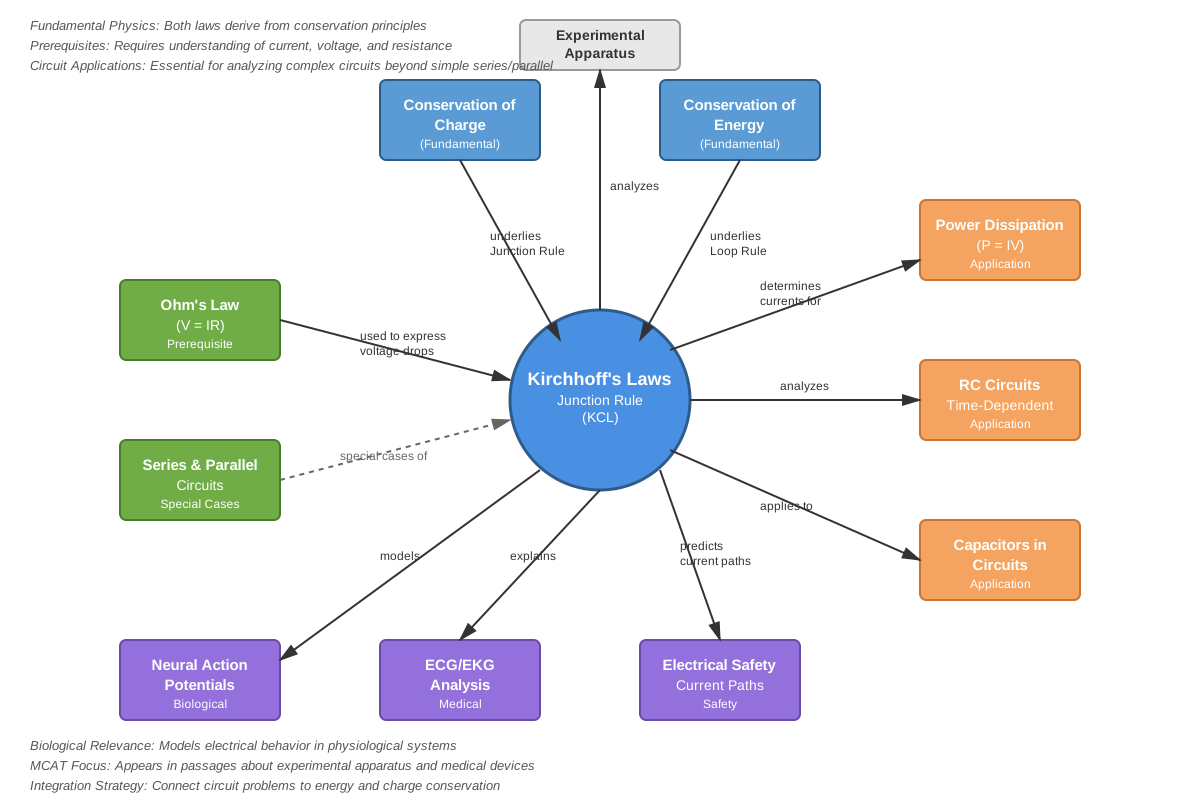
Kirchhoff's laws represent two fundamental principles that govern the behavior of electric circuits, forming the cornerstone of circuit analysis in Physics. Named after German physicist Gustav Kirchhoff, these laws—the Junction Rule (Current Law) and the Loop Rule (Voltage Law)—provide systematic methods for analyzing complex circuits that cannot be simplified using series and parallel resistor combinations alone. For the MCAT, mastery of Kirchhoff's laws is essential because they bridge conceptual understanding of charge conservation and energy conservation with practical problem-solving skills required in Electricity and Magnetism questions.
The MCAT frequently tests Kirchhoff's laws Physics concepts through multi-loop circuits, biological applications like neural signal transmission, and experimental apparatus passages. Understanding these laws enables students to determine unknown currents, voltages, and resistances in circuits that model physiological systems such as cardiac pacemakers, electrocardiograms, and membrane potential measurements. The laws are not merely mathematical tools but represent deep physical principles: the Junction Rule embodies charge conservation, while the Loop Rule reflects energy conservation in electrical systems.
Kirchhoff's laws MCAT questions typically appear in passages describing experimental setups or in discrete questions requiring circuit analysis. These problems test both conceptual understanding and quantitative reasoning, making them medium-difficulty questions that separate high-scoring students from average performers. The laws connect directly to Ohm's law, series and parallel circuits, capacitors, and power dissipation—forming an integrated framework for understanding all circuit behavior tested on the exam.
Learning Objectives
- [ ] Define Kirchhoff's laws using accurate Physics terminology
- [ ] Explain why Kirchhoff's laws matter for the MCAT
- [ ] Apply Kirchhoff's laws to exam-style questions
- [ ] Identify common mistakes related to Kirchhoff's laws
- [ ] Connect Kirchhoff's laws to related Physics concepts
- [ ] Derive and solve systems of equations for multi-loop circuits using both Kirchhoff's laws simultaneously
- [ ] Analyze the physical meaning of positive and negative current values in circuit solutions
- [ ] Predict qualitative circuit behavior before performing calculations to verify quantitative answers
Prerequisites
- Ohm's Law (V = IR): Essential for relating voltage, current, and resistance in individual circuit elements when applying Kirchhoff's laws
- Series and Parallel Circuits: Provides foundation for understanding current flow patterns and voltage distribution that Kirchhoff's laws generalize
- Conservation Laws: Understanding energy and charge conservation principles underlies the physical basis of both Kirchhoff's laws
- Basic Algebra: Required for setting up and solving systems of linear equations that emerge from applying Kirchhoff's laws to circuits
- Electric Current and Resistance: Necessary for understanding what flows through circuits and what opposes that flow
Why This Topic Matters
Kirchhoff's laws have profound clinical and real-world significance. Medical devices such as electrocardiographs, electroencephalographs, and nerve conduction measurement apparatus all rely on circuit principles governed by these laws. Understanding how current distributes through parallel pathways helps explain why electrical injuries can cause internal damage along unexpected routes through the body. Defibrillators and pacemakers are designed using circuit analysis techniques based on Kirchhoff's laws to ensure proper current delivery to cardiac tissue.
On the MCAT, Kirchhoff's laws appear in approximately 2-4% of Physics questions, typically in the Electricity and Magnetism section. Questions may be discrete (standalone) or passage-based, with passage-based questions often describing experimental apparatus, biological measurement systems, or theoretical circuit scenarios. The MCAT tests both qualitative reasoning (predicting how changes in one part of a circuit affect other parts) and quantitative problem-solving (calculating specific current or voltage values).
Common exam presentations include: circuits with multiple batteries and resistors requiring systematic analysis; biological passages describing membrane potentials or neural circuits modeled as electrical networks; experimental passages about measurement devices like galvanometers or Wheatstone bridges; and questions asking students to identify which circuit modifications would produce specific outcomes. The laws frequently appear alongside questions about power dissipation, internal resistance of batteries, and capacitor charging/discharging in complex circuits.
Core Concepts
Kirchhoff's Junction Rule (Current Law)
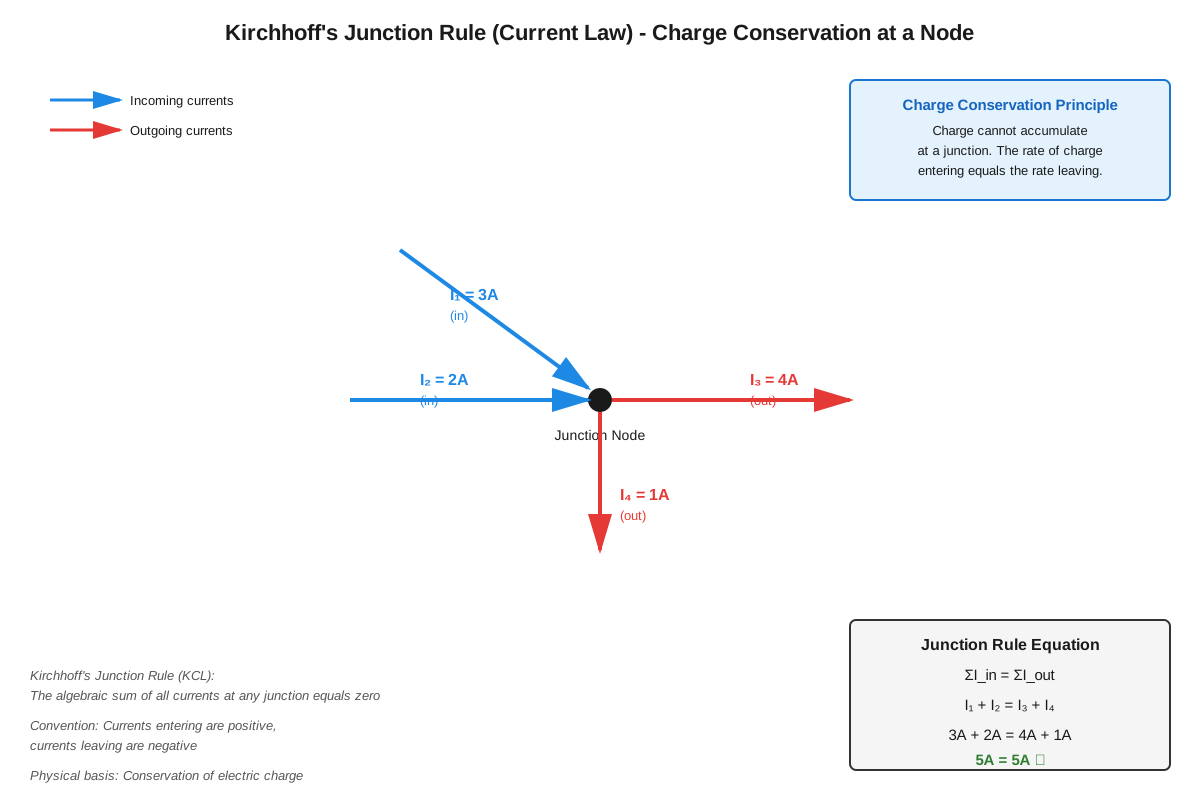
Kirchhoff's Junction Rule, also called the Current Law or First Law, states that the algebraic sum of all currents entering any junction (node) in a circuit equals zero. Alternatively stated: the total current entering a junction equals the total current leaving that junction. Mathematically:
ΣI_in = ΣI_out
or
ΣI = 0 (at any junction)
This law is a direct consequence of charge conservation. Since charge cannot accumulate at a junction point (which has negligible volume), whatever charge flows into the junction per unit time must flow out. If charge accumulated, the junction would develop an increasing electric potential that would prevent further charge accumulation—a situation that reaches equilibrium essentially instantaneously.
When applying the Junction Rule, establish a sign convention: currents entering a junction are typically assigned positive signs, while currents leaving are negative (or vice versa—consistency matters more than the specific choice). For a junction where currents I₁ and I₂ enter, and currents I₃, I₄, and I₅ leave:
I₁ + I₂ - I₃ - I₄ - I₅ = 0Key insight: In a circuit with N junctions, only (N-1) independent equations can be derived from the Junction Rule. The Nth equation would be redundant, merely restating information from the other equations.
Kirchhoff's Loop Rule (Voltage Law)
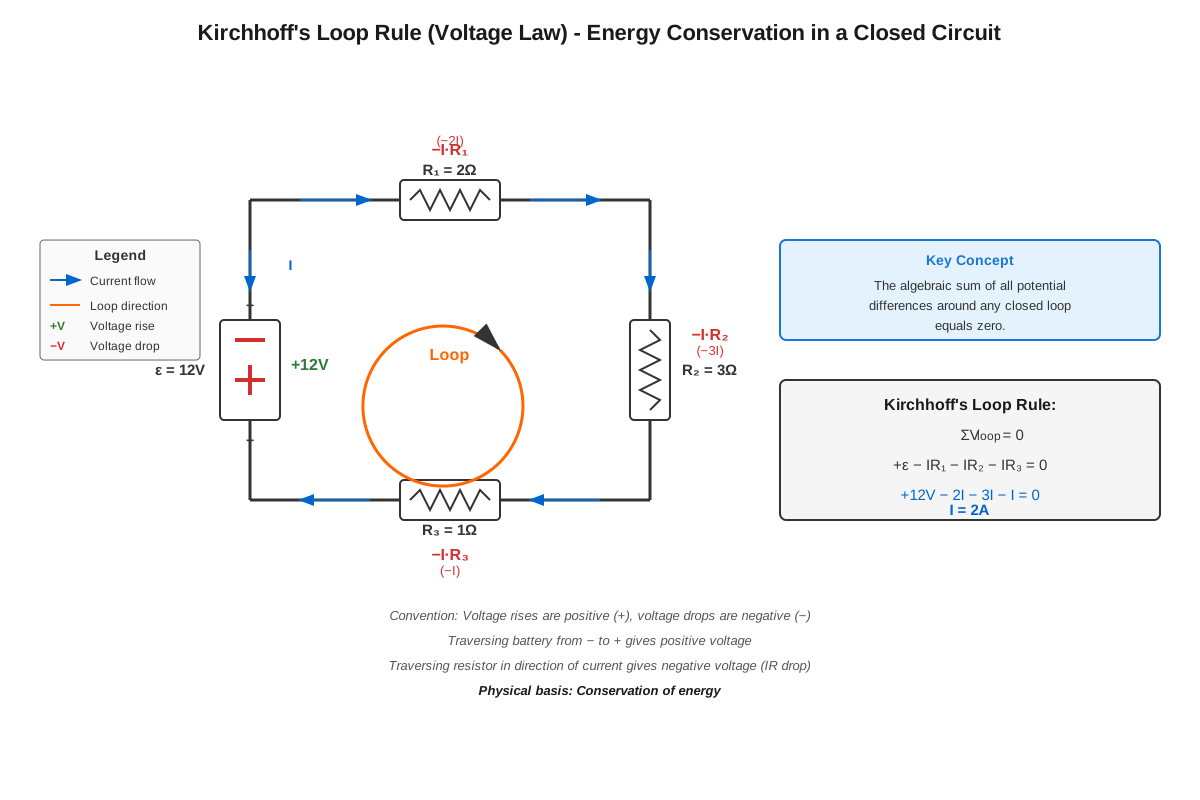
Kirchhoff's Loop Rule, also called the Voltage Law or Second Law, states that the algebraic sum of all potential differences (voltages) around any closed loop in a circuit equals zero:
ΣV = 0 (around any closed loop)This law embodies energy conservation. As a charge travels completely around a closed loop and returns to its starting point, the net work done on it must be zero—otherwise, the charge would gain or lose energy with each circuit, leading to perpetual motion. The electric potential is a state function; returning to the starting point means returning to the same potential.
When traversing a loop, follow these sign conventions:
For resistors:
- Moving in the direction of current flow (with the current): voltage change is -IR (potential drops)
- Moving against current flow: voltage change is +IR (potential rises)
For batteries/EMF sources:
- Moving from negative terminal to positive terminal: voltage change is +ε (potential rises)
- Moving from positive terminal to negative terminal: voltage change is -ε (potential drops)
For capacitors:
- Moving from negative plate to positive plate: voltage change is +Q/C
- Moving from positive plate to negative plate: voltage change is -Q/C
Systematic Circuit Analysis Procedure
To solve complex circuits using Kirchhoff's laws, follow this systematic approach:
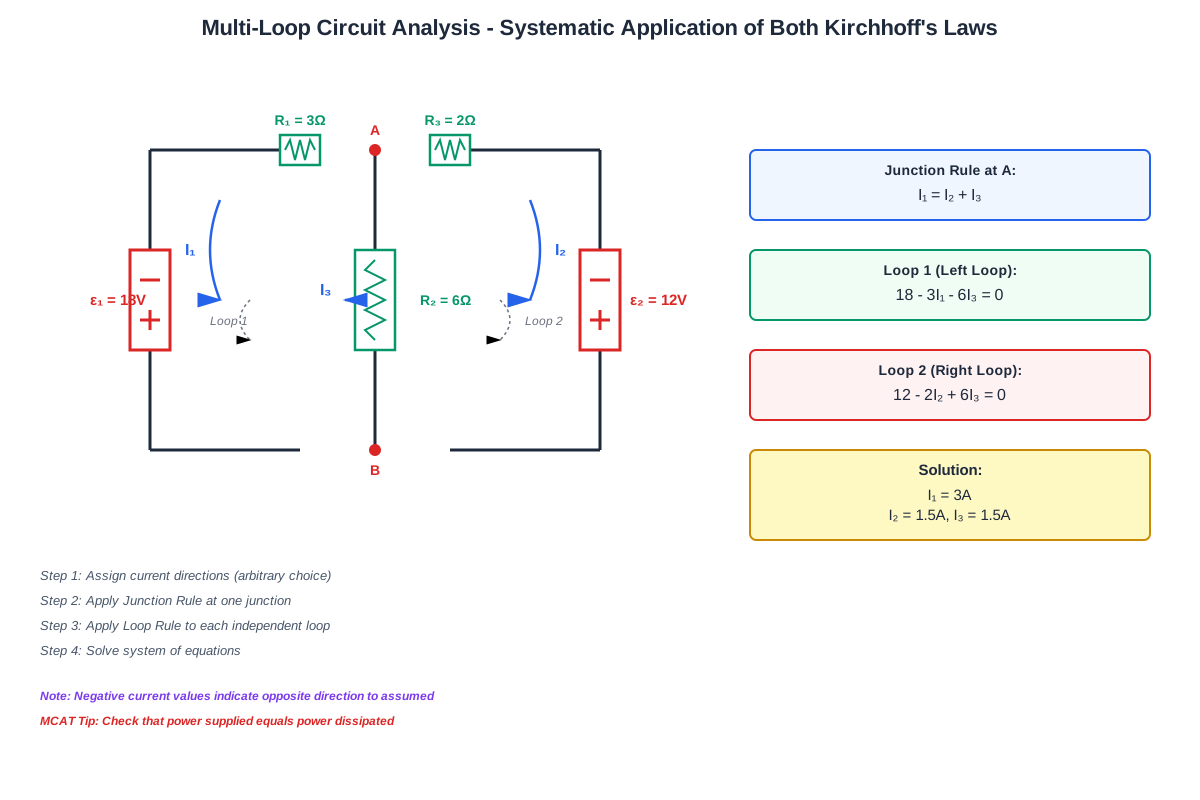
- Label all circuit elements: Assign variables to unknown currents (I₁, I₂, I₃, etc.) and indicate assumed directions with arrows. If the actual direction is opposite to your assumption, the calculated value will be negative.
- Identify all junctions: Mark each point where three or more wires meet.
- Apply the Junction Rule: Write equations for (N-1) junctions, where N is the total number of junctions.
- Identify independent loops: Choose closed paths through the circuit. For a circuit with B branches and N junctions, you need (B - N + 1) independent loop equations.
- Apply the Loop Rule: Traverse each chosen loop in one consistent direction (clockwise or counterclockwise), writing voltage equations using proper sign conventions.
- Solve the system of equations: Use substitution, elimination, or matrix methods to find all unknown currents.
- Check your answer: Verify that currents satisfy both junction and loop equations, and that the signs make physical sense.
Multi-Loop Circuit Analysis
Consider a circuit with two loops sharing a common branch. This configuration requires careful application of both laws:
| Circuit Feature | Junction Rule Application | Loop Rule Application |
|---|---|---|
| Shared branch | Current in shared branch appears in equations for both adjacent junctions | Shared branch voltage appears in both loop equations |
| Independent loops | Each junction provides one equation (except one redundant junction) | Each independent loop provides one equation |
| Current directions | Assumed directions; negative results indicate opposite actual direction | Must be consistent when writing voltage drops/rises |
For a two-loop circuit with three branches, you need:
- 2 independent junction equations (from 3 junctions)
- 1 additional loop equation (for 3 total equations to solve for 3 unknown currents)
Internal Resistance and Real Batteries
Real batteries have internal resistance (r), which must be included in circuit analysis. A real battery with EMF ε and internal resistance r can be modeled as an ideal EMF source in series with a resistor r. When current I flows through the battery:
V_terminal = ε - Ir (when battery supplies current)
V_terminal = ε + Ir (when battery is being charged)
The terminal voltage is less than the EMF when the battery delivers current because some potential is "lost" across the internal resistance. This concept frequently appears in MCAT passages about battery performance and circuit efficiency.
Sign Conventions and Physical Interpretation
Understanding the physical meaning of signs is crucial for Kirchhoff's laws MCAT success:
- Positive current value: Current flows in the assumed direction
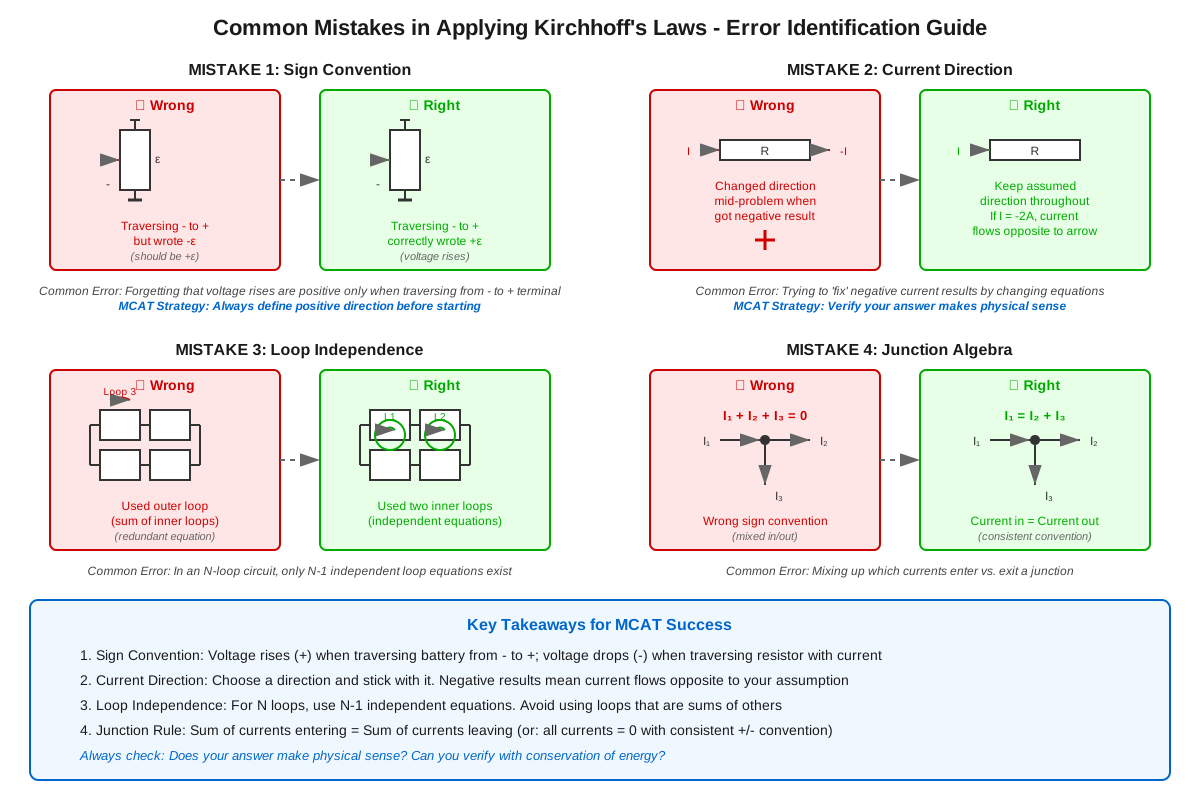
- Negative current value: Current flows opposite to the assumed direction (not an error!)
- Positive voltage across resistor: Moving against current flow (potential increasing)
- Negative voltage across resistor: Moving with current flow (potential decreasing)
The beauty of Kirchhoff's laws is that incorrect current direction assumptions automatically correct themselves through negative values—the mathematics handles the physics.
Concept Relationships
Kirchhoff's Junction Rule directly derives from the principle of charge conservation, which itself connects to the continuity equation in fluid dynamics and mass conservation in chemistry. The Junction Rule → enables analysis of parallel circuit branches → which determines how current divides based on resistance ratios → affecting power dissipation in each branch.
Kirchhoff's Loop Rule emerges from energy conservation and the conservative nature of the electrostatic field. The Loop Rule → requires understanding of potential difference → which connects to electric field and work → enabling calculation of power and energy in circuits → linking to thermodynamics and heat dissipation.
The two laws work synergistically: Junction Rule provides equations relating currents → Loop Rule provides equations relating voltages and currents → together they form a complete system of equations → solvable for all unknown circuit quantities.
These laws generalize simpler circuit analysis methods: Series circuits are special cases where the Junction Rule is trivial (same current everywhere) → Parallel circuits are cases where the Loop Rule immediately shows equal voltages → Complex circuits require full application of both laws → enabling analysis of any circuit topology.
Connection to Ohm's Law: Kirchhoff's laws don't replace Ohm's law but incorporate it. When writing Loop Rule equations, voltage drops across resistors use V = IR, making Ohm's law an integral component of the analysis.
High-Yield Facts
⭐ Kirchhoff's Junction Rule states that the sum of currents entering any junction equals the sum of currents leaving that junction (ΣI_in = ΣI_out), reflecting charge conservation.
⭐ Kirchhoff's Loop Rule states that the sum of all voltage changes around any closed loop equals zero (ΣV = 0), reflecting energy conservation.
⭐ When traversing a resistor in the direction of current flow, the voltage change is -IR (potential drops); against current flow, it's +IR (potential rises).
⭐ When traversing a battery from negative to positive terminal, the voltage change is +ε; from positive to negative, it's -ε.
⭐ For a circuit with N junctions, only (N-1) independent junction equations exist; the Nth would be redundant.
- For a circuit with B branches and N junctions, you need (B - N + 1) independent loop equations to fully solve the circuit.
- Negative current values in solutions indicate the actual current flows opposite to the assumed direction, not that an error was made.
- Real batteries have internal resistance that reduces terminal voltage below EMF when delivering current: V_terminal = ε - Ir.
- The same current flows through all elements in a series branch, making Junction Rule analysis straightforward for those sections.
- In parallel branches, the voltage across each branch is identical, which can be used to check Loop Rule applications.
- Power dissipated in a resistor is P = I²R, where I is found using Kirchhoff's laws—connecting circuit analysis to energy concepts.
- Kirchhoff's laws apply to both DC and AC circuits, though MCAT focuses primarily on DC applications.
Quick check — test yourself on Kirchhoff laws so far.
Try Flashcards →Common Misconceptions
Misconception: Kirchhoff's laws only apply to simple circuits with one or two loops.
Correction: Kirchhoff's laws are universal principles that apply to circuits of any complexity, from simple single-loop circuits to integrated circuits with millions of components. They are actually most useful for complex circuits that cannot be simplified using series/parallel combinations.
Misconception: If a calculated current comes out negative, the solution is wrong and must be recalculated.
Correction: Negative current values are perfectly valid and simply indicate that the actual current direction is opposite to the initially assumed direction. The magnitude is correct; just reverse the arrow in your diagram. This self-correcting feature is one of the strengths of Kirchhoff's laws.
Misconception: The Junction Rule and Loop Rule are independent of Ohm's law.
Correction: While Kirchhoff's laws are fundamental principles, applying them to resistive circuits requires Ohm's law (V = IR) to relate voltage drops to currents. The Loop Rule equation for a resistor explicitly uses Ohm's law to express voltage in terms of current and resistance.
Misconception: You must write equations for every junction and every possible loop in a circuit.
Correction: Writing equations for all junctions and all loops produces redundant equations that don't add new information. For N junctions, use only (N-1) junction equations. For loops, identify the minimum number of independent loops needed: (B - N + 1), where B is the number of branches.
Misconception: When applying the Loop Rule, you must always traverse loops clockwise.
Correction: You can traverse loops in either direction (clockwise or counterclockwise), as long as you apply sign conventions consistently. The choice of direction is arbitrary; the resulting equation will be valid regardless. Some students find counterclockwise more intuitive, others prefer clockwise—both work equally well.
Misconception: Kirchhoff's laws can determine the direction of current flow without solving equations.
Correction: While qualitative reasoning can sometimes predict current direction, Kirchhoff's laws require solving the full system of equations to determine actual current values and directions, especially in complex circuits with multiple batteries or competing current paths.
Misconception: The voltage across a battery is always equal to its EMF.
Correction: Real batteries have internal resistance, so the terminal voltage differs from the EMF when current flows. When supplying current, V_terminal = ε - Ir, where r is internal resistance. Only when no current flows (open circuit) does terminal voltage equal EMF.
Worked Examples
Example 1: Two-Loop Circuit with Multiple Resistors
Problem: A circuit contains two batteries and three resistors arranged in two loops. Battery 1 has EMF ε₁ = 12 V, Battery 2 has EMF ε₂ = 6 V, and the resistors have values R₁ = 4 Ω, R₂ = 2 Ω, and R₃ = 6 Ω. The circuit topology is: Battery 1 and R₁ form the left loop, Battery 2 and R₃ form the right loop, and R₂ is shared between both loops in the middle. Find all currents.
Solution:
Step 1: Label currents. Let I₁ flow clockwise through the left loop, I₂ flow clockwise through the right loop, and I₃ flow through the shared resistor R₂. Assume I₃ flows downward.
Step 2: Apply Junction Rule at the top junction:
I₁ = I₂ + I₃ ... (Equation 1)Step 3: Apply Loop Rule to the left loop (traverse clockwise):
Starting at bottom left, going up through Battery 1 (+12 V), down through R₁ (-I₁ × 4), down through R₂ (-I₃ × 2):
+12 - 4I₁ - 2I₃ = 0
12 = 4I₁ + 2I₃  ... (Equation 2)
Step 4: Apply Loop Rule to the right loop (traverse clockwise):
Starting at bottom right, going up through Battery 2 (+6 V), down through R₃ (-I₂ × 6), up through R₂ (+I₃ × 2):
+6 - 6I₂ + 2I₃ = 0
6 = 6I₂ - 2I₃  ... (Equation 3)
Step 5: Solve the system. From Equation 3:
I₂ = (6 + 2I₃)/6 = 1 + I₃/3Substitute into Equation 1:
I₁ = (1 + I₃/3) + I₃ = 1 + 4I₃/3Substitute into Equation 2:
12 = 4(1 + 4I₃/3) + 2I₃
12 = 4 + 16I₃/3 + 2I₃
8 = 16I₃/3 + 6I₃/3 = 22I₃/3
I₃ = 24/22 = 1.09 A
Therefore:
I₂ = 1 + 1.09/3 = 1.36 A
I₁ = 1 + 4(1.09)/3 = 2.45 A
Step 6: Verify using Junction Rule: I₁ = 2.45 A ≈ I₂ + I₃ = 1.36 + 1.09 = 2.45 A ✓
Physical interpretation: All currents are positive, confirming our assumed directions were correct. The larger battery (12 V) drives more current through its loop than the smaller battery (6 V).
Example 2: Circuit with Internal Resistance
Problem: A battery with EMF ε = 9.0 V and internal resistance r = 0.5 Ω is connected to two resistors in parallel: R₁ = 3 Ω and R₂ = 6 Ω. Find: (a) the total current from the battery, (b) the terminal voltage of the battery, and (c) the current through each resistor.
Solution:
Step 1: Recognize that the parallel resistors can be combined:
R_parallel = (R₁ × R₂)/(R₁ + R₂) = (3 × 6)/(3 + 6) = 18/9 = 2 ΩStep 2: The total circuit is now a simple series circuit: EMF source, internal resistance r, and equivalent resistance R_parallel.
Apply Loop Rule around the entire circuit:
ε - I_total × r - I_total × R_parallel = 0
9.0 = I_total(0.5 + 2.0)
I_total = 9.0/2.5 = 3.6 A
Answer (a): Total current from battery = 3.6 A
Step 3: Calculate terminal voltage:
V_terminal = ε - I_total × r = 9.0 - 3.6(0.5) = 9.0 - 1.8 = 7.2 VAnswer (b): Terminal voltage = 7.2 V
Step 4: The voltage across both parallel resistors equals the terminal voltage (7.2 V). Apply Ohm's law to each:
I₁ = V_terminal/R₁ = 7.2/3 = 2.4 A
I₂ = V_terminal/R₂ = 7.2/6 = 1.2 A
Answer (c): I₁ = 2.4 A, I₂ = 1.2 A
Step 5: Verify using Junction Rule: I_total = I₁ + I₂ = 2.4 + 1.2 = 3.6 A ✓
Physical interpretation: The internal resistance causes the terminal voltage (7.2 V) to be less than the EMF (9.0 V). The "lost" voltage (1.8 V) is dissipated as heat inside the battery. Current divides inversely with resistance: the smaller resistor (3 Ω) carries twice the current of the larger resistor (6 Ω).
Exam Strategy
When approaching Kirchhoff's laws MCAT questions, begin by quickly sketching the circuit if not provided, labeling all known values and assigning variables to unknowns. Before writing any equations, make qualitative predictions: Which battery will dominate? Where will current be largest? This preview helps catch calculation errors later.
Trigger words and phrases that signal Kirchhoff's laws questions include: "multi-loop circuit," "complex circuit," "find the current through," "determine the voltage across," "circuit with multiple batteries," "junction," "node," and "closed loop." Passages describing measurement devices (galvanometers, Wheatstone bridges) or biological circuits (neural networks, membrane models) often require these laws.
Process-of-elimination strategies:
- Eliminate answers that violate charge conservation (currents at a junction not summing correctly)
- Eliminate answers where power supplied by batteries is less than power dissipated in resistors (violates energy conservation)
- Check if answer choices make physical sense: current should be larger through smaller resistances in parallel branches
- For qualitative questions, eliminate options that contradict the direction of EMF sources
Time allocation: For straightforward two-loop circuits, allocate 2-3 minutes. For complex circuits or those requiring multiple steps, allow 3-4 minutes. If a problem requires solving three equations with three unknowns, consider whether the question asks for all values or just one—you might be able to use shortcuts. Sometimes the MCAT asks only for current direction or relative magnitudes, not exact values.
Shortcut recognition: If the question asks only about one branch of a multi-loop circuit, see if you can analyze just that portion without solving the entire circuit. If resistances are given in convenient ratios (like 2:1 or 3:1), the answer likely involves those same ratios. For qualitative questions about what happens when a circuit element changes, use limiting cases: what if that resistor became infinite (open circuit) or zero (short circuit)?
Exam Tip: Always check that your final answer has the correct units and reasonable magnitude. A current of 1000 A in a battery-powered circuit or 0.00001 A in a circuit with volt-scale EMFs and ohm-scale resistances should trigger recalculation.
Memory Techniques
Mnemonic for Junction Rule: "Current In Equals Current Out" → CIECO (sounds like "see-co"). Visualize a junction as a pipe intersection where water flow in must equal water flow out—no accumulation.
Mnemonic for Loop Rule: "Energy Conserved Around Loops" → ECAL (sounds like "equal"). Remember that going around a loop returns you to the same potential, so the sum must equal zero.
Sign Convention Memory Device: "Resistors Reduce Potential With Current" → RRPWC. When moving WITH current through a resistor, potential REDUCES (negative sign). Against current, potential increases (positive sign).
Battery Sign Convention: "Negative to Positive Picks Up Voltage" → NPPUV. Traversing from Negative to Positive terminal Picks Up Voltage (positive sign).
Visualization Strategy: Picture yourself as a charge carrier walking through the circuit. When you climb up through a battery (negative to positive), you gain potential energy (+). When you slide down through a resistor in the direction of current, you lose potential energy (-). Going around a complete loop brings you back to your starting height, so net elevation change is zero.
Acronym for Solution Steps: "Label, Junctions, Loops, Solve" → LJLS (sounds like "L-J-L-S"). This reminds you of the systematic procedure: Label currents, apply Junction rule, apply Loop rule, Solve equations.
Summary
Kirchhoff's laws provide the fundamental framework for analyzing any electric circuit through two conservation principles. The Junction Rule (Current Law) states that current entering any junction equals current leaving, embodying charge conservation. The Loop Rule (Voltage Law) states that the sum of voltage changes around any closed loop equals zero, embodying energy conservation. Together, these laws enable systematic analysis of complex circuits by generating systems of equations that can be solved for unknown currents and voltages. Proper application requires careful attention to sign conventions: voltage drops across resistors are negative when traversing with current flow, positive against it; EMF sources are positive when traversing from negative to positive terminal. For circuits with N junctions and B branches, (N-1) junction equations and (B-N+1) loop equations provide a complete solvable system. Real batteries include internal resistance that reduces terminal voltage below EMF when delivering current. The MCAT tests both quantitative problem-solving with these laws and qualitative reasoning about circuit behavior, making them essential tools for success in Electricity and Magnetism questions.
Key Takeaways
- Kirchhoff's Junction Rule (ΣI_in = ΣI_out) reflects charge conservation and relates currents at any node where wires meet
- Kirchhoff's Loop Rule (ΣV = 0) reflects energy conservation and relates voltages around any closed circuit path
- Sign conventions are critical: -IR when traversing resistors with current, +IR against current; +ε from negative to positive battery terminal, -ε from positive to negative
- Negative current values in solutions indicate actual current flows opposite to assumed direction—this is not an error but useful information
- Systematic approach: label currents, apply (N-1) junction equations, apply (B-N+1) loop equations, solve the system
- Real batteries have internal resistance causing terminal voltage to be less than EMF when supplying current: V_terminal = ε - Ir
- These laws generalize simpler circuit analysis methods and are essential for complex circuits that cannot be reduced to series/parallel combinations
Related Topics
Series and Parallel Circuits: Understanding how resistors combine in simple configurations provides the foundation for recognizing when Kirchhoff's laws are necessary for more complex arrangements. Mastering Kirchhoff's laws enables analysis of circuits that mix series and parallel elements.
Capacitors in Circuits: Kirchhoff's laws apply to RC circuits during charging and discharging, with capacitor voltage Q/C replacing resistor voltage IR in loop equations. This extends circuit analysis to time-dependent behavior.
Power and Energy in Circuits: Once currents are determined using Kirchhoff's laws, power dissipation (P = I²R) and energy transfer can be calculated, connecting circuit analysis to thermodynamics.
Electrical Measurements: Devices like ammeters, voltmeters, galvanometers, and Wheatstone bridges are analyzed using Kirchhoff's laws, making them essential for understanding experimental passages.
Biological Applications: Neural circuits, membrane potentials, and electrocardiography can be modeled as electrical circuits, with Kirchhoff's laws providing quantitative analysis of current flow through biological tissues.
Practice CTA
Now that you've mastered the theoretical foundations of Kirchhoff's laws, it's time to solidify your understanding through active practice. Challenge yourself with the practice questions and flashcards designed specifically for this topic. Working through problems is where conceptual knowledge transforms into exam-ready skills—each problem you solve strengthens your ability to recognize patterns, apply systematic approaches, and avoid common pitfalls. Remember, the MCAT rewards not just knowledge but the ability to apply that knowledge under time pressure. Your investment in practice now will pay dividends on test day. Start with confidence—you have the tools you need!
Sign up free to keep reading
Create a free AnvayaPrep account to finish this MCAT guide on Kirchhoff laws — plus flashcards and practice questions.