Overview
Pressure is one of the most fundamental and frequently tested concepts in MCAT Physics, particularly within the study of Fluids. Understanding pressure is essential not only for solving quantitative problems but also for interpreting physiological phenomena that appear throughout the biological sciences sections of the exam. Pressure describes how force is distributed over an area, and this seemingly simple concept underlies everything from blood flow through vessels to gas exchange in the lungs, from the mechanics of breathing to the function of the circulatory system.
The MCAT tests pressure in multiple contexts: static fluid pressure, gauge versus absolute pressure, pressure in moving fluids (Bernoulli's principle), and pressure differences that drive physiological processes. Questions may appear as standalone calculations, embedded within passage-based scenarios involving cardiovascular physiology, or integrated with chemistry concepts like gas laws. Mastery of pressure requires both computational fluency with equations and conceptual understanding of how pressure behaves in different systems.
This topic connects directly to other high-yield Physics concepts including force, energy, fluid dynamics, buoyancy, and surface tension. It also bridges to chemistry (partial pressures, gas laws) and biology (cardiovascular physiology, respiratory mechanics, osmotic pressure). A solid grasp of pressure fundamentals enables students to tackle complex interdisciplinary passages that are characteristic of the modern MCAT format.
Learning Objectives
- [ ] Define Pressure using accurate Physics terminology
- [ ] Explain why Pressure matters for the MCAT
- [ ] Apply Pressure to exam-style questions
- [ ] Identify common mistakes related to Pressure
- [ ] Connect Pressure to related Physics concepts
- [ ] Calculate pressure in various contexts including hydrostatic, atmospheric, and gauge pressure
- [ ] Distinguish between absolute and gauge pressure and determine when each is appropriate
- [ ] Analyze pressure variations with depth in static fluids and apply this to physiological systems
Prerequisites
- Force and Newton's Laws: Pressure is defined as force per unit area, requiring understanding of force as a vector quantity
- Units and Dimensional Analysis: Converting between pressure units (Pa, atm, mmHg, torr) is essential for MCAT calculations
- Density: Hydrostatic pressure calculations depend on fluid density, a fundamental property of matter
- Basic Algebra: Manipulating pressure equations and solving for unknown variables is required for quantitative problems
Why This Topic Matters
Clinical and Real-World Significance
Pressure governs countless physiological processes that medical professionals encounter daily. Blood pressure measurements assess cardiovascular health; intraocular pressure relates to glaucoma; intracranial pressure monitoring is critical in neurosurgery; and understanding pressure gradients explains how oxygen moves from alveoli into capillaries. Scuba divers experience pressure changes that can cause decompression sickness, while high-altitude environments create pressure-related challenges for oxygen delivery. Medical devices from sphygmomanometers to ventilators operate on pressure principles.
Exam Statistics and Question Types
Pressure appears in approximately 8-12% of MCAT Physics questions and is integrated into another 5-10% of biological sciences questions involving physiology. The MCAT tests pressure through:
- Standalone quantitative problems: Calculate pressure at depth, convert units, determine force from pressure
- Passage-based scenarios: Cardiovascular physiology passages, respiratory mechanics, fluid dynamics experiments
- Conceptual questions: Comparing pressures in different situations, predicting pressure changes
- Integrated problems: Combining pressure with energy conservation, fluid flow, or gas laws
Common Exam Appearances
Pressure frequently appears in passages about the circulatory system (blood pressure, vessel compliance), respiratory system (alveolar pressure, pneumothorax), diving physiology (barotrauma, nitrogen narcosis), and medical devices (IV drips, catheters). The MCAT particularly favors questions that require distinguishing between gauge and absolute pressure, calculating hydrostatic pressure at different depths, and understanding how pressure differences drive fluid flow.
Core Concepts
Definition of Pressure
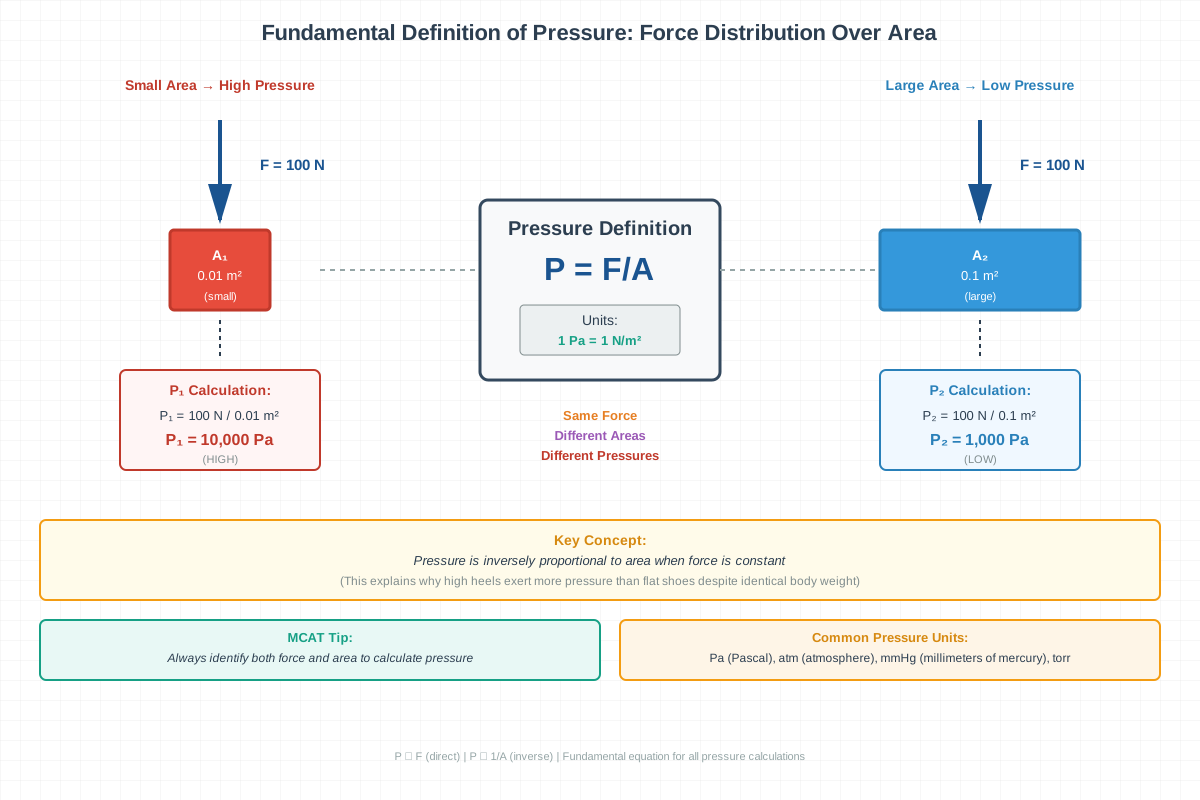
Pressure is defined as the magnitude of force applied perpendicular to a surface divided by the area over which that force is distributed. Mathematically:
P = F/AWhere P is pressure (in Pascals, Pa), F is the perpendicular force (in Newtons, N), and A is the area (in square meters, m²). The SI unit of pressure is the Pascal (Pa), where 1 Pa = 1 N/m². This definition reveals that pressure is a scalar quantity despite being derived from force (a vector)—pressure has magnitude but no direction, though it acts perpendicular to any surface it contacts.
The concept of pressure explains why a sharp knife cuts more easily than a dull one (same force over smaller area creates greater pressure) and why snowshoes prevent sinking into snow (distributing weight over larger area reduces pressure). For the MCAT, understanding that pressure depends on both force magnitude and area distribution is crucial for solving problems and interpreting physiological scenarios.
Units of Pressure
The MCAT uses multiple pressure units, and facility with conversions is essential:
| Unit | Abbreviation | Conversion to Pa | Common Use |
|---|---|---|---|
| Pascal | Pa | 1 Pa | SI unit |
| Atmosphere | atm | 101,325 Pa | Standard atmospheric pressure |
| Millimeters of mercury | mmHg | 133.3 Pa | Blood pressure, gas pressures |
| Torr | torr | 133.3 Pa | Gas pressures (1 torr ≈ 1 mmHg) |
| Pounds per square inch | psi | 6,895 Pa | Engineering applications |
Standard atmospheric pressure at sea level equals 1 atm = 101,325 Pa = 760 mmHg = 760 torr. The MCAT frequently requires converting between these units, particularly between atmospheres and mmHg for physiological contexts.
Atmospheric Pressure
Atmospheric pressure is the pressure exerted by the weight of air in Earth's atmosphere. At sea level, atmospheric pressure averages 101,325 Pa (1 atm). This pressure results from the gravitational force acting on the mass of air molecules above any given point. Atmospheric pressure decreases with altitude because there is less air mass above higher elevations.
The barometric equation describes how atmospheric pressure varies with altitude, though the MCAT typically treats atmospheric pressure as constant at approximately 1 atm unless altitude changes are explicitly mentioned. Understanding atmospheric pressure is crucial because it serves as the reference point for gauge pressure measurements and affects physiological processes like gas exchange and boiling points.
Gauge Pressure vs. Absolute Pressure
This distinction is among the most tested pressure concepts on the MCAT:
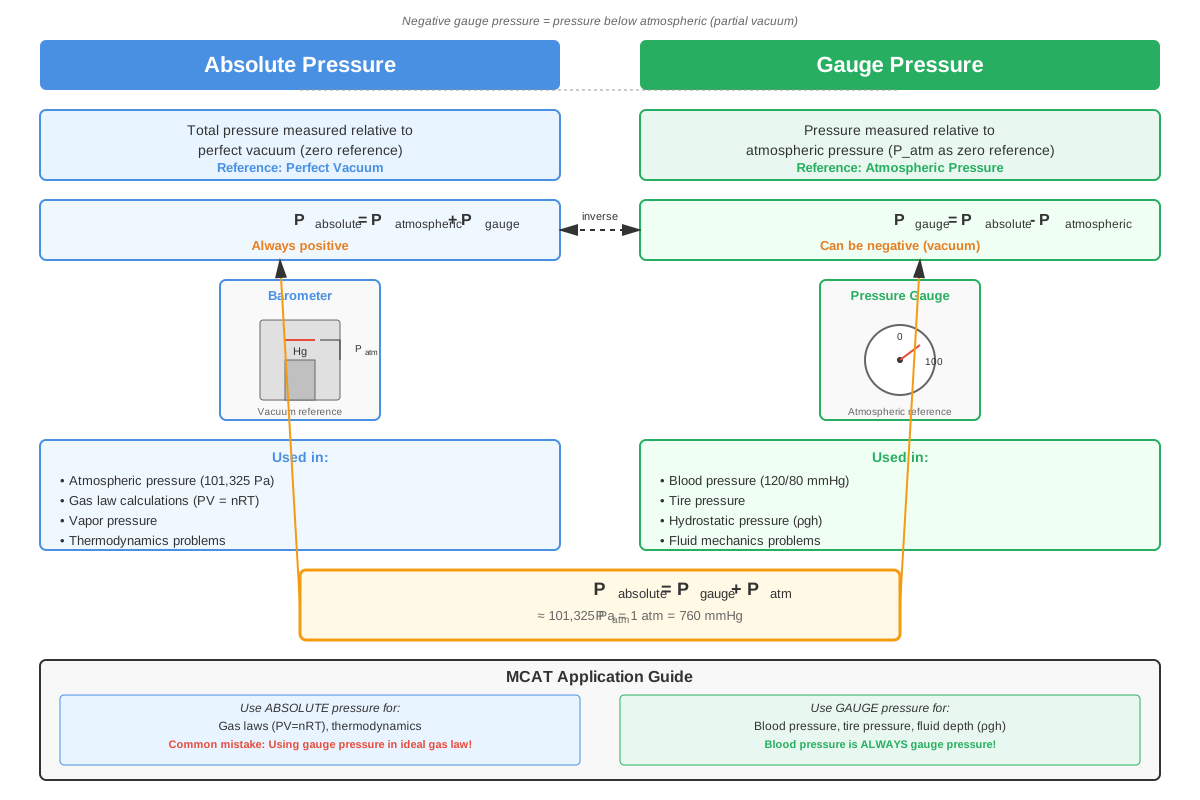
Absolute pressure (P_abs) is the total pressure measured relative to a perfect vacuum (zero pressure). It includes both the pressure from the system of interest and atmospheric pressure.
Gauge pressure (P_gauge) is the pressure measured relative to atmospheric pressure. It represents the pressure difference between the system and the surrounding atmosphere.
The relationship between them:
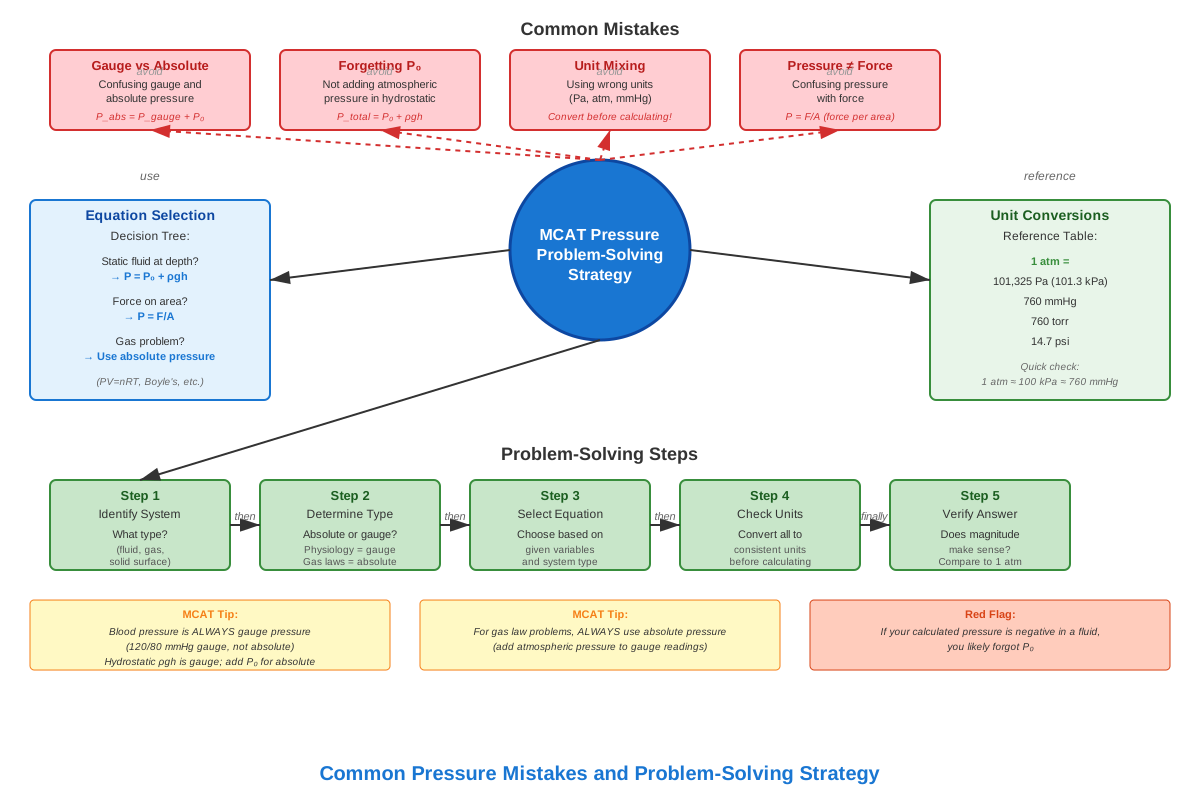
P_absolute = P_gauge + P_atmosphericMost pressure-measuring devices (tire gauges, blood pressure cuffs, manometers) measure gauge pressure. When a tire gauge reads "32 psi," this is gauge pressure; the absolute pressure inside the tire is 32 psi + 14.7 psi (atmospheric) = 46.7 psi.
MCAT Exam Tip: Blood pressure measurements are gauge pressures. When systolic pressure is 120 mmHg, the absolute pressure is 120 + 760 = 880 mmHg. However, most physiological calculations use gauge pressure unless specifically stated otherwise.
Hydrostatic Pressure
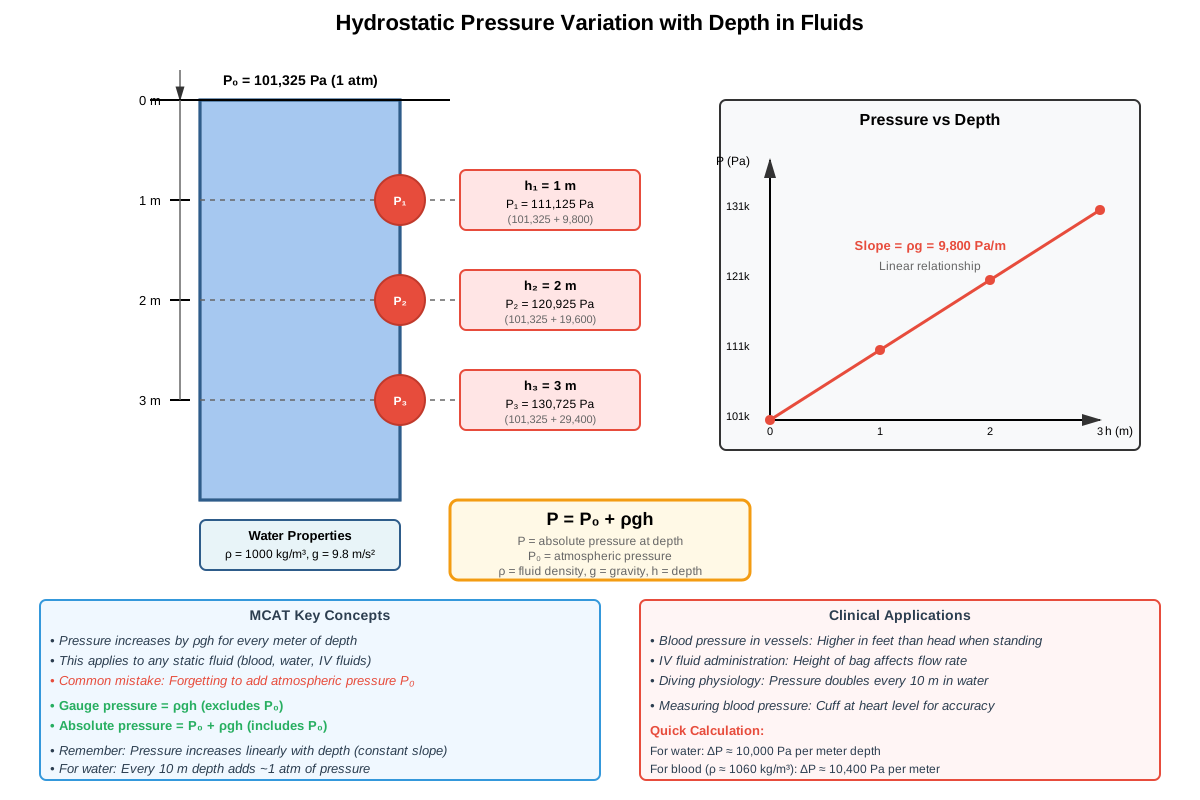
Hydrostatic pressure is the pressure exerted by a static (non-moving) fluid due to gravity. In a fluid at rest, pressure increases with depth according to:
P = P_0 + ρghWhere:
- P is the pressure at depth h
- P_0 is the pressure at the surface (often atmospheric pressure)
- ρ (rho) is the fluid density (kg/m³)
- g is gravitational acceleration (9.8 m/s² or approximately 10 m/s² for MCAT calculations)
- h is the depth below the surface (m)
This equation reveals several important principles:
- Pressure increases linearly with depth
- Pressure depends on fluid density (denser fluids create more pressure at the same depth)
- Pressure at a given depth is the same in all directions (Pascal's principle)
- Pressure depends only on vertical depth, not on the shape of the container
For the MCAT, the term ρgh represents the gauge pressure due to the fluid column, while P_0 + ρgh gives the absolute pressure.
Pascal's Principle
Pascal's principle states that a pressure change applied to an enclosed fluid is transmitted undiminished to every point in the fluid and to the walls of the container. This principle explains how hydraulic systems work: applying force to a small piston creates pressure that is transmitted through the fluid to a larger piston, multiplying force.
For a hydraulic system:
P_1 = P_2
F_1/A_1 = F_2/A_2
If A_2 > A_1, then F_2 > F_1, providing mechanical advantage. Hydraulic lifts, brake systems, and certain medical devices operate on this principle. The MCAT may present passages about hydraulic systems or ask conceptual questions about pressure transmission in fluids.
Pressure in Physiological Systems
Understanding pressure in biological contexts is crucial for MCAT success:
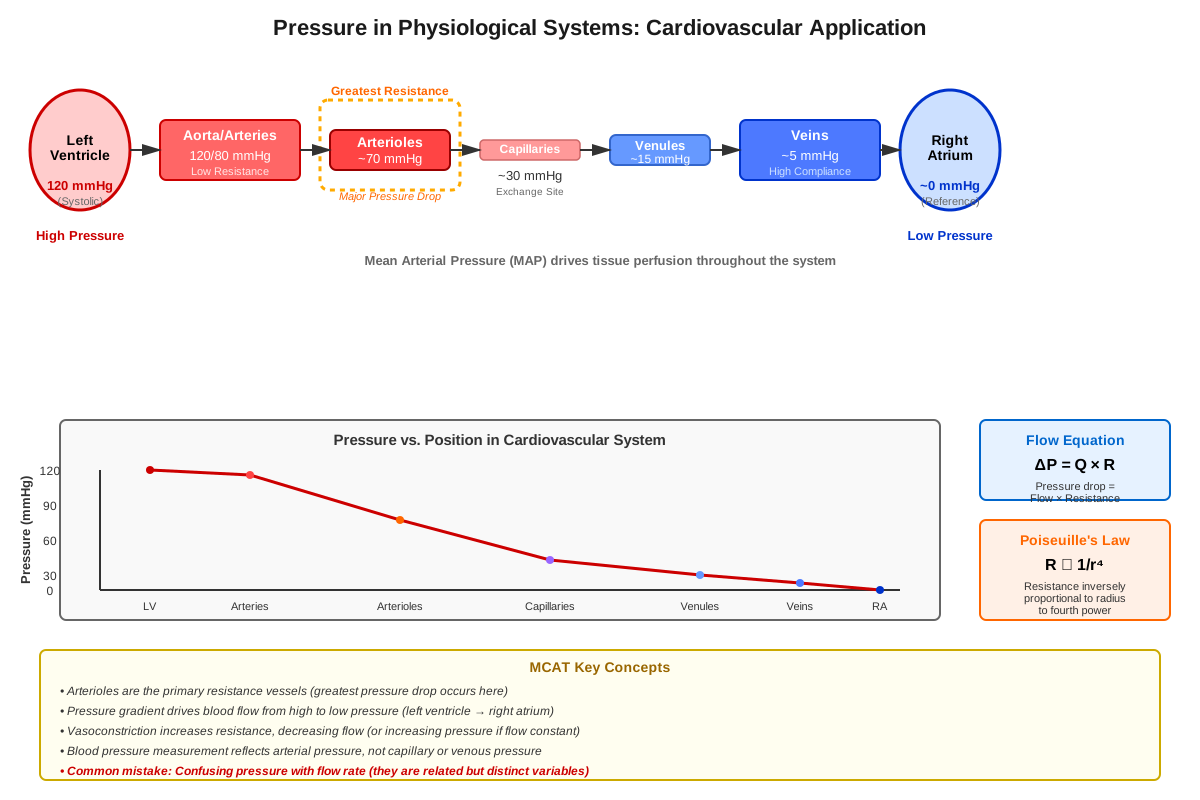
Blood Pressure: The pressure exerted by blood against vessel walls, typically measured in mmHg. Systolic pressure (120 mmHg normal) occurs during ventricular contraction; diastolic pressure (80 mmHg normal) occurs during ventricular relaxation. Blood pressure decreases as blood moves from arteries through capillaries to veins due to resistance and energy dissipation.
Intrapleural Pressure: The pressure in the pleural cavity (between the lungs and chest wall) is normally slightly negative relative to atmospheric pressure (about -4 mmHg at rest). This negative pressure keeps lungs inflated. A pneumothorax occurs when air enters the pleural space, equalizing pressure and causing lung collapse.
Alveolar Pressure: The pressure inside lung alveoli varies during breathing. During inspiration, alveolar pressure drops below atmospheric pressure, drawing air in. During expiration, alveolar pressure rises above atmospheric pressure, pushing air out.
Osmotic Pressure: Though technically a colligative property studied in chemistry, osmotic pressure drives fluid movement across membranes and is calculated using van't Hoff's equation. Understanding that osmotic pressure differences drive fluid distribution between blood and tissues is important for integrated passages.
Concept Relationships
The concepts within pressure form an interconnected framework. The fundamental definition of pressure (P = F/A) serves as the foundation from which all other concepts derive. This basic definition leads to understanding atmospheric pressure (pressure from the weight of air) and hydrostatic pressure (pressure from the weight of fluid columns).
The distinction between absolute and gauge pressure builds on atmospheric pressure: Atmospheric Pressure → serves as reference for → Gauge Pressure → combines with atmospheric pressure to give → Absolute Pressure.
Hydrostatic pressure connects to Pascal's principle: Hydrostatic Pressure Equation (P = P_0 + ρgh) → demonstrates → Pascal's Principle (pressure transmitted equally throughout fluid) → enables → Hydraulic Systems (force multiplication).
These physics concepts then extend to physiological applications: Hydrostatic Pressure → explains → Blood Pressure Variation with height in the body → relates to → Cardiovascular Physiology. Similarly, Pressure Differences → drive → Fluid Flow (Bernoulli's principle) → explains → Respiratory Mechanics and Circulatory Function.
Pressure also connects to prerequisite topics: Force → distributed over area → Pressure → in fluids depends on → Density → varies with → Depth. These relationships extend to related topics like buoyancy (pressure differences create buoyant force), fluid dynamics (pressure and velocity are inversely related), and surface tension (pressure differences across curved interfaces).
Quick check — test yourself on Pressure so far.
Try Flashcards →High-Yield Facts
⭐ Pressure is defined as force per unit area: P = F/A, measured in Pascals (Pa) where 1 Pa = 1 N/m²
⭐ Standard atmospheric pressure at sea level is 1 atm = 101,325 Pa = 760 mmHg = 760 torr
⭐ Absolute pressure = Gauge pressure + Atmospheric pressure; most measuring devices read gauge pressure
⭐ Hydrostatic pressure increases with depth: P = P_0 + ρgh, where ρ is fluid density, g is gravity, and h is depth
⭐ Blood pressure measurements (e.g., 120/80 mmHg) are gauge pressures measured relative to atmospheric pressure
- Pascal's principle states that pressure applied to an enclosed fluid is transmitted undiminished throughout the fluid
- Pressure at a given depth in a static fluid is the same in all directions and depends only on vertical depth, not container shape
- In the human body, blood pressure decreases from arteries (120/80 mmHg) to capillaries to veins (near 0 mmHg) due to resistance
- Intrapleural pressure is normally negative (-4 mmHg at rest), keeping lungs inflated against the chest wall
- Pressure differences drive fluid flow: fluid moves from high pressure to low pressure regions
- For every 10 meters of depth in water, pressure increases by approximately 1 atmosphere (101,325 Pa)
- Pressure is a scalar quantity despite being derived from force (a vector); it has magnitude but no inherent direction
Common Misconceptions
Misconception: Pressure is a vector quantity with direction because it's derived from force.
Correction: Pressure is a scalar quantity. Although force is a vector, pressure represents the magnitude of perpendicular force per unit area and acts equally in all directions at a point in a fluid. Pressure has no directional component.
Misconception: Blood pressure readings of 120/80 mmHg represent absolute pressures.
Correction: Blood pressure measurements are gauge pressures measured relative to atmospheric pressure. The absolute pressure would be 120 + 760 = 880 mmHg (systolic) and 80 + 760 = 840 mmHg (diastolic). However, physiological calculations typically use gauge pressure unless otherwise specified.
Misconception: Pressure at a given depth depends on the total volume or shape of the fluid container.
Correction: Pressure at a specific depth depends only on the vertical depth (h), fluid density (ρ), and surface pressure (P_0), not on container shape or total fluid volume. This is why pressure is the same at equal depths in differently shaped containers—a principle that often appears in MCAT questions.
Misconception: In the hydrostatic pressure equation P = P_0 + ρgh, the term ρgh represents absolute pressure.
Correction: The term ρgh represents the gauge pressure due to the fluid column alone. The P_0 term (usually atmospheric pressure) must be added to obtain absolute pressure. This distinction is critical for correctly solving MCAT problems.
Misconception: Pressure always increases as you move through a fluid system.
Correction: In static fluids, pressure increases with depth due to gravity. However, in moving fluids (Bernoulli's principle), pressure and velocity are inversely related—pressure decreases where velocity increases. Additionally, in physiological systems, pressure decreases along the direction of flow due to resistance and energy dissipation.
Misconception: A negative gauge pressure means absolute pressure is negative.
Correction: Negative gauge pressure simply means the absolute pressure is below atmospheric pressure, not that it's truly negative. For example, intrapleural pressure of -4 mmHg (gauge) corresponds to an absolute pressure of 760 - 4 = 756 mmHg, which is still positive. True negative absolute pressure (below perfect vacuum) is physically impossible.
Worked Examples
Example 1: Calculating Pressure at Depth
Problem: A diver descends to a depth of 20 meters in seawater. Given that the density of seawater is 1,025 kg/m³ and atmospheric pressure is 101,325 Pa, calculate: (a) the gauge pressure at this depth, and (b) the absolute pressure at this depth.
Solution:
(a) Gauge Pressure
The gauge pressure due to the water column is given by:
P_gauge = ρghGiven:
- ρ = 1,025 kg/m³
- g = 9.8 m/s² (or use 10 m/s² for MCAT estimation)
- h = 20 m
Using g = 10 m/s² for simplicity:
P_gauge = (1,025 kg/m³)(10 m/s²)(20 m)
P_gauge = 205,000 Pa = 205 kPa
Converting to atmospheres:
P_gauge = 205,000 Pa × (1 atm / 101,325 Pa) ≈ 2.02 atm(b) Absolute Pressure
Absolute pressure includes both the gauge pressure and atmospheric pressure:
P_absolute = P_gauge + P_atmospheric
P_absolute = 205,000 Pa + 101,325 Pa = 306,325 Pa ≈ 306 kPa
Or in atmospheres:
P_absolute = 2.02 atm + 1 atm = 3.02 atmKey Insights: This problem demonstrates the linear relationship between depth and pressure. Notice that at 20 meters depth, the pressure has approximately tripled from surface pressure. The MCAT often tests whether students remember to add atmospheric pressure when calculating absolute pressure. Also note the useful approximation that pressure increases by about 1 atm for every 10 meters of depth in water.
Example 2: Hydraulic System and Pascal's Principle
Problem: A hydraulic lift system has a small piston with area 0.02 m² and a large piston with area 0.20 m². If a force of 100 N is applied to the small piston, what force is exerted by the large piston? What is the mechanical advantage of this system?
Solution:
According to Pascal's principle, pressure is transmitted equally throughout the fluid:
P_1 = P_2
F_1/A_1 = F_2/A_2
Given:
- F_1 = 100 N
- A_1 = 0.02 m²
- A_2 = 0.20 m²
- F_2 = ?
Solving for F_2:
F_2 = F_1 × (A_2/A_1)
F_2 = 100 N × (0.20 m² / 0.02 m²)
F_2 = 100 N × 10 = 1,000 N
The mechanical advantage (MA) is:
MA = F_2/F_1 = 1,000 N / 100 N = 10Alternatively:
MA = A_2/A_1 = 0.20 m² / 0.02 m² = 10Key Insights: This problem illustrates Pascal's principle and how hydraulic systems provide mechanical advantage. The force multiplication factor equals the ratio of piston areas. The MCAT may present this concept in the context of medical devices or ask conceptual questions about how changing piston areas affects force output. Remember that while force is multiplied, energy is conserved—the small piston must move a greater distance than the large piston (d_1/d_2 = A_2/A_1).
Exam Strategy
Approaching MCAT Pressure Questions
- Identify the pressure type: Determine whether the question asks for gauge pressure, absolute pressure, or simply "pressure" (context usually indicates which). Blood pressure and tire pressure are typically gauge; pressure in sealed systems or at depth usually requires absolute pressure.
- Draw a diagram: For hydrostatic pressure problems, sketch the fluid system and label the surface, depth, and point of interest. Mark known pressures and identify what you're solving for.
- Check units: MCAT pressure problems often require unit conversions. Immediately convert all given values to consistent units (preferably SI: Pa, kg/m³, m) before calculating.
- Use estimation: For time efficiency, approximate g as 10 m/s² and atmospheric pressure as 100,000 Pa (or 1 atm = 760 mmHg). These approximations are acceptable for MCAT multiple-choice questions.
Trigger Words and Phrases
- "At depth" or "below the surface": Signals hydrostatic pressure calculation using P = P_0 + ρgh
- "Gauge pressure" or "pressure above atmospheric": Use P_gauge; don't add atmospheric pressure
- "Absolute pressure" or "total pressure": Add atmospheric pressure to gauge pressure
- "Blood pressure": Assume gauge pressure unless stated otherwise
- "Transmitted through the fluid": Indicates Pascal's principle application
- "Force on a surface": Use P = F/A; remember to use perpendicular force component
- "Pressure difference": Calculate ΔP = P_2 - P_1; often drives flow or indicates direction
Process of Elimination Tips
- Eliminate answers with incorrect units (Pa vs. atm vs. mmHg)
- For depth problems, eliminate answers that don't increase linearly with depth
- If calculating absolute pressure, eliminate any answer less than atmospheric pressure (unless dealing with vacuum)
- For gauge pressure in physiological contexts, eliminate answers that seem unreasonably high (e.g., blood pressure of 7,600 mmHg)
- Check if the answer makes physical sense: pressure should increase with depth, decrease along flow direction in vessels
Time Allocation
- Simple pressure calculations (P = F/A or unit conversions): 30-45 seconds
- Hydrostatic pressure problems: 60-90 seconds
- Multi-step problems involving both pressure and other concepts: 90-120 seconds
- Passage-based questions: Read passage (3-4 minutes), then 60-90 seconds per question
MCAT Exam Tip: If a problem seems to require complex calculations, look for conceptual shortcuts. The MCAT often tests understanding rather than computational ability. For example, if pressure doubles, what happens to force? (Doubles if area is constant.) These relationships can often be determined without full calculations.
Memory Techniques
Pressure Equation Mnemonic
"Please Find Area" → P = F/A
- Please = Pressure
- Find = Force
- Area = Area
Hydrostatic Pressure Mnemonic
"Pressure Pushes Down, Really Gets Heavy" → P = P_0 + ρgh
- Pressure = P (pressure at depth)
- Pushes = P_0 (surface pressure)
- Down = + (addition)
- Really = ρ (density)
- Gets = g (gravity)
- Heavy = h (height/depth)
Absolute vs. Gauge Pressure
"Absolute = All pressure; Gauge = Greater than atmosphere"
Visualize a tire: The gauge reads pressure above atmospheric (gauge pressure), but the absolute total pressure inside includes atmospheric pressure too.
Unit Conversions
"Standard Atmosphere: 1-100-760"
- 1 atm
- 100 kPa (actually 101.325, but 100 is close enough for estimation)
- 760 mmHg (or torr)
Pascal's Principle
"Pascal's Pressure Passes Perfectly" - Pressure applied to an enclosed fluid is transmitted undiminished throughout (all P's to remember transmission).
Pressure Increases with Depth
Visualize a swimming pool: The deeper you dive, the more water weight presses on you from above. Every 10 meters of water depth adds approximately 1 atmosphere of pressure. Think: "10 meters = 1 atm more"
Summary
Pressure, defined as force per unit area (P = F/A), is a fundamental concept in MCAT Physics that bridges multiple disciplines including fluid mechanics, cardiovascular physiology, and respiratory function. The distinction between absolute pressure (total pressure relative to vacuum) and gauge pressure (pressure relative to atmosphere) is critical for correctly interpreting measurements and solving problems. Hydrostatic pressure increases linearly with depth according to P = P_0 + ρgh, where fluid density, gravitational acceleration, and depth determine the pressure at any point below the surface. Pascal's principle explains how pressure changes transmit through enclosed fluids, enabling hydraulic systems and explaining physiological pressure transmission. The MCAT tests pressure through quantitative calculations, conceptual questions about pressure behavior, and integrated passages involving cardiovascular and respiratory physiology. Mastery requires facility with unit conversions (Pa, atm, mmHg, torr), understanding when to use gauge versus absolute pressure, and recognizing how pressure differences drive fluid flow in both physical and biological systems. Success on MCAT pressure questions demands both computational skill and conceptual understanding of how pressure behaves in static and dynamic fluid systems.
Key Takeaways
- Pressure is force per unit area (P = F/A), measured in Pascals (Pa), with 1 atm = 101,325 Pa = 760 mmHg at sea level
- Absolute pressure equals gauge pressure plus atmospheric pressure; most measurements (blood pressure, tire pressure) are gauge pressures
- Hydrostatic pressure increases linearly with depth: P = P_0 + ρgh, depending on fluid density, gravity, and depth
- Pascal's principle states that pressure applied to an enclosed fluid transmits undiminished throughout the fluid, enabling hydraulic systems
- Pressure differences drive fluid flow in both physical systems and physiological contexts (blood flow, respiration)
- The MCAT frequently tests pressure in cardiovascular and respiratory passages, requiring integration of physics and biology concepts
- Always check whether a problem requires gauge or absolute pressure, and ensure consistent units before calculating
Related Topics
Fluid Dynamics and Bernoulli's Equation: Building on static pressure concepts, fluid dynamics examines pressure in moving fluids where pressure and velocity are inversely related. Bernoulli's equation (P + ½ρv² + ρgh = constant) combines pressure, kinetic energy, and potential energy, explaining phenomena from airplane lift to blood flow through stenotic vessels.
Buoyancy and Archimedes' Principle: Pressure differences at different depths create buoyant forces on submerged objects. Understanding hydrostatic pressure is prerequisite to analyzing buoyancy, which appears in MCAT questions about floating objects and physiological applications like lung inflation.
Surface Tension and Capillary Action: Pressure differences across curved interfaces (Young-Laplace equation) explain surface tension phenomena. This connects to alveolar mechanics (surfactant reduces surface tension) and capillary action in biological systems.
Cardiovascular Physiology: Pressure concepts directly apply to understanding blood pressure regulation, vessel compliance, flow resistance, and pathological conditions like hypertension and shock. Mastering pressure physics enables deeper understanding of circulatory system function.
Respiratory Mechanics: Pressure gradients drive ventilation, with intrapleural pressure, alveolar pressure, and transpulmonary pressure governing lung inflation and deflation. Understanding pressure is essential for analyzing respiratory pathology and mechanical ventilation.
Practice CTA
Now that you've mastered the fundamental concepts of pressure, it's time to solidify your understanding through active practice. Attempt the practice questions and flashcards associated with this topic to test your ability to apply these concepts in exam-style scenarios. Focus particularly on distinguishing between gauge and absolute pressure, calculating hydrostatic pressure at depth, and recognizing how pressure concepts appear in physiological contexts. Remember that pressure is one of the highest-yield topics in MCAT Physics—investing time in practice now will pay dividends on test day. Challenge yourself with both computational problems and conceptual questions to build the comprehensive mastery that top MCAT scores require. You've got this!
Sign up free to keep reading
Create a free AnvayaPrep account to finish this MCAT guide on Pressure — plus flashcards and practice questions.