Overview
Capillary action is a fundamental phenomenon in Fluids that describes the ability of a liquid to flow in narrow spaces without the assistance of external forces, and sometimes even against gravity. This process occurs due to the interplay between cohesive forces (intermolecular attractions within the liquid) and adhesive forces (attractions between the liquid molecules and the surface of the container). Understanding capillary action is essential for mastering fluid dynamics in Physics and forms a critical bridge between molecular-level interactions and macroscopic fluid behavior.
For the MCAT, capillary action Physics represents a high-yield topic that frequently appears in both passage-based and discrete questions. The exam tests not only the conceptual understanding of why liquids rise or fall in narrow tubes, but also the quantitative relationships governing the height of capillary rise, the role of surface tension, and the influence of contact angles. Questions often integrate capillary action with biological contexts such as water transport in plants (xylem vessels), blood flow in capillaries, tear film dynamics in the eye, and fluid movement through porous tissues.
Capillary action MCAT questions typically connect to broader themes in fluid mechanics, including surface tension, pressure differentials, and the Young-Laplace equation. This topic serves as an excellent example of how molecular-scale forces manifest in observable physical phenomena, making it a favorite for MCAT test writers who want to assess integrated scientific reasoning. Mastery of capillary action enables students to tackle complex passages involving biological transport systems, microfluidic devices, and any scenario where fluid behavior in confined spaces becomes relevant.
Learning Objectives
- [ ] Define capillary action using accurate Physics terminology
- [ ] Explain why capillary action matters for the MCAT
- [ ] Apply capillary action to exam-style questions
- [ ] Identify common mistakes related to capillary action
- [ ] Connect capillary action to related Physics concepts
- [ ] Calculate the height of capillary rise using the appropriate equation and identify all relevant variables
- [ ] Predict whether a liquid will exhibit capillary rise or depression based on contact angle and intermolecular forces
- [ ] Analyze the relationship between tube radius and capillary height quantitatively and qualitatively
Prerequisites
- Surface tension: The cohesive force at the surface of a liquid that creates a "skin-like" barrier; directly determines the magnitude of capillary rise
- Intermolecular forces: Van der Waals forces, hydrogen bonding, and dipole interactions; these govern both cohesive and adhesive forces in capillary systems
- Pressure in fluids: Understanding hydrostatic pressure and pressure differentials; essential for deriving the capillary rise equation
- Contact angle: The angle formed where a liquid interface meets a solid surface; determines whether capillary action will be positive (rise) or negative (depression)
- Density and specific gravity: Required for quantitative calculations involving the weight of the liquid column in capillary tubes
Why This Topic Matters
Capillary action has profound clinical and biological significance that makes it a recurring theme on the MCAT. In human physiology, capillary beds facilitate nutrient and gas exchange through narrow vessels where surface effects dominate over gravitational effects. The tear film that protects the cornea relies on capillary action to maintain proper distribution across the eye surface. Diagnostic tests such as blood glucose monitoring using test strips depend on capillary action to draw blood samples into reaction chambers. In plants, the ascent of water from roots to leaves through xylem vessels—sometimes reaching heights of over 100 meters in tall trees—represents one of nature's most impressive applications of capillary action combined with transpiration pull.
From an exam statistics perspective, capillary action appears in approximately 2-3 questions per MCAT administration, either as discrete questions or embedded within fluid mechanics passages. The topic most commonly appears in passages describing biological transport systems, microfluidic diagnostic devices, or plant physiology. Questions typically test: (1) conceptual understanding of the balance between adhesive and cohesive forces, (2) quantitative problem-solving using the capillary rise equation, (3) prediction of behavior based on changes in tube radius or liquid properties, and (4) integration with other fluid concepts like viscosity and laminar flow.
MCAT passages frequently present capillary action in disguised forms. A passage might describe "fluid wicking" in paper chromatography, "hydraulic conductivity" in soil science, or "spontaneous imbibition" in porous media—all of which are manifestations of capillary action. Recognizing these alternative presentations and connecting them to the underlying physics of adhesive-cohesive force balance represents a key skill for high-scoring students.
Core Concepts
Definition and Fundamental Mechanism
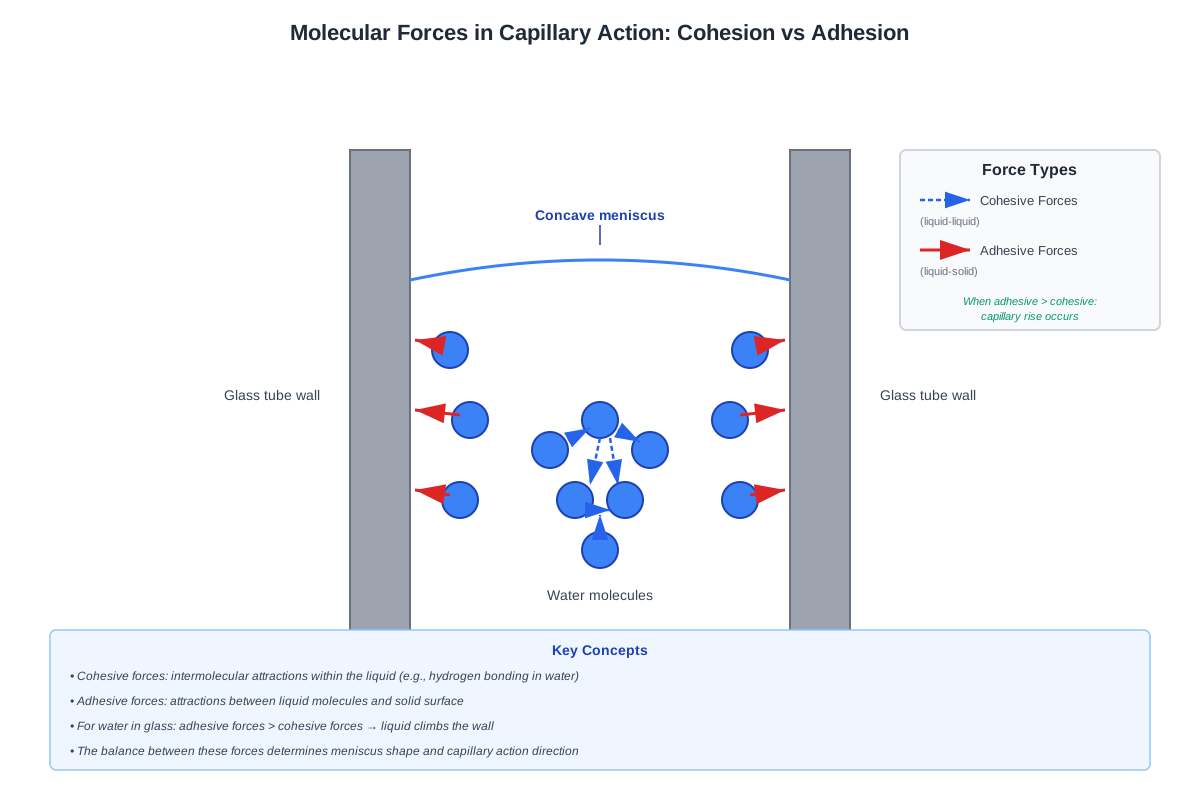
Capillary action (also called capillarity or wicking) is the phenomenon by which a liquid spontaneously rises or falls in a narrow tube or porous material due to the combined effects of adhesive forces between the liquid and the solid surface, cohesive forces within the liquid itself, and surface tension at the liquid-air interface. The direction and magnitude of capillary action depend on the relative strengths of these competing forces.
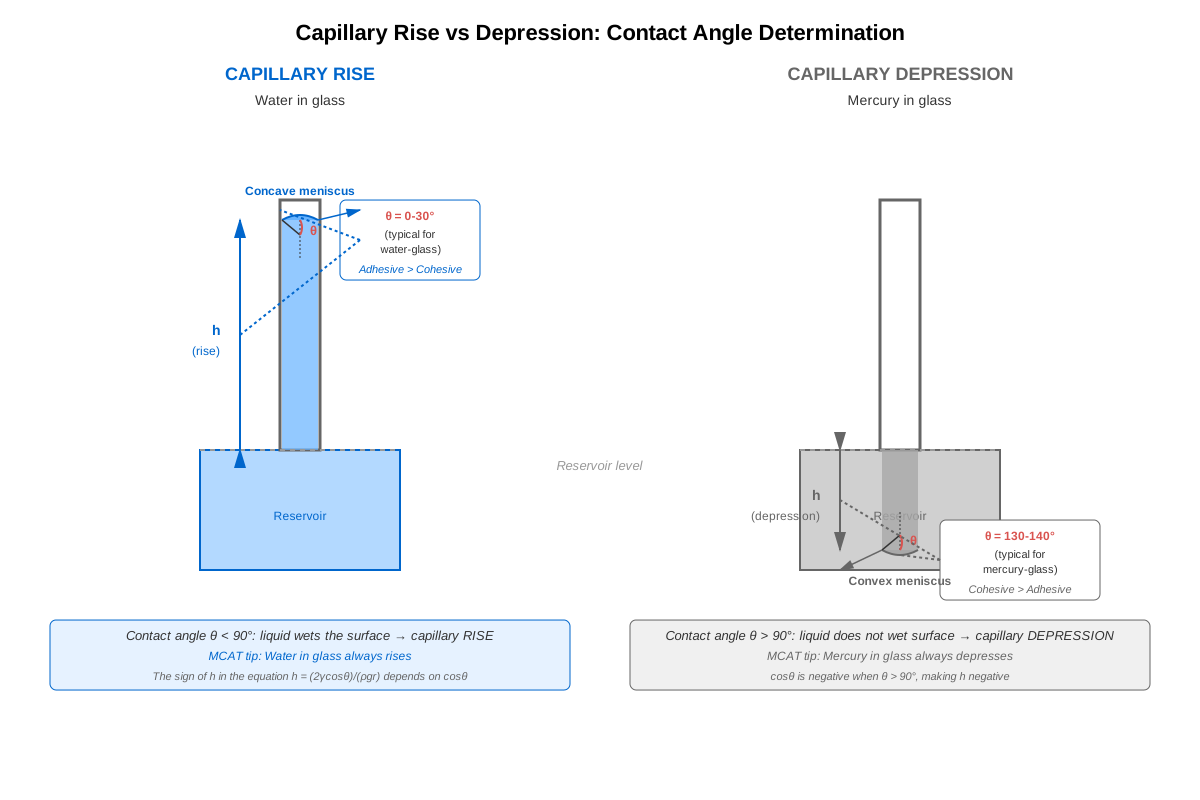
When adhesive forces between liquid molecules and the tube wall exceed cohesive forces between liquid molecules, the liquid "wets" the surface and rises in the tube (positive capillary action). Conversely, when cohesive forces dominate, the liquid forms a convex meniscus and depresses below the external liquid level (negative capillary action). Water in glass tubes exemplifies positive capillary action, while mercury in glass demonstrates negative capillary action.
The Capillary Rise Equation
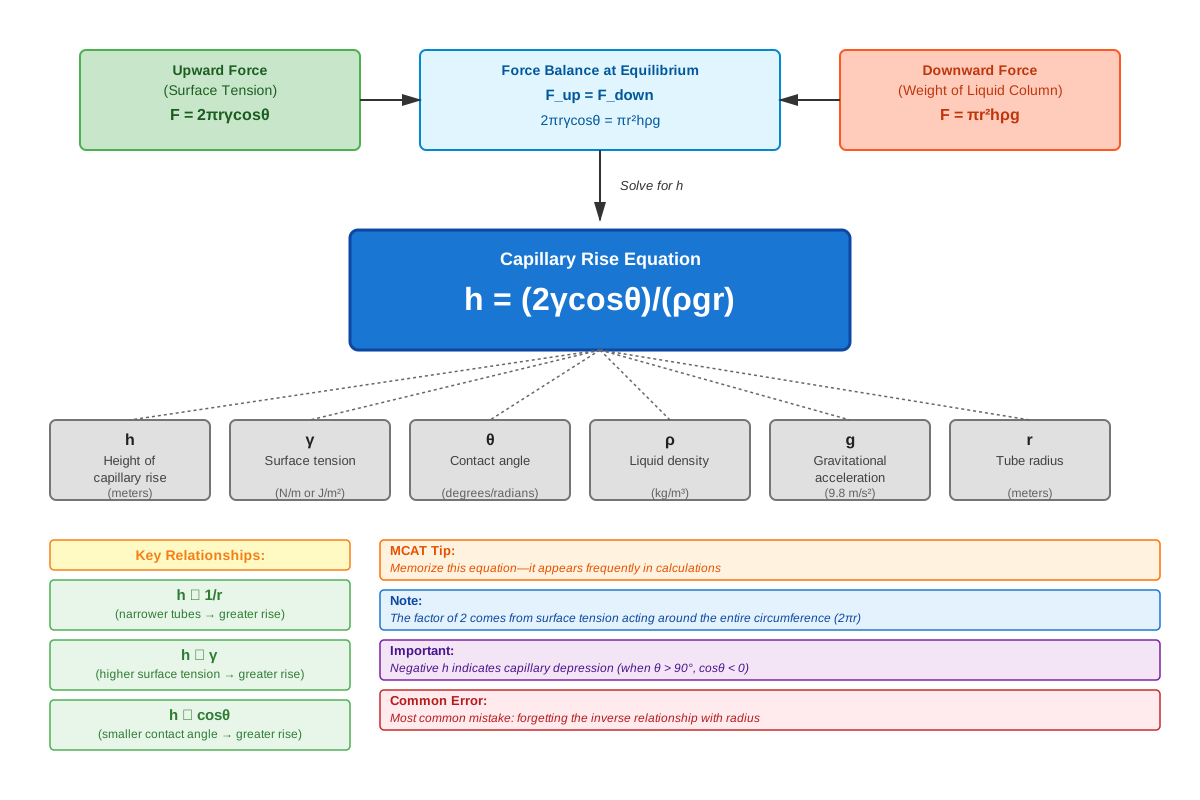
The quantitative relationship governing capillary rise derives from balancing the upward force due to surface tension against the downward gravitational force of the liquid column:
h = (2γ cos θ) / (ρgr)Where:
- h = height of capillary rise (or depression if negative)
- γ (gamma) = surface tension of the liquid (N/m or J/m²)
- θ (theta) = contact angle between liquid and tube wall
- ρ (rho) = density of the liquid (kg/m³)
- g = gravitational acceleration (9.8 m/s²)
- r = radius of the capillary tube (m)
This equation reveals several critical relationships:
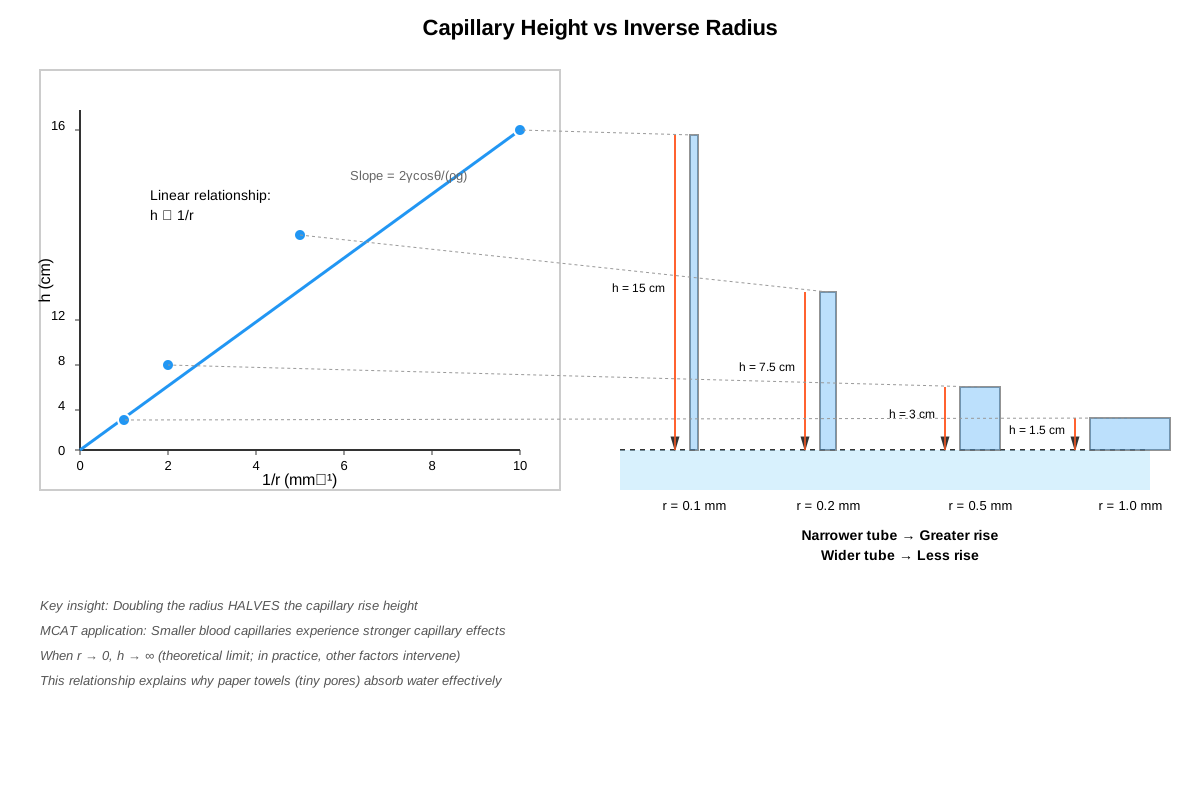
- Inverse relationship with radius: Capillary height is inversely proportional to tube radius—narrower tubes produce greater rise
- Direct relationship with surface tension: Liquids with higher surface tension exhibit greater capillary rise
- Contact angle dependence: The cosine term means that contact angles less than 90° (wetting) produce positive rise, while angles greater than 90° (non-wetting) produce depression
- Inverse relationship with density: Denser liquids rise less for the same surface tension
Contact Angle and Wetting Behavior
The contact angle (θ) represents the angle measured through the liquid phase where the liquid-vapor interface meets the solid surface. This angle provides immediate information about the relative magnitudes of adhesive versus cohesive forces:
| Contact Angle | Wetting Behavior | Capillary Action | Example |
|---|---|---|---|
| θ = 0° | Perfect wetting | Maximum rise | Water on clean glass |
| 0° < θ < 90° | Partial wetting | Positive rise | Water on most surfaces |
| θ = 90° | Neutral | No rise or depression | Some organic liquids |
| 90° < θ < 180° | Non-wetting | Depression | Mercury in glass |
| θ = 180° | Perfect non-wetting | Maximum depression | Theoretical limit |
For water in glass, the contact angle is approximately 0-20°, meaning cos θ ≈ 1, which maximizes capillary rise. For mercury in glass, θ ≈ 140°, making cos θ negative and producing capillary depression.
Forces in Capillary Action
Understanding the force balance provides deeper insight into the mechanism:
Upward force (from surface tension):
F_up = 2πr γ cos θThis force acts around the circumference (2πr) of the tube where the meniscus contacts the wall. The vertical component depends on cos θ.
Downward force (from gravity):
F_down = πr²h ρ gThis represents the weight of the liquid column with volume πr²h.
At equilibrium, these forces balance (F_up = F_down), which yields the capillary rise equation when solved for h.
Meniscus Shape
The meniscus is the curved surface of a liquid in a container, and its shape directly reflects the adhesive-cohesive force balance:
- Concave meniscus (curves upward at edges): Occurs when adhesive forces exceed cohesive forces; the liquid climbs the walls, creating a U-shaped surface (water in glass)
- Convex meniscus (curves downward at edges): Occurs when cohesive forces exceed adhesive forces; the liquid pulls away from walls, creating an inverted U-shape (mercury in glass)
- Flat meniscus: Occurs when forces are balanced; rare in practice but approximated by some organic solvents
For accurate measurements in graduated cylinders and burettes, readings should be taken at the bottom of the meniscus for liquids with concave menisci (like water) and at the top for liquids with convex menisci (like mercury).
Factors Affecting Capillary Action
Several variables influence the magnitude and direction of capillary action:
- Tube radius: The most dramatic effect—halving the radius doubles the height
- Surface tension: Temperature-dependent; decreases with increasing temperature, reducing capillary rise
- Liquid density: Denser liquids rise less due to greater gravitational force
- Surface cleanliness: Contaminants alter contact angles and can dramatically change wetting behavior
- Tube material: Different materials provide different adhesive forces (glass vs. plastic vs. metal)
- Atmospheric pressure: Generally negligible for typical capillary heights, but relevant in vacuum conditions
Biological and Practical Applications
Plant water transport: Xylem vessels (10-200 μm diameter) use capillary action combined with transpiration pull and root pressure to move water upward. While capillary action alone can only account for rises of a few meters, it contributes significantly to the overall transport mechanism.
Blood capillaries: True capillaries (5-10 μm diameter) facilitate exchange between blood and tissues. The narrow diameter increases surface area-to-volume ratio and allows surface effects to dominate, though active transport and pressure gradients are the primary drivers of flow.
Chromatography: Paper and thin-layer chromatography rely on capillary action to draw solvent through the stationary phase, separating compounds based on differential affinity.
Microfluidics: Lab-on-a-chip devices use capillary action to move small fluid volumes through channels without pumps, enabling point-of-care diagnostics.
Concept Relationships
Capillary action sits at the intersection of multiple fluid mechanics concepts, creating a rich network of relationships essential for MCAT mastery.
Surface tension → Capillary action: Surface tension provides the fundamental upward force that enables capillary rise. Without surface tension, no capillary action would occur. The magnitude of γ directly determines the height of rise through the capillary equation.
Intermolecular forces → Surface tension → Capillary action: The strength of cohesive forces (hydrogen bonding in water, metallic bonding in mercury) determines surface tension magnitude. Stronger intermolecular forces create higher surface tension and greater potential for capillary rise.
Contact angle ← Adhesive vs. Cohesive forces → Wetting behavior → Capillary direction: The balance between adhesive forces (liquid-solid attraction) and cohesive forces (liquid-liquid attraction) determines the contact angle, which in turn determines whether capillary rise or depression occurs.
Tube geometry → Capillary height: The inverse relationship between radius and height means that capillary effects become increasingly important at small scales—critical for understanding microfluidics and biological transport.
Hydrostatic pressure ← Capillary rise → Pressure differential: The risen liquid column creates a hydrostatic pressure that opposes further rise. At equilibrium, the pressure difference across the meniscus (described by the Young-Laplace equation) exactly balances the hydrostatic pressure of the column.
Viscosity → Rate of capillary rise: While the equilibrium height depends on surface tension and geometry, the rate at which equilibrium is reached depends on viscosity. More viscous liquids rise more slowly (described by the Lucas-Washburn equation for dynamic capillary rise).
Quick check — test yourself on Capillary action so far.
Try Flashcards →High-Yield Facts
⭐ Capillary rise is inversely proportional to tube radius: Halving the radius doubles the height; this is the most commonly tested quantitative relationship.
⭐ Contact angles less than 90° indicate wetting and produce capillary rise: Water in glass (θ ≈ 0-20°) rises; mercury in glass (θ ≈ 140°) depresses.
⭐ The capillary rise equation is h = (2γ cos θ)/(ρgr): Know this equation and be able to identify all variables and their units.
⭐ Adhesive forces > cohesive forces → concave meniscus and capillary rise: This is the condition for positive capillary action.
⭐ Surface tension decreases with increasing temperature: Therefore, capillary rise decreases as temperature increases.
- Capillary action can work against gravity, enabling liquids to rise spontaneously in narrow tubes without external energy input.
- The force driving capillary action acts along the circumference of the tube (2πr), while the opposing gravitational force depends on the cross-sectional area (πr²).
- In biological systems, capillary action contributes to but does not fully explain tall tree water transport; transpiration pull and cohesion-tension theory are also required.
- Detergents and surfactants reduce surface tension and alter contact angles, thereby affecting capillary action—this is why they improve wetting and penetration.
- The Young-Laplace equation (ΔP = 2γ/r for a cylindrical interface) describes the pressure difference across a curved interface and underlies the capillary rise phenomenon.
- Capillary action is more pronounced in porous materials with interconnected small pores, which is why paper towels and sponges effectively absorb liquids.
- The meniscus shape provides immediate visual information about the relative strengths of adhesive and cohesive forces.
- For very narrow tubes (r < 1 mm), capillary effects dominate over gravitational effects, making surface chemistry the primary determinant of fluid behavior.
Common Misconceptions
Misconception: Capillary action only occurs in cylindrical tubes.
Correction: Capillary action occurs in any narrow space or porous material, including irregular geometries, corners, and interconnected pores. The cylindrical tube is simply the easiest geometry to analyze mathematically.
Misconception: Capillary rise is caused by atmospheric pressure pushing the liquid up.
Correction: Capillary action is driven by surface tension and the adhesive-cohesive force balance, not atmospheric pressure. Capillary rise occurs even in vacuum conditions, whereas atmospheric pressure-driven phenomena (like drinking through a straw) do not.
Misconception: A liquid with higher viscosity will rise higher in a capillary tube.
Correction: Viscosity affects the rate of capillary rise but not the equilibrium height. The final height depends only on surface tension, contact angle, density, and tube radius. A more viscous liquid will simply take longer to reach the same equilibrium height.
Misconception: Capillary action can explain water transport to the top of 100-meter tall trees.
Correction: Capillary action alone can only account for water rise of a few meters. Tall tree water transport requires the cohesion-tension theory, which combines capillary action with transpiration pull, cohesion between water molecules, and negative pressure in xylem vessels.
Misconception: The contact angle is a property of the liquid alone.
Correction: The contact angle depends on three interfacial tensions: liquid-solid, liquid-vapor, and solid-vapor. It is therefore a property of the liquid-solid pair, not the liquid alone. Water has different contact angles on glass, plastic, and wax.
Misconception: Increasing tube diameter increases capillary rise because there's more room for liquid.
Correction: Increasing tube diameter decreases capillary rise. The relationship is inverse: h ∝ 1/r. Wider tubes have less capillary rise because the gravitational force (proportional to r²) increases faster than the surface tension force (proportional to r).
Misconception: All liquids rise in all capillary tubes.
Correction: Only liquids that wet the tube surface (contact angle < 90°) exhibit capillary rise. Non-wetting liquids (contact angle > 90°) exhibit capillary depression, where the liquid level inside the tube is lower than outside.
Worked Examples
Example 1: Calculating Capillary Rise
Problem: A clean glass capillary tube with an inner radius of 0.5 mm is placed vertically in water at 20°C. Calculate the height to which water will rise in the tube. Given: surface tension of water γ = 0.073 N/m, density of water ρ = 1000 kg/m³, contact angle θ ≈ 0°, g = 9.8 m/s².
Solution:
Step 1: Identify the appropriate equation.
We use the capillary rise equation: h = (2γ cos θ)/(ρgr)
Step 2: Convert all units to SI base units.
- r = 0.5 mm = 0.5 × 10⁻³ m = 5 × 10⁻⁴ m
- γ = 0.073 N/m (already in SI units)
- θ = 0°, so cos θ = cos(0°) = 1
- ρ = 1000 kg/m³
- g = 9.8 m/s²
Step 3: Substitute values into the equation.
h = (2 × 0.073 × 1) / (1000 × 9.8 × 5 × 10⁻⁴)
h = 0.146 / (4.9)
h = 0.0298 m ≈ 3.0 cm or 30 mm
Step 4: Evaluate the answer.
The water rises approximately 3 cm in the capillary tube. This is reasonable—capillary rise is observable but not extreme for a 0.5 mm radius tube.
Key insight: Notice that the height is inversely proportional to radius. If we used a tube with half the radius (0.25 mm), the height would double to approximately 6 cm. This inverse relationship is the most commonly tested aspect of capillary action.
Example 2: Comparing Capillary Behavior
Problem: Two identical capillary tubes are placed vertically, one in water and one in mercury. The water rises 2.0 cm above the external water level. Will the mercury rise or fall, and approximately how much? Given: surface tension of mercury γ_Hg = 0.486 N/m (about 6.7× that of water), density of mercury ρ_Hg = 13,600 kg/m³ (about 13.6× that of water), contact angle for mercury in glass θ_Hg ≈ 140°.
Solution:
Step 1: Determine the direction of mercury movement.
Since θ_Hg = 140° > 90°, mercury is non-wetting in glass. Therefore, cos(140°) is negative (cos 140° ≈ -0.766), which means h will be negative—mercury will depress below the external level.
Step 2: Set up the ratio of heights.
For water: h_w = (2γ_w cos θ_w)/(ρ_w g r)
For mercury: h_Hg = (2γ_Hg cos θ_Hg)/(ρ_Hg g r)
Taking the ratio:
h_Hg/h_w = (γ_Hg cos θ_Hg / ρ_Hg) / (γ_w cos θ_w / ρ_w)
Step 3: Substitute known values.
h_Hg/h_w = (0.486 × (-0.766) / 13,600) / (0.073 × 1 / 1000)
h_Hg/h_w = (-0.372 / 13,600) / (0.073 / 1000)
h_Hg/h_w = (-2.74 × 10⁻⁵) / (7.3 × 10⁻⁵)
h_Hg/h_w ≈ -0.375
Step 4: Calculate mercury depression.
h_Hg = -0.375 × h_w = -0.375 × 2.0 cm ≈ -0.75 cm
Answer: Mercury will depress (fall below the external level) by approximately 0.75 cm or 7.5 mm.
Key insights:
- The negative contact angle (cos θ < 0) produces capillary depression, not rise.
- Despite mercury having much higher surface tension than water, its much higher density and non-wetting behavior result in a smaller magnitude of capillary action.
- This problem demonstrates the importance of considering all variables in the capillary equation, not just surface tension.
Exam Strategy
When approaching MCAT questions on capillary action, follow this systematic strategy:
Step 1: Identify the phenomenon
Watch for trigger words: "narrow tube," "wicking," "meniscus," "spontaneous rise," "porous material," "xylem," "capillary bed," or any description of liquid behavior in confined spaces. Even if the term "capillary action" isn't explicitly used, these contexts signal its relevance.
Step 2: Determine the question type
- Conceptual: Asks about the mechanism, force balance, or qualitative predictions (most common)
- Quantitative: Requires calculation using the capillary rise equation (less common but high-yield)
- Comparative: Asks how changing one variable affects the outcome
- Application: Presents a biological or practical scenario requiring recognition of capillary principles
Step 3: For conceptual questions, establish the force balance
Ask yourself: Are adhesive forces greater than cohesive forces? This determines wetting behavior and whether rise or depression occurs. Look for clues about contact angle or meniscus shape.
Step 4: For quantitative questions, write the equation immediately
h = (2γ cos θ)/(ρgr)
Then identify which variables are given and which must be calculated. Watch for unit conversions, especially radius (often given in mm or μm).
Step 5: Use process of elimination strategically
- Eliminate answers that violate the inverse relationship between radius and height
- Eliminate answers that predict rise when contact angle > 90° (or vice versa)
- Eliminate answers with incorrect units or unrealistic magnitudes (capillary rise is typically cm-scale, not meters)
Step 6: Check for integration with other concepts
MCAT questions often combine capillary action with:
- Pressure (hydrostatic pressure of the column)
- Flow rate (Poiseuille's law in capillary tubes)
- Surface tension (Young-Laplace equation)
- Biological transport (osmosis, diffusion)
Time allocation: Discrete questions on capillary action should take 60-90 seconds. Passage-based questions may take 90-120 seconds if they require calculation or integration with passage information. If a calculation is taking longer than 2 minutes, estimate using proportional reasoning and move on.
Common trap answers:
- Answers that confuse direct and inverse relationships (e.g., claiming larger radius increases height)
- Answers that ignore the contact angle term
- Answers that attribute capillary action to atmospheric pressure
- Answers that claim viscosity affects equilibrium height
Memory Techniques
Mnemonic for the capillary rise equation: "2 Gamma Cats / Rho Goes Running"
- 2 Gamma = 2γ (numerator starts with 2 and surface tension)
- Cats = cos θ (numerator includes cosine of contact angle)
- Rho Goes = ρg (denominator has density and gravity)
- Running = r (denominator has radius)
Visualization for adhesive vs. cohesive forces: Picture water molecules as people holding hands (cohesion) while also reaching out to grab the walls (adhesion). When they grab the walls more strongly than they hold each other's hands, they climb up the wall—that's capillary rise. Mercury molecules hold hands very tightly and don't want to touch the walls, so they pull away—that's capillary depression.
Acronym for factors affecting capillary height: "STAR-D"
- Surface tension (direct relationship)
- Tube radius (inverse relationship)
- Angle of contact (through cosine term)
- Rho (density, inverse relationship)
- Direction determined by whether θ < or > 90°
Memory aid for contact angle ranges:
- "Acute angles attract": Contact angles less than 90° (acute) mean the liquid is attracted to the surface → wetting → rise
- "Obtuse angles oppose": Contact angles greater than 90° (obtuse) mean the liquid opposes the surface → non-wetting → depression
Proportional reasoning shortcut: Remember "Small Spaces, Significant Soaring" (all S's) to recall that smaller radius produces greater height. When radius is halved, height doubles; when radius is doubled, height is halved.
Summary
Capillary action represents the spontaneous movement of liquids in narrow spaces driven by the interplay between surface tension, adhesive forces, and cohesive forces. The phenomenon is quantitatively described by the equation h = (2γ cos θ)/(ρgr), which reveals that capillary height is directly proportional to surface tension and inversely proportional to both tube radius and liquid density. The contact angle determines whether capillary rise (θ < 90°, wetting) or depression (θ > 90°, non-wetting) occurs. For the MCAT, students must understand both the conceptual basis—that adhesive forces exceeding cohesive forces produce wetting and rise—and the quantitative relationships, particularly the inverse dependence on radius. Capillary action appears in biological contexts including plant water transport, blood capillary function, and diagnostic devices, making it a high-yield topic that integrates fluid mechanics with physiological applications. Mastery requires recognizing the phenomenon in various contexts, applying the governing equation correctly, and avoiding common misconceptions about the roles of atmospheric pressure, viscosity, and tube diameter.
Key Takeaways
- Capillary action is the spontaneous rise or fall of liquids in narrow spaces due to surface tension and the balance between adhesive and cohesive forces
- The capillary rise equation h = (2γ cos θ)/(ρgr) shows that height is inversely proportional to tube radius—the most commonly tested relationship
- Contact angles less than 90° indicate wetting and produce capillary rise; angles greater than 90° indicate non-wetting and produce depression
- Adhesive forces > cohesive forces → concave meniscus and capillary rise; the reverse produces convex meniscus and depression
- Capillary action is driven by surface tension, not atmospheric pressure, and occurs even in vacuum conditions
- Biological applications include plant xylem transport, blood capillary exchange, and microfluidic diagnostic devices
- Temperature increases reduce surface tension and therefore decrease capillary rise; viscosity affects rate but not equilibrium height
Related Topics
Surface Tension and Interfacial Phenomena: Deeper exploration of the molecular origins of surface tension, the Young-Laplace equation for pressure across curved interfaces, and surfactant effects. Mastering capillary action provides the foundation for understanding these more advanced surface phenomena.
Fluid Dynamics in Biological Systems: Study of blood flow through capillary networks, including the role of pressure gradients, vessel compliance, and exchange mechanisms. Capillary action concepts extend to understanding why capillaries are optimally sized for exchange.
Poiseuille's Law and Viscous Flow: Analysis of flow rates through narrow tubes, which combines capillary action (determining pressure differentials) with viscosity (determining flow resistance). Essential for understanding both circulatory physiology and microfluidic devices.
Plant Physiology and Water Transport: Comprehensive study of the cohesion-tension theory, transpiration, and xylem function. Capillary action is one component of the multi-mechanism system that enables water transport in plants.
Chromatography Techniques: Application of capillary action to separation science, including paper chromatography, thin-layer chromatography, and capillary electrophoresis. Understanding capillary principles is essential for interpreting chromatography experiments in MCAT passages.
Practice CTA
Now that you've mastered the core concepts of capillary action, it's time to solidify your understanding through active practice. Challenge yourself with MCAT-style practice questions that test both conceptual understanding and quantitative problem-solving. Use flashcards to drill the capillary rise equation, the relationship between contact angle and wetting behavior, and the key factors affecting capillary height. Focus especially on questions that integrate capillary action with biological contexts—these represent the highest-yield question types. Remember, the difference between passive reading and active mastery lies in deliberate practice. Each problem you solve strengthens the neural pathways that will serve you on test day. You've built the foundation; now construct the expertise through consistent application!
Sign up free to keep reading
Create a free AnvayaPrep account to finish this MCAT guide on Capillary action — plus flashcards and practice questions.