Overview
Surface tension is a fundamental property of liquids that arises from cohesive intermolecular forces at the interface between a liquid and another phase (typically air). This phenomenon causes the liquid surface to behave as if it were covered by an elastic membrane, minimizing surface area and creating distinctive behaviors such as water droplets forming spheres, insects walking on water, and capillary action in narrow tubes. Understanding surface tension is essential for mastering fluids concepts in Physics and forms a critical bridge between molecular-level interactions and macroscopic fluid behavior.
For the MCAT, surface tension appears frequently in both standalone questions and passage-based problems, particularly in contexts involving biological membranes, alveolar function in respiratory physiology, and fluid dynamics in capillaries. The topic integrates molecular forces, energy considerations, and practical applications that span physics, chemistry, and biological sciences—making it a high-yield interdisciplinary concept. Questions often require students to apply quantitative reasoning to calculate forces, predict fluid behavior in various geometries, or explain physiological phenomena based on surface tension principles.
Surface tension MCAT questions typically test conceptual understanding of how intermolecular forces create surface effects, mathematical problem-solving involving surface tension coefficients and dimensional analysis, and the ability to connect microscopic molecular behavior to macroscopic observations. This topic connects directly to intermolecular forces (hydrogen bonding, van der Waals forces), pressure differentials, capillary action, and energy minimization principles—all of which appear across multiple MCAT sections. Mastery of surface tension provides essential foundation for understanding more complex fluid phenomena and biological applications that appear regularly on exam day.
Learning Objectives
- [ ] Define surface tension using accurate Physics terminology
- [ ] Explain why surface tension matters for the MCAT
- [ ] Apply surface tension to exam-style questions
- [ ] Identify common mistakes related to surface tension
- [ ] Connect surface tension to related Physics concepts
- [ ] Calculate forces and pressures arising from surface tension in various geometries
- [ ] Predict how changes in temperature, solutes, and surfactants affect surface tension
- [ ] Analyze biological systems (alveoli, cell membranes, capillaries) using surface tension principles
Prerequisites
- Intermolecular forces (hydrogen bonding, dipole-dipole, London dispersion forces): Surface tension directly results from cohesive forces between liquid molecules, making understanding of these forces essential for explaining why surface tension exists and varies between substances.
- Basic fluid properties (density, pressure): Surface tension creates additional pressure effects and influences fluid behavior, requiring familiarity with fundamental fluid mechanics concepts.
- Energy and work concepts: Surface tension represents energy per unit area, and understanding energy minimization principles explains why liquids minimize surface area.
- Force vectors and equilibrium: Analyzing surface tension problems requires decomposing forces and applying equilibrium conditions to determine resultant forces on objects at liquid interfaces.
- Units and dimensional analysis: Surface tension has specific units (N/m or J/m²) that must be correctly manipulated in calculations.
Why This Topic Matters
Clinical and Real-World Significance
Surface tension plays critical roles in human physiology and medical applications. In the respiratory system, surfactant molecules reduce surface tension in alveoli, preventing collapse during exhalation—a concept tested repeatedly on the MCAT. Premature infants lacking adequate surfactant develop respiratory distress syndrome, illustrating the life-or-death importance of this physical principle. Surface tension also governs droplet formation in aerosol medications, tear film stability on the cornea, and the behavior of biological membranes. Understanding surface tension enables medical professionals to comprehend drug delivery mechanisms, respiratory pathophysiology, and diagnostic techniques involving fluid interfaces.
Exam Statistics and Question Types
Surface tension appears in approximately 3-5% of MCAT Physics passages and discrete questions, with additional appearances in interdisciplinary passages connecting physics to biological systems. Questions typically fall into three categories: (1) quantitative problems requiring calculation of forces, pressures, or energy changes; (2) conceptual questions about factors affecting surface tension or predicting fluid behavior; and (3) passage-based questions applying surface tension to physiological contexts, particularly respiratory mechanics. The topic frequently appears alongside capillary action, pressure differentials, and fluid statics.
Common Exam Contexts
MCAT passages commonly present surface tension in scenarios involving: pulmonary surfactant and alveolar mechanics; capillary rise or depression in tubes of varying diameter; insects or objects floating on water surfaces; droplet formation and coalescence; and the effects of temperature or dissolved substances on surface behavior. Experimental passages may describe techniques measuring surface tension or investigating how surfactants modify liquid properties. Recognizing these contexts allows rapid identification of relevant principles and efficient problem-solving approaches.
Core Concepts
Definition and Molecular Origin
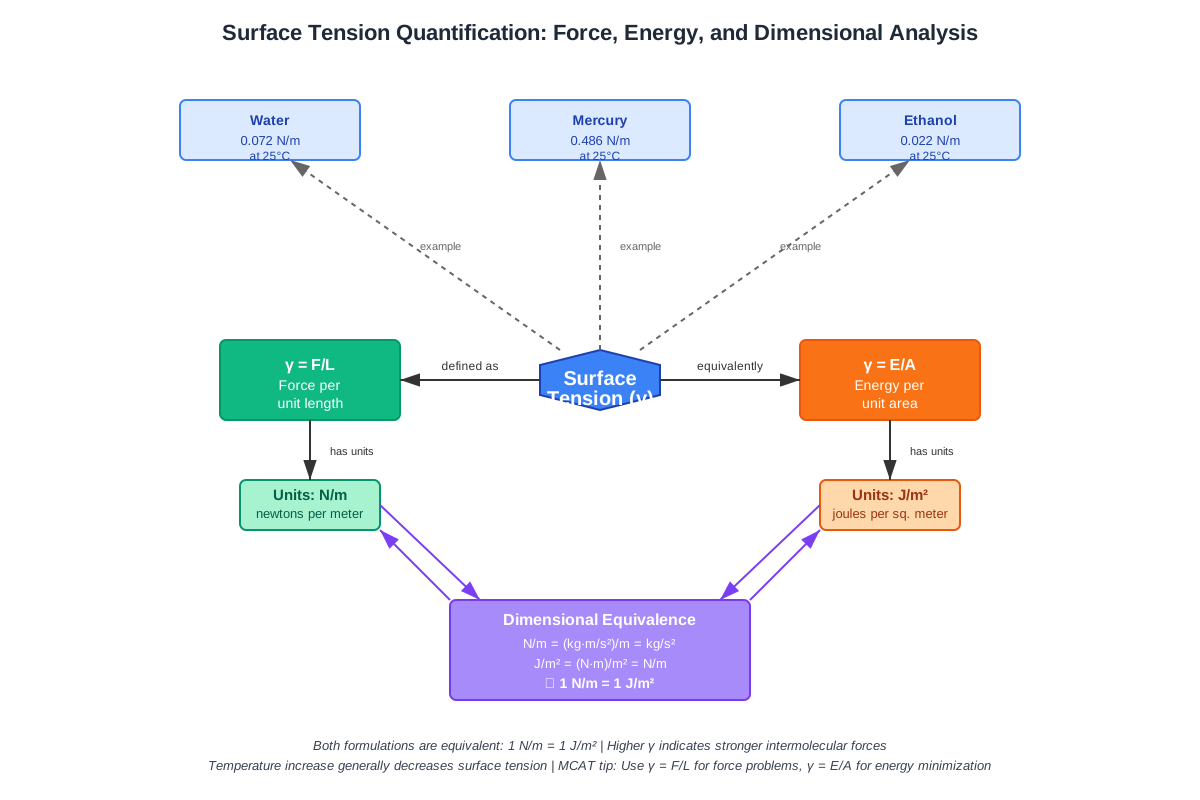
Surface tension (γ, gamma) is defined as the force per unit length acting parallel to the surface of a liquid, or equivalently, as the energy per unit area required to increase the surface area of a liquid. The SI unit is newtons per meter (N/m) or joules per square meter (J/m²), which are dimensionally equivalent. Mathematically:
γ = F/L = E/Awhere F is force, L is length, E is energy, and A is area.
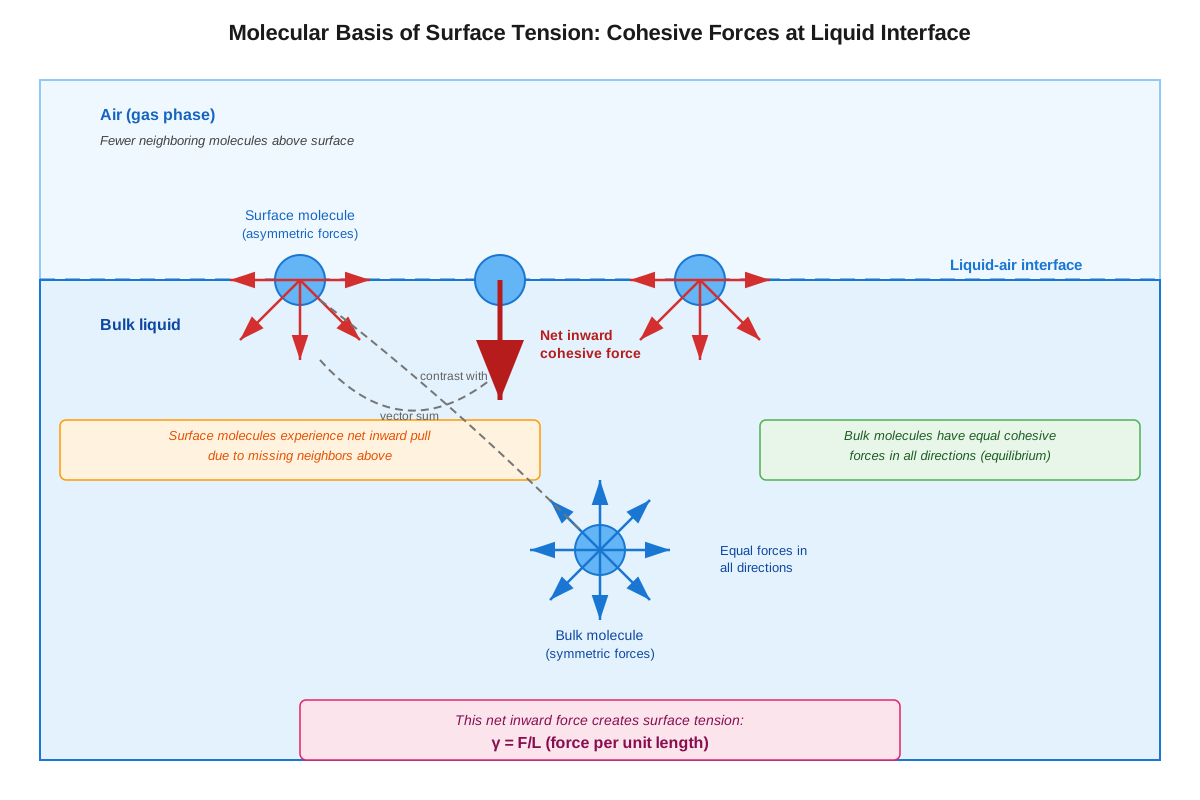
At the molecular level, surface tension arises from cohesive forces between liquid molecules. Molecules in the bulk liquid experience attractive intermolecular forces equally in all directions, resulting in zero net force. However, molecules at the surface experience a net inward force because they have neighboring molecules only on the sides and below, but not above (where air or vapor exists). This asymmetric force distribution creates a tendency for the surface to contract, minimizing surface area and behaving like a stretched elastic membrane under tension.
The strength of surface tension depends on the magnitude of intermolecular forces. Water exhibits high surface tension (approximately 0.072 N/m at 25°C) due to extensive hydrogen bonding between molecules. Organic liquids with weaker van der Waals forces typically have lower surface tension values. Mercury, despite being a liquid metal, has exceptionally high surface tension (approximately 0.486 N/m) due to strong metallic bonding.
Surface Tension and Pressure Differences
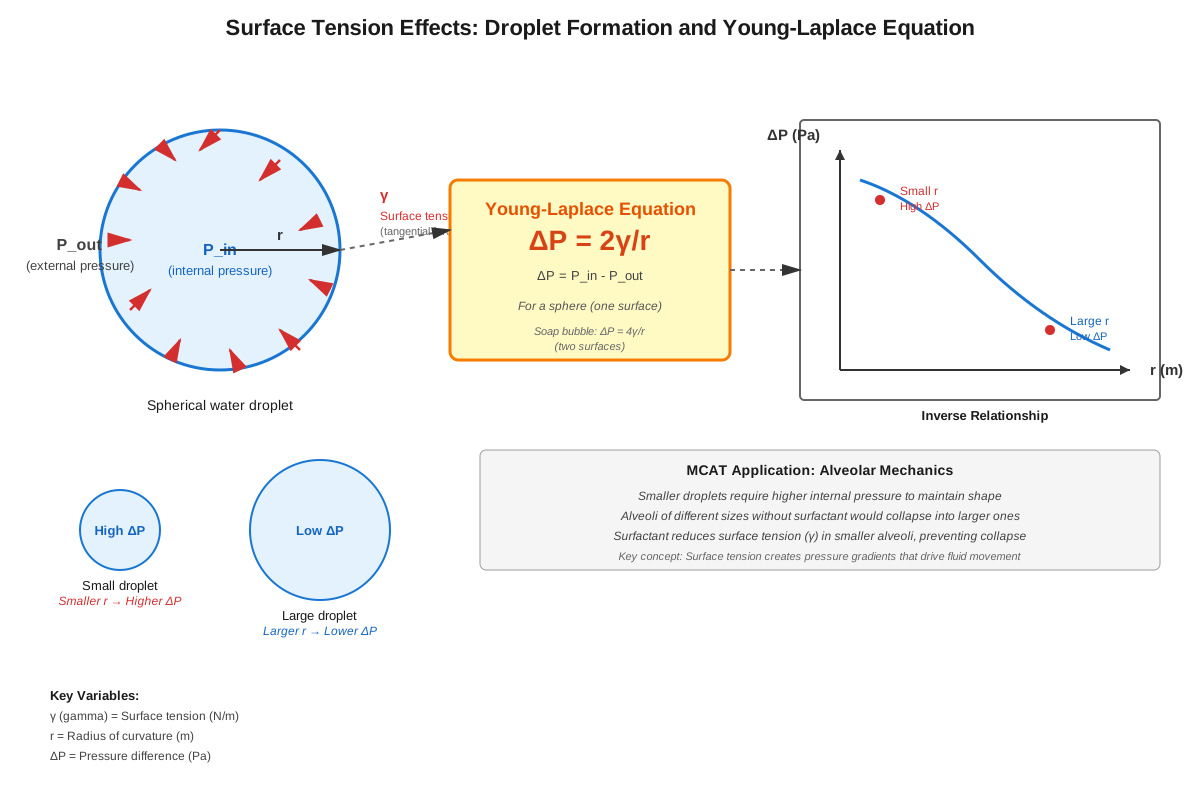
Surface tension creates pressure differences across curved interfaces, described by the Young-Laplace equation. For a spherical droplet or bubble, the pressure difference between inside and outside depends on surface tension and radius:
ΔP = 2γ/r (for a droplet with one surface)
ΔP = 4γ/r (for a bubble with two surfaces)
where ΔP is the pressure difference, γ is surface tension, and r is the radius.
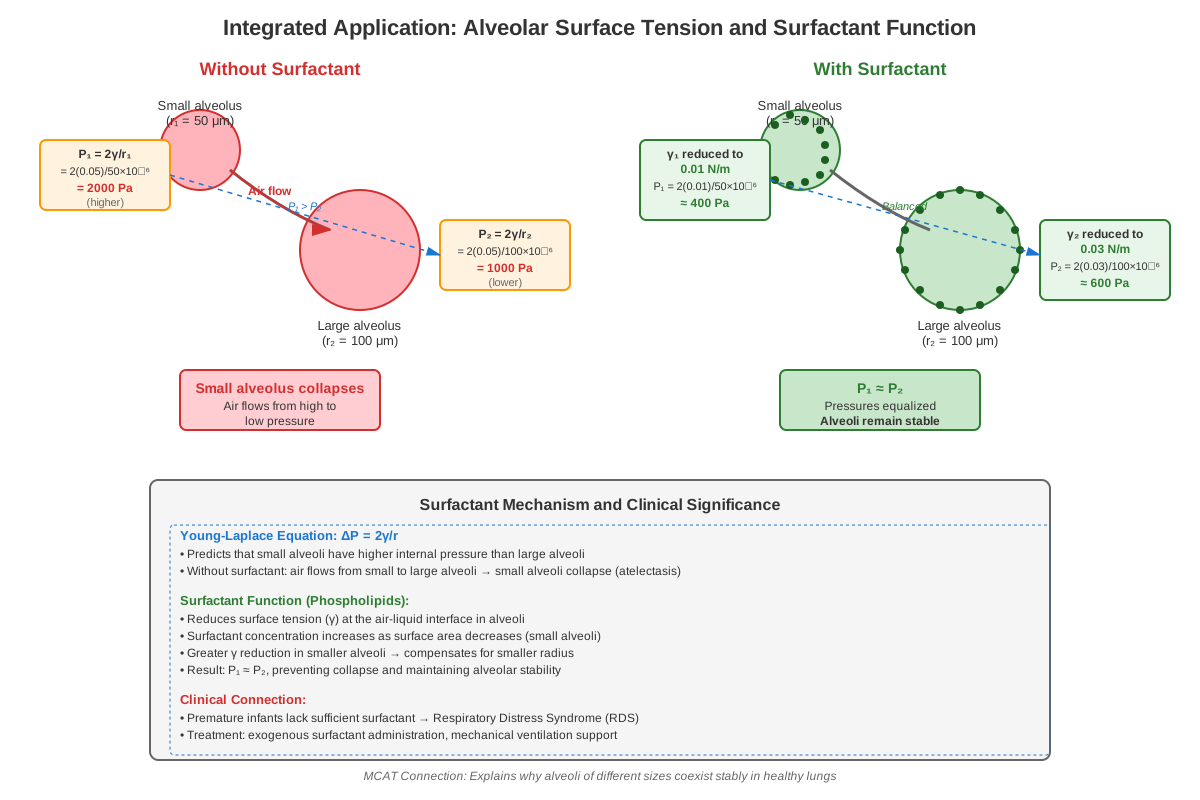
This relationship reveals that smaller droplets or bubbles have higher internal pressures. A soap bubble has two surfaces (inner and outer), each contributing to the pressure difference, hence the factor of 4 rather than 2. This principle explains why small alveoli in the lungs would collapse into larger ones without surfactant—the higher pressure in smaller alveoli would drive air into larger ones, a phenomenon called atelectasis.
Factors Affecting Surface Tension
Several variables influence surface tension magnitude:
Temperature: Surface tension decreases with increasing temperature because higher thermal energy weakens intermolecular attractions and increases molecular kinetic energy, reducing the net cohesive force at the surface. This relationship is approximately linear over moderate temperature ranges.
Dissolved substances: Solutes can either increase or decrease surface tension. Inorganic salts typically increase surface tension slightly by strengthening the water structure. Surfactants (surface-active agents) dramatically decrease surface tension by positioning themselves at the interface with hydrophobic tails extending into air and hydrophilic heads in water, disrupting the cohesive network.
Liquid identity: Different liquids have characteristic surface tension values reflecting their intermolecular force strengths. The ranking generally follows: metallic liquids > water > organic liquids with hydrogen bonding > non-polar organic liquids.
Capillary Action
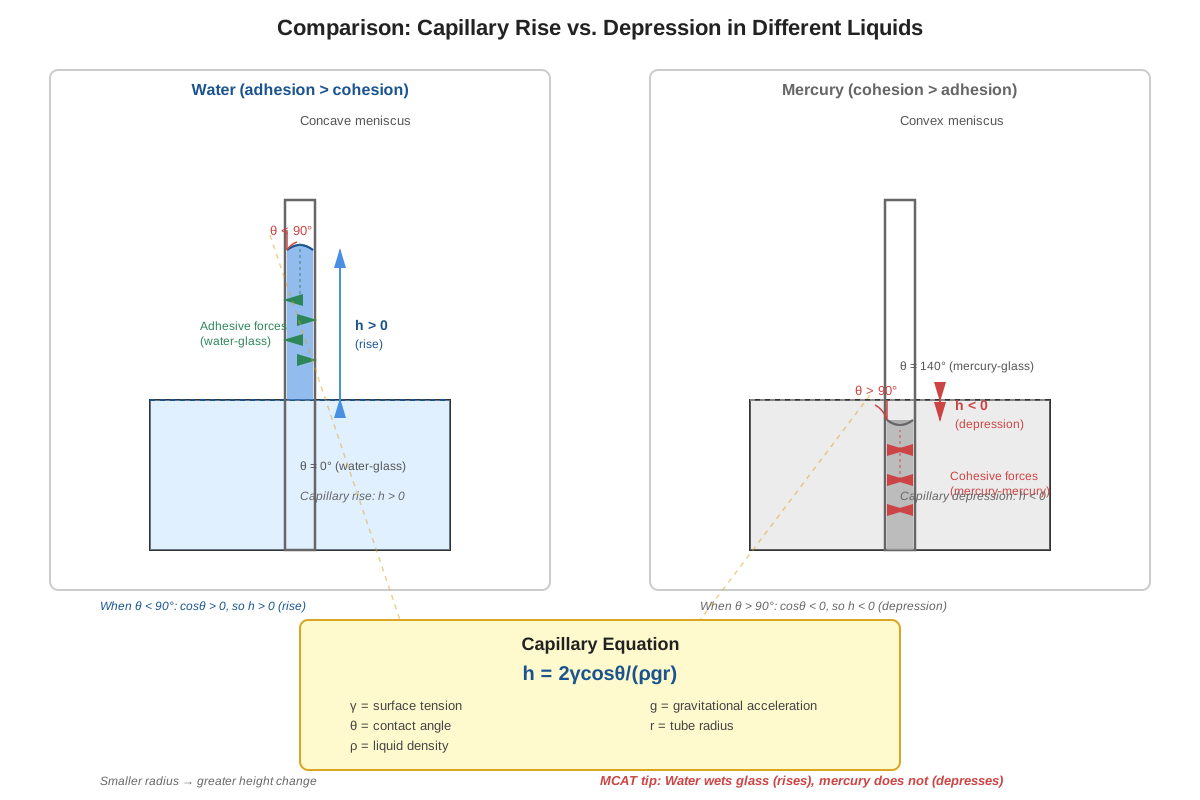
Capillary action is the spontaneous rise or depression of liquid in narrow tubes, resulting from the interplay between adhesive forces (liquid-solid attraction) and cohesive forces (liquid-liquid attraction). When adhesive forces exceed cohesive forces (as with water in glass), the liquid wets the surface, forms a concave meniscus, and rises in the tube. When cohesive forces dominate (as with mercury in glass), the liquid forms a convex meniscus and depresses below the external liquid level.
The height of capillary rise is given by:
h = (2γ cos θ)/(ρgr)where h is height, γ is surface tension, θ is the contact angle, ρ is liquid density, g is gravitational acceleration, and r is tube radius.
This equation reveals that capillary rise is inversely proportional to tube radius—narrower tubes produce greater rise. The contact angle θ measures the wetting behavior: θ < 90° indicates wetting (adhesion > cohesion), while θ > 90° indicates non-wetting (cohesion > adhesion). For water on clean glass, θ ≈ 0°, so cos θ ≈ 1.
Surface Energy and Area Minimization
Surface tension can be understood as surface energy—the excess energy molecules possess at the surface compared to the bulk. Creating new surface area requires work against cohesive forces, increasing the system's potential energy. The work required to increase surface area by ΔA is:
W = γ ΔAThis energy perspective explains why liquids spontaneously minimize surface area, forming spherical droplets in the absence of other forces (spheres have minimum surface area for a given volume). The tendency toward minimum energy drives many surface tension phenomena, from droplet coalescence to the spherical shape of soap bubbles.
Biological Applications
In pulmonary physiology, surface tension in alveoli creates a collapsing force that must be overcome during inspiration. Pulmonary surfactant, composed primarily of dipalmitoylphosphatidylcholine (DPPC) and surfactant proteins, reduces alveolar surface tension from approximately 0.070 N/m to 0.025 N/m or lower. This reduction serves two critical functions: (1) decreasing the work of breathing by reducing the pressure needed to inflate alveoli, and (2) stabilizing alveoli of different sizes by providing greater surface tension reduction in smaller alveoli, preventing their collapse into larger ones.
The Law of Laplace applied to alveoli shows that without surfactant, pressure would be inversely proportional to radius (P = 2γ/r), causing smaller alveoli to empty into larger ones. Surfactant's unique property of providing greater surface tension reduction at smaller surface areas (when compressed) counteracts this instability.
Comparison Table
| Property | High Surface Tension (Water) | Low Surface Tension (Alcohol) | With Surfactant |
|---|---|---|---|
| Intermolecular forces | Strong hydrogen bonding | Weaker forces | Disrupted cohesion |
| Droplet shape | Nearly spherical | Flattened | Spreads easily |
| Capillary rise | High in narrow tubes | Lower rise | Reduced rise |
| Contact angle (on glass) | ~0° (complete wetting) | Small but >0° | Varies with surfactant |
| Biological relevance | Alveolar collapse tendency | Less physiologically relevant | Prevents atelectasis |
Concept Relationships
Surface tension fundamentally connects to intermolecular forces, which determine the magnitude of cohesive attractions creating surface effects. Stronger intermolecular forces (hydrogen bonding in water) → higher surface tension → greater pressure differences in curved interfaces → more pronounced capillary effects. This chain of causation underlies most surface tension phenomena.
The relationship between surface tension and pressure manifests through the Young-Laplace equation, where surface tension creates additional pressure in curved interfaces. This pressure effect → influences fluid equilibrium → determines droplet stability and bubble behavior → explains physiological phenomena like alveolar mechanics.
Capillary action represents the combined effect of surface tension (cohesion) and adhesive forces, where the balance between these forces → determines contact angle → controls meniscus shape → drives fluid rise or depression in narrow spaces. This connects to fluid statics through the hydrostatic pressure column supporting the risen liquid.
The energy perspective on surface tension connects to thermodynamics: surface molecules have excess potential energy → systems minimize total energy → surfaces contract to minimum area → explains spontaneous droplet formation and coalescence. This energy minimization principle appears throughout physics and chemistry.
In biological contexts, surface tension → creates collapsing pressure in alveoli → requires surfactant intervention → enables efficient gas exchange. This pathway connects physics principles to respiratory physiology, demonstrating the interdisciplinary nature of MCAT content.
Textual relationship map: Intermolecular forces → Surface tension magnitude → Pressure differences (Young-Laplace) → Capillary action (with adhesion) → Biological applications (alveolar mechanics) → Clinical relevance (surfactant deficiency)
Quick check — test yourself on Surface tension so far.
Try Flashcards →High-Yield Facts
⭐ Surface tension is defined as force per unit length (N/m) or energy per unit area (J/m²), arising from asymmetric intermolecular forces at liquid surfaces.
⭐ The Young-Laplace equation for a spherical droplet is ΔP = 2γ/r; for a soap bubble with two surfaces, ΔP = 4γ/r.
⭐ Smaller droplets and bubbles have higher internal pressures due to the inverse relationship between pressure difference and radius.
⭐ Pulmonary surfactant reduces alveolar surface tension, preventing collapse and reducing the work of breathing; deficiency causes respiratory distress syndrome.
⭐ Capillary rise height is inversely proportional to tube radius: h = (2γ cos θ)/(ρgr).
- Surface tension decreases with increasing temperature due to weakened intermolecular forces.
- Water has high surface tension (~0.072 N/m at 25°C) due to extensive hydrogen bonding.
- Contact angle θ < 90° indicates wetting (adhesion > cohesion); θ > 90° indicates non-wetting (cohesion > adhesion).
- Surfactants decrease surface tension by disrupting cohesive forces at the liquid-air interface.
- Surface tension causes liquids to minimize surface area, forming spherical droplets when other forces are negligible.
- The work required to increase surface area is W = γ ΔA, representing the energy cost of creating new surface.
- Mercury has exceptionally high surface tension (~0.486 N/m) due to strong metallic bonding.
- In alveoli, the Law of Laplace (P = 2γ/r) would cause smaller alveoli to collapse into larger ones without surfactant stabilization.
- Inorganic salts typically increase water's surface tension slightly, while organic solutes and surfactants decrease it.
- Surface tension enables insects to walk on water by supporting their weight through the elastic-like surface membrane.
Common Misconceptions
Misconception: Surface tension is a force that acts perpendicular to the liquid surface, pulling objects downward.
Correction: Surface tension acts parallel to the liquid surface, tangent to the interface. It creates a contracting force that minimizes surface area, not a downward force. Objects can be supported on water surfaces when their weight is balanced by the upward component of surface tension forces acting along the contact perimeter.
Misconception: The pressure inside all bubbles is the same regardless of size.
Correction: According to the Young-Laplace equation (ΔP = 4γ/r for bubbles), smaller bubbles have higher internal pressures. A bubble with half the radius has twice the pressure difference. This is why small bubbles in foam tend to shrink while large ones grow—air flows from high pressure (small bubbles) to low pressure (large bubbles).
Misconception: Surfactants increase surface tension to stabilize alveoli.
Correction: Surfactants decrease surface tension, which is precisely how they stabilize alveoli. By reducing surface tension more in smaller alveoli (when surfactant molecules are compressed), they counteract the Law of Laplace that would otherwise cause small alveoli to collapse into larger ones. Lower surface tension also reduces the collapsing pressure and work of breathing.
Misconception: Capillary action only occurs in tubes; it's not relevant to flat surfaces.
Correction: While most dramatic in narrow tubes, capillary effects occur wherever liquid contacts solid surfaces. The meniscus formation in any container, wicking of liquids into porous materials, and tear film spreading on the eye all involve the same adhesion-cohesion balance underlying capillary action. The tube geometry simply makes the effect more visible and quantifiable.
Misconception: Surface tension and viscosity are the same property.
Correction: Surface tension and viscosity are distinct properties. Surface tension is a force per unit length at the interface arising from cohesive forces, while viscosity is resistance to flow within the bulk liquid arising from friction between molecular layers. Water has high surface tension but low viscosity; honey has low surface tension but high viscosity. They affect different aspects of fluid behavior.
Misconception: The contact angle is a property of the liquid alone.
Correction: Contact angle depends on three interfacial tensions: liquid-vapor, solid-liquid, and solid-vapor. It reflects the balance between adhesive forces (liquid-solid) and cohesive forces (liquid-liquid). The same liquid can have different contact angles on different surfaces—water spreads on clean glass (θ ≈ 0°) but beads on wax (θ > 90°).
Worked Examples
Example 1: Pressure Inside a Water Droplet
Question: A spherical water droplet has a radius of 0.50 mm. Given that the surface tension of water is 0.072 N/m, calculate the pressure difference between the inside and outside of the droplet. If the external atmospheric pressure is 101,325 Pa, what is the absolute pressure inside the droplet?
Solution:
Step 1: Identify the relevant equation. For a spherical droplet with one surface, use the Young-Laplace equation:
ΔP = 2γ/rStep 2: Convert radius to SI units:
r = 0.50 mm = 0.50 × 10⁻³ m = 5.0 × 10⁻⁴ m
Step 3: Calculate the pressure difference:
ΔP = (2 × 0.072 N/m) / (5.0 × 10⁻⁴ m)
ΔP = 0.144 / (5.0 × 10⁻⁴)
ΔP = 288 Pa
Step 4: Calculate absolute internal pressure:
P_inside = P_outside + ΔP
P_inside = 101,325 Pa + 288 Pa
P_inside = 101,613 PaAnswer: The pressure difference is 288 Pa, and the absolute pressure inside the droplet is 101,613 Pa (approximately 101.6 kPa).
Key insight: This example demonstrates that even small droplets have measurably higher internal pressures. For smaller droplets, this effect becomes more pronounced (inversely proportional to radius). This connects to the learning objective of calculating forces and pressures arising from surface tension.
Example 2: Capillary Rise in a Narrow Tube
Question: A glass capillary tube with an internal radius of 0.25 mm is placed vertically in water at 20°C. Given that water's surface tension is 0.072 N/m, density is 1000 kg/m³, and the contact angle with clean glass is approximately 0°, calculate the height to which water rises in the tube.
Solution:
Step 1: Identify the capillary rise equation:
h = (2γ cos θ)/(ρgr)Step 2: List known values:
- γ = 0.072 N/m
- θ = 0°, so cos θ = 1
- ρ = 1000 kg/m³
- g = 9.8 m/s²
- r = 0.25 mm = 2.5 × 10⁻⁴ m
Step 3: Substitute and calculate:
h = (2 × 0.072 × 1) / (1000 × 9.8 × 2.5 × 10⁻⁴)
h = 0.144 / (2.45)
h = 0.0588 m = 5.88 cm
Step 4: Verify units:
[N/m] / ([kg/m³][m/s²][m]) = [N/m] / [N/m²] = m ✓Answer: Water rises approximately 5.9 cm in the capillary tube.
Key insight: This demonstrates the inverse relationship between tube radius and capillary rise—halving the radius would double the height. This principle explains how plants transport water through xylem vessels and how tears spread across the eye surface. The problem connects surface tension to practical biological applications, addressing multiple learning objectives.
Extension: If the tube radius were 0.10 mm instead, the height would be:
h = 0.144 / (1000 × 9.8 × 1.0 × 10⁻⁴) = 0.147 m = 14.7 cmThis confirms the inverse proportionality: radius decreased by factor of 2.5, height increased by factor of 2.5.
Exam Strategy
Question Recognition and Approach
When encountering MCAT questions on surface tension, first identify the question type: (1) calculation problems requiring quantitative application of Young-Laplace or capillary rise equations, (2) conceptual questions testing understanding of factors affecting surface tension or predicting behavior, or (3) application questions connecting surface tension to biological systems. Each type requires a different strategic approach.
For calculation problems, immediately identify which equation applies. Trigger words include "pressure inside," "droplet," "bubble" (Young-Laplace), or "capillary rise," "narrow tube," "meniscus" (capillary equation). Write down the relevant equation, identify given values, check units, and solve systematically. Watch for the distinction between droplets (one surface, factor of 2) and bubbles (two surfaces, factor of 4)—this is a high-yield trap.
For conceptual questions, focus on cause-and-effect relationships. Questions asking "what happens if temperature increases" or "how does surfactant affect" test understanding of underlying mechanisms. Use the molecular perspective: stronger intermolecular forces → higher surface tension → greater effects. Eliminate answers that confuse surface tension with other properties (viscosity, density) or that reverse cause and effect.
Trigger Words and Phrases
Watch for these high-yield terms that signal surface tension concepts:
- "Alveoli," "surfactant," "respiratory distress" → pulmonary surface tension applications
- "Droplet," "bubble," "pressure inside" → Young-Laplace equation
- "Capillary," "narrow tube," "meniscus," "rise" → capillary action
- "Contact angle," "wetting," "adhesion" → liquid-solid interactions
- "Minimize surface area," "spherical shape" → energy minimization
- "Cohesive forces," "intermolecular forces" → molecular origin
Process of Elimination Tips
When eliminating wrong answers:
- Eliminate options that confuse surface tension (N/m) with pressure (Pa) or viscosity (Pa·s)—these are distinct properties with different units
- Eliminate answers suggesting surface tension increases with temperature (it decreases)
- Eliminate options claiming surfactant increases surface tension (it decreases it)
- For Young-Laplace problems, eliminate answers that don't show inverse relationship between pressure and radius
- For capillary problems, eliminate answers that don't show inverse relationship between height and radius
- Eliminate biological explanations that contradict physical principles (e.g., claiming small alveoli are more stable without surfactant)
Time Allocation
For discrete questions on surface tension, allocate 60-90 seconds: 15-20 seconds to identify the concept and equation, 30-45 seconds for calculation or reasoning, and 15-20 seconds to verify the answer makes physical sense. For passage-based questions, spend 30-45 seconds per question after initial passage reading. If a calculation becomes complex, estimate the answer using order-of-magnitude reasoning and eliminate implausible options rather than spending excessive time on precise calculation.
Memory Techniques
Mnemonics
"Young-Laplace: 2 for Drops, 4 for Bubbles": Remember that droplets have ONE surface (factor of 2 in ΔP = 2γ/r), while bubbles have TWO surfaces—inner and outer (factor of 4 in ΔP = 4γ/r). The number of surfaces equals half the numerical factor.
"Small Spheres = Strong Squeeze": Smaller radius → higher pressure inside. The alliteration helps remember the inverse relationship in the Young-Laplace equation.
"Surfactant Stops Small Sac Shrinkage": For pulmonary physiology, remember that surfactant prevents small alveoli (sacs) from collapsing. The alliteration reinforces the concept.
"CAP-illary: Contact Angle Predicts": The contact angle (θ) in the capillary rise equation predicts whether liquid rises (θ < 90°, cos θ positive) or depresses (θ > 90°, cos θ negative).
Visualization Strategies
Mental Model for Molecular Origin: Visualize liquid molecules as people holding hands. Those in the middle (bulk) hold hands with neighbors on all sides—balanced forces. Those at the surface hold hands only with neighbors beside and below them—unbalanced, pulling inward. This creates the "tension" trying to minimize the surface.
Pressure Gradient Visualization: Picture a balloon—smaller balloons are harder to inflate (higher pressure inside) than larger ones. This directly parallels the Young-Laplace equation: smaller radius → higher internal pressure. Use this familiar experience to remember the inverse relationship.
Capillary Action Diagram: Mentally sketch a narrow tube in water. Draw the meniscus curving upward (concave) where water touches glass. The upward curve means the surface is "pulling" the water up. Narrower tube → more pronounced curvature → stronger upward pull → greater height.
Acronym for Factors Affecting Surface Tension
"TLS" - Temperature, Liquid identity, Solutes/Surfactants
- Temperature: Higher T → Lower γ
- Liquid: Stronger intermolecular forces → Higher γ
- Solutes: Surfactants → Lower γ; Salts → Slightly higher γ
Summary
Surface tension is a fundamental fluid property arising from asymmetric intermolecular forces at liquid interfaces, quantified as force per unit length (N/m) or energy per unit area (J/m²). The molecular origin—bulk molecules experiencing balanced forces while surface molecules experience net inward cohesive forces—explains why surfaces contract to minimize area and behave like elastic membranes. The Young-Laplace equation (ΔP = 2γ/r for droplets, 4γ/r for bubbles) describes how surface tension creates pressure differences across curved interfaces, with smaller radii producing higher internal pressures. Capillary action results from the interplay between cohesive and adhesive forces, with rise height inversely proportional to tube radius. Surface tension decreases with temperature and is dramatically reduced by surfactants, which disrupt cohesive networks. In biological systems, pulmonary surfactant reduces alveolar surface tension, preventing collapse and reducing breathing work—a critical concept for MCAT passages on respiratory physiology. Mastery requires understanding both the molecular mechanism and quantitative relationships, connecting intermolecular forces to macroscopic phenomena, and applying principles to calculate pressures, predict fluid behavior, and explain physiological applications.
Key Takeaways
- Surface tension (γ) is force per unit length (N/m) arising from asymmetric cohesive forces at liquid surfaces, causing surfaces to contract and minimize area.
- The Young-Laplace equation relates pressure difference to surface tension and radius: ΔP = 2γ/r for droplets (one surface) and ΔP = 4γ/r for bubbles (two surfaces), with smaller radii producing higher pressures.
- Capillary rise is inversely proportional to tube radius (h = 2γ cos θ/ρgr), driven by the balance between adhesive and cohesive forces, with contact angle indicating wetting behavior.
- Pulmonary surfactant reduces alveolar surface tension, preventing small alveoli from collapsing into larger ones and decreasing the work of breathing—essential for respiratory physiology questions.
- Surface tension decreases with increasing temperature and is reduced by surfactants but slightly increased by inorganic salts; water has high surface tension due to hydrogen bonding.
- Surface tension represents excess surface energy, explaining spontaneous area minimization and the spherical shape of droplets in the absence of other forces.
- Common MCAT applications include calculating pressures in droplets/bubbles, predicting capillary behavior, explaining alveolar mechanics, and connecting molecular forces to macroscopic observations.
Related Topics
Fluid Dynamics and Bernoulli's Equation: Understanding surface tension provides foundation for more complex fluid flow problems where surface effects interact with pressure and velocity changes. Mastering static surface phenomena enables progression to dynamic flow situations.
Intermolecular Forces and Molecular Structure: Surface tension directly reflects intermolecular force strength, connecting to organic chemistry concepts about molecular polarity, hydrogen bonding, and structure-property relationships across disciplines.
Thermodynamics and Phase Transitions: Surface energy considerations become important in nucleation, droplet formation during condensation, and bubble formation during boiling—topics that integrate surface tension with thermodynamic principles.
Respiratory Physiology: Beyond basic surfactant function, advanced understanding includes compliance curves, pressure-volume relationships, and pathophysiology of respiratory distress syndrome, all building on surface tension foundations.
Membrane Transport and Cell Biology: While cell membranes involve lipid bilayers rather than simple liquid surfaces, understanding surface energy and minimization principles provides conceptual foundation for membrane stability and vesicle formation.
Practice CTA
Now that you've mastered the core concepts of surface tension, it's time to solidify your understanding through active practice. Attempt the practice questions to test your ability to apply Young-Laplace and capillary equations, predict the effects of temperature and surfactants, and analyze biological applications. Use the flashcards to reinforce high-yield facts and relationships until you can recall them instantly. Remember: surface tension appears frequently on the MCAT in both straightforward calculations and complex interdisciplinary passages—your investment in mastering this topic will pay dividends on test day. Focus especially on connecting molecular-level explanations to macroscopic observations, as this integration is exactly what the MCAT rewards. You've got this!
Sign up free to keep reading
Create a free AnvayaPrep account to finish this MCAT guide on Surface tension — plus flashcards and practice questions.