Overview
Intermolecular forces are the attractive and repulsive forces that exist between molecules, distinct from the intramolecular forces (covalent, ionic, metallic bonds) that hold atoms together within a molecule. These forces are fundamental to understanding the physical properties of substances, including boiling points, melting points, vapor pressure, viscosity, and solubility. While intermolecular forces are significantly weaker than chemical bonds—typically ranging from 1-50 kJ/mol compared to 150-1000 kJ/mol for covalent bonds—they profoundly influence molecular behavior and are responsible for the existence of liquids and solids. Mastery of Intermolecular forces General Chemistry concepts enables students to predict and explain macroscopic properties based on molecular structure, a skill repeatedly tested on the MCAT.
Understanding Intermolecular forces MCAT content is essential because these concepts bridge multiple disciplines tested on the exam. In the Chemical and Physical Foundations section, questions frequently require students to compare boiling points, explain solubility patterns, or interpret phase diagrams—all of which depend on intermolecular force strength. In the Biological and Biochemical Foundations section, intermolecular forces explain protein folding, DNA base pairing, membrane structure, and drug-receptor interactions. The MCAT consistently tests the ability to rank compounds by physical properties, identify the dominant intermolecular force in a given scenario, and predict molecular behavior in biological systems.
Within the broader context of Bonding and Molecular Structure in General Chemistry, intermolecular forces represent the logical extension of understanding molecular polarity, electronegativity, and three-dimensional molecular geometry. After learning how atoms bond to form molecules and how molecular shape determines polarity, students must understand how these polar or nonpolar molecules interact with each other. This topic connects directly to solution chemistry, phase changes, thermodynamics, and kinetics, making it one of the most integrative concepts in the MCAT curriculum.
Learning Objectives
- [ ] Define Intermolecular forces using accurate General Chemistry terminology
- [ ] Explain why Intermolecular forces matters for the MCAT
- [ ] Apply Intermolecular forces to exam-style questions
- [ ] Identify common mistakes related to Intermolecular forces
- [ ] Connect Intermolecular forces to related General Chemistry concepts
- [ ] Rank molecules by boiling point, melting point, and vapor pressure based on intermolecular force strength
- [ ] Distinguish between dipole-dipole interactions, hydrogen bonding, London dispersion forces, and ion-dipole forces
- [ ] Predict solubility patterns using "like dissolves like" principles and intermolecular force compatibility
Prerequisites
- Electronegativity and bond polarity: Understanding which bonds are polar is essential for predicting molecular polarity and dipole moments, which determine the types of intermolecular forces present
- Molecular geometry and VSEPR theory: Three-dimensional molecular shape determines whether bond dipoles cancel or reinforce, directly affecting intermolecular force strength
- Lewis structures: Proper Lewis structures reveal the presence of lone pairs and formal charges necessary for identifying hydrogen bond donors and acceptors
- States of matter basics: Familiarity with solids, liquids, and gases provides context for understanding how intermolecular forces affect phase transitions
Why This Topic Matters
Intermolecular forces have profound clinical and real-world significance. Drug design relies heavily on understanding how molecules interact with biological targets through hydrogen bonding, van der Waals forces, and hydrophobic interactions. Anesthetics work by disrupting intermolecular forces in neuronal membranes. The solubility of medications determines their bioavailability and route of administration—hydrophilic drugs dissolve in blood plasma through ion-dipole and hydrogen bonding interactions, while lipophilic drugs cross cell membranes via London dispersion forces with the lipid bilayer. Protein structure, enzyme function, and DNA replication all depend critically on specific intermolecular interactions.
On the MCAT, intermolecular forces appear in approximately 8-12% of General Chemistry questions and feature prominently in biochemistry passages. Common question formats include: ranking compounds by boiling point or solubility, identifying the strongest intermolecular force in a molecule, explaining anomalous properties of water, predicting miscibility of solvents, interpreting phase diagrams, and analyzing protein or nucleic acid structure. The MCAT frequently presents data tables requiring students to explain trends in physical properties or passages describing biological phenomena that depend on intermolecular interactions.
Passages often embed intermolecular force concepts within broader contexts: a biochemistry passage about protein denaturation requires understanding how heat disrupts hydrogen bonds; an organic chemistry passage about extraction techniques depends on solubility principles; a general chemistry passage about colligative properties builds on solution intermolecular forces. Discrete questions commonly present a set of molecules and ask students to identify which has the highest boiling point or which is most soluble in water—questions that can be answered in 30 seconds with solid conceptual understanding but consume valuable time if students lack systematic approaches.
Core Concepts
Types of Intermolecular Forces
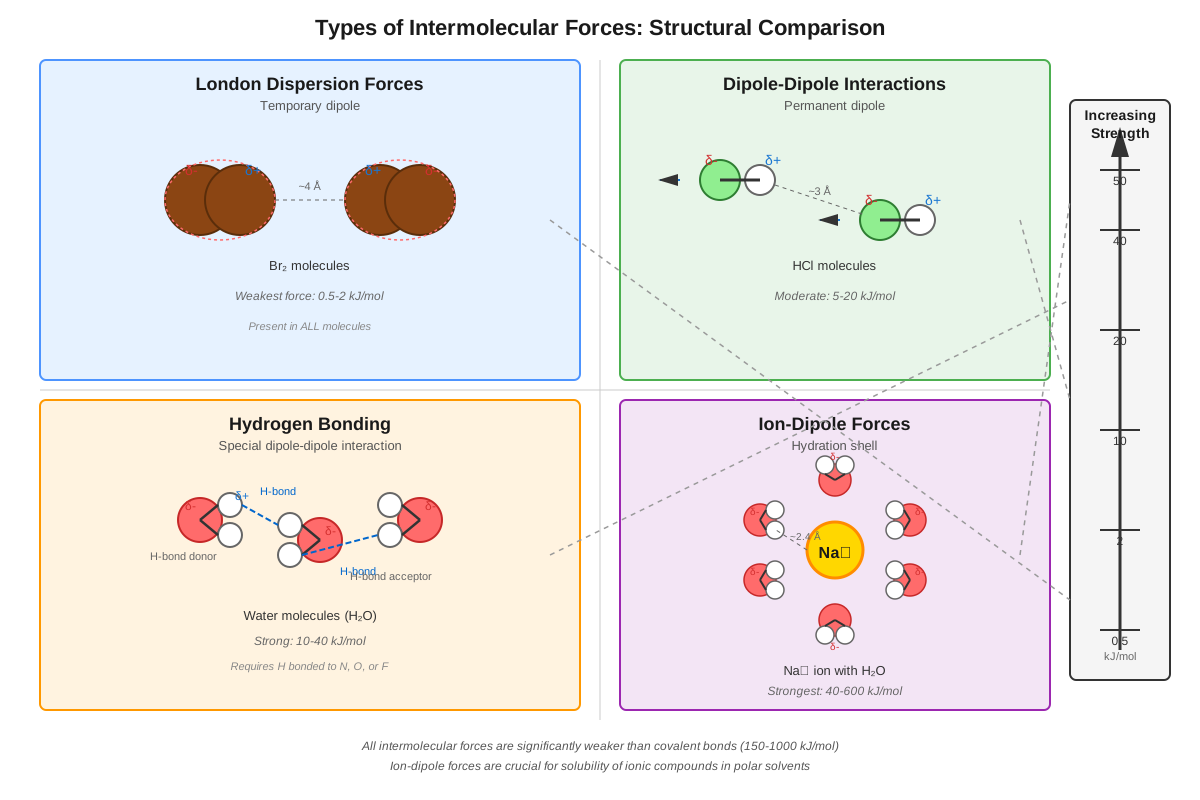
Intermolecular forces encompass several distinct types of interactions, each with characteristic strength and requirements. Understanding the hierarchy of these forces is fundamental to predicting molecular behavior.
London Dispersion Forces (also called van der Waals forces or induced dipole-induced dipole forces) are the weakest intermolecular forces and exist between all molecules, whether polar or nonpolar. These forces arise from temporary, instantaneous dipoles created when electron clouds fluctuate asymmetrically around nuclei. When electrons momentarily concentrate on one side of a molecule, they create a temporary dipole that induces a complementary dipole in neighboring molecules. The strength of London dispersion forces increases with:
- Molecular size and molar mass: Larger molecules have more electrons and larger electron clouds that are more easily polarized
- Surface area and molecular shape: Linear molecules have greater surface contact than branched molecules of the same molecular formula, leading to stronger dispersion forces
- Polarizability: Molecules with loosely held electrons (larger atoms, more electron shells) experience stronger dispersion forces
Dipole-dipole interactions occur between polar molecules with permanent dipole moments. The partially positive end of one polar molecule attracts the partially negative end of another. These forces are stronger than London dispersion forces (typically 5-25 kJ/mol) and require molecules to have permanent dipoles that don't cancel due to molecular geometry. The strength depends on the magnitude of the dipole moment and the distance between molecules.
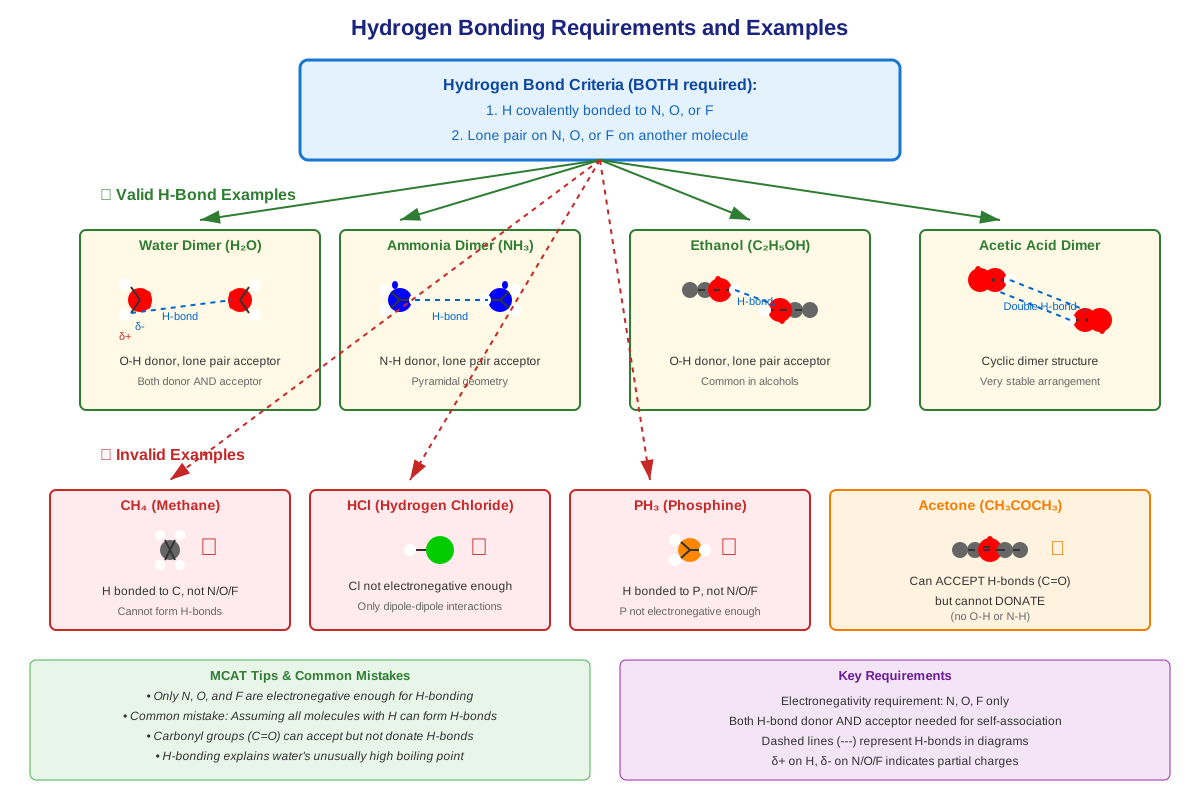
Hydrogen bonding is a special, unusually strong type of dipole-dipole interaction (typically 10-40 kJ/mol) that occurs when hydrogen is covalently bonded to highly electronegative atoms (N, O, or F) and interacts with a lone pair on another N, O, or F atom. The small size of hydrogen allows close approach between molecules, and the high electronegativity of N, O, and F creates strong partial charges. Hydrogen bonding is responsible for water's anomalously high boiling point, ice's lower density than liquid water, and the secondary structure of proteins and base pairing in DNA.
Ion-dipole forces occur between ions and polar molecules and are the strongest intermolecular forces (typically 40-600 kJ/mol). These forces are crucial for dissolving ionic compounds in polar solvents like water. The strength depends on the charge of the ion, the magnitude of the dipole moment, and the distance between them. Ion-dipole forces explain why ionic compounds dissolve readily in water but not in nonpolar solvents.
Comparative Strength of Intermolecular Forces
| Force Type | Typical Strength (kJ/mol) | Requirements | Examples |
|---|---|---|---|
| London Dispersion | 1-10 | All molecules | CH₄, C₈H₁₈, I₂ |
| Dipole-Dipole | 5-25 | Polar molecules | HCl, CH₃Cl, acetone |
| Hydrogen Bonding | 10-40 | H bonded to N, O, or F | H₂O, NH₃, HF, alcohols |
| Ion-Dipole | 40-600 | Ion + polar molecule | Na⁺ in water, K⁺ in water |
Exam Tip: All molecules experience London dispersion forces. When comparing molecules, identify the strongest intermolecular force present, but remember that dispersion forces can dominate in very large molecules even when other forces are present.
Predicting Physical Properties from Intermolecular Forces
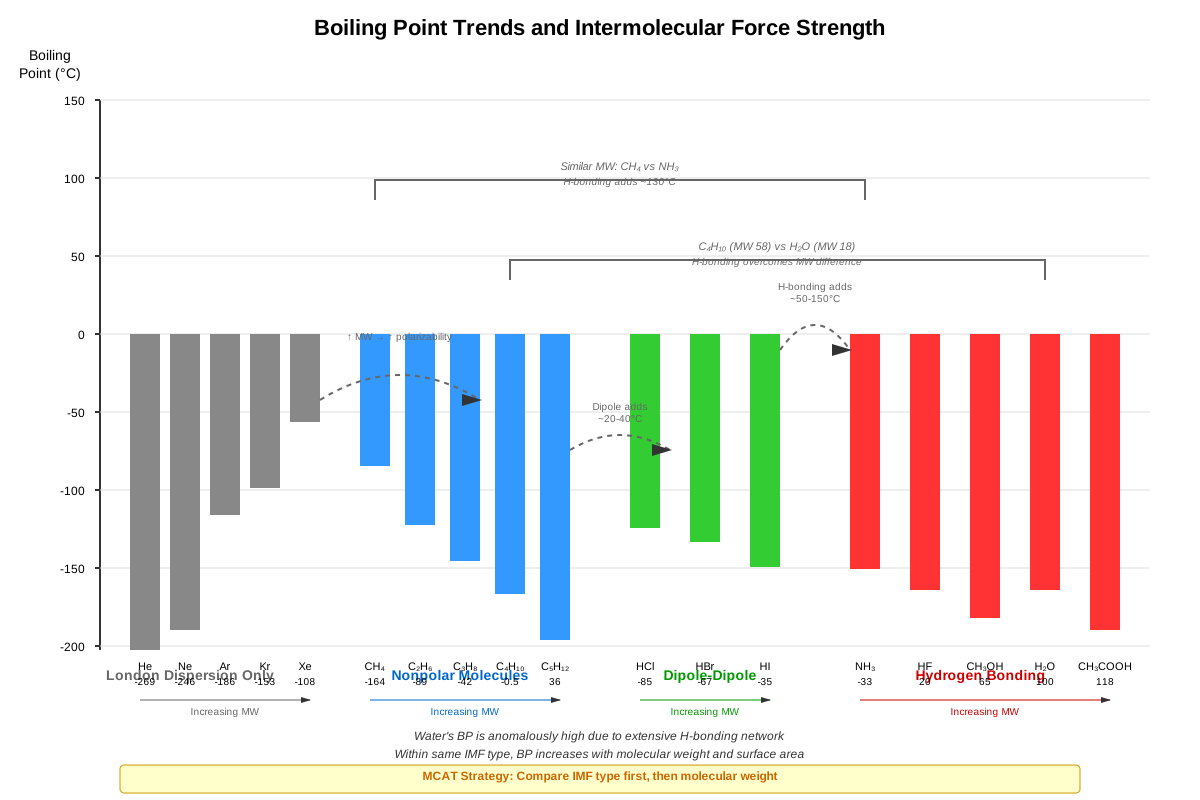
Boiling point is the temperature at which vapor pressure equals atmospheric pressure. Stronger intermolecular forces require more energy to overcome, resulting in higher boiling points. When comparing molecules:
- First, identify if hydrogen bonding is possible (highest boiling points)
- If no hydrogen bonding, compare dipole moments for dipole-dipole interactions
- For nonpolar molecules or molecules with similar polarity, compare molecular size and surface area for London dispersion forces
Melting point follows similar trends but is also influenced by molecular symmetry and packing efficiency in the solid state. Highly symmetric molecules often have higher melting points than predicted because they pack efficiently in crystal lattices.
Vapor pressure is inversely related to intermolecular force strength. Molecules with weak intermolecular forces escape the liquid phase more easily, resulting in higher vapor pressure at a given temperature. Volatile substances have weak intermolecular forces.
Viscosity increases with stronger intermolecular forces because molecules resist flowing past one another. Long-chain molecules also have higher viscosity due to entanglement.
Surface tension increases with stronger intermolecular forces because molecules at the surface are pulled inward more strongly, minimizing surface area.
Solubility and "Like Dissolves Like"
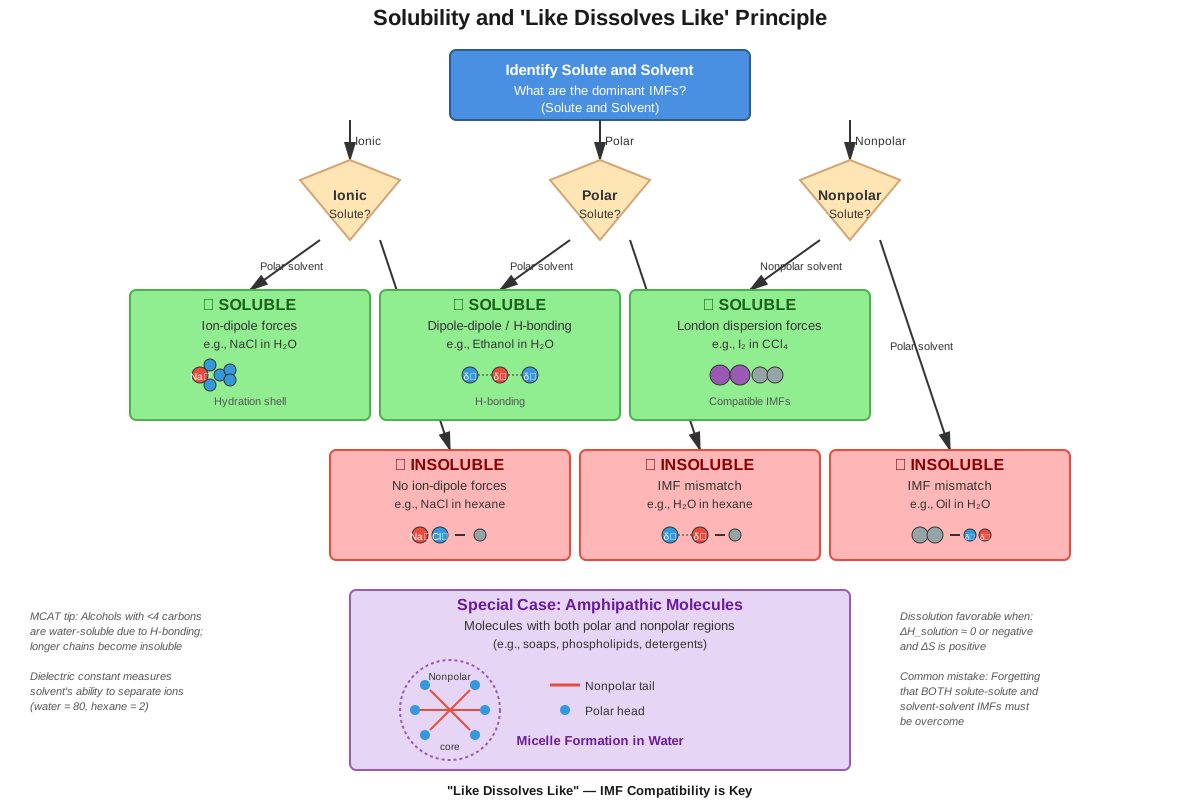
The principle "like dissolves like" summarizes solubility patterns: polar solutes dissolve in polar solvents, and nonpolar solutes dissolve in nonpolar solvents. This occurs because:
- Polar-polar interactions: Polar solutes form favorable dipole-dipole or hydrogen bonding interactions with polar solvents, compensating for the energy required to separate solute and solvent molecules
- Nonpolar-nonpolar interactions: Nonpolar solutes dissolve in nonpolar solvents through London dispersion forces; the entropy increase from mixing drives dissolution
- Polar-nonpolar incompatibility: Polar solvents cannot form favorable interactions with nonpolar solutes, and the strong solvent-solvent interactions (hydrogen bonding in water) are not compensated by weak solute-solvent dispersion forces
Ionic compounds dissolve in polar solvents through strong ion-dipole interactions. Water's high dielectric constant reduces electrostatic attraction between ions, and hydration (solvation) releases energy that compensates for lattice energy.
Amphipathic molecules contain both polar (hydrophilic) and nonpolar (hydrophobic) regions. These molecules, including phospholipids, detergents, and many biological molecules, can interact with both polar and nonpolar substances, making them crucial for membrane structure and emulsification.
Special Properties of Water
Water exhibits anomalous properties due to extensive hydrogen bonding:
- High boiling point (100°C) compared to other Group 16 hydrides (H₂S: -60°C)
- High specific heat capacity: Hydrogen bonds must be disrupted to increase temperature
- High heat of vaporization: Breaking hydrogen bonds requires substantial energy
- Lower density of ice than liquid water: Hydrogen bonding creates an open hexagonal lattice structure in ice
- High surface tension: Strong hydrogen bonding at the surface
- Excellent solvent properties: Can dissolve ionic and polar compounds through ion-dipole and hydrogen bonding interactions
Concept Relationships
The concepts within intermolecular forces form a hierarchical and interconnected framework. Molecular polarity (determined by electronegativity differences and molecular geometry) → determines the types of intermolecular forces present → which dictate physical properties (boiling point, melting point, vapor pressure, viscosity) → which influence phase behavior and solubility.
London dispersion forces serve as the foundation—present in all molecules—upon which stronger forces build. Dipole-dipole interactions add to dispersion forces in polar molecules. Hydrogen bonding represents a special case of dipole-dipole interactions with exceptional strength. Ion-dipole forces extend the concept to interactions between charged and polar species.
Connections to prerequisite topics include: Lewis structures → reveal lone pairs and bonding patterns → identify hydrogen bond donors/acceptors; VSEPR theory → determines molecular geometry → predicts whether dipoles cancel → establishes molecular polarity; Electronegativity → determines bond polarity → contributes to molecular polarity → influences intermolecular force strength.
Connections to related topics include: Phase diagrams depend on intermolecular forces to explain phase transitions; Colligative properties arise from solute-solvent intermolecular interactions; Thermodynamics quantifies the energy changes associated with breaking and forming intermolecular forces; Kinetics is influenced by intermolecular forces affecting collision frequency and orientation; Biochemistry relies on intermolecular forces for protein folding, enzyme-substrate binding, and membrane structure.
Quick check — test yourself on Intermolecular forces so far.
Try Flashcards →High-Yield Facts
⭐ Hydrogen bonding requires H bonded to N, O, or F and a lone pair on another N, O, or F atom—not just any electronegative atom
⭐ All molecules experience London dispersion forces, including polar molecules; these forces increase with molecular size and surface area
⭐ Water has an anomalously high boiling point (100°C) compared to H₂S (-60°C), H₂Se (-41°C), and H₂Te (-2°C) due to extensive hydrogen bonding
⭐ Branched isomers have lower boiling points than linear isomers because reduced surface area decreases London dispersion forces
⭐ Ion-dipole forces are stronger than hydrogen bonds, explaining why ionic compounds dissolve in water despite strong lattice energies
- Vapor pressure is inversely proportional to intermolecular force strength—weaker forces produce higher vapor pressure
- Viscosity and surface tension increase with stronger intermolecular forces
- Molecules with similar molar masses but different intermolecular forces can have vastly different boiling points (e.g., ethanol vs. dimethyl ether)
- Symmetrical molecules often have higher melting points than asymmetrical isomers due to efficient crystal packing
- The dielectric constant of a solvent indicates its ability to dissolve ionic compounds—higher dielectric constants reduce ion-ion attractions
- Hydrophobic interactions in proteins are entropy-driven, not due to attraction between nonpolar residues
Common Misconceptions
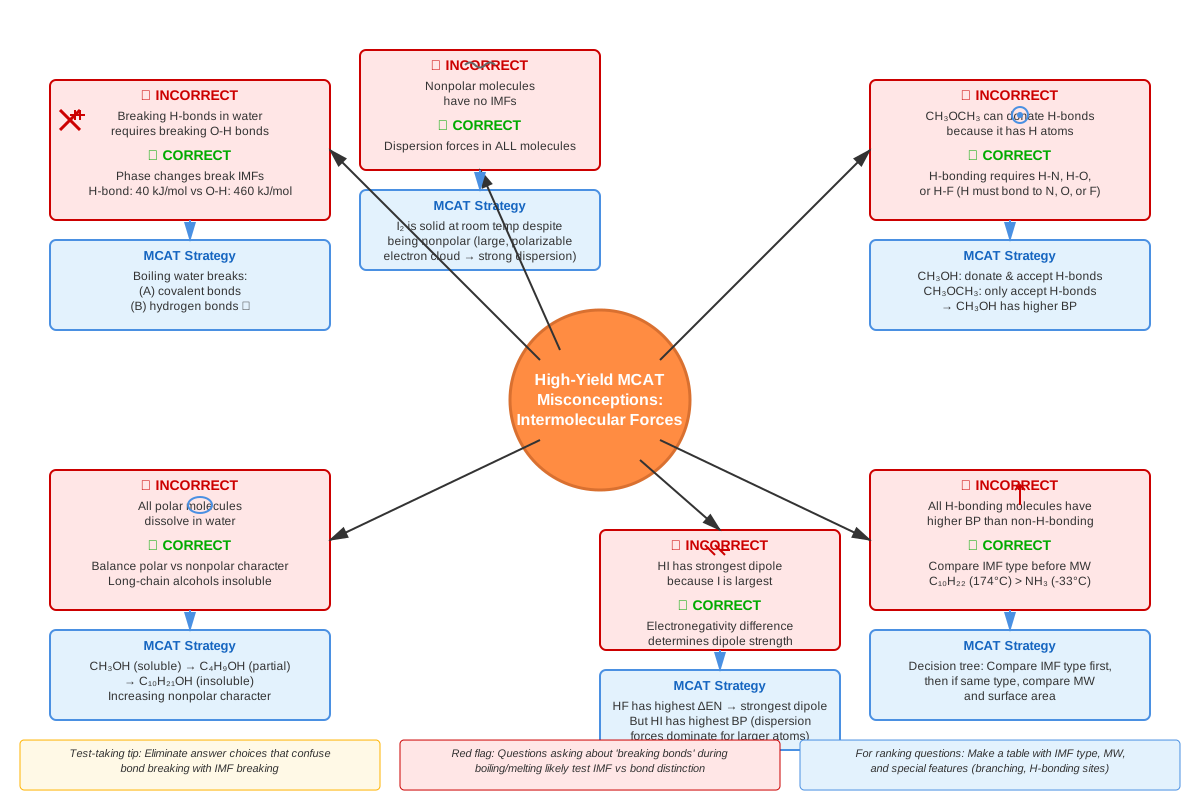
Misconception: Hydrogen bonding can occur with any hydrogen atom in a molecule
Correction: Hydrogen bonding specifically requires hydrogen covalently bonded to N, O, or F (the most electronegative elements). Hydrogen bonded to carbon or other elements does not participate in hydrogen bonding because insufficient partial positive charge develops.
Misconception: Polar molecules only experience dipole-dipole interactions
Correction: Polar molecules experience both dipole-dipole interactions AND London dispersion forces. All molecules have dispersion forces; polarity adds additional intermolecular forces. In large polar molecules, dispersion forces may actually contribute more to total intermolecular attraction than dipole-dipole interactions.
Misconception: Stronger intermolecular forces always mean higher melting points
Correction: While intermolecular force strength is the primary factor, melting point also depends on molecular symmetry and crystal packing efficiency. Some molecules with weaker intermolecular forces but highly symmetric structures have higher melting points than less symmetric molecules with stronger forces.
Misconception: Hydrogen bonds are covalent bonds involving hydrogen
Correction: Hydrogen bonds are intermolecular forces (attractions between molecules), not intramolecular covalent bonds. They are approximately 10-20 times weaker than covalent bonds. The term "bond" is somewhat misleading—they are strong intermolecular attractions, not chemical bonds.
Misconception: Nonpolar molecules cannot dissolve in water at all
Correction: While nonpolar molecules have very low solubility in water, they are not completely insoluble. Small nonpolar molecules like O₂ and CO₂ have limited but biologically significant solubility in water. The principle is that nonpolar molecules are much less soluble in polar solvents than polar molecules are.
Misconception: Larger molecules always have higher boiling points
Correction: While molecular size increases London dispersion forces, the type of intermolecular force matters more. Small molecules capable of hydrogen bonding (like water or ammonia) have higher boiling points than much larger nonpolar molecules (like butane or pentane).
Worked Examples
Example 1: Ranking Boiling Points
Question: Rank the following compounds in order of increasing boiling point: CH₃CH₂CH₂CH₃ (butane), CH₃CH₂OH (ethanol), CH₃OCH₃ (dimethyl ether), CH₃CH₂CH₃ (propane).
Solution:
Step 1: Identify the intermolecular forces present in each molecule.
- Butane (CH₃CH₂CH₂CH₃): Nonpolar molecule → only London dispersion forces
- Ethanol (CH₃CH₂OH): Contains O-H bond → capable of hydrogen bonding (also has dipole-dipole and dispersion forces)
- Dimethyl ether (CH₃OCH₃): Polar molecule with oxygen but no O-H bond → dipole-dipole interactions and dispersion forces (no hydrogen bonding because H is bonded to C, not O)
- Propane (CH₃CH₂CH₃): Nonpolar molecule → only London dispersion forces
Step 2: Rank by intermolecular force strength.
Hydrogen bonding > dipole-dipole > London dispersion forces
Therefore, ethanol will have the highest boiling point.
Step 3: Compare molecules with similar intermolecular forces.
Between butane and propane (both nonpolar), butane is larger (more electrons, greater surface area) → stronger dispersion forces → higher boiling point than propane.
Dimethyl ether has dipole-dipole interactions, which are stronger than the dispersion forces in butane.
Step 4: Final ranking (lowest to highest boiling point):
Propane < Butane < Dimethyl ether < Ethanol
Actual boiling points: Propane (-42°C), Butane (-0.5°C), Dimethyl ether (-24°C), Ethanol (78°C)
Note: Dimethyl ether actually has a lower boiling point than butane despite having dipole-dipole interactions because butane's larger size gives it stronger dispersion forces. This illustrates that molecular size can sometimes overcome the advantage of polarity.
Connection to Learning Objectives: This example demonstrates applying intermolecular forces to predict physical properties and identifying the dominant force in each molecule.
Example 2: Solubility Prediction
Question: A biochemistry researcher needs to extract a nonpolar compound from an aqueous solution. She has three solvents available: hexane (C₆H₁₄), ethanol (CH₃CH₂OH), and acetone (CH₃COCH₃). Which solvent would be most effective and why?
Solution:
Step 1: Identify the polarity of the solute.
The compound is described as nonpolar.
Step 2: Apply "like dissolves like" principle.
Nonpolar solutes dissolve best in nonpolar solvents because:
- Nonpolar solute-solvent interactions (dispersion forces) can form
- No strong solvent-solvent interactions need to be overcome
- Entropy increase from mixing is favorable
Step 3: Evaluate each solvent.
- Hexane (C₆H₁₄): Nonpolar hydrocarbon → only dispersion forces → excellent nonpolar solvent
- Ethanol (CH₃CH₂OH): Polar molecule with hydrogen bonding → good polar solvent, poor nonpolar solvent
- Acetone (CH₃COCH₃): Polar molecule with dipole-dipole interactions → moderate polarity, can dissolve some nonpolar compounds but not optimal
Step 4: Conclusion.
Hexane would be most effective because it is nonpolar and will form favorable dispersion force interactions with the nonpolar solute. The nonpolar compound will partition from the aqueous (polar) phase into the hexane (nonpolar) phase.
Additional consideration: Hexane and water are immiscible (don't mix) because hexane cannot form favorable interactions with water's hydrogen bonding network. This immiscibility is actually advantageous for extraction—the two layers separate cleanly, allowing easy separation of the nonpolar compound dissolved in hexane from the aqueous layer.
Connection to Learning Objectives: This example applies intermolecular force concepts to predict solubility and demonstrates the practical importance of understanding intermolecular forces in laboratory and clinical contexts.
Exam Strategy
When approaching MCAT questions on intermolecular forces, follow this systematic approach:
Step 1: Identify what the question is asking—boiling point ranking, solubility prediction, explanation of physical properties, or identification of intermolecular forces.
Step 2: Draw or visualize structures if not provided. Quickly sketch Lewis structures to identify:
- Presence of N-H, O-H, or F-H bonds (hydrogen bonding capability)
- Overall molecular polarity
- Molecular size and shape
Step 3: Identify the strongest intermolecular force in each molecule using the hierarchy:
- Ion-dipole (if ions and polar molecules are present)
- Hydrogen bonding (H bonded to N, O, or F)
- Dipole-dipole (polar molecules without hydrogen bonding)
- London dispersion (all molecules, but dominant in nonpolar molecules)
Step 4: Apply the appropriate principle:
- For boiling/melting point: stronger forces → higher temperature
- For vapor pressure: stronger forces → lower vapor pressure
- For solubility: like dissolves like
- For viscosity/surface tension: stronger forces → higher values
Trigger words to watch for:
- "Hydrogen bonding" or "H-bonding" → look for N-H, O-H, F-H bonds
- "Nonpolar" → London dispersion forces only
- "Volatile" → weak intermolecular forces, high vapor pressure
- "Miscible" or "soluble" → compatible intermolecular forces
- "Amphipathic" or "amphiphilic" → both polar and nonpolar regions
- "Hydrophobic" → nonpolar, avoids water
- "Hydrophilic" → polar or ionic, interacts favorably with water
Process-of-elimination tips:
- Eliminate options that confuse intramolecular and intermolecular forces
- Eliminate options that claim hydrogen bonding without N, O, or F
- Eliminate options that ignore London dispersion forces in large molecules
- Eliminate options that predict polar molecules dissolving in nonpolar solvents (or vice versa)
Time allocation: Most intermolecular force questions can be answered in 45-60 seconds once you've mastered the systematic approach. If a question takes longer, you may be overcomplicating it—return to the basic hierarchy of forces and "like dissolves like."
Exam Tip: When comparing boiling points, if two molecules have the same strongest intermolecular force type, compare molecular size and surface area. Linear molecules have higher boiling points than branched isomers of the same molecular formula.
Memory Techniques
Mnemonic for hydrogen bonding atoms: "FON" (F, O, N)
Only when hydrogen is bonded to Fluorine, Oxygen, or Nitrogen can hydrogen bonding occur. Remember: "FON calls for hydrogen bonding."
Mnemonic for intermolecular force strength: "I Don't Have Legs"
- Ion-dipole (strongest)
- Dipole-dipole
- Hydrogen bonding (special dipole-dipole)
- London dispersion (weakest)
Note: Hydrogen bonding is actually stronger than regular dipole-dipole, so the order is: Ion-dipole > Hydrogen bonding > Dipole-dipole > London dispersion
Visualization for "like dissolves like":
Picture polar molecules as magnets with positive and negative ends that attract each other. Nonpolar molecules are like smooth spheres that slide past each other. Magnets (polar) stick to other magnets (polar), and spheres (nonpolar) mix with other spheres (nonpolar), but magnets and spheres don't interact favorably.
Acronym for water's anomalous properties: "BSHD"
- Boiling point (high)
- Specific heat (high)
- Heat of vaporization (high)
- Density of ice < liquid (unusual)
All due to extensive hydrogen bonding.
Memory aid for boiling point trends:
"Hydrogen bonding beats size, but size beats polarity"
- Hydrogen bonding molecules have highest boiling points regardless of size
- Among nonpolar molecules, larger size wins
- Between polar (no H-bonding) and nonpolar molecules, polarity usually wins unless the nonpolar molecule is much larger
Summary
Intermolecular forces are the attractive interactions between molecules that determine physical properties including boiling point, melting point, vapor pressure, viscosity, surface tension, and solubility. The four main types—London dispersion forces, dipole-dipole interactions, hydrogen bonding, and ion-dipole forces—vary in strength and requirements. All molecules experience London dispersion forces, which increase with molecular size and surface area. Polar molecules additionally experience dipole-dipole interactions. Hydrogen bonding, a particularly strong type of dipole-dipole interaction, occurs when hydrogen is bonded to N, O, or F and interacts with a lone pair on another N, O, or F atom. Ion-dipole forces, the strongest intermolecular forces, occur between ions and polar molecules. Physical properties correlate with intermolecular force strength: stronger forces produce higher boiling points, lower vapor pressure, and greater viscosity. Solubility follows the "like dissolves like" principle—polar solutes dissolve in polar solvents through compatible intermolecular interactions, while nonpolar solutes dissolve in nonpolar solvents. Understanding intermolecular forces enables prediction of molecular behavior and is essential for MCAT success in general chemistry, organic chemistry, and biochemistry questions.
Key Takeaways
- Intermolecular forces are attractions between molecules (not within molecules) that determine physical properties; the hierarchy of strength is: ion-dipole > hydrogen bonding > dipole-dipole > London dispersion forces
- All molecules experience London dispersion forces, which increase with molecular size, molar mass, and surface area; linear molecules have stronger dispersion forces than branched isomers
- Hydrogen bonding requires H bonded to N, O, or F and is responsible for water's anomalously high boiling point and unique properties; it is the most commonly tested intermolecular force on the MCAT
- "Like dissolves like": polar solutes dissolve in polar solvents through dipole-dipole or hydrogen bonding interactions; nonpolar solutes dissolve in nonpolar solvents through dispersion forces
- Boiling point increases with intermolecular force strength; when comparing molecules, identify the strongest force present first, then consider molecular size if forces are similar
- Vapor pressure is inversely related to intermolecular force strength; volatile substances have weak intermolecular forces and high vapor pressure
- Intermolecular forces are critical in biochemistry for protein folding, DNA structure, membrane formation, and drug-receptor interactions, making this topic highly integrative across MCAT sections
Related Topics
Phase Diagrams and Phase Transitions: Understanding intermolecular forces provides the molecular basis for phase changes; stronger forces require higher temperatures for solid-to-liquid and liquid-to-gas transitions, explaining the position of phase boundaries.
Colligative Properties: Vapor pressure lowering, boiling point elevation, freezing point depression, and osmotic pressure all depend on solute-solvent intermolecular interactions and the disruption of solvent-solvent forces.
Solution Chemistry and Concentration Units: Solubility principles based on intermolecular forces determine which solutes dissolve in which solvents and to what extent, foundational for understanding solution preparation and behavior.
Thermodynamics of Dissolution: The enthalpy and entropy changes associated with dissolving solutes depend on breaking solute-solute and solvent-solvent intermolecular forces and forming solute-solvent interactions.
Protein Structure and Enzyme Function: Secondary structure (α-helices and β-sheets) is stabilized by hydrogen bonding; tertiary structure depends on hydrogen bonding, dipole-dipole interactions, London dispersion forces, and ionic interactions between amino acid residues.
Nucleic Acid Structure: DNA double helix stability depends on hydrogen bonding between complementary base pairs and π-π stacking interactions (a type of London dispersion force) between aromatic bases.
Practice CTA
Now that you've mastered the core concepts of intermolecular forces, it's time to solidify your understanding through active practice. Challenge yourself with MCAT-style practice questions that require you to rank molecules by boiling point, predict solubility patterns, and explain physical properties based on molecular structure. Use flashcards to drill the requirements for each type of intermolecular force and the hierarchy of force strengths. The ability to quickly identify the dominant intermolecular force in a molecule and predict its consequences is a high-yield skill that will serve you across multiple MCAT sections. Remember: intermolecular forces connect molecular structure to macroscopic properties—master this connection, and you'll excel on test day!
Sign up free to keep reading
Create a free AnvayaPrep account to finish this MCAT guide on Intermolecular forces — plus flashcards and practice questions.