Overview
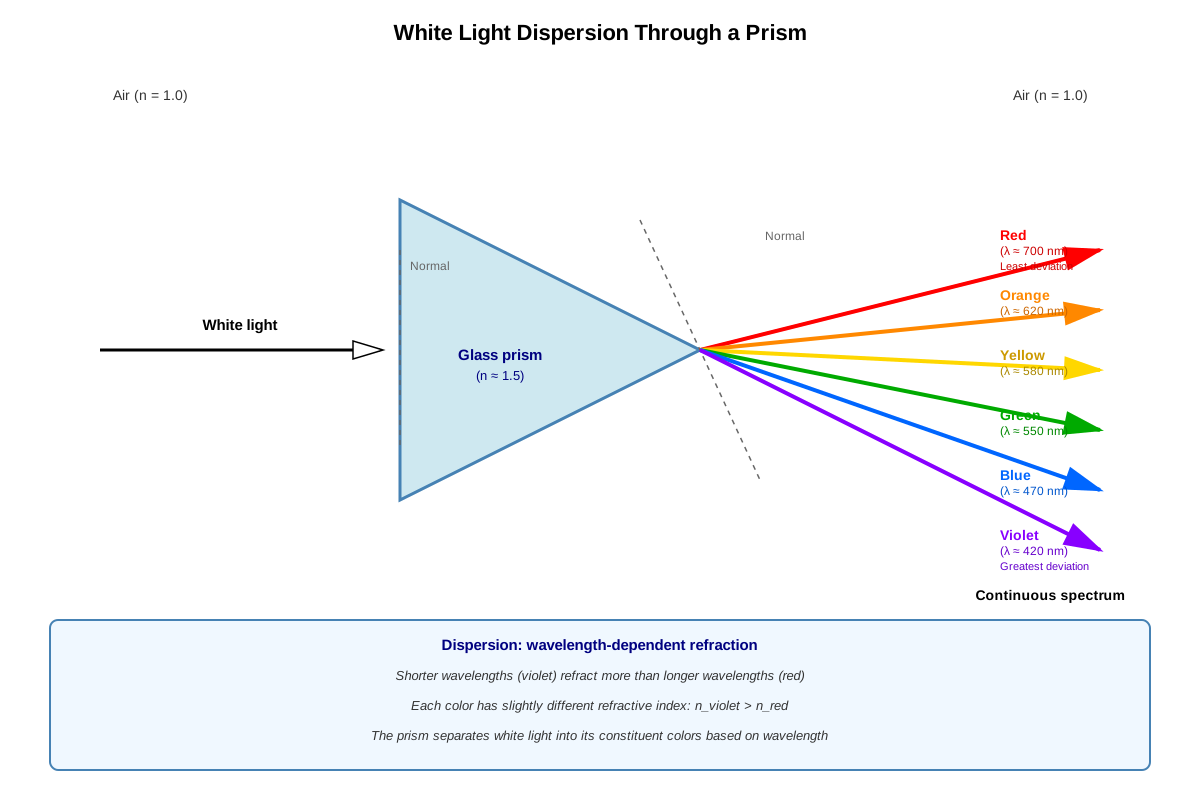
Dispersion is a fundamental optical phenomenon in which white light separates into its constituent colors when passing through a refractive medium. This separation occurs because different wavelengths of light travel at different speeds through materials, causing each wavelength to refract at a slightly different angle. The classic demonstration of dispersion is the formation of a rainbow spectrum when white light passes through a prism, revealing the continuous range of colors from red to violet.
For MCAT preparation, understanding dispersion is essential because it bridges multiple high-yield concepts in Light and Optics and Physics. The phenomenon directly connects to refraction, the wavelength-dependent nature of light, and the electromagnetic spectrum—all topics that appear regularly on the exam. Dispersion questions often appear in passage-based formats that integrate optical principles with experimental design, requiring students to analyze how light behaves in different media and predict outcomes based on wavelength-dependent properties.
Dispersion Physics represents a critical intersection between wave behavior and material properties. The concept extends beyond simple prism demonstrations to explain natural phenomena like rainbows, atmospheric optical effects, and the chromatic aberration in optical instruments. On the MCAT, dispersion serves as a gateway to understanding more complex optical systems and frequently appears in questions that test the relationship between wavelength, frequency, refractive index, and light behavior. Mastering this topic strengthens overall comprehension of electromagnetic radiation and prepares students for interdisciplinary questions that connect physics principles to biological applications, such as spectroscopy and microscopy.
Learning Objectives
- [ ] Define Dispersion using accurate Physics terminology
- [ ] Explain why Dispersion matters for the MCAT
- [ ] Apply Dispersion to exam-style questions
- [ ] Identify common mistakes related to Dispersion
- [ ] Connect Dispersion to related Physics concepts
- [ ] Calculate the angular separation between different wavelengths using Snell's law and refractive index data
- [ ] Predict the order of color separation in dispersive media based on wavelength and frequency relationships
- [ ] Analyze experimental scenarios involving dispersion to determine which variables affect the degree of separation
Prerequisites
- Refraction and Snell's Law: Dispersion is fundamentally an extension of refraction where the refractive index varies with wavelength; understanding how light bends at interfaces is essential
- Wave Properties of Light: Knowledge of wavelength, frequency, and their inverse relationship (c = λf) is necessary to understand why different colors behave differently
- Electromagnetic Spectrum: Familiarity with the visible spectrum and the relative wavelengths of different colors provides the foundation for predicting dispersion patterns
- Index of Refraction: Understanding that the refractive index (n) characterizes how light propagates through different media is critical for quantitative dispersion problems
Why This Topic Matters
Dispersion MCAT questions appear with moderate frequency, typically 1-3 questions per exam, often embedded within passages about optical instruments, experimental physics, or atmospheric phenomena. The topic is particularly valuable because it tests multiple competencies simultaneously: conceptual understanding of wave behavior, application of mathematical relationships, and interpretation of experimental data. Questions may ask students to predict which color will refract most, explain why chromatic aberration occurs in lenses, or analyze spectroscopic data.
In real-world and clinical contexts, dispersion underlies numerous important technologies and phenomena. Spectroscopy, which depends on dispersion to separate light into analyzable components, is fundamental to biochemical analysis, including the identification of molecules based on their absorption spectra. Medical imaging techniques, microscopy, and fiber optic communications all must account for dispersion effects. Ophthalmology deals with chromatic aberration in the eye's lens, and corrective optics must minimize unwanted dispersion. Understanding these applications helps students recognize dispersion concepts even when they appear in biological or clinical passages.
On the MCAT, dispersion commonly appears in passages describing: prism experiments with quantitative data about angles and wavelengths; rainbow formation and atmospheric optics; optical instrument design and limitations; spectroscopic analysis of biological molecules; and fiber optic technology in medical devices. The AAMC frequently tests whether students can distinguish between dispersion and other optical phenomena, apply wavelength-dependent refractive indices correctly, and predict the spatial arrangement of dispersed colors.
Core Concepts
Definition and Fundamental Mechanism
Dispersion is the phenomenon in which the phase velocity of a wave depends on its frequency (or wavelength), causing different wavelengths of light to propagate at different speeds through a medium. In the context of Light and Optics, dispersion specifically refers to the separation of white light into its component colors when passing through a refractive material. This occurs because the refractive index (n) of most transparent materials varies with wavelength—a property called chromatic dispersion or normal dispersion.
The physical basis for dispersion lies in the interaction between electromagnetic waves and the charged particles (electrons) within the material. When light enters a medium, it causes electrons to oscillate. These oscillating electrons re-radiate electromagnetic waves that interfere with the incident wave, effectively slowing it down. The degree of this interaction depends on how close the light's frequency is to the natural resonance frequencies of the electrons in the material. Since different wavelengths interact differently with these electrons, each wavelength experiences a different effective refractive index.
Wavelength Dependence of Refractive Index
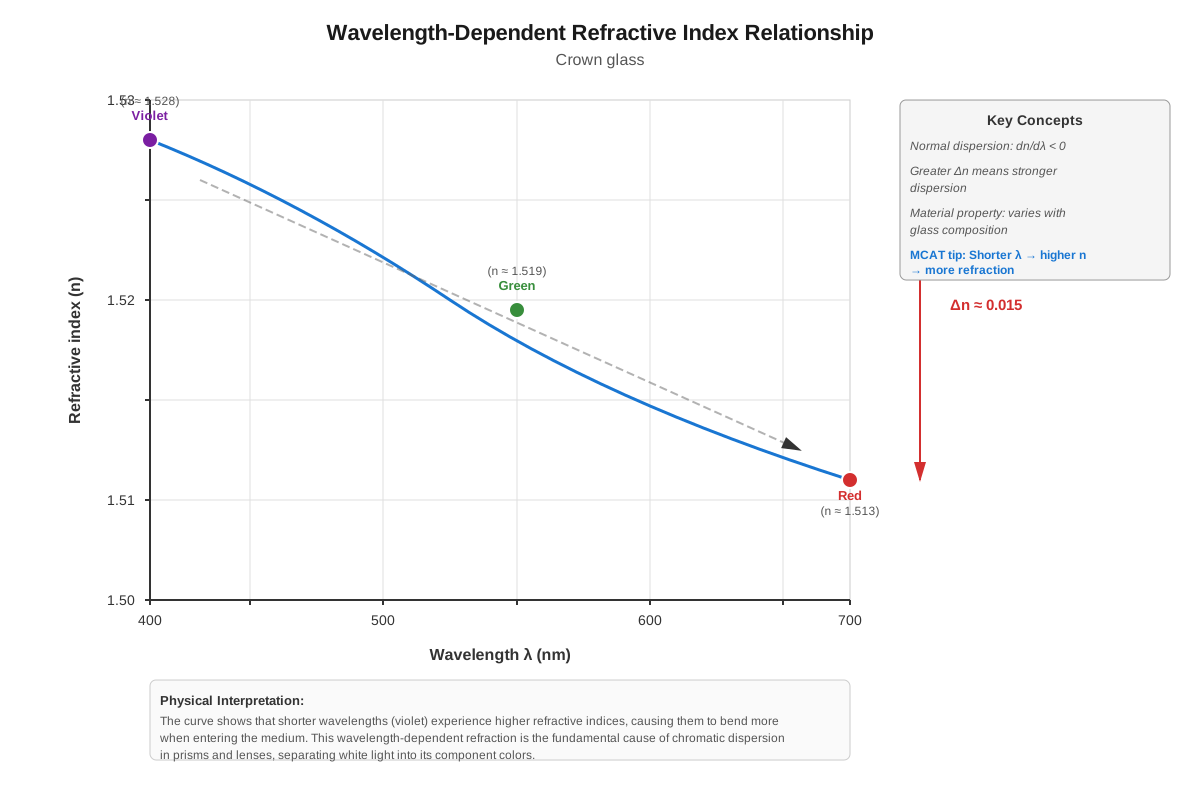
For most transparent materials in the visible spectrum, the refractive index decreases with increasing wavelength. This relationship can be expressed as:
n(λ) = A + B/λ² + C/λ⁴ + ...This is known as Cauchy's equation, though the MCAT does not require memorization of this specific formula. The key principle is that shorter wavelengths (violet/blue light) experience higher refractive indices than longer wavelengths (red light) in normal dispersion.
| Color | Approximate Wavelength (nm) | Relative Refractive Index |
|---|---|---|
| Red | 700 | Lowest (least refraction) |
| Orange | 620 | ↓ |
| Yellow | 580 | ↓ |
| Green | 550 | ↓ |
| Blue | 470 | ↓ |
| Violet | 400 | Highest (most refraction) |
This wavelength dependence means that when white light enters a prism at an angle, each component color refracts by a different amount. Violet light, having the highest refractive index, bends most toward the normal upon entering the prism and away from the normal upon exiting. Red light, with the lowest refractive index, bends least. The result is spatial separation of colors—the defining characteristic of dispersion.
Quantitative Analysis Using Snell's Law
While dispersion involves wavelength-dependent refraction, the fundamental relationship governing the bending of each individual wavelength remains Snell's Law:
n₁ sin(θ₁) = n₂ sin(θ₂)For dispersion problems, the key modification is recognizing that n₂ is different for each wavelength. If white light enters a prism from air (n₁ ≈ 1.00) at angle θ₁, each color will refract to a different angle θ₂ because each experiences a different n₂.
The angular dispersion (Δθ) between two wavelengths can be approximated by:
Δθ ≈ (dn/dλ) × Δλ × (geometry factor)While the MCAT won't require calculus-based derivations, understanding that the angular separation depends on both the difference in refractive indices and the geometry of the optical system is important for qualitative reasoning.
Prism Dispersion
A prism is the classic device for demonstrating dispersion. When white light enters one face of a triangular prism, it refracts toward the normal (bending toward the base of the prism). As the light travels through the prism, different wavelengths travel at different speeds but in the same direction. Upon exiting the second face, each wavelength refracts away from the normal, again bending toward the base. Because each wavelength has a different refractive index, each exits at a slightly different angle, creating a spectrum.
The total deviation angle for any wavelength depends on:
- The prism's apex angle (the angle between the two refracting faces)
- The refractive index of the prism material for that wavelength
- The angle of incidence of the incoming light
For the MCAT, remember that in a typical prism setup with white light entering from the left, violet light will deviate most and appear at the bottom of the spectrum, while red light deviates least and appears at the top.
Rainbow Formation
Rainbows are natural demonstrations of dispersion combined with internal reflection. When sunlight enters a spherical water droplet:
- First refraction: Light refracts as it enters the droplet, with violet bending more than red (dispersion occurs)
- Internal reflection: Light reflects off the back interior surface of the droplet
- Second refraction: Light refracts again as it exits, with additional dispersion
The combination of these processes causes different colors to exit the droplet at different angles relative to the incoming sunlight. An observer sees red light from droplets at approximately 42° from the antisolar point (the point directly opposite the sun) and violet light from droplets at approximately 40°. This angular separation creates the arc of colors characteristic of a rainbow, with red on the outside and violet on the inside of the primary bow.
Chromatic Aberration
Chromatic aberration is an unwanted consequence of dispersion in lens systems. Because lenses refract light to form images, and different wavelengths refract differently, a simple lens cannot focus all colors to the same point. This results in:
- Longitudinal chromatic aberration: Different colors focus at different distances along the optical axis
- Lateral chromatic aberration: Different colors focus at different positions perpendicular to the optical axis
This effect degrades image quality in optical instruments. The solution involves using achromatic doublets—combinations of lenses made from different types of glass (with different dispersion properties) that cancel out chromatic aberration for at least two wavelengths.
Material Dispersion Properties
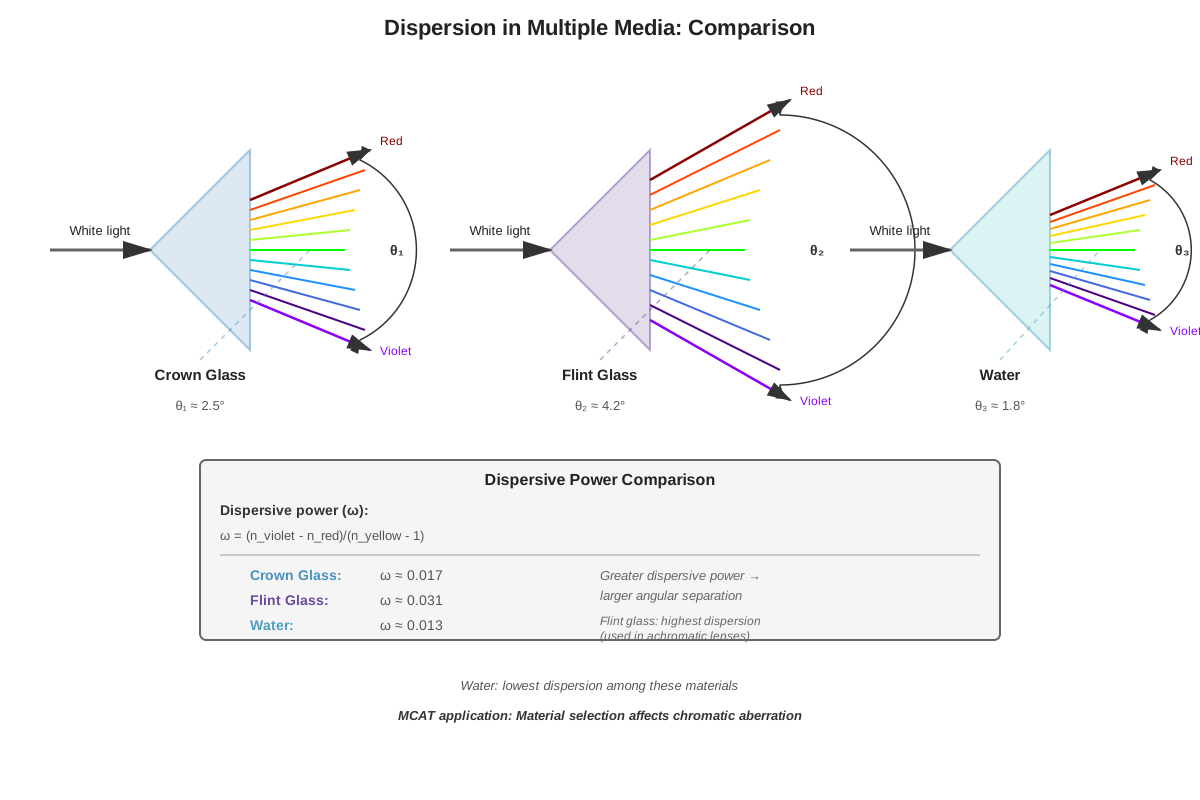
Different materials exhibit different amounts of dispersion, characterized by the dispersive power or Abbe number. Materials with high dispersive power show greater separation between colors for the same geometry. Common examples:
- Crown glass: Lower dispersion, commonly used in simple lenses
- Flint glass: Higher dispersion, used in prisms and in combination with crown glass for achromatic lenses
- Water: Moderate dispersion, responsible for rainbows
- Diamond: Very high dispersion, contributing to its "fire" or colorful sparkle
Concept Relationships
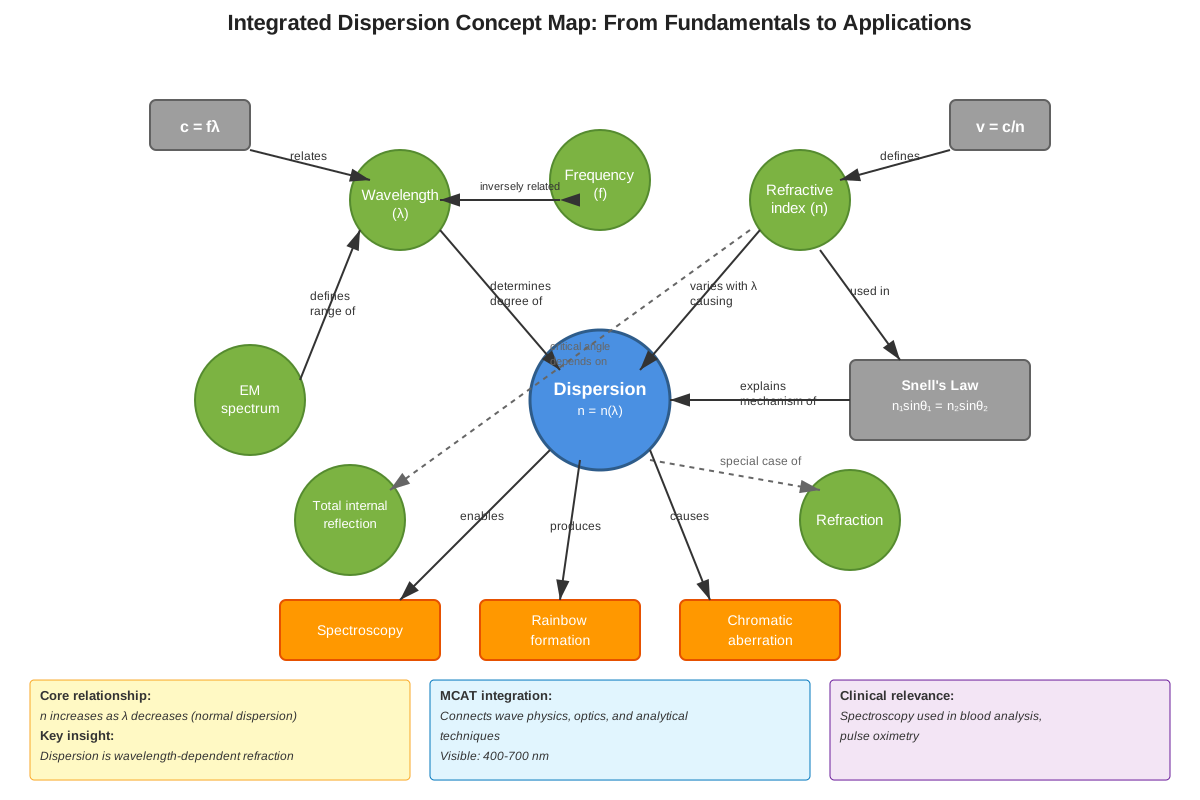
Dispersion fundamentally depends on refraction, which is governed by Snell's Law. The key distinction is that simple refraction assumes a single refractive index, while dispersion recognizes that the refractive index varies with wavelength. This wavelength dependence connects directly to the wave nature of light and the electromagnetic spectrum—understanding that visible light spans approximately 400-700 nm and that different wavelengths correspond to different colors is essential.
The relationship flows as follows: Wave properties of light (wavelength, frequency) → Wavelength-dependent refractive index → Differential refraction (dispersion) → Observable phenomena (spectra, rainbows, chromatic aberration).
Dispersion also connects to interference and diffraction. While a prism uses refraction to separate colors, a diffraction grating uses interference to achieve the same result through a different mechanism. Both produce spectra, but the underlying physics differs—this distinction is testable on the MCAT.
The concept extends to optical instruments: microscopes, telescopes, and cameras all must account for chromatic aberration. Understanding dispersion helps explain why high-quality optical systems use multiple lens elements made from different materials.
Finally, dispersion connects to spectroscopy, a crucial analytical technique in biochemistry. When molecules absorb specific wavelengths of light, spectroscopic instruments use dispersion (or diffraction) to separate the transmitted or emitted light into its component wavelengths, revealing the absorption or emission spectrum that identifies the molecule.
Quick check — test yourself on Dispersion so far.
Try Flashcards →High-Yield Facts
⭐ Dispersion occurs because the refractive index of materials varies with wavelength; shorter wavelengths (violet/blue) have higher refractive indices than longer wavelengths (red) in normal dispersion
⭐ In a prism, violet light bends more than red light, causing violet to appear at one end of the spectrum and red at the other
⭐ Dispersion is responsible for rainbow formation, where water droplets separate sunlight into its component colors through refraction and internal reflection
⭐ Chromatic aberration in lenses occurs because different wavelengths focus at different points, degrading image quality
⭐ The speed of light in a medium varies with wavelength: v = c/n, and since n depends on λ, different colors travel at different speeds
- White light is composed of all visible wavelengths; dispersion reveals this composition by spatially separating the colors
- The order of colors in the visible spectrum from longest to shortest wavelength is: red, orange, yellow, green, blue, violet (ROY G BV)
- Dispersion is distinct from diffraction; prisms use refraction while diffraction gratings use interference to separate colors
- The amount of dispersion depends on the material's dispersive power; diamond has much higher dispersion than glass
- In a primary rainbow, red appears on the outside (top) of the arc and violet on the inside (bottom)
Common Misconceptions
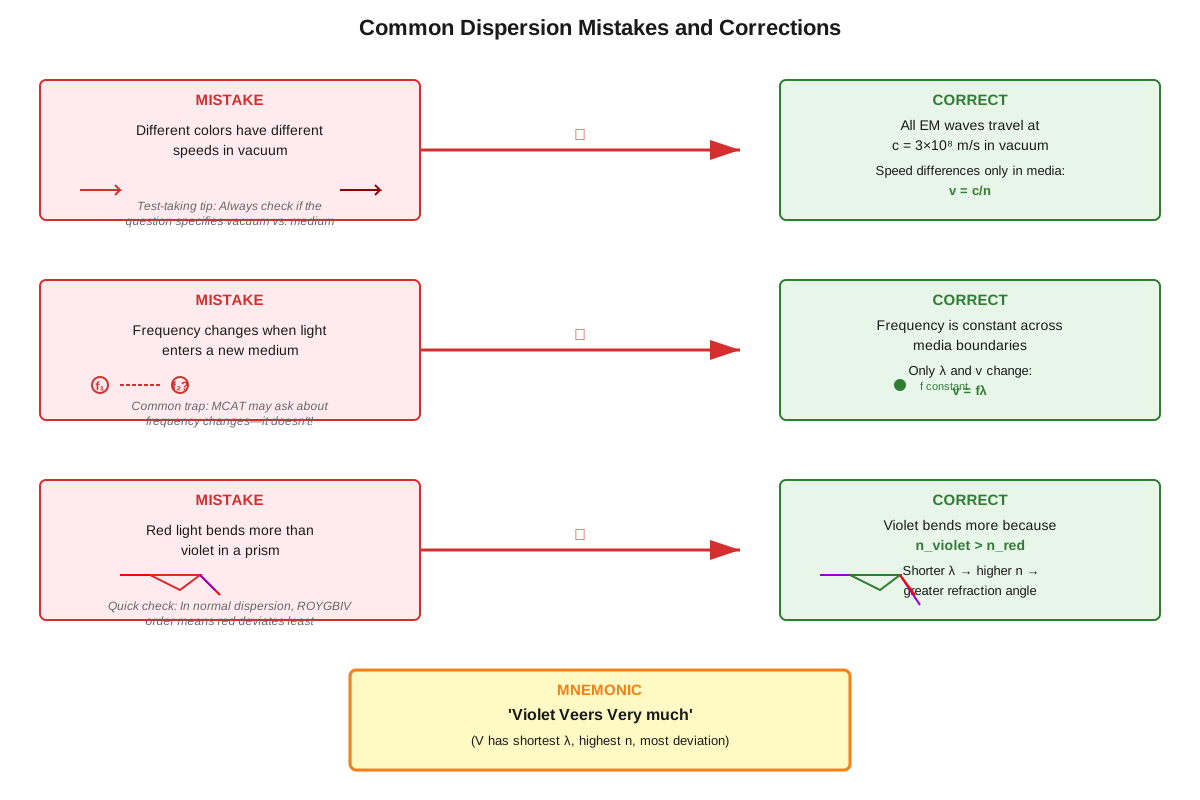
Misconception: Dispersion only occurs in prisms and is a special property of triangular glass objects.
Correction: Dispersion occurs in any transparent material where the refractive index varies with wavelength. It happens in water droplets (rainbows), lenses (chromatic aberration), the atmosphere (sunset colors), and even in the eye's lens. The prism is simply a convenient demonstration device.
Misconception: Red light bends more than violet light because red has more energy.
Correction: Violet light actually bends more than red light during refraction. Violet has shorter wavelength and higher frequency (thus higher energy per photon), and experiences a higher refractive index in most materials. Red light, with longer wavelength and lower frequency, experiences a lower refractive index and bends less.
Misconception: Dispersion and diffraction are the same phenomenon.
Correction: Dispersion and diffraction are distinct mechanisms that both can separate light into colors. Dispersion involves wavelength-dependent refraction (different speeds in a medium), while diffraction involves wavelength-dependent interference patterns. A prism uses dispersion; a diffraction grating uses diffraction.
Misconception: All materials disperse light in the same way (same order of colors).
Correction: While most materials show "normal dispersion" (shorter wavelengths refract more), some materials under specific conditions can show "anomalous dispersion" where this relationship reverses. However, for MCAT purposes, assume normal dispersion unless explicitly stated otherwise.
Misconception: The colors in a rainbow are discrete bands like in a diagram.
Correction: The spectrum produced by dispersion is continuous, not discrete. There are no sharp boundaries between colors; each wavelength transitions smoothly into the next. Diagrams show distinct color bands for clarity, but in reality, the spectrum contains infinite gradations of color across the visible range.
Misconception: Dispersion changes the wavelength of light.
Correction: Dispersion does not change the wavelength or frequency of light; these properties are determined by the source and remain constant. What changes is the speed of light in the medium (v = c/n) and the direction of propagation (refraction angle). The wavelength in the medium does change (λ_medium = λ_vacuum/n), but when the light exits back into air, it returns to its original wavelength.
Worked Examples
Example 1: Prism Dispersion Analysis
Question: White light enters a glass prism (apex angle 60°) from air at an incident angle of 45° to the first surface. The refractive index of the glass is 1.51 for red light (700 nm) and 1.53 for violet light (400 nm). Which statement correctly describes the light exiting the prism?
Solution:
Step 1: Recognize that this is a dispersion problem where different wavelengths will refract differently due to different refractive indices.
Step 2: Apply Snell's Law at the first surface for red light:
n_air × sin(45°) = n_red × sin(θ_red)
1.00 × 0.707 = 1.51 × sin(θ_red)
sin(θ_red) = 0.707/1.51 = 0.468
θ_red ≈ 27.9°
Step 3: Apply Snell's Law at the first surface for violet light:
n_air × sin(45°) = n_violet × sin(θ_violet)
1.00 × 0.707 = 1.53 × sin(θ_violet)
sin(θ_violet) = 0.707/1.53 = 0.462
θ_violet ≈ 27.5°
Step 4: Analyze the results. Violet light refracts to a smaller angle (bends more toward the normal) than red light at the first surface. This pattern continues at the second surface, causing violet to deviate more overall.
Step 5: Conclude that violet light will exit the prism at a greater angle from the original direction than red light, appearing more displaced in the spectrum.
Answer: Violet light will be refracted more than red light, appearing at a greater deviation angle from the incident beam direction. The spectrum will show violet at the position of maximum deviation and red at minimum deviation.
Connection to Learning Objectives: This example demonstrates the application of dispersion principles to quantitative problems, showing how wavelength-dependent refractive indices lead to spatial separation of colors.
Example 2: Rainbow Observation
Question: An observer standing with the sun directly behind them sees a rainbow in the sky. The observer notices that red appears at the top of the rainbow arc and violet at the bottom. A friend claims this is backwards because violet light bends more than red light. Explain why the observation is correct despite violet bending more.
Solution:
Step 1: Recall the mechanism of rainbow formation: sunlight enters water droplets, undergoes dispersion during refraction, reflects internally, and disperses again upon exiting.
Step 2: Recognize that the observer sees light that has been redirected back toward them at specific angles. The key is understanding which droplets contribute which colors.
Step 3: Violet light, bending more than red light, exits droplets at a smaller angle from the antisolar point (approximately 40° for violet vs. 42° for red).
Step 4: For the observer to see violet, they must look at droplets positioned at a lower angle (closer to the horizon if the antisolar point is below the horizon). For red, they look at droplets at a higher angle.
Step 5: This geometry means red appears at the top (outer edge) of the rainbow arc and violet at the bottom (inner edge).
Answer: The observation is correct. Although violet light bends more than red light, the geometry of rainbow formation means that violet exits droplets at a smaller angle from the antisolar point. The observer must look lower to see violet (from lower droplets) and higher to see red (from higher droplets), placing red on top and violet on bottom of the arc. The friend's confusion stems from not considering the complete geometry of the situation.
Connection to Learning Objectives: This example addresses common misconceptions about dispersion and demonstrates how to connect the fundamental principle (wavelength-dependent refraction) to real-world observations, a common MCAT question format.
Exam Strategy
When approaching Dispersion MCAT questions, first identify whether the question is asking about the mechanism (why dispersion occurs), the outcome (which color goes where), or a quantitative calculation. Look for trigger words like "spectrum," "prism," "chromatic aberration," "rainbow," or "wavelength-dependent."
Key trigger phrases and what they signal:
- "White light enters a prism" → expect a question about color separation and the order of colors
- "Chromatic aberration" → focus on how different wavelengths focus at different points
- "Refractive index varies with wavelength" → direct statement that dispersion is involved
- "Rainbow formation" → consider both refraction and internal reflection, with geometry
- "Which color bends most/least" → recall that shorter wavelengths (violet/blue) bend more
Process of elimination strategies:
- Eliminate any answer choice that suggests red light bends more than violet light (unless dealing with anomalous dispersion, which is rare)
- Eliminate choices that confuse dispersion with other phenomena (diffraction, interference, polarization)
- Eliminate choices that suggest wavelength or frequency changes during dispersion (they don't; only speed and direction change)
- If a question asks about the order of colors, eliminate any choice that doesn't follow ROY G BV from long to short wavelength
Time allocation: Dispersion questions are typically medium difficulty. Allocate 60-90 seconds for straightforward conceptual questions, and up to 2 minutes for questions requiring Snell's Law calculations or complex passage analysis. If a calculation seems too complex, look for a qualitative approach—the MCAT often rewards conceptual understanding over computational precision.
Common question formats:
- Passage-based: experimental setup with a prism or optical instrument, asking you to predict outcomes or interpret data
- Discrete: direct questions about why dispersion occurs or which color behaves in a specific way
- Pseudo-discrete: short scenario (1-2 sentences) followed by a question requiring application of dispersion principles
Exam Tip: If you're unsure about the direction of color separation, remember the mnemonic "Violet Veers" (violet bends more, veering further from the original path). This helps you quickly determine which end of the spectrum shows which color.
Memory Techniques
Mnemonic for visible spectrum order (long to short wavelength):
"Roy G. Biv" - Red, Orange, Yellow, Green, Blue, Indigo, Violet
Mnemonic for refractive index relationship:
"Short Stops More" - Shorter wavelengths experience higher refractive indices and stop (bend) more
Visualization strategy for prism dispersion:
Picture a prism as a "color spreader." White light enters as a single beam and exits as a fan of colors. Always visualize violet at the "wide" end of the fan (most deviation) and red at the "narrow" end (least deviation). Draw a quick sketch on your scratch paper if needed—visual memory is powerful.
Acronym for rainbow geometry:
"ROAR" - Red Outside, Antisolar Reference
This reminds you that red appears on the outside of a rainbow arc, and the reference point is the antisolar point (opposite the sun).
Memory hook for chromatic aberration:
Think "Chrome" (like the shiny, colorful finish) + "Aberration" (something wrong). Chromatic aberration is when colors don't focus together—something is "wrong" with the color focusing. This helps distinguish it from other types of aberrations.
Conceptual anchor:
Always anchor dispersion to the fundamental principle: "Different speeds, different angles." Different wavelengths travel at different speeds in a medium (because n varies with λ), which causes them to refract at different angles. This single principle explains all dispersion phenomena.
Summary
Dispersion is the wavelength-dependent refraction of light that occurs because the refractive index of materials varies with wavelength. In normal dispersion, shorter wavelengths (violet/blue light) experience higher refractive indices and refract more than longer wavelengths (red light). This phenomenon is responsible for the separation of white light into its component colors when passing through prisms, the formation of rainbows through water droplets, and chromatic aberration in optical systems. The fundamental mechanism involves the interaction between electromagnetic waves and electrons in the material, with different wavelengths interacting differently based on their proximity to electronic resonance frequencies. Understanding dispersion requires applying Snell's Law with wavelength-dependent refractive indices and recognizing that while the speed of light changes in different media, the wavelength and frequency of light are determined by the source and remain characteristic of each color. For the MCAT, students must be able to predict the order of color separation, explain why dispersion occurs, distinguish it from other optical phenomena like diffraction, and apply these principles to experimental scenarios and real-world applications.
Key Takeaways
- Dispersion occurs because refractive index varies with wavelength; shorter wavelengths (violet) have higher n values and bend more than longer wavelengths (red)
- The visible spectrum order from longest to shortest wavelength is red, orange, yellow, green, blue, violet (ROY G BV)
- Prisms separate white light into spectra through wavelength-dependent refraction, with violet deviating most and red least
- Rainbows form when sunlight undergoes dispersion in water droplets, with red appearing on the outside of the arc (42° from antisolar point) and violet on the inside (40°)
- Chromatic aberration in lenses results from dispersion causing different wavelengths to focus at different points, degrading image quality
- Dispersion is distinct from diffraction; prisms use refraction while diffraction gratings use interference to separate colors
- The speed of light in a medium depends on wavelength (v = c/n, where n varies with λ), but the wavelength and frequency are determined by the source and characterize each color
Related Topics
Refraction and Snell's Law: Mastering dispersion provides deeper insight into refraction by revealing that the refractive index is not a single constant but varies with wavelength. This understanding is crucial for advanced optics problems.
Diffraction Gratings: While dispersion uses refraction to separate colors, diffraction gratings use interference. Comparing these two mechanisms strengthens understanding of both and prepares students for questions that require distinguishing between them.
Spectroscopy: Dispersion is the physical basis for many spectroscopic techniques used in biochemistry and analytical chemistry. Understanding how light separates into component wavelengths enables comprehension of absorption and emission spectra.
Optical Instruments: Microscopes, telescopes, and cameras all deal with chromatic aberration resulting from dispersion. Advanced study of these instruments requires understanding how lens combinations can minimize dispersion effects.
Electromagnetic Spectrum: Dispersion in the visible range connects to the broader electromagnetic spectrum. Understanding how different wavelengths behave differently in matter extends to infrared, ultraviolet, and other regions relevant to biological applications.
Practice CTA
Now that you've mastered the core concepts of dispersion, it's time to solidify your understanding through active practice. Attempt the practice questions and flashcards associated with this topic to test your ability to apply these principles under exam conditions. Focus on questions that require you to predict color separation, explain mechanisms, and distinguish dispersion from related phenomena. Remember, the MCAT rewards not just knowledge but the ability to apply that knowledge quickly and accurately. Each practice question you complete strengthens your neural pathways and builds the confidence you need to excel on test day. You've got this—now prove it to yourself through deliberate practice!
Sign up free to keep reading
Create a free AnvayaPrep account to finish this MCAT guide on Dispersion — plus flashcards and practice questions.