Overview
The electromagnetic spectrum represents the complete range of electromagnetic radiation organized by wavelength, frequency, and energy. Understanding this fundamental concept in Physics is essential for MCAT success, as it bridges multiple disciplines tested on the exam. The electromagnetic spectrum encompasses all forms of electromagnetic radiation, from low-energy radio waves with wavelengths measured in kilometers to high-energy gamma rays with wavelengths smaller than atomic nuclei. Each region of the spectrum exhibits unique properties and interactions with matter, making this topic crucial for understanding phenomena ranging from molecular spectroscopy to medical imaging.
For the MCAT, the electromagnetic spectrum appears frequently in both the Chemical and Physical Foundations of Biological Systems section and the Biological and Biochemical Foundations of Living Systems section. Questions may involve calculating wavelengths or frequencies, understanding how different types of radiation interact with biological tissues, or applying knowledge of spectroscopy to determine molecular structures. The spectrum provides the foundation for understanding Light and Optics, photon energy calculations, and the behavior of electromagnetic waves in various media.
The electromagnetic spectrum connects intimately with quantum mechanics, atomic structure, thermodynamics, and molecular biology. Mastery of this topic enables students to tackle complex passage-based questions involving UV-Vis spectroscopy, infrared spectroscopy, X-ray crystallography, and nuclear medicine imaging techniques. The relationship between wavelength, frequency, and energy—governed by fundamental equations—appears repeatedly across MCAT questions, making this a high-yield topic that rewards thorough understanding.
Learning Objectives
- [ ] Define electromagnetic spectrum using accurate Physics terminology
- [ ] Explain why electromagnetic spectrum matters for the MCAT
- [ ] Apply electromagnetic spectrum to exam-style questions
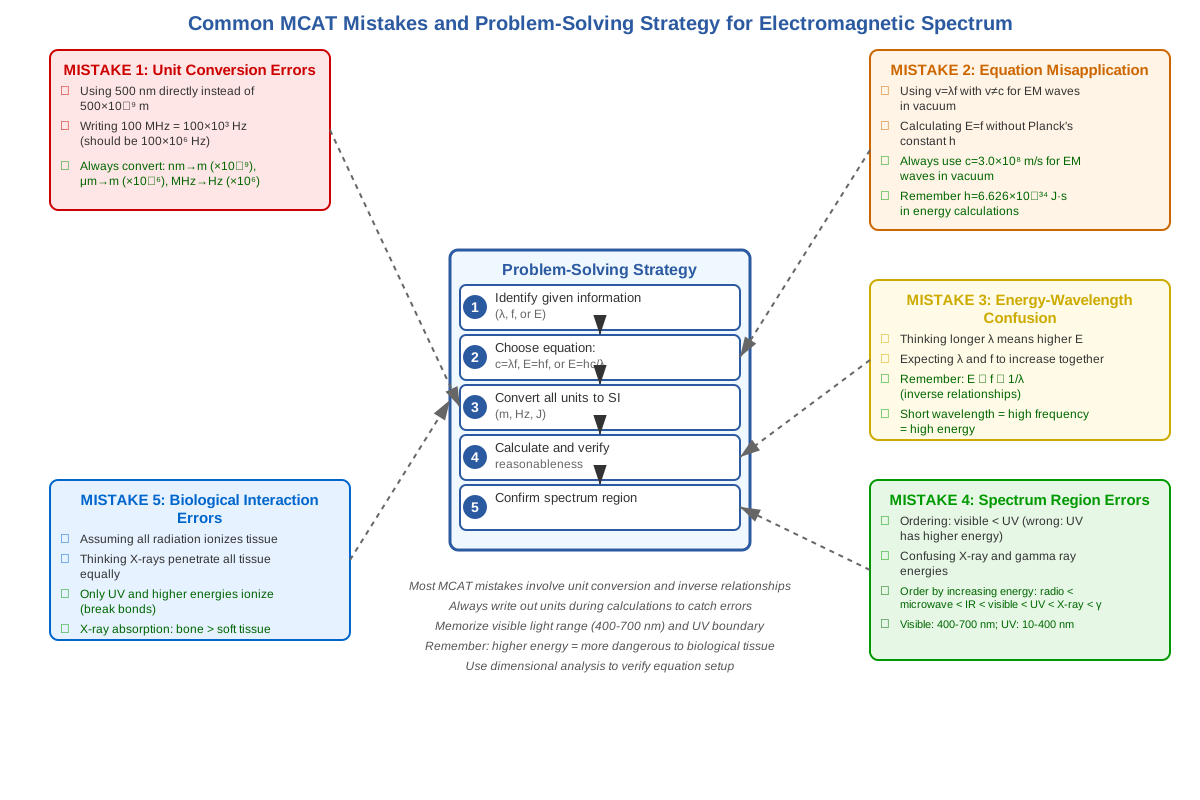
- [ ] Identify common mistakes related to electromagnetic spectrum
- [ ] Connect electromagnetic spectrum to related Physics concepts
- [ ] Calculate wavelength, frequency, and energy for any region of the electromagnetic spectrum using appropriate equations
- [ ] Predict how different types of electromagnetic radiation interact with biological molecules and tissues
- [ ] Analyze spectroscopic data to determine molecular properties and identify functional groups
Prerequisites
- Wave properties (wavelength, frequency, amplitude, speed): Essential for understanding how electromagnetic waves are characterized and how they propagate through space
- Basic algebra and unit conversion: Required for manipulating equations relating wavelength, frequency, and energy
- Atomic structure and electron transitions: Necessary for understanding how matter emits and absorbs electromagnetic radiation
- Energy concepts and units (joules, electron volts): Fundamental for calculating photon energies and understanding radiation interactions
- Speed of light constant (c = 3.0 × 10⁸ m/s): The universal constant that relates wavelength and frequency for all electromagnetic radiation
Why This Topic Matters
The electromagnetic spectrum has profound clinical and real-world significance that makes it a favorite topic for MCAT test writers. Medical imaging technologies—including X-rays, CT scans, MRI (which uses radio waves), and PET scans—all rely on different regions of the electromagnetic spectrum. Understanding how various wavelengths interact with biological tissues enables physicians to diagnose diseases, monitor treatment progress, and perform minimally invasive procedures. Additionally, UV radiation's role in vitamin D synthesis and skin cancer development, infrared radiation in thermography, and visible light in photosynthesis all represent clinically relevant applications.
On the MCAT, electromagnetic spectrum questions appear in approximately 3-5% of Physics passages and discrete questions, with additional appearances in biochemistry passages involving spectroscopy. Questions typically fall into three categories: (1) calculation-based problems requiring use of c = λν or E = hf equations, (2) conceptual questions about radiation properties and biological interactions, and (3) passage-based questions involving spectroscopic techniques or medical imaging. The topic frequently appears in interdisciplinary passages that combine physics principles with biological or chemical applications.
Common MCAT passage contexts include: UV-Vis spectroscopy for determining protein concentration or analyzing conjugated systems, infrared spectroscopy for identifying functional groups in organic molecules, fluorescence microscopy in cell biology research, radiation therapy in oncology, and the photoelectric effect in quantum mechanics. The ability to quickly recall the order of the spectrum, understand inverse relationships between wavelength and energy, and apply fundamental equations makes this topic highly testable and worth dedicated study time.
Core Concepts
The Nature of Electromagnetic Radiation
Electromagnetic radiation consists of oscillating electric and magnetic fields that propagate through space as transverse waves. Unlike mechanical waves, electromagnetic waves require no medium and travel at the speed of light (c = 3.0 × 10⁸ m/s) in a vacuum. All electromagnetic waves share fundamental properties: they exhibit wave-particle duality, carry energy and momentum, and obey the wave equation relating speed, wavelength, and frequency.
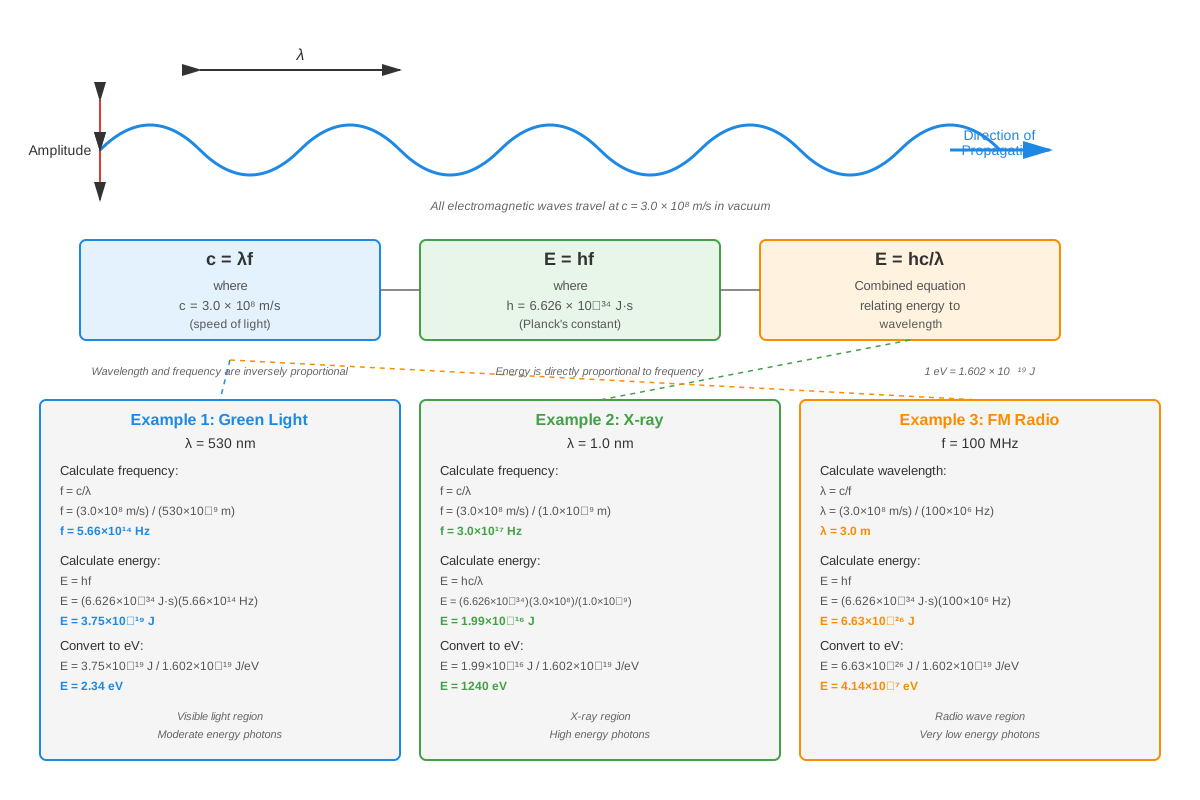
The electromagnetic spectrum organizes all forms of electromagnetic radiation by their wavelength (λ), frequency (ν or f), and energy (E). These three properties are mathematically related through two fundamental equations that every MCAT student must memorize:
c = λνE = hf = hc/λwhere h is Planck's constant (6.626 × 10⁻³⁴ J·s or 4.14 × 10⁻¹⁵ eV·s).
These equations reveal crucial inverse relationships: as wavelength increases, frequency decreases, and energy decreases. Conversely, shorter wavelengths correspond to higher frequencies and higher energies. This relationship explains why gamma rays are dangerous (high energy can ionize atoms and damage DNA) while radio waves are relatively harmless (low energy cannot break chemical bonds).
Regions of the Electromagnetic Spectrum
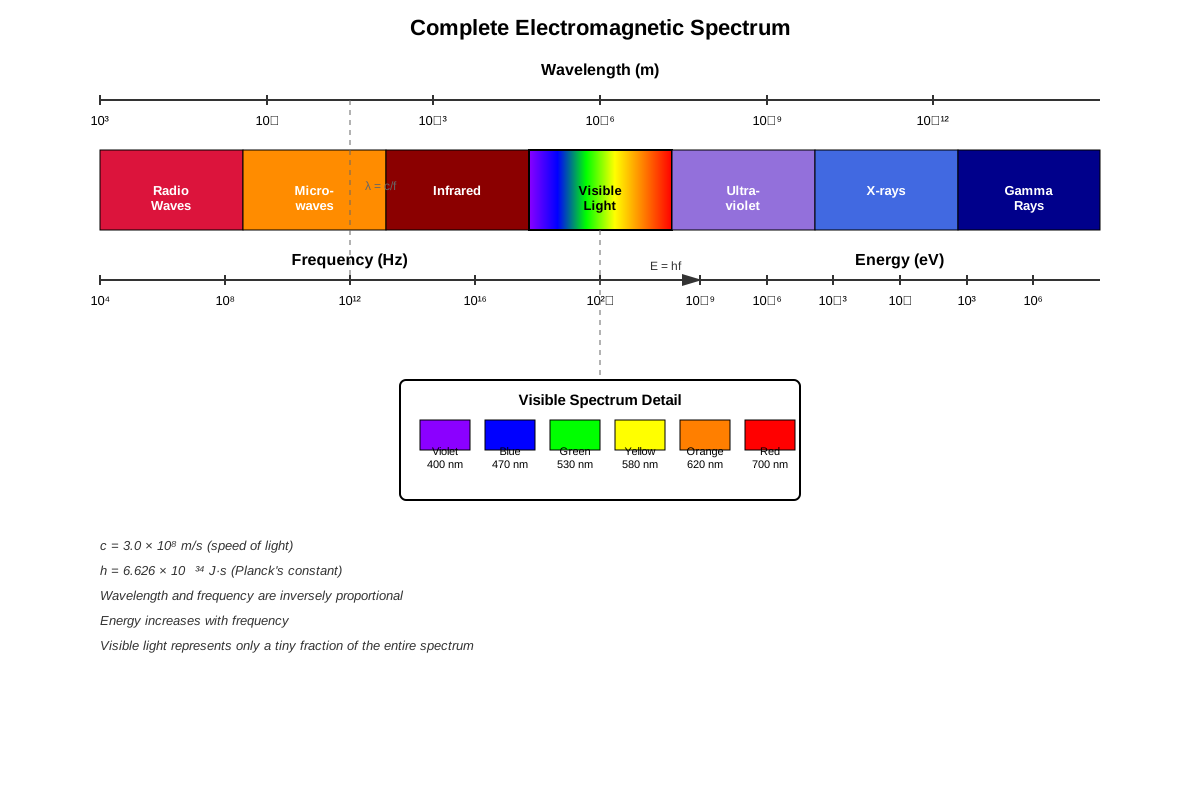
The electromagnetic spectrum divides into seven major regions, listed here from longest wavelength (lowest energy) to shortest wavelength (highest energy):
| Region | Wavelength Range | Frequency Range | Energy Range | Key Applications |
|---|---|---|---|---|
| Radio waves | > 1 mm to km | < 3 × 10¹¹ Hz | < 10⁻³ eV | MRI, NMR spectroscopy, communications |
| Microwaves | 1 mm to 1 m | 3 × 10⁸ to 3 × 10¹¹ Hz | 10⁻³ to 1 eV | Rotational spectroscopy, heating water molecules |
| Infrared (IR) | 700 nm to 1 mm | 3 × 10¹¹ to 4.3 × 10¹⁴ Hz | 1 to 10³ eV | IR spectroscopy, thermal imaging, molecular vibrations |
| Visible light | 400 to 700 nm | 4.3 × 10¹⁴ to 7.5 × 10¹⁴ Hz | 1.8 to 3.1 eV | Vision, photosynthesis, UV-Vis spectroscopy |
| Ultraviolet (UV) | 10 to 400 nm | 7.5 × 10¹⁴ to 3 × 10¹⁶ Hz | 3 to 10² eV | Sterilization, vitamin D synthesis, DNA damage |
| X-rays | 0.01 to 10 nm | 3 × 10¹⁶ to 3 × 10¹⁹ Hz | 10² to 10⁵ eV | Medical imaging, crystallography, ionizing radiation |
| Gamma rays | < 0.01 nm | > 3 × 10¹⁹ Hz | > 10⁵ eV | Cancer treatment, nuclear medicine, sterilization |
Visible Light Spectrum
The visible light region deserves special attention for the MCAT, as it represents the narrow band of electromagnetic radiation detectable by human eyes. The visible spectrum spans approximately 400 nm (violet) to 700 nm (red), with the mnemonic ROY G. BIV helping students remember the color order from longest to shortest wavelength:
- Red: ~700 nm (lowest energy visible light)
- Orange: ~620 nm
- Yellow: ~580 nm
- Green: ~550 nm
- Blue: ~470 nm
- Indigo: ~450 nm
- Violet: ~400 nm (highest energy visible light)
White light contains all visible wavelengths combined. When white light passes through a prism, dispersion separates the wavelengths due to their different refractive indices, creating a rainbow spectrum. This principle underlies spectroscopic techniques that analyze which wavelengths molecules absorb or emit.
Energy and Biological Interactions
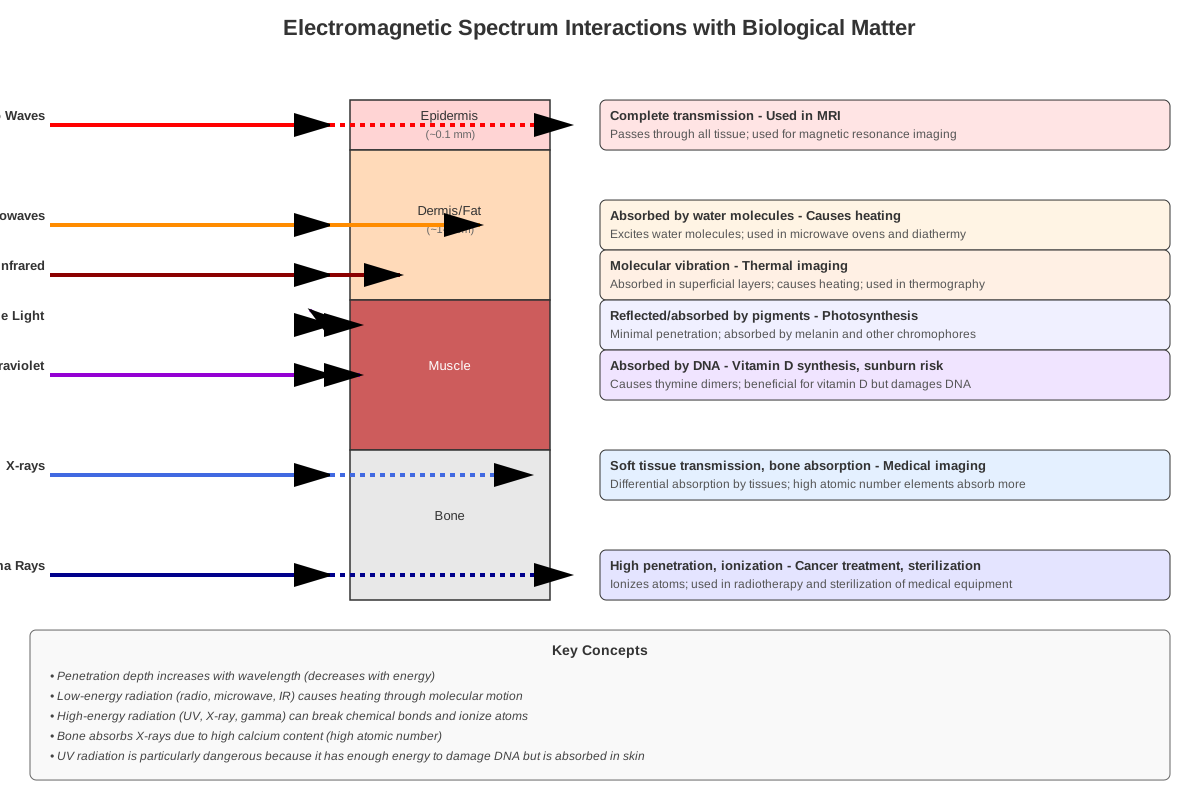
The energy of electromagnetic radiation determines how it interacts with matter, particularly biological tissues. This relationship has critical implications for both medical applications and health hazards:
Low-energy radiation (radio waves, microwaves, infrared) primarily causes molecular rotation and vibration, generating heat. These non-ionizing radiations lack sufficient energy to remove electrons from atoms or break chemical bonds. Microwaves specifically excite water molecules, explaining their use in heating food and in magnetic resonance imaging.
Moderate-energy radiation (visible and UV light) can excite electrons to higher energy levels without ionizing atoms. Visible light drives photosynthesis by exciting electrons in chlorophyll molecules. UV radiation has enough energy to cause some chemical reactions, including the formation of thymine dimers in DNA (leading to mutations) and the conversion of 7-dehydrocholesterol to vitamin D₃ in skin.
High-energy radiation (X-rays and gamma rays) constitutes ionizing radiation capable of removing electrons from atoms and breaking chemical bonds. This property makes high-energy radiation both useful (killing cancer cells, sterilizing equipment) and dangerous (causing mutations, radiation sickness, cancer). The penetrating power increases with energy: X-rays penetrate soft tissue but are absorbed by bone (basis of radiography), while gamma rays penetrate most materials and require lead shielding.
Spectroscopy Applications
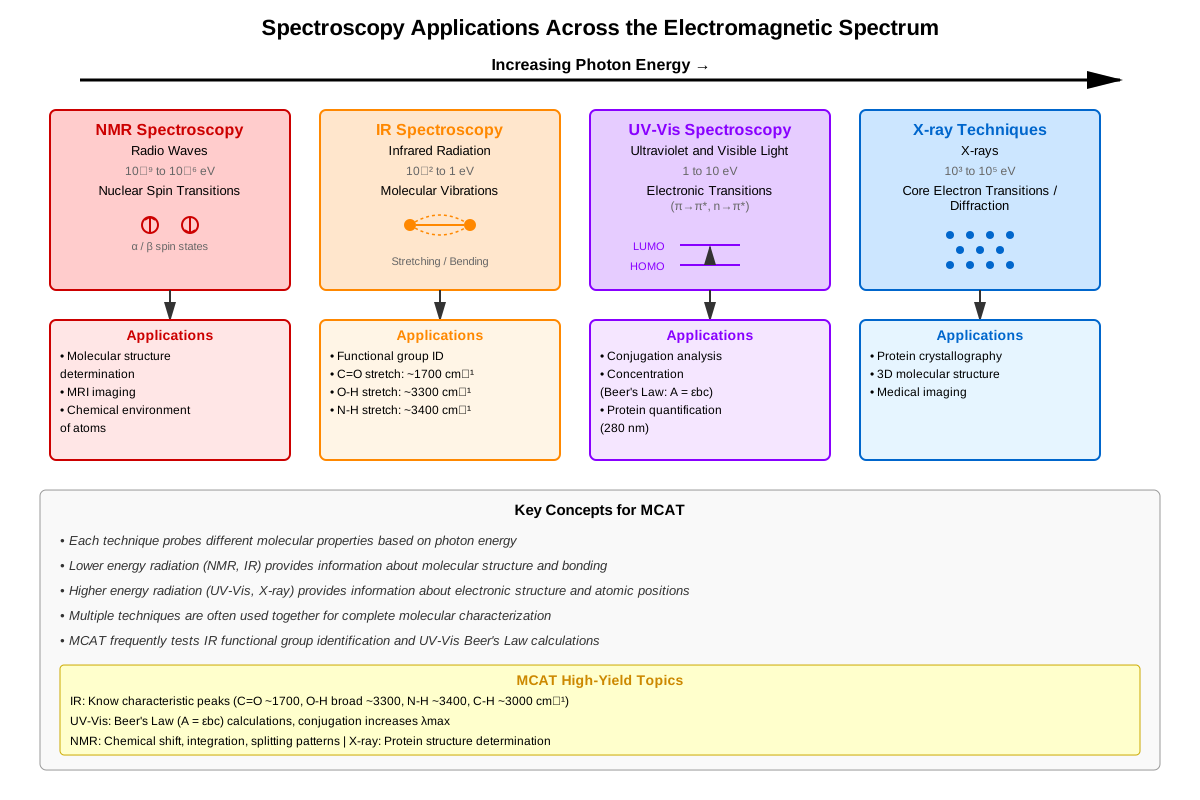
Spectroscopy exploits the electromagnetic spectrum to analyze molecular structure and composition. Different spectroscopic techniques use different regions of the spectrum:
UV-Visible Spectroscopy (200-800 nm) measures electronic transitions in molecules. Conjugated systems and aromatic compounds absorb UV-Vis radiation, with the wavelength of maximum absorption (λmax) providing information about molecular structure. The Beer-Lambert Law (A = εbc) relates absorbance to concentration, making UV-Vis spectroscopy essential for quantifying proteins, nucleic acids, and other biomolecules.
Infrared Spectroscopy (2.5-25 μm or 4000-400 cm⁻¹) detects molecular vibrations. Different functional groups absorb characteristic IR frequencies: O-H stretches appear around 3300 cm⁻¹, C=O stretches around 1700 cm⁻¹, and C-H stretches around 3000 cm⁻¹. IR spectroscopy identifies functional groups and confirms molecular structures.
Nuclear Magnetic Resonance (NMR) Spectroscopy uses radio waves to excite nuclear spins in a magnetic field. ¹H-NMR and ¹³C-NMR provide detailed information about molecular structure, including the number and environment of hydrogen and carbon atoms.
Photon Energy Calculations
Every electromagnetic wave can be viewed as a stream of particles called photons, each carrying a discrete quantum of energy. The photon model becomes essential when electromagnetic radiation interacts with matter through absorption or emission. For MCAT calculations, students must be comfortable converting between wavelength, frequency, and energy:
Example calculation framework:
- Given wavelength → find frequency: ν = c/λ
- Given frequency → find energy: E = hf
- Given wavelength → find energy directly: E = hc/λ
The value hc appears frequently in calculations and equals approximately 1240 eV·nm, providing a convenient shortcut for photon energy calculations when wavelength is given in nanometers.
Concept Relationships
The electromagnetic spectrum serves as a central organizing principle connecting multiple physics concepts. Wave properties (wavelength, frequency, amplitude) provide the foundation for characterizing electromagnetic radiation, while the wave equation (c = λν) mathematically relates these properties. This relationship leads directly to photon energy through Planck's equation (E = hf), bridging wave and particle descriptions of light.
The spectrum connects to atomic structure through emission and absorption spectra. When electrons transition between energy levels, atoms emit or absorb photons with energies exactly matching the energy difference between levels. This principle explains why hydrogen's emission spectrum contains discrete lines rather than a continuous spectrum, and it underlies spectroscopic techniques used to identify elements and molecules.
Quantum mechanics provides the theoretical framework explaining why electromagnetic radiation exhibits both wave and particle properties. The photoelectric effect demonstrates light's particle nature, as photons with sufficient energy (above the work function threshold) can eject electrons from metal surfaces. This phenomenon requires UV or higher-energy radiation for most metals, illustrating the practical importance of photon energy.
The electromagnetic spectrum also connects to thermodynamics through blackbody radiation. All objects emit electromagnetic radiation with a spectrum determined by their temperature, following Wien's displacement law and the Stefan-Boltzmann law. This relationship explains infrared thermography and the sun's emission spectrum.
In biological contexts, the spectrum relates to molecular structure through spectroscopy, cellular processes through photosynthesis and vision, and medical applications through imaging and therapy. Understanding these connections enables students to tackle interdisciplinary MCAT passages effectively.
Relationship map: Wave properties → Electromagnetic spectrum organization → Photon energy → Atomic transitions → Spectroscopy → Molecular structure determination → Biological applications
Quick check — test yourself on Electromagnetic spectrum so far.
Try Flashcards →High-Yield Facts
⭐ The electromagnetic spectrum in order from longest to shortest wavelength: Radio, Microwave, Infrared, Visible, Ultraviolet, X-ray, Gamma ray
⭐ The fundamental equations: c = λν and E = hf = hc/λ, where c = 3.0 × 10⁸ m/s and h = 6.626 × 10⁻³⁴ J·s
⭐ Wavelength and energy are inversely related: shorter wavelength means higher energy and higher frequency
⭐ Visible light range: approximately 400 nm (violet) to 700 nm (red)
⭐ Only X-rays and gamma rays are ionizing radiation capable of removing electrons from atoms and breaking chemical bonds
- The speed of all electromagnetic radiation in vacuum is constant at c, regardless of wavelength or frequency
- UV radiation causes DNA damage (thymine dimers) and is responsible for sunburn and skin cancer risk
- Infrared radiation is absorbed by molecular vibrations and is the basis of IR spectroscopy for identifying functional groups
- Radio waves are used in MRI and NMR spectroscopy because they can flip nuclear spins in magnetic fields
- The convenient conversion factor hc ≈ 1240 eV·nm simplifies photon energy calculations when wavelength is in nanometers
- Microwaves are absorbed by water molecules, causing rotational excitation and heating
- X-rays are absorbed by dense materials like bone but pass through soft tissue, making them ideal for radiography
- The photoelectric effect requires photons with energy above the work function, typically UV or higher energy radiation
- Conjugated systems and aromatic compounds absorb UV-Visible light due to π-electron transitions
- Gamma rays have the highest penetrating power and require lead or thick concrete shielding
Common Misconceptions
Misconception: All electromagnetic radiation travels at different speeds depending on its energy.
Correction: All electromagnetic radiation travels at the same speed (c = 3.0 × 10⁸ m/s) in a vacuum, regardless of wavelength, frequency, or energy. The speed only changes when electromagnetic waves enter a medium with a different refractive index.
Misconception: Higher frequency means longer wavelength.
Correction: Frequency and wavelength are inversely related through c = λν. Higher frequency always corresponds to shorter wavelength, and vice versa. This inverse relationship is fundamental to understanding the electromagnetic spectrum.
Misconception: Visible light is the most energetic form of electromagnetic radiation.
Correction: Visible light occupies the middle range of the electromagnetic spectrum. UV radiation, X-rays, and gamma rays all have higher energies than visible light. Gamma rays are the most energetic form of electromagnetic radiation.
Misconception: Infrared radiation is the same as heat.
Correction: While infrared radiation is often associated with thermal energy and can cause heating when absorbed, heat is the transfer of thermal energy and can occur through conduction, convection, or radiation. Infrared is one form of electromagnetic radiation that objects emit based on their temperature, but heat itself is not a type of radiation.
Misconception: Radio waves and microwaves are dangerous because they're used in technology.
Correction: Radio waves and microwaves are non-ionizing radiation with insufficient energy to break chemical bonds or damage DNA directly. They are among the safest forms of electromagnetic radiation. The concern with high-power microwave exposure is tissue heating, not ionization or chemical damage.
Misconception: UV light and X-rays are fundamentally different types of radiation.
Correction: UV light and X-rays are both electromagnetic radiation differing only in wavelength, frequency, and energy. They exist on a continuum in the electromagnetic spectrum. The distinction between them is based on energy ranges, with X-rays having higher energy than UV radiation.
Misconception: The color of visible light is determined by its intensity.
Correction: Color is determined by wavelength (or frequency), not intensity. Intensity affects brightness but not color. Red light remains red whether dim or bright; changing the wavelength to 450 nm would make it blue regardless of intensity.
Worked Examples
Example 1: Calculating Photon Energy from Wavelength
Question: A UV lamp emits radiation at a wavelength of 254 nm, commonly used for sterilization. Calculate the energy of a single photon in both joules and electron volts. Is this radiation capable of breaking a C-C bond (bond energy ≈ 3.5 eV)?
Solution:
Step 1: Identify the given information and required equations.
- Given: λ = 254 nm = 254 × 10⁻⁹ m
- Required: E in joules and eV
- Equations: E = hc/λ
Step 2: Calculate energy in joules.
E = hc/λ = (6.626 × 10⁻³⁴ J·s)(3.0 × 10⁸ m/s) / (254 × 10⁻⁹ m)
E = (1.988 × 10⁻²⁵ J·m) / (254 × 10⁻⁹ m)
E = 7.83 × 10⁻¹⁹ J
Step 3: Convert to electron volts.
E = 7.83 × 10⁻¹⁹ J × (1 eV / 1.6 × 10⁻¹⁹ J)
E ≈ 4.89 eV
Alternative method using the shortcut:
E (eV) = 1240 eV·nm / λ (nm) = 1240 / 254 ≈ 4.88 eVStep 4: Compare to bond energy.
The photon energy (4.89 eV) exceeds the C-C bond energy (3.5 eV), so this UV radiation can break carbon-carbon bonds. This explains why UV radiation can damage biological molecules and why it's effective for sterilization—it can break chemical bonds in DNA and proteins of microorganisms.
Key takeaway: This problem demonstrates why UV radiation is classified as potentially harmful. The energy is sufficient to cause chemical damage, unlike visible light (1.8-3.1 eV) which cannot break most chemical bonds.
Example 2: Comparing Regions of the Electromagnetic Spectrum
Question: A research laboratory uses three different spectroscopic techniques: (A) NMR spectroscopy with radio waves at 400 MHz, (B) IR spectroscopy at 3000 cm⁻¹, and (C) UV-Vis spectroscopy at 280 nm. Rank these from lowest to highest photon energy and calculate the energy of each photon in eV.
Solution:
Step 1: Convert all values to common units and calculate energies.
For NMR (radio waves):
- Given: f = 400 MHz = 4.0 × 10⁸ Hz
- E = hf = (6.626 × 10⁻³⁴ J·s)(4.0 × 10⁸ Hz) = 2.65 × 10⁻²⁵ J
- E = 2.65 × 10⁻²⁵ J / (1.6 × 10⁻¹⁹ J/eV) = 1.66 × 10⁻⁶ eV
For IR spectroscopy:
- Given: wavenumber = 3000 cm⁻¹
- Convert to wavelength: λ = 1/(3000 cm⁻¹) = 3.33 × 10⁻⁴ cm = 3.33 × 10⁻⁶ m
- E = hc/λ = (6.626 × 10⁻³⁴)(3.0 × 10⁸)/(3.33 × 10⁻⁶) = 5.97 × 10⁻²⁰ J
- E = 5.97 × 10⁻²⁰ J / (1.6 × 10⁻¹⁹ J/eV) = 0.373 eV
For UV-Vis spectroscopy:
- Given: λ = 280 nm
- Using shortcut: E = 1240 eV·nm / 280 nm = 4.43 eV
Step 2: Rank from lowest to highest energy.
NMR (1.66 × 10⁻⁶ eV) < IR (0.373 eV) < UV-Vis (4.43 eV)
Step 3: Interpret the biological significance.
- NMR uses extremely low-energy radiation that only affects nuclear spins—completely non-invasive and safe
- IR radiation causes molecular vibrations but cannot break bonds—safe for biological samples
- UV radiation has sufficient energy to excite electrons and potentially break bonds—can damage biological molecules
This ranking explains why different spectroscopic techniques provide different types of information: NMR reveals nuclear environments, IR identifies functional groups through vibrations, and UV-Vis detects electronic transitions in conjugated systems.
Exam Strategy
When approaching electromagnetic spectrum questions on the MCAT, first identify whether the question requires calculation or conceptual understanding. Calculation questions typically provide one variable (wavelength, frequency, or energy) and ask for another, requiring the equations c = λν or E = hf. Conceptual questions test understanding of spectrum organization, biological interactions, or spectroscopic applications.
Trigger words to watch for:
- "Wavelength" or "frequency" → expect to use c = λν
- "Photon energy" or "energy per photon" → use E = hf or E = hc/λ
- "Ionizing radiation" → only X-rays and gamma rays qualify
- "Spectroscopy" → identify which region of spectrum and what information it provides
- "Penetrating power" → increases with energy (gamma > X-ray > UV > visible > IR > microwave > radio)
- "Most/least energetic" → remember inverse relationship between wavelength and energy
Process-of-elimination strategies:
- Eliminate answers that violate the inverse relationship between wavelength and energy
- For spectrum ordering questions, eliminate any answer that doesn't follow the correct sequence
- For biological interaction questions, eliminate answers suggesting low-energy radiation (radio, microwave) can break chemical bonds
- For spectroscopy questions, eliminate answers that mismatch the technique with the wrong type of information (e.g., NMR revealing electronic transitions)
Time allocation advice: Simple calculation questions should take 30-45 seconds once you've identified the correct equation. Spend 10 seconds identifying what's given and what's asked, 20 seconds on calculation, and 10 seconds checking units and reasonableness. For passage-based questions, spend 15-20 seconds locating relevant information in the passage before attempting calculations. If a calculation seems complex, check whether the question can be answered conceptually or through estimation.
Exam Tip: When wavelength is given in nanometers and energy is requested in electron volts, use the shortcut E(eV) = 1240/λ(nm) to save time. This eliminates the need for multiple unit conversions and reduces calculation errors.
Memory Techniques
Mnemonic for electromagnetic spectrum order (longest to shortest wavelength):
"Raging Martians Invaded Venus Using X-ray Guns"
- Radio
- Microwave
- Infrared
- Visible
- Ultraviolet
- X-ray
- Gamma
Mnemonic for visible light spectrum (longest to shortest wavelength):
"ROY G. BIV"
- Red (~700 nm)
- Orange
- Yellow
- Green
- Blue
- Indigo
- Violet (~400 nm)
Visualization strategy for inverse relationships: Picture a seesaw with wavelength on one side and energy/frequency on the other. When wavelength goes up (longer waves), energy and frequency go down. When wavelength goes down (shorter waves), energy and frequency go up. This mental image reinforces the inverse relationship.
Acronym for ionizing radiation: "X-tremely Gamma" reminds you that only X-rays and Gamma rays are ionizing radiation capable of removing electrons and breaking bonds.
Memory aid for spectroscopy applications:
- NMR → Nuclei (nuclear environments)
- IR → Identify functional groups (vibrations)
- UV-Vis → Understand conjugation (electronic transitions)
Number memory technique: Remember "400-700" for visible light range by thinking "400 is violet (violent/high energy) and 700 is red (relaxed/low energy)." The numbers also conveniently span from 4 to 7, making them easier to recall.
Summary
The electromagnetic spectrum represents the complete range of electromagnetic radiation organized by wavelength, frequency, and energy, from low-energy radio waves to high-energy gamma rays. All electromagnetic radiation travels at the speed of light (c = 3.0 × 10⁸ m/s) and exhibits wave-particle duality. The fundamental relationships c = λν and E = hf connect wavelength, frequency, and energy, with wavelength and energy being inversely related. The spectrum divides into seven major regions: radio waves, microwaves, infrared, visible light (400-700 nm), ultraviolet, X-rays, and gamma rays. Only X-rays and gamma rays constitute ionizing radiation capable of breaking chemical bonds. Different regions interact with matter in characteristic ways: radio waves affect nuclear spins (NMR), infrared causes molecular vibrations (IR spectroscopy), visible light drives electronic transitions (UV-Vis spectroscopy), and high-energy radiation causes ionization. Understanding these properties and relationships enables students to solve calculation problems, interpret spectroscopic data, and analyze biological interactions with electromagnetic radiation—all essential skills for MCAT success.
Key Takeaways
- The electromagnetic spectrum orders radiation by wavelength, frequency, and energy, with all forms traveling at c = 3.0 × 10⁸ m/s in vacuum
- Wavelength and energy are inversely related: shorter wavelength means higher frequency and higher energy (E = hc/λ)
- The seven regions in order from longest to shortest wavelength are: radio, microwave, infrared, visible (400-700 nm), ultraviolet, X-ray, and gamma
- Only X-rays and gamma rays are ionizing radiation capable of breaking chemical bonds and removing electrons from atoms
- Different spectroscopic techniques use different regions: NMR (radio), IR (infrared), and UV-Vis (ultraviolet-visible) each provide unique molecular information
- The equations c = λν and E = hf are essential for all electromagnetic spectrum calculations on the MCAT
- Biological interactions with electromagnetic radiation depend on photon energy: low-energy radiation causes heating, moderate-energy excites electrons, and high-energy ionizes atoms
Related Topics
Atomic Structure and Emission Spectra: Understanding how electrons transition between energy levels explains why atoms emit and absorb specific wavelengths, directly connecting to the electromagnetic spectrum and spectroscopy applications.
Photoelectric Effect: This quantum phenomenon demonstrates light's particle nature and requires understanding photon energy calculations from the electromagnetic spectrum, particularly for UV and higher-energy radiation.
Optics and Refraction: The behavior of visible light when passing through lenses and prisms depends on wavelength-dependent refractive indices, building on electromagnetic spectrum knowledge.
Molecular Structure and Spectroscopy: IR and UV-Vis spectroscopy use different regions of the electromagnetic spectrum to determine functional groups and conjugation in organic molecules, essential for MCAT organic chemistry.
Nuclear Chemistry and Radiation: Gamma rays from nuclear decay represent the highest-energy region of the electromagnetic spectrum, connecting to radioactive decay and medical applications.
Practice CTA
Now that you've mastered the electromagnetic spectrum, test your understanding with practice questions and flashcards. Focus on problems requiring wavelength-frequency-energy conversions, spectroscopy applications, and biological interactions with different types of radiation. Challenge yourself with passage-based questions that integrate electromagnetic spectrum concepts with organic chemistry, biochemistry, and biology. Remember: consistent practice with these concepts will build the speed and confidence you need to excel on test day. The electromagnetic spectrum appears throughout the MCAT—make it one of your strengths!
Sign up free to keep reading
Create a free AnvayaPrep account to finish this MCAT guide on Electromagnetic spectrum — plus flashcards and practice questions.