Overview
Refraction is a fundamental phenomenon in Light and Optics that describes the bending of light as it passes from one medium to another with a different optical density. This bending occurs because light travels at different speeds in different materials, causing a change in direction at the interface between media. Understanding refraction is essential for comprehending how lenses work, how images form in optical systems, and how light behaves in biological tissues—all critical concepts for the MCAT Physics section.
For the MCAT, refraction represents a medium-difficulty topic that frequently appears in both discrete questions and passage-based problems. The exam tests not only the mathematical relationships governing refraction but also conceptual understanding of how light behaves at boundaries, why objects appear displaced when viewed through different media, and how optical instruments function. Mastery of Refraction Physics enables students to tackle questions involving the human eye, microscopes, corrective lenses, and fiber optics—topics that bridge physics with biological and clinical applications.
Refraction MCAT questions often integrate multiple physics principles, requiring students to connect concepts such as wave behavior, electromagnetic radiation, and geometric optics. This topic serves as a foundation for understanding more complex optical phenomena including total internal reflection, dispersion, and lens systems. A solid grasp of refraction principles allows students to approach interdisciplinary passages that combine physics with biochemistry (spectroscopy), biology (vision), or even psychology (perception).
Learning Objectives
- [ ] Define Refraction using accurate Physics terminology
- [ ] Explain why Refraction matters for the MCAT
- [ ] Apply Refraction to exam-style questions
- [ ] Identify common mistakes related to Refraction
- [ ] Connect Refraction to related Physics concepts
- [ ] Calculate angles of refraction using Snell's Law with precision
- [ ] Predict the direction of light bending based on relative indices of refraction
- [ ] Analyze real-world optical systems using refraction principles
Prerequisites
- Wave properties of light: Understanding that light is an electromagnetic wave with frequency, wavelength, and speed is essential for comprehending why refraction occurs
- Basic trigonometry: Sine, cosine, and tangent functions are necessary for applying Snell's Law and calculating angles
- Speed-distance-time relationships: The concept that v = d/t underlies why light changes speed in different media
- Ray diagrams: Ability to draw and interpret light rays helps visualize refraction at interfaces
- Index of refraction concept: Familiarity with the idea that different materials have different optical properties
Why This Topic Matters
Clinical and Real-World Significance
Refraction is the fundamental principle behind corrective eyewear, contact lenses, and refractive surgery procedures like LASIK. The human eye itself is a sophisticated refractive system where the cornea and lens bend light to focus images on the retina. Ophthalmologists and optometrists rely on refraction principles daily to diagnose and correct vision problems such as myopia, hyperopia, and astigmatism. Medical imaging techniques including endoscopy and microscopy depend on precisely controlled refraction through fiber optic cables and lens systems.
MCAT Exam Statistics
Refraction appears in approximately 3-5% of MCAT Physics questions, making it a medium-yield topic that students cannot afford to ignore. Questions typically appear as:
- Discrete questions testing direct application of Snell's Law
- Passage-based problems involving optical instruments or biological vision systems
- Interdisciplinary questions connecting physics concepts to biological structures (eye anatomy)
- Conceptual questions about apparent depth, critical angles, and light behavior at interfaces
Common Exam Presentations
MCAT passages frequently present refraction in contexts such as:
- Vision correction and lens prescriptions
- Underwater optics and apparent depth
- Fiber optic technology in medical devices
- Spectroscopy and light separation
- Atmospheric phenomena (mirages, rainbows)
- Microscope and telescope design
Core Concepts
Definition and Fundamental Mechanism
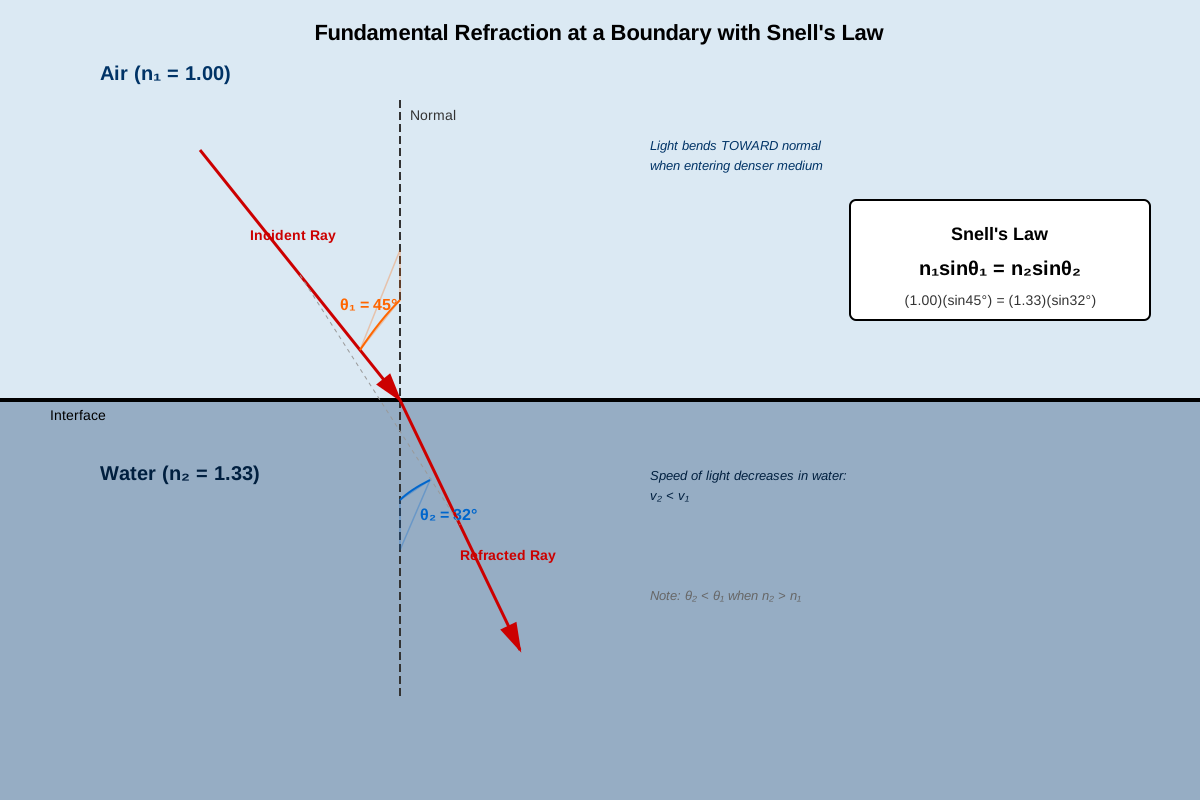
Refraction is the change in direction of a light wave as it passes from one transparent medium to another due to a change in its speed. When light travels from one material to another with different optical properties, it bends at the interface between the two media. This bending occurs because light propagates at different velocities in different materials.
The index of refraction (n) quantifies how much a material slows down light compared to its speed in a vacuum:
n = c/vWhere:
- n = index of refraction (dimensionless)
- c = speed of light in vacuum (3.0 × 10⁸ m/s)
- v = speed of light in the medium (m/s)
Since light always travels slower in matter than in vacuum, the index of refraction is always greater than or equal to 1. Common values include n = 1.00 for air (approximately), n = 1.33 for water, n = 1.50 for glass, and n = 1.38 for the human cornea.
Snell's Law
Snell's Law (also called the law of refraction) mathematically describes the relationship between the angles of incidence and refraction:
n₁ sin(θ₁) = n₂ sin(θ₂)Where:
- n₁ = index of refraction of the first medium
- θ₁ = angle of incidence (measured from the normal)
- n₂ = index of refraction of the second medium
- θ₂ = angle of refraction (measured from the normal)
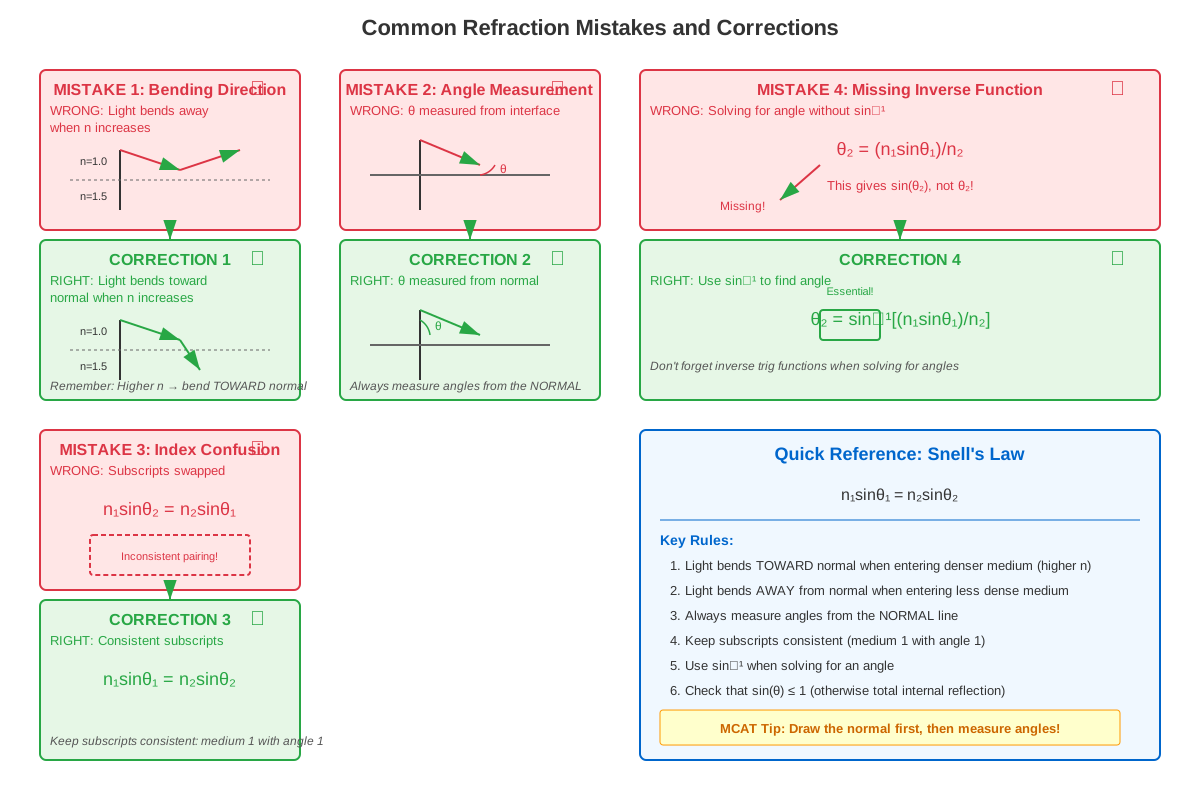
Critical concept: All angles in refraction problems are measured from the normal (perpendicular) to the surface, not from the surface itself. This is a frequent source of errors on the MCAT.
Direction of Bending
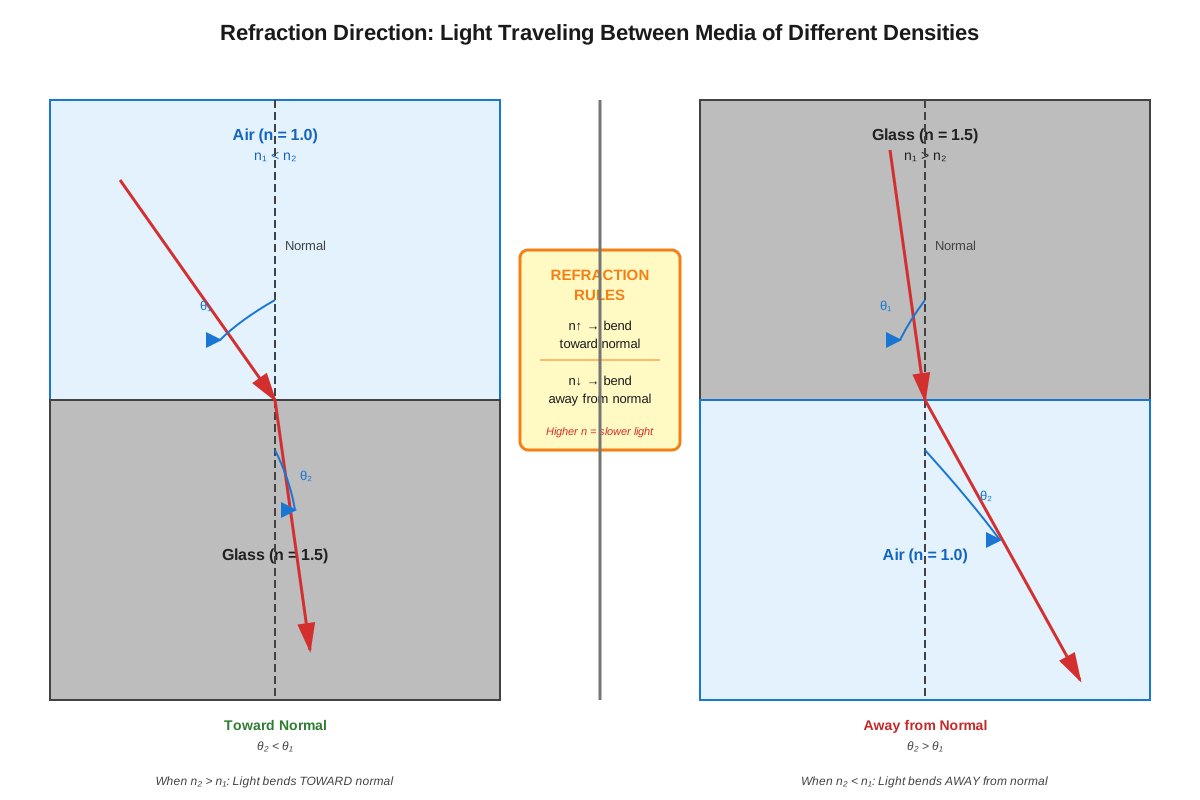
The direction light bends during refraction follows predictable rules:
- Light entering a denser medium (higher n): The light ray bends toward the normal, and the refracted angle is smaller than the incident angle (θ₂ < θ₁)
- Light entering a less dense medium (lower n): The light ray bends away from the normal, and the refracted angle is larger than the incident angle (θ₂ > θ₁)
- Light perpendicular to the interface (θ₁ = 0°): No bending occurs; light passes straight through regardless of the change in medium
| Transition | Relative Density | Bending Direction | Speed Change | Angle Relationship |
|---|---|---|---|---|
| Air → Water | Less → More dense | Toward normal | Decreases | θ₂ < θ₁ |
| Water → Air | More → Less dense | Away from normal | Increases | θ₂ > θ₁ |
| Glass → Water | More → Less dense | Away from normal | Increases | θ₂ > θ₁ |
| Air → Glass | Less → More dense | Toward normal | Decreases | θ₂ < θ₁ |
Wavelength and Frequency Changes
During refraction, important wave properties change while others remain constant:
- Frequency remains constant: The frequency of light does not change when crossing media boundaries
- Wavelength changes: Since v = fλ and velocity changes, wavelength must change proportionally
- Speed changes: Light slows down in denser media and speeds up in less dense media
λ₁/λ₂ = v₁/v₂ = n₂/n₁This relationship explains why the color of light (determined by frequency) doesn't change when light enters water, but the wavelength becomes shorter in the denser medium.
Apparent Depth and Displacement
Refraction causes objects viewed through different media to appear displaced from their actual positions. When looking at an object underwater from above the surface, the object appears closer to the surface than it actually is. This phenomenon is called apparent depth.
The relationship between real depth (d_real) and apparent depth (d_apparent) is:
d_apparent = d_real × (n₁/n₂)Where n₁ is the index of the viewing medium (typically air) and n₂ is the index of the medium containing the object (typically water).
For an object in water viewed from air:
d_apparent = d_real × (1.00/1.33) ≈ 0.75 × d_realThis means objects underwater appear about 75% of their actual depth—a critical concept for MCAT questions involving vision and perception.
Critical Angle and Total Internal Reflection
When light travels from a denser medium to a less dense medium, there exists a special critical angle (θc) beyond which refraction cannot occur. At this angle, the refracted ray would travel along the interface (θ₂ = 90°). Beyond the critical angle, total internal reflection occurs—all light reflects back into the denser medium with no refraction.
The critical angle is calculated by setting θ₂ = 90° in Snell's Law:
sin(θc) = n₂/n₁Where n₁ > n₂ (light traveling from denser to less dense medium).
For a water-air interface:
sin(θc) = 1.00/1.33 = 0.752
θc ≈ 48.8°
This principle enables fiber optic cables to transmit light over long distances and explains why diamonds sparkle brilliantly—their high index of refraction (n ≈ 2.42) creates a very small critical angle, trapping light inside through multiple internal reflections.
Dispersion
Dispersion is the phenomenon where different wavelengths (colors) of light refract by different amounts when passing through a medium. This occurs because the index of refraction varies slightly with wavelength—shorter wavelengths (blue/violet) typically experience higher indices and bend more than longer wavelengths (red).
Dispersion explains:
- Rainbow formation when sunlight refracts through water droplets
- Chromatic aberration in simple lenses
- Prism separation of white light into its component colors
While dispersion is related to refraction, MCAT questions typically focus on the basic refraction principles rather than detailed dispersion calculations.
Concept Relationships
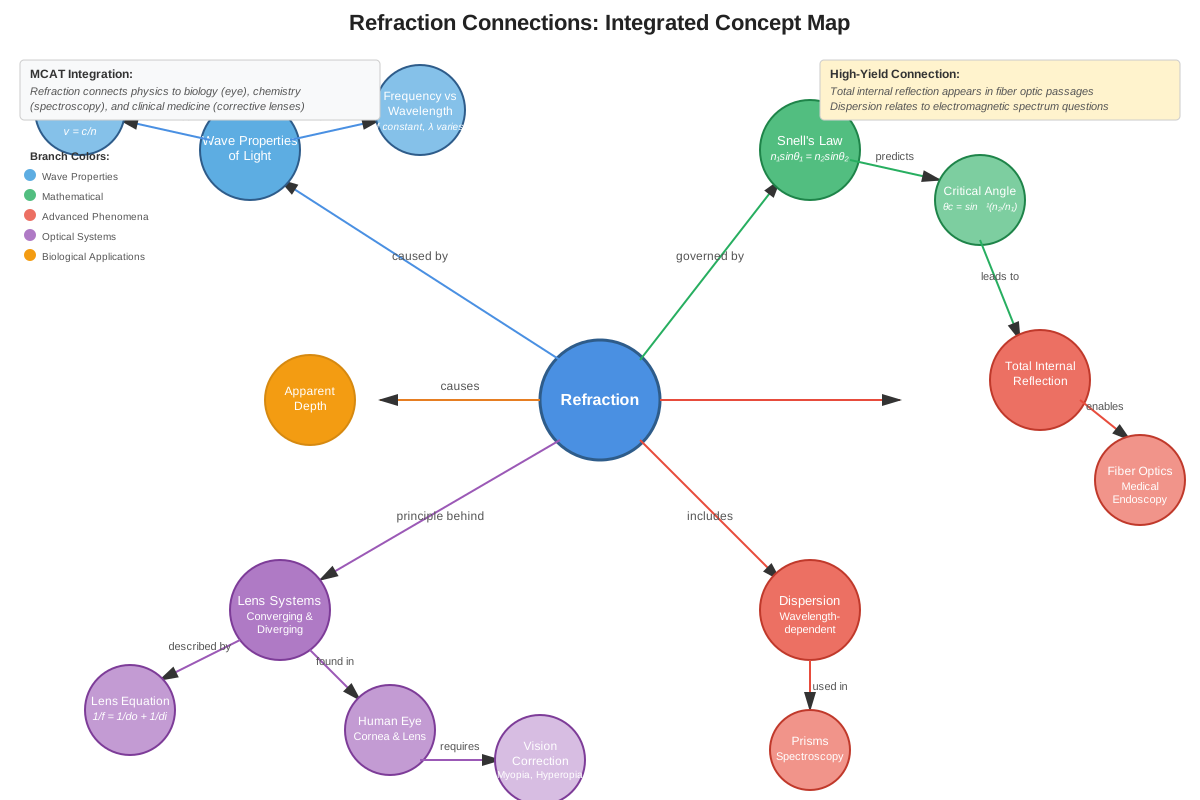
Refraction connects to multiple physics concepts in an integrated network. Snell's Law serves as the central mathematical relationship, derived from the fundamental principle that light speed changes in different media. This speed change is quantified by the index of refraction, which directly determines the direction of bending at interfaces.
The relationship flows as follows:
Index of refraction → determines light speed in medium → causes direction change at boundary → described mathematically by Snell's Law → leads to apparent depth effects → and at extreme angles produces critical angle phenomena → resulting in total internal reflection
Refraction connects to prerequisite topics:
- Wave properties: Refraction demonstrates wave behavior of light, with frequency remaining constant while wavelength and speed change
- Electromagnetic spectrum: Different wavelengths refract differently (dispersion), connecting to spectroscopy
- Trigonometry: Snell's Law requires sine function calculations and angle measurements
Refraction enables understanding of advanced topics:
- Lens systems: Converging and diverging lenses function through controlled refraction at curved surfaces
- Optical instruments: Microscopes, telescopes, and cameras all rely on refraction principles
- Human vision: The eye's refractive system (cornea and lens) focuses light on the retina
- Fiber optics: Medical endoscopes use total internal reflection, a refraction-related phenomenon
High-Yield Facts
⭐ Snell's Law: n₁ sin(θ₁) = n₂ sin(θ₂) is the fundamental equation for all refraction calculations on the MCAT
⭐ Light bends toward the normal when entering a denser medium (higher n) and away from the normal when entering a less dense medium (lower n)
⭐ Index of refraction n = c/v, where c is always 3.0 × 10⁸ m/s and n is always ≥ 1
⭐ Frequency never changes during refraction, but wavelength and speed both change proportionally
⭐ Apparent depth = real depth × (n_viewing/n_object), making underwater objects appear about 75% of their actual depth when viewed from air
- The critical angle only exists when light travels from higher n to lower n medium: sin(θc) = n₂/n₁
- All angles in refraction are measured from the normal (perpendicular to the surface), not from the surface itself
- When light hits an interface at normal incidence (perpendicular, θ = 0°), no bending occurs regardless of the media
- Common indices: air ≈ 1.00, water = 1.33, glass ≈ 1.50, diamond ≈ 2.42, human cornea ≈ 1.38
- Total internal reflection occurs when the angle of incidence exceeds the critical angle (only possible when n₁ > n₂)
- Light always travels slower in denser media, never faster than c
- The wavelength decreases when light enters a denser medium: λ_dense = λ_air/n
- Dispersion causes different colors to refract by different amounts, with blue light bending more than red light
- Refraction is responsible for mirages, where hot air near the ground has a lower index than cooler air above
- Fiber optic cables use total internal reflection to transmit light signals with minimal loss over long distances
Quick check — test yourself on Refraction so far.
Try Flashcards →Common Misconceptions
Misconception: Angles in refraction problems are measured from the surface of the interface.
Correction: All angles (incident, reflected, and refracted) are measured from the normal (the line perpendicular to the surface). This is crucial for correctly applying Snell's Law. If a problem states light hits a surface at 30° from the surface, the angle from the normal is actually 60°.
Misconception: Light always bends toward the normal during refraction.
Correction: Light bends toward the normal only when entering a denser medium (higher n). When light enters a less dense medium (lower n), it bends away from the normal. The direction depends on the relative indices of the two media.
Misconception: The speed of light is constant in all materials.
Correction: Light travels at c = 3.0 × 10⁸ m/s only in a vacuum. In all other materials, light travels slower. The index of refraction quantifies this slowdown: v = c/n. In water (n = 1.33), light travels at approximately 2.25 × 10⁸ m/s.
Misconception: Both wavelength and frequency change during refraction.
Correction: Only the wavelength and speed change during refraction; frequency remains constant. This is because frequency is determined by the source and doesn't change as the wave propagates through different media. Since v = fλ, if v decreases and f stays constant, λ must decrease proportionally.
Misconception: Total internal reflection can occur when light travels from any medium to any other medium.
Correction: Total internal reflection only occurs when light travels from a higher index medium to a lower index medium (n₁ > n₂) and only when the angle of incidence exceeds the critical angle. It cannot occur when light travels from a less dense to a more dense medium.
Misconception: The index of refraction can be less than 1.
Correction: The index of refraction is always ≥ 1 because light cannot travel faster in matter than in a vacuum. The definition n = c/v ensures this, since v ≤ c always. Air has n ≈ 1.00 (very close to vacuum), which is the lowest possible value for normal materials.
Misconception: Apparent depth makes objects look farther away than they actually are.
Correction: Apparent depth makes objects appear closer to the surface than their actual position. An object 4 meters deep in water appears only about 3 meters deep when viewed from above the surface. This occurs because refracted light rays appear to originate from a shallower position.
Worked Examples
Example 1: Calculating Angle of Refraction
Problem: A beam of light traveling through air strikes the surface of water at an angle of 40° from the normal. Calculate the angle of refraction in the water. (n_air = 1.00, n_water = 1.33)
Solution:
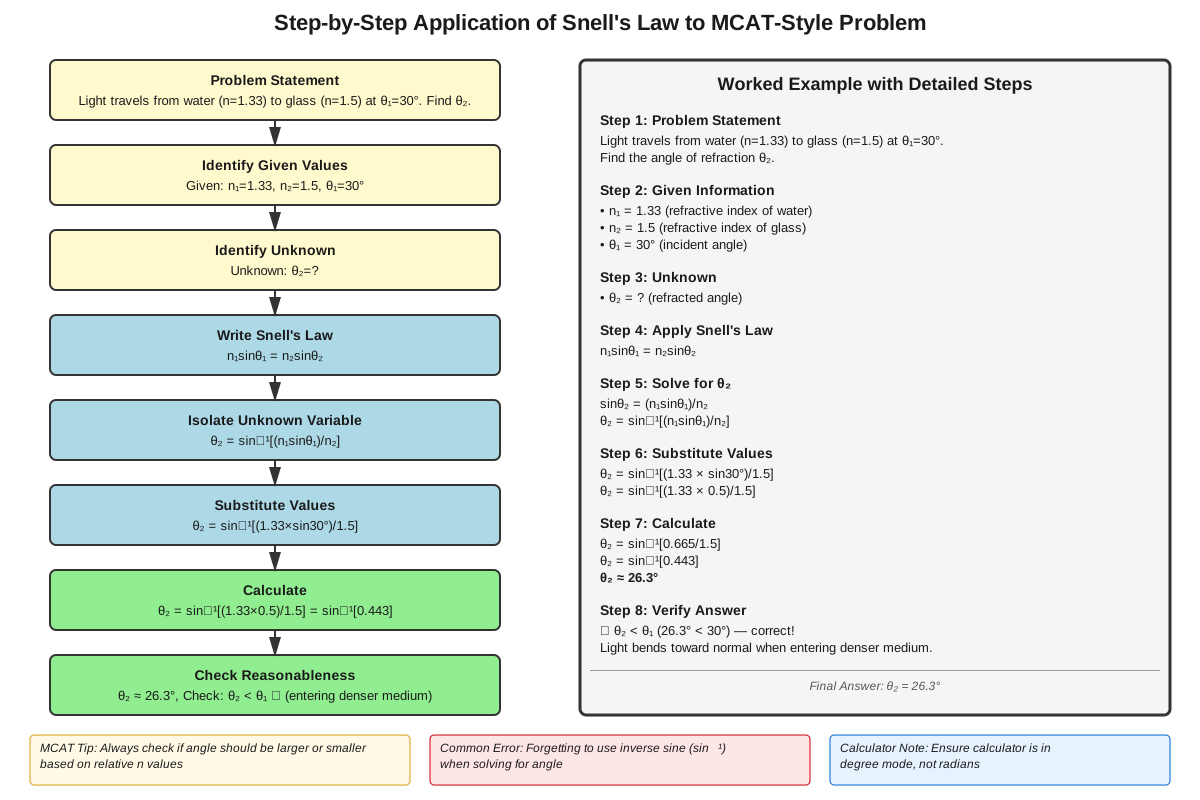
Step 1: Identify the known values and what we're solving for.
- n₁ (air) = 1.00
- θ₁ (incident angle) = 40°
- n₂ (water) = 1.33
- θ₂ (refracted angle) = ?
Step 2: Apply Snell's Law.
n₁ sin(θ₁) = n₂ sin(θ₂)Step 3: Substitute known values.
(1.00) sin(40°) = (1.33) sin(θ₂)Step 4: Calculate sin(40°).
sin(40°) ≈ 0.643Step 5: Solve for sin(θ₂).
0.643 = 1.33 sin(θ₂)
sin(θ₂) = 0.643/1.33 = 0.483
Step 6: Find θ₂ using inverse sine.
θ₂ = sin⁻¹(0.483) ≈ 28.9° ≈ 29°Answer: The angle of refraction in water is approximately 29°.
Key Concepts Applied:
- Light bends toward the normal when entering a denser medium (40° → 29°)
- The refracted angle is smaller than the incident angle when n₂ > n₁
- This demonstrates Learning Objective: "Calculate angles of refraction using Snell's Law with precision"
Example 2: Apparent Depth Problem
Problem: A diver looks up at a fish swimming 3.0 meters directly above her in the water. From the perspective of someone standing on a boat looking down, how deep does the fish appear to be below the surface? (n_water = 1.33, n_air = 1.00)
Solution:
Step 1: Identify what we're calculating.
- Real depth of fish below surface = 3.0 m
- We need apparent depth as seen from air looking into water
Step 2: Recognize this is an apparent depth problem.
The formula for apparent depth is:
d_apparent = d_real × (n_viewing/n_object)Step 3: Identify the indices.
- n_viewing (air, where observer is) = 1.00
- n_object (water, where fish is) = 1.33
- d_real = 3.0 m
Step 4: Substitute and calculate.
d_apparent = 3.0 m × (1.00/1.33)
d_apparent = 3.0 m × 0.752
d_apparent ≈ 2.26 m ≈ 2.3 mAnswer: The fish appears to be approximately 2.3 meters below the surface when viewed from the boat.
Key Concepts Applied:
- Objects underwater appear closer to the surface than they actually are
- The apparent depth is about 75% of the real depth for water-air interfaces
- This demonstrates Learning Objective: "Apply Refraction to exam-style questions"
MCAT Connection: This type of problem could appear in a passage about underwater vision, diving physiology, or optical perception. The exam might ask follow-up questions about how this affects the diver's perception or how corrective lenses might compensate for this effect.
Exam Strategy
Approaching MCAT Refraction Questions
Step 1: Identify the type of refraction problem
- Is it asking for angle calculations? → Use Snell's Law
- Is it about apparent position? → Use apparent depth formula
- Is it about critical angle? → Check if n₁ > n₂ and use sin(θc) = n₂/n₁
- Is it conceptual about bending direction? → Compare indices
Step 2: Draw a diagram
Even for conceptual questions, quickly sketch the interface, normal line, and light ray. This prevents angle measurement errors and helps visualize the physical situation.
Step 3: Check angle measurements
Verify that all angles are measured from the normal, not the surface. If a problem gives an angle "from the surface," convert it by subtracting from 90°.
Trigger Words and Phrases
Watch for these key phrases that signal refraction concepts:
- "Light passes from... to..." → Snell's Law calculation
- "Appears to be" or "seems to be" → Apparent depth/position
- "Looking into water" or "viewing through" → Interface problem
- "Bends toward/away" → Conceptual understanding of density relationship
- "Critical angle" or "total internal reflection" → n₁ > n₂ situation
- "Index of refraction" or "optical density" → Direct n value usage
Process of Elimination Tips
For calculation questions:
- Eliminate answers where the refracted angle is larger than incident angle when light enters a denser medium (should bend toward normal)
- Eliminate answers where the refracted angle is smaller than incident angle when light enters a less dense medium (should bend away from normal)
- Check if answer choices are in degrees or radians—MCAT typically uses degrees
For conceptual questions:
- Eliminate options suggesting frequency changes during refraction (it doesn't)
- Eliminate options suggesting light speeds up in denser media (it slows down)
- Eliminate options about total internal reflection when light goes from low n to high n (impossible)
Time Allocation
- Discrete refraction questions: Allocate 60-90 seconds
- Passage-based refraction questions: Allocate 90-120 seconds per question
- If a calculation requires multiple steps, don't spend more than 2 minutes—estimate and move on
- Conceptual questions should take less time than calculation questions
Exam Tip: If you're stuck on a Snell's Law calculation, remember that light bends toward the normal in denser media. You can often eliminate 2-3 answer choices based on this principle alone, then estimate or guess from remaining options.
Memory Techniques
Mnemonic for Bending Direction
"Dense Draws In, Thin Throws Out"
- Dense medium Draws light ray In toward the normal
- Thin (less dense) medium Throws light ray Out away from the normal
Snell's Law Memory Aid
"Nice Students Never Struggle"
- N₁ Sin(θ₁) = N₂ Sin(θ₂)
Index Values Visualization
Create a mental "density ladder" from least to most optically dense:
Vacuum/Air (1.00)
    ↓
Water (1.33)
    ↓
Glass (1.50)
    ↓
Diamond (2.42)
Light bends toward normal going DOWN the ladder, away from normal going UP.
Critical Angle Memory
"Critical = Can't Refract Into Thinner"
- Critical angle only exists when going from thicker (higher n) to thinner (lower n)
- Beyond critical angle, you Can't get Refraction anymore—only reflection
Apparent Depth Shortcut
"Three-Quarter Rule"
For water (n = 1.33), objects appear at approximately 3/4 their actual depth when viewed from air.
- 4 meters actual → 3 meters apparent
- 8 meters actual → 6 meters apparent
This quick estimation can save calculation time on the MCAT.
Frequency vs. Wavelength
"Frequency is Faithful"
- Frequency stays faithful to the source—never changes
- Wavelength is flexible—changes with the medium
Summary
Refraction is the bending of light as it passes between media with different optical densities, governed by Snell's Law: n₁ sin(θ₁) = n₂ sin(θ₂). The index of refraction (n = c/v) quantifies how much a material slows light compared to vacuum, with all real materials having n ≥ 1. Light bends toward the normal when entering denser media and away from the normal when entering less dense media. During refraction, frequency remains constant while wavelength and speed change proportionally. Critical applications include apparent depth calculations, where objects underwater appear closer to the surface than their actual position, and critical angle phenomena leading to total internal reflection. For the MCAT, students must master both quantitative applications of Snell's Law and conceptual understanding of how light behaves at interfaces, as these concepts connect to biological vision systems, optical instruments, and medical imaging technologies.
Key Takeaways
- Snell's Law (n₁ sin θ₁ = n₂ sin θ₂) is the fundamental equation for all refraction calculations; memorize it and practice applying it under time pressure
- Light bends toward the normal when entering a denser medium (higher n) and away from the normal when entering a less dense medium (lower n)
- The index of refraction n = c/v is always ≥ 1, with common values being air (1.00), water (1.33), and glass (1.50)
- Frequency never changes during refraction, but both wavelength and speed change proportionally to maintain v = fλ
- Apparent depth makes underwater objects appear about 75% of their actual depth when viewed from air, calculated as d_apparent = d_real × (n_air/n_water)
- Total internal reflection occurs only when light travels from higher n to lower n and the incident angle exceeds the critical angle (sin θc = n₂/n₁)
- Always measure angles from the normal (perpendicular to the surface), not from the surface itself—this is a critical detail for correct calculations
Related Topics
Lenses and Lens Systems: Refraction at curved surfaces creates converging and diverging lenses. Understanding how light bends at interfaces enables analysis of focal points, image formation, and magnification—essential for questions about corrective eyewear and optical instruments.
Total Internal Reflection: This phenomenon occurs at the critical angle when light cannot refract out of a denser medium. Mastering refraction provides the foundation for understanding fiber optics, prisms, and why diamonds sparkle.
The Human Eye: The eye's optical system relies entirely on refraction through the cornea and lens to focus light on the retina. Refraction principles explain myopia, hyperopia, and how corrective lenses work—a high-yield MCAT topic bridging physics and biology.
Dispersion and Spectroscopy: Different wavelengths refract by different amounts, enabling separation of light into component colors. This connects refraction to analytical chemistry techniques and electromagnetic spectrum concepts.
Wave Optics: Refraction demonstrates wave behavior of light. Advanced topics like interference and diffraction build on understanding how light waves propagate through different media.
Practice CTA
Now that you've mastered the core concepts of refraction, it's time to solidify your understanding through active practice. Work through the practice questions and flashcards to test your ability to apply Snell's Law, predict bending directions, and solve apparent depth problems under timed conditions. Remember, the MCAT rewards not just knowledge but the ability to quickly recognize question types and apply the right approach. Each practice problem you complete builds the pattern recognition and problem-solving speed essential for test day success. You've built a strong foundation—now strengthen it through deliberate practice!
Sign up free to keep reading
Create a free AnvayaPrep account to finish this MCAT guide on Refraction — plus flashcards and practice questions.