Overview
Human eye optics is a critical intersection of physics principles and biological systems that appears consistently on the MCAT. This topic examines how the eye functions as a sophisticated optical instrument, utilizing refraction, accommodation, and image formation to convert light into neural signals. Understanding the physics of the human eye requires mastery of lens equations, power calculations, and the behavior of converging optical systems—all fundamental concepts in Light and Optics. The eye serves as the quintessential real-world application of geometric optics, making it a favorite subject for MCAT test writers who seek to assess both physics knowledge and biological reasoning.
The Physics of human vision extends beyond simple lens mechanics. Students must understand how the cornea and crystalline lens work together as a compound optical system, how accommodation allows for variable focal lengths, and how common vision defects arise from optical imperfections. These concepts bridge multiple MCAT disciplines: the physics of refraction and image formation, the biology of ocular anatomy, and the clinical relevance of corrective interventions. Questions often present clinical scenarios involving myopia, hyperopia, presbyopia, or astigmatism, requiring students to apply lens equations and optical principles to diagnose and correct vision problems.
Mastery of Human eye optics MCAT content provides a foundation for understanding other sensory systems, medical imaging technologies, and optical instruments like microscopes and telescopes. The eye demonstrates how biological evolution has optimized physical principles, creating a system that automatically adjusts its optical power through muscular control of lens shape. This topic typically appears in 2-4 questions per MCAT administration, often embedded within passages discussing visual perception, optical corrections, or comparative anatomy across species.
Learning Objectives
- [ ] Define Human eye optics using accurate Physics terminology
- [ ] Explain why Human eye optics matters for the MCAT
- [ ] Apply Human eye optics to exam-style questions
- [ ] Identify common mistakes related to Human eye optics
- [ ] Connect Human eye optics to related Physics concepts
- [ ] Calculate the optical power of the eye and corrective lenses using the lens equation
- [ ] Distinguish between near point, far point, and their changes in various vision defects
- [ ] Analyze ray diagrams for normal vision and common refractive errors
- [ ] Determine the appropriate corrective lens prescription for myopia, hyperopia, and presbyopia
Prerequisites
- Geometric optics and ray tracing: Essential for understanding how light paths bend through the eye's refractive elements and form images on the retina
- Thin lens equation (1/f = 1/do + 1/di): Required for calculating image positions and determining corrective lens powers
- Converging and diverging lenses: The eye primarily uses converging elements, while corrective lenses may be either type depending on the defect
- Refraction and Snell's Law: Explains how light bends at interfaces between media of different refractive indices (air-cornea, aqueous humor-lens)
- Power of lenses (P = 1/f, measured in diopters): The standard unit for expressing lens strength in optometry and ophthalmology
- Real vs. virtual images: Critical for understanding how the eye forms real images on the retina and how corrective lenses create virtual images
Why This Topic Matters
Clinical and Real-World Significance: Vision defects affect billions of people worldwide, making corrective optics one of the most common medical interventions. Understanding the physics behind glasses, contact lenses, and refractive surgery (LASIK) provides insight into how medical technology addresses biological imperfections. The eye's optical system also serves as a model for camera design, microscopy, and other imaging technologies. For future physicians, understanding ocular optics is essential for recognizing vision problems, interpreting ophthalmological findings, and explaining treatment options to patients.
MCAT Exam Statistics: Human eye optics appears in approximately 3-5% of physics questions on the MCAT, typically in the Chemical and Physical Foundations section but occasionally in Biological and Biochemical Foundations when integrated with sensory physiology. Questions may be standalone or embedded in passages discussing visual perception, optical instruments, or comparative biology. The topic frequently appears alongside questions about other optical systems, allowing test writers to assess whether students can transfer principles across contexts.
Common Exam Presentations: MCAT passages often present clinical vignettes describing patients with vision complaints, requiring students to diagnose the optical defect and calculate appropriate corrections. Experimental passages may describe studies comparing vision across species or testing new corrective technologies. Standalone questions frequently test the relationship between object distance, image distance, and focal length, or ask students to determine whether a corrective lens should be converging or diverging. The MCAT particularly favors questions that combine quantitative calculations with conceptual understanding, such as determining how accommodation changes with age or why certain corrections work for specific defects.
Core Concepts
Anatomy and Optical Components of the Eye
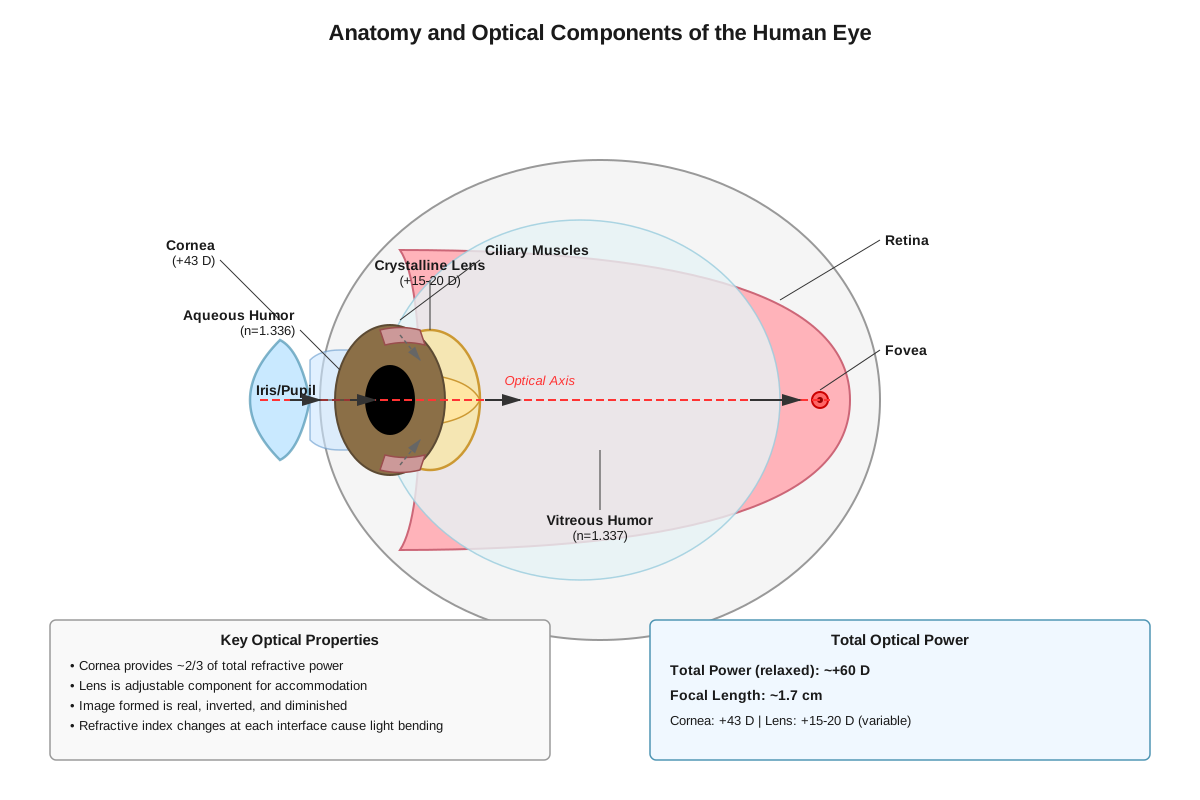
The human eye functions as a complex converging lens system composed of multiple refractive elements. The cornea provides approximately 70% of the eye's total refractive power (about +43 diopters), making it the primary focusing element. Light passes through the cornea into the aqueous humor, then through the crystalline lens (contributing about +20 diopters), and finally through the vitreous humor before reaching the retina. The retina contains photoreceptor cells that convert light into neural signals, functioning as the "screen" where real, inverted images form.
The total optical power of the relaxed eye is approximately +60 diopters, corresponding to a focal length of about 1.7 cm (since P = 1/f, where f is in meters). The distance from the lens system to the retina is approximately 2.5 cm in adults, though the effective optical system can be modeled as a single thin lens located about 1.7 cm from the retina. This simplified model, while not anatomically precise, allows for accurate calculations using the thin lens equation.
The iris controls the amount of light entering through the pupil, functioning like a camera's aperture. While the iris doesn't contribute to focusing, pupil size affects depth of field and image quality. Smaller pupils increase depth of field (range of distances in focus) but may cause diffraction effects, while larger pupils allow more light but increase spherical aberration.
Accommodation and the Near Point
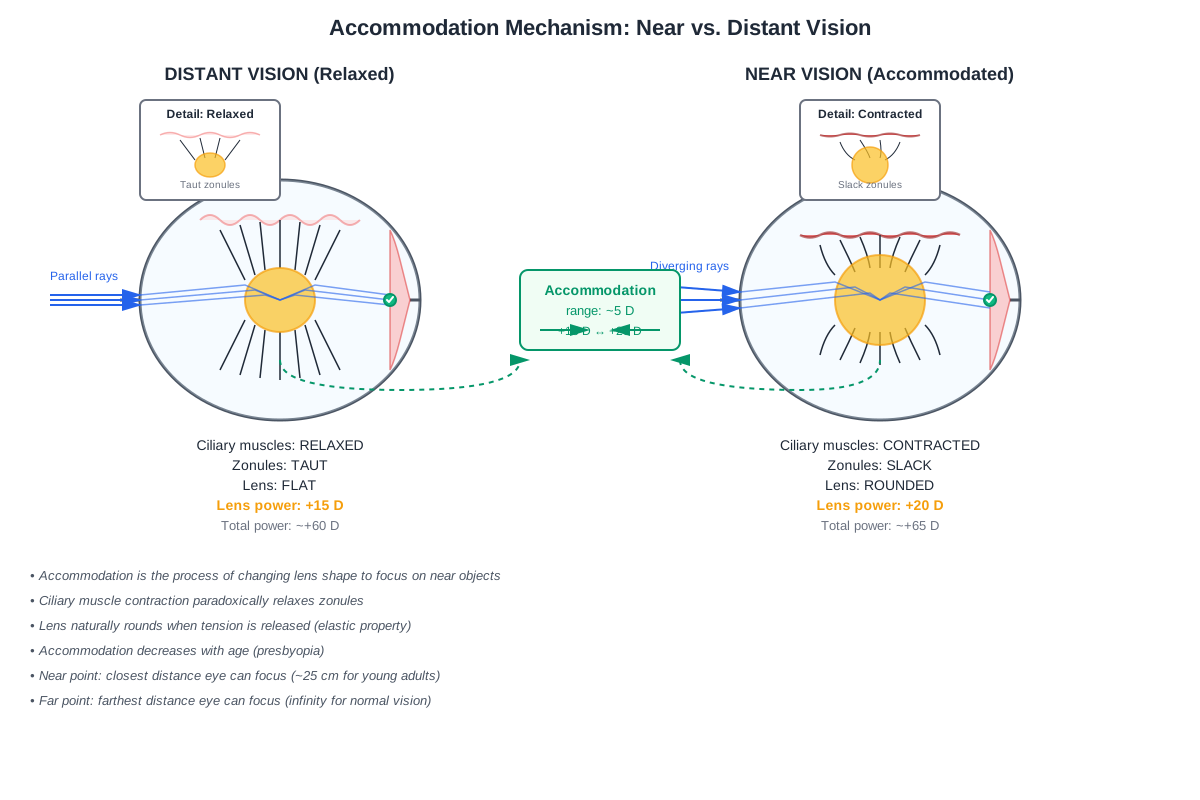
Accommodation is the eye's ability to change its optical power by altering the shape of the crystalline lens. The ciliary muscles control lens shape: when relaxed, the lens is relatively flat (minimum power) for viewing distant objects; when contracted, suspensory ligaments loosen, allowing the lens to become more spherical (maximum power) for viewing near objects. This dynamic adjustment can add approximately 10-15 diopters of power in young adults.
The near point is the closest distance at which the eye can focus clearly with maximum accommodation. For young adults, this is typically about 25 cm (the "standard near point" used in optics calculations). The far point is the farthest distance at which objects can be focused clearly; for normal vision, this is infinity (∞). As people age, the lens loses elasticity, reducing accommodation ability—a condition called presbyopia. By age 60, most people have lost nearly all accommodation, making reading glasses necessary.
Exam Tip: The MCAT often tests whether students understand that accommodation changes lens power, not the distance to the retina. The retina's position is fixed; only the lens's focal length changes.
Emmetropia (Normal Vision)
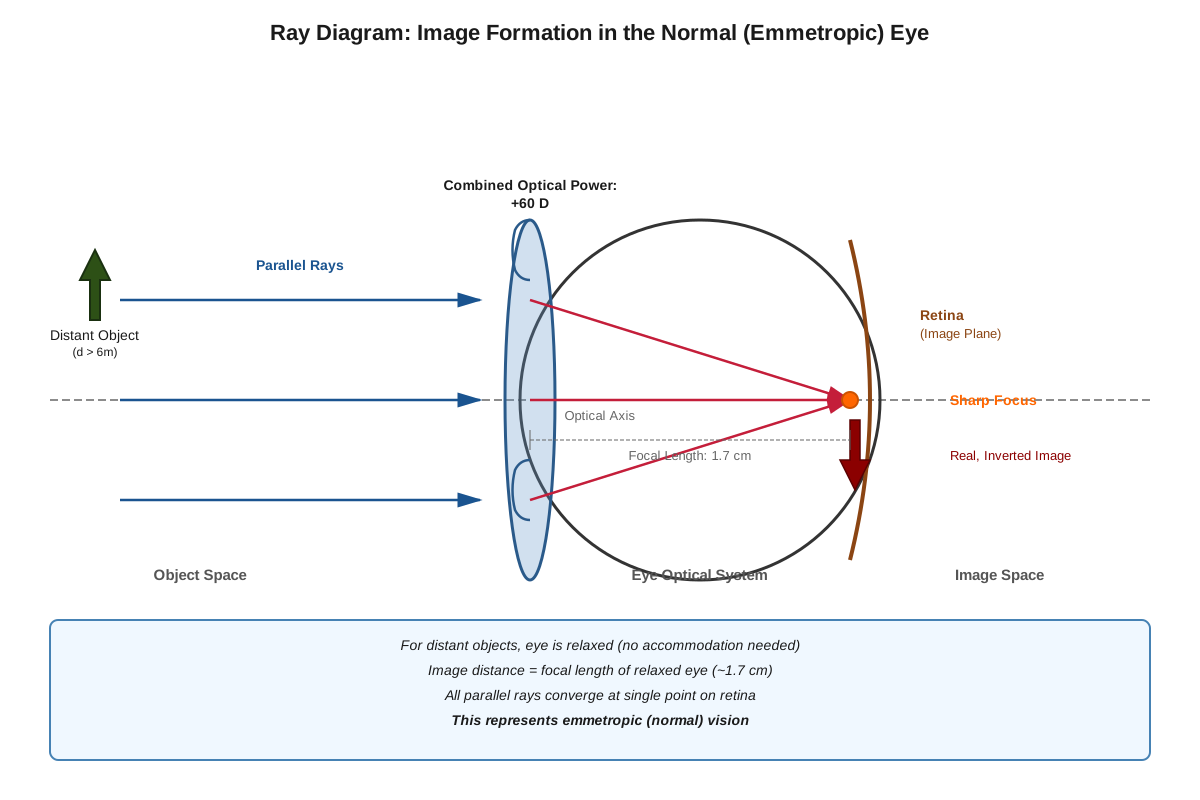
Emmetropia describes the condition of normal vision where parallel rays from distant objects focus precisely on the retina when the eye is relaxed. For an emmetropic eye:
- Distant objects (at optical infinity, practically > 6 meters) focus on the retina without accommodation
- The far point is at infinity
- Near objects can be focused through accommodation down to the near point (typically 25 cm)
- The eye's optical power matches the eye's axial length perfectly
In the relaxed emmetropic eye, the lens equation is satisfied: 1/f = 1/do + 1/di, where do approaches infinity (1/do ≈ 0), so di ≈ f ≈ 1.7 cm, matching the distance to the retina.
Myopia (Nearsightedness)
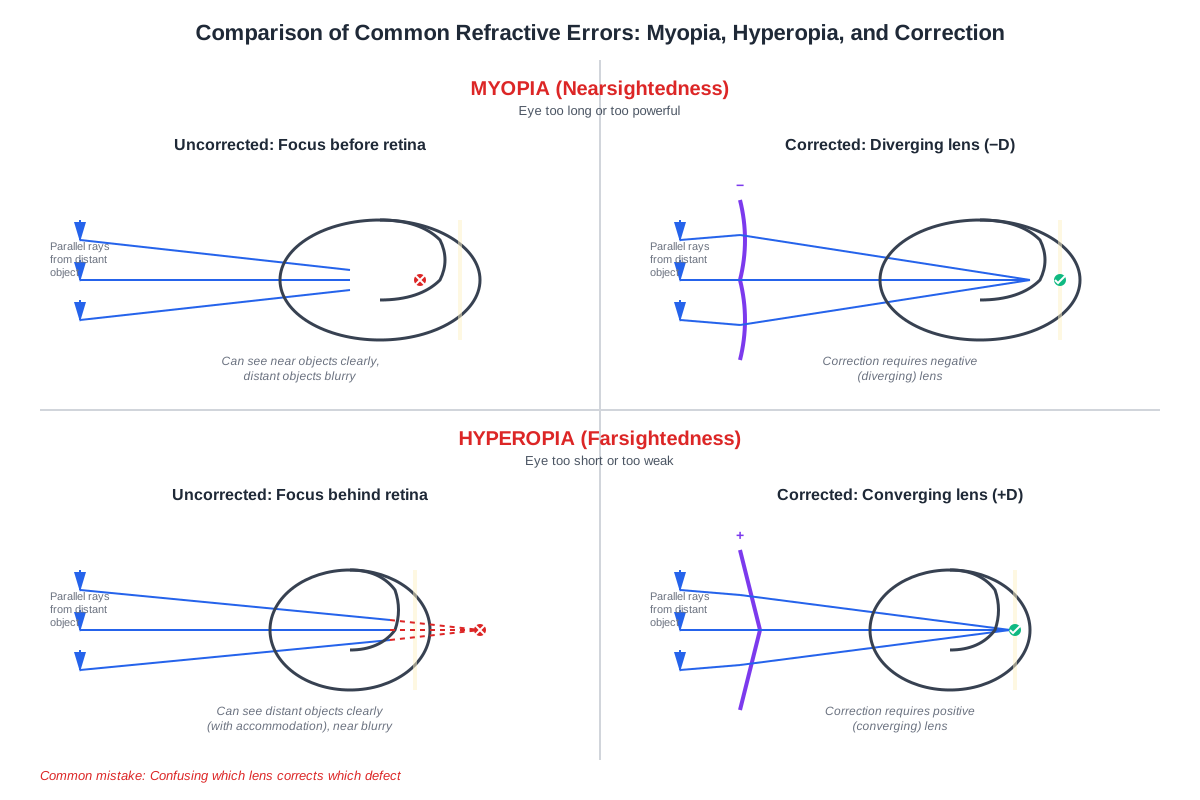
Myopia occurs when the eye's optical power is too strong or the eyeball is too long, causing parallel rays from distant objects to focus in front of the retina. Myopic individuals can see near objects clearly but distant objects appear blurred. The far point is at a finite distance rather than infinity.
Characteristics of myopia:
- Far point < infinity (e.g., 2 meters for moderate myopia)
- Near point may be closer than normal
- Excessive convergence of light rays
- Correction requires diverging (negative/concave) lenses
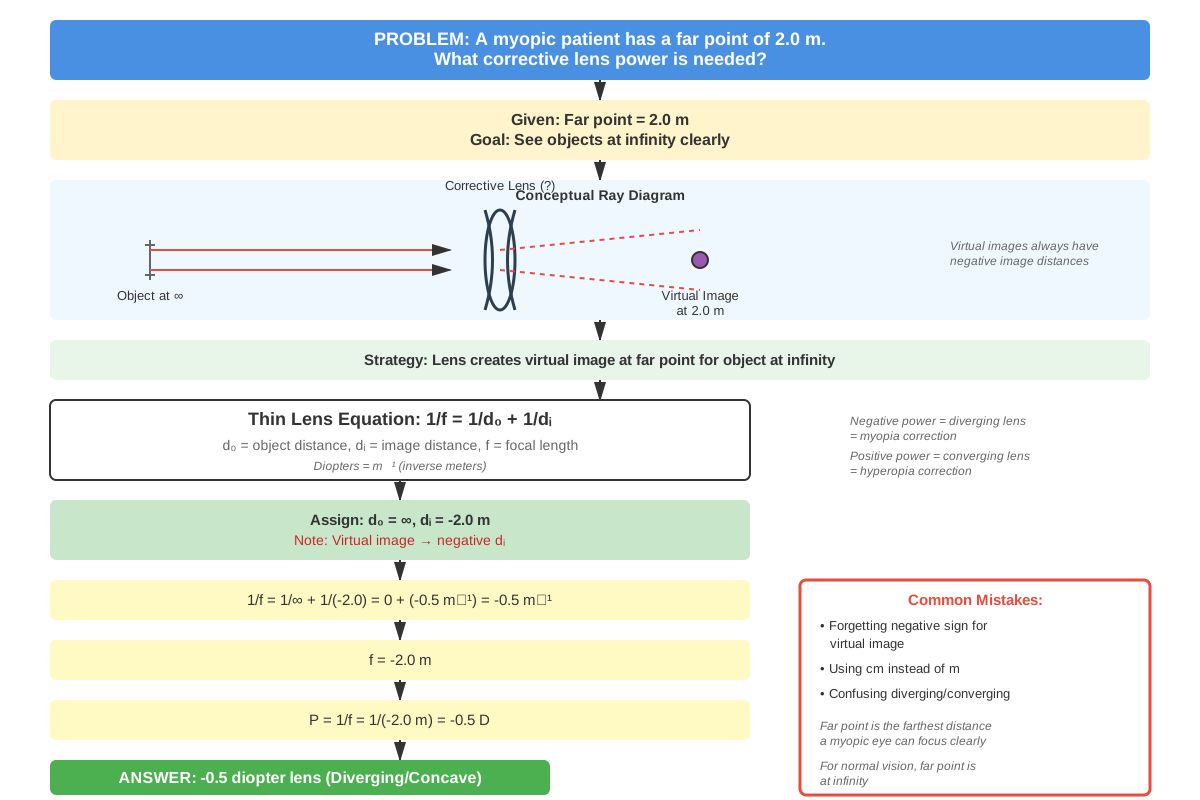
Correction principle: A diverging lens placed before the eye creates a virtual image of distant objects at the eye's far point. For example, if a person's far point is 2 meters, a -0.5 diopter lens (f = -2 m) will make distant objects appear to be at 2 meters, where the myopic eye can focus them onto the retina.
The power of the corrective lens needed equals the negative reciprocal of the far point distance: P = -1/far point (in meters).
Hyperopia (Farsightedness)
Hyperopia occurs when the eye's optical power is too weak or the eyeball is too short, causing parallel rays to converge behind the retina. Hyperopic individuals may see distant objects clearly (using accommodation) but struggle with near vision. Severe hyperopia affects both near and distant vision.
Characteristics of hyperopia:
- Near point > 25 cm (e.g., 100 cm for significant hyperopia)
- Accommodation must be used even for distant objects
- Insufficient convergence of light rays
- Correction requires converging (positive/convex) lenses
Correction principle: A converging lens adds optical power, allowing the combined system (corrective lens + eye) to focus light onto the retina. The corrective lens creates a virtual image farther from the eye than the actual object, placing it within the eye's focusing range.
For near vision correction, the lens must allow the person to see at 25 cm. If the near point is 100 cm, the lens must create a virtual image at 100 cm when the object is at 25 cm. Using the lens equation: 1/f = 1/do + 1/di = 1/0.25 + 1/(-1.0) = 4 - 1 = 3 diopters.
Presbyopia and Age-Related Changes
Presbyopia is the age-related loss of accommodation due to decreased lens elasticity and ciliary muscle effectiveness. Unlike myopia and hyperopia, which are refractive errors, presbyopia is a normal aging process affecting everyone typically after age 40.
Progression of presbyopia:
- Age 40-45: Near point recedes to ~40-50 cm, reading at 25 cm becomes difficult
- Age 50-55: Near point at ~100 cm, reading glasses essential
- Age 60+: Minimal to no accommodation remaining
Correction strategies:
- Reading glasses (converging lenses) for near work only
- Bifocals: upper portion for distance, lower portion for near vision
- Progressive lenses: gradual power change from top to bottom
- Monovision: one eye corrected for distance, one for near (in contact lenses)
People with myopia may find that presbyopia partially compensates their distance vision problem, as they can remove their glasses for reading. Conversely, those with hyperopia need stronger corrections as presbyopia develops.
Astigmatism
Astigmatism results from non-spherical curvature of the cornea or lens, causing different focal lengths in different meridians (planes). Light rays in one plane may focus in front of the retina while rays in a perpendicular plane focus behind it, creating blurred or distorted vision at all distances.
Correction: Cylindrical lenses that have different powers in different meridians, compensating for the eye's asymmetric curvature. Prescriptions specify sphere power, cylinder power, and axis orientation (e.g., -2.00 -0.75 × 180).
Optical Power and the Lens Equation
The power of a lens is measured in diopters (D), where:
P = 1/fwhere f is focal length in meters. Positive power indicates a converging lens; negative power indicates a diverging lens.
For the eye as an optical system, the thin lens equation applies:
1/f = 1/do + 1/diwhere:
- f = focal length of the lens system
- do = object distance (distance from object to lens)
- di = image distance (distance from lens to image/retina)
Sign conventions:
- Real objects: do is positive
- Real images: di is positive (images formed on the retina are real)
- Virtual images: di is negative
- Converging lenses: f is positive
- Diverging lenses: f is negative
For corrective lenses, the goal is to create a virtual image at a distance where the defective eye can focus it onto the retina.
Magnification and Image Characteristics
The magnification of the eye's optical system is:
m = -di/do = hi/howhere hi is image height and ho is object height. The negative sign indicates that images on the retina are inverted (the brain processes this inversion).
For distant objects (do → ∞), the image size on the retina depends on the angular size of the object and the eye's focal length. This is why larger eyes (longer focal length) can produce larger retinal images, though this effect is minimal in humans.
Comparison of Vision Defects
| Condition | Cause | Far Point | Near Point | Image Focus | Correction | Lens Type | Lens Power |
|---|---|---|---|---|---|---|---|
| Emmetropia | Normal | ∞ | ~25 cm | On retina | None | N/A | N/A |
| Myopia | Eye too long/powerful | Finite distance | Normal or closer | In front of retina | Diverging | Concave | Negative |
| Hyperopia | Eye too short/weak | ∞ (with effort) | > 25 cm | Behind retina | Converging | Convex | Positive |
| Presbyopia | Loss of accommodation | Usually ∞ | > 25 cm | Behind retina (near) | Converging (reading) | Convex | Positive |
| Astigmatism | Asymmetric curvature | Variable | Variable | Multiple points | Cylindrical | Toric | Variable by axis |
Concept Relationships
The physics of human eye optics builds directly on fundamental principles of geometric optics. Refraction at curved surfaces (governed by Snell's Law) → enables the cornea and lens to converge light → which must satisfy the thin lens equation to form real images on the retina. The eye's optical power (measured in diopters) determines where parallel rays converge, and this must match the fixed distance to the retina for clear vision.
Accommodation represents a dynamic adjustment mechanism: ciliary muscle contraction → lens shape change → altered focal length → variable optical power → ability to focus at different distances. The loss of this mechanism leads to presbyopia, requiring external optical power from converging corrective lenses.
Vision defects arise from mismatches between optical power and eye length: excessive optical power or elongated eye → myopia → corrected by diverging lenses that create virtual images at the far point. Conversely, insufficient optical power or shortened eye → hyperopia → corrected by converging lenses that add power to the system.
The relationship between object distance, image distance, and focal length (thin lens equation) underlies all corrective lens calculations. Understanding that corrective lenses create virtual images at distances where the defective eye can focus them is crucial. This connects to the broader concept that optical instruments (microscopes, telescopes, cameras) all manipulate image position and size using the same fundamental lens equations.
The eye's optical system also demonstrates the principle of compound lenses: the cornea and crystalline lens work together, with their powers adding (Ptotal = Pcornea + Plens). This relates to how multiple optical elements combine in complex instruments and how contact lenses and glasses add their power to the eye's existing power to achieve proper focus.
Quick check — test yourself on Human eye optics so far.
Try Flashcards →High-Yield Facts
⭐ The cornea provides approximately 70% of the eye's total refractive power (~43 diopters), while the lens contributes ~20 diopters, for a total of ~60 diopters in the relaxed state.
⭐ Myopia (nearsightedness) is corrected with diverging (concave, negative power) lenses; hyperopia (farsightedness) is corrected with converging (convex, positive power) lenses.
⭐ The power of a corrective lens for myopia equals the negative reciprocal of the far point distance: P = -1/far point (in meters).
⭐ Accommodation is the process by which the ciliary muscles change the lens shape to alter focal length, allowing focus on near objects; this ability decreases with age (presbyopia).
⭐ The standard near point for a young adult is 25 cm; the far point for normal vision is infinity.
- Images formed on the retina are real, inverted, and reduced in size compared to the object.
- The thin lens equation (1/f = 1/do + 1/di) applies to the eye's optical system, where di is approximately the distance to the retina (~1.7 cm for the simplified model).
- Presbyopia affects everyone with age and is corrected with converging lenses for near work (reading glasses or bifocals).
- Astigmatism results from non-spherical corneal or lens curvature and requires cylindrical corrective lenses with different powers in different meridians.
- The diopter (D) is the unit of optical power, equal to the reciprocal of focal length in meters (P = 1/f).
- When calculating corrective lens power, virtual images have negative image distances in the lens equation.
- The eye's depth of field (range of distances in acceptable focus) increases with smaller pupil size but decreases image brightness.
Common Misconceptions
Misconception: The lens is the primary refractive element of the eye.
Correction: The cornea provides about 70% of the eye's total optical power (~43 of ~60 diopters). The lens contributes only about 20 diopters but is crucial because it can change shape for accommodation. The cornea's high power comes from the large refractive index difference between air (n ≈ 1.0) and the cornea (n ≈ 1.38).
Misconception: Accommodation changes the distance between the lens and retina.
Correction: Accommodation changes the shape and therefore the focal length of the crystalline lens, not the eye's physical dimensions. The retina's position is fixed by the eyeball's structure. The ciliary muscles alter lens curvature, changing its optical power by up to 10-15 diopters.
Misconception: Hyperopia means you can only see far objects, and myopia means you can only see near objects.
Correction: Myopia (nearsightedness) means near objects are clear but distant objects are blurry because the far point is at a finite distance. Hyperopia (farsightedness) means the near point is farther than normal (> 25 cm), making near vision difficult, but distant objects may be clear if sufficient accommodation is available. Severe hyperopia affects both near and far vision.
Misconception: A positive diopter value always means the lens is converging.
Correction: While this is true for lenses themselves, in prescriptions, the sign indicates the type of correction needed. A prescription of +2.00 D means a converging lens is needed (for hyperopia), while -2.00 D means a diverging lens is needed (for myopia). The sign convention is consistent, but students must understand what is being corrected.
Misconception: The corrective lens creates a real image on the retina.
Correction: Corrective lenses (glasses or contacts) create virtual images at distances where the defective eye can then focus them onto the retina. The corrective lens itself doesn't form the final image; it adjusts the apparent position of objects so the eye's optical system can form a real image on the retina. This is why di is negative when calculating corrective lens power.
Misconception: Presbyopia is the same as hyperopia.
Correction: Presbyopia is age-related loss of accommodation (lens flexibility), affecting near vision regardless of whether the person was previously emmetropic, myopic, or hyperopic. Hyperopia is a refractive error where the eye's optical power is insufficient for its length. A person can have both conditions, but they have different causes. Presbyopia affects everyone with age; hyperopia is present from birth or develops due to eye shape.
Misconception: The image on the retina is upright.
Correction: The image formed on the retina is inverted (upside-down) and reversed (left-right flipped), as with all real images formed by converging lenses. The brain processes and interprets this inverted image as upright. The magnification equation m = -di/do includes a negative sign specifically because the image is inverted.
Worked Examples
Example 1: Correcting Myopia
Problem: A patient has a far point of 50 cm. What power corrective lens is needed to allow them to see distant objects clearly?
Solution:
Step 1: Understand the goal
For distant objects (do = ∞), we need the corrective lens to create a virtual image at the patient's far point (50 cm), where their eye can focus it onto the retina.
Step 2: Set up the lens equation
For the corrective lens:
- Object distance: do = ∞ (distant objects)
- Image distance: di = -50 cm = -0.50 m (negative because it's a virtual image on the same side as the object)
Step 3: Apply the thin lens equation
1/f = 1/do + 1/di
1/f = 1/∞ + 1/(-0.50)
1/f = 0 + (-2.0)
1/f = -2.0 m⁻¹
Step 4: Calculate power
P = 1/f = -2.0 DAnswer: The patient needs a -2.0 diopter (diverging) lens.
Conceptual check: This makes sense because myopia requires diverging lenses (negative power). The lens spreads out the parallel rays from distant objects so they appear to come from 50 cm away, where the myopic eye can focus them.
MCAT connection: This problem tests understanding of the lens equation, sign conventions for virtual images, and the principle that corrective lenses create virtual images at the defective eye's focusing range.
Example 2: Correcting Hyperopia for Reading
Problem: A patient with hyperopia has a near point of 80 cm. What power lens is needed to allow them to read a book held at 25 cm?
Solution:
Step 1: Understand the goal
The corrective lens must create a virtual image at 80 cm (where the hyperopic eye can focus) when the object (book) is at 25 cm (standard reading distance).
Step 2: Set up the lens equation
For the corrective lens:
- Object distance: do = 25 cm = 0.25 m (the book's position)
- Image distance: di = -80 cm = -0.80 m (negative because it's a virtual image; the lens makes the book appear to be at 80 cm)
Step 3: Apply the thin lens equation
1/f = 1/do + 1/di
1/f = 1/0.25 + 1/(-0.80)
1/f = 4.0 + (-1.25)
1/f = 2.75 m⁻¹
Step 4: Calculate power
P = 1/f = +2.75 DAnswer: The patient needs a +2.75 diopter (converging) lens for reading.
Conceptual check: This is correct because hyperopia requires converging lenses (positive power). The lens adds optical power, creating a virtual image farther away (80 cm) than the actual book (25 cm), placing it within the eye's focusing range.
Alternative approach: Some students find it easier to think of this as the lens needing to provide the "missing" accommodation. The eye needs to focus at 25 cm but can only focus at 80 cm. The difference in optical power is:
P = 1/0.25 - 1/0.80 = 4.0 - 1.25 = 2.75 DMCAT connection: This problem type frequently appears on the MCAT, testing whether students can correctly apply the lens equation with proper sign conventions and understand that corrective lenses create virtual images. The exam may also ask how this prescription would change if the patient wanted to read at a different distance.
Example 3: Accommodation Range
Problem: A young adult with normal vision has a near point of 20 cm and a far point at infinity. What is the range of accommodation (change in optical power) for this person's eye?
Solution:
Step 1: Calculate power for distant vision (relaxed eye)
For distant objects (do = ∞), the image must form at the retina (di ≈ 1.7 cm = 0.017 m):
1/f = 1/∞ + 1/0.017 ≈ 0 + 58.8 = 58.8 m⁻¹
P_far = 58.8 D
Step 2: Calculate power for near vision (maximum accommodation)
For the near point (do = 20 cm = 0.20 m), the image still forms at the retina (di = 0.017 m):
1/f = 1/0.20 + 1/0.017 = 5.0 + 58.8 = 63.8 m⁻¹
P_near = 63.8 D
Step 3: Calculate accommodation range
Accommodation = P_near - P_far = 63.8 - 58.8 = 5.0 DAnswer: The accommodation range is approximately 5 diopters.
Conceptual insight: This represents the change in optical power the eye can achieve by altering lens shape. Young adults typically have 10-15 D of accommodation; this simplified calculation gives a lower value because we used a near point of 20 cm rather than the maximum possible. The key concept is that accommodation adds optical power to focus on closer objects.
MCAT connection: This problem tests understanding that accommodation changes optical power, not eye dimensions, and requires applying the lens equation to calculate power at different object distances. The MCAT may present this in the context of comparing accommodation across ages or species.
Exam Strategy
Approaching MCAT Questions on Human Eye Optics:
- Identify the vision defect first: Determine whether the problem involves myopia, hyperopia, presbyopia, or normal vision. Look for keywords like "nearsighted" (myopia), "farsighted" (hyperopia), "difficulty reading with age" (presbyopia), or statements about far point and near point positions.
- Determine what needs correction: Is the question asking about correcting distance vision, near vision, or both? This determines which distances to use in calculations.
- Set up the lens equation carefully: The most common errors involve sign conventions. Remember:
- Virtual images (created by corrective lenses) have negative di
- Real images (on the retina) have positive di
- Converging lenses have positive f; diverging lenses have negative f
- Check your answer conceptually: Does the sign make sense? Myopia needs negative power (diverging); hyperopia needs positive power (converging). Does the magnitude seem reasonable? Most prescriptions range from -10 to +10 diopters.
Trigger Words and Phrases:
- "Nearsighted" or "cannot see distant objects" → myopia → diverging lens
- "Farsighted" or "cannot see near objects" → hyperopia → converging lens
- "Difficulty reading with age" → presbyopia → converging lens for near vision
- "Far point" → the farthest distance of clear vision (infinity for normal; finite for myopia)
- "Near point" → the closest distance of clear vision (25 cm for normal; > 25 cm for hyperopia/presbyopia)
- "Accommodation" → changing lens shape/power for near vision
- "Diopters" → units of optical power (P = 1/f)
Process of Elimination Tips:
- If a question asks about correcting myopia and an answer choice suggests a converging lens, eliminate it immediately (myopia requires diverging lenses).
- If a calculation yields a power greater than ±20 diopters for a common vision correction, double-check your work (most prescriptions are much smaller).
- For conceptual questions about accommodation, eliminate any answer suggesting the retina moves or the eye changes length.
- If a question describes someone who can see near but not far, eliminate answers about hyperopia (that's myopia).
Time Allocation:
- Straightforward lens equation problems: 60-90 seconds
- Multi-step problems requiring both calculation and conceptual understanding: 90-120 seconds
- Passage-based questions: Read the passage carefully (2-3 minutes), then allocate 60-90 seconds per question
- If a calculation becomes complex, consider whether there's a conceptual shortcut or whether you can estimate and eliminate wrong answers
High-Yield Exam Tip: The MCAT loves to test whether students understand that corrective lenses create virtual images at distances where the defective eye can focus them. If you're stuck on a problem, ask yourself: "Where does this person's eye naturally focus, and where does the corrective lens need to make the object appear to be?"
Memory Techniques
Mnemonic for Vision Defects and Corrections:
"My Distant Cousin Has Converging Problems"
- My = Myopia
- Distant = can't see distant objects
- Cousin = needs Concave (diverging) lenses
- Has = Hyperopia
- Converging = needs Converging lenses
- Problems = Problems with near vision
Mnemonic for Lens Types:
"MAID" for Myopia correction:
- Myopia
- Away (far point is closer, not at infinity)
- Inverted power (negative)
- Diverging lens
"HITCH" for Hyperopia correction:
- Hyperopia
- Insufficient power
- Too short (eye) or too weak (optics)
- Converging lens
- Helps near vision
Visualization Strategy for Accommodation:
Picture the ciliary muscles as a circular drawstring around a balloon (the lens). When you pull the drawstring tight (muscles relaxed), the balloon flattens (lens for distant vision). When you release the drawstring (muscles contracted), the balloon becomes rounder (lens for near vision). This helps remember that muscle contraction increases lens curvature for near vision.
Sign Convention Memory Aid:
"RVN" - Real is Positive, Virtual is Negative
- Real images: positive di (images on retina)
- Virtual images: negative di (images created by corrective lenses)
- This applies to both image distances and focal lengths
Power Calculation Shortcut:
Remember "Power is Reciprocal": P = 1/f (in meters)
- 1 meter focal length = 1 diopter
- 50 cm (0.5 m) focal length = 2 diopters
- 25 cm (0.25 m) focal length = 4 diopters
- This helps with quick estimation during exams
Accommodation Age Memory:
"40-50-60 Rule":
- Age 40: Accommodation problems begin (near point ~40 cm)
- Age 50: Reading glasses essential (near point ~100 cm)
- Age 60: Minimal accommodation remains
- This progression helps answer questions about presbyopia
Summary
Human eye optics represents the application of fundamental geometric optics principles to a biological system, making it a high-yield MCAT topic that bridges physics and biology. The eye functions as a converging lens system with approximately 60 diopters of total power, primarily from the cornea (~43 D) with additional contribution from the crystalline lens (~20 D). Accommodation allows the lens to change shape, adding up to 10-15 diopters of power for near vision, though this ability decreases with age (presbyopia). Vision defects arise from mismatches between optical power and eye length: myopia (nearsightedness) occurs when the eye is too powerful or too long, requiring diverging (negative power) lenses to create virtual images at the finite far point; hyperopia (farsightedness) occurs when the eye is too weak or too short, requiring converging (positive power) lenses to add optical power for near vision. All calculations use the thin lens equation (1/f = 1/do + 1/di) with careful attention to sign conventions, particularly that virtual images created by corrective lenses have negative image distances. Understanding these principles allows students to diagnose vision defects, calculate appropriate corrections, and explain how optical interventions restore normal vision.
Key Takeaways
- The cornea provides ~70% of the eye's refractive power (~43 D), while the lens contributes ~20 D, totaling ~60 D in the relaxed state
- Myopia (nearsightedness) is corrected with diverging (concave, negative power) lenses; hyperopia (farsightedness) is corrected with converging (convex, positive power) lenses
- Accommodation is the ciliary muscle-controlled change in lens shape that alters focal length for near vision; this ability decreases with age (presbyopia)
- The thin lens equation (1/f = 1/do + 1/di) applies to both the eye's optical system and corrective lenses, with virtual images having negative di values
- Normal vision has a far point at infinity and a near point at ~25 cm; vision defects alter these distances
- Corrective lenses create virtual images at distances where the defective eye can focus them onto the retina, not real images on the retina itself
- The power of a corrective lens for myopia equals P = -1/(far point in meters); for hyperopia, calculate using the lens equation with the desired and actual near points
Related Topics
Optical Instruments (Microscopes and Telescopes): Understanding eye optics provides the foundation for analyzing compound optical systems where multiple lenses work together to magnify images. The eye often serves as the final optical element in these systems.
Refraction and Snell's Law: The eye's optical power derives from refraction at curved interfaces (air-cornea, aqueous humor-lens). Deeper study of refraction explains why the cornea provides most of the eye's power despite the lens being adjustable.
Wave Optics and Diffraction: Advanced study of vision includes diffraction effects at the pupil, explaining why very small pupils reduce image quality despite increasing depth of field, and why perfect point images are impossible.
Photoreceptor Physiology: After mastering the optics of image formation, studying how rod and cone cells convert light into neural signals completes the understanding of vision from physics to biology.
Laser Eye Surgery (LASIK): Understanding corneal optics enables analysis of how reshaping the cornea's curvature changes its refractive power to correct vision defects permanently.
Comparative Anatomy of Vision: Different species have evolved various optical solutions (compound eyes in insects, camera-type eyes in cephalopods, reflective tapetum in nocturnal animals), demonstrating how physics constrains and enables biological adaptations.
Practice CTA
Now that you've mastered the core concepts of human eye optics, it's time to reinforce your understanding through active practice. Work through the practice questions to test your ability to apply the lens equation, diagnose vision defects, and calculate corrective lens powers. Use the flashcards to drill high-yield facts and ensure you can quickly recall key relationships between optical power, focal length, and diopters. Remember, the MCAT rewards both conceptual understanding and computational accuracy—practice both! The more you engage with these problems, the more automatic your approach will become, allowing you to tackle even complex passage-based questions with confidence. You've built a strong foundation; now solidify it through deliberate practice.
Sign up free to keep reading
Create a free AnvayaPrep account to finish this MCAT guide on Human eye optics — plus flashcards and practice questions.