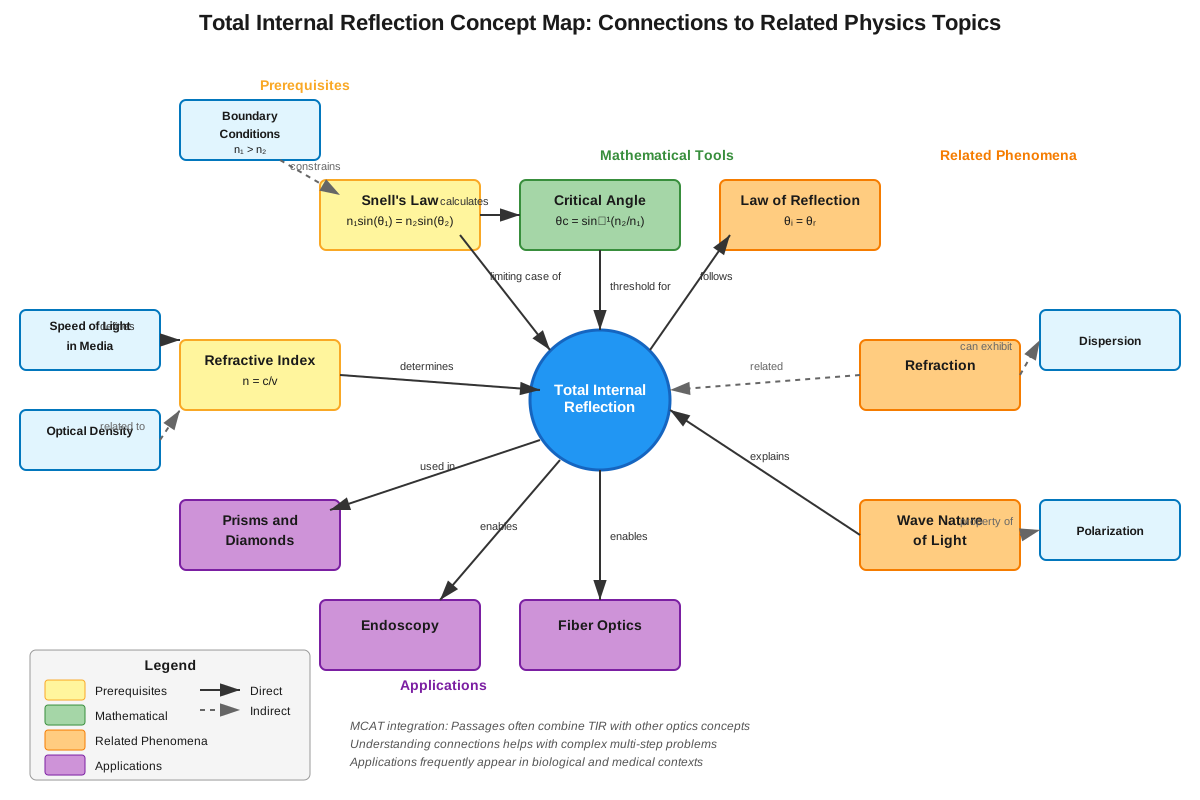
Overview
Total internal reflection is a fundamental optical phenomenon that occurs when light traveling through a denser medium strikes the boundary with a less dense medium at an angle greater than a specific threshold, called the critical angle. Rather than refracting into the second medium, the light is completely reflected back into the denser medium with no transmission across the boundary. This phenomenon is not merely a curiosity of Physics—it forms the basis for fiber optic technology, endoscopic medical procedures, and various biological adaptations that students encounter in MCAT passages.
Understanding total internal reflection is essential for the MCAT because it integrates multiple physics principles including Snell's law, refraction, and the behavior of electromagnetic waves at interfaces. The MCAT frequently tests this concept through both standalone questions and passage-based scenarios involving medical imaging devices, optical instruments, or biological systems like the human eye. Questions may require students to calculate critical angles, predict whether total internal reflection will occur under specific conditions, or explain why certain optical technologies function as they do.
Within the broader context of Light and Optics, total internal reflection represents a special limiting case of refraction. It connects directly to concepts such as refractive index, the speed of light in different media, and the wave nature of electromagnetic radiation. Mastery of this topic enables students to understand more complex optical systems and provides a foundation for analyzing how light behaves in biological tissues, diagnostic equipment, and therapeutic devices commonly featured in MCAT passages.
Learning Objectives
- [ ] Define Total internal reflection using accurate Physics terminology
- [ ] Explain why Total internal reflection matters for the MCAT
- [ ] Apply Total internal reflection to exam-style questions
- [ ] Identify common mistakes related to Total internal reflection
- [ ] Connect Total internal reflection to related Physics concepts
- [ ] Calculate the critical angle for any two-medium interface given refractive indices
- [ ] Predict whether total internal reflection will occur for a given angle of incidence and medium combination
- [ ] Analyze real-world applications of total internal reflection in medical and biological contexts
Prerequisites
- Snell's Law and Refraction: Understanding how light bends when crossing boundaries between media with different refractive indices is essential, as total internal reflection represents the limiting case where refraction can no longer occur
- Refractive Index: Knowledge of how the refractive index quantifies the optical density of materials and affects light speed is necessary to understand why total internal reflection only occurs when light travels from higher to lower refractive index media
- Basic Trigonometry: Familiarity with sine, cosine, and inverse trigonometric functions is required for calculating critical angles and analyzing incident angles
- Wave Properties of Light: Understanding light as an electromagnetic wave helps explain the physical mechanism behind reflection and refraction at boundaries
Why This Topic Matters
Total internal reflection has profound clinical and technological significance that makes it a high-yield MCAT topic. Fiber optic endoscopes, which enable minimally invasive visualization of internal organs, rely entirely on total internal reflection to transmit light and images through flexible cables. Pulse oximeters, used to measure blood oxygen saturation, employ optical principles including total internal reflection. The phenomenon also explains biological adaptations such as the reflective tapetum lucidum in nocturnal animals' eyes and the sparkle of diamonds.
On the MCAT, total internal reflection appears in approximately 3-5% of physics passages and standalone questions, making it a medium-to-high frequency topic. Questions typically fall into three categories: (1) calculation-based problems requiring determination of critical angles or prediction of reflection versus refraction, (2) conceptual questions about the conditions necessary for total internal reflection, and (3) passage-based applications involving medical devices or biological systems. The topic frequently appears in passages about optical instruments, diagnostic imaging, or the physics of vision.
Common MCAT passage contexts include: fiber optic medical devices (endoscopes, arthroscopes), light guides in surgical instruments, refractometry for measuring fluid properties, prisms and optical systems, aquatic vision and the air-water interface, and the structure of the eye (particularly the cornea-air interface). Understanding total internal reflection enables students to quickly analyze these scenarios and eliminate incorrect answer choices based on fundamental principles.
Core Concepts
Definition and Fundamental Conditions
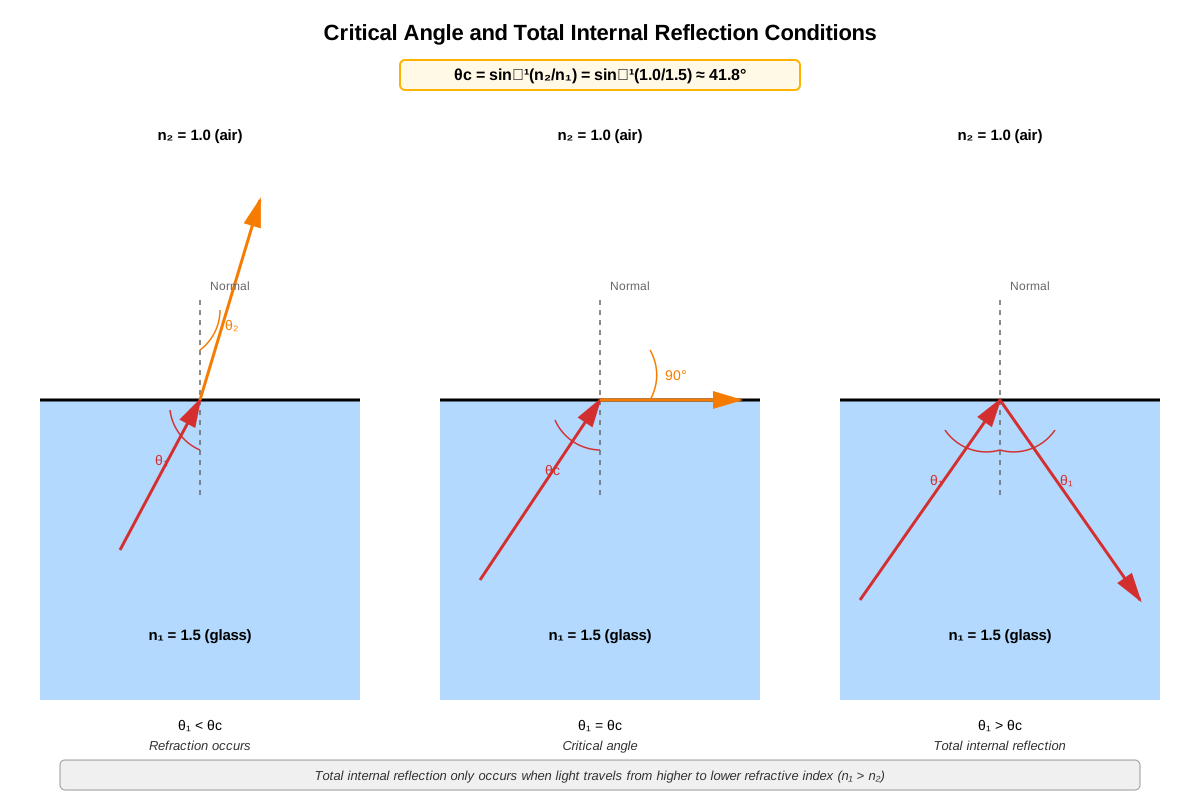
Total internal reflection occurs when light traveling from a medium with a higher refractive index (optically denser) to a medium with a lower refractive index (optically less dense) strikes the interface at an angle of incidence greater than or equal to the critical angle. Under these conditions, 100% of the incident light is reflected back into the denser medium, with zero transmission into the less dense medium. This phenomenon represents a complete breakdown of refraction.
Three conditions must be simultaneously satisfied for total internal reflection to occur:
- Light must travel from a medium with higher refractive index to one with lower refractive index (n₁ > n₂)
- The angle of incidence (measured from the normal to the interface) must be greater than or equal to the critical angle
- The interface must be smooth enough to allow specular reflection
Critical Angle Derivation and Calculation
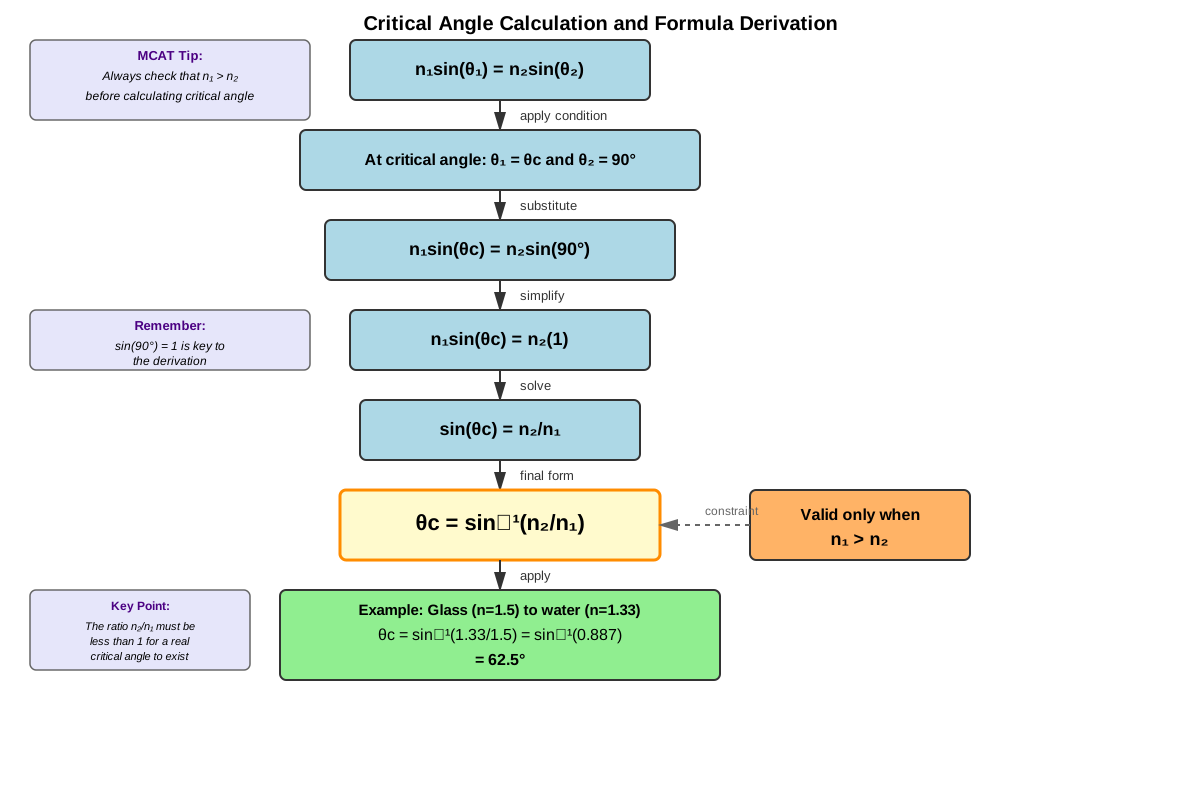
The critical angle (θc) represents the minimum angle of incidence at which total internal reflection begins. It can be derived from Snell's law by considering the limiting case where the refracted ray travels along the interface (refraction angle = 90°).
Starting with Snell's law:
n₁ sin(θ₁) = n₂ sin(θ₂)At the critical angle, θ₁ = θc and θ₂ = 90°:
n₁ sin(θc) = n₂ sin(90°)
n₁ sin(θc) = n₂ × 1
sin(θc) = n₂/n₁
θc = arcsin(n₂/n₁)
This equation only yields a real solution when n₂ < n₁, confirming that total internal reflection requires light to travel from a denser to a less dense medium. For angles of incidence less than θc, normal refraction occurs. For angles equal to or greater than θc, total internal reflection occurs.
Comparison with Regular Reflection and Refraction
| Phenomenon | Direction of Travel | Angle Condition | Energy Distribution |
|---|---|---|---|
| Regular Reflection | Any direction | Any angle | Partial (typically 4-10% for glass-air) |
| Refraction | Denser to less dense OR less dense to denser | θ < θc (when applicable) | Partial transmission, partial reflection |
| Total Internal Reflection | Denser to less dense ONLY | θ ≥ θc | 100% reflection, 0% transmission |
Physical Mechanism
At the microscopic level, total internal reflection occurs because the electromagnetic wave cannot establish a propagating wave in the second medium when the angle exceeds the critical angle. While a small evanescent wave penetrates a few wavelengths into the less dense medium, this wave decays exponentially and carries no net energy across the boundary. All energy returns to the denser medium through reflection.
The reflected ray obeys the law of reflection: the angle of reflection equals the angle of incidence, both measured from the normal to the interface. Unlike partial reflection from surfaces, total internal reflection involves no phase change for most polarizations and no energy loss (assuming no absorption in the medium).
Common Material Interfaces
Understanding typical refractive indices helps predict where total internal reflection occurs:
Water-Air Interface (n_water = 1.33, n_air = 1.00):
θc = arcsin(1.00/1.33) = arcsin(0.752) ≈ 48.6°Glass-Air Interface (n_glass = 1.50, n_air = 1.00):
θc = arcsin(1.00/1.50) = arcsin(0.667) ≈ 41.8°Diamond-Air Interface (n_diamond = 2.42, n_air = 1.00):
θc = arcsin(1.00/2.42) = arcsin(0.413) ≈ 24.4°The low critical angle of diamond explains its exceptional brilliance—light entering the stone undergoes multiple total internal reflections before exiting, creating sparkle.
Applications in Medical Technology
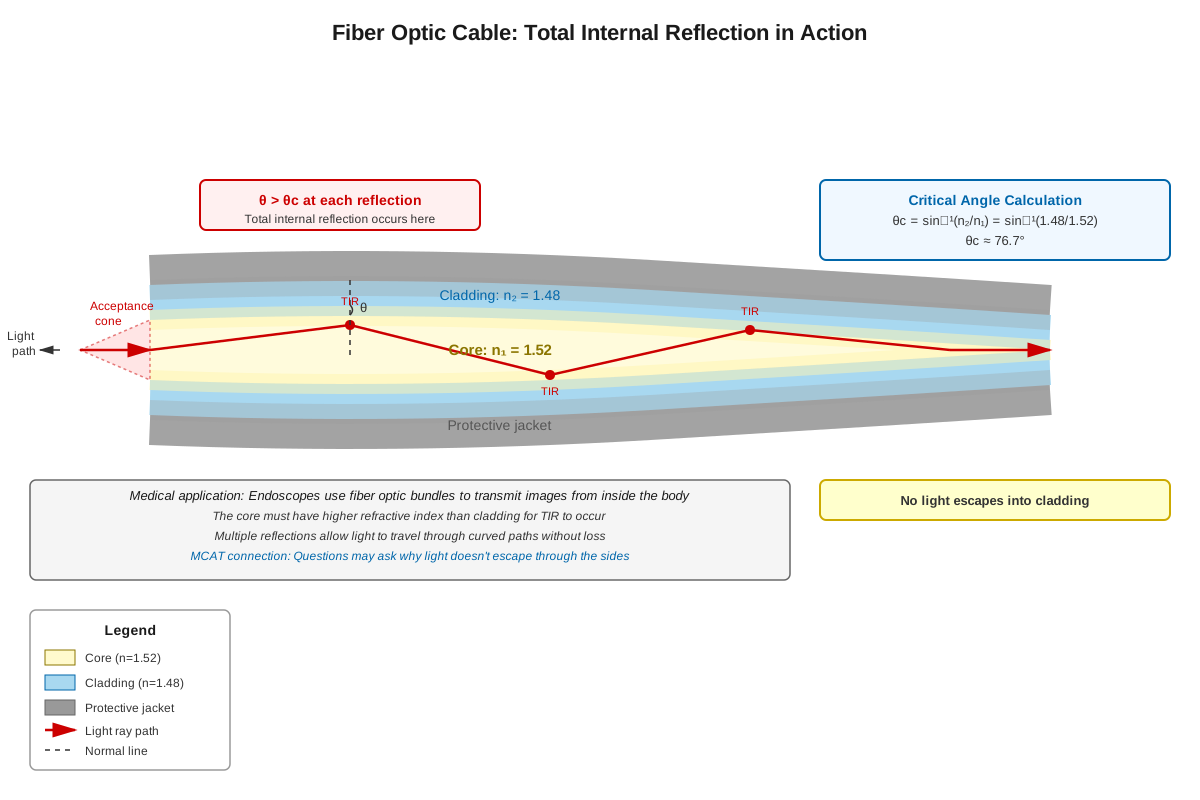
Fiber Optic Endoscopy: Flexible fiber optic cables consist of a high-refractive-index core surrounded by a lower-refractive-index cladding. Light entering at one end undergoes repeated total internal reflection at the core-cladding interface, allowing transmission around curves without loss. This enables visualization of internal organs through natural orifices or small incisions.
Optical Coherence Tomography (OCT): This imaging technique uses light reflection and interference patterns to create high-resolution cross-sectional images of biological tissues. Understanding total internal reflection helps interpret artifacts and optimize imaging parameters.
Refractometry: Clinical refractometers measure the refractive index of fluids (urine, serum) by detecting the critical angle, which changes with solute concentration. This provides rapid assessment of specific gravity and protein content.
Concept Relationships
Total internal reflection emerges directly from Snell's law when the mathematical solution for the refraction angle becomes undefined (requiring sin θ > 1, which is impossible). This represents the limiting case of refraction → when the refracted ray would need to bend beyond 90° from the normal, total internal reflection occurs instead.
The refractive index determines both the critical angle and whether total internal reflection is possible at a given interface. Higher refractive index contrast (larger n₁/n₂ ratio) → smaller critical angle → easier to achieve total internal reflection. This connects to the speed of light in media, since refractive index equals c/v, where v is light speed in the medium.
Regular reflection occurs at all angles and interfaces, but total internal reflection represents a special case where reflection becomes complete. The relationship: partial reflection (all cases) → enhanced reflection (approaching critical angle) → total internal reflection (at and beyond critical angle).
The phenomenon connects to wave optics through the evanescent wave that penetrates the boundary during total internal reflection. This wave → enables frustrated total internal reflection → which forms the basis for near-field optical microscopy and optical coupling devices.
In biological systems, total internal reflection at the cornea-air interface affects vision, particularly in aquatic animals. The high refractive index contrast → enables total internal reflection at relatively small angles → affects the visual field and light-gathering ability of the eye.
High-Yield Facts
⭐ Total internal reflection only occurs when light travels from a higher refractive index medium to a lower refractive index medium (n₁ > n₂)
⭐ The critical angle is calculated using θc = arcsin(n₂/n₁), where n₁ is the denser medium and n₂ is the less dense medium
⭐ For the water-air interface, the critical angle is approximately 48.6°, meaning underwater objects viewed at angles greater than this appear mirror-like
⭐ At angles of incidence greater than or equal to the critical angle, 100% of light is reflected with no transmission
⭐ Fiber optic cables use total internal reflection by having a high-index core surrounded by a low-index cladding
- The critical angle decreases as the refractive index difference between media increases
- Total internal reflection involves no energy loss (unlike partial reflection), making it highly efficient for light transmission
- A small evanescent wave penetrates approximately one wavelength into the less dense medium during total internal reflection, though it carries no net energy
- Diamonds have a critical angle of approximately 24.4° due to their high refractive index (2.42), causing extensive internal reflection and brilliance
- Prisms can use total internal reflection at 45° angles to redirect light with minimal loss, as used in binoculars and periscopes
Quick check — test yourself on Total internal reflection so far.
Try Flashcards →Common Misconceptions
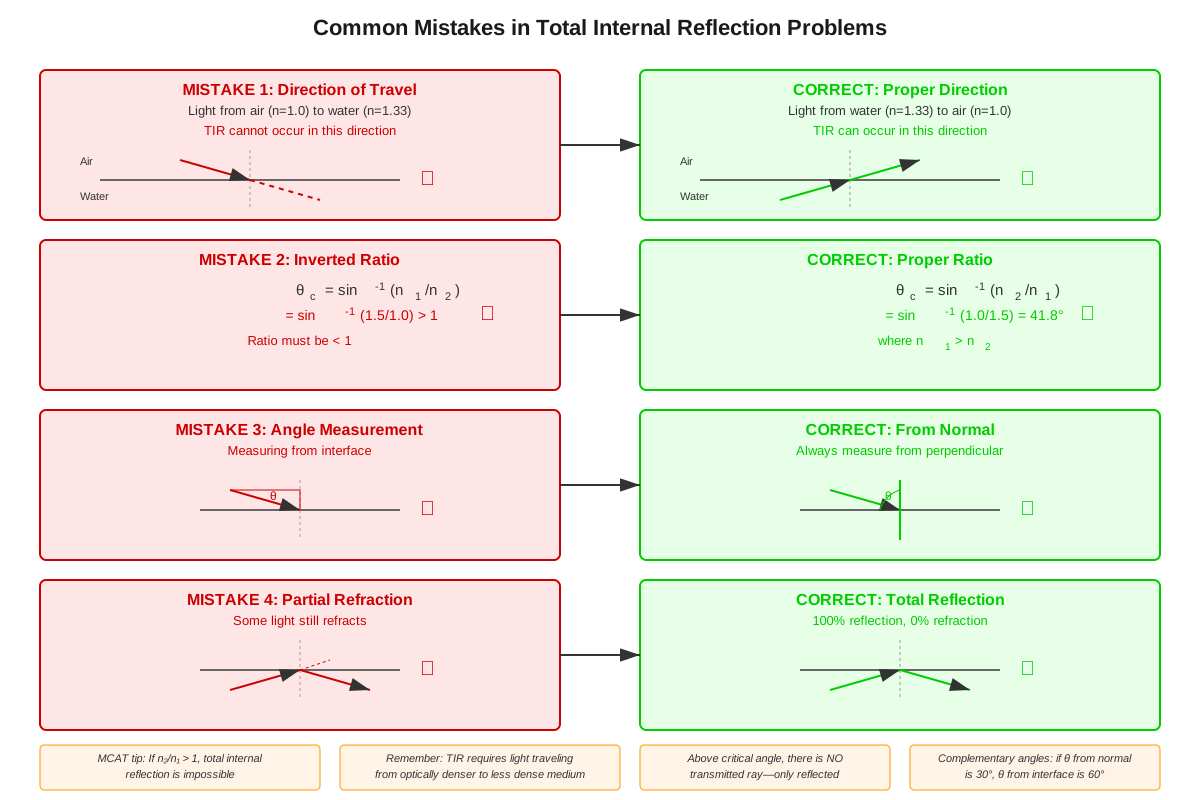
Misconception: Total internal reflection can occur when light travels from air into water or from any less dense medium into a denser medium.
Correction: Total internal reflection ONLY occurs when light travels from a higher refractive index (denser) medium to a lower refractive index (less dense) medium. When light travels from air into water, it refracts toward the normal but cannot undergo total internal reflection regardless of angle.
Misconception: The critical angle is the same for all material interfaces.
Correction: The critical angle is specific to each pair of materials and depends on their refractive index ratio. It is calculated using θc = arcsin(n₂/n₁), so different material combinations yield different critical angles. Glass-air has a different critical angle than water-air.
Misconception: At the critical angle, light is partially reflected and partially refracted along the interface.
Correction: At exactly the critical angle, the refracted ray travels along the interface (90° from normal), but this represents the threshold where total internal reflection begins. For any angle greater than or equal to the critical angle, 100% reflection occurs with zero transmission.
Misconception: Total internal reflection occurs at the interface between any two transparent materials.
Correction: Total internal reflection requires not just transparency but also the correct refractive index relationship (n₁ > n₂) and an angle of incidence exceeding the critical angle. Two transparent materials with the same refractive index will show no reflection or refraction at their interface.
Misconception: The angle of reflection during total internal reflection differs from the angle of incidence.
Correction: Total internal reflection obeys the law of reflection: the angle of reflection equals the angle of incidence, both measured from the normal. This is identical to regular reflection; the "total" refers to the completeness of reflection (100% of energy), not to any change in angular relationships.
Misconception: Total internal reflection can be used to focus or concentrate light like a lens.
Correction: Total internal reflection redirects light through reflection, which preserves parallel rays as parallel (like a mirror). It does not converge or diverge light rays like refraction through curved surfaces does. However, curved reflecting surfaces using total internal reflection can focus light, but the focusing comes from the curved geometry, not from the total internal reflection itself.
Worked Examples
Example 1: Calculating Critical Angle for Fiber Optic Cable
Problem: A fiber optic cable used in an endoscope has a glass core with refractive index 1.62 surrounded by a cladding with refractive index 1.52. Calculate the critical angle for the core-cladding interface. Will light entering the core at an incident angle of 75° (from the normal to the interface) undergo total internal reflection?
Solution:
Step 1: Identify the media and their refractive indices.
- Core (denser medium): n₁ = 1.62
- Cladding (less dense medium): n₂ = 1.52
- Light travels from core to cladding, so total internal reflection is possible
Step 2: Calculate the critical angle using the formula.
θc = arcsin(n₂/n₁)
θc = arcsin(1.52/1.62)
θc = arcsin(0.938)
θc ≈ 69.7°
Step 3: Compare the incident angle to the critical angle.
- Incident angle: 75°
- Critical angle: 69.7°
- Since 75° > 69.7°, total internal reflection WILL occur
Answer: The critical angle is approximately 69.7°. Light at 75° incident angle will undergo total internal reflection, allowing the fiber to transmit light efficiently around bends. This explains why fiber optic endoscopes can navigate curved anatomical pathways while maintaining image quality.
Connection to Learning Objectives: This problem demonstrates the application of total internal reflection principles to medical technology, requires accurate calculation of critical angles, and shows how to predict whether total internal reflection occurs under specific conditions.
Example 2: Underwater Vision and the Critical Angle
Problem: A diver swimming underwater looks upward toward the surface. The refractive index of water is 1.33 and air is 1.00. At what angle from the vertical will the diver begin to see total internal reflection instead of seeing through the surface? Explain what the diver observes at angles greater than this critical angle.
Solution:
Step 1: Identify the direction of light travel and media.
- Light travels from water (n₁ = 1.33) to air (n₂ = 1.00)
- This is denser to less dense, so total internal reflection is possible
- The angle is measured from the normal (vertical), which is the same as from the vertical in this case
Step 2: Calculate the critical angle.
θc = arcsin(n₂/n₁)
θc = arcsin(1.00/1.33)
θc = arcsin(0.752)
θc ≈ 48.6°
Step 3: Interpret the result in context.
- At angles less than 48.6° from vertical: The diver can see through the surface (refraction occurs)
- At angles equal to or greater than 48.6° from vertical: Total internal reflection occurs
- The diver sees a mirror-like reflection of underwater objects instead of the above-water environment
Answer: The critical angle is approximately 48.6° from the vertical. At angles greater than this, the water surface acts as a perfect mirror due to total internal reflection. This creates "Snell's window"—a cone of approximately 97° total angle through which the diver can see the entire above-water hemisphere. Outside this cone, the diver sees only reflections of the underwater environment.
Connection to Learning Objectives: This example connects total internal reflection to biological and real-world contexts, demonstrates the calculation process, and explains the observational consequences of the phenomenon. It also illustrates why MCAT passages about aquatic vision or underwater optics frequently test this concept.
Exam Strategy
When approaching MCAT questions on total internal reflection, first identify whether the question asks for conceptual understanding or numerical calculation. Trigger phrases include "critical angle," "fiber optic," "light traveling from [denser] to [less dense]," "complete reflection," and "underwater viewing."
Step-by-step approach for calculation questions:
- Identify which medium has the higher refractive index (n₁) and which has the lower (n₂)
- Verify that light travels from higher to lower index (if not, total internal reflection is impossible)
- Calculate critical angle: θc = arcsin(n₂/n₁)
- Compare the given incident angle to the critical angle
- If θ_incident ≥ θc, total internal reflection occurs; if θ_incident < θc, refraction occurs
Process of elimination strategies:
- Immediately eliminate answer choices suggesting total internal reflection when light travels from less dense to denser medium
- Eliminate choices that claim partial transmission occurs at angles above the critical angle
- For critical angle calculations, eliminate answers greater than 90° or less than 0° (physically impossible)
- If a question asks about efficiency of light transmission, favor total internal reflection over partial reflection
Time allocation: Most total internal reflection questions can be solved in 60-90 seconds. Spend 20 seconds identifying the scenario and conditions, 30-40 seconds on calculations (if needed), and 10-20 seconds verifying your answer makes physical sense. If a calculation seems complex, check whether the question can be answered conceptually without precise numbers.
Watch for these exam traps:
- Questions that reverse the direction of light travel to test whether students automatically apply formulas without checking conditions
- Answer choices that confuse angle of incidence with angle of refraction
- Scenarios involving multiple interfaces where total internal reflection occurs at one but not another
- Questions asking about the refracted ray when total internal reflection occurs (trick: there is no refracted ray)
Exam Tip: If a passage describes fiber optics, endoscopes, or light guides, immediately recall that these devices require n_core > n_cladding and that light must strike the interface at angles exceeding the critical angle. This framework helps answer multiple questions quickly.
Memory Techniques
Critical Angle Formula Mnemonic: "Small Light Needs Exit" → Sin θc = Lower n / Entering n (sin θc = n₂/n₁, where n₂ is the lower index and n₁ is the entering/initial medium)
Condition Checklist - "HIT":
- Higher to lower (refractive index direction)
- Incident angle exceeds critical angle
- Total reflection results
Visualization Strategy: Picture a swimming pool from underwater. The surface appears mirror-like at shallow angles (high incident angles from normal) but transparent when looking straight up (low incident angles). This concrete image helps recall that total internal reflection requires both the correct medium transition and sufficient angle.
Acronym for Applications - "FEDS":
- Fiber optics
- Endoscopes
- Diamonds (brilliance)
- Snorkeling/swimming (Snell's window)
Numerical Memory Aid: The water-air critical angle (48.6°) is approximately 50°, and the glass-air critical angle (41.8°) is approximately 42°. Remember "Water is Wider (larger angle), Glass is Greater density (smaller angle)."
Summary
Total internal reflection represents a complete reflection phenomenon occurring when light travels from an optically denser medium (higher refractive index) to a less dense medium (lower refractive index) at an angle of incidence equal to or exceeding the critical angle. The critical angle is calculated using θc = arcsin(n₂/n₁), where n₁ > n₂. This phenomenon differs fundamentally from partial reflection because 100% of incident light energy is reflected with zero transmission across the boundary. The MCAT tests this concept through calculations of critical angles, predictions about whether total internal reflection will occur under specified conditions, and applications to medical technology such as fiber optic endoscopes and diagnostic instruments. Understanding the three necessary conditions—correct refractive index relationship, sufficient incident angle, and appropriate interface—enables students to quickly analyze exam questions and eliminate incorrect answers. The phenomenon connects to broader optical principles including Snell's law, refraction, and the wave nature of light, making it a cornerstone concept in Light and Optics.
Key Takeaways
- Total internal reflection occurs exclusively when light travels from higher to lower refractive index media (n₁ > n₂) at angles meeting or exceeding the critical angle
- The critical angle formula θc = arcsin(n₂/n₁) is essential for MCAT calculations and must be memorized
- At angles below the critical angle, normal refraction occurs; at or above it, 100% reflection occurs with no transmission
- Fiber optic medical devices (endoscopes, light guides) function by maintaining total internal reflection through core-cladding refractive index differences
- Common critical angles to remember: water-air ≈ 48.6°, glass-air ≈ 41.8°, with smaller angles for higher refractive index materials
- Total internal reflection questions often appear in MCAT passages about medical imaging, optical instruments, or aquatic biology
- The phenomenon represents the limiting case of Snell's law where the refracted angle would exceed 90°, making refraction impossible
Related Topics
Snell's Law and Refraction: Mastering total internal reflection provides the foundation for understanding the general case of light bending at interfaces, including lens systems and the optics of the eye. Snell's law governs all refraction phenomena, with total internal reflection representing a special limiting case.
Optical Instruments: Knowledge of total internal reflection enables analysis of prisms, periscopes, binoculars, and other devices that redirect light. These instruments frequently appear in MCAT passages about experimental apparatus or medical diagnostic equipment.
Fiber Optic Technology in Medicine: Building on total internal reflection principles, students can explore advanced applications in minimally invasive surgery, photodynamic therapy, and optical biosensors used in clinical diagnostics.
Wave Optics and Interference: The evanescent wave produced during total internal reflection connects to more advanced wave phenomena including frustrated total internal reflection, near-field optics, and surface plasmon resonance used in biosensing.
Electromagnetic Spectrum and Tissue Optics: Understanding how different wavelengths of light interact with biological tissues through reflection, refraction, and absorption builds on total internal reflection principles and appears in passages about medical imaging modalities.
Practice CTA
Now that you have mastered the core concepts of total internal reflection, reinforce your understanding by working through practice questions and flashcards. Focus on problems requiring critical angle calculations, scenarios involving fiber optics and medical devices, and questions that test the conditions necessary for total internal reflection to occur. Pay special attention to questions that combine this topic with Snell's law or refractive index concepts. Remember: the MCAT rewards both conceptual understanding and rapid application of formulas, so practice both calculation speed and conceptual reasoning. Your solid grasp of this high-yield topic will serve you well across multiple physics passages and standalone questions. Keep pushing forward—mastery of fundamental optics principles like total internal reflection builds the foundation for success on test day!
Sign up free to keep reading
Create a free AnvayaPrep account to finish this MCAT guide on Total internal reflection — plus flashcards and practice questions.