Overview
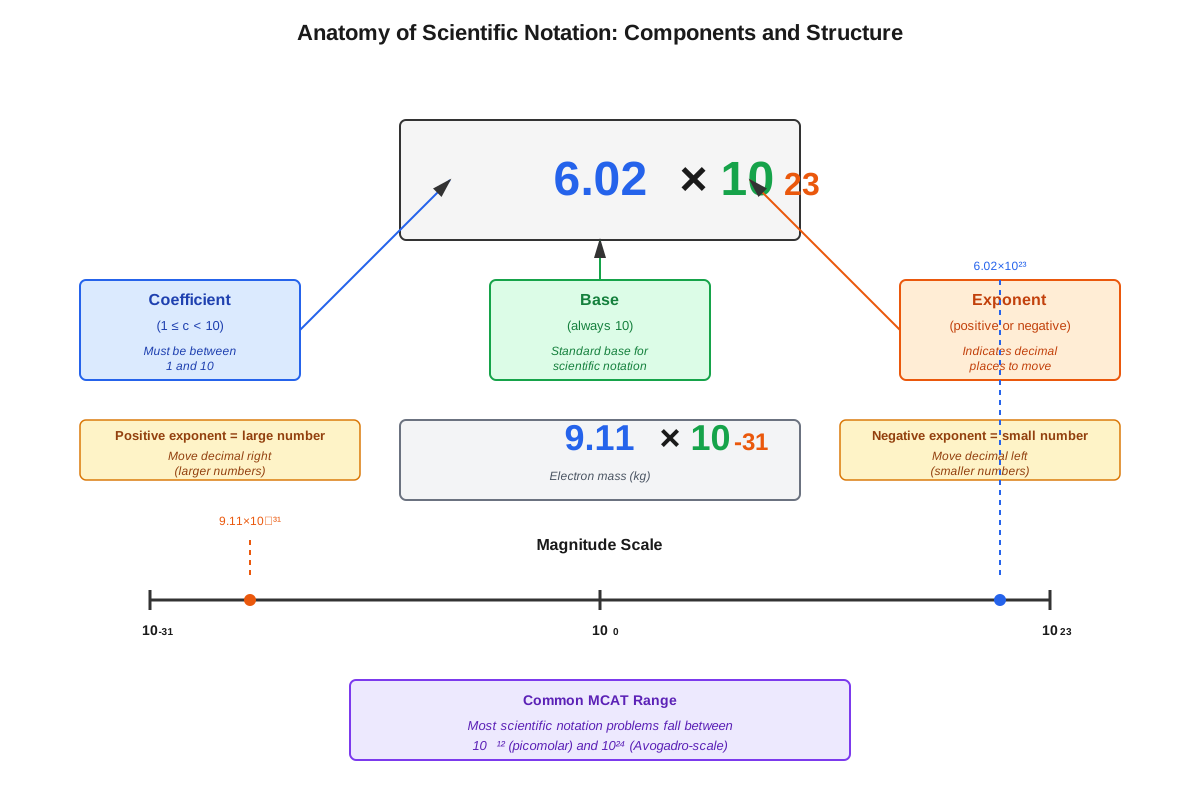
Scientific notation is a standardized mathematical system for expressing very large or very small numbers in a compact, manageable form. In the context of Physics and the MCAT, scientific notation serves as an essential tool for handling the extreme ranges of values encountered in biological and physical systems—from the mass of an electron (9.11 × 10⁻³¹ kg) to Avogadro's number (6.02 × 10²³ particles/mol). This notation system expresses numbers as a product of a coefficient (typically between 1 and 10) and a power of ten, allowing for efficient calculation, comparison, and communication of numerical data.
For MCAT preparation, mastery of scientific notation extends beyond simple arithmetic. The exam frequently presents data in scientific notation within passages describing experimental results, physiological measurements, and molecular concentrations. Students must rapidly convert between standard and scientific notation, perform calculations without a calculator on certain sections, and interpret orders of magnitude to make quick comparisons. The Chemical and Physical Foundations of Biological Systems section particularly relies on scientific notation when dealing with equilibrium constants, pH calculations, electromagnetic radiation wavelengths, and thermodynamic quantities.
Understanding scientific notation connects directly to broader Math and Units concepts tested on the MCAT, including dimensional analysis, unit conversions, and significant figures. This foundational skill underpins quantitative reasoning across all MCAT science sections, making it a high-yield topic despite its apparent simplicity. Students who develop fluency with scientific notation gain speed and accuracy advantages that compound throughout the exam, particularly when evaluating answer choices that differ by orders of magnitude or when estimating calculations under time pressure.
Learning Objectives
- [ ] Define Scientific notation using accurate Physics terminology
- [ ] Explain why Scientific notation matters for the MCAT
- [ ] Apply Scientific notation to exam-style questions
- [ ] Identify common mistakes related to Scientific notation
- [ ] Connect Scientific notation to related Physics concepts
- [ ] Convert between standard decimal notation and scientific notation in under 10 seconds
- [ ] Perform multiplication and division operations with numbers in scientific notation without a calculator
- [ ] Compare and order quantities expressed in scientific notation by analyzing exponents and coefficients
- [ ] Apply scientific notation to solve multi-step problems involving unit conversions and dimensional analysis
Prerequisites
- Basic exponent rules: Understanding that 10³ = 1000 and 10⁻² = 0.01 is essential for interpreting the magnitude component of scientific notation
- Multiplication and division of powers: Knowledge that 10ᵃ × 10ᵇ = 10⁽ᵃ⁺ᵇ⁾ enables efficient calculations with scientific notation
- Place value in decimal system: Recognizing how digits shift when multiplying or dividing by powers of ten allows for rapid conversions
- Order of operations: Proper sequencing of mathematical operations ensures accurate manipulation of scientific notation expressions
- Significant figures: Understanding precision and accuracy complements scientific notation in representing measured quantities
Why This Topic Matters
Scientific notation appears throughout the MCAT in contexts that mirror real scientific practice. In biochemistry passages, enzyme kinetics problems present Michaelis constants (Kₘ) in the micromolar range (10⁻⁶ M), while molecular biology questions involve DNA fragment sizes in base pairs (10³ to 10⁶ bp). Physics passages discussing electromagnetic radiation require students to work with wavelengths spanning from gamma rays (10⁻¹² m) to radio waves (10³ m). The ability to quickly interpret these values and perform mental calculations separates high-scoring students from those who struggle with time management.
Exam statistics indicate that approximately 15-20% of Chemical and Physical Foundations questions involve numerical calculations where scientific notation provides a strategic advantage. While the MCAT provides a basic four-function calculator for the chemistry and physics section, efficient use of scientific notation often eliminates the need for calculator use entirely, saving precious seconds per question. Questions testing scientific notation rarely appear in isolation; instead, this skill integrates into problems involving gas laws, radioactive decay, electrochemistry, and solution chemistry.
Common exam passage scenarios include: interpreting spectroscopy data with wavelengths in nanometers (10⁻⁹ m), analyzing experimental results with p-values expressed as 10⁻³ or smaller, calculating drug concentrations in nanomolar ranges for pharmacology questions, and comparing molecular masses across different biomolecules. Students who struggle with scientific notation often misinterpret orders of magnitude, leading to answer choices that are off by factors of 10, 100, or 1000—errors that are easily avoidable with proper preparation.
Core Concepts
Definition and Structure of Scientific Notation
Scientific notation expresses any number as the product of two components: a coefficient (also called the mantissa or significand) and an exponential term representing a power of ten. The standard form is:
N = a × 10ⁿwhere:
- a is the coefficient, typically constrained to 1 ≤ |a| < 10
- n is an integer exponent (positive, negative, or zero)
- 10 is the base (consistent with our decimal number system)
For example, the speed of light (299,792,458 m/s) is expressed as 3.00 × 10⁸ m/s in scientific notation, where 3.00 is the coefficient and 8 is the exponent. This representation immediately conveys that the value is in the hundreds of millions, facilitating quick magnitude comparisons.
Converting to Scientific Notation
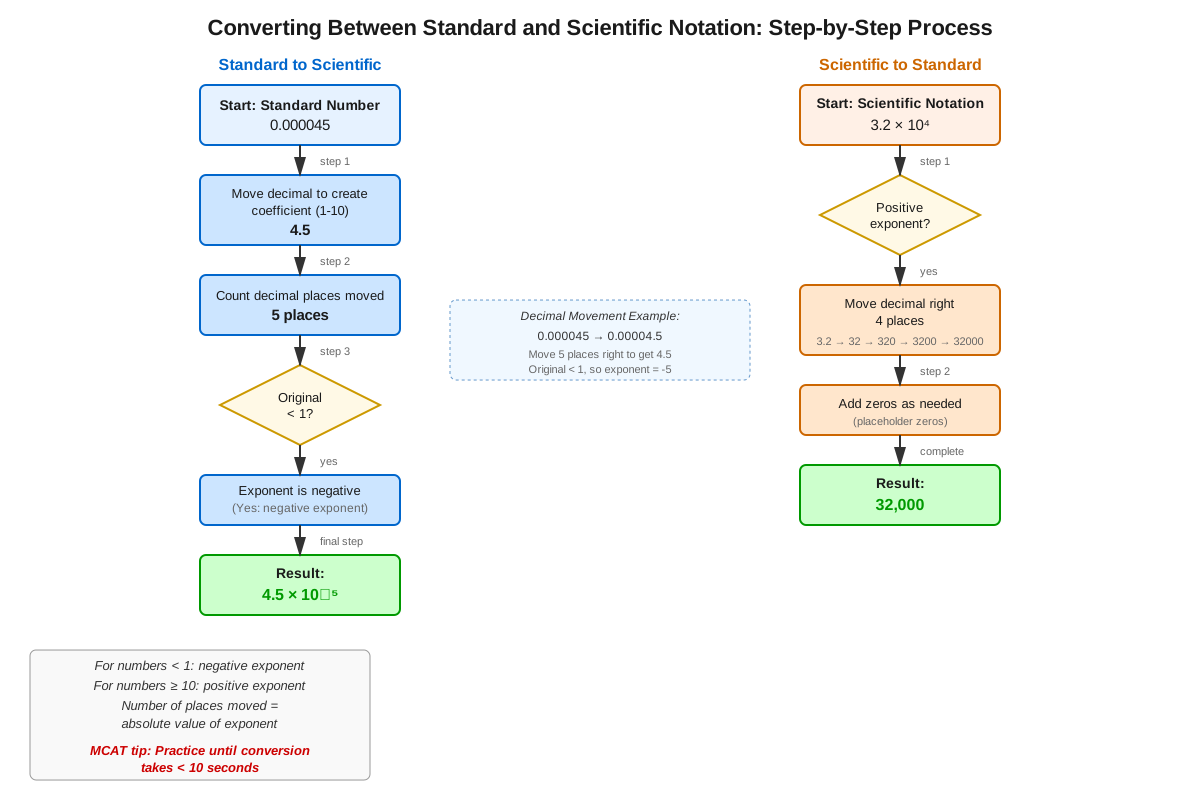
Converting standard decimal notation to scientific notation involves a systematic process:
- Identify the first non-zero digit in the number
- Place the decimal point immediately after this digit
- Count the number of places the decimal point moved
- Assign the exponent: positive if the original number was ≥ 10, negative if < 1, zero if between 1 and 10
- Write the result in the form a × 10ⁿ
Example 1: Convert 45,000 to scientific notation
- First non-zero digit: 4
- Place decimal after 4: 4.5000
- Decimal moved 4 places left
- Result: 4.5 × 10⁴
Example 2: Convert 0.000067 to scientific notation
- First non-zero digit: 6
- Place decimal after 6: 6.7
- Decimal moved 5 places right (from original position)
- Result: 6.7 × 10⁻⁵
Converting from Scientific Notation
Reversing the process requires moving the decimal point according to the exponent:
- Positive exponent: Move decimal point to the right (number gets larger)
- Negative exponent: Move decimal point to the left (number gets smaller)
- Add zeros as placeholders when necessary
Example: Convert 3.2 × 10⁻³ to standard notation
- Start with 3.2
- Exponent is -3, so move decimal 3 places left
- Result: 0.0032
Arithmetic Operations with Scientific Notation
Multiplication
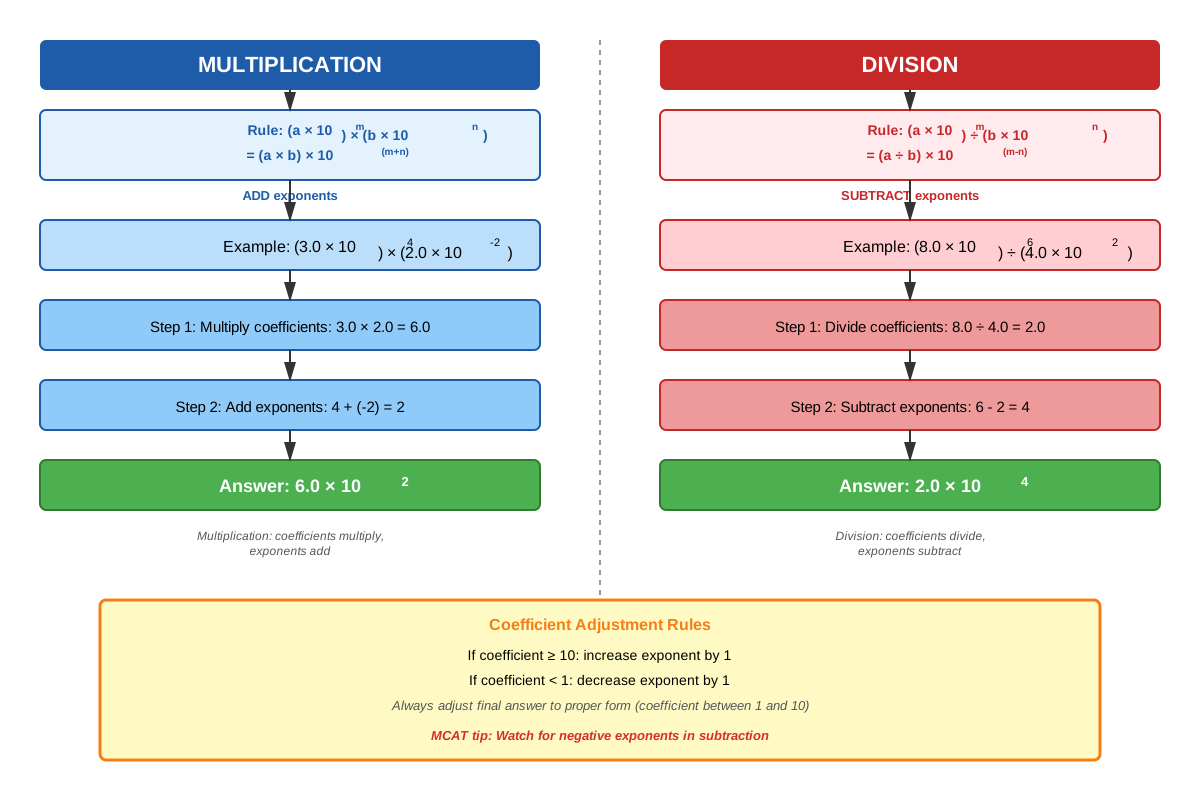
When multiplying numbers in scientific notation:
- Multiply the coefficients
- Add the exponents
- Adjust to proper scientific notation if needed
(a × 10ᵐ) × (b × 10ⁿ) = (a × b) × 10⁽ᵐ⁺ⁿ⁾Example: (3.0 × 10⁴) × (2.0 × 10³)
- Coefficients: 3.0 × 2.0 = 6.0
- Exponents: 4 + 3 = 7
- Result: 6.0 × 10⁷
Division
When dividing numbers in scientific notation:
- Divide the coefficients
- Subtract the exponents (numerator minus denominator)
- Adjust to proper scientific notation if needed
(a × 10ᵐ) ÷ (b × 10ⁿ) = (a ÷ b) × 10⁽ᵐ⁻ⁿ⁾Example: (8.0 × 10⁶) ÷ (4.0 × 10²)
- Coefficients: 8.0 ÷ 4.0 = 2.0
- Exponents: 6 - 2 = 4
- Result: 2.0 × 10⁴
Addition and Subtraction
These operations require matching exponents before combining coefficients:
- Express both numbers with the same power of ten
- Add or subtract the coefficients
- Keep the common exponent
- Adjust to proper scientific notation if needed
Example: (5.0 × 10³) + (3.0 × 10²)
- Convert to matching exponents: (5.0 × 10³) + (0.3 × 10³)
- Add coefficients: 5.0 + 0.3 = 5.3
- Result: 5.3 × 10³
Order of Magnitude Comparisons
The order of magnitude refers to the power of ten that best represents a number's scale. For MCAT purposes, comparing orders of magnitude allows rapid elimination of incorrect answer choices:
| Comparison | Rule |
|---|---|
| Same exponent | Compare coefficients directly |
| Different exponents | Larger exponent = larger number (for positive coefficients) |
| Negative vs. positive exponent | Positive exponent yields larger absolute value |
| Both negative exponents | Less negative exponent = larger number |
Example: Which is larger: 7.5 × 10⁻⁴ or 2.1 × 10⁻³?
- Exponents differ: -4 vs. -3
- -3 is less negative (closer to zero)
- Answer: 2.1 × 10⁻³ is larger
Scientific Notation in MCAT Physics Contexts
Common Physics applications on the MCAT include:
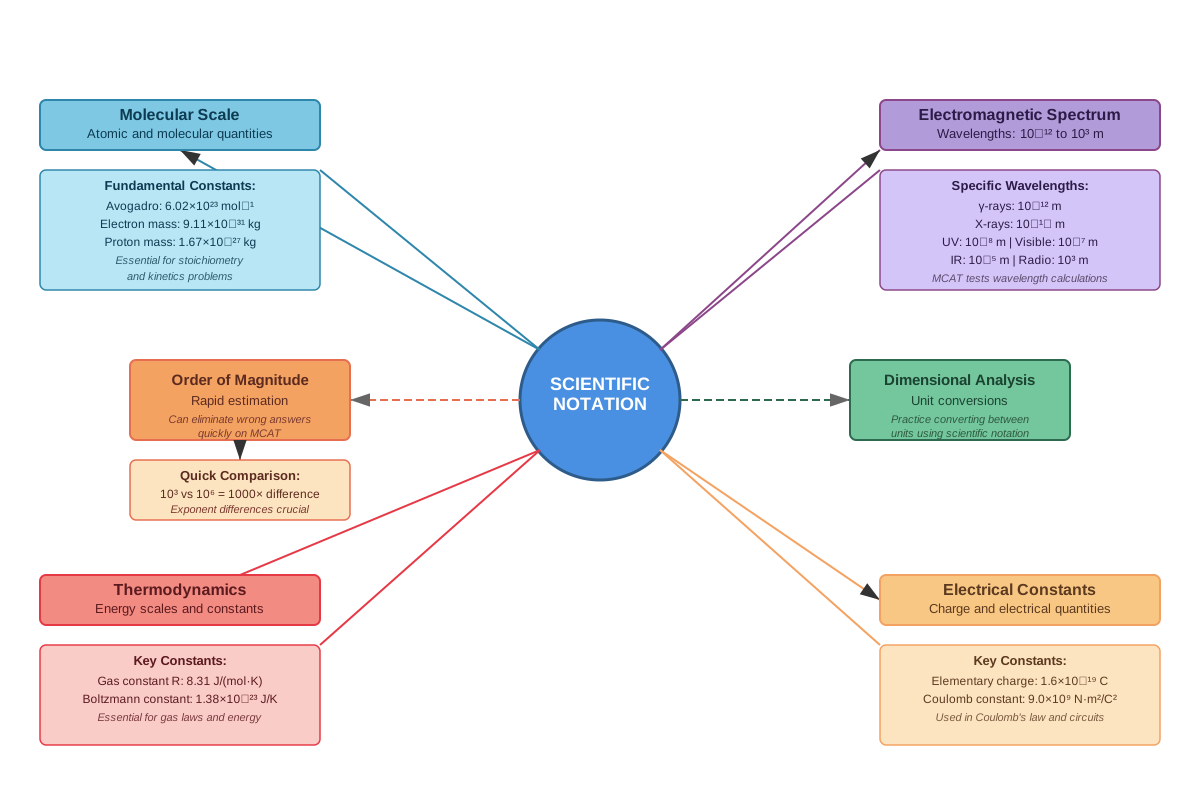
- Electromagnetic spectrum: Wavelengths from 10⁻¹² m (gamma rays) to 10³ m (radio waves)
- Atomic and subatomic scales: Electron mass (9.11 × 10⁻³¹ kg), proton mass (1.67 × 10⁻²⁷ kg)
- Avogadro's number: 6.02 × 10²³ particles/mol (essential for stoichiometry)
- Universal constants: Gravitational constant (6.67 × 10⁻¹¹ N·m²/kg²), Planck's constant (6.63 × 10⁻³⁴ J·s)
- Energy scales: Electron volt (1.6 × 10⁻¹⁹ J), typical chemical bond energies (10⁻¹⁹ to 10⁻¹⁸ J)
Significant Figures in Scientific Notation
Scientific notation clarifies the precision of measurements by making significant figures explicit. All digits in the coefficient are significant:
- 3.00 × 10⁴ has three significant figures
- 3.0 × 10⁴ has two significant figures
- 3 × 10⁴ has one significant figure
When performing calculations, apply significant figure rules to the coefficient while handling exponents separately. The final answer should reflect the precision of the least precise measurement.
Concept Relationships
Scientific notation serves as a foundational tool that connects to virtually every quantitative aspect of MCAT Physics and chemistry. The relationship hierarchy flows as follows:
Exponent rules → Scientific notation → Dimensional analysis and unit conversions
Understanding how powers of ten combine enables scientific notation fluency, which in turn facilitates complex unit conversions (e.g., converting nm² to m² involves manipulating 10⁻⁹ squared to 10⁻¹⁸).
Scientific notation → Significant figures → Measurement precision
The coefficient in scientific notation explicitly displays significant figures, making precision analysis straightforward in experimental contexts.
Scientific notation → Logarithmic scales → pH, pKa, and decibel calculations
The exponent in scientific notation directly relates to logarithmic values: pH = -log[H⁺], so [H⁺] = 1.0 × 10⁻⁷ M corresponds to pH 7.
Order of magnitude reasoning → Answer elimination strategies → Improved exam performance
Rapid magnitude comparisons using scientific notation enable students to eliminate obviously incorrect answers without detailed calculations.
Within the Math and Units framework, scientific notation integrates with metric prefixes (nano- = 10⁻⁹, micro- = 10⁻⁶, milli- = 10⁻³, kilo- = 10³, mega- = 10⁶), creating a unified system for expressing measurements across scales. This connection appears frequently in MCAT passages presenting experimental data with mixed unit prefixes that students must normalize for comparison.
Quick check — test yourself on Scientific notation so far.
Try Flashcards →High-Yield Facts
⭐ Numbers in scientific notation are multiplied by multiplying coefficients and adding exponents: (a × 10ᵐ)(b × 10ⁿ) = ab × 10⁽ᵐ⁺ⁿ⁾
⭐ Numbers in scientific notation are divided by dividing coefficients and subtracting exponents: (a × 10ᵐ)/(b × 10ⁿ) = (a/b) × 10⁽ᵐ⁻ⁿ⁾
⭐ A positive exponent indicates a number greater than or equal to 10; a negative exponent indicates a number less than 1
⭐ To compare magnitudes quickly, compare exponents first; only compare coefficients if exponents are equal
⭐ Moving the decimal point one place to the right decreases the exponent by 1; moving left increases the exponent by 1
- The coefficient in proper scientific notation must be between 1 and 10 (1 ≤ |a| < 10)
- Adding or subtracting numbers in scientific notation requires expressing them with the same exponent before combining coefficients
- Avogadro's number (6.02 × 10²³) and the speed of light (3.00 × 10⁸ m/s) are the most frequently used constants in scientific notation on the MCAT
- Converting between metric prefixes and scientific notation: nano (n) = 10⁻⁹, micro (μ) = 10⁻⁶, milli (m) = 10⁻³, kilo (k) = 10³, mega (M) = 10⁶
- When raising a number in scientific notation to a power, raise the coefficient to that power and multiply the exponent by that power: (a × 10ⁿ)ᵐ = aᵐ × 10⁽ⁿᵐ⁾
- Scientific notation eliminates ambiguity in trailing zeros: 2000 could have 1-4 significant figures, but 2.0 × 10³ clearly has 2 significant figures
- The exponent represents the order of magnitude, which differs by a factor of 10 for each integer change
Common Misconceptions
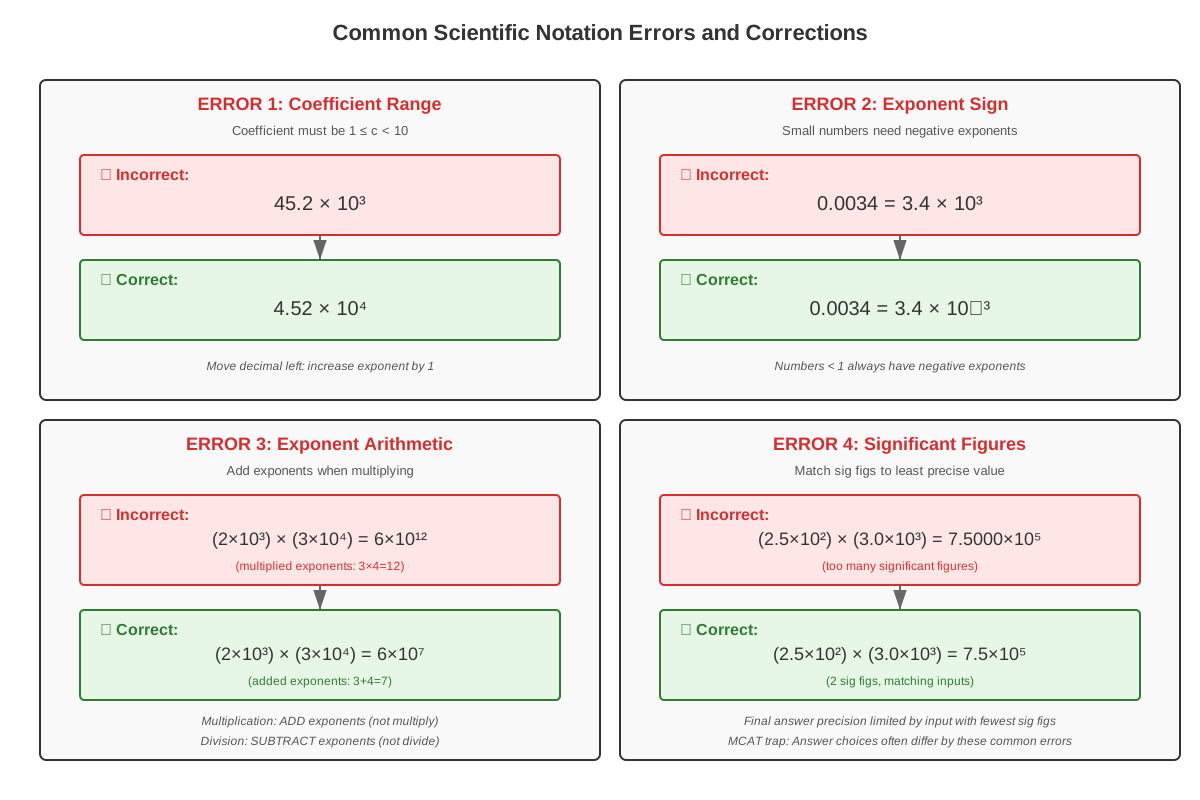
Misconception: When converting 0.0045 to scientific notation, the exponent should be positive because you're moving the decimal point.
Correction: The exponent is negative (-3) because the original number is less than 1. The direction of decimal movement determines the sign: moving right (for numbers < 1) gives negative exponents; moving left (for numbers ≥ 10) gives positive exponents. Result: 4.5 × 10⁻³
Misconception: To add (3 × 10⁴) + (5 × 10⁵), simply add the coefficients and exponents: 8 × 10⁹.
Correction: Addition requires matching exponents first. Convert to (0.3 × 10⁵) + (5 × 10⁵) = 5.3 × 10⁵. Never add exponents during addition or subtraction—only during multiplication.
Misconception: A larger coefficient always means a larger number, so 9.9 × 10³ > 1.1 × 10⁵.
Correction: The exponent dominates magnitude comparisons. 1.1 × 10⁵ = 110,000 while 9.9 × 10³ = 9,900. Always compare exponents first; only compare coefficients when exponents are equal.
Misconception: The number 1.0 cannot be expressed in scientific notation.
Correction: Any number can be expressed in scientific notation: 1.0 = 1.0 × 10⁰. This form is useful when performing calculations with other numbers in scientific notation to maintain consistent formatting.
Misconception: When dividing (6 × 10⁸) by (2 × 10³), you divide both the coefficients and the exponents: 3 × 10⁵/³.
Correction: Divide coefficients but subtract exponents: (6/2) × 10⁽⁸⁻³⁾ = 3 × 10⁵. Exponents are never divided during division operations—they are subtracted.
Misconception: Scientific notation is only necessary for extremely large or small numbers.
Correction: While scientific notation is essential for extreme values, it's also valuable for clarifying significant figures in any measurement (e.g., 2.50 × 10² clearly shows three significant figures, while 250 is ambiguous) and for simplifying calculations with any numbers involving powers of ten.
Misconception: The coefficient must be exactly between 1 and 10, so 0.5 × 10⁴ is incorrect.
Correction: While standard scientific notation requires 1 ≤ |a| < 10, intermediate calculation steps may temporarily produce coefficients outside this range. The final answer should be adjusted: 0.5 × 10⁴ = 5 × 10³. However, during mental math, working with non-standard forms can be strategically useful.
Worked Examples
Example 1: Multi-Step Calculation with Unit Conversion
Problem: A researcher measures the concentration of a drug in blood plasma as 250 ng/mL. Express this concentration in g/L using scientific notation.
Solution:
Step 1: Convert the given value to scientific notation
- 250 ng/mL = 2.5 × 10² ng/mL
Step 2: Convert nanograms to grams
- nano (n) = 10⁻⁹
- 2.5 × 10² ng = 2.5 × 10² × 10⁻⁹ g = 2.5 × 10⁻⁷ g
Step 3: Convert milliliters to liters
- 1 mL = 10⁻³ L
- Concentration = (2.5 × 10⁻⁷ g)/(10⁻³ L)
Step 4: Perform the division
- Divide coefficients: 2.5 ÷ 1 = 2.5
- Subtract exponents: -7 - (-3) = -7 + 3 = -4
- Result: 2.5 × 10⁻⁴ g/L
Answer: 2.5 × 10⁻⁴ g/L
Connection to learning objectives: This problem demonstrates applying scientific notation to unit conversions (a frequent MCAT task) and performing division operations with scientific notation. The systematic approach prevents common errors with negative exponents.
Example 2: Comparing Electromagnetic Wavelengths
Problem: A passage describes three types of electromagnetic radiation: ultraviolet light at 3.0 × 10⁻⁷ m, visible light at 550 nm, and infrared radiation at 1.2 × 10⁻⁵ m. Rank these wavelengths from shortest to longest.
Solution:
Step 1: Convert all wavelengths to the same units (meters) and scientific notation
- UV: 3.0 × 10⁻⁷ m (already in correct form)
- Visible: 550 nm = 550 × 10⁻⁹ m = 5.5 × 10⁻⁷ m (moved decimal left 2 places, decreased exponent by 2)
- IR: 1.2 × 10⁻⁵ m (already in correct form)
Step 2: Compare exponents
- UV: 10⁻⁷
- Visible: 10⁻⁷
- IR: 10⁻⁵
Step 3: For UV and visible (same exponent), compare coefficients
- UV: 3.0 × 10⁻⁷
- Visible: 5.5 × 10⁻⁷
- Since 3.0 < 5.5, UV is shorter than visible
Step 4: Compare IR to the others
- 10⁻⁵ is less negative than 10⁻⁷
- Therefore, 10⁻⁵ represents a larger number
- IR has the longest wavelength
Answer: Shortest to longest: UV (3.0 × 10⁻⁷ m) < Visible (5.5 × 10⁻⁷ m) < IR (1.2 × 10⁻⁵ m)
Connection to learning objectives: This example illustrates order of magnitude comparisons, unit conversions with metric prefixes, and the practical application of scientific notation in Physics contexts typical of MCAT passages. Students must recognize that less negative exponents represent larger values when dealing with negative powers of ten.
Example 3: Calculation Without Calculator
Problem: Calculate the number of molecules in 2.0 × 10⁻⁴ moles of glucose without using a calculator. (Avogadro's number = 6.0 × 10²³ molecules/mol)
Solution:
Step 1: Set up the calculation
- Number of molecules = (moles) × (Avogadro's number)
- Number of molecules = (2.0 × 10⁻⁴ mol) × (6.0 × 10²³ molecules/mol)
Step 2: Multiply coefficients
- 2.0 × 6.0 = 12
Step 3: Add exponents
- -4 + 23 = 19
Step 4: Combine results
- 12 × 10¹⁹ molecules
Step 5: Adjust to proper scientific notation
- 12 = 1.2 × 10¹
- 1.2 × 10¹ × 10¹⁹ = 1.2 × 10²⁰ molecules
Answer: 1.2 × 10²⁰ molecules
Connection to learning objectives: This problem demonstrates multiplication with scientific notation and the adjustment step when the coefficient exceeds 10. The mental math approach mirrors MCAT test-taking conditions where calculator use may be inefficient or unavailable for certain sections.
Exam Strategy
Approaching MCAT Questions
When encountering scientific notation in MCAT questions, implement this systematic approach:
- Scan answer choices first: Note the range of exponents to determine required precision
- Identify the operation required: Multiplication/division (easier) vs. addition/subtraction (requires matching exponents)
- Estimate before calculating: Predict the order of magnitude to catch errors
- Work with exponents separately: Handle powers of ten independently from coefficients
- Adjust final answers: Ensure coefficients fall between 1 and 10 before selecting
Trigger Words and Phrases
Watch for these exam cues that signal scientific notation utility:
- "Order of magnitude": Compare exponents only; ignore coefficients
- "Approximately": Round coefficients to simplify mental math (3.2 → 3, 8.7 → 9)
- Metric prefixes (nano-, micro-, milli-, kilo-, mega-): Convert to powers of ten immediately
- "Express in scientific notation": Explicit instruction to convert
- Very large or small numbers in passages: Convert to scientific notation even if not explicitly requested
- "Compare" or "rank": Use exponent comparison strategy
- "Without a calculator": Scientific notation makes mental math feasible
Process of Elimination Tips
Scientific notation enables powerful elimination strategies:
- Exponent screening: If the correct answer requires 10⁵ and a choice shows 10², eliminate immediately
- Sign checking: Verify whether the exponent should be positive or negative based on whether the number is greater or less than 1
- Coefficient range: Eliminate answers with coefficients ≥ 10 or < 1 (unless the question specifically allows non-standard form)
- Unit consistency: Ensure the exponent matches the unit prefix (e.g., nanometers should involve 10⁻⁹)
- Reasonableness: Use real-world knowledge (e.g., human height is ~10⁰ m, not 10⁻³ or 10³ m)
Exam Tip: When answer choices differ by orders of magnitude (e.g., 10³, 10⁵, 10⁷, 10⁹), you can often solve by estimation alone, focusing only on exponents and ignoring precise coefficient calculations.
Time Allocation
For questions primarily involving scientific notation:
- Simple conversions: 15-20 seconds
- Single operation (multiply/divide): 30-45 seconds
- Multi-step calculations: 60-90 seconds
- Complex passage-based problems: 2-3 minutes
If a calculation exceeds these timeframes, reassess your approach—there's likely a shortcut through estimation or answer choice elimination.
Memory Techniques
Mnemonic for Exponent Operations
"MADSUB" - Multiplication Add, Division Subtract
- Multiplication: ADd exponents
- Division: SUBtract exponents
Visualization for Decimal Movement
Imagine the decimal point as a sliding marker on a number line:
- Moving RIGHT = number gets SMALLER = exponent becomes MORE NEGATIVE
- Moving LEFT = number gets LARGER = exponent becomes MORE POSITIVE
Picture: Right = Reduce (negative), Left = Lift (positive)
Metric Prefix Ladder
Visualize a ladder with each rung representing a power of 10:
Mega (M)    10⁶   ↑
Kilo (k)    10³   ↑
Base unit   10⁰   ← (meter, gram, liter)
milli (m)   10⁻³  ↓
micro (μ)   10⁻⁶  ↓
nano (n)    10⁻⁹  ↓
Each step up multiplies by 10³; each step down divides by 10³.
Acronym for Common Constants
"GASP" for frequently used scientific notation constants:
- Gravitational constant: ~10⁻¹¹ N·m²/kg²
- Avogadro's number: ~10²³ particles/mol
- Speed of light: ~10⁸ m/s
- Planck's constant: ~10⁻³⁴ J·s
Significant Figure Reminder
"CSE" - Coefficient Shows Everything
- The Coefficient in scientific notation
- Shows all significant figures
- Explicitly (no ambiguity)
Summary
Scientific notation is a fundamental mathematical tool that expresses numbers as a coefficient multiplied by a power of ten (a × 10ⁿ), enabling efficient representation and manipulation of values across the extreme ranges encountered in Physics and biological sciences. For MCAT success, students must master rapid conversions between standard and scientific notation, perform arithmetic operations by manipulating coefficients and exponents separately, and leverage order of magnitude comparisons for quick answer elimination. The system integrates seamlessly with dimensional analysis, unit conversions, and significant figure rules, appearing throughout the exam in contexts ranging from molecular concentrations to electromagnetic wavelengths. Proficiency with scientific notation accelerates problem-solving, reduces calculation errors, and provides strategic advantages in time-pressured testing environments. The key operations—multiplying by adding exponents, dividing by subtracting exponents, and matching exponents before addition or subtraction—form the core competencies that enable students to handle quantitative reasoning efficiently across all MCAT science sections.
Key Takeaways
- Scientific notation expresses numbers as a × 10ⁿ where 1 ≤ |a| < 10, clarifying magnitude and significant figures simultaneously
- Multiplication and division with scientific notation involve simple coefficient operations combined with adding or subtracting exponents, respectively
- Addition and subtraction require matching exponents before combining coefficients, making these operations slightly more complex
- Order of magnitude comparisons focus on exponents first, enabling rapid answer elimination when choices differ by powers of ten
- Converting between metric prefixes and scientific notation is essential for MCAT passages presenting data in mixed units
- Scientific notation facilitates mental math and estimation strategies that save time on exam day
- Common MCAT applications include molecular concentrations, electromagnetic wavelengths, physical constants, and experimental measurements across multiple orders of magnitude
Related Topics
Dimensional Analysis: Building on scientific notation fluency, dimensional analysis uses unit conversion factors to solve complex problems by systematically canceling units—a critical skill for MCAT physics and chemistry calculations.
Logarithmic Scales: Scientific notation exponents directly relate to logarithmic values, forming the foundation for understanding pH, pKa, decibel scales, and the Richter scale for earthquakes.
Significant Figures and Measurement Precision: Scientific notation makes significant figures explicit, connecting to broader concepts of experimental error, precision, and data interpretation in research contexts.
Metric System and Unit Conversions: The powers of ten in scientific notation correspond to metric prefixes, enabling seamless transitions between nanometers, micrometers, millimeters, and meters in physics problems.
Exponential Growth and Decay: Understanding how exponents behave in scientific notation prepares students for radioactive decay, population dynamics, and pharmacokinetics problems involving exponential functions.
Mastering scientific notation creates a strong foundation for these advanced topics, each of which appears regularly on the MCAT and builds upon the core skills developed here.
Practice CTA
Now that you've completed this comprehensive guide to scientific notation, reinforce your understanding by attempting the practice questions and flashcards designed specifically for this topic. Focus on timed practice to build the speed and accuracy essential for MCAT success. Remember: scientific notation isn't just about memorizing rules—it's about developing intuition for magnitudes and building confidence with quantitative reasoning. Every practice problem you solve strengthens the neural pathways that will serve you on exam day. You've built the foundation; now apply it systematically to transform understanding into mastery. Your investment in this fundamental skill will pay dividends across every quantitative section of the MCAT!
Sign up free to keep reading
Create a free AnvayaPrep account to finish this MCAT guide on Scientific notation — plus flashcards and practice questions.