Overview
Unit conversion is a fundamental mathematical skill that underpins virtually every quantitative problem encountered in MCAT Physics, as well as many questions in Chemistry and Biological Sciences. At its core, unit conversion involves transforming a measurement from one system of units to another while preserving the physical quantity being measured. This seemingly simple process is critical because the MCAT frequently presents data in non-standard units, requires answers in specific units, or tests whether students can recognize when dimensional analysis reveals an error in reasoning.
Mastery of unit conversion extends far beyond mechanical calculation—it represents a deep understanding of dimensional analysis, the relationships between physical quantities, and the ability to verify that equations and solutions make physical sense. The MCAT tests this skill both explicitly (through direct calculation questions) and implicitly (by embedding unit conversions within multi-step problems in passages). Students who can rapidly and accurately convert between metric prefixes, SI and non-SI units, and derived units gain significant time advantages and avoid careless errors that cost points.
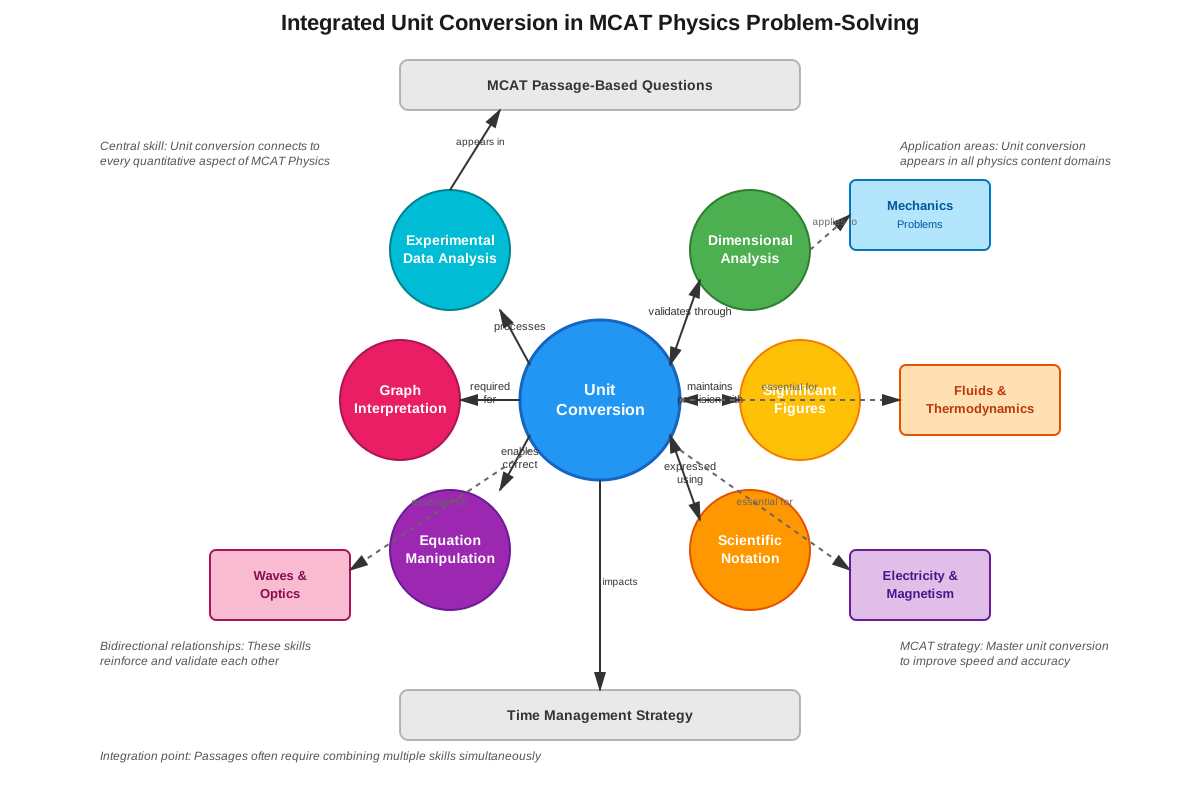
Within the broader context of Math and Units in Physics, unit conversion serves as the foundation for problem-solving across mechanics, electricity and magnetism, fluids, thermodynamics, and waves. Every equation in physics carries dimensional information, and the ability to manipulate units correctly ensures that students can combine equations, solve for unknowns, and verify their work. This topic connects directly to scientific notation, significant figures, dimensional analysis, and the interpretation of graphs and data tables—all high-yield skills for MCAT success.
Learning Objectives
- [ ] Define unit conversion using accurate Physics terminology
- [ ] Explain why unit conversion matters for the MCAT
- [ ] Apply unit conversion to exam-style questions
- [ ] Identify common mistakes related to unit conversion
- [ ] Connect unit conversion to related Physics concepts
- [ ] Execute multi-step unit conversions involving derived units (e.g., converting kg·m²/s² to other energy units)
- [ ] Use dimensional analysis to verify the correctness of physics equations and solutions
- [ ] Convert between metric prefixes with confidence and speed (nano-, micro-, milli-, centi-, kilo-, mega-, etc.)
Prerequisites
- Basic algebra and fraction manipulation: Essential for setting up conversion factors as multiplicative fractions and canceling units
- Understanding of the metric system: The MCAT predominantly uses SI units, requiring familiarity with base units (meter, kilogram, second, ampere, kelvin, mole)
- Scientific notation: Unit conversions often involve very large or very small numbers that must be expressed in powers of ten
- Concept of physical quantities: Recognition that measurements consist of both numerical values and units that describe what is being measured
Why This Topic Matters
In clinical practice, unit conversion errors represent a significant source of medical mistakes, particularly in medication dosing where conversions between milligrams, micrograms, milliliters, and units can mean the difference between therapeutic and toxic doses. Physicians must routinely convert between different measurement systems (e.g., pounds to kilograms for weight-based dosing, mmHg to kPa for pressure measurements) and interpret laboratory values reported in various units.
On the MCAT, unit conversion appears in approximately 15-20% of physics questions and is embedded in many chemistry and biochemistry problems. The exam tests this skill through standalone discrete questions, but more commonly integrates it into passage-based questions where students must extract data from tables or graphs, perform calculations, and select answers in specified units. The AAMC deliberately includes answer choices that represent common unit conversion errors, making this a high-yield area for avoiding careless mistakes.
Common MCAT scenarios involving unit conversion include: calculating kinetic energy from velocity given in km/h rather than m/s; determining fluid flow rates when pressure is given in mmHg or atm rather than Pascals; analyzing electrical circuits where current might be expressed in milliamperes; and interpreting experimental data where concentrations appear in various molarity-related units. Passages frequently present mixed unit systems to test whether students recognize the need for conversion before applying equations.
Core Concepts
Definition and Fundamental Principle
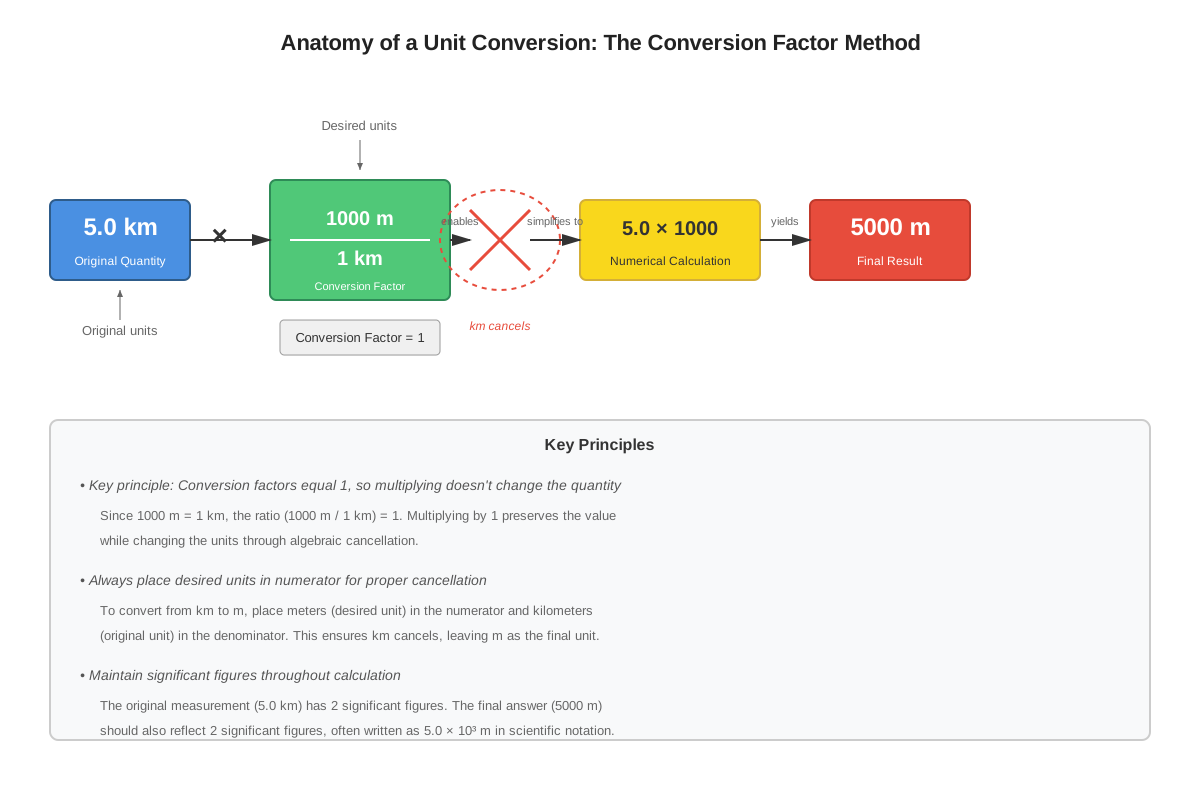
Unit conversion is the process of expressing a physical quantity in different units while maintaining its actual magnitude. The fundamental principle underlying all unit conversions is the multiplication by unity: any quantity can be multiplied by 1 without changing its value, and conversion factors are carefully constructed ratios that equal 1.
A conversion factor is a fraction expressing the equivalence between two different units. For example, since 1 meter equals 100 centimeters, both (1 m / 100 cm) and (100 cm / 1 m) equal unity. The strategic selection of which form to use depends on which units need to cancel. This approach ensures dimensional consistency—the requirement that both sides of any equation must have the same units.
The Conversion Factor Method
The systematic approach to unit conversion Physics problems involves:
- Identify the starting quantity with its current units
- Identify the target units required for the answer
- Determine the conversion relationship between units (memorized or provided)
- Construct conversion factors as fractions equal to 1
- Arrange conversion factors so unwanted units cancel
- Multiply through and simplify
- Verify dimensional correctness of the final answer
For example, converting 45 km/h to m/s:
45 km/h × (1000 m / 1 km) × (1 h / 3600 s) = 45 × 1000 / 3600 m/s = 12.5 m/sNotice how "km" cancels with "km" and "h" cancels with "h", leaving only m/s.
Metric Prefixes and Powers of Ten
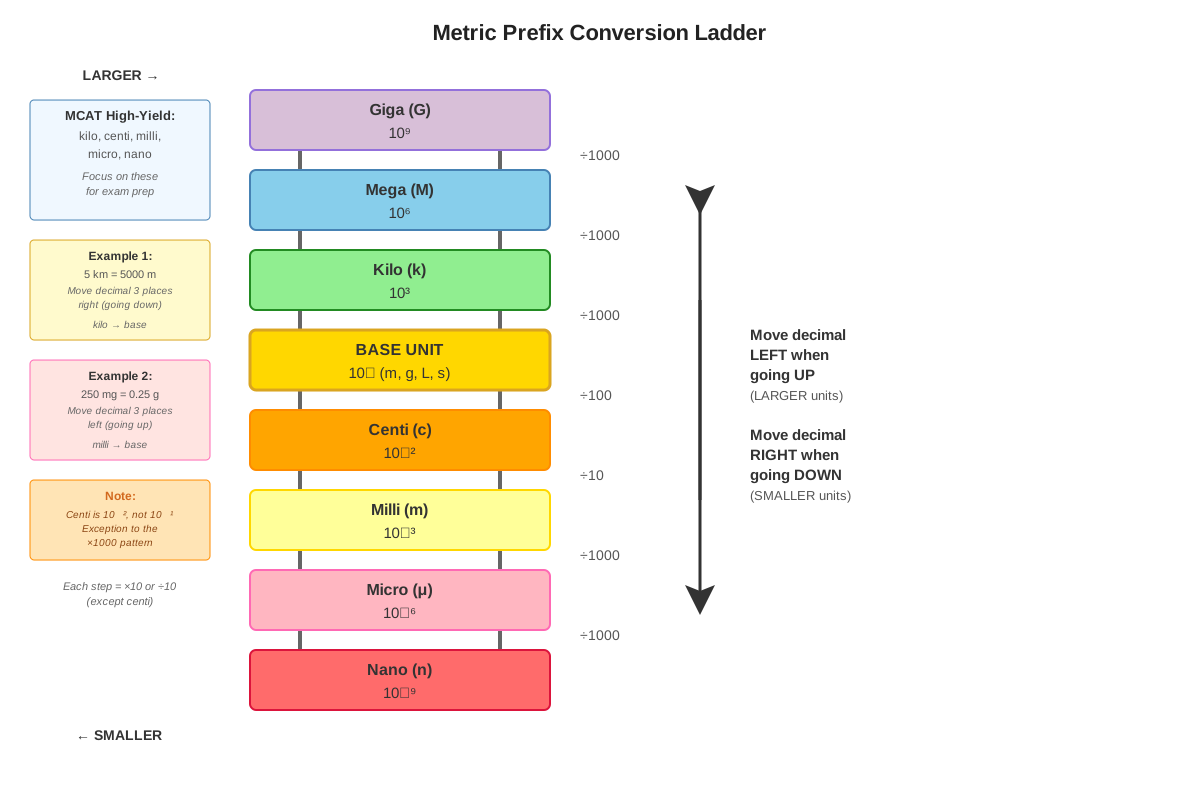
The metric system uses prefixes to denote powers of ten, which is particularly important for MCAT calculations. The most commonly tested prefixes include:
| Prefix | Symbol | Power of 10 | Decimal |
|---|---|---|---|
| nano- | n | 10⁻⁹ | 0.000000001 |
| micro- | μ | 10⁻⁶ | 0.000001 |
| milli- | m | 10⁻³ | 0.001 |
| centi- | c | 10⁻² | 0.01 |
| deci- | d | 10⁻¹ | 0.1 |
| kilo- | k | 10³ | 1,000 |
| mega- | M | 10⁶ | 1,000,000 |
| giga- | G | 10⁹ | 1,000,000,000 |
Converting between metric prefixes requires understanding that moving "up" the prefix scale (toward larger prefixes) means the numerical value decreases, while moving "down" means the numerical value increases. For instance, 5000 milligrams equals 5 grams (fewer grams because grams are larger units).
SI Base Units and Derived Units
The International System of Units (SI) defines seven base units, of which the MCAT most frequently tests:
- Length: meter (m)
- Mass: kilogram (kg)
- Time: second (s)
- Electric current: ampere (A)
- Temperature: kelvin (K)
- Amount of substance: mole (mol)
Derived units are combinations of base units. Understanding their dimensional composition is crucial for unit conversion MCAT problems:
- Force: newton (N) = kg·m/s²
- Energy/Work: joule (J) = kg·m²/s² = N·m
- Power: watt (W) = J/s = kg·m²/s³
- Pressure: pascal (Pa) = N/m² = kg/(m·s²)
- Frequency: hertz (Hz) = 1/s = s⁻¹
- Charge: coulomb (C) = A·s
- Voltage: volt (V) = J/C = kg·m²/(A·s³)
Non-SI Units Common on the MCAT
Several non-SI units appear regularly on the exam and require memorized conversion factors:
Energy units:
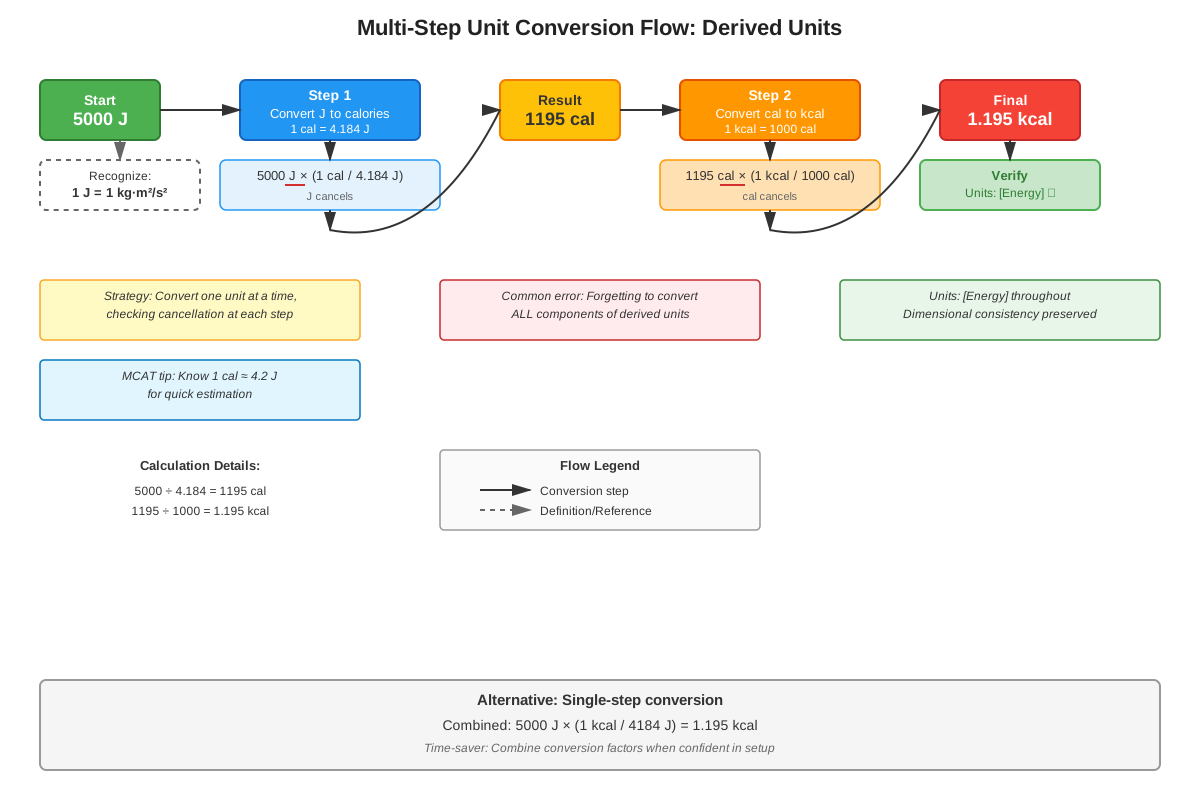
- 1 calorie (cal) = 4.184 joules (J)
- 1 Calorie (dietary, Cal) = 1 kilocalorie (kcal) = 4184 J
- 1 electron volt (eV) = 1.6 × 10⁻¹⁹ J
Pressure units:
- 1 atmosphere (atm) = 101,325 Pa ≈ 1.01 × 10⁵ Pa
- 1 atm = 760 mmHg = 760 torr
- 1 bar = 10⁵ Pa
Volume units:
- 1 liter (L) = 1000 mL = 1000 cm³ = 10⁻³ m³
Temperature conversions:
- K = °C + 273.15 (often approximated as 273)
- °F = (9/5)°C + 32
Dimensional Analysis as a Problem-Solving Tool
Dimensional analysis extends beyond simple unit conversion to serve as a powerful verification method. By tracking units through complex calculations, students can:
- Verify that equations are dimensionally consistent
- Identify errors in problem setup before completing calculations
- Determine the form of unknown relationships between variables
- Check whether a final numerical answer is reasonable
For example, if calculating velocity and obtaining an answer with units of m/s², dimensional analysis immediately reveals an error—velocity must have units of m/s.
Complex Multi-Step Conversions
Many MCAT problems require converting derived units through multiple steps. The key strategy is to break down derived units into their base unit components, convert each component separately, then recombine.
Example: Converting 50 J to kg·cm²/s²
50 J × (1 kg·m²/s² / 1 J) × (100 cm / 1 m)² = 50 × 10,000 kg·cm²/s² = 5 × 10⁵ kg·cm²/s²Notice the exponent on the conversion factor (100 cm / 1 m)² because the meters are squared in the original unit.
Unit Conversion in Rate and Ratio Problems
Rates (quantities per unit time) and ratios require special attention because conversions affect numerators and denominators differently. When converting a rate like 60 miles per hour to meters per second, both the distance unit AND the time unit must be converted:
60 mi/h × (1609 m / 1 mi) × (1 h / 3600 s) ≈ 26.8 m/sConcentration units (moles per liter, grams per milliliter) follow the same principle—both numerator and denominator may require conversion.
Concept Relationships
Unit conversion serves as the mathematical foundation that enables all quantitative problem-solving in physics. The relationship flows as follows:
Physical Quantities → require → Units of Measurement → necessitate → Unit Conversion → enables → Equation Application → produces → Numerical Solutions
Within the topic itself, the concepts build hierarchically:
Conversion Factor Method (fundamental technique) → enables → Metric Prefix Conversions (simplest applications) → extends to → SI and Non-SI Conversions (moderate complexity) → generalizes to → Derived Unit Conversions (highest complexity) → supports → Dimensional Analysis (verification and problem-solving strategy)
Unit conversion connects backward to prerequisite topics: algebra provides the mathematical manipulation skills, scientific notation handles the large and small numbers that result from conversions, and understanding of physical quantities ensures meaningful application rather than mechanical calculation.
Forward connections include virtually every physics topic: kinematics requires converting velocities and accelerations, dynamics involves force unit conversions, energy problems frequently require converting between joules and calories, fluids demand pressure unit conversions, electricity uses various charge and current units, and thermodynamics requires temperature scale conversions.
The relationship to Math and Units as a broader category is that unit conversion represents the practical application of dimensional reasoning—it's where abstract unit definitions become concrete problem-solving tools.
High-Yield Facts
⭐ The conversion factor method preserves quantity magnitude by multiplying by ratios equal to unity
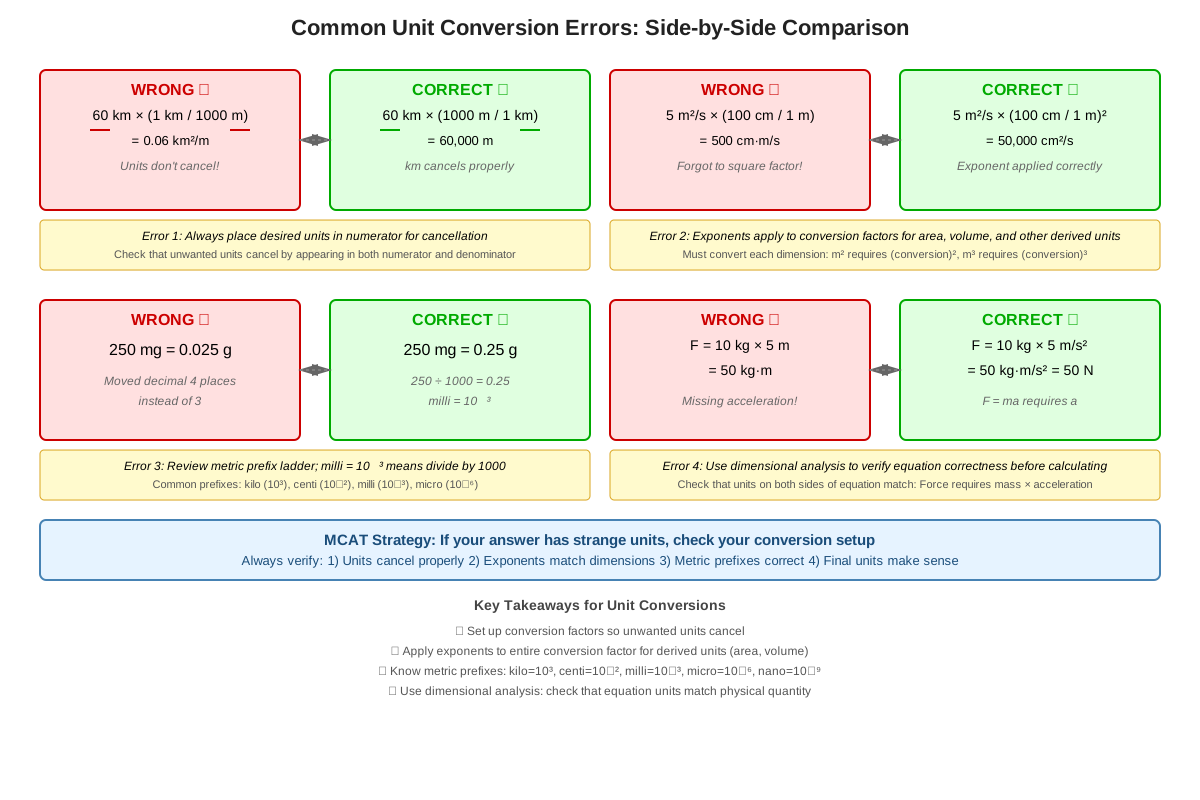
⭐ When converting derived units, exponents apply to the entire conversion factor (e.g., converting m² to cm² requires multiplying by (100)² = 10,000, not just 100)
⭐ 1 atm = 760 mmHg = 101,325 Pa ≈ 1.01 × 10⁵ Pa (pressure conversions appear in fluids and gas law problems)
⭐ 1 calorie = 4.184 J; 1 dietary Calorie = 1 kcal = 4184 J (energy conversions in metabolism and thermodynamics)
⭐ To convert km/h to m/s, multiply by 5/18 or divide by 3.6 (quick shortcut for velocity conversions)
- Metric prefix conversions involve moving the decimal point: each prefix step represents a factor of 10³ for the major prefixes (milli-, base, kilo-, mega-)
- Temperature conversions between Celsius and Kelvin add/subtract 273: K = °C + 273 (never multiply or divide for this conversion)
- 1 liter = 1000 cm³ = 10⁻³ m³: volume conversions connect to concentration calculations in chemistry
- Dimensional analysis can identify incorrect equations: if both sides don't have matching units, the equation is wrong
- Newton (N) = kg·m/s²; Joule (J) = N·m = kg·m²/s²; Watt (W) = J/s: these derived unit relationships enable complex conversions
- When converting rates, both numerator and denominator units may need conversion: don't forget to convert the "per" unit
- 1 eV = 1.6 × 10⁻¹⁹ J: electron volt conversions appear in atomic and nuclear physics
- Pressure conversions: 1 mmHg = 1 torr; 1 bar = 10⁵ Pa (bars are close to but not equal to atmospheres)
Quick check — test yourself on Unit conversion so far.
Try Flashcards →Common Misconceptions
Misconception: Metric prefix conversions always involve multiplying by powers of 10.
Correction: While the conversion factors are powers of 10, the direction matters. Converting from smaller to larger units (e.g., millimeters to meters) requires dividing by the power of 10 (or multiplying by 10⁻³), not multiplying. The numerical value decreases when converting to larger units.
Misconception: When converting squared or cubed units, the conversion factor is applied once.
Correction: Exponents apply to the entire conversion factor. Converting m² to cm² requires multiplying by (100 cm/1 m)² = 10,000, not just 100. Similarly, m³ to cm³ requires multiplying by (100)³ = 1,000,000. This is one of the most common sources of order-of-magnitude errors.
Misconception: Temperature conversions between Celsius and Kelvin use multiplication.
Correction: The Celsius and Kelvin scales have the same degree size but different zero points. Conversion requires addition or subtraction (K = °C + 273), never multiplication or division. Multiplication is only used for Celsius-Fahrenheit conversions.
Misconception: A dietary Calorie (capital C) is the same as a calorie (lowercase c).
Correction: A dietary Calorie (Cal) equals 1000 calories (cal), or 1 kilocalorie (kcal). This distinction is critical in metabolism and thermodynamics problems. 1 Cal = 1 kcal = 4184 J, while 1 cal = 4.184 J.
Misconception: Unit conversion is only necessary when the problem explicitly asks for a different unit.
Correction: Many MCAT problems require implicit unit conversion because equations require specific units to work correctly. For example, kinetic energy (KE = ½mv²) requires mass in kg and velocity in m/s to yield energy in joules. If velocity is given in km/h, conversion is necessary even if not explicitly requested.
Misconception: All conversion factors must be memorized.
Correction: While some conversions should be memorized for speed (metric prefixes, atm to Pa, calories to joules), many can be derived from basic relationships or will be provided in passage text. The MCAT tests the ability to use conversion factors correctly more than the ability to recall obscure conversions.
Misconception: Dimensional analysis is too time-consuming for the MCAT.
Correction: Quick dimensional checks (verifying units make sense) take only seconds and prevent costly errors. Full dimensional analysis for complex problems is time-consuming, but abbreviated checks should be routine for every calculation.
Worked Examples
Example 1: Multi-Step Velocity Conversion
Problem: A car travels at 108 km/h. What is this velocity in m/s?
Solution:
Step 1: Identify starting units (km/h) and target units (m/s).
Step 2: Set up conversion factors for distance (km to m) and time (h to s):
- 1 km = 1000 m, so (1000 m / 1 km) is our distance conversion factor
- 1 h = 3600 s, so (1 h / 3600 s) is our time conversion factor
Step 3: Arrange factors so unwanted units cancel:
108 km/h × (1000 m / 1 km) × (1 h / 3600 s)Step 4: Cancel units and calculate:
- km cancels with km
- h cancels with h
- Remaining units: m/s
108 × 1000 / 3600 m/s = 108,000 / 3600 m/s = 30 m/sVerification: The numerical value decreased (108 → 30) which makes sense because meters are smaller than kilometers and seconds are smaller than hours, so we need fewer of the larger unit combination (m/s) to represent the same speed.
MCAT Connection: This conversion appears in kinematics problems where velocities might be given in km/h but equations require m/s. The shortcut (divide by 3.6 or multiply by 5/18) gives the same result: 108 ÷ 3.6 = 30 m/s.
Example 2: Derived Unit Conversion with Exponents
Problem: The kinetic energy of a particle is 2.5 × 10⁴ kg·mm²/s². Express this in joules (J).
Solution:
Step 1: Recall that 1 J = 1 kg·m²/s². We need to convert mm² to m².
Step 2: Identify the conversion: 1 m = 1000 mm, so 1 mm = 10⁻³ m.
Step 3: Critical step: Since we're converting mm², we need (10⁻³ m / 1 mm)²:
2.5 × 10⁴ kg·mm²/s² × (10⁻³ m / 1 mm)²Step 4: Apply the exponent to the entire conversion factor:
2.5 × 10⁴ kg·mm²/s² × (10⁻³)² m²/mm²
= 2.5 × 10⁴ kg·mm²/s² × 10⁻⁶ m²/mm²
Step 5: Cancel mm² and combine powers of 10:
2.5 × 10⁴ × 10⁻⁶ kg·m²/s² = 2.5 × 10⁻² kg·m²/s² = 0.025 JVerification: The numerical value decreased dramatically (25,000 → 0.025) because millimeters are much smaller than meters, and when squared, the effect is magnified. This is dimensionally correct: kg·m²/s² = J.
MCAT Connection: This type of problem tests whether students correctly apply exponents to conversion factors. Answer choices often include 2.5 × 10² J (forgot to square the conversion factor) or 2.5 × 10¹ J (only applied the exponent to the power of 10, not the base number).
Example 3: Pressure Conversion in a Fluids Problem
Problem: A diver experiences a pressure of 3.5 atm at a certain depth. Express this pressure in Pascals (Pa).
Solution:
Step 1: Recall the conversion: 1 atm = 101,325 Pa ≈ 1.01 × 10⁵ Pa (the approximation is acceptable for MCAT calculations).
Step 2: Set up the conversion factor:
3.5 atm × (1.01 × 10⁵ Pa / 1 atm)Step 3: Cancel atm and calculate:
3.5 × 1.01 × 10⁵ Pa ≈ 3.5 × 10⁵ Pa = 3.5 × 10⁵ Pa(For more precision: 3.5 × 1.01 = 3.535, but 3.5 × 10⁵ Pa is sufficient for most MCAT purposes)
Alternative approach using mmHg:
If the problem involved mmHg instead:
3.5 atm × (760 mmHg / 1 atm) = 2660 mmHgThen convert to Pa:
2660 mmHg × (1 atm / 760 mmHg) × (1.01 × 10⁵ Pa / 1 atm) ≈ 3.5 × 10⁵ PaMCAT Connection: Pressure conversions appear in fluid statics, Bernoulli's equation, and gas law problems. The MCAT may provide the conversion factor or expect it to be memorized. Recognizing that 1 atm ≈ 10⁵ Pa allows for quick order-of-magnitude estimates.
Exam Strategy
When approaching unit conversion MCAT questions, employ these strategic approaches:
Immediate Recognition: Scan the problem for mismatched units between given data and required answer format. If velocity is given in km/h but the answer choices are in m/s, unit conversion is necessary before applying any equations.
Trigger Words: Watch for phrases like "express in terms of," "convert to," "what is the equivalent," or answer choices with different units than the given data. These explicitly signal unit conversion requirements.
Implicit Conversions: Many problems don't explicitly ask for conversion but require it for equations to work. If using F = ma and mass is given in grams, convert to kilograms before calculating. If using kinetic energy equations and velocity is in km/h, convert to m/s first.
Answer Choice Analysis: MCAT answer choices often include common conversion errors:
- Forgot to convert (original number with wrong units)
- Converted in the wrong direction (multiplied when should have divided)
- Forgot to apply exponents to conversion factors (off by powers of 10)
- Converted only one component of a rate or ratio
Use process of elimination by checking dimensional correctness and order of magnitude before detailed calculation.
Time Management: For straightforward conversions, spend 30-45 seconds. For complex multi-step conversions embedded in larger problems, allocate 60-90 seconds for the conversion portion. If a conversion seems excessively complicated, check whether the passage provides the conversion factor or whether there's a simpler approach.
Dimensional Analysis as a Check: After obtaining a numerical answer, perform a quick dimensional check. Do the units make sense for what's being asked? If calculating power and getting units of J/s, that's correct (W = J/s). If getting J·s, there's an error.
Metric Prefix Speed: Memorize the major metric prefixes and practice rapid conversions. Being able to instantly recognize that 5000 mg = 5 g or that 2.5 μm = 2.5 × 10⁻⁶ m saves valuable time.
Strategic Approximation: For complex conversions, use approximations when appropriate. 1 atm ≈ 10⁵ Pa (not 101,325 Pa) is sufficient for most calculations. 1 cal ≈ 4 J (not 4.184 J) works for order-of-magnitude estimates.
Exam Tip: If stuck on a complex unit conversion, work backward from the answer choices. Determine what conversion would transform the given value into each answer choice, then assess which conversion makes physical sense.
Memory Techniques
Metric Prefix Mnemonic (from smallest to largest):
"Nano Mice Might Consume King-sized Meals Gladly"
- Nano (10⁻⁹), Micro (10⁻⁶), Milli (10⁻³), Centi (10⁻² - less common), base unit, Kilo (10³), Mega (10⁶), Giga (10⁹)
Pressure Conversion Anchor: "Seven-Six-Oh at sea level"
- 1 atm = 760 mmHg = 760 torr
- Also remember: 1 atm ≈ 10⁵ Pa (think "atmosphere is about 100,000 Pascals")
Energy Conversion: "Four-One-Eight-Four for food"
- 1 cal = 4.184 J (often approximated as 4 J)
- 1 Cal (dietary) = 1 kcal = 4184 J
- Remember: Capital C = 1000 lowercase c
Velocity Quick Conversion: "Divide by 3.6" or "Five-Eighteenths"
- km/h to m/s: divide by 3.6 (or multiply by 5/18)
- m/s to km/h: multiply by 3.6 (or multiply by 18/5)
- Example: 36 km/h ÷ 3.6 = 10 m/s
Temperature Conversion Visualization: Picture a thermometer with three scales:
- Water freezes: 0°C = 273 K = 32°F
- Water boils: 100°C = 373 K = 212°F
- Body temperature: 37°C = 310 K = 98.6°F
- Remember: K = °C + 273 (just add, never multiply)
Derived Unit Breakdown: "Never Just Walk Past Volts"
- Newton = kg·m/s²
- Joule = N·m = kg·m²/s²
- Watt = J/s = kg·m²/s³
- Pascal = N/m² = kg/(m·s²)
- Volt = J/C = kg·m²/(A·s³)
Exponent Rule Reminder: "Square the whole thing"
- When converting area (m² to cm²), square the entire conversion factor: (100)² = 10,000
- When converting volume (m³ to cm³), cube it: (100)³ = 1,000,000
- Visualize: 1 m × 1 m = 100 cm × 100 cm, so 1 m² = 10,000 cm²
Summary
Unit conversion is the essential mathematical skill that enables accurate quantitative problem-solving across all MCAT science sections. The fundamental principle—multiplying by conversion factors equal to unity—preserves physical quantities while transforming their units. Mastery requires understanding metric prefixes (nano- through giga-), memorizing key conversions (pressure, energy, temperature), and correctly applying exponents when converting derived units. The conversion factor method provides a systematic approach: identify starting and target units, construct appropriate conversion factors, arrange them for unit cancellation, and verify dimensional correctness. Common pitfalls include forgetting to square or cube conversion factors for area and volume, confusing dietary Calories with calories, and neglecting implicit conversions required by physics equations. Dimensional analysis serves both as a conversion technique and a powerful verification tool. For MCAT success, students must execute conversions rapidly and accurately, recognize when conversions are needed even when not explicitly requested, and use unit analysis to eliminate incorrect answer choices. This foundational skill connects to every quantitative physics topic and frequently determines whether students can successfully navigate multi-step problems within time constraints.
Key Takeaways
- Unit conversion preserves physical quantity magnitude by multiplying by ratios equal to one, constructed from equivalent expressions of the same measurement
- Exponents apply to entire conversion factors: converting m² to cm² requires multiplying by (100)² = 10,000, not just 100—this is the most common source of order-of-magnitude errors
- Memorize high-yield conversions: 1 atm = 760 mmHg ≈ 10⁵ Pa; 1 cal = 4.184 J; 1 Cal = 1 kcal = 4184 J; km/h to m/s (divide by 3.6); K = °C + 273
- Dimensional analysis serves dual purposes: executing conversions and verifying equation correctness—if units don't match on both sides of an equation, there's an error
- Many MCAT problems require implicit unit conversion: even when not explicitly requested, equations demand specific units (e.g., SI base units for most physics formulas)
- Answer choices often include common conversion errors: use process of elimination by checking dimensional correctness and order of magnitude before detailed calculation
- Metric prefix conversions follow predictable patterns: each major prefix step (milli-, base, kilo-, mega-) represents a factor of 10³, and numerical values move inversely to unit size
Related Topics
Dimensional Analysis: Extends unit conversion principles to verify equation correctness, determine relationships between variables, and solve problems where equations aren't immediately known. Mastering unit conversion provides the foundation for advanced dimensional reasoning.
Scientific Notation and Significant Figures: Unit conversions frequently produce very large or small numbers requiring scientific notation, and the precision of converted values depends on significant figure rules. These topics work together in quantitative problem-solving.
Kinematics and Dynamics: Virtually every mechanics problem requires unit conversions—velocities given in km/h must be converted to m/s, forces may need conversion between newtons and dynes, and energy calculations require consistent units throughout.
Fluid Mechanics: Pressure conversions (atm, mmHg, Pa) are essential for Bernoulli's equation, hydrostatic pressure calculations, and understanding physiological measurements like blood pressure.
Thermodynamics: Energy conversions between joules, calories, and Calories appear in heat transfer, calorimetry, and metabolism problems. Temperature scale conversions between Celsius and Kelvin are required for gas law calculations.
Electricity and Circuits: Current (amperes vs. milliamperes), charge (coulombs), voltage (volts), and resistance (ohms) problems often require unit conversions, particularly when dealing with physiological applications like nerve conduction.
Practice CTA
Now that you've mastered the principles and techniques of unit conversion, it's time to solidify your skills through active practice. Work through the practice questions to apply these concepts to MCAT-style problems, and use the flashcards to drill high-yield conversions until they become automatic. Remember: unit conversion errors are among the most preventable mistakes on the MCAT—consistent practice transforms this potential weakness into a reliable strength. Every conversion you execute correctly is a point earned and time saved for more challenging problems. Approach each practice problem systematically, verify your dimensional reasoning, and build the confidence that comes from mastery of this foundational skill.
Sign up free to keep reading
Create a free AnvayaPrep account to finish this MCAT guide on Unit conversion — plus flashcards and practice questions.